Newsletter Subscribe
Enter your email address below and subscribe to our newsletter

HVAC made simple
By Jake Lawson | HVAC Specialist | The Furnace Outlet
Updated October 2026 | Indoor Air Quality & Seasonal Allergy Guide
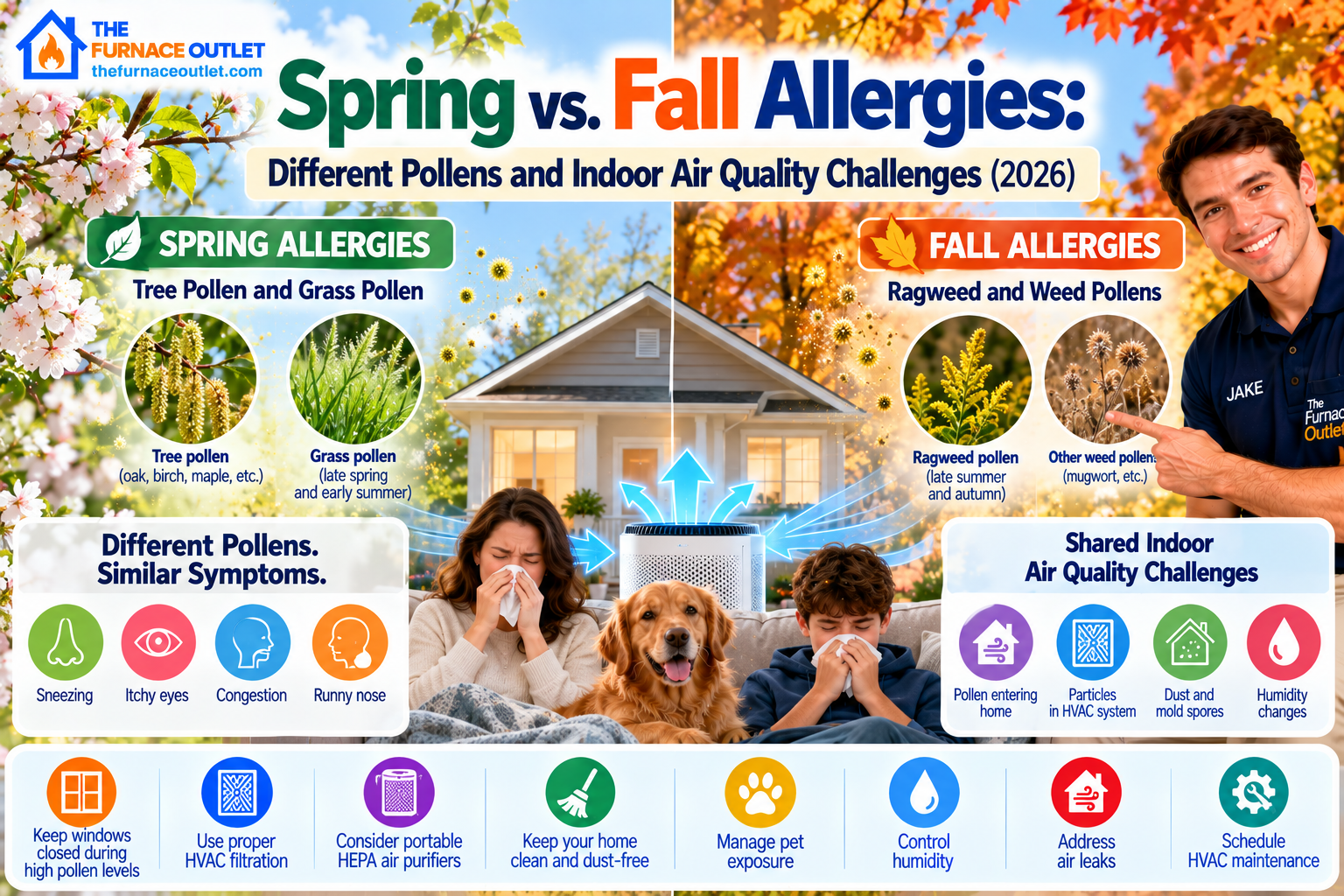
Spring and fall are two of the most challenging seasons for homeowners who experience pollen allergies. Although sneezing, nasal congestion, itchy eyes, and other symptoms may feel similar during both seasons, the environmental triggers responsible for those symptoms can be quite different. Spring is commonly associated with tree pollen and, later, grass pollen, while fall brings increased exposure to ragweed and other weed pollens across many parts of the United States. Seasonal changes in humidity, ventilation, outdoor activities, and HVAC operation can further influence indoor allergen exposure.
As an HVAC specialist with more than 10 years of experience, I often explain that controlling seasonal allergens requires understanding how outdoor particles enter the home and what happens after they arrive. Your heating and cooling system can help capture certain airborne particles, but filtration alone cannot eliminate allergens that accumulate in bedding, carpeting, upholstery, or other household materials. Building air leaks, cleaning practices, ventilation arrangements, and moisture conditions are equally important considerations.
In this guide, I will compare spring and fall allergy triggers, explain how pollen exposure changes throughout the year, and discuss practical indoor air quality improvements for each season. My objective is to help homeowners make informed decisions about HVAC filtration, portable air purifiers, ventilation, humidity control, and household maintenance without assuming that every allergy problem requires expensive equipment.

The most important distinction between spring and fall allergies is the type of pollen commonly present in the outdoor environment. During spring, many trees release airborne pollen as temperatures rise and vegetation begins its growing season. Depending on the region, oak, birch, maple, cedar, and other tree species may contribute to seasonal exposure. Grass pollen becomes more important during late spring and early summer in many locations.
Fall allergies are more strongly associated with ragweed and other weed pollens. Ragweed is particularly significant because it releases lightweight pollen that wind can carry over considerable distances. Homeowners may therefore experience symptoms even when there are no obvious ragweed plants near their properties.
However, pollen is not the only seasonal concern. Mold spores, household dust, pet allergens, and indoor irritants can contribute to respiratory discomfort throughout the year. Spring rainfall and damp conditions may encourage certain outdoor mold exposures, while fall leaves and decaying vegetation can create additional opportunities for mold spores to become airborne.
The American College of Allergy, Asthma & Immunology provides useful information about seasonal allergies and the importance of identifying individual triggers. From an HVAC perspective, understanding those triggers helps homeowners select appropriate exposure-reduction measures rather than relying on one product to solve every indoor air quality concern.
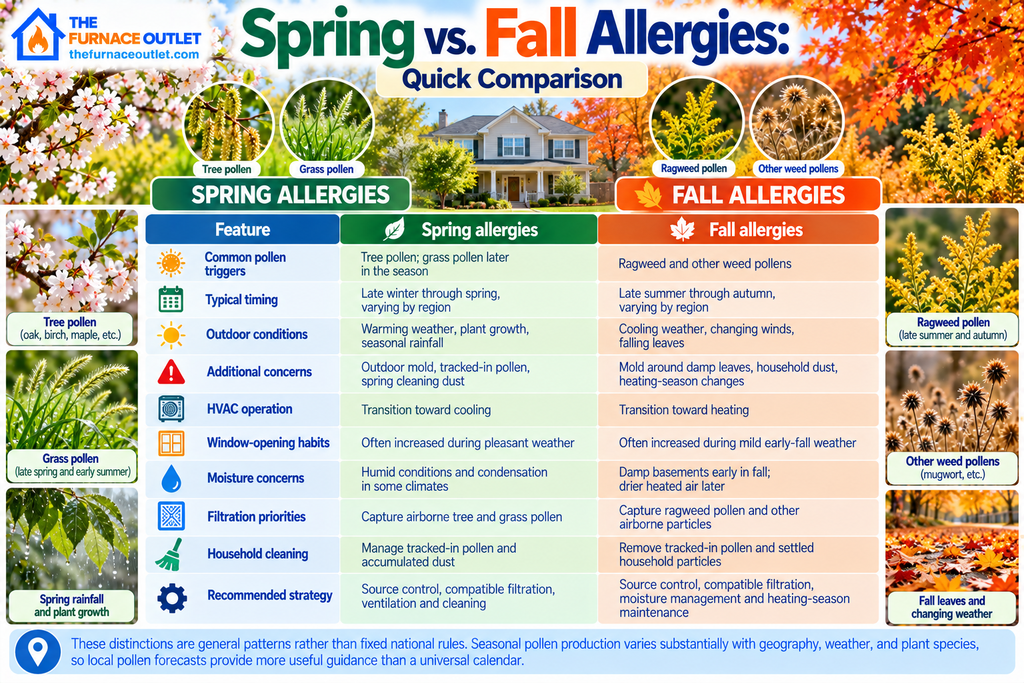
| Feature | Spring allergies | Fall allergies |
|---|---|---|
| Common pollen triggers | Tree pollen; grass pollen later in the season | Ragweed and other weed pollens |
| Typical timing | Late winter through spring, varying by region | Late summer through autumn, varying by region |
| Outdoor conditions | Warming weather, plant growth, seasonal rainfall | Cooling weather, changing winds, falling leaves |
| Additional concerns | Outdoor mold, tracked-in pollen, spring cleaning dust | Mold around damp leaves, household dust, heating-season changes |
| HVAC operation | Transition toward cooling | Transition toward heating |
| Window-opening habits | Often increased during pleasant weather | Often increased during mild early-fall weather |
| Moisture concerns | Humid conditions and condensation in some climates | Damp basements early in fall; drier heated air later |
| Filtration priorities | Capture airborne tree and grass pollen | Capture ragweed pollen and other airborne particles |
| Household cleaning | Manage tracked-in pollen and accumulated dust | Remove tracked-in pollen and settled household particles |
| Recommended strategy | Source control, compatible filtration, ventilation and cleaning | Source control, compatible filtration, moisture management and heating-season maintenance |
These distinctions are general patterns rather than fixed national rules. Seasonal pollen production varies substantially with geography, weather, and plant species, so local pollen forecasts provide more useful guidance than a universal calendar.
Tree pollen is one of the most recognizable causes of spring allergies in the United States. As trees begin reproductive activity, certain species release large quantities of pollen into the atmosphere. Wind-pollinated trees can contribute substantial airborne pollen concentrations, particularly during favorable weather conditions.
Homeowners may notice pollen accumulating on vehicles, outdoor furniture, and windowsills during spring. However, visible yellow deposits do not necessarily represent every allergenic pollen species present in the air. Many relevant pollen grains are too small to identify individually without specialized equipment.
Pollen can enter homes through open windows, exterior doors, ventilation pathways, and uncontrolled air leakage. Family members may also carry it indoors on clothing, shoes, and hair. Once deposited on household surfaces, some material can become airborne again when disturbed by normal activities.
My preferred spring strategy begins with monitoring local pollen conditions and limiting unnecessary entry during elevated exposure periods. Keeping windows closed when outdoor pollen is high, maintaining appropriate HVAC filtration, and cleaning frequently occupied rooms can help reduce indoor particle accumulation.
Ragweed is a major fall allergy trigger across much of the United States, although the severity and timing of exposure vary by location. In many regions, ragweed pollen becomes prominent during late summer and continues into autumn until sufficiently cold conditions reduce pollen production.
Unlike many flowering plants that rely on insects for pollination, ragweed releases pollen into the surrounding air. Wind can carry those particles beyond the immediate growing area, making exposure possible even in neighborhoods without visible ragweed vegetation.
Fall pollen can enter homes through the same pathways as spring pollen, including open windows, doorways, building air leaks, and outdoor clothing. Pets that spend time in gardens or grassy areas may also carry environmental particles indoors.
For fall allergy prevention, I recommend combining outdoor pollen awareness with consistent indoor cleaning. Changing clothes after outdoor activities, removing shoes near entrances, and keeping bedrooms clean can reduce pollen transfer. Properly maintained HVAC filtration and suitable portable air purifiers may provide additional particle removal.
For more detailed guidance, read our related article, Ragweed Allergy Season: How to Keep Pollen Out of Your Home (2026).
Although the dominant pollen types differ, seasonal allergies often produce similar symptoms because the body’s immune response to particular allergens can involve comparable inflammatory processes. Sneezing, nasal congestion, watery eyes, itching, and other symptoms may occur during either season.
However, symptoms alone cannot reliably identify the responsible allergen. A person experiencing discomfort in April may be reacting to tree pollen, while someone with similar symptoms in September may be sensitive to ragweed. Another individual may have year-round dust mite or pet allergies that become more noticeable during seasonal changes.
This distinction matters when deciding how to improve the home environment. Reducing pollen entry may help someone whose symptoms are primarily seasonal, but a household with significant dust mite exposure may also need to focus on bedding, cleaning, and moisture control.
I encourage homeowners to avoid assuming that every symptom originates from the HVAC system. Environmental improvements can reduce exposure to certain particles, but persistent or severe symptoms should be evaluated by a qualified healthcare professional. Allergy testing may help identify specific triggers when the cause remains unclear.
Many homeowners assume that keeping windows closed is sufficient to prevent outdoor pollen from entering their homes. Unfortunately, buildings are rarely completely airtight, and outdoor air can enter through small gaps around windows, doors, attic penetrations, and other construction details.
Wind, temperature differences, and pressure changes influence air movement through these openings. Exhaust fans, duct leakage, and certain ventilation arrangements can also affect how outdoor air enters occupied spaces.
Pollen transfer through everyday activities creates another challenge. Shoes, clothing, backpacks, pets, and outdoor equipment can introduce particles even when windows remain closed throughout the day.
The EPA’s indoor air quality resources explain how pollution sources, ventilation, and building conditions influence indoor environments. I recommend addressing obvious air leaks while maintaining appropriate ventilation, because eliminating uncontrolled infiltration should not mean eliminating necessary fresh-air exchange.

A properly operating HVAC system can help reduce certain airborne particles by circulating indoor air through a compatible filter. In a typical ducted installation, return air moves toward the air handler, passes through filtration, and is distributed back into the living space.
The effectiveness of this process depends on filter performance, airflow, installation quality, and how frequently air passes through the system. A high-efficiency filter cannot capture particles that never reach it, and gaps around the filter frame may allow some air to bypass the filtration material.
Seasonal operating patterns also matter. During spring and fall, mild outdoor temperatures may reduce heating and cooling demand. If the central system operates less frequently, the volume of air passing through its filter may also decrease.
This is one reason portable air purifiers can be useful in frequently occupied rooms. They operate independently of the central thermostat and may provide additional particle removal when heating or cooling equipment is not running regularly.
Residential HVAC filters are commonly evaluated using the Minimum Efficiency Reporting Value, or MERV. Higher MERV ratings generally indicate improved particle capture across relevant size ranges under standardized testing conditions.
MERV 8 filters are widely used for residential filtration and can capture many larger airborne particles. MERV 11 filters provide improved capture across additional particle sizes, while MERV 13 filters offer stronger performance for smaller particles under the applicable test conditions.
For homeowners concerned about pollen, MERV 13 can be a reasonable option when the HVAC system is designed or verified to accommodate it. However, filtration efficiency must be considered alongside airflow resistance, because an excessively restrictive filter can reduce equipment performance.
Filter thickness, surface area, construction, and installation quality all influence the result. I recommend reviewing manufacturer specifications or requesting professional airflow evaluation before making significant filtration upgrades.
The EPA’s Guide to Air Cleaners in the Home provides useful information about filtration and residential air-cleaning technologies.
Portable HEPA air purifiers can supplement central HVAC filtration during spring and fall, particularly in bedrooms and other frequently occupied spaces. A properly sized purifier can capture many airborne particles passing through its filter, including pollen and dust-associated material.
When selecting equipment, I recommend paying attention to Clean Air Delivery Rate, or CADR. This measurement helps indicate how quickly a device delivers cleaned air for particular particle categories. Room size, airflow, operating speed, and placement influence how effectively the purifier can reduce airborne particle concentrations.
A purifier positioned behind furniture or in a confined corner may not circulate air efficiently. Consistent operation can be more useful than running the device occasionally at maximum speed, although noise and electricity consumption should also be considered.
Portable purification cannot remove pollen already embedded in bedding or carpeting, nor can it prevent new particles from entering through open windows or clothing. It should complement cleaning, source reduction, and appropriate HVAC maintenance rather than replace them.
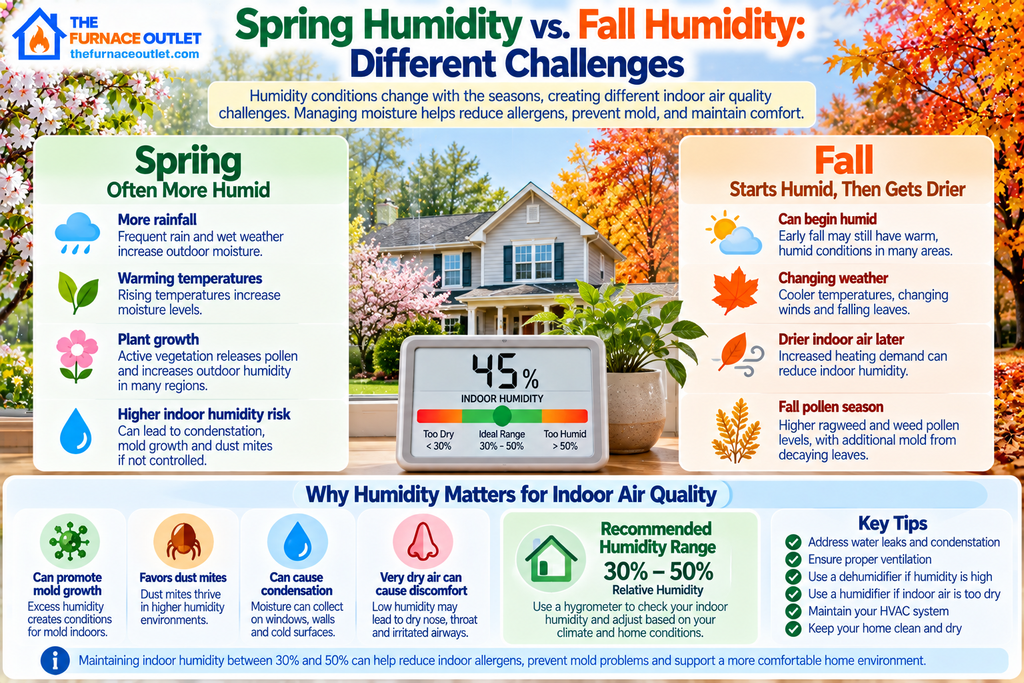
Humidity conditions can change considerably between spring and fall, depending on the region and local weather. Spring may bring rainfall, warming temperatures, and elevated moisture levels in some climates, while fall can begin humid and gradually transition toward drier indoor conditions as heating demand increases.
Excessive indoor humidity can contribute to condensation, mold growth, and conditions favorable to dust mites. Very dry indoor air may also create discomfort, although adding moisture is not automatically an effective allergy treatment.
Maintaining indoor relative humidity around 30% to 50% is a commonly recommended general target, with adjustments based on climate, building conditions, and condensation risk. A hygrometer can help homeowners understand actual moisture levels rather than relying entirely on how the air feels.
The EPA’s mold and moisture guidance emphasizes controlling moisture as an essential part of preventing indoor mold problems. I recommend addressing water leaks, condensation, and inadequate drainage before investing in equipment that merely masks musty odors.
Mold can contribute to indoor air quality problems during either season, particularly where moisture remains on susceptible materials. Spring rainfall, groundwater intrusion, and damp building conditions may support mold growth, while fall brings wet leaves, decaying vegetation, and changing indoor moisture patterns.
Outdoor mold spores may enter homes through ventilation pathways, doors, windows, and tracked-in materials. Indoor mold can develop around plumbing leaks, roof damage, condensation, and persistently damp areas such as basements or bathrooms.
Cleaning visible mold without correcting the moisture source may provide only temporary improvement. If water continues entering the building or condensation remains uncontrolled, contamination can recur.
I recommend investigating persistent musty odors, visible water damage, and recurring dampness rather than assuming that air filtration alone will solve the problem. Significant or hidden contamination may require professional assessment and appropriate remediation.

Spring cleaning is often associated with improving household hygiene, but certain cleaning activities can temporarily disturb accumulated dust and allergens. Moving furniture, shaking rugs, sweeping dry surfaces, and handling stored fabrics may release particles into the surrounding air.
For allergy-sensitive households, cleaning methods matter as much as cleaning frequency. Damp dusting can help collect particles instead of redistributing them, while vacuum cleaners with effective filtration may reduce the release of captured material.
Bedrooms, upholstered furniture, carpets, and other fabric-rich areas deserve attention because they can hold pollen, dust mite allergens, and pet-associated particles. Washing suitable bedding and cleaning nearby surfaces can help manage these reservoirs.
I recommend cleaning consistently throughout the year rather than waiting for one major seasonal cleaning session. Smaller, regular efforts can help prevent substantial accumulation and may be easier to maintain.
As outdoor temperatures decline, households begin operating furnaces and heat pumps more frequently. This changes indoor airflow patterns and may disturb particles already present around registers, furnishings, and other surfaces.
Some heating systems may produce a temporary odor during initial operation after a relatively inactive period. However, persistent musty smells, smoke, or burning electrical odors should not be dismissed as normal seasonal behavior.
The beginning of heating season also changes household ventilation habits. Windows may remain closed more frequently, while indoor humidity can decline in certain climates. These changes may influence comfort and the concentration of some indoor pollutants.
Before sustained heating begins, I recommend inspecting filters, cleaning accessible registers, checking airflow openings, and scheduling appropriate HVAC maintenance. The goal is to ensure reliable heating while reducing avoidable dust accumulation and identifying equipment problems early.
Keeping windows closed during elevated outdoor pollen conditions can help reduce direct pollen entry in both spring and fall. However, the decision should consider local pollen forecasts, outdoor air quality, weather, and the home’s ventilation requirements.
Opening windows during pleasant weather may provide useful natural ventilation when outdoor conditions are suitable. During high-pollen periods, however, it can introduce particles that accumulate on indoor surfaces and require subsequent cleaning.
Mechanical ventilation may provide more controlled outdoor air exchange, particularly when suitable filtration is incorporated. Heat recovery ventilators and energy recovery ventilators can also exchange indoor and outdoor air while recovering some heating or cooling energy, although suitability depends on climate and system design.
I recommend balancing ventilation with filtration and source control rather than assuming that permanently closing every opening will automatically produce healthier indoor air.

Continuous fan operation can increase the amount of indoor air passing through a properly installed HVAC filter, potentially improving airborne particle removal. However, it is not automatically the best operating strategy for every system.
Running the blower continuously may increase electricity consumption, while certain cooling configurations can experience humidity-related effects when the fan operates after active cooling ends. Duct leakage and filter compatibility can also influence performance.
Some modern systems offer circulation settings that operate the blower periodically rather than continuously. These modes may provide additional filtration without requiring full-time operation, although the benefits depend on equipment design.
My preferred approach is to verify filtration quality, airflow, and building conditions before changing fan settings. Reducing pollen entry and maintaining clean indoor surfaces remain important regardless of how frequently the blower operates.
Air duct cleaning is frequently advertised as a seasonal allergy solution, but routine cleaning is not necessary for every household. Dust can accumulate inside duct systems without necessarily being released into occupied rooms in significant quantities.
The EPA’s guidance on residential air duct cleaning identifies circumstances where cleaning may deserve consideration, including certain contamination problems, vermin infestation, or excessive debris entering living spaces.
Before recommending duct cleaning, I prefer to evaluate filter installation, duct leakage, moisture conditions, and overall HVAC performance. Cleaning ducts without correcting damaged return connections or persistent moisture problems may leave the underlying cause unresolved.
Homeowners should be cautious about contractors promising complete allergy elimination through routine duct cleaning. When cleaning is justified, appropriate procedures should be used to avoid damaging duct materials or spreading contamination.
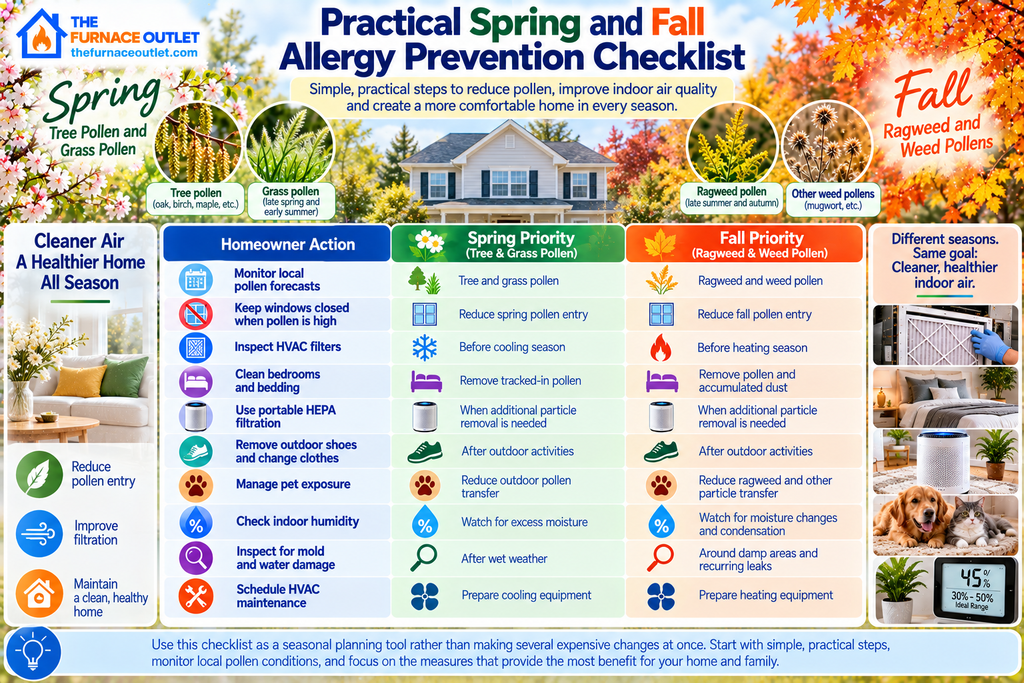
| Homeowner action | Spring priority | Fall priority |
|---|---|---|
| Monitor local pollen forecasts | Tree and grass pollen | Ragweed and weed pollen |
| Keep windows closed when pollen is high | Reduce spring pollen entry | Reduce fall pollen entry |
| Inspect HVAC filters | Before cooling season | Before heating season |
| Clean bedrooms and bedding | Remove tracked-in pollen | Remove pollen and accumulated dust |
| Use portable HEPA filtration | When additional particle removal is needed | When additional particle removal is needed |
| Remove outdoor shoes and change clothes | After outdoor activities | After outdoor activities |
| Manage pet exposure | Reduce outdoor pollen transfer | Reduce ragweed and other particle transfer |
| Check indoor humidity | Watch for excess moisture | Watch for moisture changes and condensation |
| Inspect for mold and water damage | After wet weather | Around damp areas and recurring leaks |
| Schedule HVAC maintenance | Prepare cooling equipment | Prepare heating equipment |
I recommend using this checklist as a seasonal planning tool rather than treating every item as an expensive project. Start with ordinary maintenance and practical exposure-reduction measures, then evaluate whether additional filtration or professional improvements are justified.
Neither season is universally worse. Severity depends on individual sensitivities, local pollen concentrations, weather conditions, and exposure patterns. Someone allergic to tree pollen may experience stronger spring symptoms, while a person sensitive to ragweed may struggle more during fall.
Spring pollen commonly comes from trees and, later, grasses in many regions. Fall pollen is more strongly associated with ragweed and other weeds. The exact timing and dominant species vary geographically.
Appropriately selected HVAC filters can capture airborne pollen particles that pass through the filtration system. Effectiveness depends on filter performance, proper installation, airflow, and operating conditions. Filtration cannot remove all allergens from household surfaces.
MERV 13 generally offers improved capture of smaller particles compared with lower-rated filters under standardized testing conditions. However, the HVAC system must be capable of maintaining acceptable airflow with the selected filter.
Yes. A properly sized HEPA purifier can capture many airborne particles passing through the device during either season. Its effectiveness depends on room size, clean-air delivery, placement, and consistent use.
Persistent symptoms may involve other triggers such as dust mites, mold, pet allergens, or indoor irritants. Some pollen may also remain on indoor surfaces after outdoor concentrations decline. A healthcare professional can help identify the underlying cause when symptoms persist.

When homeowners ask whether spring or fall allergies are more difficult to manage, I explain that the answer depends on the allergens involved and the conditions inside the home. Spring commonly brings tree and grass pollen, while fall introduces ragweed and other weed pollens across many regions. Both seasons can create similar indoor exposure problems when outdoor particles enter through doors, windows, air leaks, clothing, and pets.
My preferred strategy is to maintain a consistent indoor air quality foundation throughout the year. Compatible HVAC filtration, regular cleaning, appropriate ventilation, moisture control, and attention to building air leaks can all contribute to reduced particle exposure. Seasonal adjustments should focus on local pollen conditions, changes in HVAC operation, and the particular allergens affecting household occupants.
The best approach is not to treat spring and fall as completely separate indoor air quality problems, but to build a reliable year-round prevention strategy and adjust it as environmental conditions change. With practical maintenance and informed equipment choices, homeowners can support cleaner indoor air and more comfortable living conditions throughout both allergy seasons.
This article is provided by The Furnace Outlet for general educational purposes and does not constitute medical advice. Indoor air quality improvements may reduce exposure to certain allergens and airborne particles, but they do not diagnose, treat, or cure allergies, asthma, or other medical conditions. Individuals experiencing persistent, severe, or worsening symptoms should consult an appropriately qualified healthcare professional.
HVAC filtration upgrades, ventilation modifications, duct repairs, and equipment maintenance should follow manufacturer instructions and applicable safety requirements. Electrical work, refrigerant servicing, and internal HVAC repairs should be performed by qualified professionals.
The Furnace Outlet publishes independent educational content. References to government agencies and external resources are provided for informational purposes and do not imply sponsorship, affiliation, or endorsement.
© 2026 The Furnace Outlet. All rights reserved.