Newsletter Subscribe
Enter your email address below and subscribe to our newsletter

HVAC made simple

By Jake Lawson, HVAC Specialist | The Furnace Outlet
When homeowners compare heat pumps, most conversations begin with efficiency ratings. SEER2 gets attention because it tells us about cooling efficiency, while HSPF2 helps us compare seasonal heating efficiency. Those numbers are important, but there is another part of the heat pump that can have just as much influence on how the system actually feels inside your home: the compressor and the way it delivers capacity.
That is where single-stage, two-stage and variable-speed heat pumps enter the conversation.
At first glance, the choice seems obvious. Single-stage sounds basic, two-stage sounds better, and variable-speed sounds like the technology everyone should want. In reality, I would not make the decision that quickly. I have seen straightforward single-stage systems provide years of comfortable, reliable service, and I have seen homeowners spend considerably more for advanced equipment without fully understanding what they were buying.
The right question is not simply, “Which technology is best?” A much better question is, “Which technology makes the most sense for my home, climate, comfort expectations and budget?”
Let’s look at how the three systems actually differ.
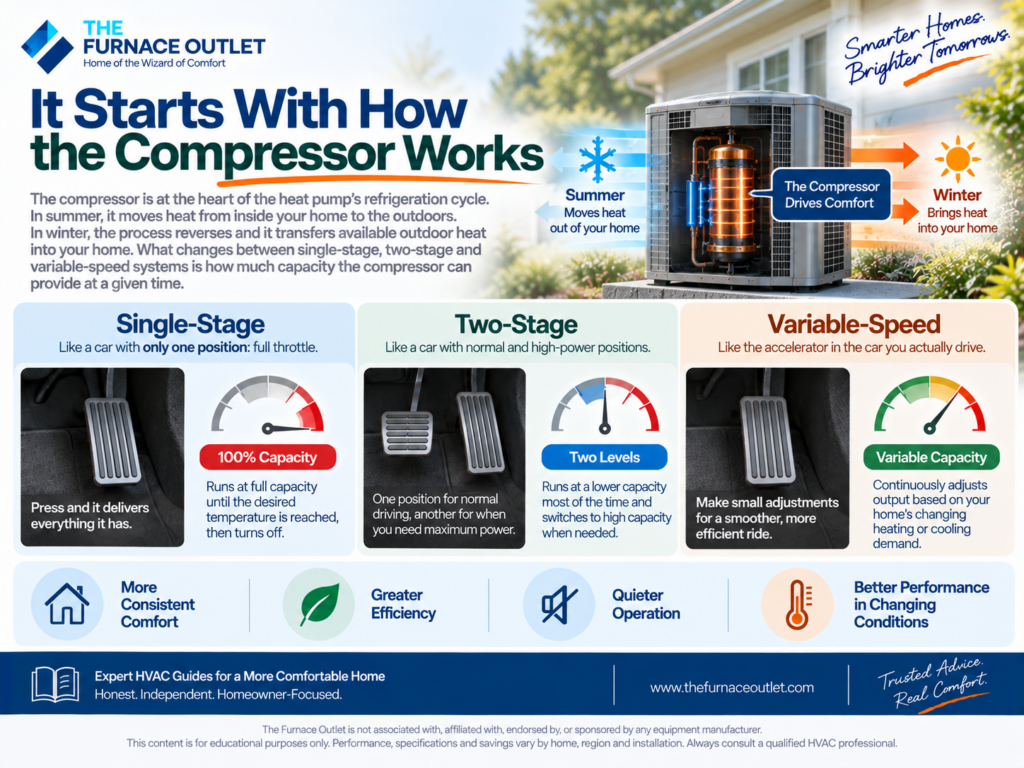
The compressor is at the heart of the heat pump’s refrigeration cycle. During summer, the system moves heat from inside your home to the outdoors. During winter, that process reverses and the heat pump transfers available outdoor heat into the house. What changes between single-stage, two-stage and variable-speed equipment is largely how much capacity the compressor can provide at a given time.
I often explain this using a car accelerator. Imagine a car where the accelerator has only one useful position: fully pressed. Every time you need power, the engine delivers everything it has until you reach the desired speed, and then you release the accelerator. That gives you a rough idea of single-stage operation.
Now, suppose you have two accelerator positions, one for normal driving, and one for when you need maximum power. That is closer to how a two-stage system behaves. Variable-speed technology is more like the accelerator in the car you actually drive. You can make small adjustments according to traffic, road conditions and the speed you need. An inverter-driven heat pump can similarly adjust its output as the heating or cooling demand of the house changes. The U.S. Department of Energy discusses staged, multi-speed and variable-capacity heat-pump technology as ways equipment can operate closer to the capacity required under changing conditions.
That difference in capacity control is what creates many of the comfort and efficiency differences between these systems.
Single-stage equipment is the simplest of the three.
When your thermostat calls for heating or cooling, the heat pump operates at its available stage. Once the thermostat is satisfied, the compressor shuts down. When the temperature moves sufficiently away from the thermostat setting, the system starts again. There is nothing inherently wrong with this approach.
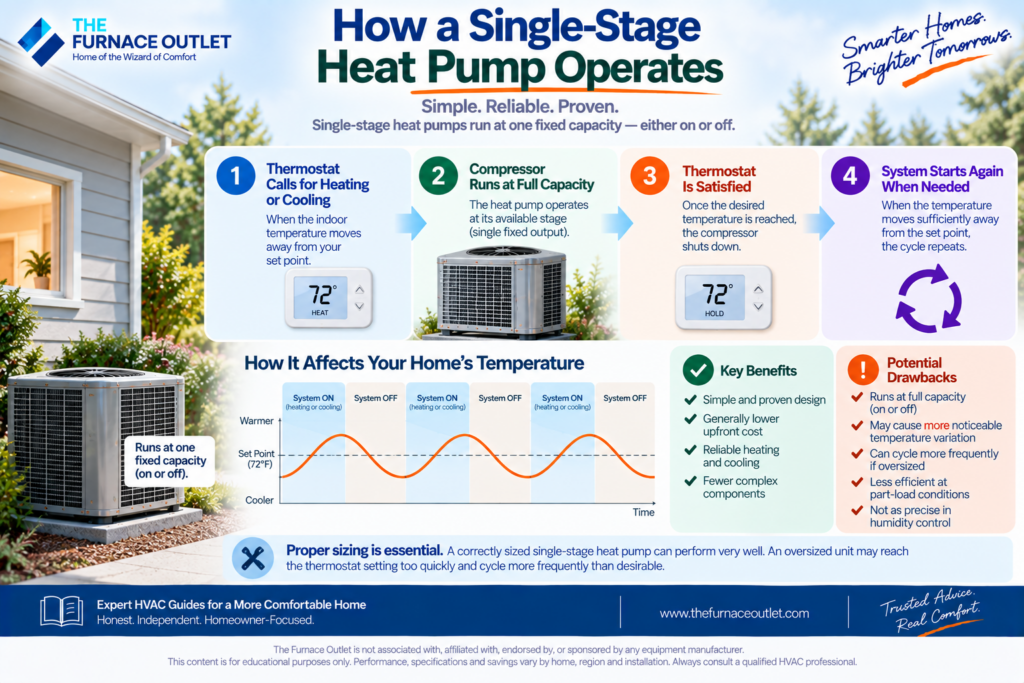
Single-stage equipment has been heating and cooling homes successfully for decades. It is generally less expensive to purchase than more sophisticated systems, and its relative simplicity can make it attractive to homeowners who want reliable heating and cooling without paying for premium capacity-control technology. Where you may notice the difference is in the way comfort is delivered.
Because a single-stage system cannot significantly reduce compressor output when the house needs only a small amount of heating or cooling, it may satisfy the thermostat relatively quickly and shut down. Later, it starts again. That on-and-off operation can create more noticeable indoor temperature variation than you might experience with equipment capable of adjusting its output. This becomes particularly important when equipment is oversized. A correctly sized single-stage heat pump can perform quite well, but an oversized unit may reach the thermostat setting too quickly and cycle more frequently than desirable.
That is why I would never dismiss single-stage equipment, but I would insist on proper sizing.
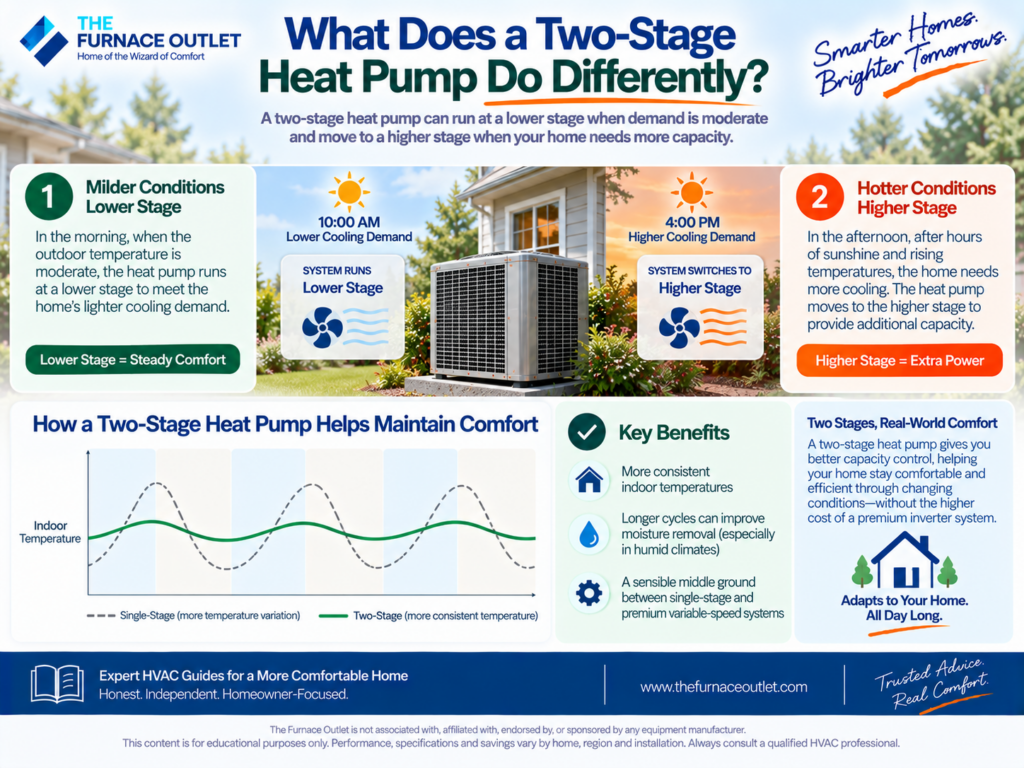
A two-stage heat pump adds another level of capacity. Instead of operating at essentially one main output, the compressor can run at a lower stage when the heating or cooling demand is moderate and move to the higher stage when the home requires more capacity.
Think about a summer day. At 10 a.m., outdoor temperatures may be relatively comfortable and the house might need only modest cooling. By late afternoon, after several hours of sunshine and rising temperatures, the cooling load can be considerably greater. A two-stage system can respond differently to those conditions.
For light loads, it can spend more time working at the lower stage instead of using max capacity immediately. When conditions become demanding, the second stage provides additional output. That can translate into longer operating cycles, fewer abrupt starts and stops and more consistent indoor temperatures. During cooling season, longer cycles may also provide more opportunity for moisture removal, which can be particularly useful in humid climates.
For many homeowners, I consider two-stage equipment to be a very sensible middle ground. It offers better capacity control than a basic single-stage system without necessarily moving into the price and sophistication of a premium inverter heat pump.
Variable-speed, or variable-capacity, heat pumps take the same concept considerably further. Rather than selecting between one or two primary stages, an inverter-driven compressor can adjust its operation across a broader capacity range. The exact range and control strategy varies by manufacturer and model, so I would not assume every variable-speed heat pump operates identically.
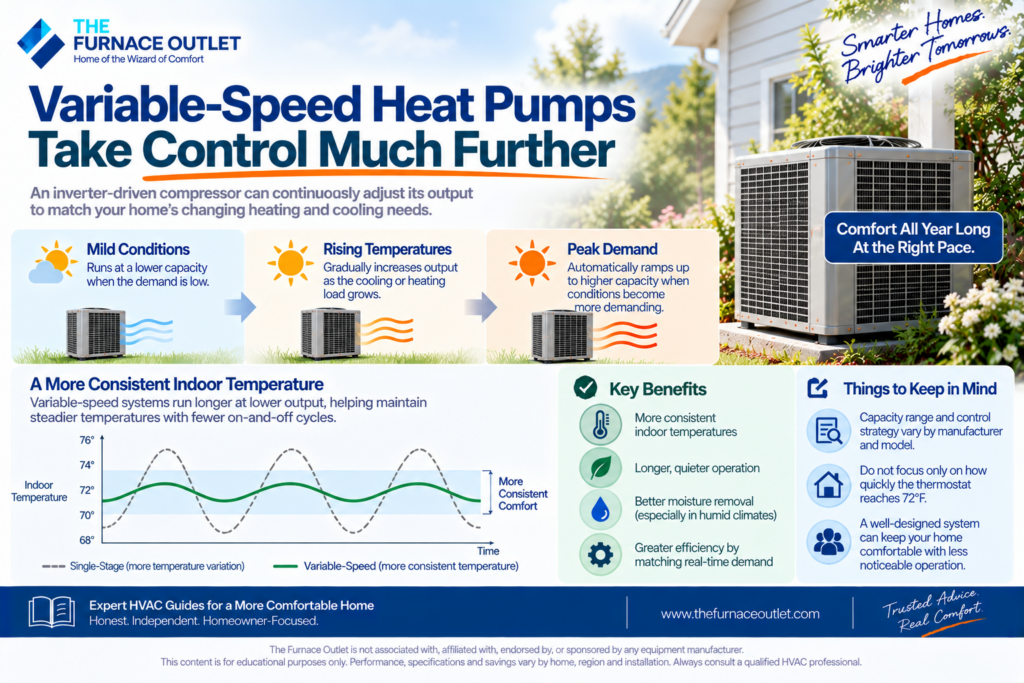
What matters is that the system has much greater ability to match its output to what the house actually needs. On a mild afternoon, the home may require only a fraction of the system’s maximum cooling capacity. Instead of operating at full output for a short period and shutting down, the heat pump can reduce capacity and continue running gently.
When outdoor conditions become more demanding, it can increase output.
This is one of those situations where homeowners should stop thinking only about how quickly the thermostat reaches 72°F. Comfort also depends on how steadily the home stays near that temperature. A well-designed variable-capacity system can operate for longer periods at lower output, making the heating or cooling process feel much less noticeable.
If comfort is one of your biggest priorities, this is where two-stage and variable-speed equipment begin to show their advantages. A single-stage system tends to operate in more noticeable cycles. The indoor temperature moves enough to trigger the thermostat, the equipment runs, the thermostat is satisfied and the system shuts down.
A variable-capacity system has more opportunity to reduce output rather than completely stopping. By producing approximately the amount of heating or cooling the house needs at that moment, it can help reduce some of the temperature swings associated with traditional cycling. Two-stage equipment sits between the two. It cannot make the fine adjustments of a fully variable system, but its lower stage gives it considerably more flexibility than a basic single-stage compressor.
I would not promise perfectly even temperatures simply because somebody buys variable-speed equipment. Insulation, duct design, solar exposure, room layout and thermostat location still matter enormously. A sophisticated compressor cannot repair poor ductwork or stop sunlight from pouring through an unshaded west-facing window. But when the house and HVAC system are properly designed, variable capacity can produce noticeably steadier comfort.
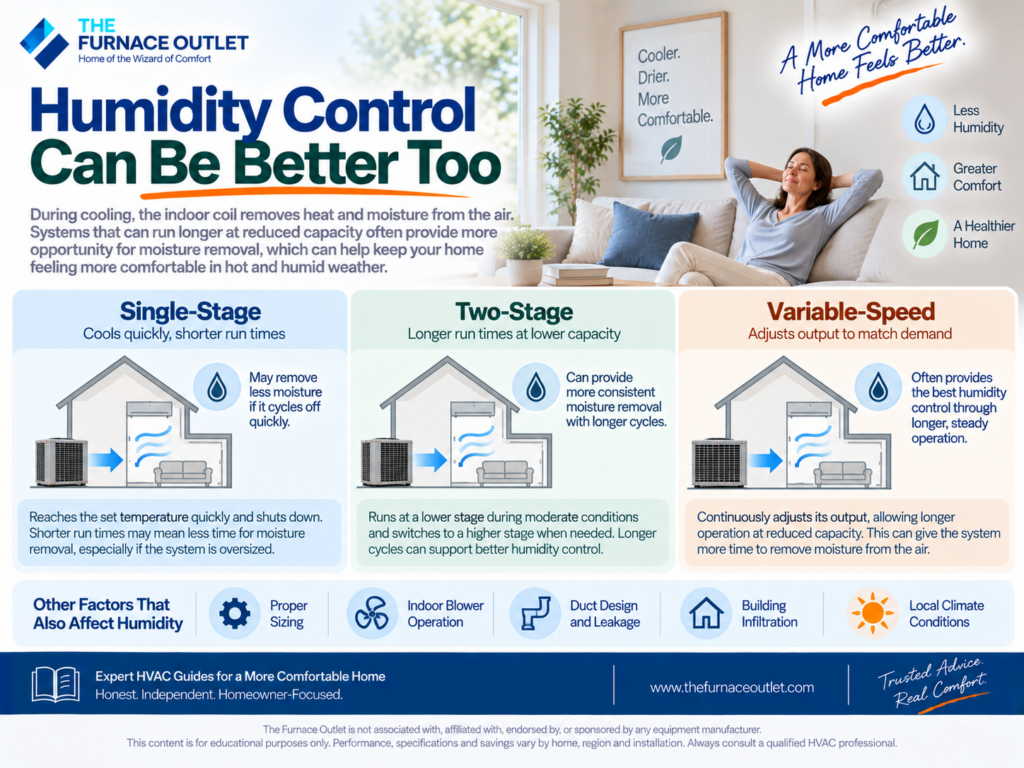
Humidity is another reason I pay attention to part-load operation, particularly in hot and humid parts of the country. During cooling, the indoor coil does more than lower the air temperature. Moisture can condense on the cold coil and drain away, helping reduce indoor humidity. If an oversized system cools the home very quickly and repeatedly shuts down, it may spend less continuous time removing moisture.
Two-stage and variable-capacity equipment can often operate longer at reduced capacity when maximum cooling is unnecessary. When paired with appropriate indoor equipment, airflow and controls, that longer operation can support better humidity management.
I would still avoid choosing equipment based on compressor type alone if humidity is a serious concern. System sizing, blower operation, duct leakage, building infiltration and local climate all affect indoor moisture levels. But in a humid climate, the ability to operate effectively at part load is something I would absolutely discuss with the contractor.
Noise can be surprisingly important once you start living with the equipment. A single-stage system repeatedly starts and operates at its available capacity, so compressor and airflow noise may be more noticeable when it comes on. Variable-speed equipment often spends substantial periods operating below maximum capacity. Lower-capacity operation can make both the indoor airflow and outdoor equipment less intrusive.
Two-stage equipment can provide some of the same benefit when operating at its lower stage. However, I would not simply assume that every variable-speed heat pump is quiet. If noise matters because the outdoor unit will sit beside a bedroom, patio or neighboring property, look at the manufacturer’s published sound rating for the actual model. Technology tells you part of the story. The actual specification tells you more.
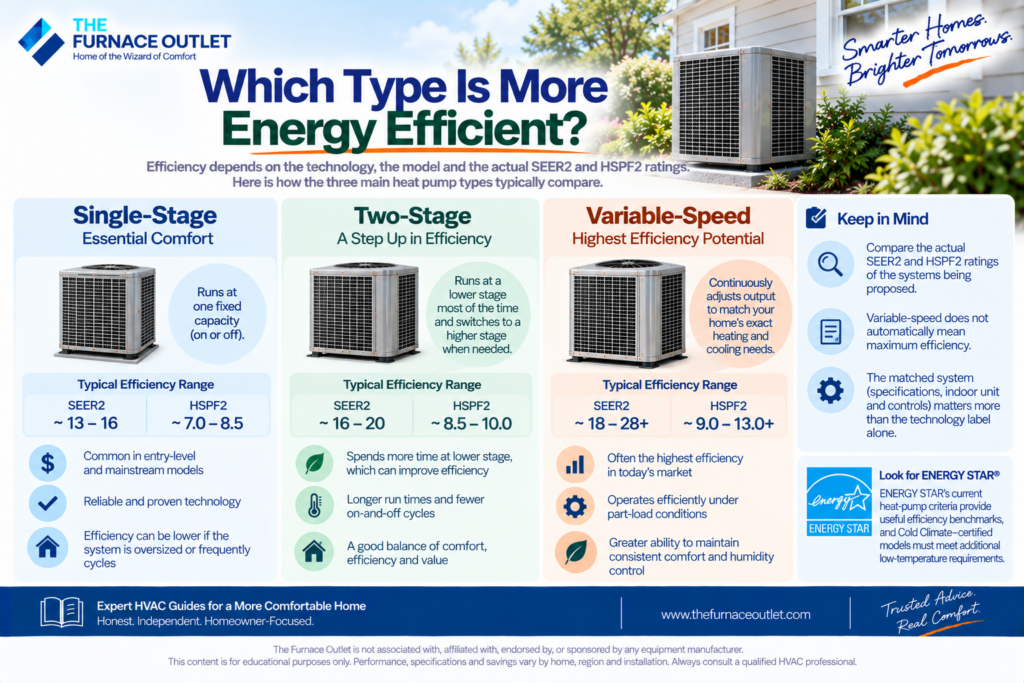
Variable-capacity heat pumps commonly occupy the higher-efficiency end of today’s residential market. Their ability to adjust output and operate efficiently under part-load conditions can contribute to strong seasonal SEER2 and HSPF2 ratings. Two-stage equipment can also benefit from spending much of its operating time at the lower stage rather than constantly cycling at maximum output.
Single-stage equipment is more common toward the entry-level and mainstream efficiency ranges. But I would be careful with broad assumptions. Do not buy a variable-speed heat pump simply because somebody tells you that variable speed automatically means maximum efficiency. Compare the actual SEER2 and HSPF2 ratings of the systems being proposed.
ENERGY STAR’s current heat-pump criteria provide useful efficiency benchmarks, while equipment carrying its Cold Climate designation must satisfy additional low-temperature requirements. The specification of the actual matched system matters more than the technology label alone.
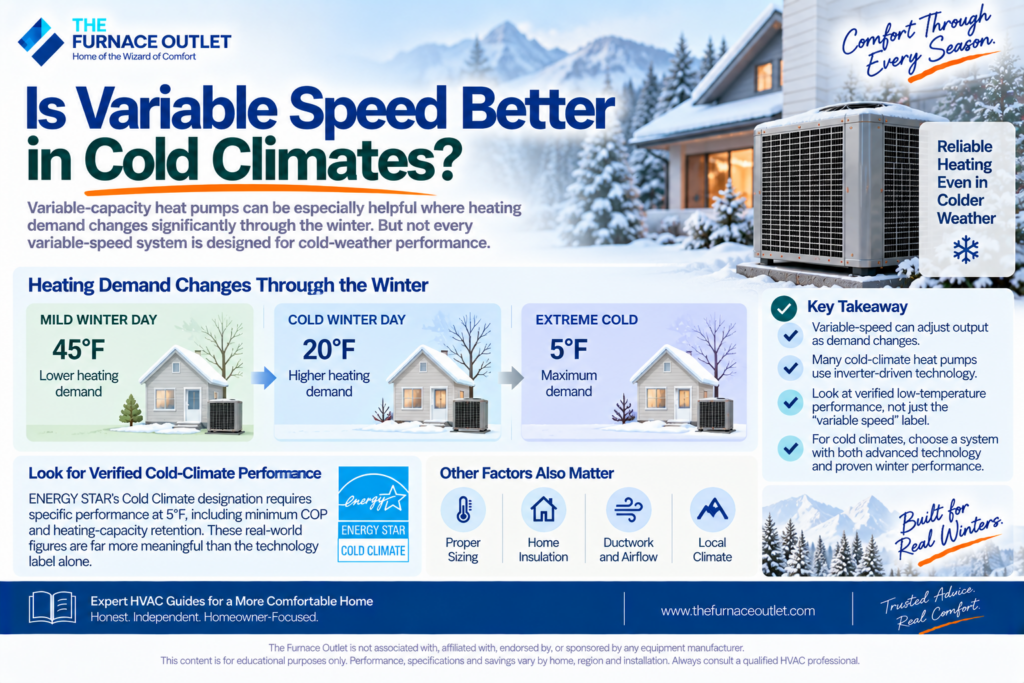
Variable-capacity technology can be particularly useful in climates where heating requirements change dramatically through the winter. A home may require relatively little heat when it is 45°F outside but considerably more when temperatures fall into the teens or single digits. An inverter-driven system has the ability to adjust compressor operation as that demand changes.
Many modern cold-climate heat pumps therefore use inverter-driven technology. But there is an important distinction here: variable-speed does not automatically mean cold-climate capable. If you live somewhere with serious winters, look at the actual low-temperature heating data.
ENERGY STAR’s current Cold Climate designation includes requirements for performance at 5°F, including minimum COP and heating-capacity retention. Those figures tell me much more about winter capability than seeing “variable speed” written across a brochure. For a cold-climate installation, I want both: good technology and proven low-temperature performance.
This is where the decision becomes personal. Variable-speed systems usually cost more than comparable single-stage equipment. Whether that premium makes sense depends on the home and what the homeowner values. If you plan to stay in the house for years, have a long heating or cooling season, care about quiet operation and want very consistent indoor temperatures, a good variable-capacity heat pump can be an attractive investment.
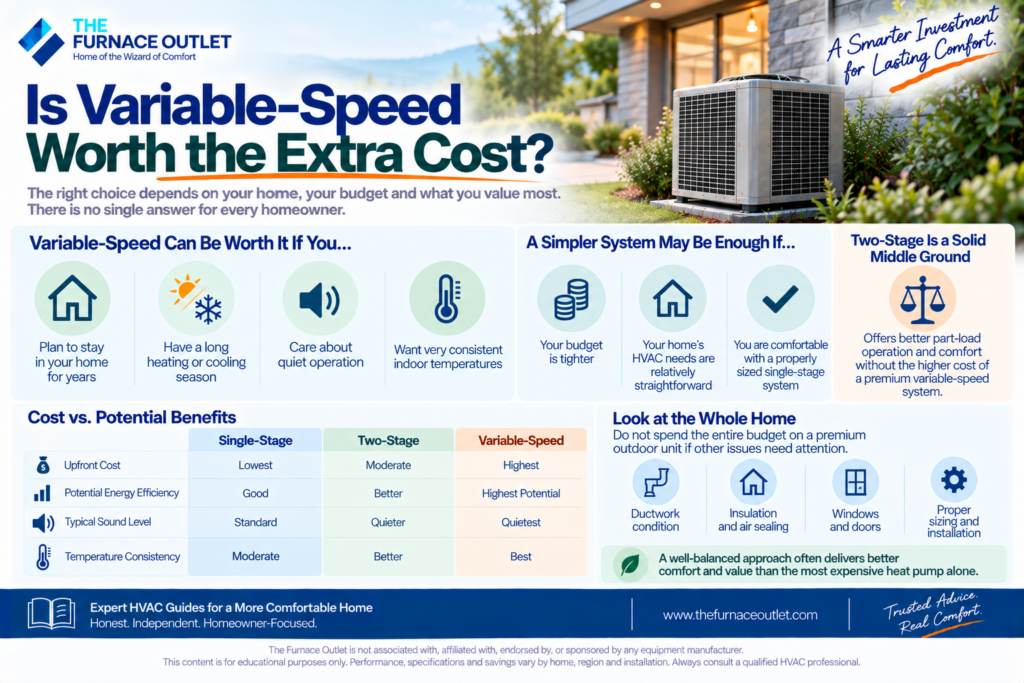
If your budget is tighter and the home’s HVAC requirements are relatively straightforward, a properly sized single-stage system may serve you perfectly well. Two-stage equipment deserves particular consideration for homeowners who want better part-load operation and comfort but do not necessarily need—or want to pay for—the most sophisticated system available.
I would also look at the rest of the house before spending the entire budget on compressor technology. If choosing the premium variable-speed heat pump means leaving badly leaking ductwork untouched, I might prefer the simpler equipment and use some of the budget to fix the ducts. The most expensive outdoor unit is not always the smartest overall investment.
No compressor technology eliminates the need for correct system sizing. An oversized single-stage heat pump can cycle excessively. Two-stage and variable-capacity equipment have more flexibility at lower loads, but that should not become an excuse to install unnecessarily oversized equipment.
A professional load calculation should consider the characteristics of the actual home, including insulation, windows, orientation, air leakage, local climate and other factors affecting heating and cooling demand. This is one area where I would rather have excellent fundamentals than impressive technology.
A properly sized two-stage system can be a better installation than an oversized variable-speed system chosen simply because the salesperson said it could “always ramp down.” Advanced technology works best when the basic HVAC design is correct.
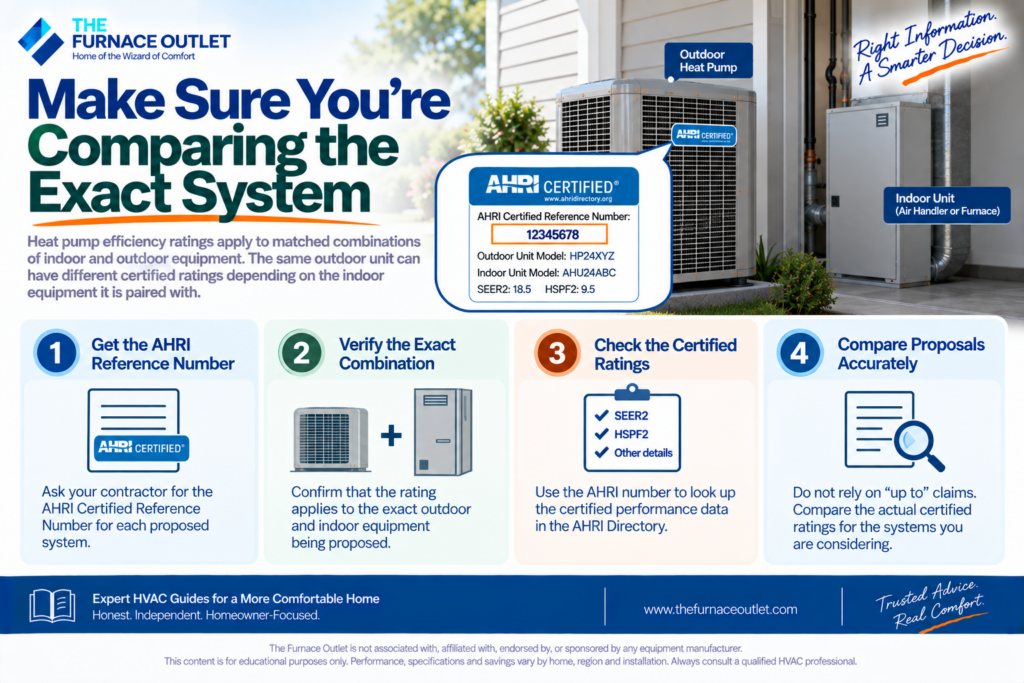
When comparing heat-pump proposals, ask the contractor for the AHRI Certified Reference Number of each proposed equipment combination. Heat-pump efficiency ratings apply to matched combinations of indoor and outdoor equipment. The same outdoor heat pump can produce different certified efficiency ratings depending on the indoor equipment with which it is paired.
That becomes especially important when you are paying extra for high-efficiency two-stage or variable-capacity equipment. If a proposal says the heat pump offers “up to 20 SEER2,” I want to know whether your exact combination actually achieves that rating. The AHRI Certified Reference Number gives you a way to verify what you’re actually buying.
If I were replacing the heat pump in my own house, I would start with the home and the budget rather than deciding in advance that I needed the most sophisticated compressor available. For a straightforward application where keeping the initial investment under control matters, I would have no problem considering a good single-stage system—as long as it was properly sized and installed.
If I wanted better temperature control and longer part-load operation without moving to the premium end of the market, I would give a two-stage system serious consideration. For many homes, that can be a very attractive balance.
If quiet operation, excellent part-load comfort, efficiency and precise capacity control were high priorities, and the budget supported it, I would lean toward a quality variable-capacity heat pump. But I would still check the efficiency ratings, low-temperature performance where relevant, warranty, equipment match and contractor quality before making the final decision. The most advanced heat pump is not automatically the best value. The best system is the one whose technology you will actually benefit from.
Single-stage, two-stage and variable-speed heat pumps can all be good choices. The difference lies in how precisely they can adapt their output to changing heating and cooling demand.
Single-stage equipment offers simplicity and a generally lower purchase price. Two-stage systems provide additional capacity control and can be a useful middle ground for homeowners looking for better comfort without moving into premium equipment. Variable-speed systems offer the greatest ability to modulate output and can deliver excellent temperature control, quiet operation and seasonal efficiency.
When comparing contractor proposals, do not ask only which heat pump has the most advanced compressor. Ask what that technology will actually change inside your home. Compare SEER2 and HSPF2. Look at low-temperature heating capacity if you live in a cold climate. Consider noise and humidity control. Make sure the equipment has been properly sized and ask for the AHRI Certified Reference Number of the exact matched system.
When those pieces are considered together, choosing between single-stage, two-stage and variable-speed becomes much easier—and much more meaningful than simply choosing the most expensive option.
For our broader comparison of heat-pump models, efficiency, cold-weather performance, compressor technology and homeowner buying considerations, continue with The Furnace Outlet’s Best Heat Pumps of 2026: The Complete Homeowner Buying Guide on www.thefurnaceoutlet.com.
— Jake Lawson, HVAC Specialist | The Furnace Outlet
Best Heat Pumps of 2026: The Complete Homeowner Buying Guide – The Furnace Outlet
For technical information on heat-pump compressors, efficiency and equipment matching, I recommend primary government and HVAC-industry resources rather than relying solely on manufacturer sales material.
U.S. Department of Energy — Heat Pump Systems explains heat-pump operation and technologies including staged, multi-speed and variable-capacity compressors:
DOE Heat Pump Systems
ENERGY STAR — Heat Pump Equipment Key Product Criteria provides current SEER2, HSPF2 and Cold Climate Heat Pump performance requirements:
ENERGY STAR Heat Pump Criteria
AHRI — Air Conditioners and Heat Pumps provides homeowner information covering proper sizing, installation and HVAC system performance:
AHRI Air Conditioners and Heat Pumps
AHRI — Air-Conditioning and Heat Pump Efficiency 101 explains efficiency ratings and the importance of properly matched indoor and outdoor equipment:
AHRI Efficiency 101
NREL / U.S. Department of Energy — Cold-Climate Heat Pump Field Validation provides field research involving variable-speed air-source heat pumps operating in cold climates:
NREL Cold-Climate Heat Pump Field Study
For individual heat-pump recommendations and the complete buying framework, read Best Heat Pumps of 2026: The Complete Homeowner Buying Guide on The Furnace Outlet.
Equipment specifications and efficiency ratings can vary by model and matched indoor/outdoor combination. Verify current manufacturer specifications and AHRI-certified ratings before purchasing.