Newsletter Subscribe
Enter your email address below and subscribe to our newsletter

HVAC made simple
Mark Callahan – the expert installer
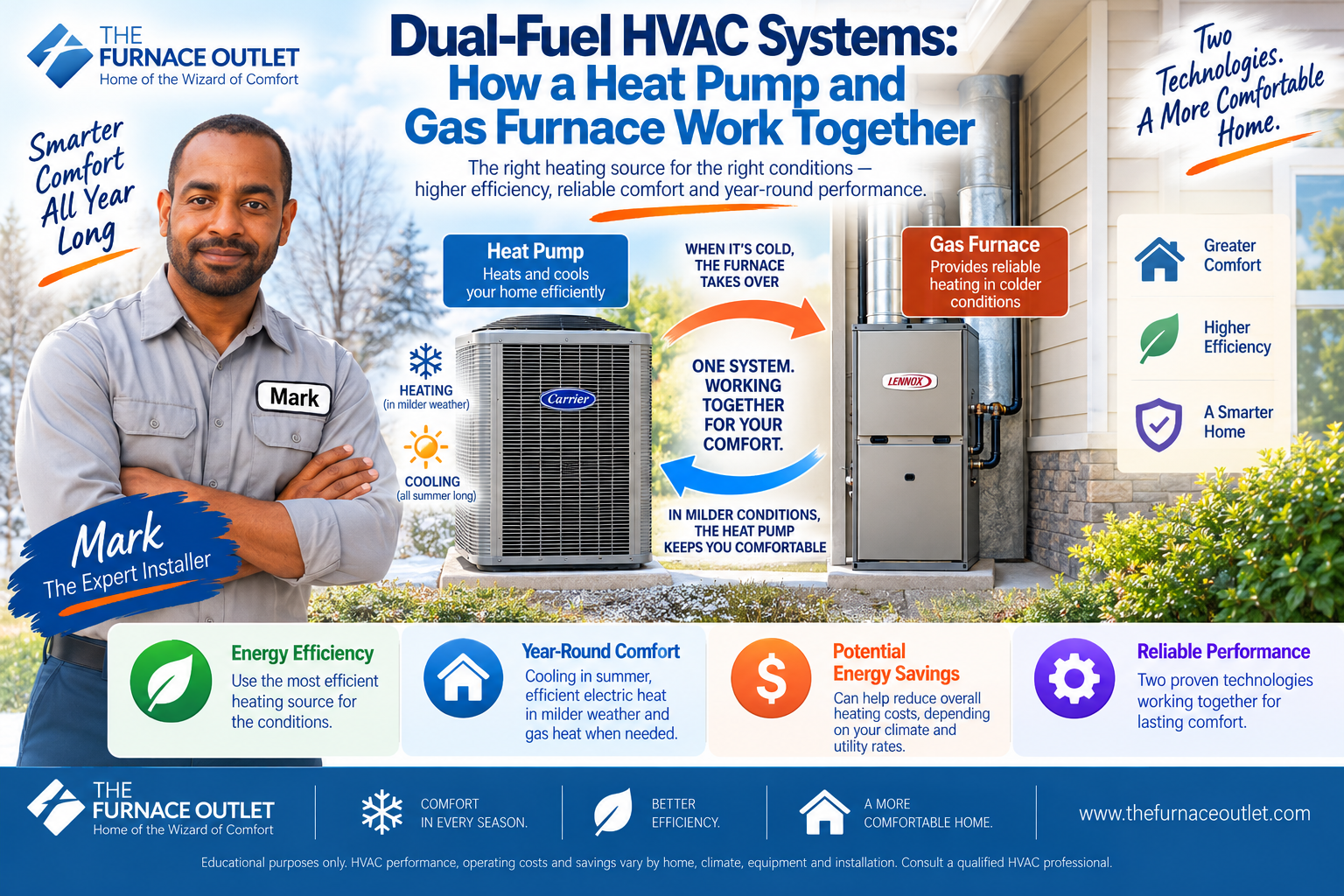
For homeowners who already like the dependable winter heating of a gas furnace but also want the efficiency and versatility of a heat pump, a dual-fuel HVAC system can offer an interesting middle ground. Instead of forcing one piece of equipment to handle every outdoor condition, the system combines an electric heat pump with a gas furnace and allows each heating source to operate when it makes the most sense.
I like to explain dual fuel as a coordinated heating and cooling system rather than simply a furnace with another appliance attached to it. The heat pump normally handles cooling in summer and can provide heating during much of the cooler season. When conditions reach a point where the system is configured to transition away from heat-pump operation, the gas furnace takes over. Properly designed controls manage that change automatically, so the homeowner should not have to walk to the thermostat and manually decide which appliance to use.
That sounds simple, but a good dual-fuel installation requires much more than putting a heat pump outside and a furnace inside. Sizing, equipment matching, low-temperature heat-pump performance, fuel and electricity prices, airflow, controls, ductwork and commissioning all matter.
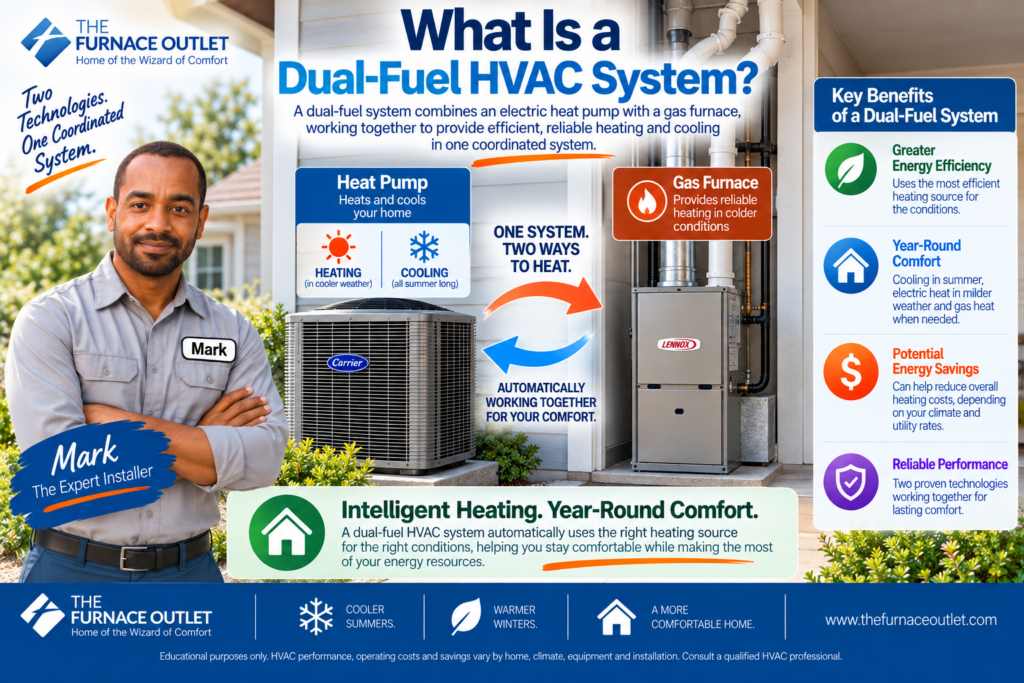
A residential dual-fuel system—also called a hybrid heating system—typically combines an electric air-source heat pump with a gas furnace. The heat pump can both heat and cool the home, while the furnace serves as the alternative heating source.
ENERGY STAR specifically discusses dual-fuel configurations as an option for homeowners who have a relatively new furnace and are considering replacing or adding central cooling. Instead of installing another conventional AC condenser, an eligible homeowner may be able to install a heat pump and gain the ability to heat with either electricity or the existing fuel-fired furnace.
That flexibility is the defining feature of dual fuel. You are not buying two heating appliances so they can compete with each other. You are creating one coordinated system with two different ways of providing heat.
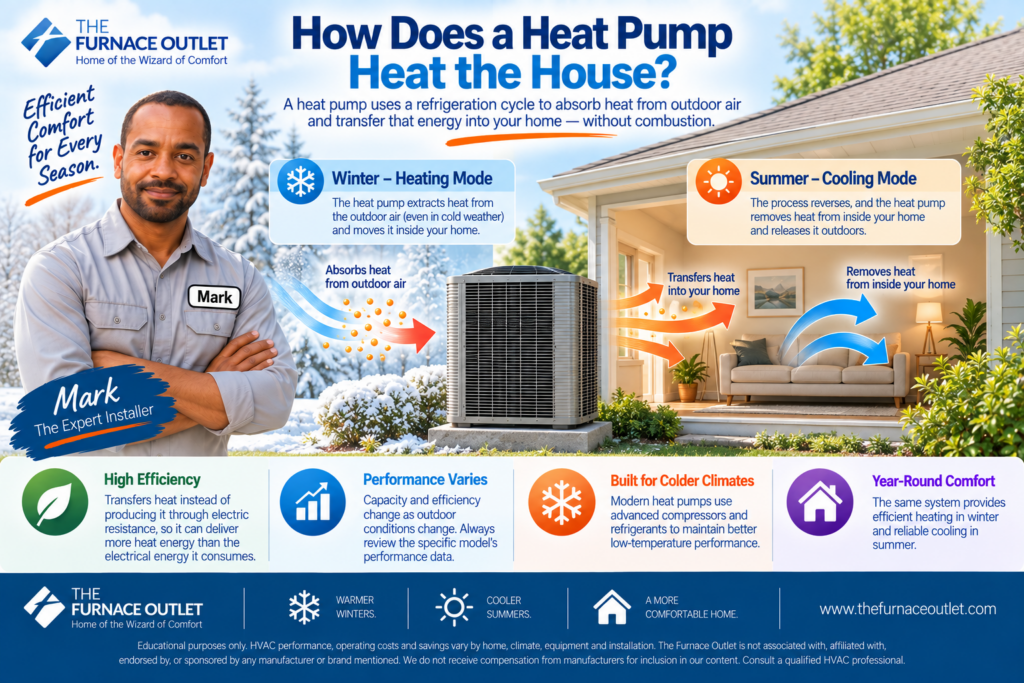
A heat pump does not create heat through combustion. During heating operation, it uses a refrigeration cycle to absorb available heat from outdoor air and transfer that energy into the house. During summer, the process reverses and the same outdoor unit operates much like a central air conditioner, moving heat from inside the house to outdoors.
Because the heat pump transfers heat instead of producing it through electric resistance, it can deliver substantially more heat energy than the electrical energy it consumes under suitable operating conditions. Its capacity and efficiency, however, change as outdoor conditions change.
Modern heat pumps have also become considerably more capable at low outdoor temperatures. ENERGY STAR notes that cold-climate air-source heat pumps use advanced compressors and refrigerants to improve low-temperature performance, which means homeowners should not assume that every heat pump needs to surrender heating duty at the first freezing night. The specific heat pump’s performance data matters much more than an old rule of thumb about outdoor temperature.
The gas furnace provides the second heating source. Instead of transferring outdoor heat, it burns fuel and transfers combustion heat through a heat exchanger. The furnace blower then moves indoor air across that heat exchanger and distributes heated air through the home’s duct system.
In a properly designed dual-fuel system, the furnace does not necessarily operate every time the house needs heat. During conditions favorable to the heat pump, the heat pump can handle the heating load. When the controls determine that furnace operation is appropriate, the system transitions to gas heat.
Carrier describes dual fuel as an arrangement in which the heat pump and furnace alternate according to operating conditions rather than functioning as unrelated systems. This is one reason I prefer thinking about dual fuel as system design rather than simply equipment selection.
Imagine a cool fall morning. The thermostat calls for heat, and the outdoor temperature is well within the heat pump’s effective operating range. The heat pump starts and transfers outdoor heat into the home.
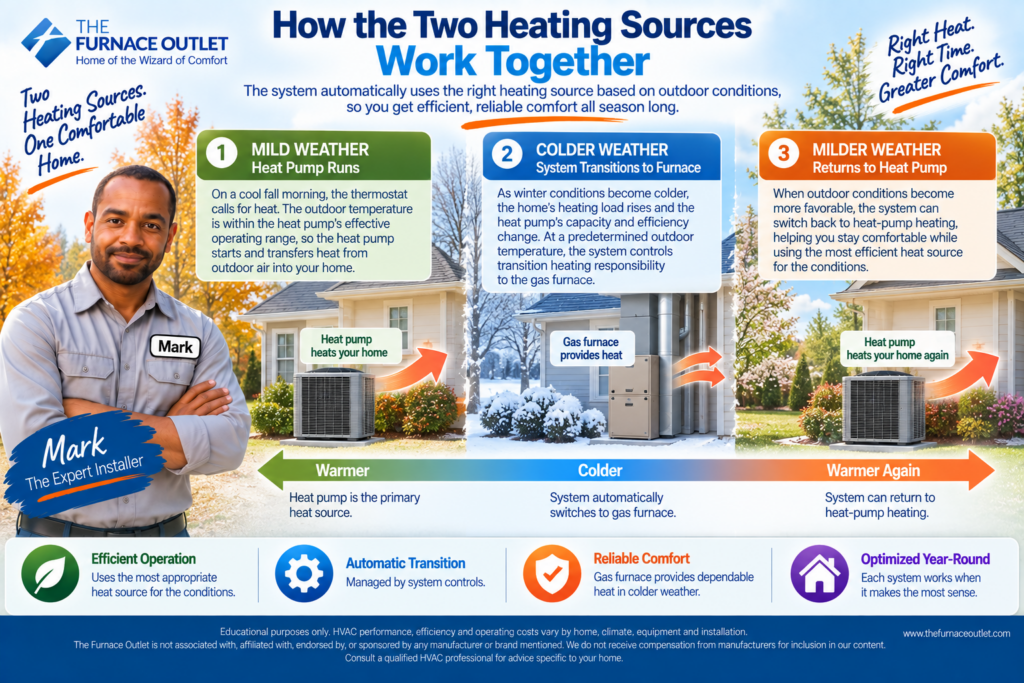
As winter conditions become colder, the home’s heating load rises while the heat pump’s available capacity and operating efficiency change. At some predetermined operating condition, the system controls can transition heating responsibility to the gas furnace. When outdoor conditions become more favorable again, the system can return to heat-pump heating. Carrier and Trane both describe this automatic transition as a core characteristic of residential dual-fuel systems. The important point is that the transition temperature should not be treated as one universal number for every house and every heat pump.
Homeowners sometimes hear that a heat pump should run above approximately 35°F or 40°F and the furnace should automatically take over below that temperature. That may resemble the configuration of some systems, but I would not use it as a universal design rule.
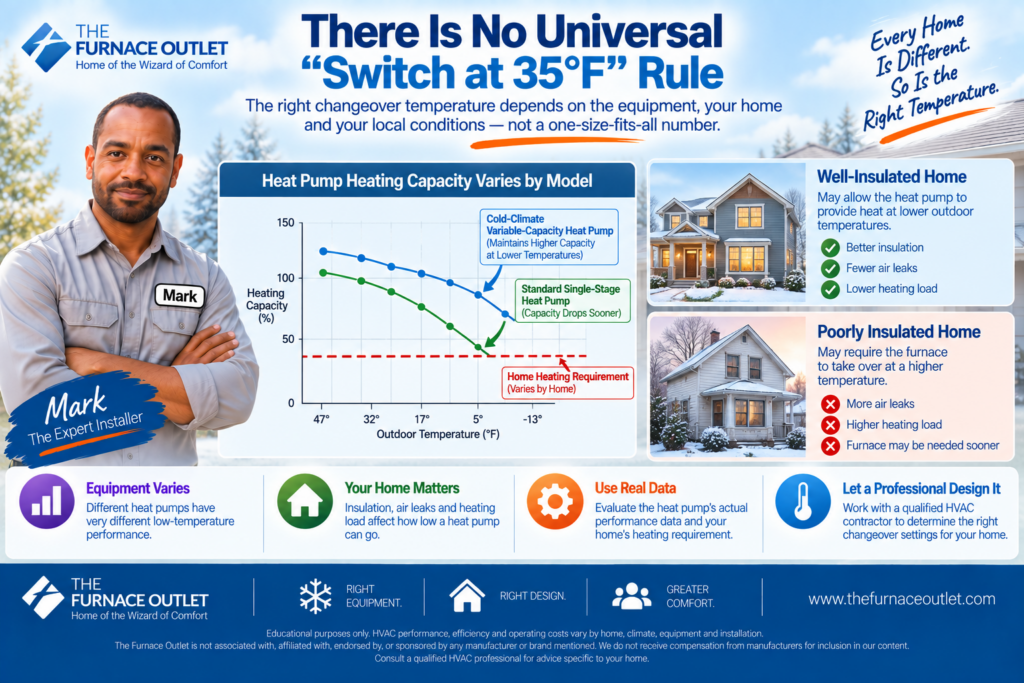
Modern equipment varies enormously. A conventional single-stage heat pump and an advanced cold-climate variable-capacity heat pump can have very different capacity curves at 47°F, 32°F, 17°F, 5°F and below. The house also matters. A well-insulated home with a modest heating load may allow a heat pump to carry the building to a considerably lower outdoor temperature than a similar-capacity unit installed in a poorly insulated, drafty house.
The contractor should therefore evaluate the heat pump’s actual low-temperature performance against the home’s heating requirement, rather than selecting a changeover temperature because “that is what we normally use.”
One useful concept is the thermal balance point. In simplified terms, this is the outdoor condition at which the heat pump’s available heating capacity approximately equals the home’s heating requirement. As outdoor temperatures fall, the building generally loses heat faster. At the same time, an air-source heat pump’s available heating capacity may change. Eventually, depending on the equipment and house, the building load can exceed what the heat pump alone can provide.
That relationship is one reason accurate load calculations are so important. ACCA’s Manual J is the ANSI-recognized residential load-calculation methodology used to determine heating and cooling loads. I would want that calculation performed before deciding how large the heat pump and furnace should be. Without knowing the home’s heating load, it becomes much harder to make an informed decision about where one heating source should hand responsibility to the other.
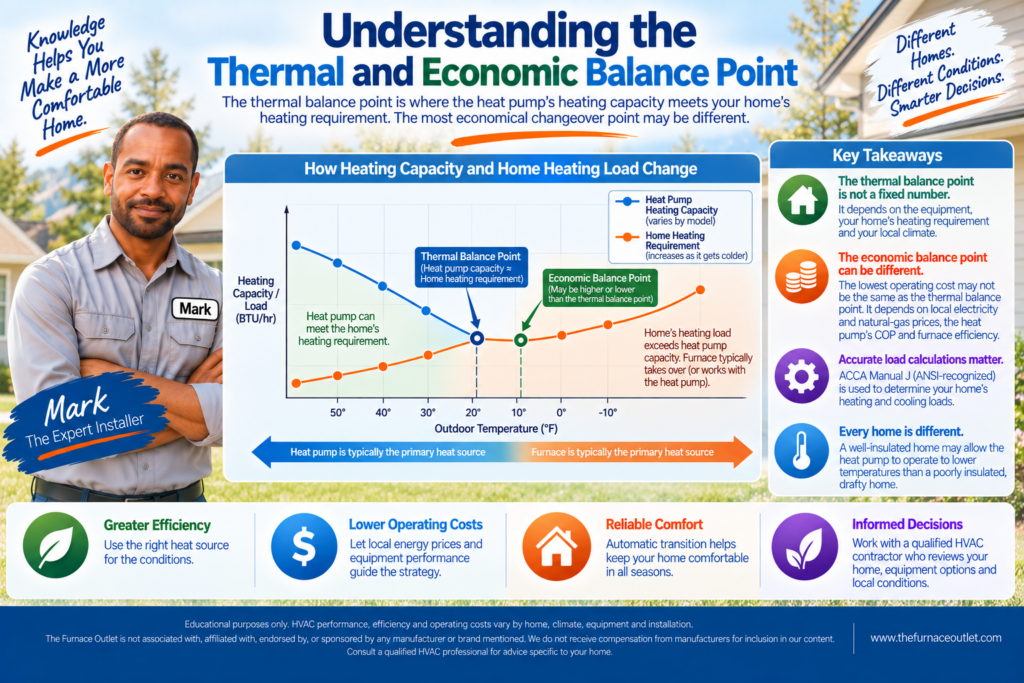
There is another concept homeowners should understand: the most economical changeover point may not be identical to the thermal balance point. Suppose the heat pump is still physically capable of heating the house at a particular outdoor temperature. That does not automatically tell us whether electricity or natural gas provides the lower operating cost at that moment.
The answer depends on factors such as local electricity prices, natural-gas prices, heat-pump COP at that outdoor condition and furnace efficiency. If electricity is relatively inexpensive and the heat pump maintains strong low-temperature performance, it may make economic sense to operate it farther into winter. Where natural gas is inexpensive relative to electricity, an earlier furnace transition might make more financial sense.
This is why claims that dual fuel will always reduce every homeowner’s utility bill should be treated cautiously. The system provides flexibility; the financial result depends heavily on local conditions.
Older discussions of heat pumps often portray them as equipment for mild weather that quickly needs backup when winter becomes serious. That description is increasingly incomplete. Modern cold-climate heat pumps are specifically engineered for improved low-temperature operation. ENERGY STAR advises homeowners in climates that regularly experience freezing temperatures to work with contractors to select equipment designed for those conditions.
That changes how I would approach dual fuel. The furnace should not automatically be oversized or programmed to take over prematurely simply because the outdoor temperature has fallen below freezing. Instead, examine the heat pump’s published heating capacity and efficiency at relevant winter temperatures, compare those figures with the home’s load calculation and then determine how the furnace fits into the overall strategy.
One of the most interesting opportunities appears when a homeowner has a good existing gas furnace but an aging central air conditioner. If the furnace has meaningful remaining service life, an appropriate blower, compatible controls and suitable indoor equipment, replacing the old AC with a compatible heat pump may create dual-fuel capability without abandoning a perfectly serviceable furnace.
ENERGY STAR specifically highlights this scenario, suggesting that homeowners with a relatively new furnace and older central AC consider an ENERGY STAR certified heat pump. I would still verify the complete equipment combination. The existing furnace blower must be capable of delivering the airflow required by the new heat pump, and the indoor coil, refrigerant system, controls and ductwork must all be appropriate.
Keeping the furnace simply because “it still works” is not enough.

During heat-pump operation, refrigerant circulates through the indoor coil, and the furnace blower moves air across that coil. The furnace therefore participates in heat-pump operation even when its gas burners are completely off. That makes blower performance critical.
A sophisticated variable-capacity heat pump may require or benefit from particular airflow characteristics and control capabilities. Pairing advanced outdoor equipment with an unsuitable indoor blower can prevent the system from delivering the performance and comfort the homeowner expected. I would verify the approved indoor/outdoor equipment combination and confirm the blower’s capability at the actual external static pressure of the installed duct system.
Dual fuel does not eliminate the principles of equipment compatibility. It makes them even more important.
The thermostat or communicating control has a more complicated job in a dual-fuel installation than in a basic furnace-only system. It needs to coordinate cooling, heat-pump heating, furnace heating and potentially multiple stages or variable capacities. Depending on the equipment, the control strategy may consider outdoor temperature, indoor demand, equipment staging and other manufacturer-specific logic.
Carrier notes that dual-fuel systems use controls to manage the transition between heat-pump and furnace operation. I would therefore ask the contractor to explain exactly how the proposed system decides when to switch fuels.
If the answer is simply, “The thermostat handles it,” ask for more detail. What outdoor-temperature sensor or data source is used? What changeover settings are programmed? Are they adjustable? Does the system use simple temperature lockouts or more sophisticated communicating logic? Those settings affect how the system operates for years after the installer leaves.
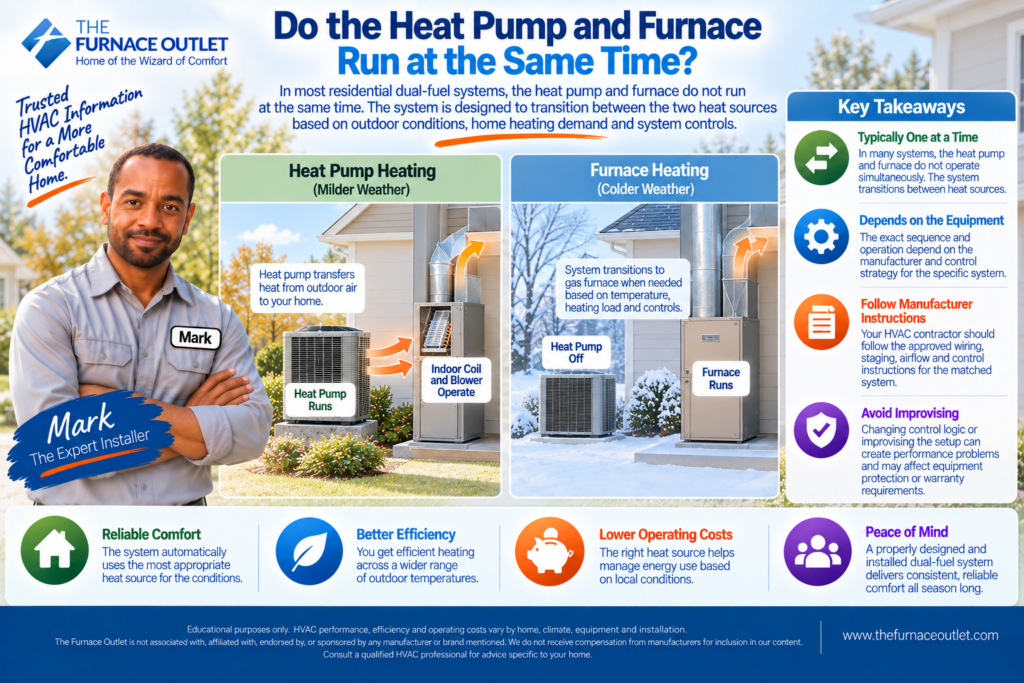
Homeowners sometimes assume that dual fuel means the gas furnace and heat pump provide heat simultaneously. In many conventional residential dual-fuel configurations, however, the system is designed to transition between the two heat sources rather than simply operating both together.
The exact sequence depends on the equipment and manufacturer-approved controls, so this is not something I would generalize across every product. The contractor should follow the wiring, staging, airflow and control instructions for the specific matched system being installed. Improvising control logic can create performance problems and potentially affect equipment protection or warranty requirements.
A conventional furnace-and-AC system has a clear division of labor: the air conditioner cools and the furnace heats. Dual fuel gives the outdoor unit another job. During summer, the heat pump cools. During mild and moderate heating conditions, it reverses operation and heats. During conditions where the system is configured to use the furnace, the furnace takes over heating.
Trane describes this heat-pump-plus-furnace arrangement as a matched hybrid system capable of providing both heating and cooling across the year. For homeowners replacing an AC anyway, that additional heating capability can be one of the strongest reasons to investigate a heat pump instead of automatically buying another cooling-only condenser.
During heat-pump heating, there is no combustion occurring at the home. ENERGY STAR notes that air-source heat pumps avoid direct on-site combustion emissions such as carbon monoxide, carbon dioxide and nitrogen oxides during heat-pump operation.
A dual-fuel system still burns natural gas when the furnace operates, so it is not a fully non-combustion heating system. However, shifting some portion of annual heating from the furnace to the heat pump can reduce the amount of fuel burned at the house.
The broader emissions comparison is more complicated because electricity generation varies geographically and over time. I would therefore avoid treating dual fuel as having one universal emissions result for every location.
Installing advanced equipment on poor ductwork is still poor HVAC design. The duct system must handle the required airflow in cooling mode, heat-pump heating mode and furnace heating mode. Restrictive returns, undersized supplies, poor fittings, dirty or overly restrictive filters and excessive static pressure can undermine performance.
This is particularly important when different operating stages require different airflow targets. A contractor evaluating dual fuel should inspect the duct system rather than focusing exclusively on the heat pump and furnace cabinets. Equipment can only deliver conditioned air effectively if the distribution system allows it to do so.
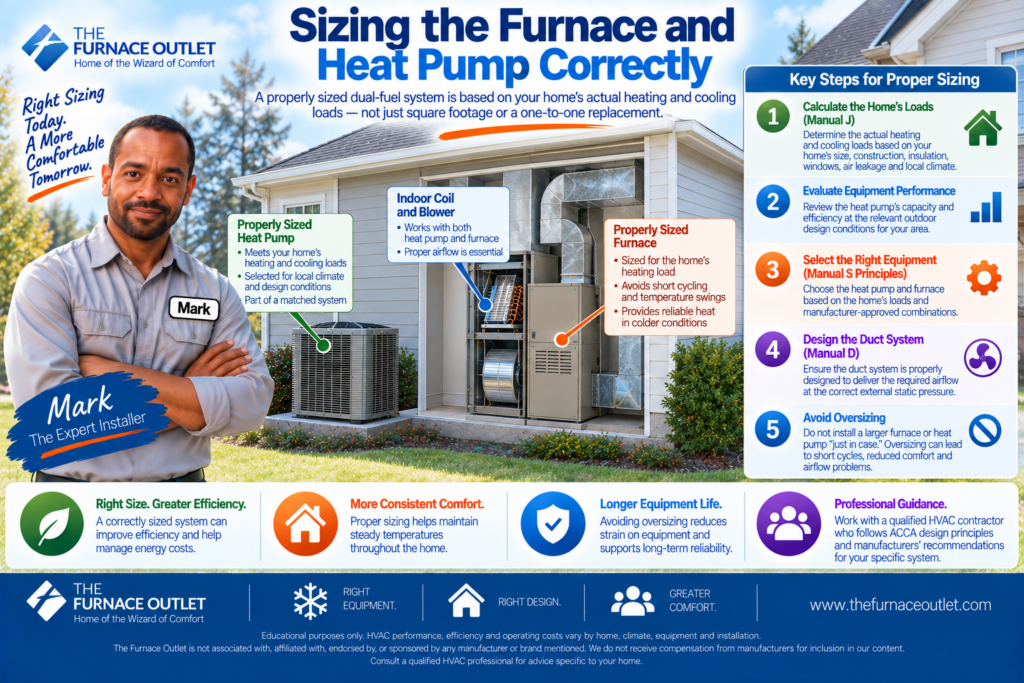
I would not size a dual-fuel system using square footage alone, and I would not automatically copy the capacities of the equipment being replaced.
Start with the home’s heating and cooling loads. Then examine heat-pump performance at the relevant outdoor design conditions and select equipment accordingly. ACCA’s residential design framework uses Manual J for load calculations and Manual S principles for equipment selection, while duct design is addressed through Manual D.
The furnace also needs thoughtful sizing. Installing an unnecessarily large furnace “just in case” can produce short heating cycles, temperature swings and airflow issues.
Dual fuel should give the system more operating flexibility, not become an excuse for oversizing both pieces of equipment.
I would give dual fuel serious consideration when a home already has natural-gas infrastructure, the homeowner is replacing central air conditioning, winters include a meaningful range of mild and cold conditions, and the homeowner wants to use heat-pump heating without completely giving up furnace backup.
It can also be attractive where electricity and gas prices make fuel flexibility valuable or where a homeowner wants to reduce annual furnace runtime while retaining strong cold-weather heating capability.
On the other hand, dual fuel is not automatically the right answer everywhere. A modern cold-climate heat pump without a furnace may be appropriate for some homes, while other properties may continue to make sense with conventional furnace-and-AC configurations.
The house, climate, utility rates and equipment should drive the decision.
Before signing a proposal, I would ask the contractor for the home’s calculated heating and cooling loads, the proposed heat pump’s heating capacity at relevant low outdoor temperatures, its efficiency ratings, the furnace’s input and output capacity, AFUE, blower type and the documentation showing that the indoor and outdoor components are approved to operate together.
I would also want a clear explanation of the dual-fuel changeover strategy, including what determines when the heat pump stops and the furnace starts. Ask whether the contractor has compared local electricity and gas costs, whether the existing ductwork can handle all operating modes and what measurements will be taken during commissioning.
A proposal containing excellent equipment model numbers is only the beginning. The design and setup determine how those components actually behave in your house.
When I look at dual fuel, I do not see a heat pump competing against a furnace. I see two different heating technologies being assigned the conditions they are best equipped to handle.
The heat pump can provide cooling and efficient electric heating across a substantial portion of the year. The gas furnace gives the system another heating option when outdoor conditions, building load, equipment performance or operating economics favor gas heat. Modern cold-climate heat pumps can push that transition considerably lower than older assumptions might suggest, so the changeover strategy should be based on actual performance data rather than an arbitrary temperature.
Most importantly, start with the house. Perform the load calculation, evaluate the ductwork, select compatible equipment, verify blower capability, design the controls properly and commission the finished installation. A dual-fuel system should not merely contain a good heat pump and a good furnace. It should operate as one carefully matched HVAC system in which the heat pump, furnace, indoor coil, blower, ductwork and controls all understand their roles. That is when dual fuel becomes genuinely useful: not because the house has two heating sources, but because the complete system knows how to use them effectively.
Best Furnaces of 2026: Gas Furnace Brands & Models Compared – The Furnace Outlet
For further reading, ENERGY STAR’s Air-Source Heat Pumps guide covers sizing, cold-climate equipment and dual-fuel applications. ACCA’s Manual J Residential Load Calculation guidance explains the recognized residential load-calculation process used before equipment selection.
For manufacturer explanations of system operation, see Carrier’s Dual Fuel Heating System guide and Trane’s Heat Pump + Furnace Matched System guide. ENERGY STAR’s Clean Heating and Cooling guidance also discusses proper sizing, component matching and dual-fuel considerations.
Editorial Disclosure & Educational Disclaimer: The Furnace Outlet is an independent educational resource and is not affiliated with, endorsed by or sponsored by the manufacturers or organizations referenced above. HVAC capacity, efficiency, operating costs and low-temperature performance vary by home, climate, equipment, utility rates and installation. Verify current manufacturer specifications and approved equipment combinations, and consult a qualified HVAC professional before selecting or modifying a system.