Newsletter Subscribe
Enter your email address below and subscribe to our newsletter

HVAC made simple

Mark Callahan – the expert installer
Buying a gas furnace in 2026 is not simply a matter of finding the highest AFUE number or choosing the brand with the most familiar name. A furnace becomes part of a complete heating and cooling system, and the way that equipment is sized, matched, installed, configured and commissioned can have just as much influence on comfort and reliability as the name printed on the cabinet.
I have worked around HVAC installations for more than 15 years, and one lesson keeps coming back: a premium furnace does not automatically create a premium HVAC system. I would rather see a properly sized, correctly installed mid-range furnace connected to good ductwork than an expensive modulating furnace forced to operate through undersized returns, poor airflow or badly configured controls.
For this 2026 guide, The Furnace Outlet compares the major furnace brands and the types of equipment homeowners are most likely to encounter, including Goodman, Carrier, Trane, Lennox, Rheem, Amana, Bryant, York and American Standard. We will also look beyond the brands at AFUE, furnace staging, variable-speed blowers, BTU sizing, installation configuration, dual-fuel systems, warranties, expected lifespan and the situations where premium equipment really is worth paying for.
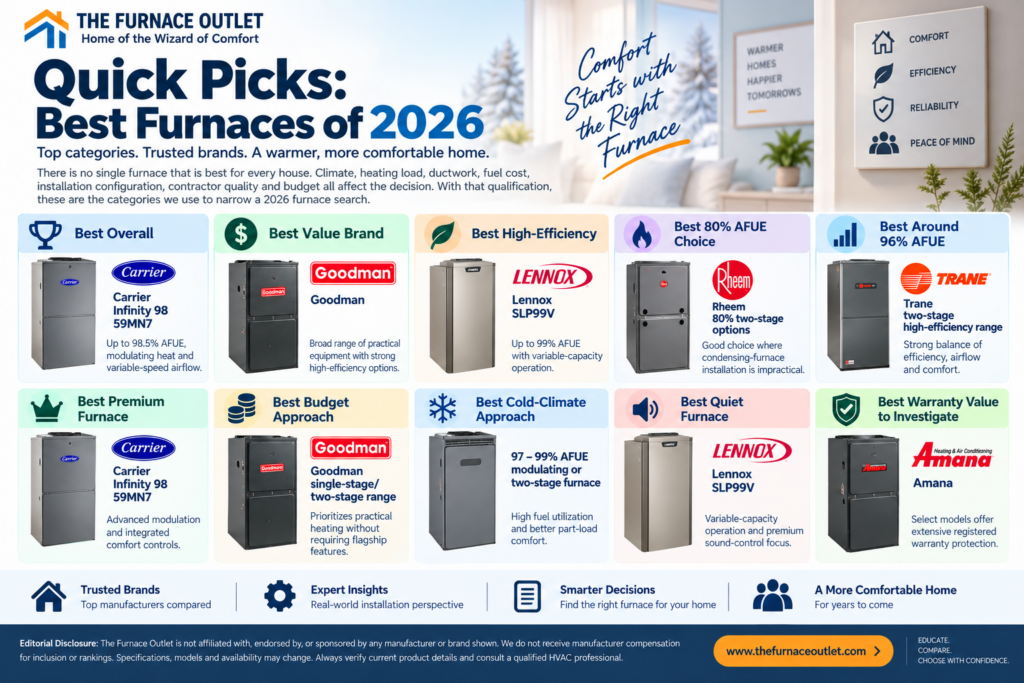
There is no single furnace that is best for every house. Climate, heating load, ductwork, fuel cost, installation configuration, contractor quality and budget all affect the decision. With that qualification, these are the categories I would use to narrow a 2026 furnace search.
| Category | Our 2026 Pick | Why It Stands Out |
|---|---|---|
| Best Overall | Carrier Infinity 98 59MN7 | Up to 98.5% AFUE, modulating heat and variable-speed airflow |
| Best Value Brand | Goodman | Broad range of practical equipment with strong high-efficiency options |
| Best High-Efficiency | Lennox SLP99V | Up to 99% AFUE with variable-capacity operation |
| Best 80% AFUE Choice | Rheem 80% two-stage options | Good choice where condensing-furnace installation is impractical |
| Best Around 96% AFUE | Trane two-stage high-efficiency range | Strong balance of efficiency, airflow and comfort |
| Best Premium Furnace | Carrier Infinity 98 59MN7 | Advanced modulation and integrated comfort controls |
| Best Budget Approach | Goodman single-stage/two-stage range | Prioritizes practical heating without requiring flagship features |
| Best Cold-Climate Approach | 97–99% AFUE modulating or two-stage furnace | High fuel utilization and better part-load comfort |
| Best Quiet Furnace | Lennox SLP99V | Variable-capacity operation and premium sound-control focus |
| Best Warranty Value to Investigate | Amana | Select models offer extensive registered warranty protection |
These selections should be treated as starting points rather than universal rankings. Model availability, capacities, orientations and specifications can change, and the best furnace is ultimately the one that matches the home’s actual heating load and installation requirements.
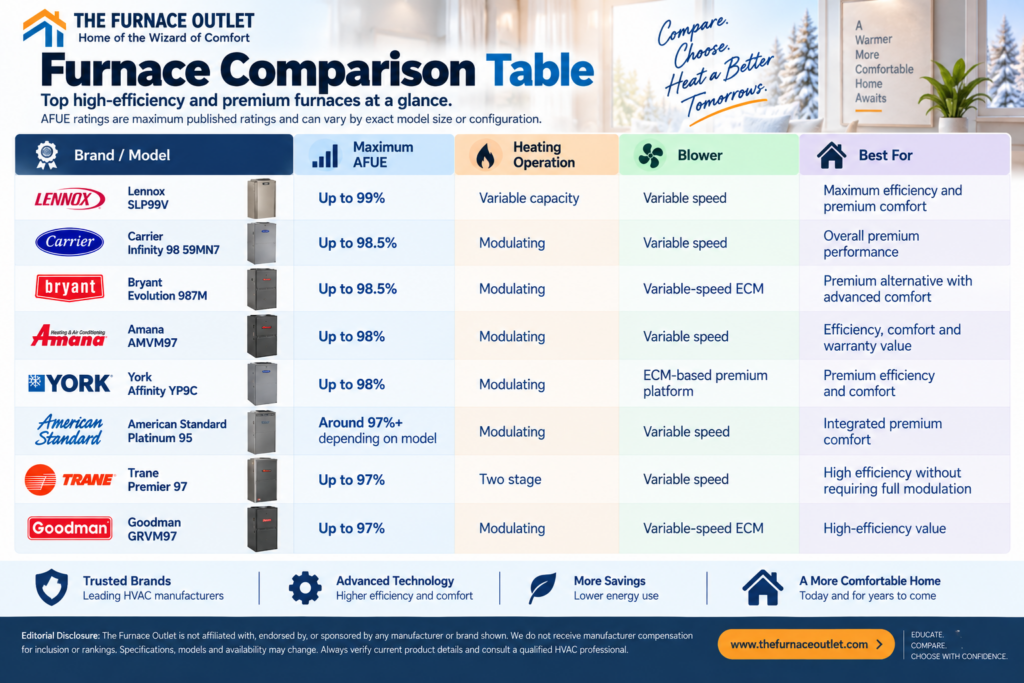
The table below gives homeowners a useful snapshot of how some notable premium and high-efficiency furnaces compare. AFUE ratings are maximum published ratings and can vary by exact model size or configuration.
| Brand / Model | Maximum AFUE | Heating Operation | Blower | Best For |
|---|---|---|---|---|
| Lennox SLP99V | Up to 99% | Variable capacity | Variable speed | Maximum efficiency and premium comfort |
| Carrier Infinity 98 59MN7 | Up to 98.5% | Modulating | Variable speed | Overall premium performance |
| Bryant Evolution 987M | Up to 98.5% | Modulating | Variable-speed ECM | Premium alternative with advanced comfort |
| Amana AMVM97 | Up to 98% | Modulating | Variable speed | Efficiency, comfort and warranty value |
| York Affinity YP9C | Up to 98% | Modulating | ECM-based premium platform | Premium efficiency and comfort |
| American Standard Platinum 95 | Around 97%+ depending on model | Modulating | Variable speed | Integrated premium comfort |
| Trane Premier 97 | Up to 97% | Two stage | Variable speed | High efficiency without requiring full modulation |
| Goodman GRVM97 | Up to 97% | Modulating | Variable-speed ECM | High-efficiency value |
Current manufacturer literature lists the Lennox SLP99V at up to 99% AFUE, while Carrier lists the Infinity 98 59MN7 at up to 98.5% AFUE. Bryant likewise lists the Evolution 987M at up to 98.5%, Amana lists its AMVM97 at 98%, and York lists the YP9C at up to 98%. Specifications should always be verified for the exact equipment combination being quoted.
The Carrier Infinity 98 59MN7 remains one of the most complete premium furnace packages for homeowners who want high efficiency and very precise comfort. Carrier currently rates the furnace at up to 98.5% AFUE, and its modulating gas valve can adjust heating output rather than simply operating at full capacity whenever the thermostat calls for heat. When used as part of the appropriate Infinity system, the furnace combines modulation with variable-speed airflow and integrated controls.
That matters because a furnace spends much of the heating season operating when outdoor conditions are less severe than the coldest design day. A properly configured modulating furnace can operate at reduced output during those periods, providing longer, gentler heating cycles instead of repeatedly turning full heat on and off.
I would not recommend paying the premium for this equipment unless the rest of the installation supports it. Correct sizing, adequate return air, appropriate supply duct capacity and proper commissioning are essential. Advanced equipment cannot compensate for a fundamentally poor installation.
Goodman remains an important brand for homeowners who care more about practical performance and value than owning the most expensive equipment available. The current lineup extends well beyond basic single-stage furnaces and includes sophisticated high-efficiency equipment such as the GRVM97, which Goodman lists at up to 97% AFUE with modulating operation, a variable-speed ECM blower and ComfortBridge technology.
That broad range is what makes Goodman interesting from a value perspective. A homeowner can choose a simpler furnace where budget and installation simplicity matter, or move into high-efficiency, variable-speed equipment without automatically moving into the highest-priced premium category.
Value, however, should never mean shopping for the lowest equipment price alone. Contractor quality matters enormously. A properly installed Goodman can be a better investment than a more expensive furnace installed with poor airflow, incorrect gas pressure, bad venting or improper furnace sizing.
For homeowners pursuing maximum gas efficiency, the Lennox SLP99V deserves serious consideration. Lennox currently publishes an efficiency rating of up to 99% AFUE for the SLP99V and positions the model as both its highest-efficiency and quietest furnace. The system uses variable-capacity heating rather than relying on a basic single-stage burner.
A 99% AFUE rating sounds impressive because it is. But homeowners should keep the number in perspective. The financial difference between a 96% and 99% furnace may be smaller than expected, especially in a moderate climate or a well-insulated home with relatively low annual heating demand.
The reason to consider equipment at this level is therefore not efficiency alone. Comfort, lower-stage operation, airflow management, sound characteristics and system integration may provide as much practical value as those final few AFUE percentage points.
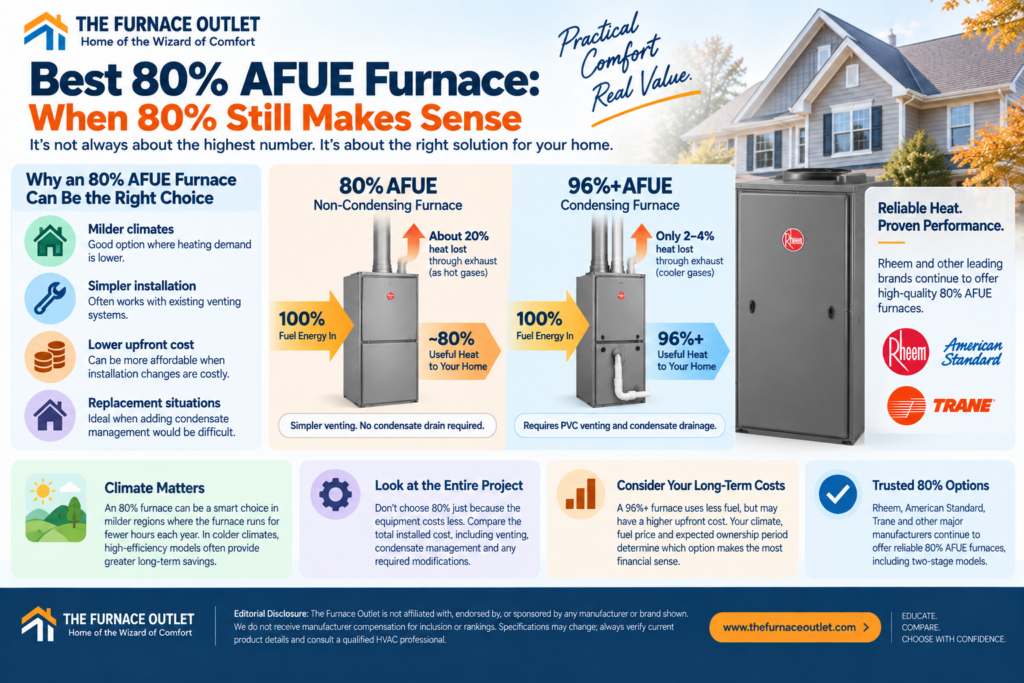
An 80% AFUE furnace can look outdated beside equipment advertising 96%, 97%, 98% or 99% efficiency, but there are installations where an 80% furnace remains a logical choice. These non-condensing furnaces can be particularly relevant in milder heating climates or replacement situations where changing venting and adding condensate management would significantly complicate the project.
Rheem, American Standard, Trane and other major manufacturers continue to offer 80% platforms. Rheem, for example, currently lists two-stage 80% AFUE equipment with constant-airflow motor options in its residential furnace lineup.
Do not choose 80% merely because the equipment costs less. Compare the entire installed project. A high-efficiency condensing furnace requires suitable venting and condensate disposal, while an 80% furnace loses more heat through the flue. Climate and annual runtime determine how meaningful that efficiency difference becomes.
For many homeowners, a furnace around 96% AFUE represents one of the most sensible compromises between efficiency and equipment cost. You recover much more heat from the fuel than with a conventional 80% furnace without necessarily paying for every feature found in a flagship modulating model.
This is where I often encourage homeowners to compare two-stage furnaces with ECM or variable-speed blowers. They can provide a meaningful comfort improvement over basic single-stage equipment while avoiding some of the complexity and cost of the most advanced communicating systems.
A good 96% furnace that is correctly sized and installed can be an excellent long-term heating system. Do not reject it simply because another model says 98% on the brochure.
The premium category is less about finding another percentage point of AFUE and more about how the furnace delivers heat. Carrier’s Infinity 98, Lennox’s SLP99V, Bryant’s Evolution 987M, Amana’s AMVM97 and York’s YP9C illustrate what premium furnace design looks like in 2026.
Expect features such as modulating or variable-capacity heating, variable-speed ECM blowers, advanced controls, diagnostics, insulated cabinets and better integration with matching air conditioners or heat pumps. Bryant, for example, lists the Evolution 987M with up to 98.5% AFUE, modulating operation, a variable-speed constant-airflow ECM blower and dual-fuel capability when properly paired.
Premium equipment makes the most sense when the homeowner values tighter temperature control, quieter operation and advanced system management and plans to remain in the home long enough to enjoy those benefits.
A budget furnace should be simple, correctly sized and properly installed, not simply cheap. In many homes, a straightforward single-stage furnace with an efficient ECM blower can provide dependable heating without the additional cost of modulation and proprietary controls.
Goodman is one of the first brands I would investigate in this category, but I would also obtain quotes for entry-level or mid-tier equipment from Rheem, Bryant, York, Carrier, Trane and American Standard. Local dealer strength can completely change the value equation.
If one contractor provides a detailed load calculation, inspects the ductwork and documents commissioning while another simply offers a cheaper furnace based on the capacity of the old unit, I would pay very close attention to the first proposal.
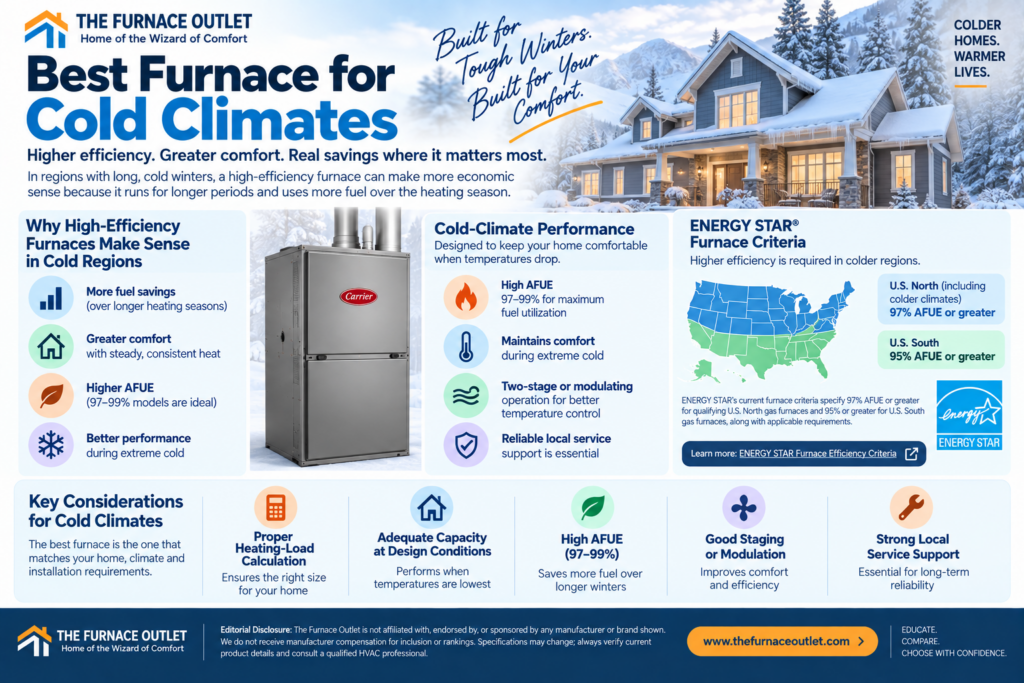
Cold climates are where high-efficiency furnaces become particularly compelling because the furnace operates for longer periods and consumes more fuel over the heating season. A 97–99% AFUE condensing furnace can therefore make more economic sense in Minnesota, Wisconsin or New England than it might in a region with short, mild winters.
ENERGY STAR’s current furnace criteria reflect this regional difference. Its criteria specify 97% AFUE or greater for qualifying U.S. North gas furnaces and 95% or greater for U.S. South gas furnaces, along with applicable requirements.
ENERGY STAR Furnace Efficiency Criteria
For severe winters, I would prioritize correct heating-load calculation, adequate capacity at design conditions, high AFUE, good staging or modulation and strong local service support. The highest-efficiency furnace in the world is not useful if it has been undersized or if qualified service for that particular system is difficult to obtain locally.
Noise is more complicated than comparing published sound claims. Burner operation, inducer design, blower speed, cabinet insulation, return-air design and duct velocity all contribute to what you actually hear inside the house.
The Lennox SLP99V deserves consideration in this category because Lennox specifically positions it around high efficiency and quiet operation. Premium variable-capacity furnaces from Carrier, Bryant, Amana, York and others can also operate quietly because they can spend substantial time at lower output rather than repeatedly starting at maximum heating capacity.
Installation again matters. Restrictive ductwork can make an expensive variable-speed furnace sound far less sophisticated than the brochure suggests.
Goodman covers a broad portion of the residential market and is particularly attractive to value-conscious homeowners. Its range includes straightforward furnaces as well as high-efficiency modulating models such as the GRVM97.
I would consider Goodman when the homeowner wants to put more of the project budget into proper sizing, duct improvements, filtration or installation quality rather than spending everything on the equipment badge.
Carrier offers one of the broadest furnace lineups, spanning basic comfort equipment through sophisticated Infinity systems. The Infinity 98 59MN7 is the standout for homeowners who want modulation, high efficiency and integrated system controls.
Carrier can be particularly attractive when the furnace will be combined with matching premium cooling equipment and the homeowner wants the entire HVAC system designed as an integrated package rather than as separate appliances.
Trane has a strong reputation in residential HVAC and offers several approaches to furnace efficiency and staging. Its current 97 Two-Stage Variable Speed Gas Furnace, formerly identified as the S9V2-VS platform, combines two-stage heating with a variable-speed blower and stainless-steel primary and secondary heat exchangers.
For homeowners who want high efficiency and improved comfort but do not necessarily need full modulation, this type of two-stage variable-speed design is worth comparing against premium modulating equipment.
Lennox occupies a strong position at the premium end of the furnace market. The SLP99V is the headline product, with efficiency reaching up to 99% AFUE, while Lennox also offers less elaborate furnaces for homeowners who do not need its flagship technology.
I would put Lennox high on the comparison list when efficiency, quiet operation and premium comfort are priorities, but the installed price and quality of the local dealer should still be evaluated carefully.
Rheem’s lineup spans 80% furnaces through high-efficiency equipment, including the R98MV, which Rheem lists at 98% AFUE with modulating heating and a constant-airflow motor. That gives homeowners room to select equipment according to climate and project requirements instead of forcing every installation into the same efficiency tier.
Rheem is particularly worth considering when a strong local contractor supports the brand and can properly commission its airflow and controls.
Amana’s premium furnaces combine high efficiency with features such as ComfortBridge technology and variable-speed operation. The AMVM97 is currently listed at 98% AFUE with a modulating gas valve, variable-speed circulator motor and stainless-steel tubular primary heat exchanger.
Warranty terms are another reason homeowners often investigate Amana. Some registered residential products offer extensive coverage, although the exact model, registration requirements, ownership conditions and exclusions need to be checked before purchasing.
Bryant shares a technology-rich approach with its premium Evolution equipment. The Evolution 987M reaches up to 98.5% AFUE and combines modulation with variable-speed airflow. Bryant also offers less expensive two-stage and single-stage choices, so homeowners do not have to buy the flagship model to stay within the brand.
The 987M is particularly interesting for homeowners considering a hybrid system because Bryant identifies it as capable of operating in a heat-pump/furnace configuration when properly matched.
York’s premium Affinity YP9C reaches up to 98% AFUE and uses modulating operation. York lists a lifetime heat-exchanger warranty and 10-year parts coverage for the model subject to its applicable warranty and registration terms.
York should not be overlooked simply because another brand has stronger consumer name recognition. Local installation and service support should be part of the comparison.
American Standard offers equipment ranging from simpler systems to premium variable-speed and modulating furnaces. Its Platinum 95 platform uses modulating heating and variable-speed airflow, while the S9V2-VS platform provides a 97% AFUE two-stage alternative.
For homeowners comparing American Standard and Trane, look beyond the badge and compare the specific quoted models, controls, warranty, dealer quality and installed price.
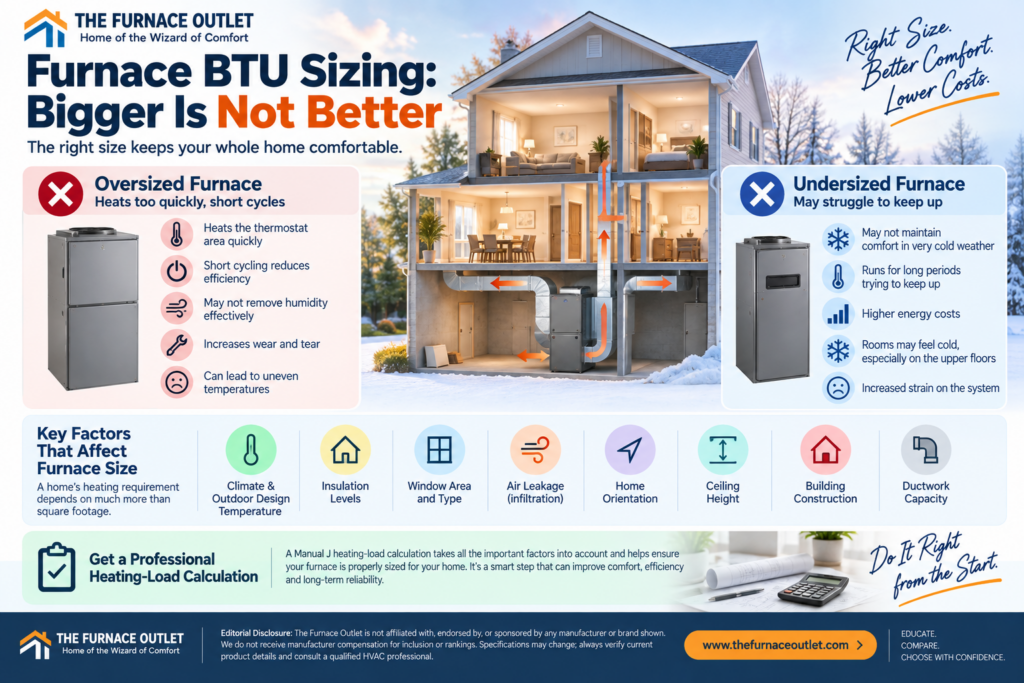
One of the biggest furnace mistakes happens before installation begins: choosing capacity based mainly on the old furnace or a rough square-footage rule. A home’s heating requirement depends on much more than floor area. Climate, outdoor winter design temperature, insulation, window area, air leakage, orientation, ceiling height and building construction all influence heat loss. Existing ductwork also has to handle the airflow associated with the selected equipment.
An oversized furnace can heat the thermostat area quickly and shut down before temperatures throughout the house stabilize. Repeated short cycles can hurt comfort and create unnecessary equipment cycling. An undersized furnace may struggle during severe weather. A professional heating-load calculation should therefore be part of the selection process rather than an afterthought.
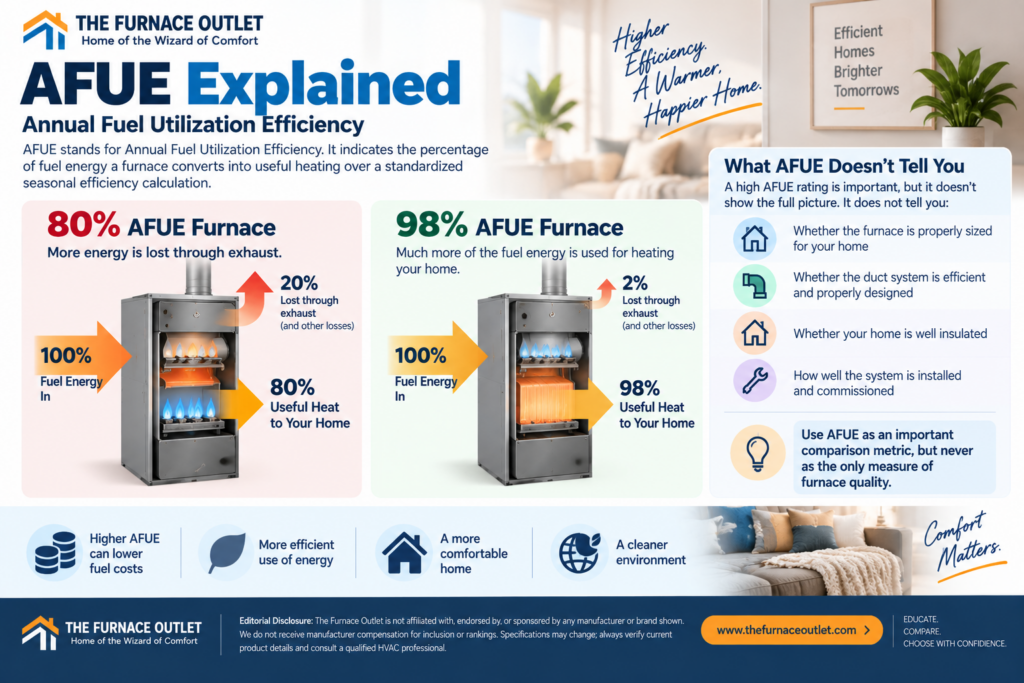
AFUE stands for Annual Fuel Utilization Efficiency. In simplified terms, it indicates the percentage of fuel energy a furnace converts into useful heating over its standardized seasonal efficiency calculation.
An 80% AFUE furnace therefore loses substantially more fuel energy through combustion and venting than a furnace rated around 96–98%. A high AFUE rating, however, does not tell you whether the furnace is properly sized, whether the duct system is efficient or whether the home itself is poorly insulated.
Use AFUE as an important comparison metric, but never as the only measure of furnace quality.
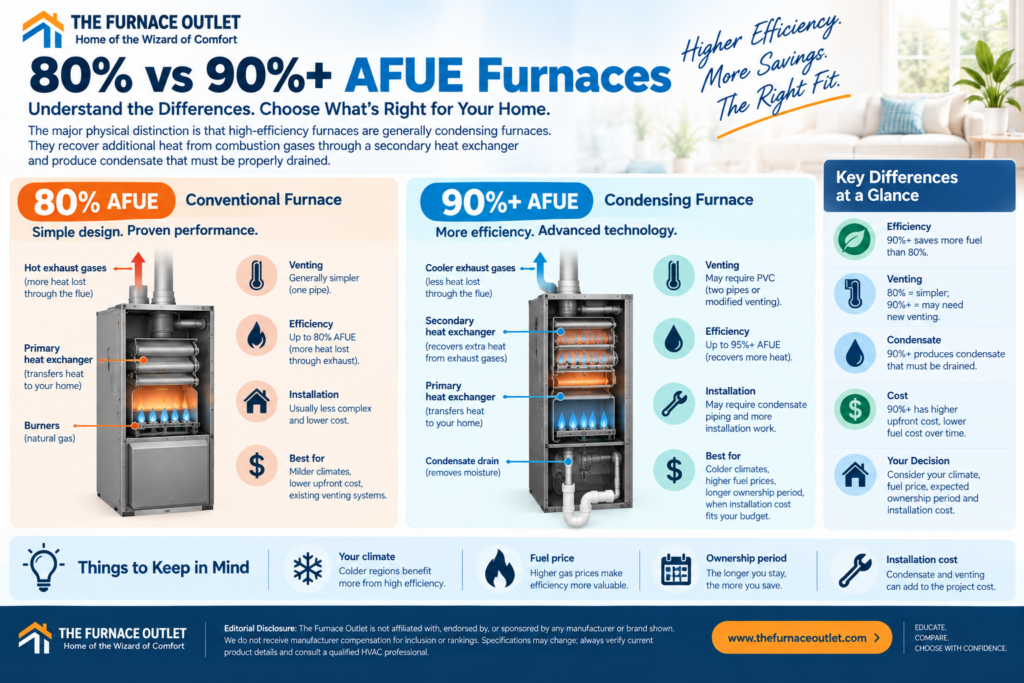
The major physical distinction is that high-efficiency furnaces are generally condensing furnaces. They recover additional heat from combustion gases through a secondary heat exchanger and produce condensate that must be properly drained.
An 80% furnace generally has simpler venting arrangements in existing applications but sends more heat out through the exhaust. A 90%+ furnace saves more fuel but may require new venting, condensate piping and changes around the installation area. Your climate, fuel price, expected ownership period and installation cost should determine which makes financial sense.
A single-stage furnace is fundamentally an on-or-off heating appliance. When there is a heating call, the burner operates at its designed heating rate. A two-stage furnace can operate at a lower first-stage output for moderate heating demand and move to higher output when required. That can produce longer heating cycles, steadier temperatures and less aggressive airflow during much of the season.
For many homeowners, two-stage heating is the practical middle ground between basic equipment and expensive modulation.
A modulating furnace can vary heat output across a broader operating range instead of choosing between only one or two heating levels. The main benefit is comfort. When conditions are mild, the furnace can operate at reduced capacity for longer periods. When the weather becomes severe, output increases.
Do not assume modulation automatically saves enough fuel to justify any price difference. Its strongest argument is often temperature stability, lower-stage operation and overall comfort.
Modern ECM blower motors are a significant improvement in furnace technology. Depending on the specific design and controls, they can provide more efficient airflow management and allow the furnace to coordinate better with air-conditioning and heat-pump operation.
Variable-speed ECM systems can also ramp airflow rather than abruptly jumping from off to full blower speed. That can improve perceived comfort and sound quality. Airflow still needs to be measured. A sophisticated motor should never be treated as permission to ignore undersized ducts or excessive static pressure.
Furnaces are available in different airflow configurations because homes are built differently. An upflow furnace commonly draws return air from below or the side and supplies heated air upward. A downflow furnace sends conditioned air downward and can be useful in certain attic or slab-based duct arrangements. A horizontal furnace lies on its side and is frequently used in attics, crawlspaces and other constrained installations.
Do not choose orientation from a photograph. The installation location, duct layout, service clearances, venting and manufacturer-approved configurations determine what is appropriate.
Many gas furnaces are designed primarily for natural gas but can be converted for propane using manufacturer-approved components when the model permits it.
Propane contains different fuel characteristics and requires correct conversion procedures, gas pressure setup and combustion verification. This is not a situation for improvised adjustments. Where both fuels are available, compare local fuel pricing, infrastructure and long-term operating cost rather than simply assuming one fuel is always cheaper.
Your furnace is also part of the cooling system because its blower moves air across the indoor evaporator coil. That means furnace airflow capabilities must be appropriate for the air conditioner. When replacing both systems, I prefer to evaluate them as a matched HVAC system. The blower, coil, outdoor equipment and controls need to work together, and applicable certified performance combinations should be verified.
AHRI Directory of Certified Product Performance
This becomes increasingly important with advanced variable-capacity air conditioners and heat pumps. Never assume that any furnace and any outdoor unit will automatically deliver the published efficiency ratings when connected together.
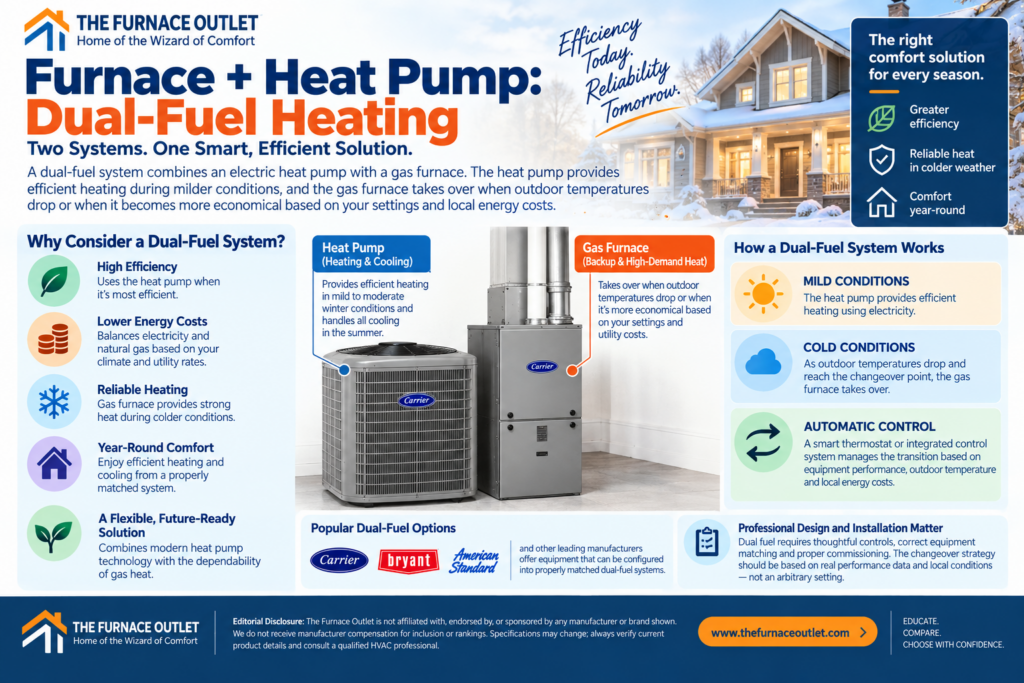
A dual-fuel system combines an electric heat pump with a gas furnace. During milder winter conditions, the heat pump can provide heating. As outdoor conditions change and the control strategy reaches the appropriate balance or changeover point, the gas furnace can take over.
This approach can be attractive for homeowners who want heat-pump efficiency without giving up gas heat during colder conditions. Carrier, Bryant, American Standard and other manufacturers offer equipment capable of being configured into appropriately matched hybrid systems. Dual fuel requires thoughtful controls and commissioning. The changeover strategy should reflect equipment performance, outdoor temperature and local energy costs rather than an arbitrary setting.
There is no responsible national price tag that applies to every furnace installation. The furnace itself is only one part of the job.
A replacement may involve venting changes, condensate drainage, gas piping, electrical work, thermostat or communicating controls, filter cabinets, sheet-metal transitions, return-air improvements, permits, removal of old equipment and commissioning. This is why two quotes for the “same size furnace” can differ substantially. Ask what is actually included before deciding that one contractor is expensive and another is cheap.
Homeowners naturally ask which furnace brand is most reliable. Brand and component design certainly matter, but I would not rank reliability from the badge alone.
Incorrect airflow, excessive static pressure, poor venting, improper gas pressure, bad condensate drainage and weak maintenance can shorten the useful life of otherwise good equipment. The strongest purchase is usually a combination of well-supported equipment and a contractor who installs it correctly.
Many manufacturers advertise 10-year registered parts warranties and long or lifetime heat-exchanger coverage on qualifying equipment, but the details vary considerably. Registration deadlines, original-owner requirements, transferability and exclusions can affect actual coverage.
Some premium products add unit-replacement provisions under specified circumstances. Do not compare warranties by headline length alone. Read the current warranty document for the exact model before purchase.
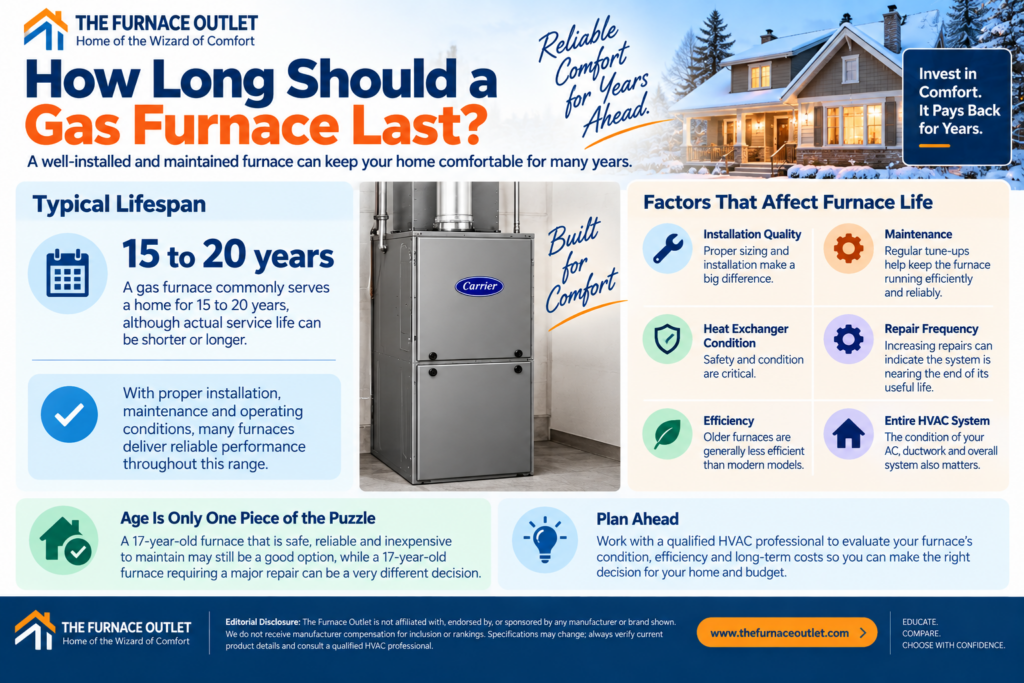
A well-installed and maintained gas furnace commonly serves a home for many years, and a useful planning range is often roughly 15 to 20 years, although actual service life can be shorter or longer.
Age alone does not determine replacement. Heat-exchanger condition, repair frequency, parts availability, efficiency, comfort problems and the condition of the rest of the HVAC system all matter. A 17-year-old furnace requiring a major repair is a very different decision from a 17-year-old furnace that remains safe, reliable and inexpensive to maintain.
Premium furnaces make the most sense when you value quieter operation, tighter temperature control, advanced airflow, sophisticated system integration and high efficiency, especially in climates with substantial heating demand.
They are less compelling when the house has serious duct problems, poor insulation or a limited budget that forces you to compromise on installation quality. If I had to choose between spending an extra $3,000 on a flagship furnace or using part of that money to correct an inadequate return-air system and install a properly sized mid-range furnace, I would often choose the second approach. Installation quality is a feature you cannot see on the equipment brochure, but it may be one of the most important features you buy.
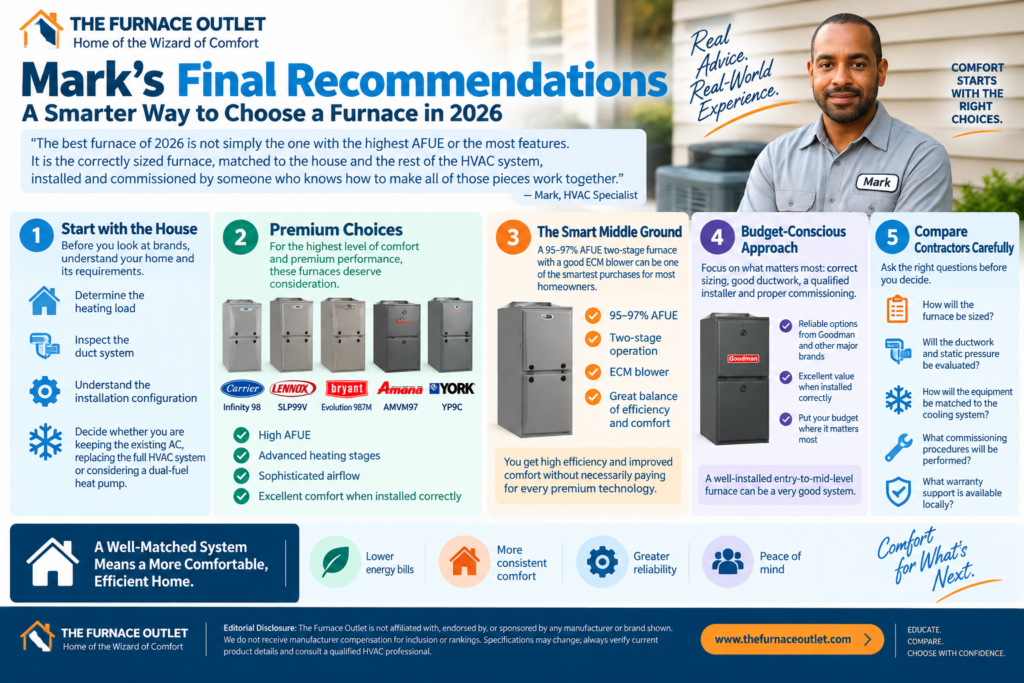
If you are shopping for a furnace in 2026, I would start by resisting the temptation to choose a brand immediately. Start with the house. Determine the heating load, inspect the duct system, understand the installation configuration and decide whether you are keeping the existing air conditioner, replacing the complete HVAC system or considering a dual-fuel heat pump.
For homeowners who want the highest level of comfort and are prepared for premium pricing, furnaces such as the Carrier Infinity 98, Lennox SLP99V, Bryant Evolution 987M, Amana AMVM97 and York YP9C deserve consideration. Their combination of high AFUE, advanced heating stages and sophisticated airflow can deliver excellent comfort when installed correctly.
For the broader market, however, I would pay very close attention to the middle of the range. A 95–97% AFUE two-stage furnace with a good ECM blower can be one of the smartest purchases available. You get high efficiency and improved comfort without necessarily paying for every premium technology.
For budget-conscious homeowners, I would rather see money spent on correct sizing, good ductwork, a qualified installer and proper commissioning than see the entire budget consumed by a flagship furnace. Goodman and the entry-to-mid-level ranges from the other major manufacturers can make very good systems when the installation is right.
Finally, compare contractors as carefully as you compare furnaces. Ask how the furnace will be sized, whether the ductwork and static pressure will be evaluated, how the equipment will be matched to the cooling system, what commissioning procedures will be performed and what warranty support is available locally.
After more than 15 years around HVAC installation, that is the point I would leave every homeowner with: the best furnace of 2026 is not simply the furnace with the highest AFUE or the most features. It is the correctly sized furnace, matched to the house and the rest of the HVAC system, installed and commissioned by someone who knows how to make all of those pieces work together.
Homeowners who want to verify efficiency criteria and equipment specifications can consult ENERGY STAR’s Furnace Criteria for current furnace-efficiency requirements and the AHRI Directory of Certified Product Performance for certified HVAC equipment combinations. Manufacturer specifications should also be checked directly; useful references include Carrier’s Furnace Buyer’s Guide, Lennox’s Current Furnace Lineup and Rheem’s Residential Furnace Lineup.
Editorial Disclosure: The Furnace Outlet is an independent educational and editorial resource. The Furnace Outlet is not associated with, affiliated with, endorsed by or sponsored by Carrier, Lennox, Trane, Goodman, Rheem, Amana, Bryant, York, American Standard or any other manufacturer or brand mentioned in this guide. We do not receive manufacturer compensation for inclusion in or placement within these rankings. Brand and model selections represent editorial assessments based on publicly available specifications, features and intended applications.
Educational & Product Disclaimer: This article is provided for general educational and informational purposes and should not replace an on-site evaluation by a qualified HVAC professional. Furnace efficiency, capacity, operating cost, noise, reliability, compatibility and performance vary according to the specific model, home, climate, fuel cost, duct system, installation and maintenance. Product specifications, model availability, warranty terms, certifications, rebates and manufacturer offerings may change. Always verify current specifications and warranty terms with the manufacturer and your HVAC contractor before purchasing equipment.
Installation & Safety Disclaimer: Gas furnaces involve combustible fuel, combustion gases, electrical components and venting requirements. Installation, conversion, adjustment, commissioning, inspection and repair should be performed in accordance with applicable manufacturer instructions, codes and regulations by appropriately qualified HVAC professionals. A professional load calculation and evaluation of the home’s ductwork, venting, gas supply and complete HVAC system are recommended before selecting replacement equipment.
Last updated: September 2026.