Newsletter Subscribe
Enter your email address below and subscribe to our newsletter

HVAC made simple
By Tony Marino (Tony the Trusted Tech) The Furnace Outlet | Updated October 2026
When winter temperatures drop and your heat pump struggles to keep the house warm, auxiliary heat can provide the additional heating capacity needed to maintain indoor comfort. But what happens when the thermostat displays “AUX HEAT,” the indoor temperature continues falling, and the backup heating system never seems to engage? Some homeowners notice that their heat pump runs almost continuously without reaching the thermostat setting. Others discover the problem during a defrost cycle, when the supply air becomes noticeably cooler than usual.
After decades of working with residential HVAC systems, I’ve learned that auxiliary heating problems are frequently misunderstood. A homeowner may assume the electric heat strips have burned out, while the actual problem involves thermostat configuration, a failed sequencer, an electrical supply issue, or a control signal that never reaches the air handler. In other cases, the auxiliary heater is functioning correctly, but the thermostat has not requested it because the equipment’s operating conditions do not require supplemental heating.
The challenge is determining whether the backup heat is genuinely failing or simply operating according to the manufacturer’s control strategy. Modern heat pumps use increasingly sophisticated thermostats, outdoor temperature sensors, staging controls, and communicating electronics. These features improve efficiency, but they also make troubleshooting more complicated than checking whether a heating element becomes hot. In this guide, I’ll explain how auxiliary heat works, why it may fail to activate, how thermostat and heat strip problems differ, and what homeowners can safely check before calling an HVAC technician. I’ll also cover the warning signs of failed backup heating, professional diagnostic procedures, and practical steps to prepare your system for the 2026–2027 winter heating season.
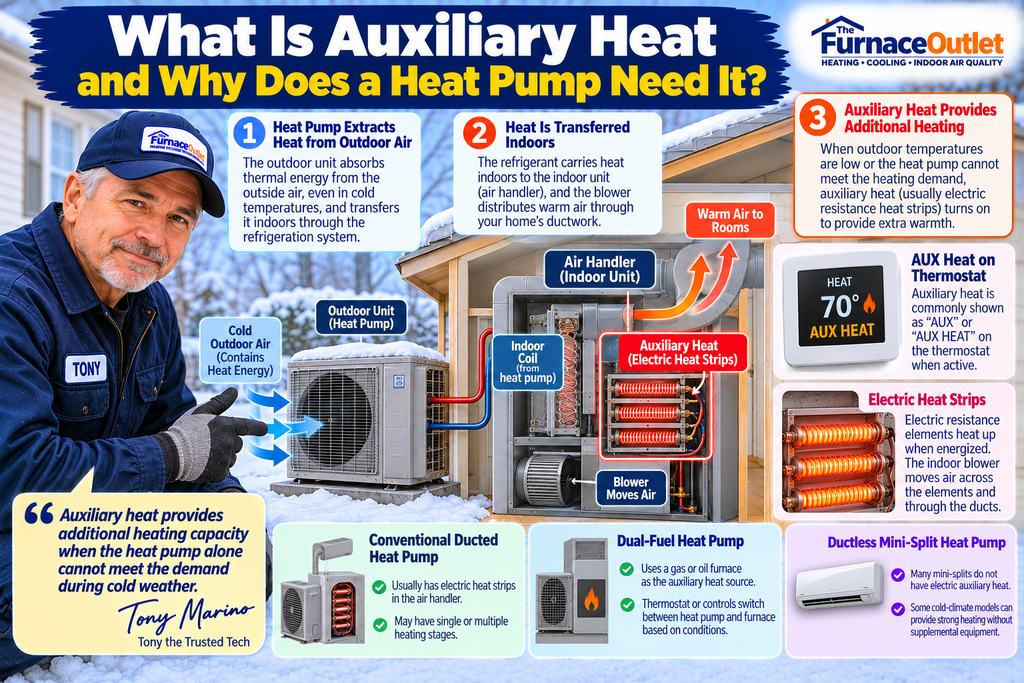
An air-source heat pump normally heats your home by extracting thermal energy from outdoor air and transferring it indoors through its refrigeration system. As outdoor temperatures fall, the building’s heating demand generally increases, while the heat pump’s available heating capacity may decrease, depending on its design. At some point, the equipment may need supplemental heating to maintain the desired indoor temperature.
Auxiliary heat, commonly displayed as “AUX” on a thermostat, refers to additional heating capacity that operates alongside or in coordination with the heat pump. In many conventional ducted systems, this backup consists of electric resistance heating elements installed inside the air handler. Other installations may use a gas or oil furnace as part of a dual-fuel heating system. Electric heat strips operate by passing electricity through resistance elements that produce heat. The indoor blower moves air across these elements and distributes the warmed air through the home’s ductwork. Depending on the installation, the heat strips may operate in multiple stages rather than energizing at full capacity immediately.
Not every heat pump includes auxiliary heat. Many ductless mini-split systems operate without electric resistance backup, and some cold-climate heat pumps are designed to cover a large portion of the home’s heating demand without supplemental equipment. Before troubleshooting an apparent auxiliary heating failure, the homeowner or technician must confirm that backup heat is actually installed and enabled.
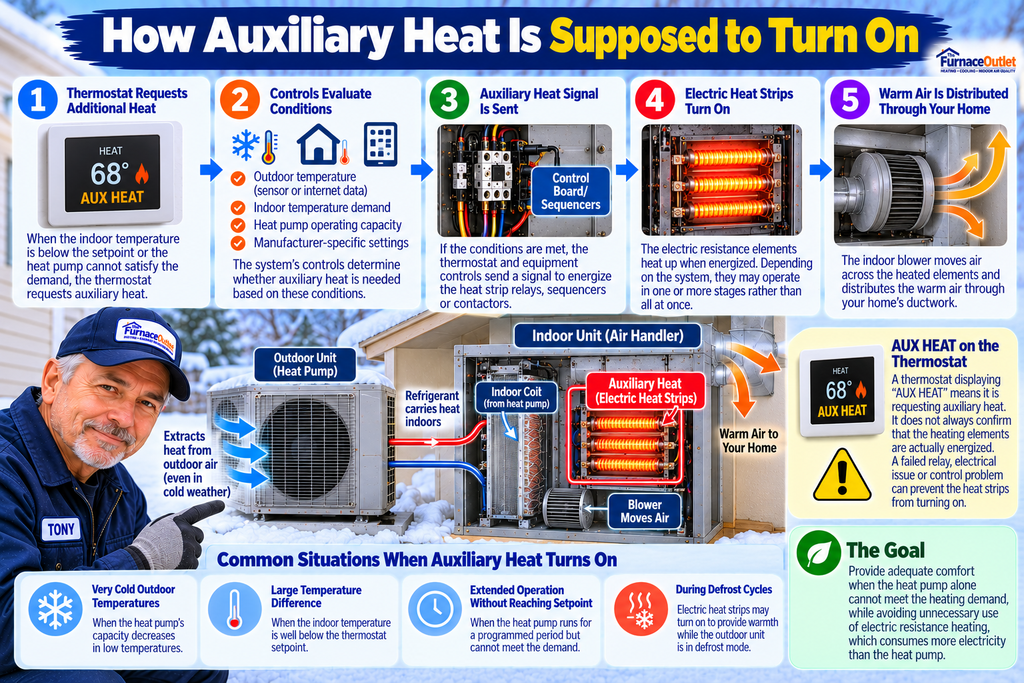
In a properly configured system, auxiliary heat is activated according to the thermostat’s staging logic, outdoor temperature conditions, indoor temperature demand, and equipment controls. A conventional thermostat may request supplemental heat when the difference between the desired temperature and actual indoor temperature becomes sufficiently large or when the heat pump cannot satisfy the heating demand within a programmed period. Some systems use an outdoor temperature sensor or internet-based weather information to influence staging decisions. Others use communicating controls that evaluate equipment capacity, operating conditions, and manufacturer-specific settings. The objective is to provide adequate comfort while avoiding unnecessary use of electric resistance heating, which generally consumes more electricity per unit of delivered heat than an efficiently operating heat pump.
Auxiliary heating may also operate during certain defrost cycles. When a conventional heat pump temporarily reverses its refrigeration cycle to warm the outdoor coil, the indoor coil may no longer provide normal heating. Electric supplemental heat can help offset the temporary reduction in delivered warmth, depending on the system’s design.
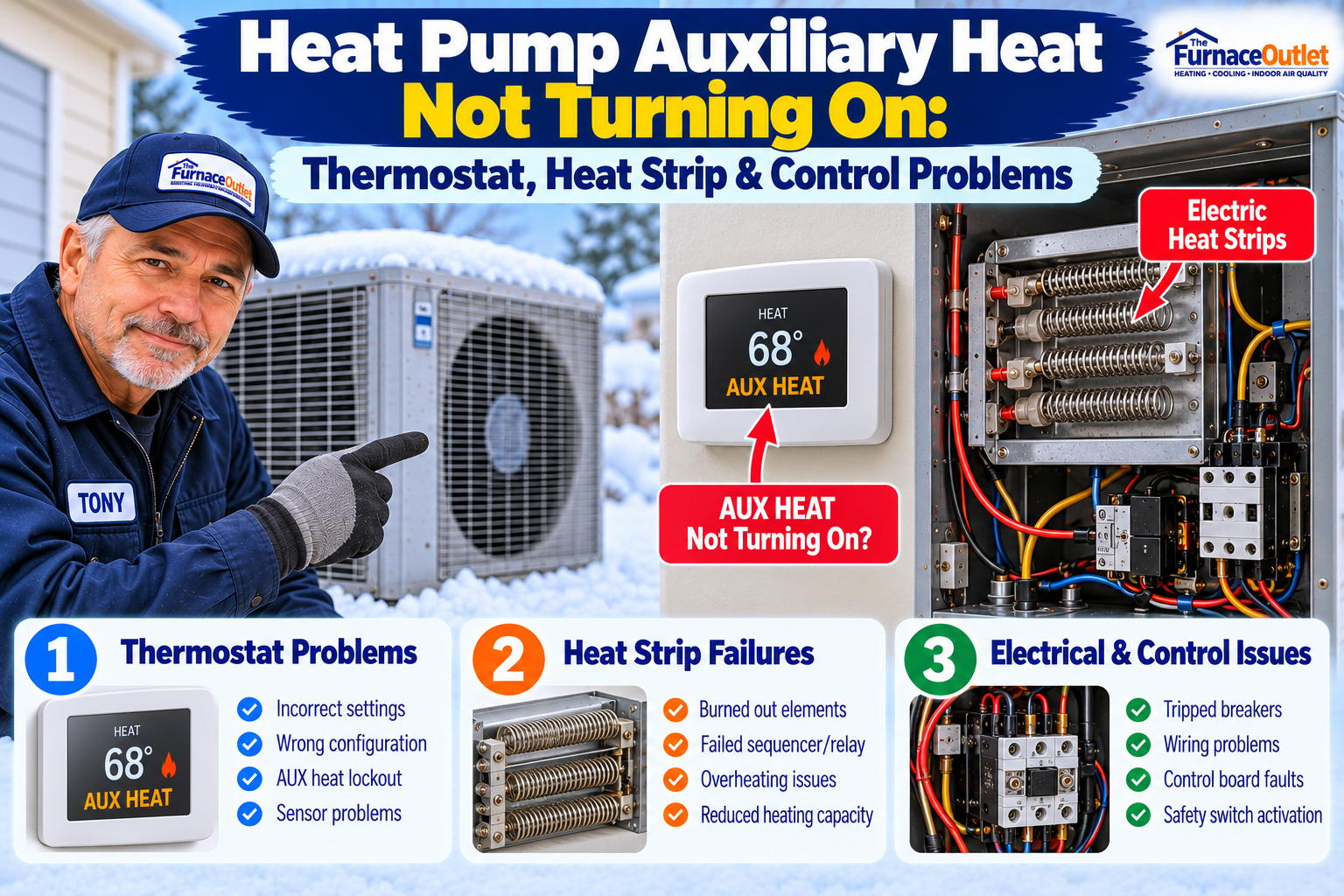
A thermostat displaying “AUX HEAT” does not always prove that the heating elements are energized. It may indicate that the thermostat is requesting supplemental heating, while a failed relay, disconnected electrical circuit, or equipment control problem prevents the requested heat from being delivered. That distinction is central to accurate troubleshooting.
One of the first things I check when auxiliary heat is not working is the thermostat configuration. A thermostat can appear to operate normally while using incorrect equipment settings that prevent the backup heating stages from activating. This problem is particularly common after thermostat replacement, system upgrades, or changes to installer settings.
Heat pump thermostats must be configured for the correct equipment type and available heating stages. A thermostat set up for a conventional furnace or an incorrect number of auxiliary heating stages may fail to send the proper signals. On certain systems, installer-defined temperature thresholds or staging restrictions can also prevent supplemental heat from engaging when expected. Smart thermostats introduce additional variables. Some use algorithms that prioritize heat pump efficiency, delay auxiliary heating, or limit backup operation above a configured outdoor temperature. These settings can be useful when properly matched to the equipment, but incorrect configuration may create comfort problems during unusually cold weather.
I recommend verifying the thermostat’s displayed operating mode and reviewing the equipment configuration with the installation documentation. Homeowners should avoid changing unfamiliar installer settings because an incorrect adjustment can interfere with heating, cooling, or defrost operation.
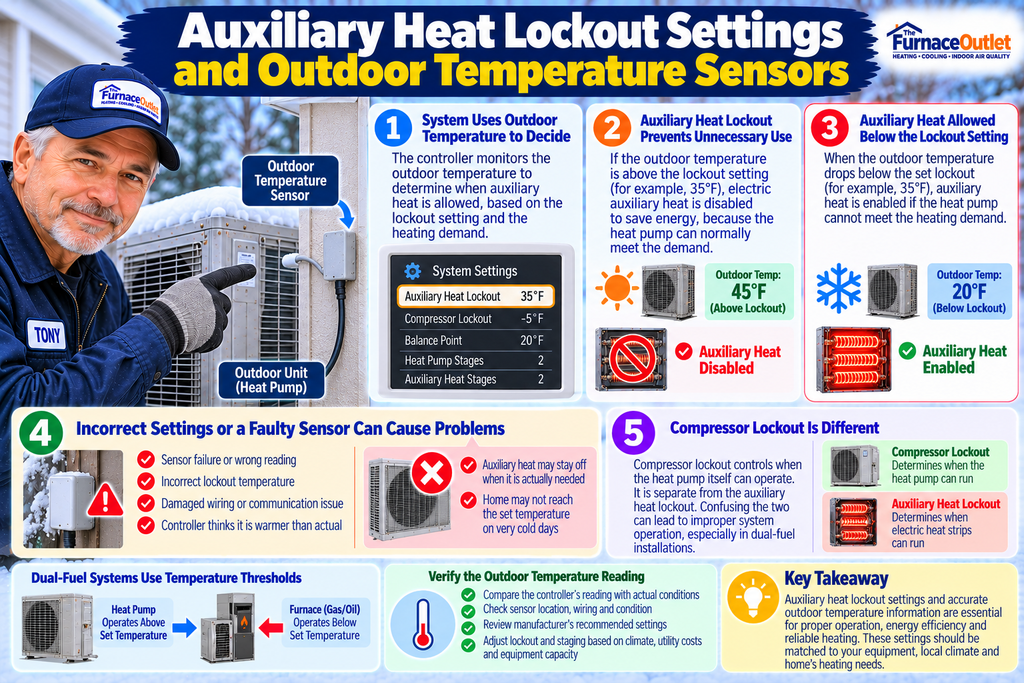
Many heat pump systems use outdoor temperature information to decide when auxiliary heating is permitted. An auxiliary heat lockout setting can prevent electric resistance heat from operating above a specified outdoor temperature, reducing unnecessary energy consumption when the heat pump can meet the heating demand independently. Problems arise when the lockout temperature is set incorrectly or the system receives inaccurate outdoor temperature information. A defective outdoor sensor, damaged wiring connection, or communication problem may cause the controller to believe conditions are warmer than they actually are. Depending on the control logic, auxiliary heat may remain disabled even when additional heating is needed.
Some systems also have compressor lockout settings that determine when the heat pump itself is permitted to operate. These settings are different from auxiliary heat lockouts, and confusing the two can lead to improper equipment operation. In dual-fuel installations, temperature thresholds may control the transition between heat pump heating and furnace heating rather than simply adding electric heat strips. A technician should compare the controller’s reported outdoor temperature with actual conditions and review the manufacturer’s recommended staging strategy. Lockout settings should reflect the installed equipment, climate, utility costs, and available heating capacity rather than an arbitrary universal temperature.
Electric heat strips are among the most recognizable auxiliary heating components in a ducted heat pump system. They typically consist of resistance elements mounted within the air handler’s airflow path. When the appropriate controls energize them, the elements produce heat that supplements the heat pump’s output. A heating element can fail because of electrical damage, overheating, physical deterioration, or other component problems. Depending on the heater assembly, one failed element may reduce available heating capacity while other stages continue operating. This can make the problem difficult to recognize because the system may still deliver some warm air.
The technician should verify whether the heater assembly is receiving the correct operating command and electrical supply before concluding that the elements have failed. Manufacturer-approved testing can help determine whether an element has an open circuit or another electrical defect. It is equally important to investigate why a heating element failed. Restricted airflow, defective controls, or improper installation can contribute to overheating. Replacing a damaged element without correcting the underlying condition may result in another failure or create a safety concern.
Electric auxiliary heaters often use sequencers, relays, or contactors to control when individual heating stages become energized. These components help coordinate heater operation with the indoor blower and may stagger electrical loads to avoid energizing all heating elements simultaneously. A defective sequencer may prevent one or more heating stages from activating, even when the thermostat correctly requests auxiliary heat. In other cases, a relay may fail to close, leaving the heating elements without power. The exact arrangement varies by equipment manufacturer and heater design.
Some newer systems use electronic control boards instead of traditional electromechanical sequencers. These controls may incorporate timing logic, protective monitoring, and communication with the thermostat or outdoor equipment. A technician should establish whether the appropriate control signal reaches the heater assembly and whether the switching components respond as intended. Replacing a sequencer or relay based solely on a lack of heat can be misleading because an upstream thermostat, wiring, or safety-control problem may produce the same symptom.
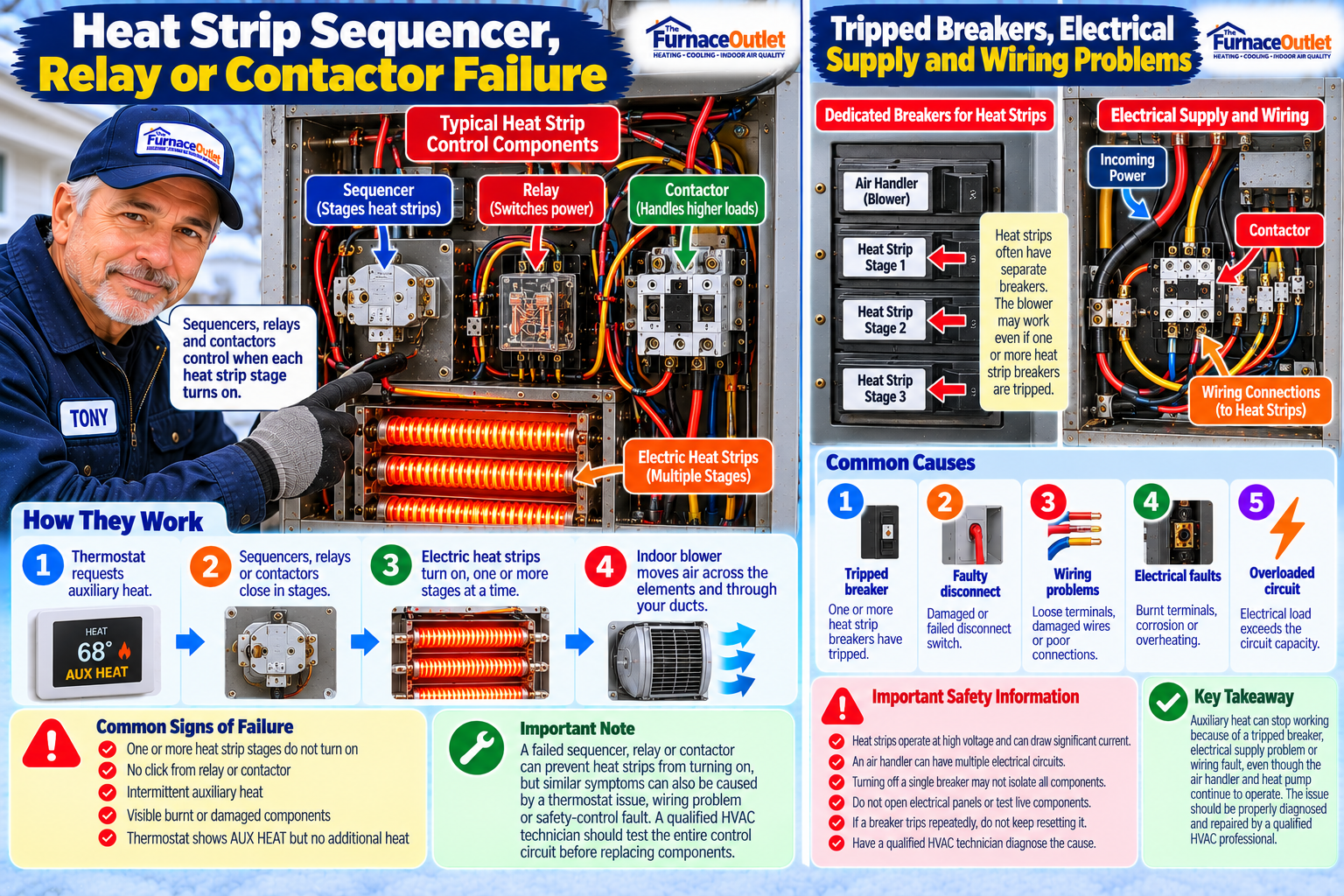
Electric heat strips can require substantial electrical power, and many air handlers have separate circuits or breakers for supplemental heating. Consequently, the indoor blower and heat pump may continue operating even when the auxiliary heater’s electrical supply has been interrupted. A tripped breaker, damaged disconnect, loose terminal, deteriorated wire, or other electrical fault can prevent one or more heating stages from receiving power. In some installations, multiple heater circuits serve different stages, so a supply problem may reduce backup heating capacity without eliminating it completely.
Homeowners should be aware that an air handler can contain more than one electrical circuit. Turning off a single breaker may not isolate every energized component. This is one reason internal heater troubleshooting should be left to qualified professionals. If a breaker has tripped, consult the equipment instructions and arrange service when the cause is uncertain. Repeatedly resetting a breaker is not a repair. A breaker that trips again may indicate an electrical fault, overloaded circuit, damaged heating element, or other condition requiring professional investigation.
Electric auxiliary heaters include safety devices intended to prevent unsafe operating temperatures. High-temperature limit switches may interrupt heater operation when the equipment becomes excessively hot, helping protect the heater assembly and surrounding components. Restricted indoor airflow is one possible reason for overheating. A severely dirty air filter, blocked return-air grille, closed or obstructed supply registers, malfunctioning blower, or ductwork problem can reduce the amount of air moving across the heating elements.
When airflow is inadequate, the heat strips may reach temperatures that activate protective controls. Depending on the equipment, a limit device may reset automatically after cooling, require manual service intervention, or indicate a fault that prevents continued operation. The result may be intermittent auxiliary heat, reduced heating capacity, or a system that repeatedly attempts to activate backup heating without sustaining it. A technician should evaluate airflow, blower operation, heater staging, and the relevant protective devices before replacing components. Safety switches must never be bypassed to restore heating. Their activation is a warning that the equipment may be experiencing an unsafe operating condition.
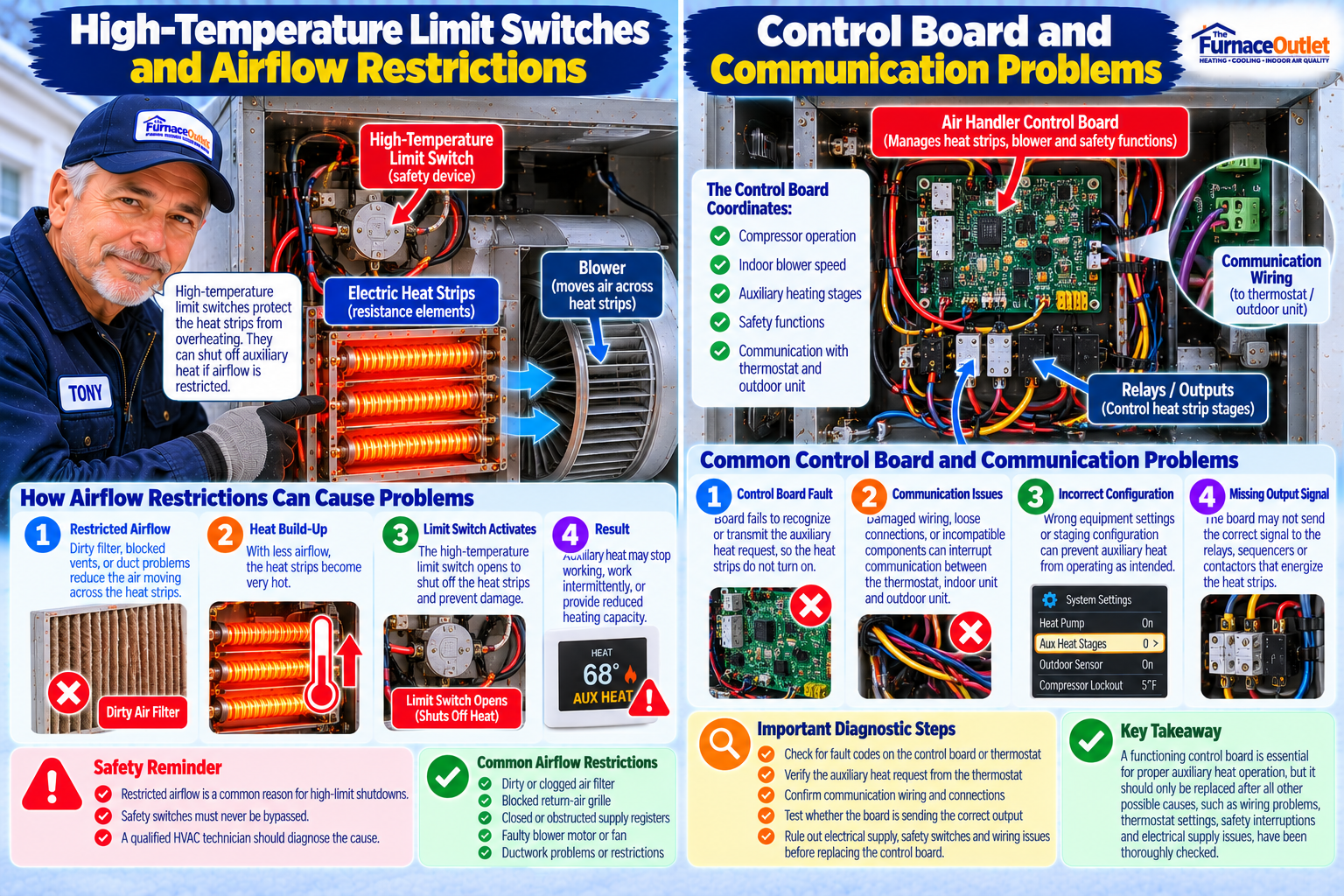
Modern heat pump systems often rely on electronic control boards to coordinate compressor operation, indoor blower speed, auxiliary heating stages, and safety functions. If the air handler’s control board fails to recognize or transmit an auxiliary heating request, the heat strips may remain inactive even when the thermostat indicates that additional heating is required.
Communication problems can be especially challenging on systems using proprietary communicating thermostats and variable-speed equipment. A damaged communication wire, incorrect configuration, failed sensor, or incompatible replacement component may interfere with the control sequence without causing a complete system shutdown. A technician should review available fault codes, verify the heating request, and determine whether the control board is issuing the required output. Manufacturer-specific diagnostic procedures are essential because different equipment designs use different control signals and staging arrangements. I would not replace an expensive control board until the technician has ruled out wiring defects, incorrect thermostat configuration, safety interruptions, and other external causes. A functioning board cannot energize heating elements if the necessary electrical supply or safety conditions are missing.
During winter, frost can accumulate on the outdoor coil while the heat pump is extracting heat from cold outdoor air. Many conventional systems periodically enter a reverse-cycle defrost mode, temporarily redirecting heat toward the outdoor coil to melt frost. During this sequence, electric auxiliary heating may activate to reduce the cooling effect experienced indoors.
If the backup heat fails to operate during defrost, homeowners may notice unusually cool supply air or a temporary decline in indoor comfort. However, not every heat pump uses the same defrost strategy, and some systems may not energize supplemental heat under every defrost condition. A failed auxiliary heat relay, incorrect thermostat wiring, control-board fault, or disabled heating stage can interfere with the expected sequence. Problems involving the outdoor defrost controls may also prevent the correct auxiliary heating request from being issued. The technician should verify the manufacturer’s intended defrost operation before declaring a failure. Observing cool air briefly during defrost does not automatically prove that the heat strips are defective.
Some homes use dual-fuel systems that combine an electric heat pump with a gas or oil furnace. These installations differ from conventional heat pumps with electric resistance strips because the backup heat source is a separate combustion appliance. Depending on the equipment configuration, the thermostat or integrated controller may switch from heat pump operation to furnace heating when outdoor conditions or heating demand justify the change. Many dual-fuel systems are designed to avoid simultaneous compressor and furnace operation.
If the furnace fails to take over, possible causes include incorrect thermostat configuration, outdoor temperature sensor problems, communication faults, furnace ignition failures, or furnace safety shutdowns. A homeowner may mistakenly describe the problem as failed auxiliary heat, even though the actual fault lies within the furnace. Professional diagnosis must therefore consider both heating systems and the controls coordinating their operation.
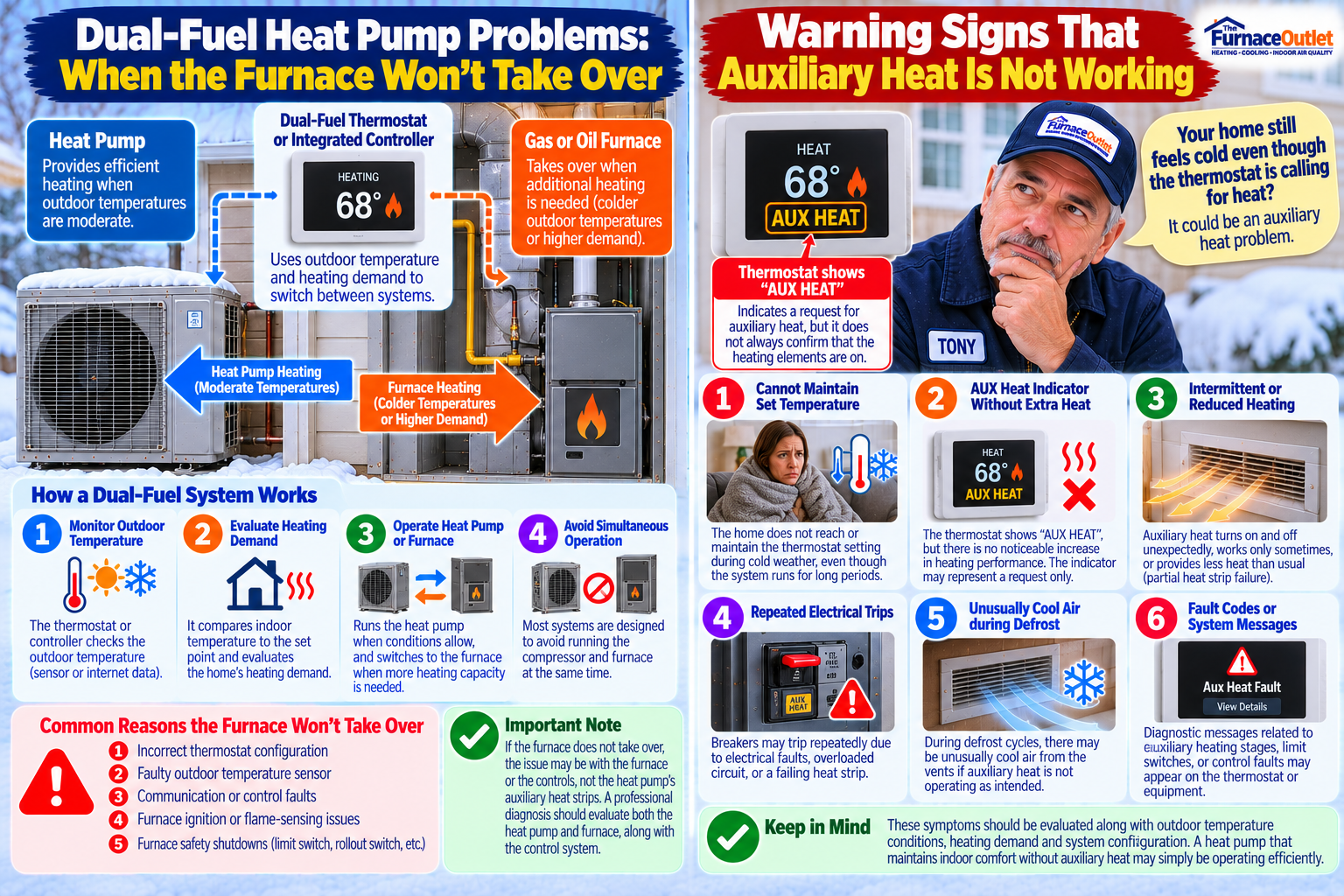
One of the clearest warning signs is a home that cannot maintain the thermostat setting during cold weather, particularly when the heat pump has reached conditions where supplemental heating should normally operate. The indoor temperature may gradually decline despite prolonged equipment operation.
Another warning sign is an auxiliary heat indicator that appears on the thermostat without a corresponding improvement in heating performance. However, the indicator may represent a request rather than confirmed heater operation, so it should not be treated as definitive proof of component failure. Other symptoms include repeated electrical trips, intermittent backup heating, unusually cool air during defrost, or diagnostic messages related to heating stages and safety limits. Partial heat strip failure may be less obvious because some supplemental heating capacity can remain available.
These symptoms should be evaluated together with the equipment’s actual heating demand, outdoor temperature, and control configuration. A heat pump that maintains indoor comfort without auxiliary heat may simply be operating efficiently.
Start by confirming that the thermostat is set to heating and that the desired temperature is above the actual indoor temperature. Check whether the display shows auxiliary heating, emergency heat, a system fault, or an unusual operating mode.
Review the thermostat’s user-accessible settings and any available operating messages. If the system was recently upgraded or the thermostat replaced, tell the technician because incorrect equipment configuration may be relevant. Inspect the indoor air filter and replace or clean it according to the manufacturer’s instructions. Keep return-air grilles and supply registers unobstructed so the system can maintain proper airflow.
If accessible without opening electrical equipment, observe whether the indoor blower is operating and whether the system is delivering useful heat. Record any error codes, repeated shutdowns, or circumstances under which the problem occurs. Do not remove air handler panels, touch heating elements, bypass limit switches, or attempt electrical testing. Electric heat strips operate at potentially dangerous voltages and can become extremely hot. If you notice a burning smell, sparking, smoke, or repeated breaker trips, stop operating the affected equipment safely and contact a qualified technician.
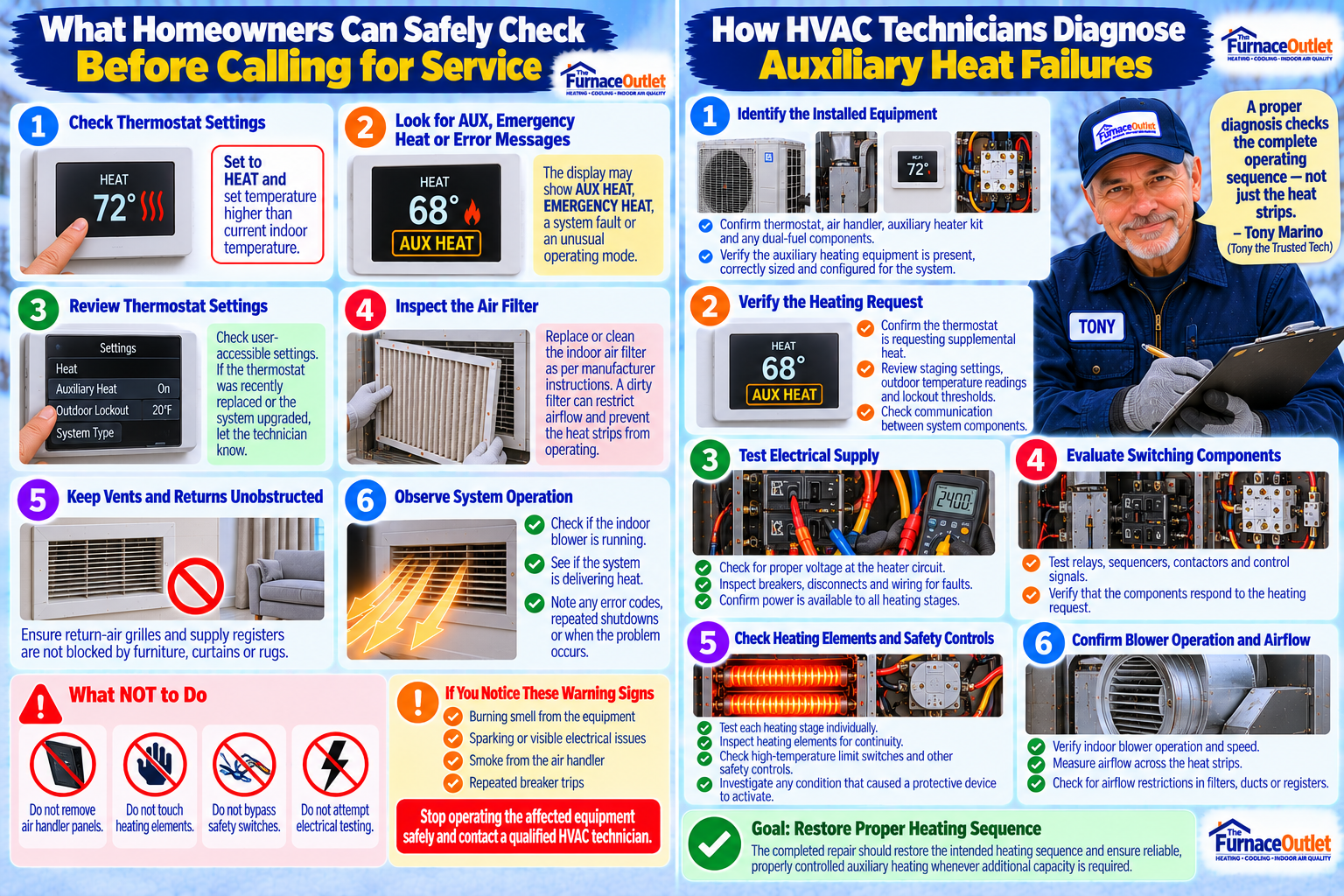
A reliable diagnosis begins with identifying the installed equipment, including the thermostat, air handler, auxiliary heater kit, and any dual-fuel components. The technician should verify that the auxiliary heating equipment is present, correctly sized, and configured for the system.
The next step is determining whether the thermostat is requesting supplemental heat under the observed operating conditions. The technician may examine staging settings, outdoor temperature readings, lockout thresholds, and communication between system components. If an auxiliary heating request is present, the investigation moves toward the air handler. The technician may evaluate heater circuit power, control signals, relays, sequencers, heating elements, limit switches, and blower operation using approved electrical safety procedures.
For systems with multiple heating stages, each stage should be assessed individually. A partially functioning heater assembly can produce symptoms different from a complete loss of auxiliary heat. The technician should also investigate any condition that caused a protective device to activate. The completed repair should restore the intended heating sequence rather than simply forcing the heating elements to energize.
An auxiliary heating failure does not automatically justify replacing the air handler or complete heat pump system. Defective relays, sequencers, sensors, wiring connections, or individual heater components may be repairable when compatible replacement parts are available.
For relatively new equipment in otherwise good condition, repairing the confirmed fault is often worth considering. Warranty coverage may also influence the decision, although labor and associated service expenses are not always included. Replacement becomes a broader consideration when the air handler has extensive electrical damage, severe corrosion, unavailable components, repeated overheating problems, or multiple major failures. Any replacement heater kit must be approved for the specific air handler and matched to its electrical supply and airflow requirements. I recommend obtaining an itemized diagnosis before authorizing major replacement work. The contractor should explain whether the fault involves an isolated heating component, an electrical supply problem, or a larger equipment issue.
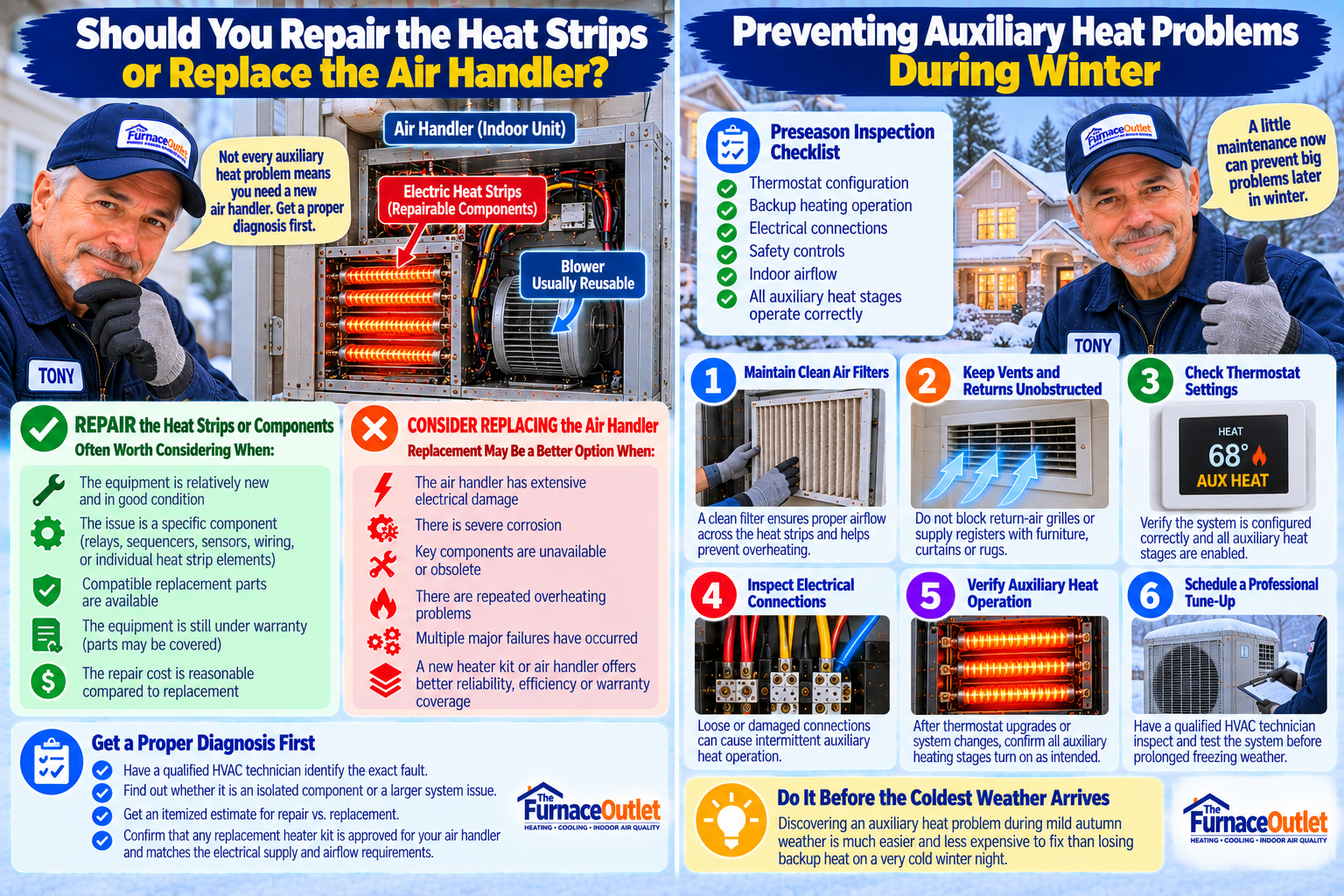
A professional preseason inspection can help identify developing auxiliary heating problems before the coldest weather arrives. The inspection should include thermostat configuration, backup heating operation, electrical connections, safety controls, and indoor airflow.
Filters should be maintained regularly, and homeowners should avoid blocking return-air grilles or restricting supply registers. Proper airflow is particularly important for electric resistance heating because inadequate airflow can cause excessive heater temperatures. After thermostat replacement, heat pump upgrades, or electrical work, the installer should verify that all available heating stages operate according to the manufacturer’s intended sequence. For the 2026–2027 heating season, I recommend checking backup heating performance before prolonged freezing weather. Discovering an auxiliary heat failure during mild autumn conditions is much more manageable than losing supplemental heating during a severe cold spell.
The thermostat may be requesting supplemental heating without the heater assembly actually energizing. Possible causes include failed heating elements, relays, sequencers, electrical supply problems, or control faults. Professional testing is needed to determine whether the heating request reaches the equipment and whether the heater responds.
There is no universal outdoor temperature at which auxiliary heat must activate. The decision depends on the heat pump’s heating capacity, building heat loss, thermostat staging logic, outdoor temperature settings, and installed backup equipment. Some systems can maintain comfort at very low temperatures without supplemental heating.
Yes. Incorrect thermostat configuration, damaged wiring, communication problems, or failed control outputs can prevent an auxiliary heating request from reaching the air handler. However, the thermostat should not be replaced until the technician verifies that it is responsible for the problem.
Not exactly. Auxiliary heat generally supplements normal heat pump operation when additional heating capacity is required. Emergency heat is a separately selected or controlled operating mode that, on suitably equipped systems, relies on backup heating while disabling compressor-based heating. Exact behavior depends on the equipment.
Yes. Some electric heater assemblies have multiple elements or stages. A failure affecting one element, relay, or circuit may reduce heating capacity while other stages continue operating. This can make the problem less obvious than a complete loss of backup heat.
A heat pump may operate normally without auxiliary heat when it can independently meet the home’s heating demand. However, a confirmed backup heating failure can become serious if outdoor temperatures fall and the heat pump cannot maintain safe indoor conditions. Arrange repairs promptly and follow manufacturer guidance.
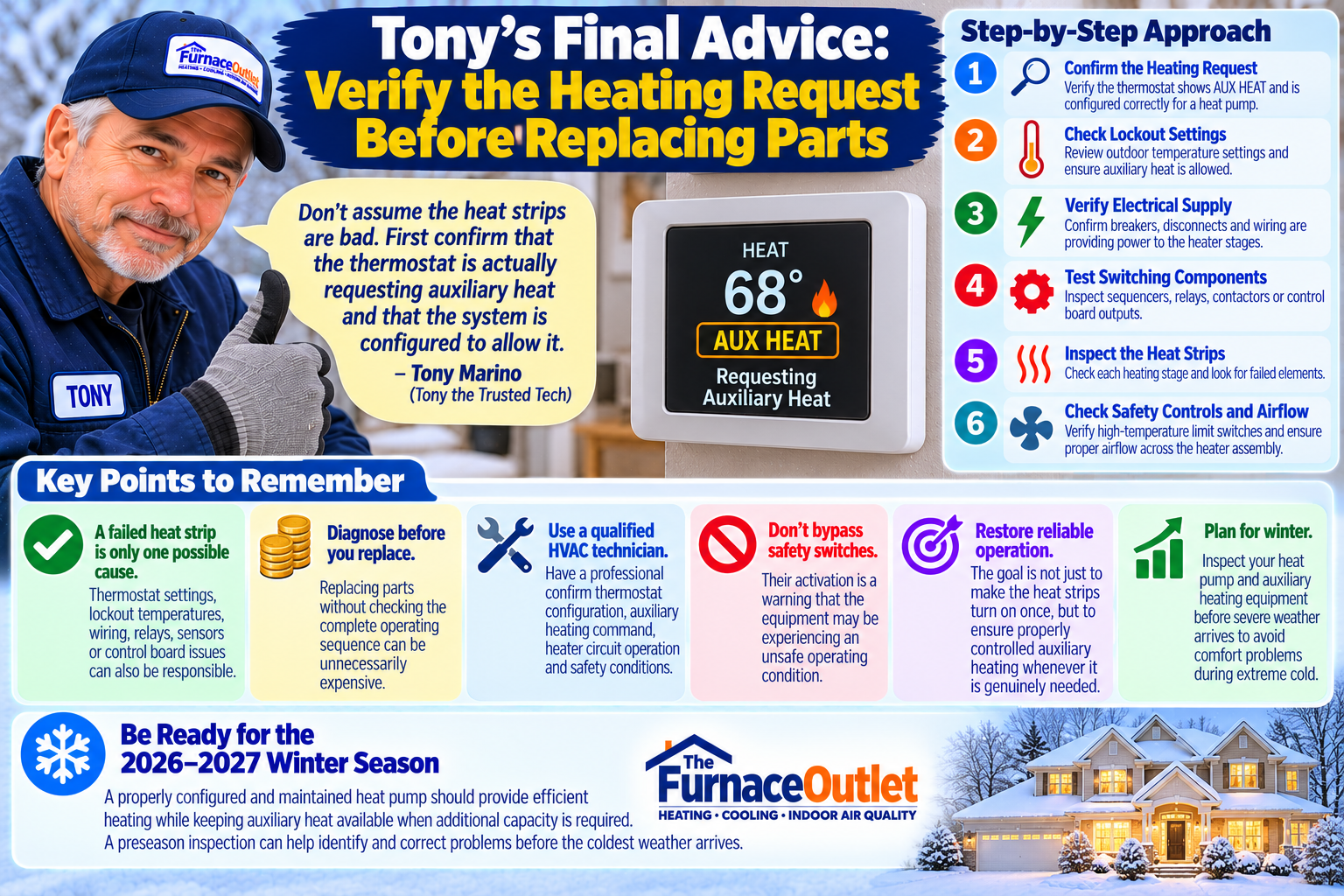
When a homeowner tells me their auxiliary heat is not turning on, I begin by asking whether the thermostat is actually requesting backup heating and whether the equipment is configured to permit it. A thermostat setting, outdoor temperature lockout, or control delay can sometimes explain why the heat strips remain inactive. If supplemental heat is being requested but not delivered, I want the technician to verify the electrical supply, switching components, heating elements, safety controls, and indoor airflow. A failed heat strip is only one possible cause, and replacing parts without checking the complete operating sequence can become unnecessarily expensive.
My recommendation is to have a qualified HVAC technician confirm the thermostat configuration, auxiliary heating command, heater circuit operation, and safety conditions before authorizing repairs. The goal is not simply to make the heat strips turn on once, but to restore reliable, properly controlled backup heating whenever the home genuinely needs it. For the 2026–2027 winter season, ensure your heat pump and auxiliary heating equipment are inspected before severe weather arrives. A properly configured and maintained system should provide efficient heat pump operation while keeping supplemental heating available when additional capacity is required.
This article is intended for general educational purposes and does not replace manufacturer instructions, professional HVAC diagnosis, or applicable electrical safety requirements. Electric auxiliary heaters may contain multiple high-voltage circuits, hot resistance elements, capacitors, and protective devices. Homeowners should not open electrical panels, test energized components, bypass safety switches, or attempt heater repairs without appropriate qualifications. Always follow equipment-specific service documentation and applicable local codes.
The following resources provide additional information about heat pump operation, supplemental heating, system efficiency, and professional maintenance.
These are general reference resources. Specific thermostat staging settings, auxiliary heat lockouts, heater wiring arrangements, and safety-control procedures must be verified against the manufacturer’s documentation for the installed equipment.