Newsletter Subscribe
Enter your email address below and subscribe to our newsletter

HVAC made simple
By Tony Marino (Tony the Trusted Tech)
The Furnace Outlet | Updated October 2026
When you walk outside on a freezing winter morning and notice that your heat pump’s outdoor fan is not spinning, your first reaction may be that something has broken. The thermostat is calling for heat, the indoor blower is operating, and the outdoor equipment may even be making a humming or compressor sound. Yet the large fan visible through the outdoor grille remains completely stationary. For homeowners who depend on their heat pumps during winter, that can be an unsettling sight.
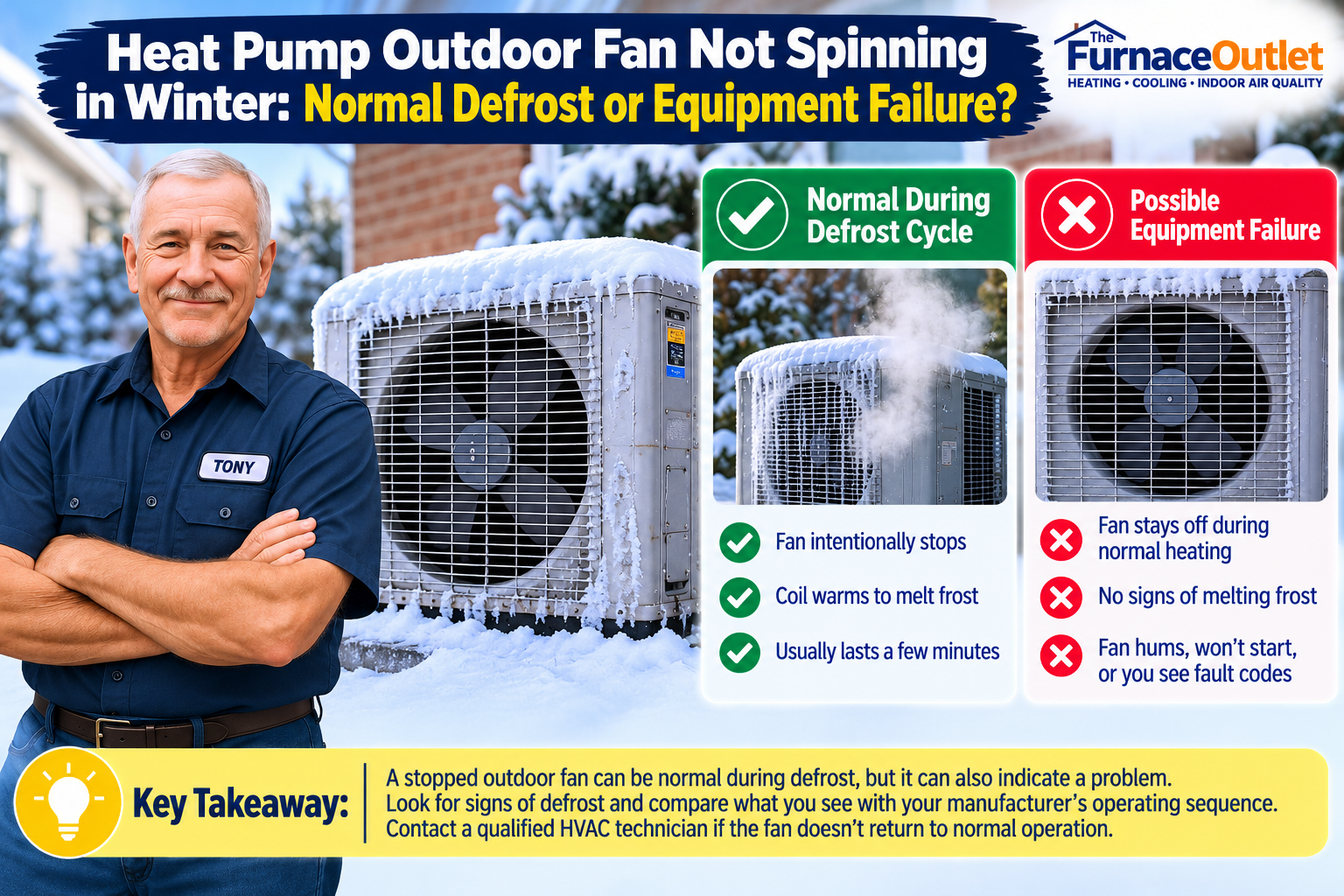
Here’s something I’ve learned after years of troubleshooting residential heating systems: a stopped outdoor fan does not automatically mean a failed fan motor. During certain operating conditions, particularly a normal defrost cycle, the fan is intentionally stopped by the equipment’s controls. The heat pump may be working exactly as its manufacturer intended, even though the outdoor unit temporarily looks inactive.
The difficulty is that genuine equipment failures can produce similar symptoms. A defective fan motor, failed capacitor, damaged wiring connection, control-board problem, or mechanical obstruction may prevent the fan from operating when it should. If the compressor continues running without the required outdoor airflow during normal heating, the system may develop abnormal operating conditions and reduced heating performance.
The key is understanding when a stationary fan is normal and when it indicates a problem that requires professional attention. In this guide, I’ll explain how the outdoor fan operates during winter, why it stops during defrost, which failures can prevent it from restarting, and what homeowners can safely observe before scheduling HVAC service.
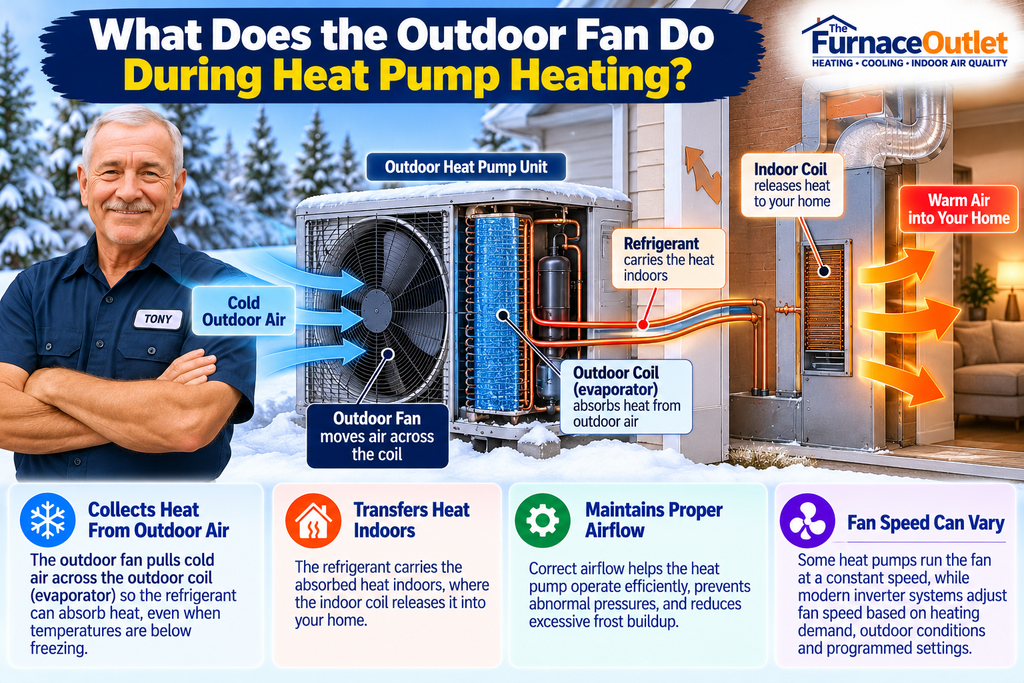
An air-source heat pump heats your home by collecting thermal energy from outdoor air and transferring that energy indoors through its refrigeration system. During normal heating operation, the outdoor coil functions as an evaporator, absorbing heat from the surrounding air while the indoor heat exchanger releases that heat into the living space.
The outdoor fan moves air across the coil so the refrigerant can absorb heat efficiently. Even when outdoor temperatures are below freezing, the air still contains thermal energy that a properly designed heat pump can collect. The fan helps maintain the airflow required for this heat-transfer process. If airflow becomes inadequate, the outdoor coil may operate under abnormal temperature and pressure conditions. Heating capacity can decline, frost formation may become more problematic, and the equipment may respond through protective controls or operating limitations. However, not every heat pump operates its fan at a constant speed. Conventional single-stage equipment may use relatively straightforward fan control, while modern inverter-driven systems can vary fan speed according to heating demand, outdoor conditions, and programmed operating sequences.
This distinction matters because a slowly rotating fan, temporarily stopped fan, or changing fan speed is not necessarily evidence of a defective motor. The expected behavior depends on the equipment model and what the system is doing at that moment.
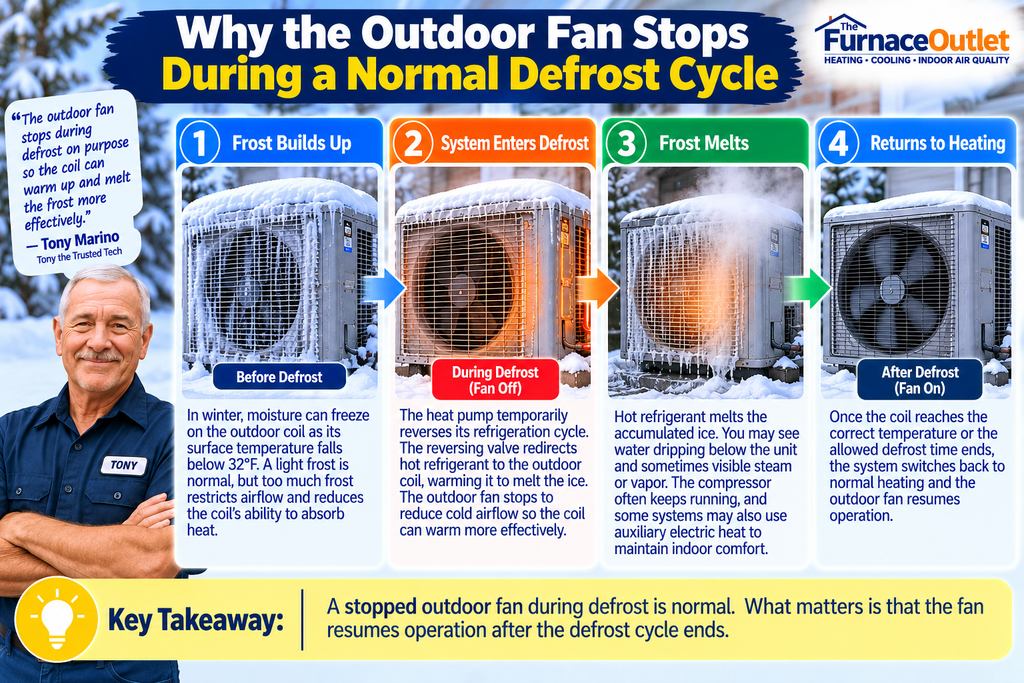
During winter heating, moisture can freeze on the outdoor coil because its surface temperature may fall below the freezing point. A light frost coating is normal, but excessive accumulation restricts airflow and reduces the coil’s ability to absorb heat. To remove this frost, many conventional heat pumps temporarily reverse their refrigeration cycle. The reversing valve changes the refrigerant-flow path so hot refrigerant warms the outdoor coil and melts accumulated ice. During this process, the outdoor fan commonly stops. Keeping the fan off reduces the amount of cold outdoor air passing across the coil, allowing the available heat to melt frost more effectively.
The compressor may continue operating during the defrost sequence, depending on the manufacturer’s design. Some ducted systems also activate auxiliary electric heat to maintain indoor comfort while the heat pump temporarily redirects heat toward the outdoor coil. Homeowners may notice water dripping beneath the outdoor unit, visible water vapor rising from the cabinet, or a temporary change in operating sound. These observations can be normal during defrost. Once the coil reaches the required termination condition, or the control system reaches its permitted defrost limit, the equipment returns to heating operation. The outdoor fan should then resume operating according to the manufacturer’s sequence.
I would not diagnose a fan failure simply because the fan stops while frost is melting. The more useful question is whether the fan resumes normal operation after defrost ends.
There is no universal fan-off duration that applies to every heat pump. Defrost timing depends on equipment design, coil temperature, outdoor conditions, control strategy, and the amount of frost that needs to be removed. Some defrost events are relatively brief, while others require several minutes. Certain systems use time-and-temperature controls, while more sophisticated equipment may evaluate multiple operating measurements to determine when defrost should begin and end. During damp weather near freezing, frost may accumulate more rapidly than it does during colder but drier conditions. Consequently, a heat pump may require more frequent defrost operation on a humid 32°F day than on a dry 15°F day.
A homeowner should therefore avoid judging fan operation using an arbitrary fixed interval. A stopped fan for several minutes may be completely normal during defrost, but a fan that remains stationary throughout an extended heating call deserves further investigation. The most useful observations are whether frost is melting, whether the system transitions out of defrost, and whether the outdoor fan subsequently operates during normal heating.
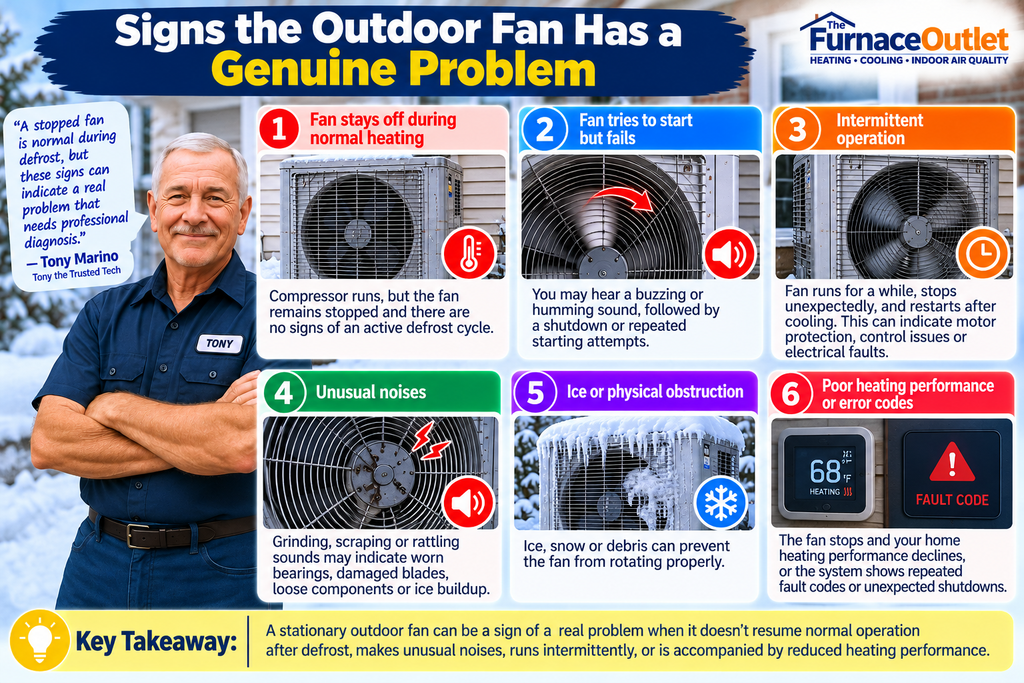
A stationary outdoor fan becomes more concerning when the heat pump is clearly attempting normal heating rather than defrosting. If the compressor appears to operate continuously while the outdoor fan remains stopped and the coil does not show signs of an active defrost sequence, the equipment may have a fan motor, electrical, or control problem. Another warning sign is a fan that attempts to start but fails. Homeowners sometimes hear an unusual buzzing or humming sound, followed by a shutdown or repeated starting attempts. Such behavior may indicate an electrical or motor problem, although the sound alone cannot establish the cause.
Intermittent fan operation can also indicate trouble. A motor may run for a period, stop unexpectedly, and restart after cooling. Depending on the equipment, this behavior may involve internal motor protection, electronic controls, or other electrical faults. Unusual grinding, scraping, or rattling sounds should also be investigated. Ice accumulation, damaged fan blades, deteriorated bearings, or loose components can interfere with normal operation.
If the outdoor fan stops and the home simultaneously experiences declining heating performance, repeated equipment fault codes, or unexpected shutdowns, professional diagnosis becomes more important. These symptoms should not be interpreted in isolation. The technician must determine whether the fan is receiving the correct operating command and whether the equipment is intentionally preventing operation for another reason.
The outdoor fan motor is responsible for rotating the fan blade and maintaining the airflow required across the outdoor coil. Like other electromechanical components, it can deteriorate over time because of bearing wear, electrical problems, environmental exposure, or internal component failure. A failing motor may stop operating completely, start inconsistently, produce unusual noises, or overheat during extended operation. Some motors incorporate internal protection that interrupts operation under certain fault conditions.
Modern heat pumps may use electronically commutated motors or other variable-speed motor designs. These components can include integrated electronics and manufacturer-specific communication or control requirements. The technician should identify the exact motor type before testing. A diagnostic method appropriate for a conventional permanent-split-capacitor motor may not apply to an electronically controlled variable-speed motor. A proper assessment includes evaluating the required power supply, operating command, wiring, motor condition, and applicable control electronics. Replacing the motor without confirming these factors may fail to correct the actual problem.
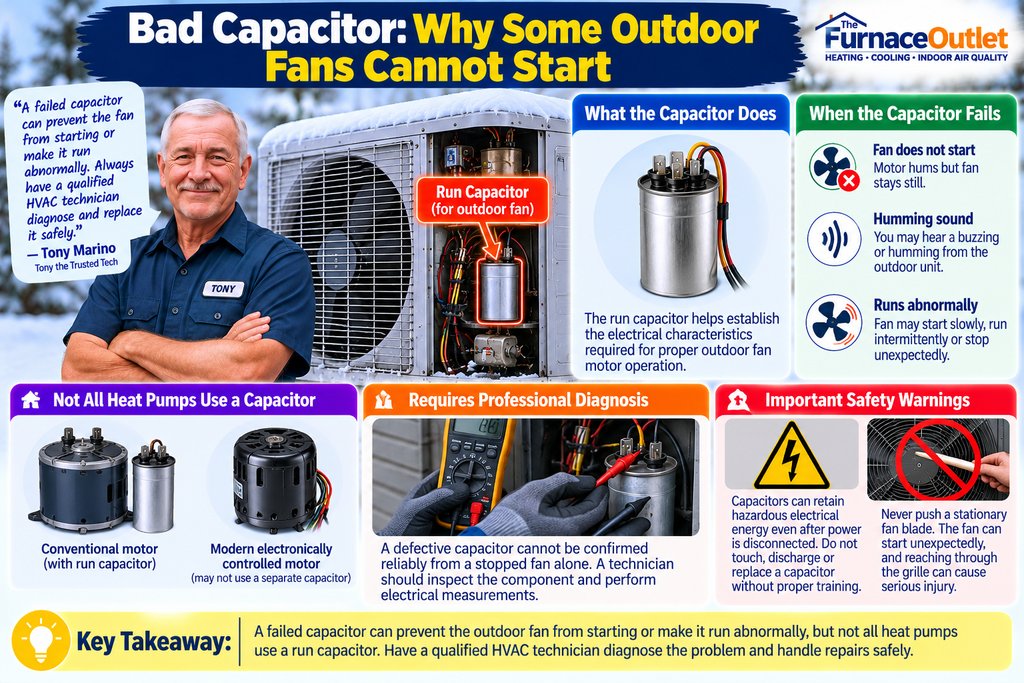
Certain conventional heat pumps use a run capacitor as part of the outdoor fan motor circuit. The capacitor helps establish the electrical characteristics required for proper motor operation. If the capacitor deteriorates or fails, the motor may struggle to start, operate abnormally, or fail to run. Homeowners may hear a humming sound from the outdoor unit while the fan remains stationary. However, not every heat pump fan motor uses a separate run capacitor. Many modern electronically controlled motors use different designs, so a capacitor diagnosis must begin with identifying the actual equipment.
A defective capacitor cannot be confirmed reliably from a stopped fan alone. A technician should inspect the component and perform appropriate electrical measurements using the manufacturer’s specifications. Homeowners should never attempt to touch, discharge, or replace a capacitor without proper training. Capacitors can retain hazardous electrical energy even after equipment power has been disconnected. I also discourage the common internet suggestion to push a stationary fan blade with a stick. A fan can start unexpectedly, and reaching through the grille creates a serious injury risk.
The outdoor fan depends on more than its motor. Depending on the heat pump design, its operation may be coordinated through relays, contactors, electronic control boards, motor modules, or communicating controls. A defective relay or control output may prevent the fan from receiving the required operating command. Damaged wiring, corroded terminals, loose connections, or electrical supply problems can produce similar symptoms. A heat pump may also intentionally stop its fan because the control system has detected an operating condition that requires protective action. In that situation, the stationary fan may be a consequence of another fault rather than the original cause.
Technicians should examine available diagnostic codes, verify the operating sequence, and determine whether the control system is requesting fan operation. If the proper command is present but the motor does not respond, the investigation may focus on the motor and its electrical circuit. If the command is absent, the technician must determine whether that absence is intentional or caused by a control failure. This is why replacing the fan motor without checking its control circuit can lead to unnecessary expense.
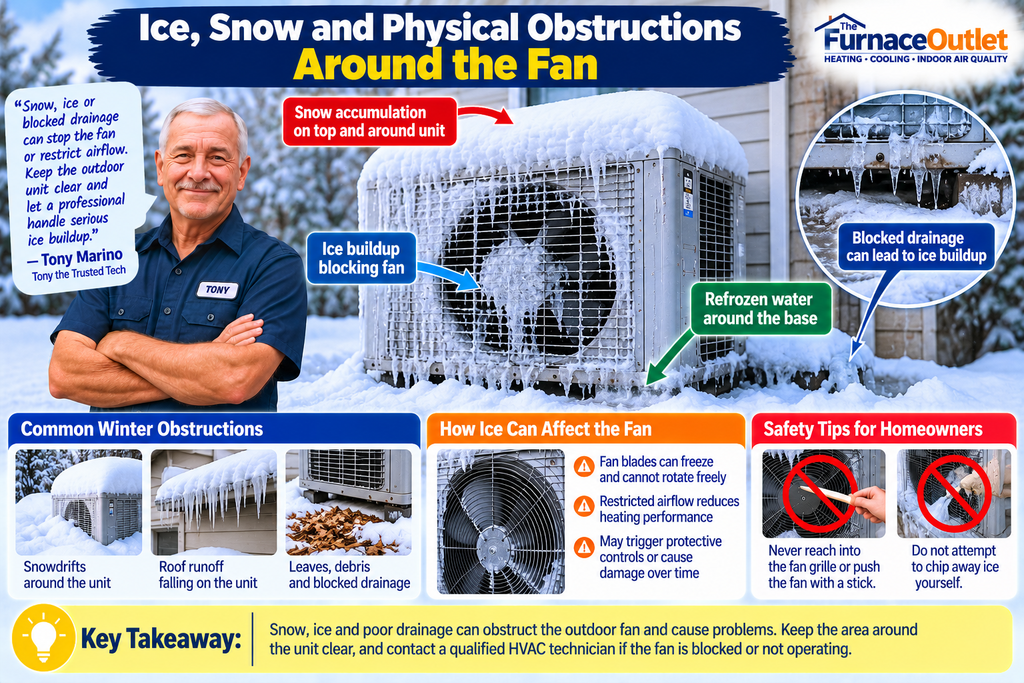
Winter weather introduces mechanical problems that may not occur during summer cooling. Snow accumulation, freezing rain, and refrozen defrost water can interfere with the outdoor fan or its surrounding cabinet. During a normal defrost cycle, frost melts and drains from the outdoor coil. If the water cannot drain away properly, it may collect in the base pan or around the fan area before freezing again. Over time, ice accumulation can obstruct moving components or interfere with the equipment’s airflow. A fan that cannot rotate freely may trigger protective controls or experience mechanical damage.
Installation conditions can make these problems worse. An outdoor unit positioned where snowdrifts accumulate, roof runoff falls directly onto the cabinet, or drainage remains blocked may experience repeated winter icing. Homeowners can visually inspect the area for obvious snow accumulation or debris, but should never reach into the fan grille or attempt to chip ice away from the blades. If ice appears to be obstructing the fan, stop operating the equipment according to manufacturer instructions and arrange professional service. The technician should investigate both the obstruction and the reason it developed.
Refrigerant-system problems do not normally explain a stationary fan as directly as a failed motor or control circuit, but they can influence overall equipment operation. Low refrigerant charge, refrigerant restrictions, compressor deficiencies, and abnormal operating pressures may cause protective controls to interrupt operation or change the equipment’s operating sequence. In these situations, the fan may stop because the heat pump has entered a protective shutdown or fault condition. The actual problem may therefore lie elsewhere in the system.
A technician should evaluate refrigerant-system performance only when the operating observations justify that investigation. Pressure measurements, line temperatures, compressor behavior, and manufacturer-specific diagnostic information must be considered together. Adding refrigerant simply because the outdoor fan is stopped is not a valid repair. Refrigerant charge should be evaluated using approved procedures, and suspected leaks should be investigated rather than concealed through repeated adjustments.
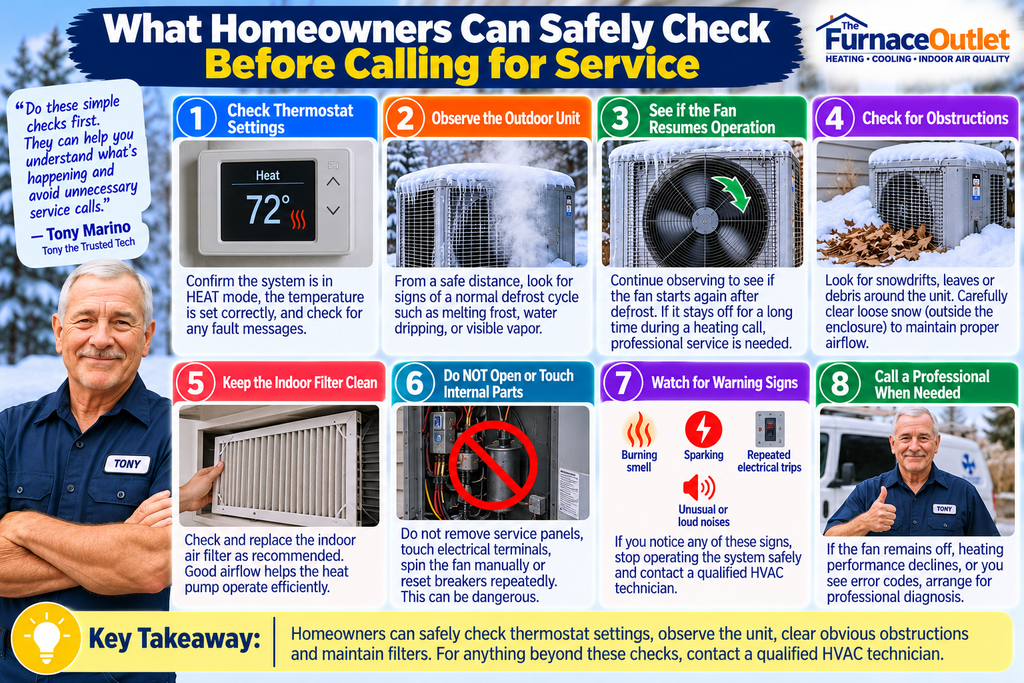
When you notice that the outdoor fan is not spinning, begin by checking whether the heat pump is actually requesting heating. Confirm the thermostat mode, temperature setting, and any displayed fault messages. Next, observe the outdoor equipment from a safe distance. If frost is melting, water is draining, or vapor is rising from the coil, the heat pump may be performing a normal defrost cycle.
Continue observing without touching the equipment to see whether the system returns to heating and the fan resumes operation. If the fan remains stopped during an extended heating call, or the home cannot maintain temperature, professional diagnosis is appropriate. Check for visible snowdrifts, leaves, or other obstructions around the outdoor cabinet. Loose snow outside the equipment’s protective enclosure may be cleared carefully while avoiding electrical components and moving parts.
The indoor filter should also be maintained according to manufacturer instructions. Although a dirty filter is not usually the direct cause of a stationary outdoor fan, airflow restrictions can worsen heating performance. Do not remove service panels, touch electrical terminals, manually spin the fan, or repeatedly reset breakers. If the equipment produces a burning smell, sparking, repeated electrical trips, or severe mechanical noise, stop operation safely and contact a qualified technician.
A professional diagnosis begins with identifying the heat pump model and reviewing its manufacturer-defined operating sequence. The technician should determine whether the equipment is in normal heating, defrost, standby, or a protective shutdown. The next step is confirming the homeowner’s complaint. The technician may review fault codes, observe compressor operation, inspect the outdoor coil, and determine whether the fan is being commanded to run. If fan operation is expected, the electrical supply and control circuit should be evaluated using appropriate procedures. The technician may inspect wiring, connectors, relays, capacitors where applicable, and motor-specific electronic controls.
Mechanical conditions also deserve attention. Fan blades, bearings, ice accumulation, and cabinet obstructions can affect operation even when the electrical components are functioning correctly. If the equipment appears to be remaining in defrost, the technician should investigate the defrost sensors, control logic, reversing valve response, and termination conditions. Refrigerant-system performance should be evaluated when symptoms indicate that protective controls or abnormal operating conditions may be involved.
The diagnosis should establish whether the fan is intentionally stopped, unable to receive a valid command, or incapable of operating despite receiving the correct command.
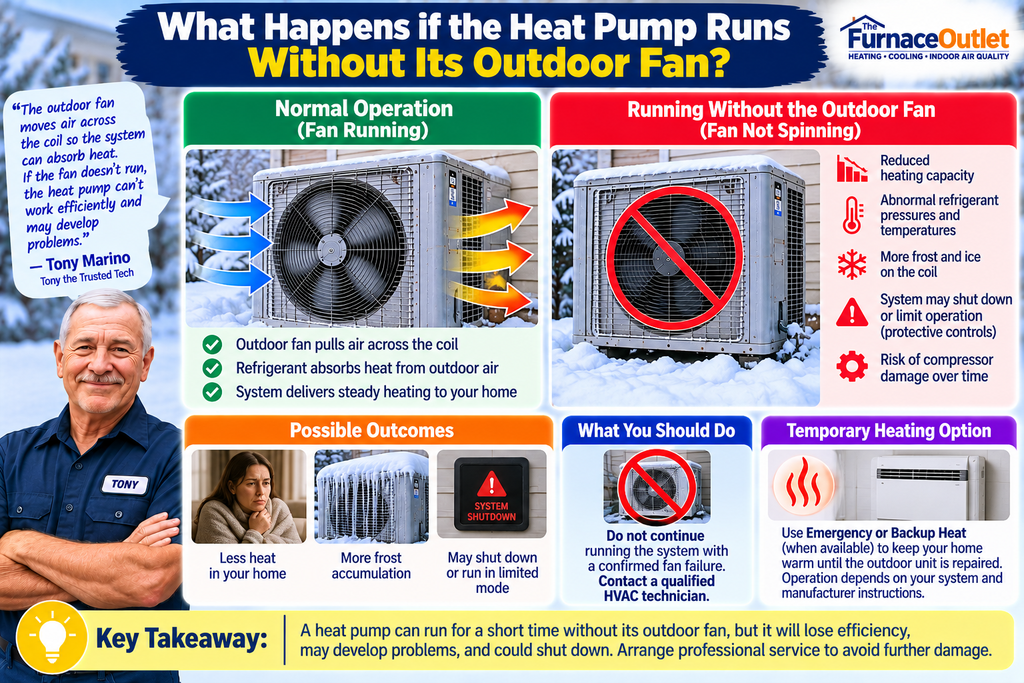
During normal heating, the outdoor fan provides airflow needed for effective heat absorption. If the compressor operates without the required airflow, heating capacity can deteriorate and abnormal refrigeration conditions may develop. The severity depends on equipment design, outdoor conditions, and the system’s protective controls. Some heat pumps may detect abnormal operation and shut down or limit performance, while others may continue operating under unfavorable conditions. A prolonged fan failure can also contribute to unusual coil temperatures and frost accumulation, making the original problem more difficult to distinguish from a defrost malfunction.
Homeowners should not intentionally continue operating a heat pump with a confirmed outdoor fan failure simply because the compressor still runs. Where available and properly configured, a separate emergency or backup heating mode may provide temporary indoor heat while the outdoor equipment is repaired. The suitability of that option depends on the installed system and manufacturer instructions.
A confirmed outdoor fan problem does not automatically justify replacing the entire heat pump. A defective capacitor, damaged wiring connection, failed relay, or isolated fan motor may be repairable without replacing the refrigeration equipment. For relatively new systems that have otherwise performed reliably, repairing the affected component may be the most sensible approach. Warranty coverage and replacement-part availability can also influence the decision. More expensive repairs deserve closer evaluation when the heat pump is older or has a history of repeated failures. Multiple major component problems, significant refrigerant leaks, poor heating performance, and unavailable parts may make complete replacement more attractive.
The decision should not depend on equipment age alone. A well-maintained heat pump with one isolated fan failure may have substantial useful life remaining, while a newer system with serious recurring problems may warrant a broader assessment. I recommend requesting a written diagnosis and itemized repair quotation before authorizing major work. The technician should explain the confirmed fault and whether any related components require attention.
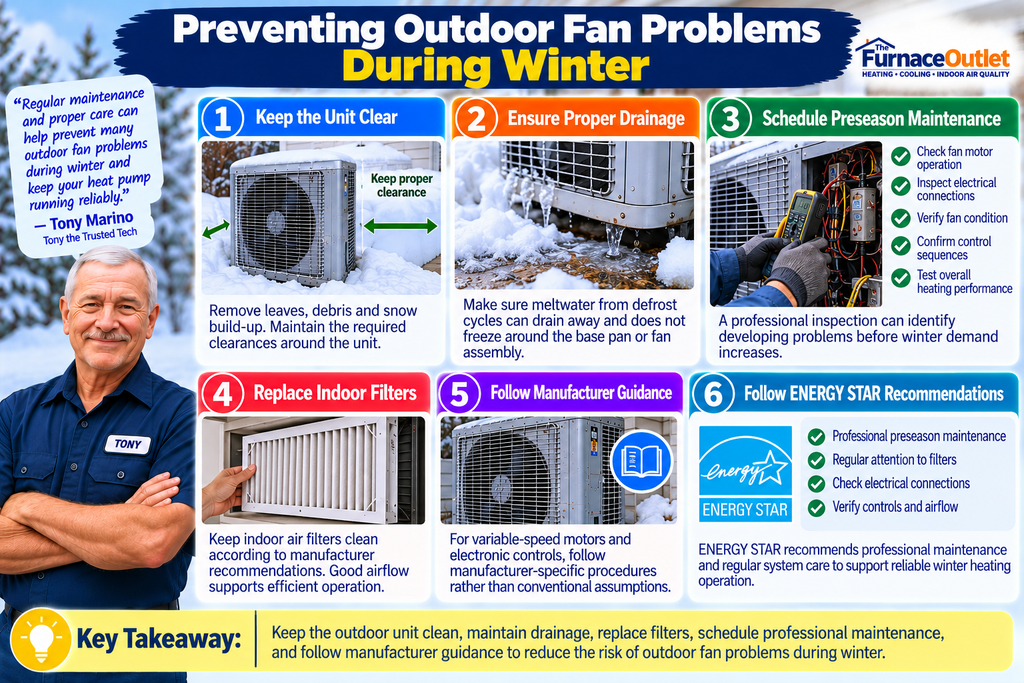
Regular maintenance helps reduce avoidable fan and airflow problems, although it cannot prevent every motor or electronic failure. Outdoor equipment should remain free from excessive leaves, debris, and snow accumulation. Required clearances should be maintained so the fan can move air across the coil without unnecessary restrictions. Drainage deserves particular attention in colder regions. Meltwater from defrost cycles should be able to leave the equipment without repeatedly freezing around the base pan or fan assembly.
A professional preseason inspection can include checking motor operation, electrical connections, fan condition, control sequences, and overall heating performance. On systems with variable-speed motors, technicians should follow manufacturer-specific procedures rather than applying conventional motor assumptions. ENERGY STAR recommends professional preseason maintenance and regular attention to filters, electrical connections, controls, and airflow. These practices support reliable heating operation and can help identify developing problems before winter demand increases.
Yes, the outdoor fan may stop during a normal defrost cycle, when the equipment is not calling for heating, or during certain manufacturer-defined operating sequences. However, a fan that remains stationary throughout an extended normal heating call may indicate a motor, electrical, or control problem. The correct interpretation depends on what the system is doing at that moment.
A humming sound may originate from the compressor, an energized electrical component, or a motor attempting to operate. On some conventional systems, a failed capacitor can prevent the fan from starting, but other faults can produce similar symptoms. A qualified technician should determine which component is making the sound before recommending repairs.
On many conventional reverse-cycle heat pumps, the outdoor fan stops during defrost so the coil can warm and melt frost more effectively. Some equipment uses different fan-control strategies, so manufacturer instructions should determine what is normal. The fan should return to its expected operation after defrost is complete.
Yes, on equipment that uses a separate fan run capacitor, a failed capacitor can prevent normal motor operation. However, many modern variable-speed motors do not use the same capacitor arrangement. A technician should identify the motor type and verify the component’s electrical condition before replacing anything.
If the fan is confirmed not to operate during normal heating, continued compressor operation may create unfavorable conditions. Follow the manufacturer’s shutdown instructions and arrange service. A brief fan stop during normal defrost does not necessarily require shutting down the equipment.
Yes. Snow accumulation, freezing rain, or refrozen defrost water can obstruct the fan or surrounding cabinet. Homeowners should not attempt to reach into the grille or force the fan to rotate. Persistent ice buildup requires investigation of drainage, installation conditions, and defrost performance.
Repair costs vary according to the failed component, motor design, equipment brand, labor requirements, warranty coverage, and parts availability. A wiring repair or conventional capacitor replacement may be less involved than replacing a variable-speed motor and its associated electronics. An itemized contractor quotation is more useful than assuming one universal price.
Some ducted heat pump systems include an emergency heating mode that operates a separate backup heat source without relying on the outdoor compressor. Other systems do not have this capability. Homeowners should verify their equipment configuration and follow manufacturer instructions before using emergency heat as a temporary alternative.
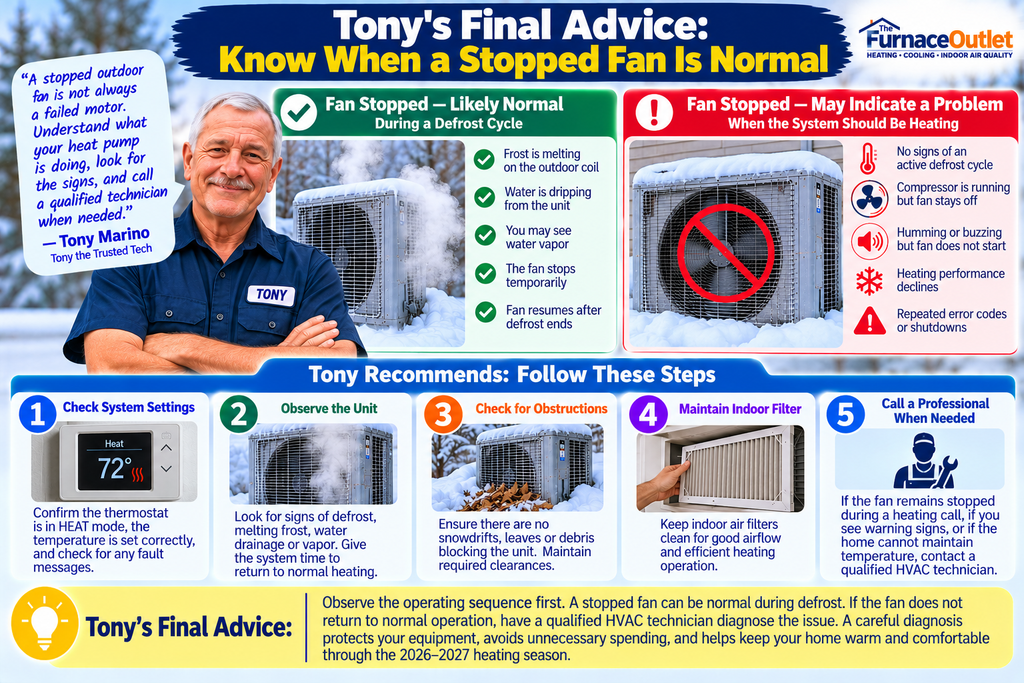
When a homeowner tells me the outdoor fan has stopped on a cold winter day, my first question is not whether the motor needs replacement. I want to know whether the heat pump is actually in normal heating operation or performing a defrost cycle. If the equipment is defrosting, a temporarily stationary outdoor fan may be exactly what the manufacturer intended. I look for evidence that the coil is warming, frost is melting, and the system subsequently returns to normal heating. If the fan remains stopped when airflow should be present, I want the technician to verify the operating command, electrical supply, motor condition, and relevant controls. I also want ice obstructions, drainage problems, and protective shutdowns considered before anyone orders expensive replacement parts.
My recommendation is to observe the operating sequence first and have a qualified HVAC technician diagnose persistent fan problems rather than assuming every winter fan shutdown indicates a failed motor. A careful diagnosis protects the equipment, avoids unnecessary spending, and helps restore dependable heating.
For the 2026–2027 heating season, keep outdoor airflow unobstructed, address unusual icing early, and arrange professional service when the fan does not return to normal operation. A properly functioning heat pump should manage its fan and defrost sequences automatically while delivering the heating capacity expected from its design.
This article is provided by The Furnace Outlet for general educational purposes and is not a substitute for professional HVAC diagnosis, manufacturer service instructions, or applicable safety regulations. Outdoor fan troubleshooting can involve energized electrical circuits, capacitors capable of retaining hazardous energy, moving fan blades, hot components, and pressurized refrigerants. Homeowners should not remove service panels, manipulate fan blades, bypass controls, or perform electrical testing without appropriate training and authorization.
In the United States, refrigerant-related service activities must comply with applicable EPA Section 608 requirements, including technician certification where required. Always follow equipment-specific service documentation and applicable local codes.
1. U.S. Department of Energy — Quantifying and Reducing Defrost Energy Use. This technical research presentation explains frost accumulation, reverse-cycle defrost, and the energy consequences of defrost operation. It provides useful background for understanding why heat pumps temporarily change their operating sequence during winter. Read the DOE defrost research.
2. U.S. Department of Energy — Field Performance of Inverter-Driven Heat Pumps in Cold Climates. This research examines cold-climate heat pump behavior, including changes in operation during defrost. It is relevant to understanding why inverter-driven equipment may not follow the same fan and compressor patterns as conventional single-stage systems. Read the DOE field-performance study.
3. ENERGY STAR — Heating and Cooling Maintenance Checklist. ENERGY STAR recommends professional preseason inspections and maintenance of motors, electrical connections, controls, filters, and other HVAC components. These practices can help identify developing fan and airflow problems. Read the ENERGY STAR maintenance checklist.
4. ENERGY STAR — Clean Heating and Cooling. This homeowner resource explains heat pump technology and provides practical advice about keeping indoor and outdoor equipment clean, maintaining airflow, and arranging professional maintenance. Explore ENERGY STAR’s heat pump guidance.
5. U.S. Environmental Protection Agency — Section 608 Technician Certification Requirements. The EPA explains federal certification requirements for technicians performing covered refrigerant-related service activities. These requirements are relevant when fan-related troubleshooting reveals an underlying refrigerant-system problem. Review EPA technician certification requirements.
6. U.S. Environmental Protection Agency — Refrigerant Management Program Questions and Answers. This resource explains which refrigeration service activities fall under Section 608 and provides additional guidance for technicians and equipment owners. Read the EPA refrigerant management FAQ.
These references support the article’s general discussion of winter heat pump operation, defrost behavior, maintenance, and refrigerant safety. For exact fan motor wiring, capacitor specifications, fault-code meanings, control-board commands, and defrost procedures, consult the manufacturer’s current service manual for the specific equipment model.