
Newsletter Subscribe
Enter your email address below and subscribe to our newsletter

HVAC made simple


HVAC numbers can get confusing pretty quickly. BTUs, heating loads, AFUE ratings, furnace sizes, efficiency percentages—there’s a lot to understand, especially when you’re simply trying to figure out what will work for your home. That’s why we’ve put together these free HVAC calculators.
They’re designed to give homeowners a practical starting point without requiring an engineering degree to understand the results. Whether you’re replacing an old furnace, comparing equipment, trying to understand your home’s heating needs, or simply doing some research before talking to an HVAC contractor, choose the calculator that matches what you’re trying to figure out.
This is usually one of the first questions homeowners ask when shopping for heating equipment. And while you may have heard rules such as “just multiply the square footage by 40,” HVAC sizing isn’t quite that simple. A 2,000-square-foot home in Florida doesn’t have the same heating requirements as a 2,000-square-foot home in Minnesota. Insulation, ceiling height, climate, windows and other characteristics of the home can all make a difference.
Our BTU Calculator takes several of these factors into account to give you a preliminary estimate of the heating capacity your home may need.
🔎 Try the BTU Calculator if you’re asking:
💡 Good to know: Think of the result as a useful starting point—not the final equipment specification.
Once you have an idea of your home’s heating requirement, the next question is usually: What size furnace does that translate to?
Furnaces are available in capacities such as 40,000, 60,000, 80,000, 100,000 BTU and higher. Choosing the biggest furnace isn’t necessarily the best answer. A furnace that’s too small may struggle to keep your home comfortable during very cold weather. But going too large isn’t ideal either. An oversized furnace may heat the home very quickly, shut down, and then start again shortly afterward. That repeated cycling can affect comfort and equipment operation.
Our Furnace Sizing Calculator considers your home’s dimensions, climate, insulation, ceiling height, construction characteristics and furnace efficiency to give you a preliminary size recommendation.
💡 Best for: Homeowners comparing furnace capacities and trying to determine which size range makes sense for their home.
This is where HVAC sizing gets a little more interesting. Your furnace isn’t really heating a number of square feet. It’s replacing the heat your home is losing.
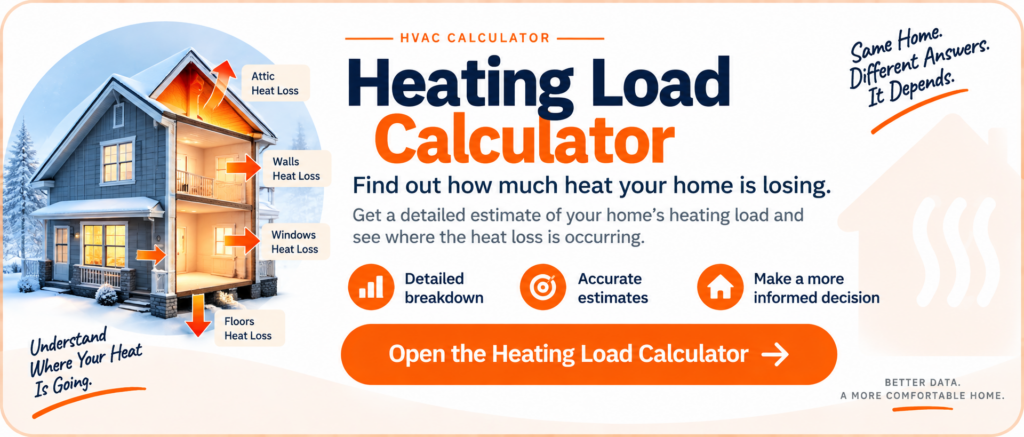
On a cold winter day, heat is constantly escaping through different parts of the building:
The colder it gets outside, the faster that heat can leave the building. Our Heating Load Calculator looks at these factors and estimates how many BTUs per hour may be required to replace that lost heat and maintain the indoor temperature you’ve selected. It also gives you a breakdown of where the estimated heat loss is occurring.
So instead of simply seeing: Estimated Heating Load: 60,000 BTU/hr. You can get a better understanding of why your home may need that much heating.
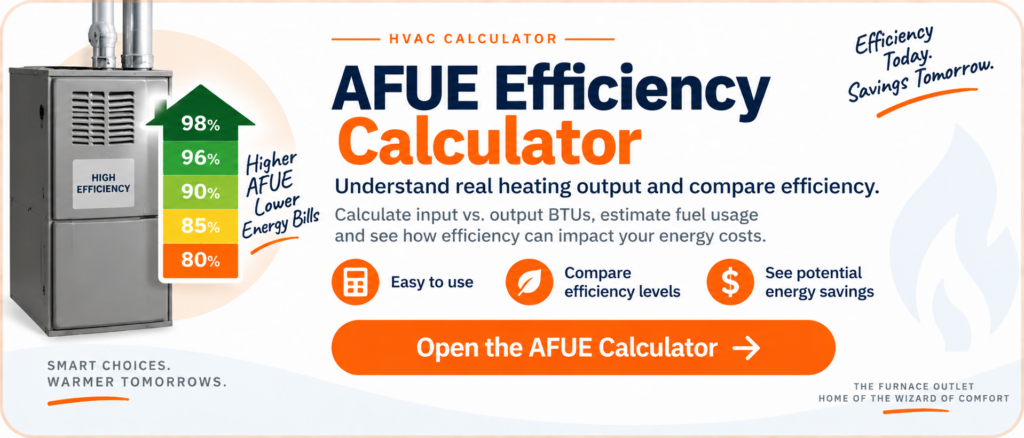
If you’ve been looking at furnaces, you’ve probably seen numbers such as: 80% AFUE · 90% AFUE · 95% AFUE · 96% AFUE · 98% AFUE, AFUE stands for Annual Fuel Utilization Efficiency.
The easiest way to understand it is to think about what happens to the energy contained in the fuel your furnace uses. With an 80% AFUE furnace, roughly 80% of the fuel’s energy becomes useful heat for the home, while the remainder is lost through the combustion and venting process. A higher-efficiency furnace converts a greater percentage of that fuel into useful heat.
📊 Our AFUE Calculator helps you compare:
💰 Thinking about upgrading?
If you’re wondering whether moving from an older 80% AFUE furnace to a 95% or 96% model could make a meaningful difference to heating costs, this calculator is a good place to start.
Not sure which tool you need? Start with the question you’re trying to answer.
For a furnace replacement, try this order:🌡️ Heating Load → 🔥 Furnace Size → ⚡ AFUE Efficiency
That gives you a much better overall picture of what your home may need.
Square footage is useful, but it only tells part of the story. Imagine two houses sitting side by side. Both are 2,000 square feet.
They’re the same size—but their heating requirements can be very different. Now move one of those homes from a relatively mild climate to somewhere that regularly experiences very cold winter temperatures. The difference becomes even greater. That’s why our calculators consider more than just square footage whenever possible.
🔍 Depending on the calculator, we may ask about:
A few extra details can produce a much more useful preliminary estimate.
You’ll see BTU mentioned throughout our calculators and HVAC guides. (BTU stands for British Thermal Unit.) You don’t need to worry too much about the technical definition. For HVAC purposes, the important thing to understand is that BTUs are commonly used to describe heating and cooling capacity. A furnace rated at 80,000 BTU/hr has a greater heating capacity than one rated at 60,000 BTU/hr.
But there’s another important detail. ⚙️ Furnace Input BTU and Output BTU Are Not the Same Thing
Suppose you’re looking at an: 80,000 BTU furnace with 95% AFUE.
The furnace receives approximately 80,000 BTUs of fuel energy per hour at its rated input. But because it is 95% efficient, its approximate useful heating output would be: 80,000 × 0.95 = 76,000 BTU/hr
That distinction matters when you’re comparing the heating requirement of your home with the capacity of a furnace. Our calculators try to make that relationship easier to understand.
You’ll notice that we mention Manual J throughout our HVAC calculators. There’s a good reason for that. A professional residential HVAC load calculation goes considerably deeper than an online calculator can reasonably go.
A detailed load calculation may consider:
Our calculators aren’t intended to replace that process. They’re here to help you understand the numbers before you make a decision. Use them for research. Use them to compare options. And use them to better understand what an HVAC contractor is talking about. When it’s time to select and install the actual equipment, have the final sizing confirmed by a qualified HVAC professional.
⚠️ A final note: The Furnace Outlet calculators provide preliminary estimates for educational and planning purposes. They should not replace professional HVAC design, equipment selection, or an appropriate Manual J load calculation.