Newsletter Subscribe
Enter your email address below and subscribe to our newsletter

HVAC made simple
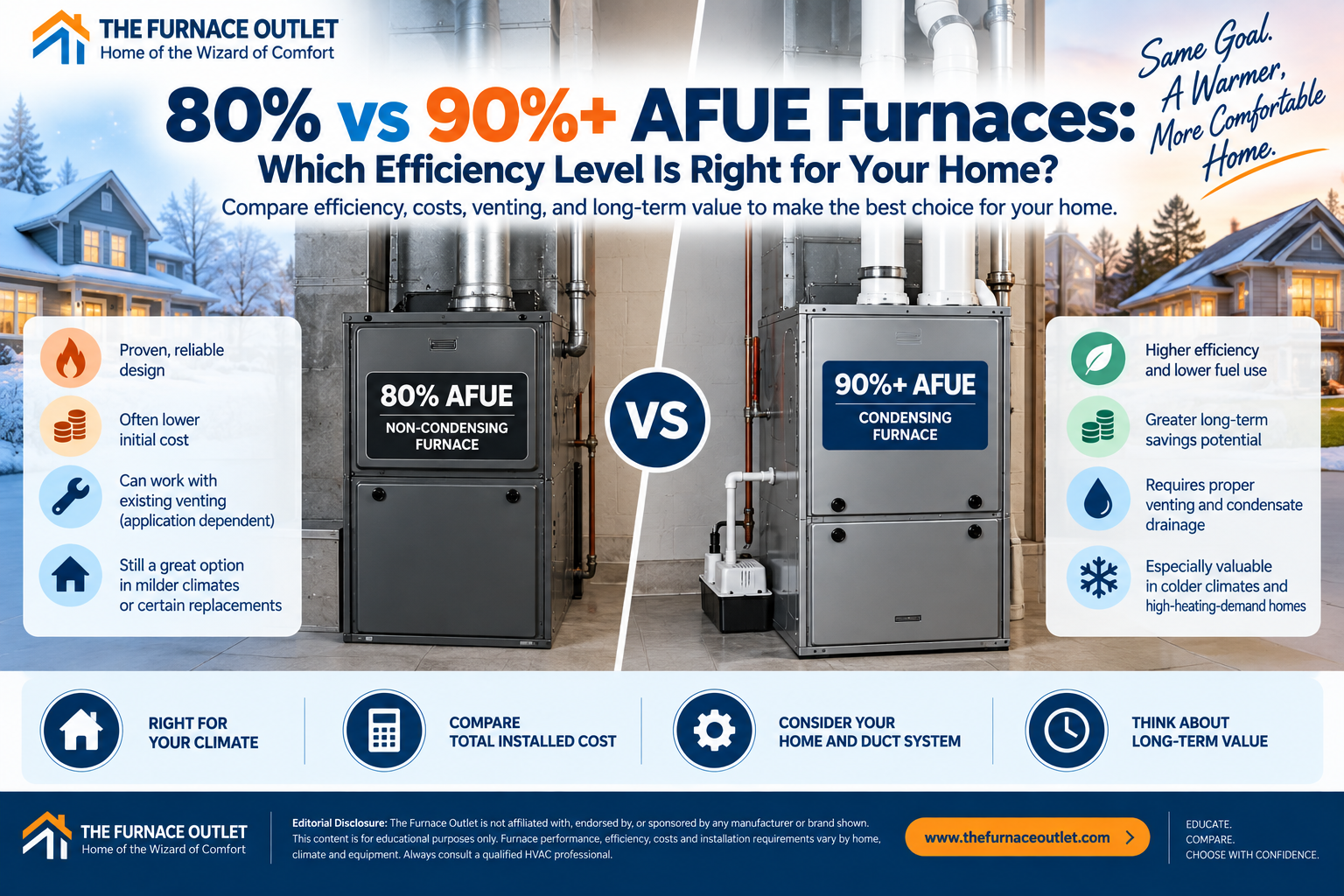
When homeowners compare gas furnaces, one of the first numbers they notice is AFUE. An 80% AFUE furnace may sit beside models rated at 95%, 96%, 97% or even higher, making the decision appear straightforward: choose the furnace with the biggest number and enjoy lower heating bills.
In practice, furnace selection is more complicated than that. Higher AFUE means the furnace converts a greater percentage of its fuel into useful heat, but efficiency is only one part of the buying decision. Climate, natural-gas prices, venting requirements, condensate drainage, installation cost, expected ownership period, furnace sizing and the condition of your ductwork can all change which option makes the most sense.
After years of working around HVAC installations, I would never recommend choosing between an 80% and a 90%+ furnace from the AFUE number alone. The better question is: Which furnace gives your particular home the best combination of efficiency, installation quality, comfort and long-term cost?
That is what we are going to work through in this guide.
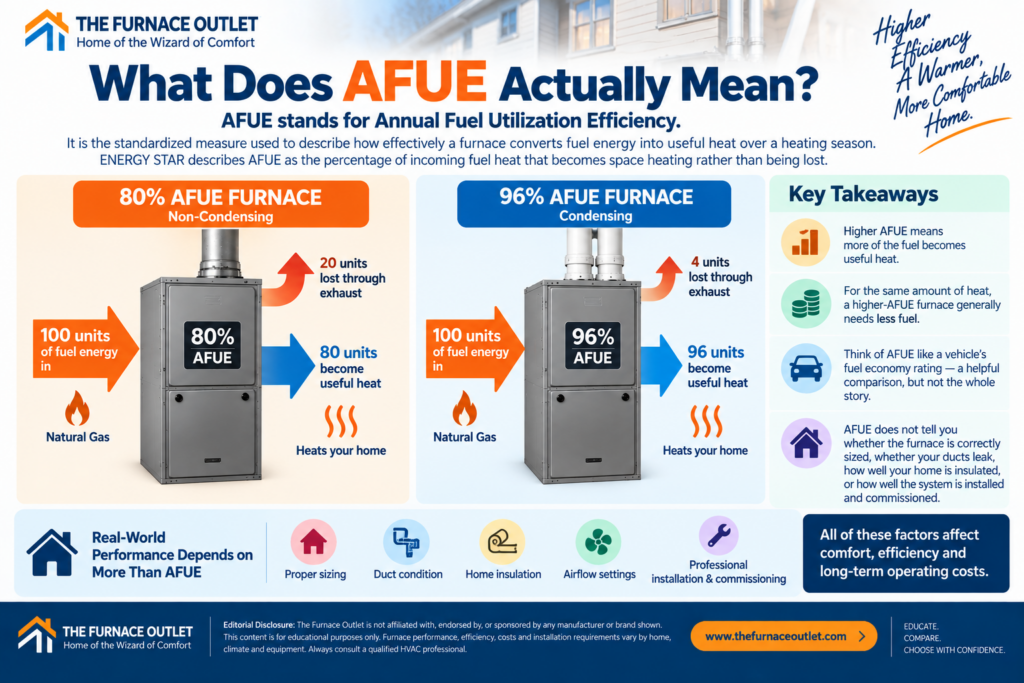
AFUE stands for Annual Fuel Utilization Efficiency. It is the standardized measure used to describe how effectively a furnace converts fuel energy into useful heat over a heating season. ENERGY STAR describes AFUE generally as the percentage of incoming fuel heat that becomes space heating rather than being lost.
An 80% AFUE furnace therefore converts approximately 80% of its fuel energy into useful heating under the standardized AFUE calculation, while the remaining portion is lost. A 96% AFUE furnace converts approximately 96% into useful heat, leaving a much smaller percentage as losses.
That difference is meaningful. If two furnaces must provide the same amount of heat to a house, the higher-AFUE furnace generally needs less fuel to accomplish the job. But AFUE should be thought of somewhat like the fuel-economy rating of a vehicle. It is an extremely useful comparison metric, but it does not tell you everything about what ownership will actually cost.
AFUE does not tell you whether the furnace is correctly sized, whether your ducts leak, whether your house has poor insulation, whether airflow has been properly set or whether the furnace was commissioned correctly. Those factors can have a major effect on real-world comfort and energy use.
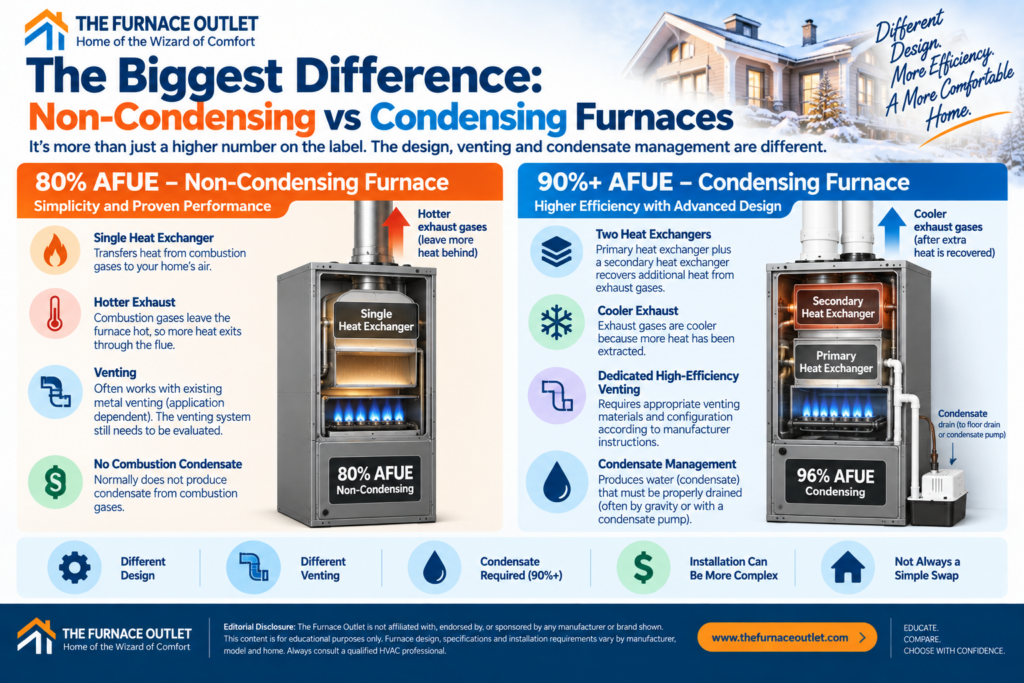
The distinction between an 80% furnace and most 90%+ furnaces is more significant than simply changing the efficiency number on the equipment label.
An 80% AFUE gas furnace is generally a non-condensing furnace. Combustion gases leave the furnace hot enough that a significant amount of energy exits through the flue. Depending on the application, these furnaces may be able to work with existing metal venting arrangements, although the venting system still needs to be evaluated for the specific furnace and installation.
A 90%+ AFUE furnace is generally a condensing furnace. High-efficiency designs recover additional heat from combustion gases, typically using a secondary heat exchanger. Trane, for example, describes high-efficiency furnaces as condensing furnaces using two heat exchangers, while Carrier notes that condensing furnaces with secondary heat exchangers can reach the mid-to-high 90% AFUE range.
Recovering more heat cools the exhaust gases enough that water vapor condenses. That condensate has to go somewhere, so the installation needs a properly designed drainage arrangement. Venting requirements are also different from those of conventional non-condensing equipment.
This is why replacing an 80% furnace with a 96% furnace is not always a simple equipment swap.
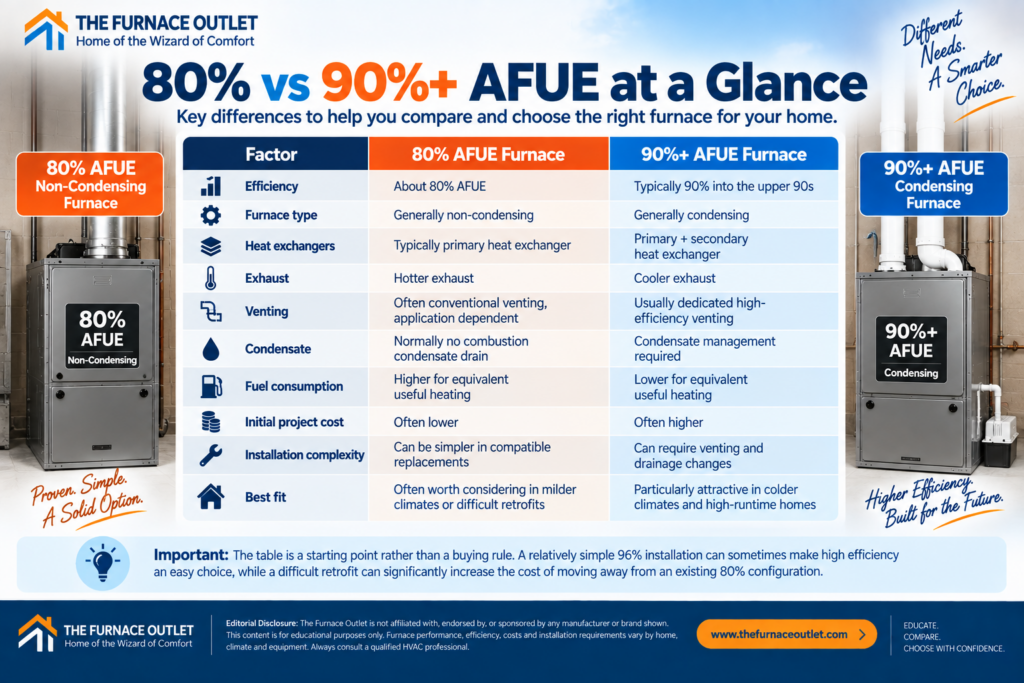
| Factor | 80% AFUE Furnace | 90%+ AFUE Furnace |
|---|---|---|
| Efficiency | About 80% AFUE | Typically 90% into the upper 90s |
| Furnace type | Generally non-condensing | Generally condensing |
| Heat exchangers | Typically primary heat exchanger | Primary + secondary heat exchanger |
| Exhaust | Hotter exhaust | Cooler exhaust |
| Venting | Often conventional venting, application dependent | Usually dedicated high-efficiency venting |
| Condensate | Normally no combustion condensate drain | Condensate management required |
| Fuel consumption | Higher for equivalent useful heating | Lower for equivalent useful heating |
| Initial project cost | Often lower | Often higher |
| Installation complexity | Can be simpler in compatible replacements | Can require venting and drainage changes |
| Best fit | Often worth considering in milder climates or difficult retrofits | Particularly attractive in colder climates and high-runtime homes |
The table is a starting point rather than a buying rule. A relatively simple 96% installation can sometimes make high efficiency an easy choice, while a difficult retrofit can significantly increase the cost of moving away from an existing 80% configuration.
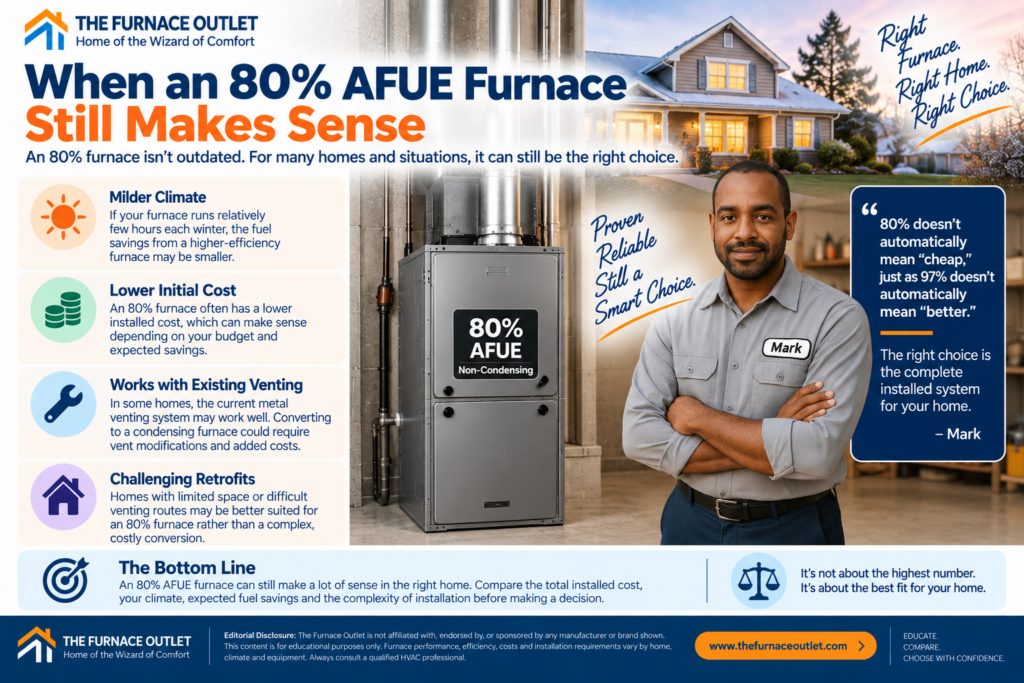
It is easy to look at an 80% furnace in 2026 and assume that it represents outdated technology. That is too simplistic. Major manufacturers still market 80% furnaces because there are homes and installation situations where non-condensing equipment remains useful. One of the clearest examples is a milder heating climate. If your furnace operates relatively few hours each winter, the fuel savings created by moving from 80% to the mid- or upper-90% range may be smaller than they would be in a house experiencing a long northern winter.
That does not make the efficiency improvement meaningless. It means you need to compare the additional installed cost against the amount of fuel you are realistically likely to save. Replacement configuration matters as well. Imagine an existing 80% furnace located where the current venting arrangement works well but installing new high-efficiency venting would be difficult. Moving to a condensing furnace could require vent modifications, condensate piping and possibly a condensate pump or other installation changes.
If those modifications substantially increase project cost, another appropriately selected 80% furnace deserves consideration. The important point is that 80% should not automatically mean “cheap,” just as 97% should not automatically mean “better.” The correct comparison is between two complete installed systems.
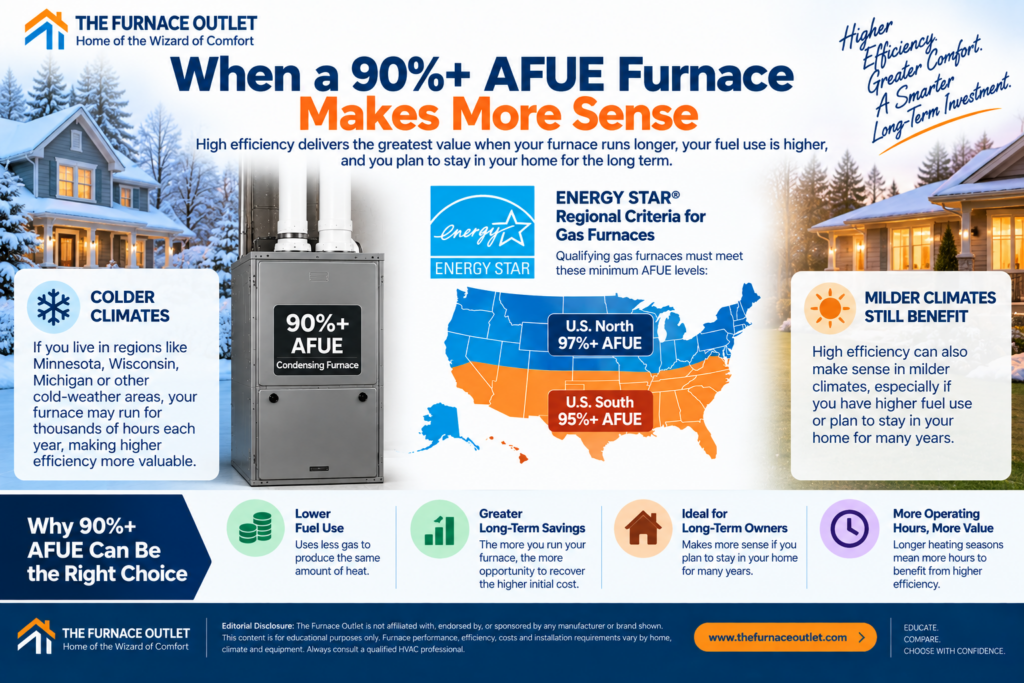
The argument for high efficiency becomes progressively stronger as furnace runtime and fuel consumption increase. A homeowner in Minnesota, Wisconsin, Michigan or another cold-weather region may operate a furnace heavily for months. Over many heating seasons, reducing the fuel required to produce the same useful heat can become financially significant.
ENERGY STAR’s current criteria illustrate the importance of geography. Qualifying gas furnaces are required to reach 97% AFUE or greater in the U.S. North and 95% AFUE or greater in the U.S. South, along with applicable program requirements. That regional distinction makes sense from an installation perspective. If a furnace has a long annual runtime, you have many more operating hours over which a higher-efficiency system can recover its additional purchase and installation cost. High efficiency can also make sense when you expect to remain in the house for a long time. A homeowner expecting to move within a few years evaluates payback differently from someone planning to own the house for another 15 years.
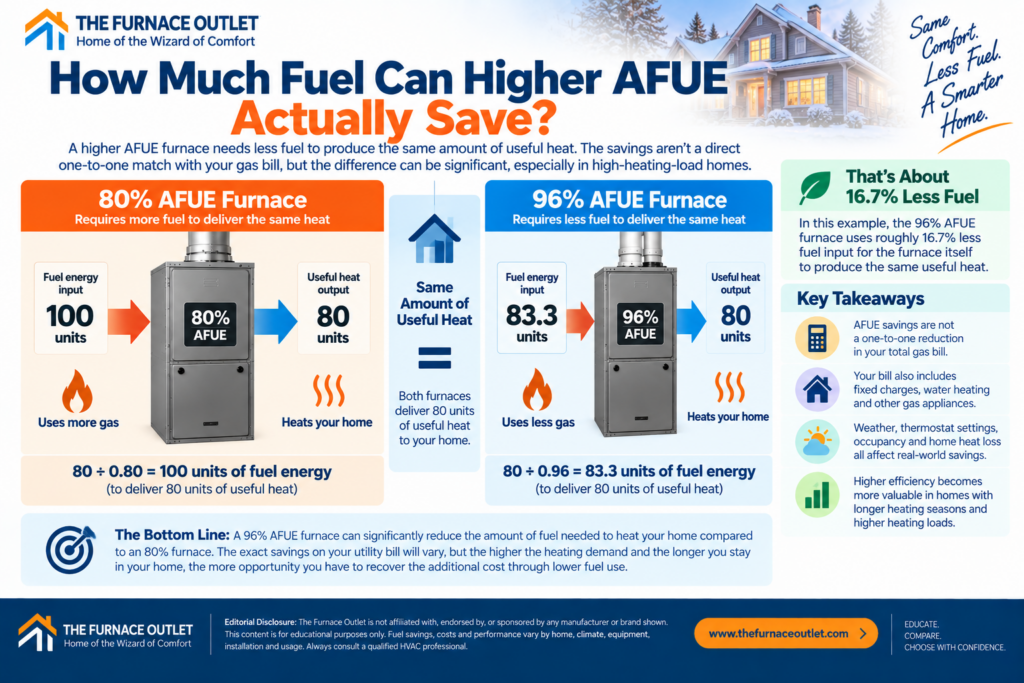
AFUE percentages are easy to compare, but there is an important mathematical detail homeowners sometimes miss. Going from 80% to 96% AFUE does not simply mean your gas bill will fall by 16%. To provide the same amount of useful heat, the required fuel input is inversely related to efficiency. For a simplified example, suppose your house requires 80 units of useful heat.
An 80% AFUE furnace would theoretically require about: 80 ÷ 0.80 = 100 units of fuel energy
A 96% furnace supplying the same 80 units of useful heat would require about: 80 ÷ 0.96 = 83.3 units of fuel energy
Under that simplified comparison, the 96% furnace would require roughly 16.7% less fuel input for the furnace itself to produce the same useful heat.
Real utility-bill savings will not exactly match this example because your gas bill can include fixed charges, water heating and other gas appliances. Weather, thermostat settings, occupancy and building heat loss also change from year to year. Still, this calculation demonstrates why the efficiency difference becomes increasingly important in high-heating-load homes.
I would put climate near the top of the decision list. In a cold northern climate, a furnace may accumulate thousands of operating hours over its service life. Every percentage point of efficiency has more opportunity to reduce fuel consumption. In a relatively mild climate, the furnace may operate far less. An expensive installation conversion may therefore take considerably longer to recover through energy savings.
ENERGY STAR itself uses different furnace efficiency criteria for northern and southern regions, reinforcing that furnace economics are geographically dependent rather than universal. This is why a furnace recommendation made for Minneapolis should not automatically be applied to Atlanta, Dallas or another region with very different winter conditions.
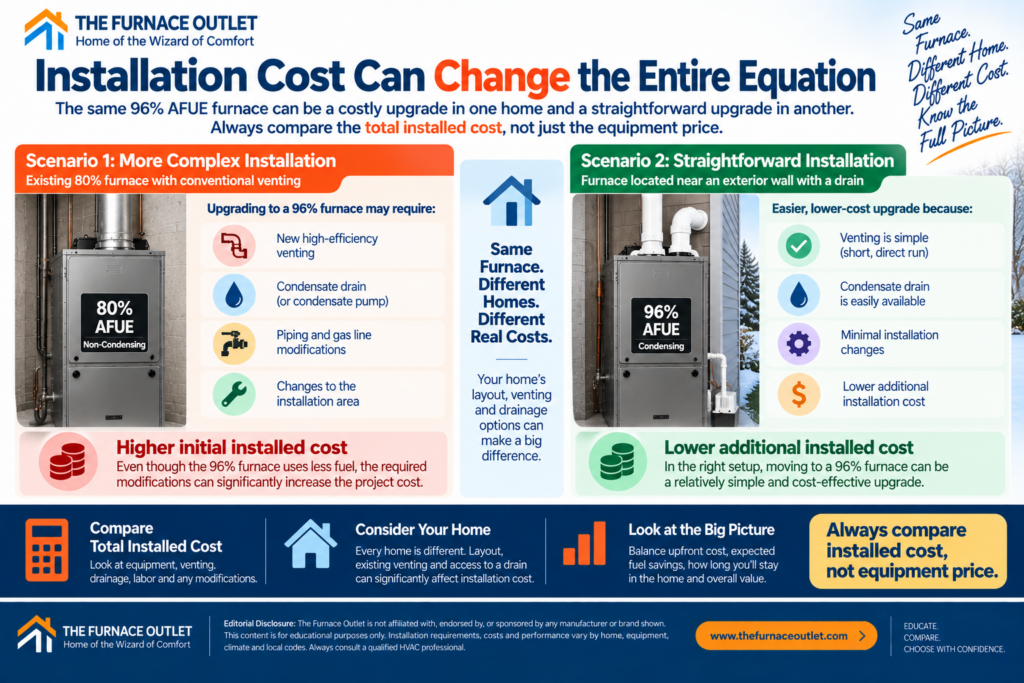
Equipment price is only one component of a furnace replacement. Suppose Contractor A quotes an 80% furnace that works with an appropriate existing venting configuration. Contractor B quotes a 96% furnace but needs to install new venting, establish a condensate drain, make piping changes and modify the installation area.
The second furnace will consume less fuel, but its initial installed cost may be considerably higher. Now consider another house where the furnace sits close to an exterior wall and a suitable drain. Converting to a condensing furnace might be relatively straightforward. In that home, the additional installation cost could be much smaller.
The exact same two furnaces can therefore produce completely different financial conclusions in two different houses. Always compare installed cost, not equipment price.
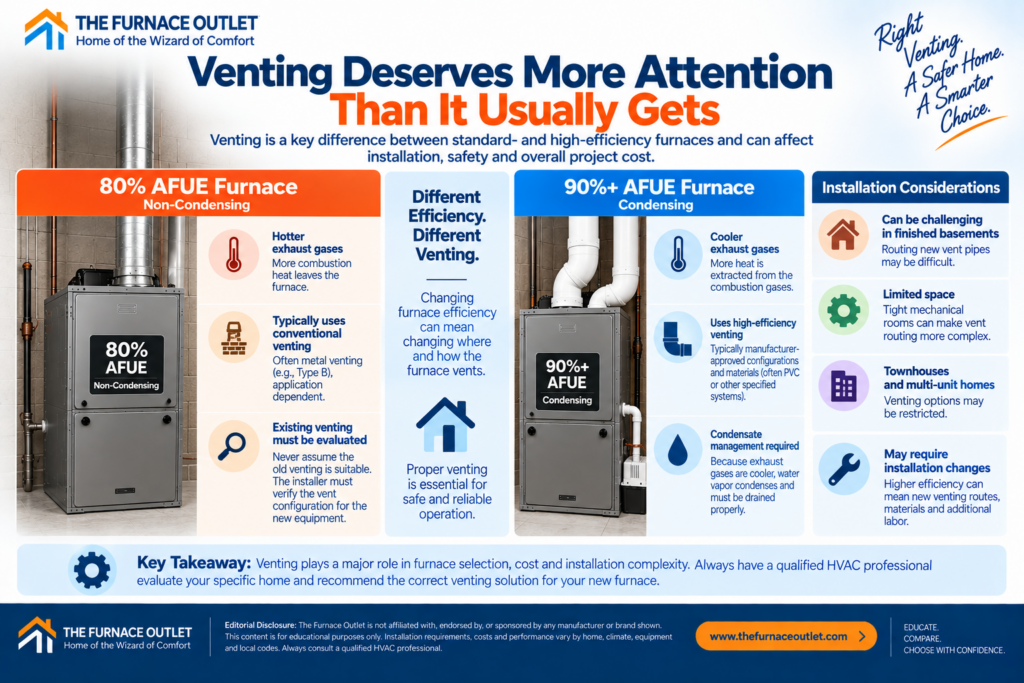
Venting is one of the biggest practical differences between standard- and high-efficiency furnaces. An 80% furnace produces hotter flue gases because more combustion heat leaves the furnace. The venting system must safely carry those combustion products outside. Existing venting should never simply be assumed to be suitable because the old furnace used it; the installer needs to verify the vent configuration for the new equipment.
High-efficiency condensing furnaces have much cooler exhaust because more heat has been extracted from the combustion gases. Their venting systems are designed accordingly and typically use manufacturer-approved configurations and materials. Changing furnace efficiency can therefore mean changing where and how the furnace vents.
That becomes particularly important in finished basements, tight mechanical rooms, townhouses and other installations where routing new vent pipes can be difficult.
A condensing furnace creates water as part of normal operation. That condensate must be managed correctly. Depending on the installation, it may drain by gravity or require a condensate pump. Local requirements, manufacturer instructions and the characteristics of the condensate disposal system all need to be considered.
Drainage may sound like a small detail compared with choosing a $5,000–$10,000 HVAC project, but poor condensate management can cause shutdowns, leaks and property damage. This is exactly why I keep coming back to installation quality. A high AFUE number does not compensate for bad installation work.
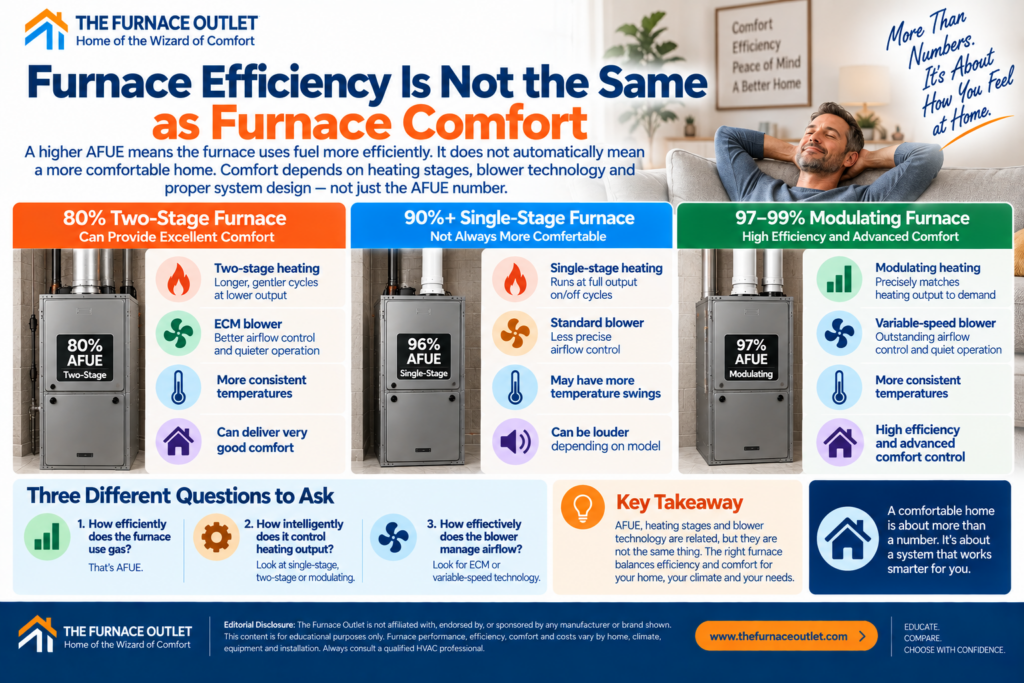
Another common mistake is assuming a 97% furnace must automatically be more comfortable than an 80% furnace. AFUE measures fuel utilization efficiency. It does not directly measure temperature consistency, airflow, sound level or humidity performance.
Those characteristics depend heavily on heating stages and blower technology. An 80% two-stage furnace with a good ECM blower can potentially provide better comfort than a poorly selected high-efficiency single-stage system because it may operate for longer periods at lower heating output and manage airflow more effectively.
Likewise, a premium 97–99% furnace may combine high AFUE with two-stage or modulating heat and variable-speed airflow, giving you both efficiency and more sophisticated comfort control. When comparing quotes, separate these questions: How efficiently does the furnace use gas? How intelligently does it control heating output? How effectively does the blower manage airflow?
They are related, but they are not the same thing.
I would rather install a correctly sized 95% furnace than an oversized 98% furnace simply because someone wanted the highest specification on the brochure. Furnace sizing should be based on the home’s heating load, not merely the capacity of the furnace being replaced or a rough square-footage rule.
Climate, outdoor design temperature, insulation, windows, air leakage, ceiling height, orientation and building construction all influence heat loss. Carrier and Rheem both emphasize professional load calculations when selecting equipment, including the problems created by oversized or undersized systems. An oversized furnace can satisfy the thermostat quickly and shut off before temperatures throughout the house stabilize. An undersized furnace can struggle to maintain the desired indoor temperature during severe weather. Your duct system also needs to accommodate the airflow requirements of the selected equipment. AFUE cannot fix any of these problems.
Before spending extra money moving from 80% to 96%, 97% or 98% AFUE, find out what condition your ducts are in. A furnace can be extremely efficient at transferring heat from gas into the air passing through its cabinet while the house still performs poorly because conditioned air is leaking through ducts or airflow is restricted.
Return-air capacity, supply duct sizing, filter pressure drop, coil resistance, registers and overall static pressure can all affect system operation. ENERGY STAR specifically points homeowners toward insulation, air sealing and duct sealing as ways to improve overall heating and cooling performance. This is another reason I dislike furnace shopping based exclusively on specifications. The furnace is one component of a heating system, and the heating system is operating inside a building.
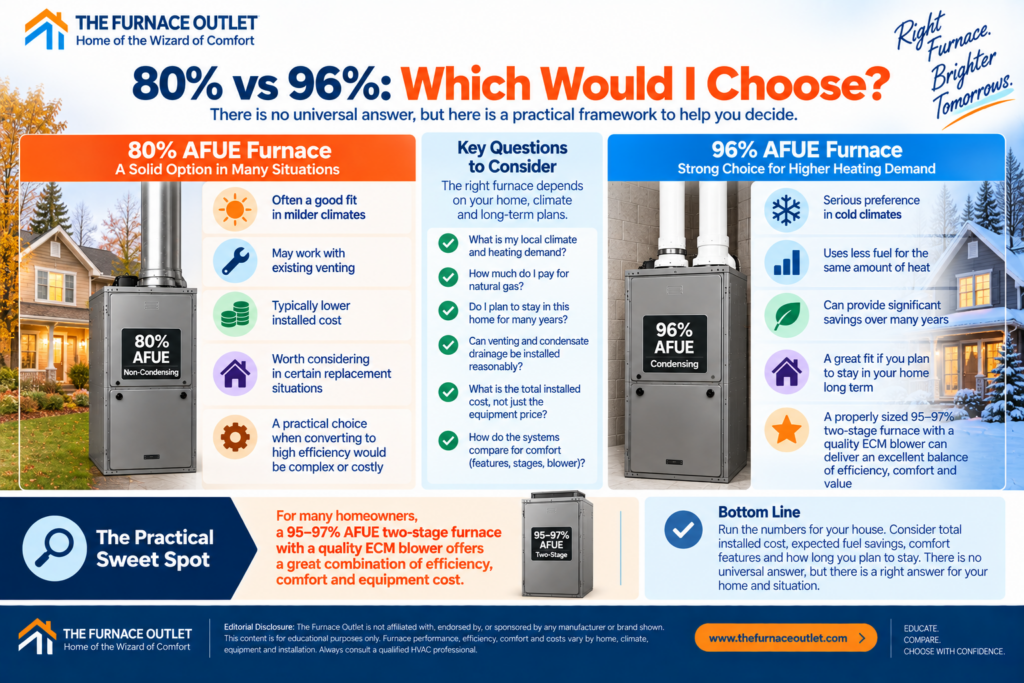
There is no universal answer, but there is a practical framework. I would give a 90%+ condensing furnace serious preference in a cold climate, particularly when the home has substantial heating demand, natural-gas costs are meaningful, the homeowner expects to stay for many years and the venting and condensate installation can be completed reasonably.
I would keep an 80% furnace firmly in consideration in milder climates, certain replacement applications and situations where conversion to condensing equipment introduces significant installation complexity or cost. For many homeowners choosing high efficiency, the practical sweet spot is not necessarily the most expensive 98–99% flagship model. A properly sized 95–97% AFUE two-stage furnace with a quality ECM blower can deliver an excellent combination of fuel efficiency, comfort and equipment cost. The numbers still need to be run for your house.
Do not ask contractors simply, “Which furnace is better?” Ask them to explain why each proposed system fits your home. A good comparison should cover the heating-load calculation, furnace input and output capacity, AFUE, staging or modulation, blower type, venting, combustion-air requirements, condensate disposal, filter arrangement, duct modifications, static-pressure testing, compatibility with the existing air conditioner or heat pump, controls, commissioning procedures and warranty support.
You should also ask what changes are included in the quoted price. A lower furnace quote can become considerably more expensive once required venting, drainage, electrical or duct modifications are added. Conversely, do not assume the contractor proposing the highest-AFUE equipment has designed the best system. The quality of the installation deserves at least as much scrutiny as the model number on the proposal.
When I compare an 80% furnace with a 90%+ furnace, I do not begin by deciding which AFUE number I prefer. I start with the house and the installation. Determine the heating load. Inspect the duct system. Understand the existing venting. Identify a practical condensate route. Look at local winter conditions and fuel prices. Decide how long you expect to own the house. Then compare complete installed prices for appropriately sized systems.
If you live in a cold climate and the installation is straightforward, moving into the mid-to-upper 90% AFUE range can be a very compelling long-term choice. If you live in a mild climate or have an installation where converting to condensing equipment creates disproportionate cost and complexity, a properly selected 80% furnace may still be perfectly reasonable.
Most importantly, do not sacrifice correct sizing, ductwork, airflow, installation quality or commissioning simply to afford a higher AFUE rating.
The best furnace is not the one that wins a specification contest. It is the furnace that fits the heating load, works properly with the duct system, makes financial sense for the homeowner and has been installed and commissioned correctly.
Best Furnaces of 2026: Gas Furnace Brands & Models Compared – The Furnace Outlet
For further research, homeowners can review ENERGY STAR Furnace Key Product Criteria, ENERGY STAR Furnace Buying Guidance, Carrier’s AFUE Guide, Trane’s Furnace Efficiency Guide and Rheem’s HVAC Product Education resources.
Editorial Disclosure: The Furnace Outlet is an independent educational and editorial resource. We are not associated with, affiliated with, endorsed by or sponsored by any furnace manufacturer or brand discussed in this article. We do not receive manufacturer compensation for inclusion or rankings.
Educational & Product Disclaimer: This article is provided for general educational purposes and should not replace an on-site evaluation by a qualified HVAC professional. Furnace efficiency, fuel consumption, operating costs, equipment availability, specifications and installation requirements vary by model, home, climate and installation. Manufacturer specifications, ENERGY STAR requirements, incentives and regulations may change; verify current information before purchasing equipment.
Installation & Safety Disclaimer: Gas furnaces involve combustible fuel, combustion gases, electrical systems, venting and potentially condensate disposal. Furnace installation, venting, conversion, adjustment, commissioning, inspection and repair should follow manufacturer instructions and applicable codes and should be performed by appropriately qualified professionals. A professional heating-load calculation and evaluation of ductwork, venting, gas supply and system compatibility are recommended before equipment selection.
Last updated: September 2026.