Newsletter Subscribe
Enter your email address below and subscribe to our newsletter

HVAC made simple
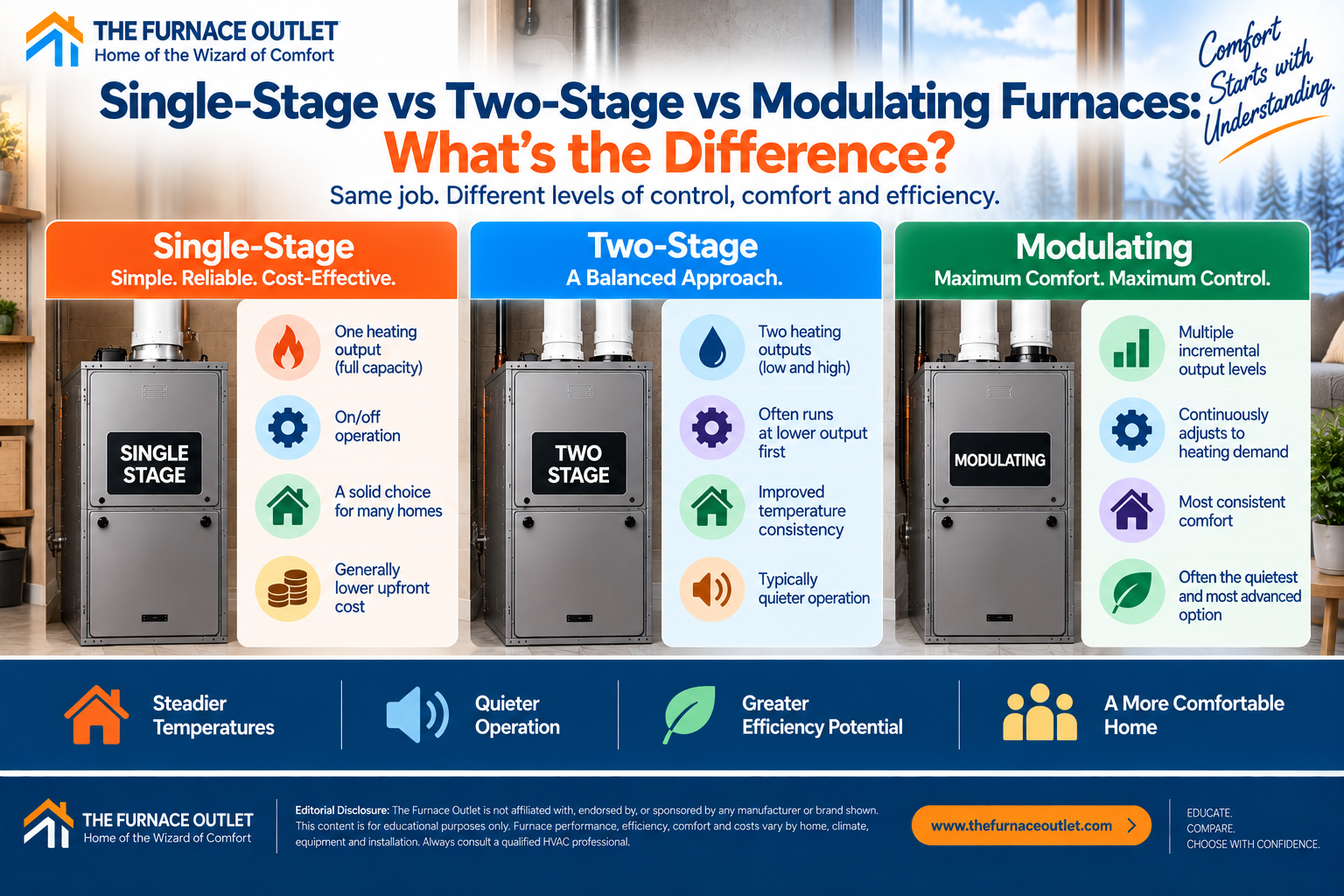
When homeowners compare gas furnaces, AFUE usually gets most of the attention. A 96% furnace sounds better than an 80% furnace, and a 98% model sounds better still. But efficiency is only part of the story. How a furnace delivers heat can have just as much influence on how comfortable the house feels. That is where furnace staging comes in.
A single-stage furnace essentially has one heating output: full capacity. A two-stage furnace can operate at a lower heating output or full capacity. A modulating furnace can adjust its heating output through a much broader range, allowing it to more closely follow the home’s changing heating demand. Carrier and Trane both describe these as the three fundamental approaches to controlling furnace heat output.
The practical difference is easiest to understand this way. Imagine driving a car where the accelerator has only one position besides off. That resembles single-stage heating. Add a second, gentler accelerator position and you have something similar to two-stage operation. Give the accelerator the ability to adjust gradually according to how much power is needed, and you are much closer to a modulating furnace.
None of those technologies can compensate for poor furnace sizing, inadequate ductwork or bad installation. But when the furnace is properly selected and installed, staging can significantly affect temperature consistency, cycling, airflow, sound and overall comfort.
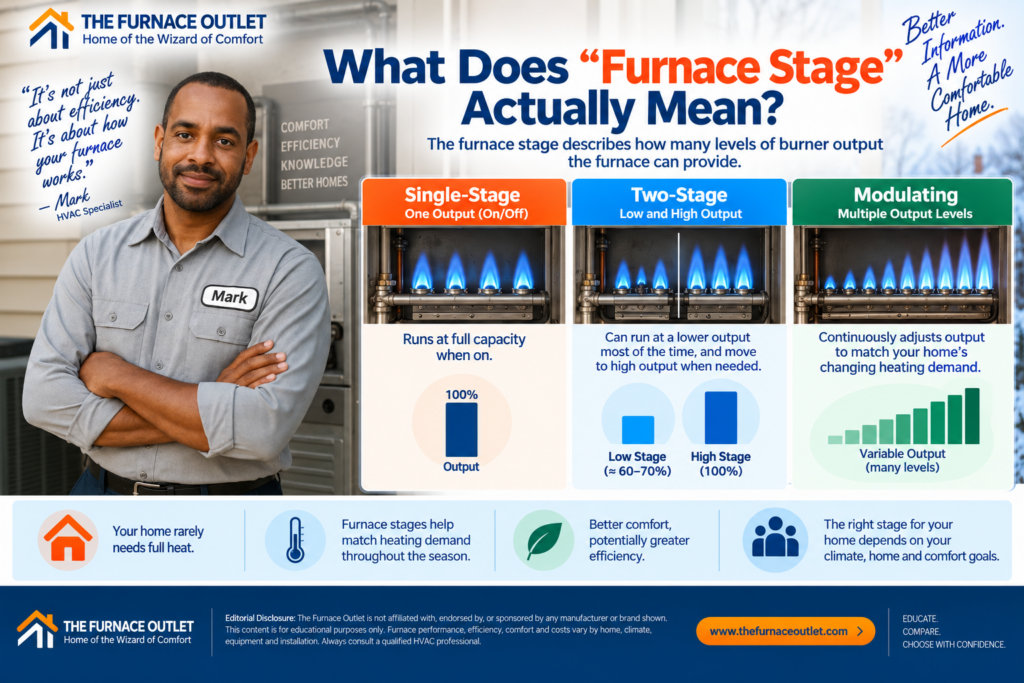
The heating stage describes how many levels of burner output the furnace can provide. In a gas furnace, this is primarily controlled through the gas valve and associated controls. Carrier describes single-stage gas valves as simple on/off devices, two-stage valves as providing low and high output, and modulating valves as adjusting gas flow through a broader operating range.
That distinction is important because your house rarely needs its maximum heating capacity every minute of the winter. A furnace might be sized to handle a very cold winter design condition, but much of the heating season occurs at temperatures considerably warmer than that design point. On those milder days, the house may need only a fraction of the furnace’s maximum output.
The question becomes: What does the furnace do when the house needs less heat than its maximum capacity?
A single-stage furnace generally cycles full output on and off. A two-stage furnace can spend much of its time operating at reduced output before moving to high stage when necessary. A modulating furnace can make much finer adjustments to more closely match heating demand. That difference forms the foundation of the comfort advantages associated with multi-stage equipment.
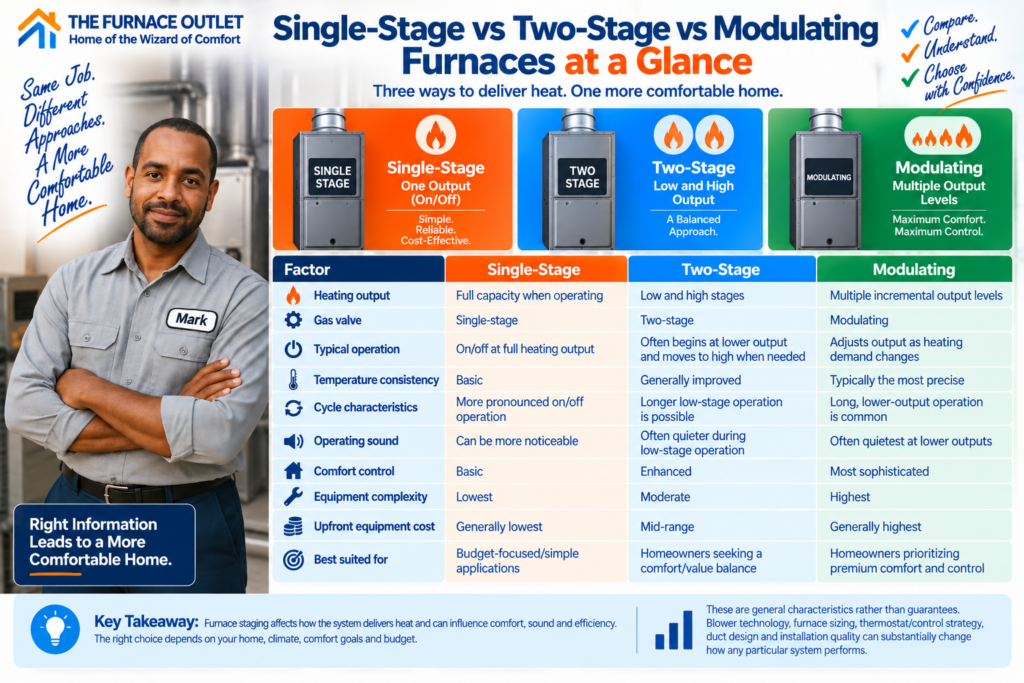
| Factor | Single-Stage | Two-Stage | Modulating |
|---|---|---|---|
| Heating output | Full capacity when operating | Low and high stages | Multiple incremental output levels |
| Gas valve | Single-stage | Two-stage | Modulating |
| Typical operation | On/off at full heating output | Often begins at lower output and moves to high when needed | Adjusts output as heating demand changes |
| Temperature consistency | Basic | Generally improved | Typically the most precise |
| Cycle characteristics | More pronounced on/off operation | Longer low-stage operation is possible | Long, lower-output operation is common |
| Operating sound | Can be more noticeable | Often quieter during low-stage operation | Often quietest at lower outputs |
| Comfort control | Basic | Enhanced | Most sophisticated |
| Equipment complexity | Lowest | Moderate | Highest |
| Upfront equipment cost | Generally lowest | Mid-range | Generally highest |
| Best suited for | Budget-focused/simple applications | Homeowners seeking a comfort/value balance | Homeowners prioritizing premium comfort and control |
These are general characteristics rather than guarantees. Blower technology, furnace sizing, thermostat/control strategy, duct design and installation quality can substantially change how any particular system performs.
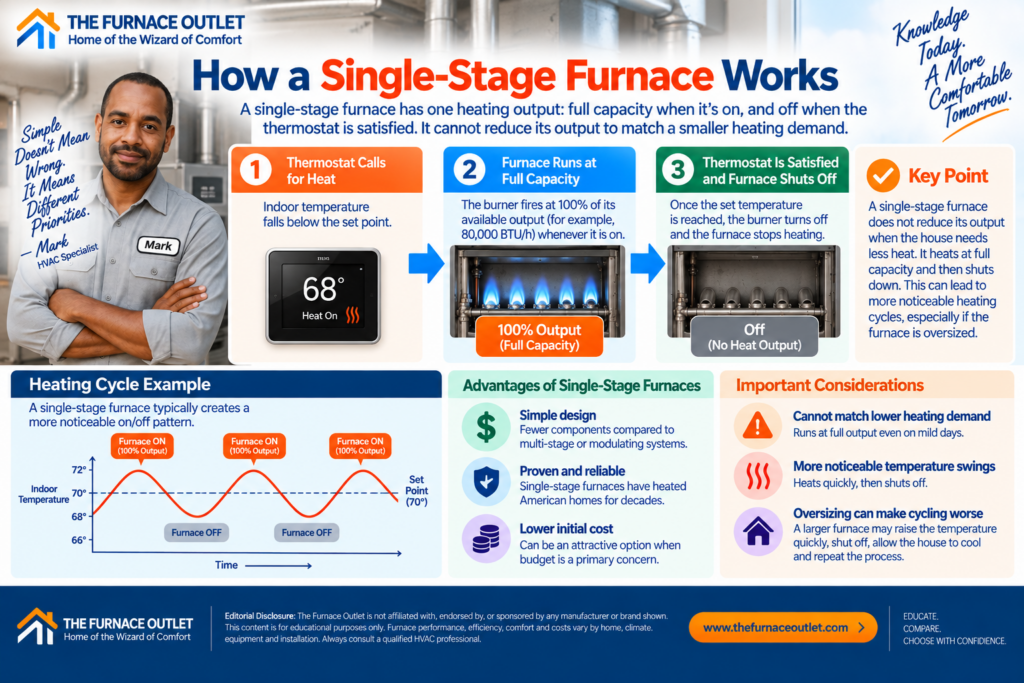
A single-stage gas furnace is the simplest of the three designs. When the thermostat calls for heat, the furnace operates at its full available heating output. When the thermostat is satisfied, the burner shuts off. Carrier describes single-stage furnaces as operating at 100% capacity whenever they are heating, while Trane similarly characterizes single-stage equipment as either off or operating at full capacity.
There is nothing inherently wrong with that approach. Single-stage furnaces have heated American homes successfully for decades, and their simpler design can make them attractive when initial equipment cost is a major consideration. The compromise is that the furnace cannot reduce burner output when the house needs only a modest amount of heat. Suppose a furnace can deliver approximately 80,000 BTU/h at full output, but during a relatively mild winter afternoon the house needs considerably less heat. A single-stage furnace cannot simply reduce its burner output to match that smaller demand. It heats at full capacity and then shuts down when the thermostat is satisfied. That can produce more noticeable heating cycles.
If the furnace is oversized, the effect can become considerably worse. The system may raise the indoor temperature quickly, shut off, allow the house to cool and then repeat the process. This is one reason proper furnace sizing remains important regardless of staging technology.
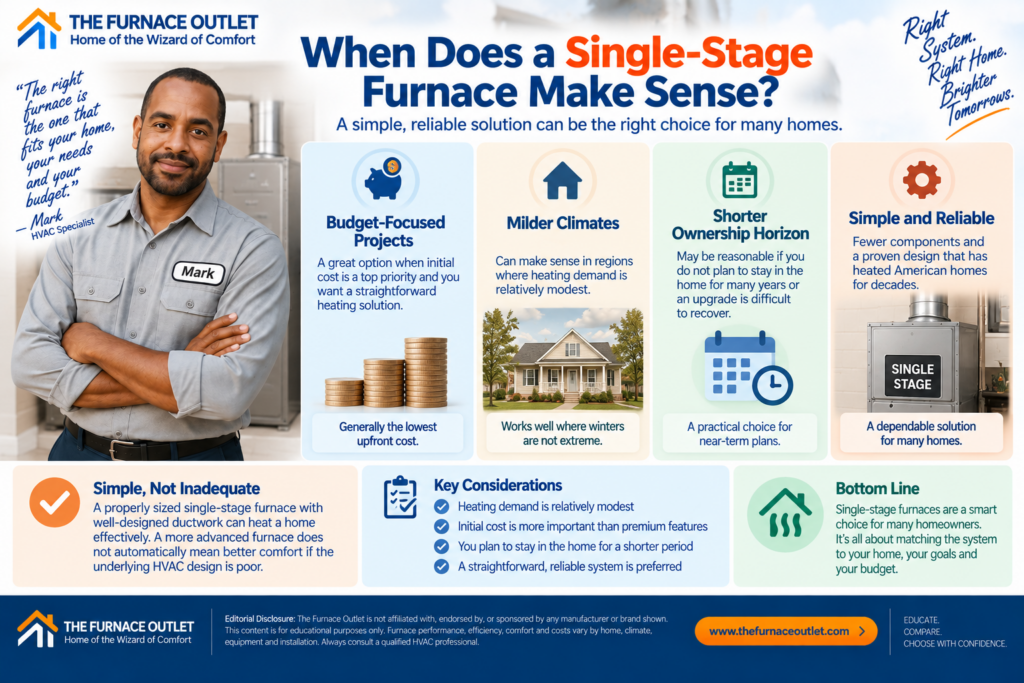
Single-stage equipment deserves consideration when the project calls for a straightforward heating solution and the homeowner places greater importance on initial cost than premium comfort features. It may also be reasonable in homes where heating demand is relatively modest, particularly when the additional cost of advanced equipment would be difficult to recover or the homeowner does not expect to remain in the property for many years.
The important distinction is between simple and inadequate. A properly sized single-stage furnace connected to well-designed ductwork can heat a house effectively. Buying a two-stage or modulating furnace does not automatically mean the house will be comfortable if the underlying HVAC design is poor. Single-stage equipment generally carries the lowest upfront cost of the three categories, while more sophisticated staging increases equipment cost. For some homeowners, that simplicity is exactly what they want.
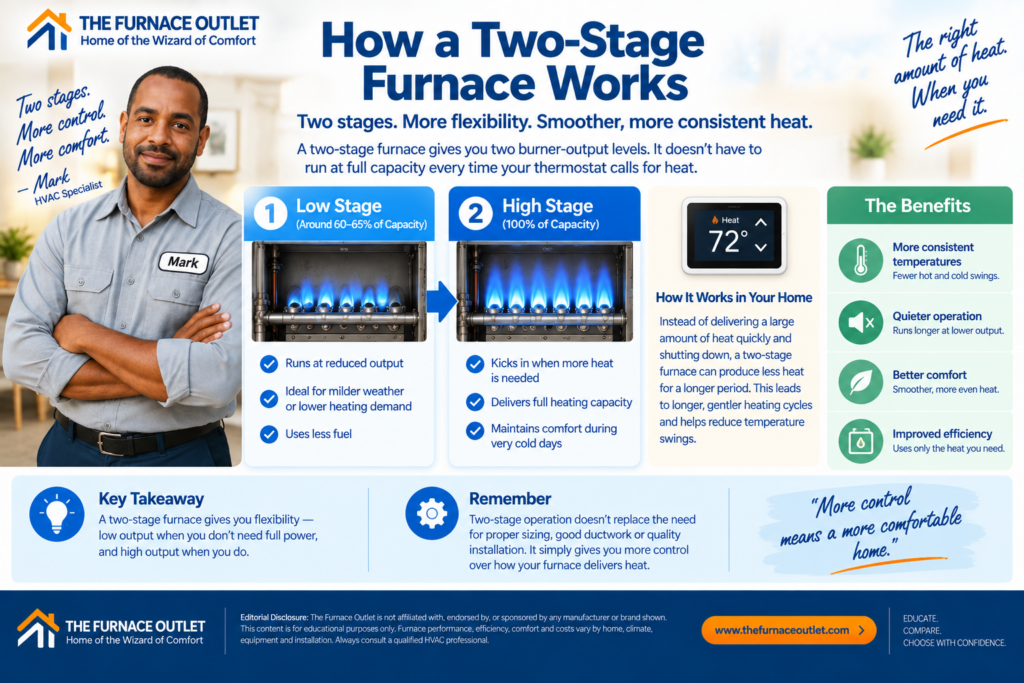
A two-stage furnace adds an important capability: it does not have to operate at maximum heating output every time the thermostat calls for heat. Instead, it has two burner-output levels. The exact percentages vary by manufacturer and model, but Carrier describes typical two-stage operation as having a lower setting around 60–65% of capacity and a high setting at full capacity. During moderate weather, the furnace can operate in its lower stage. If the lower stage cannot satisfy the heating demand, the system can move into high stage.
Think about what that changes inside the house. Instead of delivering a large amount of heat quickly and shutting down, the furnace may be able to produce less heat for a longer period. Longer, gentler heating cycles can help reduce the noticeable temperature swings associated with repeated full-output operation. Carrier describes two-stage systems as providing smoother temperature control by operating at reduced output when full capacity is unnecessary. For many homeowners, that is the biggest reason to consider two-stage equipment.
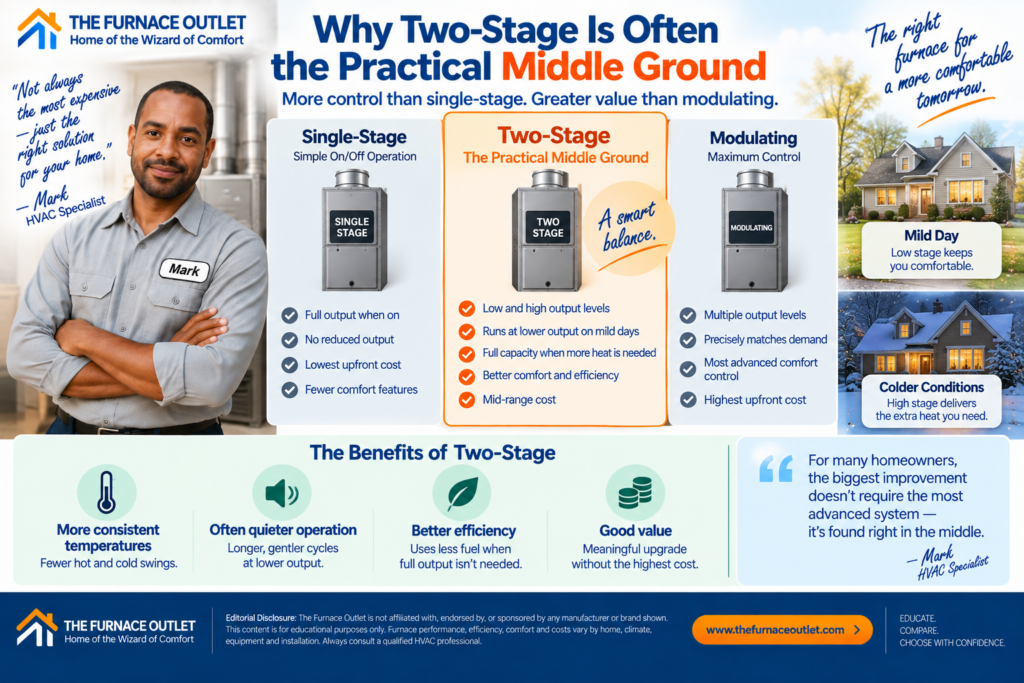
Two-stage furnaces occupy an interesting position in the market because they offer a meaningful improvement in heat-output control without requiring the full sophistication and cost of modulation. On a relatively mild winter day, low-stage operation may be sufficient to maintain the thermostat setting. When temperatures fall sharply overnight, the furnace still has its full heating capacity available.
That gives the system flexibility. You are no longer limited to the full-power-or-off operation of a single-stage furnace, but you are also not paying for dozens of incremental heating levels that you may or may not value. For homeowners looking for a balance of equipment cost, temperature consistency, quieter operation and efficiency, a properly selected two-stage furnace can therefore be particularly compelling.
It is also why I would not automatically recommend jumping from the least expensive single-stage model directly to a flagship modulating furnace. Depending on the house and budget, the most meaningful upgrade may occur in the middle.
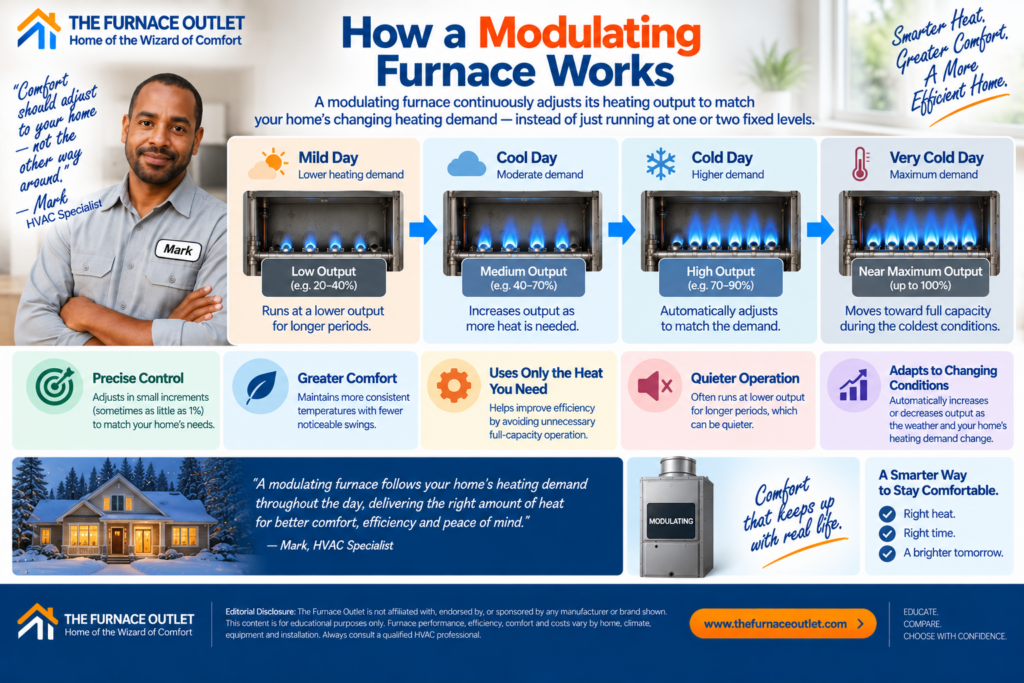
A modulating furnace takes heat-output control considerably further. Instead of choosing between one or two burner outputs, a modulating gas valve can make much smaller adjustments. Lennox describes modulation as continuously fine-tuning furnace output rather than operating at one or two fixed levels, while Carrier notes that some modulating designs can adjust capacity in increments as small as approximately 1%.
The exact minimum output, maximum output and modulation increments depend on the specific furnace. The basic principle, however, remains the same: produce approximately the amount of heat the house needs instead of repeatedly producing much more heat than it needs.
Imagine that the heating demand is relatively low during a cool autumn morning. A modulating furnace may operate at a lower output for an extended period. As outdoor conditions become colder and the house loses heat faster, the furnace can increase its output. During very cold conditions, it can move toward maximum capacity. That ability to follow heating demand is what makes modulation fundamentally different from simple staging.
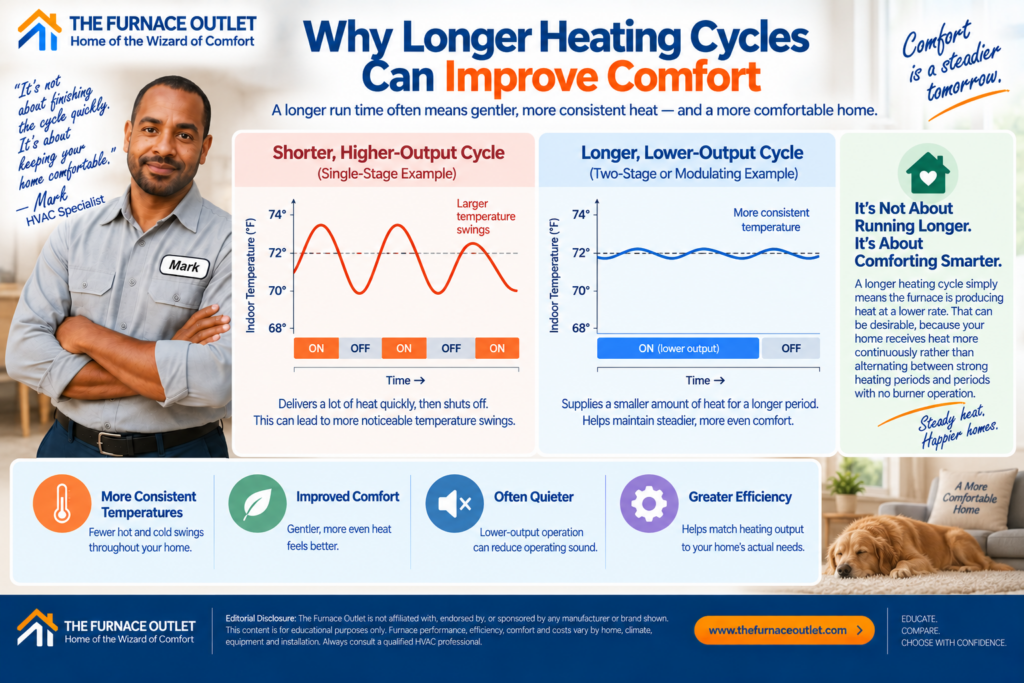
Homeowners sometimes assume that a furnace running longer must be wasting energy. That is not necessarily true. With staged and modulating equipment, a long cycle can simply mean the furnace is producing heat at a lower rate. That can be desirable. Consider two hypothetical systems heating the same properly designed home. One produces a large amount of heat for a short period and shuts down. The other supplies a smaller amount of heat over a longer period.
The second approach can help maintain steadier indoor conditions because the house is receiving heat more continuously rather than alternating between strong heating periods and periods with no burner operation. Lennox describes variable-capacity equipment as continuously adjusting heating capacity between minimum and maximum demand, while two-stage equipment first attempts to maintain comfort using its lower stage before increasing output. That is why the objective should not necessarily be to make the furnace finish each heating cycle as quickly as possible. The objective is to maintain comfort efficiently.
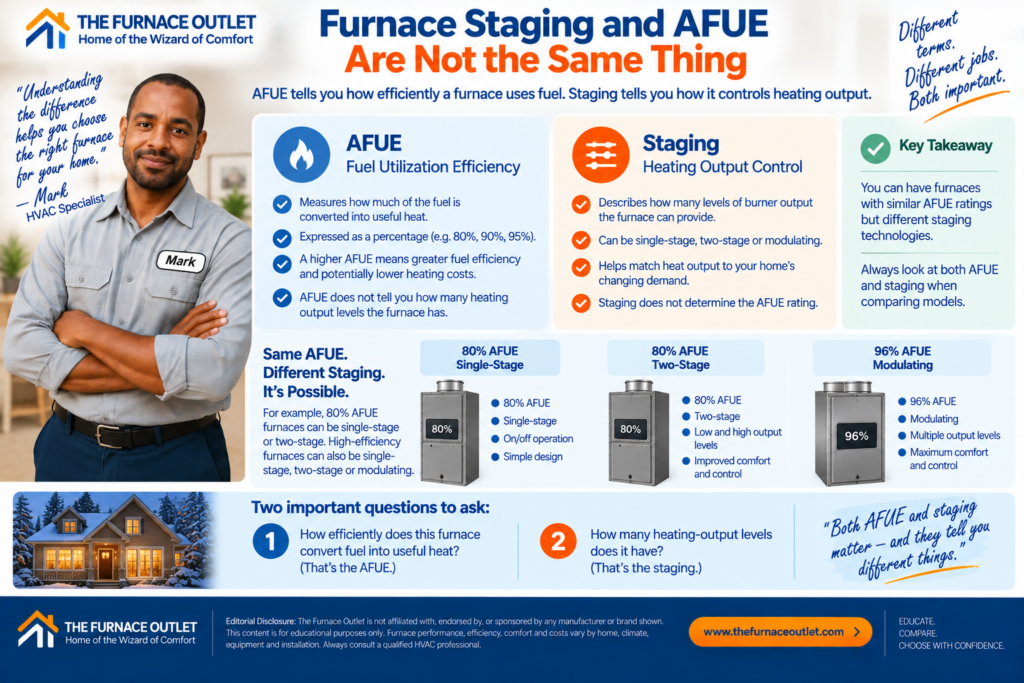
This distinction deserves particular attention because the terminology is often mixed together. AFUE measures fuel utilization efficiency. Staging describes how the furnace controls heating output. You can therefore encounter furnaces with similar AFUE ratings but very different staging technologies.
For example, an 80% furnace could be single-stage or two-stage. High-efficiency furnaces may also be available in single-stage or two-stage configurations, while premium high-efficiency products commonly incorporate modulation. Trane specifically notes that furnace efficiency and staging are separate characteristics: high-efficiency condensing furnaces can gain additional control through multiple stages or modulating gas valves, but AFUE itself remains the efficiency measurement.
When reviewing a furnace proposal, I would therefore ask two different questions: How efficiently does this furnace convert fuel into useful heat? And: How many heating-output levels does it have? Those answers describe different aspects of the system.
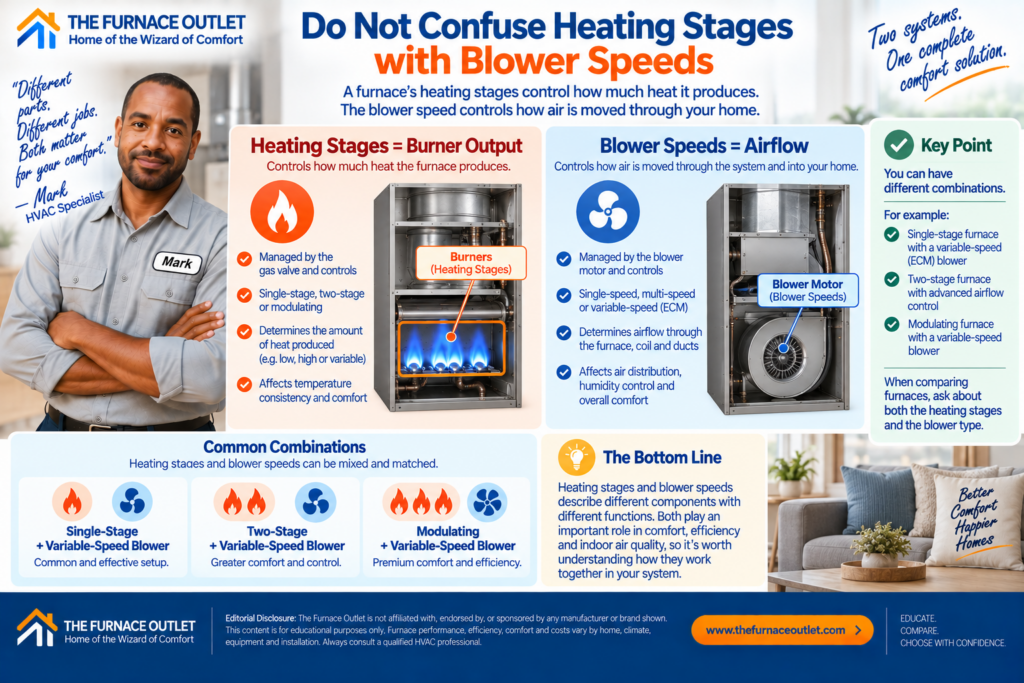
This is probably one of the most important terminology issues in furnace shopping. A two-stage furnace and a variable-speed furnace blower are not describing the same component. Heating stages concern burner output. Blower speed concerns the movement of air through the furnace, evaporator coil and duct system.
Carrier explicitly distinguishes the two: variable-speed refers to the blower motor’s ability to adjust airflow, while single-stage, two-stage and modulating terminology describes heating capacity or gas-valve operation. You could therefore encounter combinations such as a single-stage furnace with an ECM blower, a two-stage furnace with more advanced airflow control, or a modulating furnace paired with a variable-speed blower. The exact combination matters. When I compare furnaces, I want to know both how the burners control heat and how the blower controls airflow.
The furnace can create heat perfectly, but that heat still has to move through the house. The blower pushes conditioned air through the supply ductwork and draws return air back toward the equipment. Its operation affects airflow, sound, filtration performance and how evenly heat is distributed.
Variable-speed blower technology can gradually adjust airflow rather than relying on one fixed operating speed. Carrier notes that variable-speed blowers can help maintain more consistent temperatures and reduce operating noise. That is why a well-designed two-stage furnace with a quality ECM or variable-speed blower can be such an attractive configuration. Low-stage heating and controlled airflow can work together to provide longer, quieter heating cycles without necessarily requiring a top-of-the-line modulating furnace.
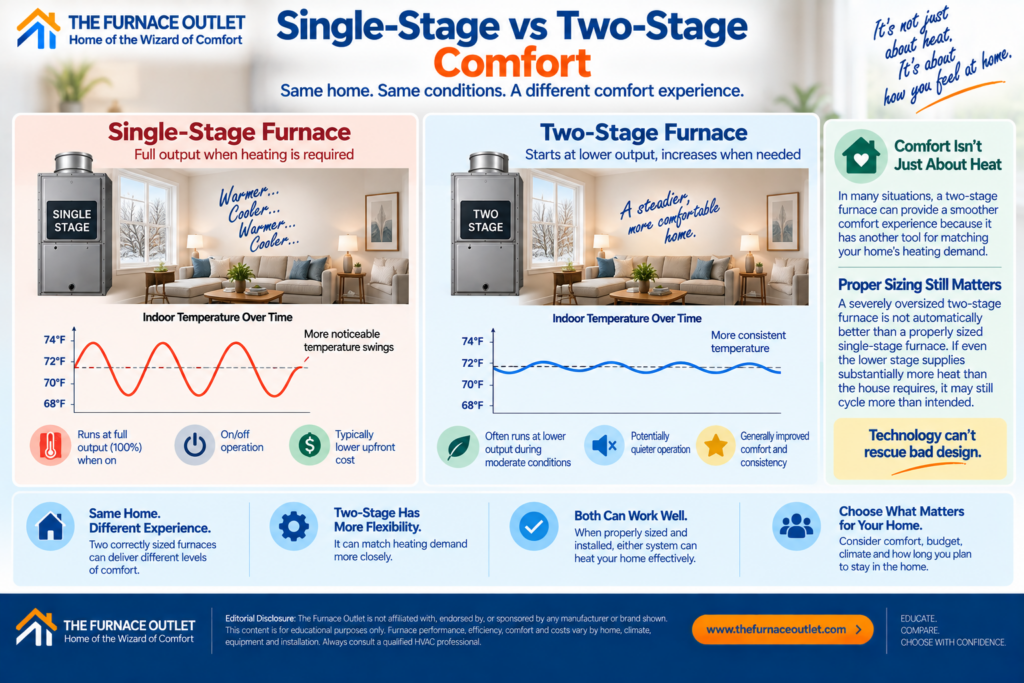
Suppose two correctly sized furnaces serve otherwise identical houses. The single-stage furnace operates at full burner output whenever heating is required. The two-stage furnace begins at reduced output during moderate conditions and increases to full capacity only when necessary.
In many situations, I would expect the two-stage furnace to provide the smoother comfort experience because it has another tool available for matching the house’s heating demand. Carrier and Trane both describe two-stage operation as offering improved temperature consistency compared with basic single-stage operation. But there is an important qualification: the furnace still needs to be sized correctly.
A severely oversized two-stage furnace is not automatically better than a properly sized single-stage furnace. If even its lower stage supplies substantially more heat than the house requires, it may still cycle more than intended. Technology cannot completely rescue bad system design.
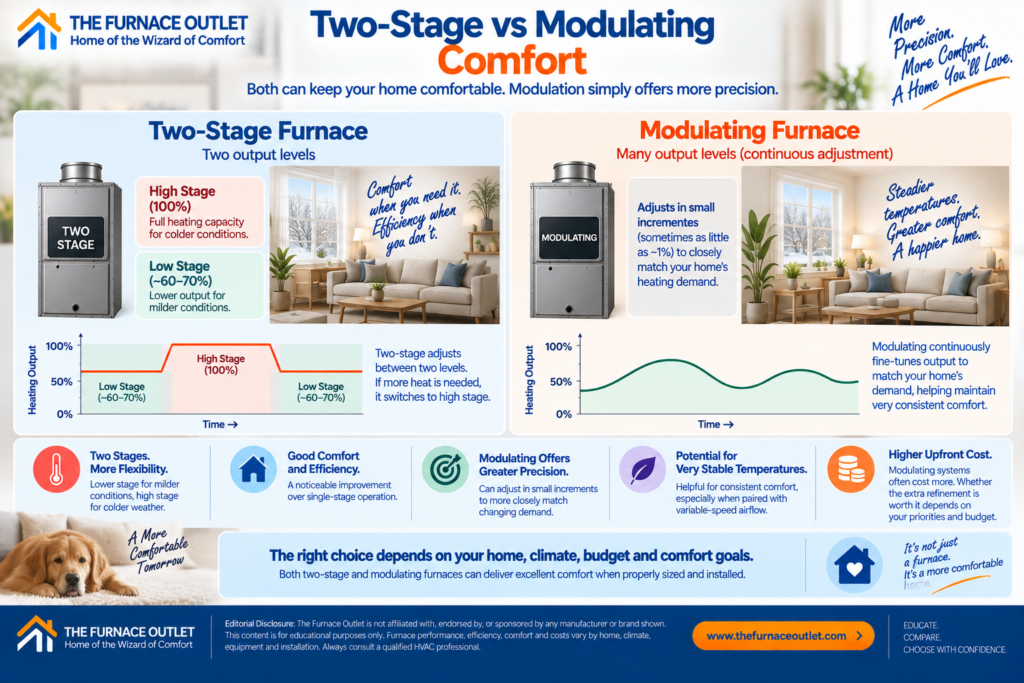
The difference between these two categories is primarily one of precision.
Suppose a home’s heating requirement at a particular moment is roughly half the furnace’s maximum output. Depending on the equipment, a two-stage furnace may be able to operate reasonably close to that demand using its low stage. If the demand changes, however, its next major option is high stage. A modulating furnace can potentially make smaller adjustments as demand changes.
Lennox describes this approach as continuously fine-tuning output, while Carrier compares modulation with adjusting an accelerator rather than simply choosing fixed output levels. That precision can help produce extremely stable indoor temperatures, particularly when modulation is combined with compatible variable-speed airflow and advanced controls. Whether that additional refinement is worth the premium depends on the homeowner.
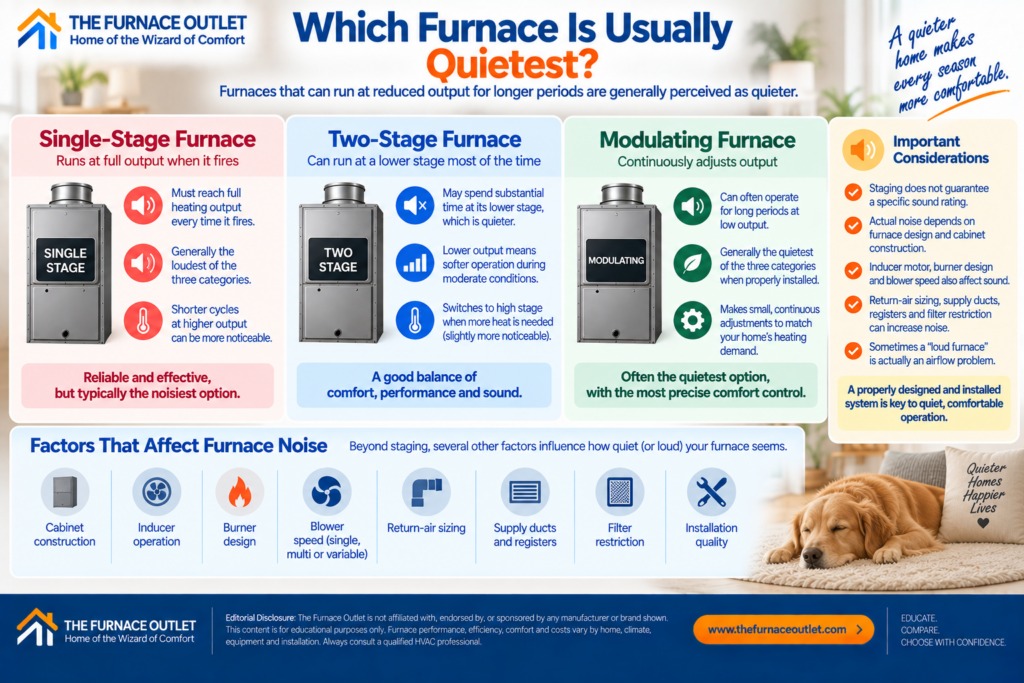
All else being equal, equipment that can operate for extended periods at reduced output generally has an advantage when it comes to perceived operating sound.
Carrier describes two-stage operation as quieter during lower-stage operation and modulating equipment as generally offering the quietest operation of the three categories. But I would be careful about treating staging as a guaranteed sound rating. Actual noise depends on cabinet construction, inducer operation, burner design, blower speed, return-air sizing, supply ducts, registers, filter restriction and installation. Sometimes what homeowners describe as a “loud furnace” is actually an airflow problem.
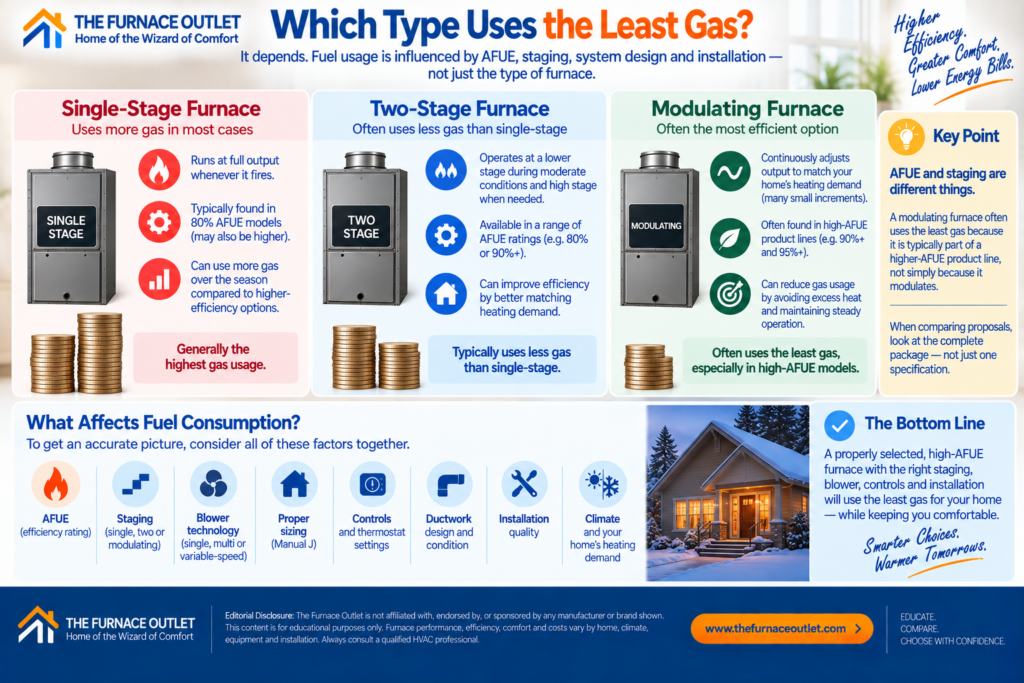
This question is more complicated than it appears. A modulating furnace is often found in premium, high-AFUE product lines, so it may use substantially less fuel than an older 80% single-stage furnace. But you should not attribute the entire difference to modulation. AFUE and staging must again be separated.
If one furnace is 80% AFUE and another is 98% AFUE, much of the fuel-consumption difference relates to combustion efficiency. Staging can improve how intelligently the system responds to heating demand, but it does not replace the AFUE calculation. When comparing proposals, look at the complete package: AFUE + staging + blower technology + furnace sizing + controls + ductwork + installation.
That gives you a much better picture than any one specification.
The normal progression is straightforward:
Carrier describes single-stage furnaces as generally having the lowest upfront cost, with two-stage models occupying the middle and modulating furnaces carrying the highest initial cost because of their more sophisticated technology. However, equipment price should never be confused with total installed cost.
An inexpensive furnace requiring extensive duct modifications, venting changes or electrical work may produce a higher project cost than expected. Conversely, upgrading staging within a compatible furnace installation may sometimes represent a relatively modest portion of the total replacement project. Compare actual installed proposals.
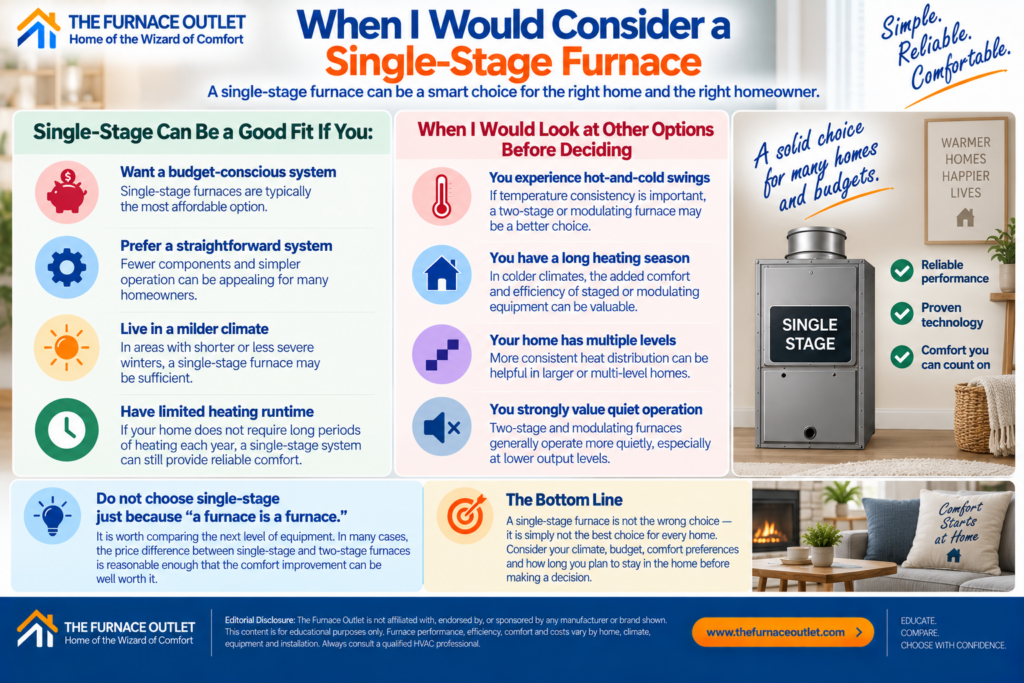
I would keep single-stage equipment in consideration when the homeowner wants a straightforward, budget-conscious system and does not place a high value on premium temperature control. It can also make sense in some milder climates or properties where heating runtime is limited. What I would not do is choose single-stage simply because “a furnace is a furnace.”
If the house experiences noticeable hot-and-cold swings, has a long heating season, contains multiple levels or the homeowner strongly values quiet operation, it is worth pricing the next level of equipment before deciding. Sometimes the cost difference between single-stage and two-stage equipment is reasonable enough that the comfort improvement becomes attractive.
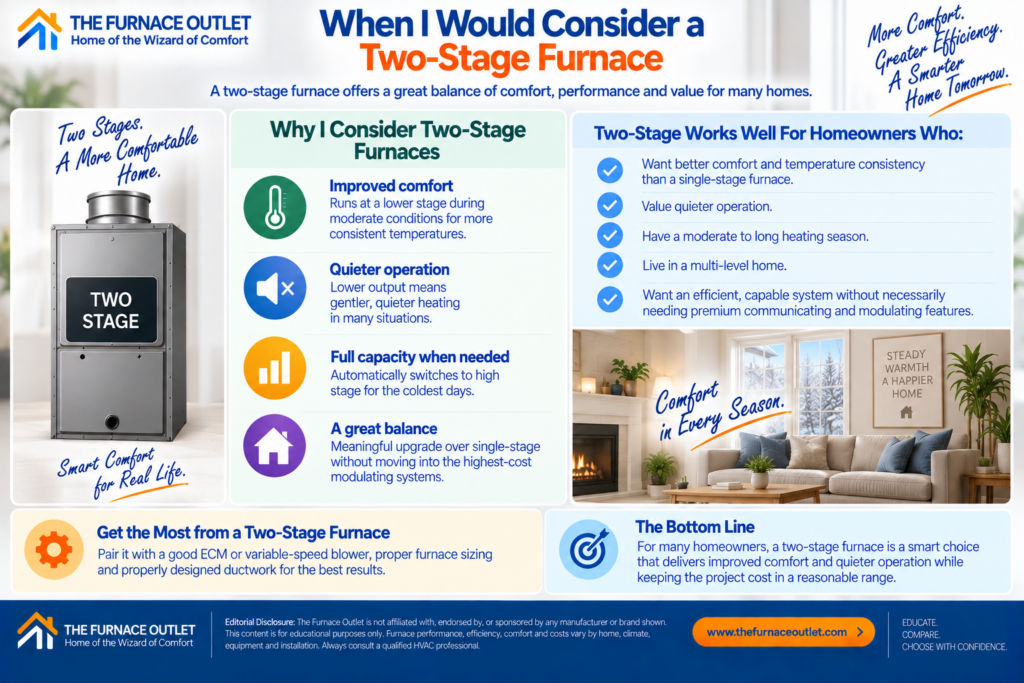
For many homeowners, two-stage is the configuration I would investigate particularly closely. It provides a meaningful improvement over basic on/off heating without automatically moving the project into the most sophisticated equipment category.
The furnace can operate at reduced output during much of the heating season while retaining full capacity for the coldest conditions. Pair that with a good ECM or variable-speed blower, proper furnace sizing and properly designed ductwork, and the result can be a very capable residential heating system. That combination is especially attractive for homeowners who want improved comfort and quieter operation but do not necessarily need every premium communicating and modulating feature available.
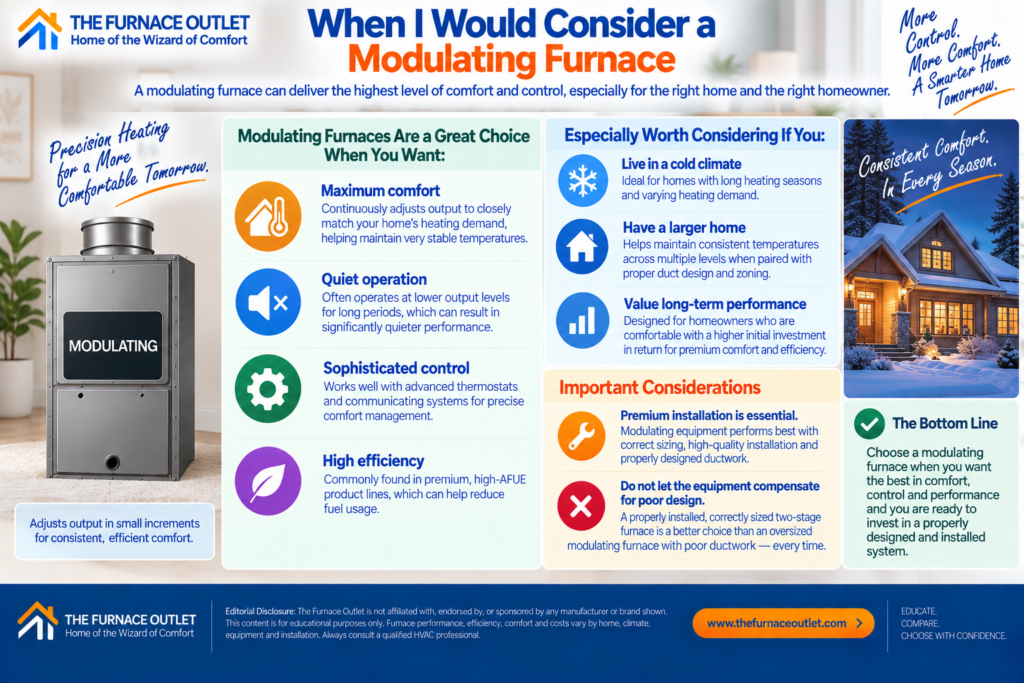
Modulating equipment deserves serious consideration when maximum comfort, temperature stability, quiet operation and sophisticated control are priorities and the homeowner is comfortable with the higher initial investment.
It becomes particularly interesting in cold climates where the furnace operates for long periods and heating demand changes significantly throughout the season. It may also be attractive in larger homes where maintaining consistent temperatures is challenging, provided the duct system and zoning strategy are designed appropriately.
But premium equipment deserves premium installation. If I had to choose between a perfectly installed, correctly sized two-stage furnace and an oversized modulating furnace connected to poor ductwork, I would choose the properly designed system. Every time.
This point cannot be overstated. A modulating furnace does provide a wider operating range, but that does not mean contractors should intentionally oversize it. The furnace still needs to be selected according to the home’s heating load.
Insulation, air leakage, windows, ceiling height, construction, orientation and local winter design temperatures all influence that load. Carrier recommends professional load calculations rather than relying solely on square footage when determining furnace capacity. Once the heating requirement is understood, staging becomes a tool for matching equipment output to that changing demand. First size the furnace correctly. Then decide how sophisticated you want its capacity control to be.
A sophisticated furnace connected to inadequate ductwork can still perform poorly. Before paying a premium for staging and variable-speed technology, I would want the installer to evaluate supply capacity, return-air capacity, filter pressure drop, existing duct restrictions and overall external static pressure.
A variable-speed blower is particularly useful because it can intelligently manage airflow, but it is not a license to ignore duct design. If the duct system is excessively restrictive, forcing the blower to work harder is not the same as fixing the restriction. Advanced equipment performs best when the entire air-distribution system supports it.
When contractors present different furnace options, avoid comparing only the model numbers and AFUE ratings. Ask each contractor to explain exactly what you are buying.
I would want each proposal to identify the furnace’s input and output capacity, AFUE, burner staging, blower motor type, thermostat/control requirements, venting arrangement, filter configuration, duct modifications, commissioning procedure and warranty coverage.
Then ask how the furnace capacity was selected. If one contractor recommends a 100,000 BTU furnace and another recommends 70,000 BTU for the same house, that difference deserves an explanation before you start debating single-stage versus modulation. The quality of the system design matters more than the sophistication printed on the brochure.
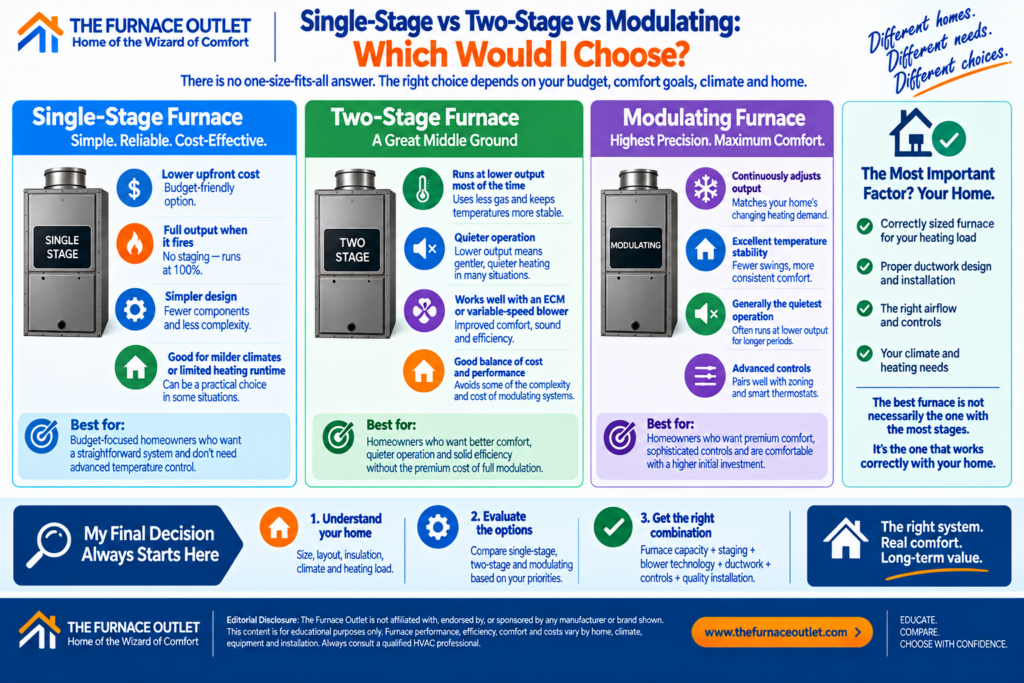
There is no universal answer, because homeowners value different things and houses have different heating requirements. For a budget-focused replacement, I would consider a correctly sized single-stage furnace rather than spending money on advanced features while neglecting ductwork or installation quality. For the broad middle of the market, I would look very closely at a two-stage furnace with a quality ECM or variable-speed blower. It can provide a meaningful improvement in comfort and sound while avoiding some of the cost and complexity associated with flagship equipment.
For a homeowner who wants premium comfort and sophisticated temperature control, particularly in a cold climate and a home with substantial heating demand, a properly designed modulating system can be excellent. But I would never choose among those three categories before understanding the house. The best furnace is not necessarily the furnace with the most stages. It is the furnace whose capacity, staging, airflow and controls work correctly with the home’s actual heating load and duct system.
When I look at furnace staging, I do not begin by asking whether the homeowner can afford the most sophisticated furnace. I begin by asking what the house actually needs. Get the heating load right. Inspect the ductwork. Determine the correct furnace capacity. Understand the venting arrangement. Then decide how much control you want over heat output and airflow.
Single-stage equipment remains a legitimate choice when simplicity and upfront cost matter most. Two-stage furnaces can provide an excellent middle ground by allowing lower-output operation through much of the heating season while retaining full heating capacity when conditions demand it. Modulating equipment takes that concept further and can deliver exceptionally stable comfort when paired with variable-speed airflow and compatible controls.
For many homeowners, my practical sweet spot would be a correctly sized two-stage furnace with a quality ECM or variable-speed blower. For homeowners who place a premium on quiet operation, precise temperature control and sophisticated system performance, a modulating furnace deserves consideration. Whichever direction you go, remember the principle that matters more than the number of stages: Good equipment cannot compensate for bad system design.
A properly sized and commissioned furnace connected to well-designed ductwork will usually be a better investment than more sophisticated equipment that was selected or installed poorly.
Best Furnaces of 2026: Gas Furnace Brands & Models Compared – The Furnace Outlet
For additional technical information, see Carrier’s guide to modulating and variable-speed furnaces, Trane’s high-efficiency furnace guide, and Lennox’s explanation of modulating furnaces.
Editorial Disclosure: The Furnace Outlet is an independent educational resource and is not affiliated with, endorsed by, or sponsored by the manufacturers referenced in this article. We do not receive manufacturer compensation for inclusion or rankings. Product features and specifications can change, so verify current information directly with the manufacturer.
Educational & Installation Disclaimer: This article is for educational purposes only. Furnace sizing, efficiency, staging, airflow requirements, venting and expected performance vary by home, climate, equipment and installation. Gas-fired HVAC equipment should be selected, installed, inspected and commissioned by appropriately qualified professionals in accordance with manufacturer instructions and applicable codes.