Newsletter Subscribe
Enter your email address below and subscribe to our newsletter

HVAC made simple

Buying a furnace that is “big enough” sounds simple. Measure the house, find a BTU chart, choose the corresponding furnace and move on. Unfortunately, residential furnace sizing does not work that neatly.
Two homes can each contain 2,000 square feet and require very different amounts of heat. One might be a newer, tightly sealed home with excellent insulation and efficient windows. The other might be an older house with significant air leakage, limited insulation, large windows and ductwork running through an unconditioned attic. Put those houses in different climates and the difference becomes even larger.
That is why I treat square-footage furnace charts as preliminary estimating tools, not equipment-selection tools. The professional approach is to calculate the home’s heating load and then select equipment capable of meeting that load under the local winter design conditions. ACCA’s Manual J is the ANSI-recognized residential load-calculation standard used for this purpose, while Manual S addresses equipment selection based on the calculated load and manufacturer performance data.
For homeowners, however, understanding the basic numbers is still extremely useful. You should know what BTUs mean, why furnace input and output are different, what affects your home’s heating load and what questions to ask when contractors recommend different furnace sizes.
The goal of this guide is not to replace a professional load calculation. It is to help you understand why your house needs the furnace size being proposed.
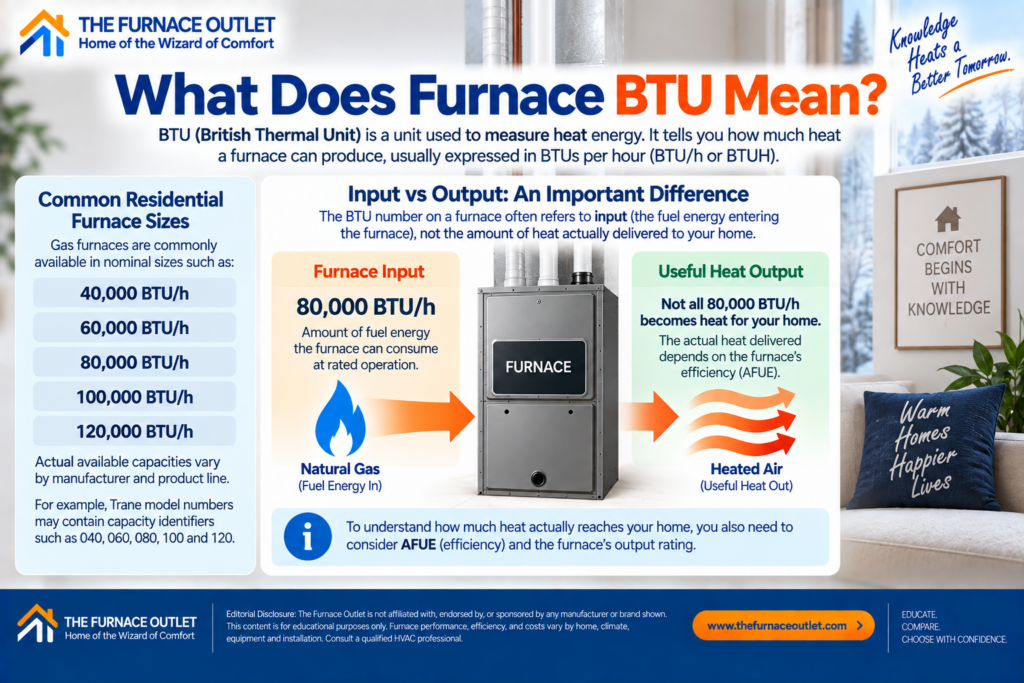
BTU stands for British Thermal Unit, a unit used to measure heat energy. Furnace capacities are normally expressed in BTUs per hour, commonly written as BTU/h or BTUH. Residential gas furnaces are commonly available in nominal sizes such as 40,000, 60,000, 80,000, 100,000 or 120,000 BTU/h, although actual available capacities vary by manufacturer and product line. Trane, for example, explains that its furnace model numbers may contain capacity identifiers such as 040, 060, 080, 100 and 120.
There is an important complication: the BTU number you see may represent furnace input rather than the amount of heat actually delivered to the home. If a furnace has an input rating of 80,000 BTU/h, that means it can consume fuel containing approximately 80,000 BTUs of energy per hour at rated operation. It does not necessarily mean 80,000 BTUs of useful heat are delivered into the duct system. For that, you also need to understand AFUE and furnace output.
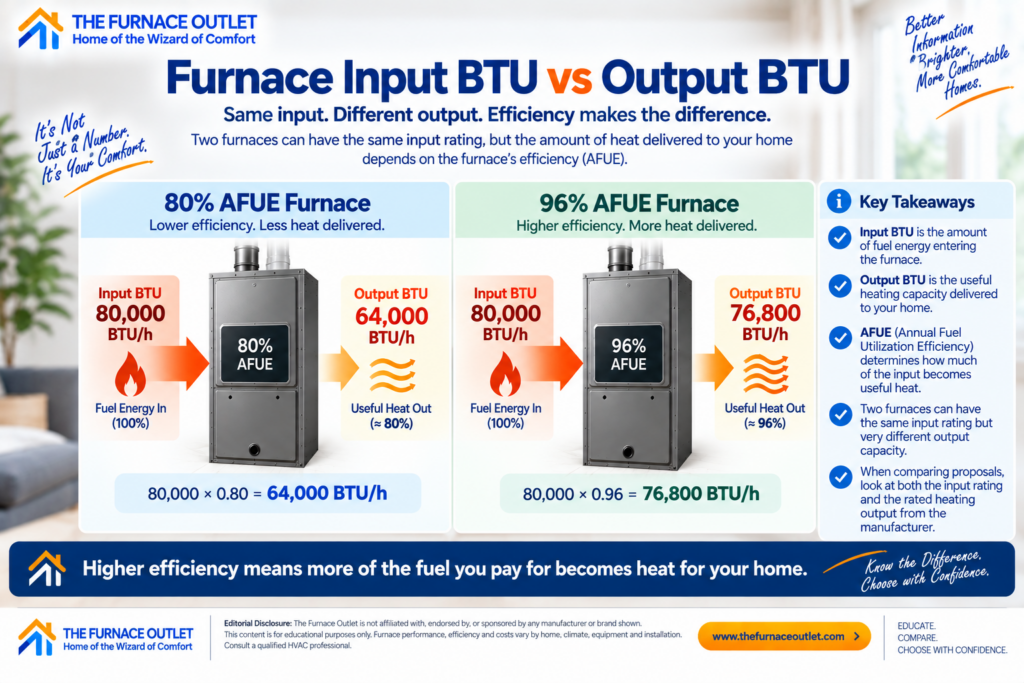
This distinction causes a lot of confusion when homeowners compare furnaces. Input BTU describes the energy entering the furnace in the fuel. Output BTU represents the useful heating capacity available after accounting for furnace efficiency. As a simplified illustration, suppose we compare two furnaces with the same 80,000 BTU/h input rating.
An 80% AFUE furnace converts roughly 80% of the fuel’s energy into useful heat over the standardized seasonal efficiency calculation. Using a simplified comparison:
80,000 × 0.80 = approximately 64,000 BTU/h
Now consider a 96% AFUE furnace:
80,000 × 0.96 = approximately 76,800 BTU/h
The two furnaces may both be described as 80,000-BTU furnaces, but their useful heating output is substantially different. AFUE is a seasonal efficiency metric rather than a direct laboratory measurement of instantaneous output, so for actual equipment selection you should use the manufacturer’s published input and output capacities rather than relying on this simplified multiplication alone. Still, it is a useful way for homeowners to understand why input capacity cannot be considered by itself.
When comparing furnace proposals, I therefore want to see both the input rating and the rated heating output.
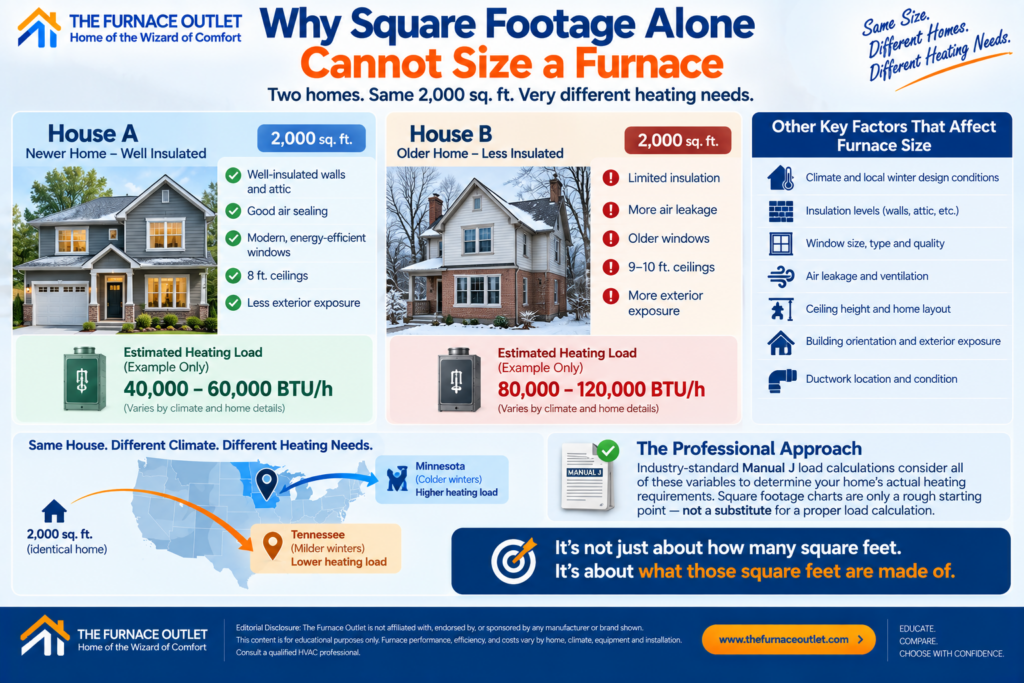
You will find plenty of charts online that say something like 30, 40, 50 or 60 BTUs per square foot depending on climate. Such numbers can be useful for a very rough preliminary estimate, but they should not be used as the final basis for purchasing equipment. Carrier similarly cautions that generic furnace-sizing charts cannot account for important variables such as insulation, ceiling height and window quality, and identifies a professional Manual J load calculation as the industry-standard approach.
Consider two 2,000-square-foot houses. House A was built recently. It has well-insulated walls and attic, good air sealing, modern windows, eight-foot ceilings and relatively little exposed glass. House B was built decades ago. It has limited insulation, substantial air leakage, older windows, nine- or ten-foot ceilings and considerable exterior exposure. The floor area is identical. The heating load probably is not. Now move House A from Tennessee to Minnesota. Nothing about its square footage changed, but the outdoor winter conditions changed dramatically. That is why I would never ask only: “How many square feet is the house?” I would ask what that square footage is actually made of.
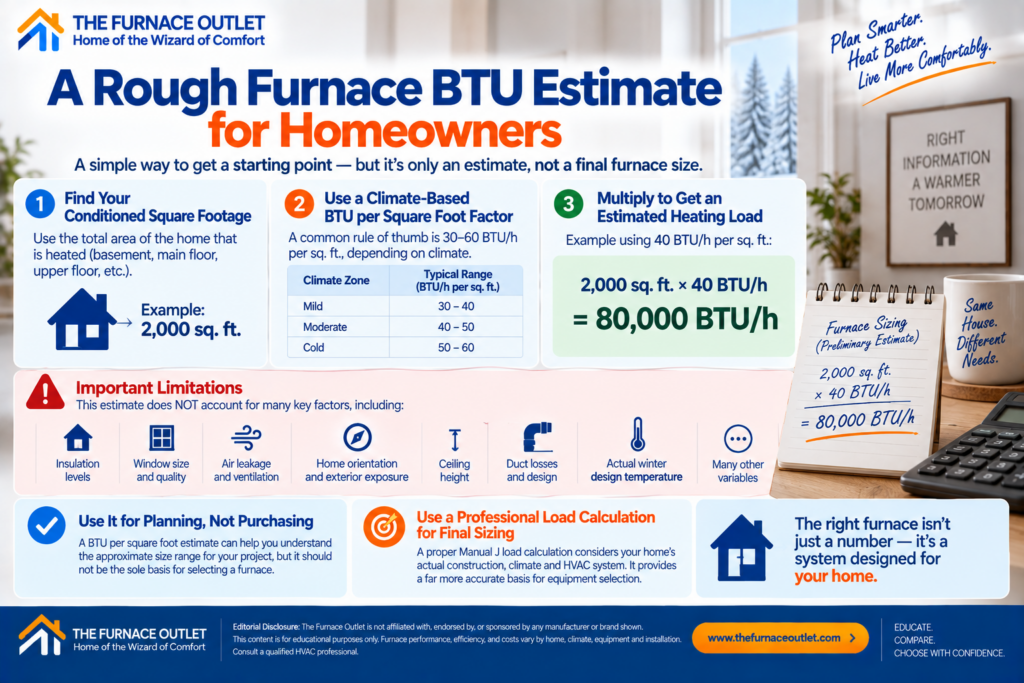
For preliminary planning only, homeowners sometimes estimate heating requirements by multiplying conditioned floor area by a rough climate-related BTU-per-square-foot factor.
For example, if someone assumed 40 BTU/h per square foot for a preliminary estimate on a 2,000-square-foot house: 2,000 sq. ft. × 40 BTU/h = 80,000 BTU/h
That number should not immediately become an 80,000-BTU furnace purchase. The estimate has not properly accounted for the home’s insulation, windows, air leakage, orientation, ceiling height, duct losses, actual winter design temperature or numerous other variables. It may also blur the important distinction between required heating output and furnace input capacity. Use rules of thumb to understand the approximate scale of a project. Use a load calculation to select the equipment. That distinction can prevent an expensive sizing mistake.
A furnace’s job is essentially to replace the heat that the building loses. As outdoor temperature falls, heat leaves the house more rapidly. The colder the local winter design condition, the greater the heating capacity that may be required to maintain the desired indoor temperature. Imagine maintaining a house at approximately 70°F.
If it is 40°F outside, the indoor-to-outdoor temperature difference is approximately 30°F. If it is 0°F outside, that difference becomes approximately 70°F. Those are very different heating conditions. This is why a 2,000-square-foot home in a relatively mild part of the country cannot automatically be assigned the same furnace capacity as a 2,000-square-foot home in a severe northern climate. ACCA’s Manual J procedure specifically incorporates outdoor design conditions as part of residential load calculations rather than simply applying one nationwide BTU-per-square-foot number. Climate should therefore be one of the first considerations in furnace sizing, but it is still only one part of the calculation.
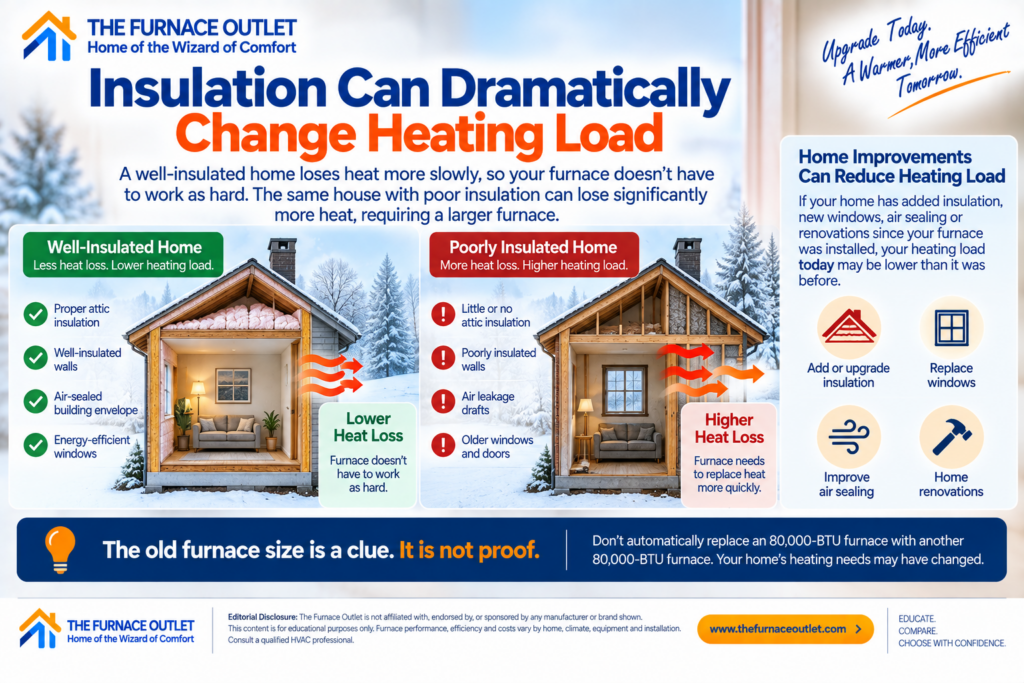
Insulation slows heat transfer through the building envelope. A house with properly insulated walls, attic and other building assemblies generally loses heat more slowly than an otherwise similar poorly insulated house. That means the furnace does not have to replace heat as quickly. This becomes particularly important when replacing an older furnace.
Suppose the existing furnace was installed 20 years ago. Since then, the homeowner may have added attic insulation, replaced windows, air-sealed the house or completed major renovations. The heating load today may be lower than it was when the original furnace was selected. Trane specifically notes that homeowners who have made improvements such as adding insulation or sealing windows and doors may not need as much furnace capacity as their existing equipment provides. That is another reason I would not automatically replace an 80,000-BTU furnace with another 80,000-BTU furnace. The old size is a clue. It is not proof.
A load calculation does not simply count windows. It considers their characteristics. Window area, orientation and thermal performance influence how much heat is lost through the building envelope. A house with large areas of older glass may behave very differently from one with modern high-performance windows.
Doors also contribute to conductive heat loss and potentially air leakage. Carrier’s explanation of Manual J identifies window and door size, placement and energy performance among the factors considered when determining HVAC capacity. This is one reason two houses that look nearly identical from the street can have different heating loads.
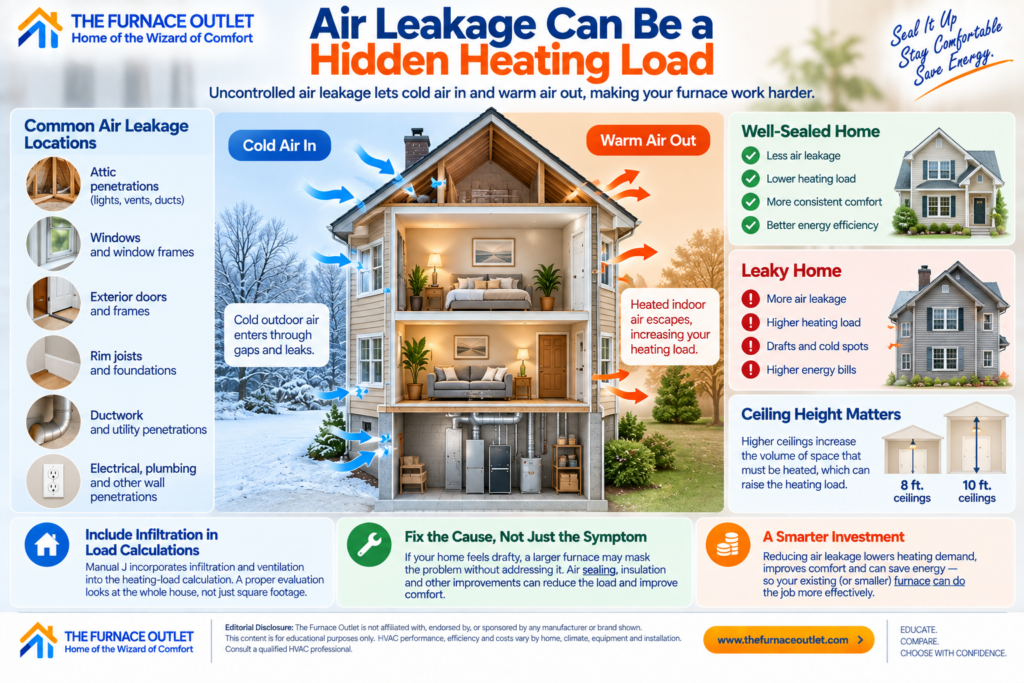
Insulation receives a lot of attention, but uncontrolled air leakage can be equally important. Cold outdoor air can enter through gaps and penetrations in the building envelope while heated indoor air escapes. The furnace then has to heat the incoming cold air. Older homes may have leakage around windows, doors, attic penetrations, rim joists and other parts of the structure. Newer or properly air-sealed homes can behave very differently.
Manual J incorporates infiltration into the heating-load calculation, and ACCA’s current Manual J documentation specifically includes procedures addressing infiltration and ventilation loads. If a house feels drafty, simply installing a larger furnace may treat the symptom without addressing the building problem. Sometimes the better investment is reducing the load.
Square footage describes floor area, not the full volume and geometry of the conditioned space. A 2,000-square-foot home with eight-foot ceilings is not identical to a 2,000-square-foot home containing vaulted great rooms, ten-foot ceilings and large open staircases. Ceiling height also often comes with other architectural differences such as increased exterior-wall area, larger windows and open spaces that affect heat distribution. A basic square-footage calculator cannot adequately capture those differences. A proper load calculation can.
Detached houses, townhouses and apartments do not lose heat in exactly the same way. A detached house may have exterior exposure on all four sides. A townhouse in the middle of a row may share walls with conditioned neighboring spaces. A condominium may have conditioned units above, below and beside it. Even within detached houses, geometry matters. A long sprawling ranch may have a different exterior-surface-to-floor-area relationship from a compact two-story home containing the same conditioned square footage.
Orientation, wall exposure, foundation type, basement conditions and construction details can all influence the final heating load. This is why professional sizing becomes a building-analysis problem rather than a simple furnace-shopping problem.
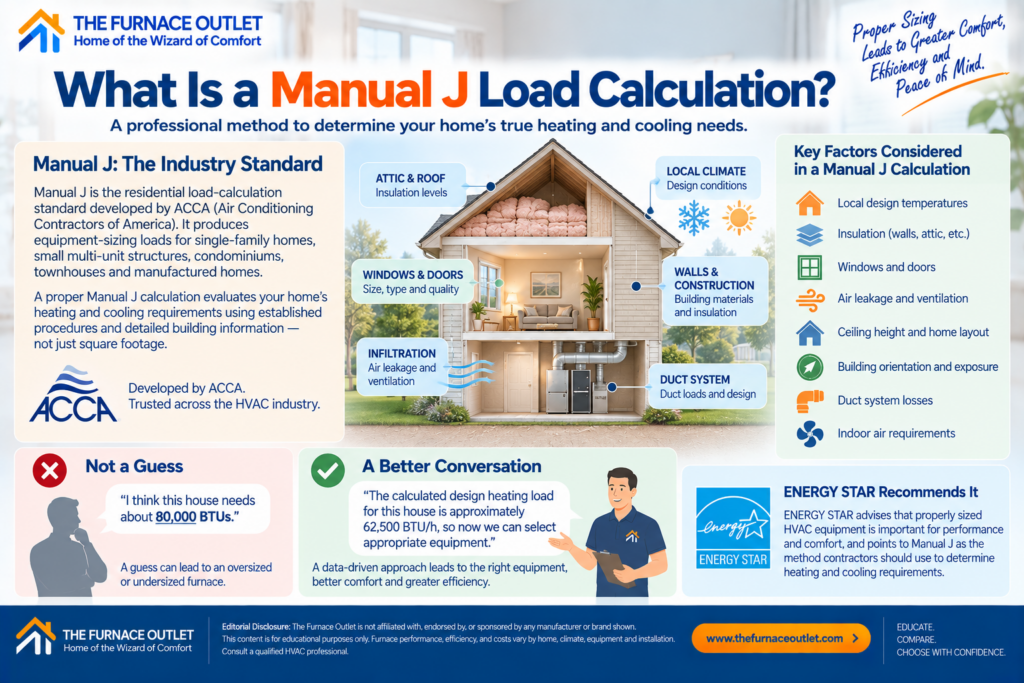
Manual J is the residential load-calculation standard developed by ACCA. ACCA states that Manual J produces equipment-sizing loads for single-family detached homes, small multi-unit structures, condominiums, townhouses and manufactured homes. It evaluates the home’s heating and cooling requirements using established calculation procedures and building information.
A proper calculation considers factors such as local design conditions, insulation, windows, walls, infiltration, duct loads and ventilation rather than simply using floor area. ENERGY STAR likewise advises homeowners that properly sized HVAC equipment is important for performance and comfort and points to Manual J as the method contractors should use to determine heating and cooling requirements. For me, this is the point where furnace sizing changes from: “I think this house needs about 80,000 BTUs.” to: “The calculated design heating load for this house is approximately X BTU/h, so now we can select appropriate equipment.”. That is a much better conversation.
Homeowners will frequently hear about Manual J, but it is useful to understand that load calculation is only one part of good HVAC design. Manual J determines the heating and cooling loads. Manual S is used for equipment selection. Manual D addresses residential duct-system design. ACCA explains that Manual S uses local climate, construction specifications and manufacturer performance information to select appropriate equipment, while Manual D addresses duct-system design.
A furnace can be correctly sized in terms of BTUs and still perform poorly if the duct system cannot support it.
One of the most persistent furnace-sizing myths is that extra capacity provides extra protection. Homeowners sometimes think: “If 60,000 BTUs is enough, 80,000 BTUs must be even better.” It does not work that way.
An oversized furnace can raise the indoor temperature rapidly and satisfy the thermostat before the system has operated for an appropriate period. The furnace shuts down, the house begins cooling and the process repeats. That behavior is commonly called short cycling. Carrier warns that oversizing can contribute to short cycling, temperature fluctuations, uneven heating, higher energy consumption and increased equipment wear. I would rather have a furnace properly matched to the calculated load than buy unnecessary capacity as “insurance.” You are not purchasing heating capacity by the pound.
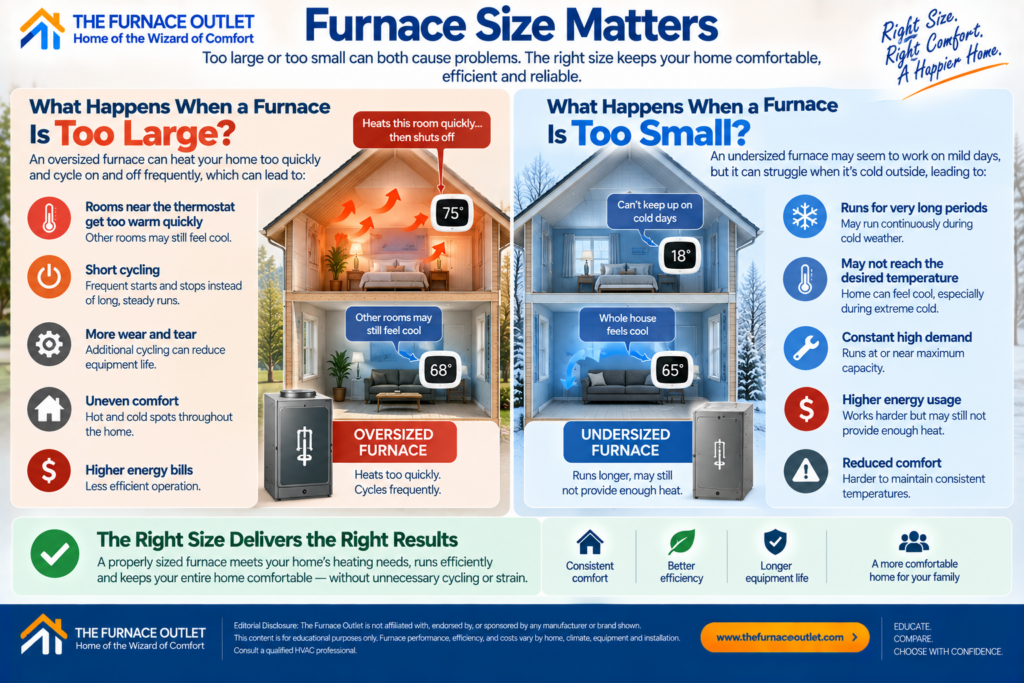
An oversized furnace can create several problems simultaneously. First, indoor temperature may rise rapidly near the thermostat while other parts of the house have not received enough conditioned air. The thermostat shuts the furnace down because its immediate area is warm, even though distant rooms may still feel cool.
Second, repeated starts and stops can make the heating system more noticeable. Instead of long, controlled operation, homeowners may experience bursts of warm airflow followed by periods with no heating. Third, additional cycling places more operating events on components.
The problem can become even more complicated when the furnace shares a blower and duct system with central air conditioning. Equipment selection should therefore consider the HVAC system as a whole rather than treating the furnace as an isolated appliance. A larger furnace is not an upgrade if the house does not need the capacity.
Undersizing creates the opposite problem. During moderate winter conditions, an undersized furnace may appear to work normally. The problem becomes obvious during the coldest weather, when the building loses heat faster than the furnace can replace it.
The furnace may run for very long periods or almost continuously while the indoor temperature gradually falls below the thermostat setting. Carrier notes that undersized equipment may run continuously yet still provide inadequate heating during demanding conditions. Long furnace cycles are not automatically bad—properly sized staged and modulating equipment can intentionally operate for extended periods at lower output. The concern is a furnace operating at maximum available capacity and still being unable to satisfy the calculated heating requirement. That is genuine insufficient capacity.

Suppose a home’s calculated heating load is approximately 60,000 BTU/h. That does not necessarily mean you should purchase a furnace labeled 60,000 BTU input.
If we use simplified efficiency math, an 80% AFUE furnace with 80,000 BTU/h input would correspond to approximately: 80,000 × 0.80 = 64,000 BTU/h
A 96% AFUE furnace with 70,000 BTU/h input would correspond approximately to: 70,000 × 0.96 = 67,200 BTU/h
Despite having lower input capacity, the high-efficiency furnace can provide comparable or greater useful output. Again, actual equipment selection should use the manufacturer’s rated output and performance data, not simplified AFUE multiplication. But the example illustrates an important point: Compare furnace output with the heating load—not merely the input number printed on the furnace.
Staging improves the furnace’s ability to adapt its output as heating demand changes, but it does not eliminate the need for correct sizing. A two-stage furnace can operate at reduced output during milder conditions and increase to full output when additional heating is required. A modulating furnace can make finer adjustments across a broader capacity range.
That flexibility is valuable because your house rarely experiences its maximum design heating load throughout the entire winter. However, I would not intentionally oversize a furnace simply because it has two-stage or modulating capability. If the furnace’s minimum or low-stage output is still excessive for the home’s typical heating demand, the system can still cycle more than intended. Advanced technology gives the equipment more flexibility; it does not repeal the fundamentals of HVAC design.
Calculate the load first. Choose the staging strategy second.
Furnace capacity and duct capacity have to make sense together. As heating output increases, the system generally needs appropriate airflow to move that heat safely and effectively through the house. The blower, supply ducts, return ducts, filter, registers and other system components all affect airflow and static pressure.
This is where furnace replacements sometimes reveal problems that have existed for years. A contractor may install a larger furnace on undersized return ductwork, or pair sophisticated variable-speed equipment with a restrictive filter arrangement. The furnace itself may be excellent, but the air-distribution system prevents it from operating as intended. ACCA’s design framework separates these responsibilities logically: Manual J determines load, Manual S addresses equipment selection and Manual D addresses duct design. I would therefore be cautious about any furnace-size recommendation made without at least considering the existing duct system.
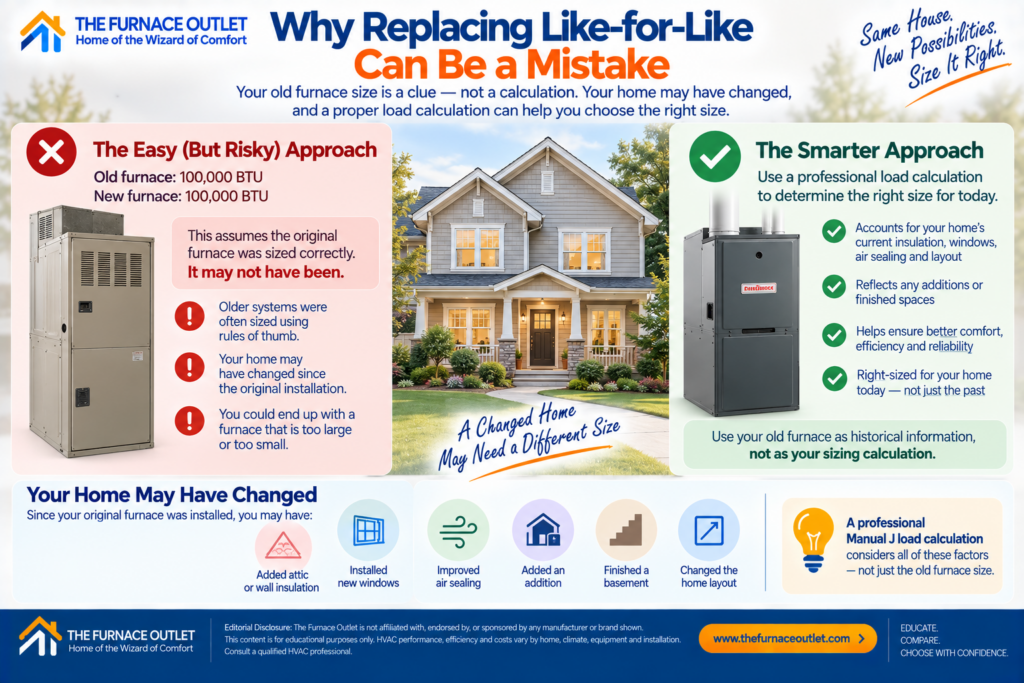
One of the easiest furnace replacement methods is also one of the most questionable: Old furnace: 100,000 BTU. New furnace: 100,000 BTU.
That assumes the original furnace was sized correctly. It may not have been. Older residential HVAC systems were frequently selected using rules of thumb, and the home itself may also have changed substantially since the equipment was installed. Maybe insulation was added. Perhaps new windows were installed. Air sealing may have improved. An addition might have increased the conditioned area. A basement may have been finished. Trane notes that home improvements such as added insulation and better air sealing can reduce the amount of furnace capacity required compared with the existing system. Use the old furnace as historical information, not as your sizing calculation.
This is where professional design conditions become important. A furnace is not normally sized by simply finding the coldest temperature ever recorded in the city and designing around that extreme. Load calculations use established outdoor design conditions intended to represent appropriate local sizing conditions.
Adding a large arbitrary safety factor can defeat the purpose of calculating the load in the first place. A homeowner may feel reassured by a furnace with enormous reserve capacity, but that extra capacity is present during every ordinary winter day too. The objective is not to create the biggest possible gap between heating load and furnace capacity. The objective is to select equipment appropriately for the calculated design requirement using recognized equipment-selection procedures.
When you receive furnace proposals, do not focus only on brand, AFUE and price. Look for the sizing logic. I would ask the contractor to show the calculated heating load and explain how the proposed furnace was selected from it. Then compare that number with the manufacturer’s rated heating output. If Contractor A proposes a 60,000-BTU furnace and Contractor B proposes a 100,000-BTU furnace for the same house, do not assume Contractor B is giving you “more furnace for the money.”
Ask why there is a 40,000-BTU difference. I would also want to know whether the quoted capacity is input or output, whether the furnace is single-stage, two-stage or modulating, what its low-stage or minimum capacity is, and whether the existing duct system can accommodate the required airflow. Those questions reveal far more about the quality of a proposal than simply comparing model numbers.
A proper furnace-sizing process should require information about the house. Expect discussion of conditioned square footage, local outdoor design conditions, insulation levels, window characteristics, exterior doors, air leakage, ceiling heights, exposed walls, foundation or basement conditions and duct location. Depending on the system and calculation, additional building and ventilation details may also be relevant.
If the entire sizing conversation consists of: “Your house is 2,500 square feet, so you need a 100,000-BTU furnace,”. I would ask for the load calculation behind that conclusion. The answer may ultimately be 100,000 BTUs. The problem is not necessarily the number. The problem is reaching it without properly analyzing the house.
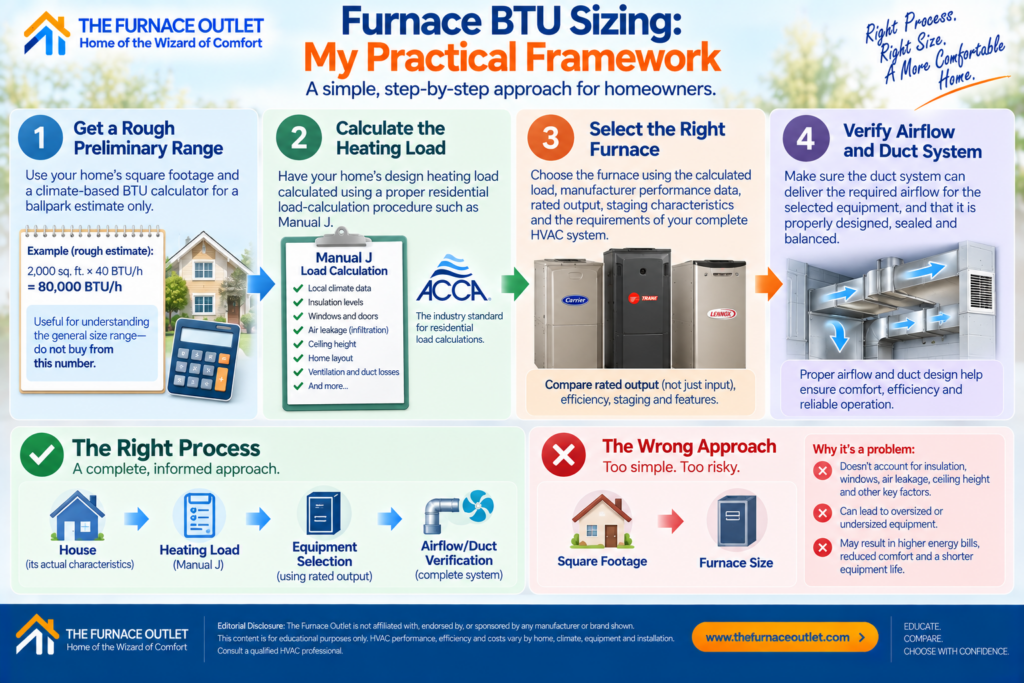
For homeowners researching equipment before obtaining quotes, I would approach sizing in three stages. Use square footage and climate-based calculators only to establish a rough preliminary range. That can help you understand whether you are generally looking at residential equipment around 40,000 BTU/h or something much larger, but do not buy from that number. Next, have the home’s design heating load calculated using an appropriate residential load-calculation procedure such as Manual J. ACCA describes Manual J as the ANSI-recognized standard for producing residential HVAC equipment-sizing loads.
Finally, select the actual furnace using the load, manufacturer performance data, rated output, staging characteristics and the requirements of the complete HVAC system. That is where Manual S principles and professional equipment selection become important.
The process should therefore look like: House → Heating Load → Equipment Selection → Airflow/Duct Verification, —not— Square Footage → Furnace Size.
That difference is the heart of good furnace sizing.
When homeowners ask me what size furnace they need, I would resist giving them a BTU number until I know something about the house. Square footage matters, but it is only the beginning. I want to know the climate, winter design conditions, insulation, windows, air leakage, ceiling heights, building configuration and duct system. I also want to know whether the number being discussed is furnace input or useful heating output. Then I want the load calculation.
Once we know the home’s design heating requirement, we can have a meaningful discussion about furnace capacity, AFUE, single-stage versus two-stage versus modulating operation, blower technology and equipment cost. If your load calculation indicates that the house needs roughly 55,000 BTU/h of heating under design conditions, the objective is not to find the biggest furnace your budget allows. The objective is to select equipment whose rated performance appropriately meets that requirement and works with the rest of the HVAC system.
I would rather install a correctly sized furnace with properly designed airflow and careful commissioning than an oversized flagship furnace with every premium feature available. The number on the furnace cabinet is not what makes the house comfortable. The complete system design does.
That is why the best furnace-sizing question is not simply, “How many BTUs per square foot do I need?”
It is: “How much heat does my house actually lose under design conditions, and which furnace is properly matched to that load?”
Get that answer right, and everything else about furnace selection becomes considerably easier.
Best Furnaces of 2026: Gas Furnace Brands & Models Compared – The Furnace Outlet
For homeowners who want to go beyond basic sizing charts, these are the resources I would use as starting points:
Editorial Disclosure: The Furnace Outlet is an independent educational resource. We are not affiliated with, endorsed by, or sponsored by the manufacturers or organizations referenced in this guide, and we do not receive manufacturer compensation for inclusion or rankings.
Educational & Installation Disclaimer: This guide is for educational purposes only. Furnace capacity, heating load, efficiency, airflow, venting and installation requirements vary by home, climate, equipment and applicable codes. Rules of thumb and online BTU calculators should not replace a professional residential load calculation or qualified HVAC system design. Gas-fired equipment should be selected, installed and commissioned by appropriately qualified professionals in accordance with manufacturer instructions and applicable requirements.