Newsletter Subscribe
Enter your email address below and subscribe to our newsletter

HVAC made simple

By Jake Lawson, HVAC Specialist | The Furnace Outlet
If you had asked many HVAC contractors 20 years ago whether an air-source heat pump was a good choice for a home with serious winters, you probably would have heard some hesitation. Heat pumps had a reputation for working well during mild weather but struggling once outdoor temperatures dropped substantially. That reputation did not come from nowhere. Older systems could lose considerable heating capacity in very cold conditions, which meant homeowners often depended heavily on electric resistance backup heat or another heating system during the coldest part of winter.
Modern cold-climate heat pumps have changed that conversation considerably. Better compressor technology, improved refrigerant circuits, variable-speed operation and more sophisticated controls have allowed manufacturers to build equipment capable of producing useful heat at temperatures that would have been difficult for previous generations of air-source heat pumps. Some of today’s systems can maintain substantial heating capacity at 5°F and continue operating at temperatures below zero.
That does not mean I would recommend any heat pump simply because the manufacturer puts the words cold climate on the brochure. If I were helping a homeowner in Maine, Minnesota, Wisconsin, upstate New York or another region with severe winters, I would want to know exactly what the proposed equipment can do when the temperature reaches 5°F, 0°F or below. Seasonal efficiency ratings are useful, but winter performance requires a closer look at low-temperature heating capacity, COP, capacity retention, sizing and the home’s actual heating load.
That is what this guide is designed to explain.

A cold-climate heat pump operates on the same basic refrigeration principle as a conventional air-source heat pump. During the winter, the system absorbs thermal energy from outdoor air and transfers that energy into the house. This sometimes sounds impossible to homeowners because air at 10°F certainly does not feel warm, but cold outdoor air still contains thermal energy that a refrigeration system can capture and move indoors.
The difficulty increases as outdoor temperatures fall. The heat pump has to work under progressively more challenging conditions at the same time that the house itself is losing heat faster. A conventional system may therefore reach a point where its available heating capacity drops significantly below what the home requires. Cold-climate equipment is designed specifically to perform better under those demanding conditions.
Modern cold-climate systems commonly use inverter-driven compressors that can adjust their operating speed instead of simply switching between full capacity and off. Depending on the manufacturer, you may also find technologies such as enhanced vapor injection, flash injection, advanced heat exchangers and sophisticated electronic controls. The engineering approaches differ, but the objective is essentially the same: maintain useful heating output and reasonable efficiency as outdoor temperatures continue to fall.
The U.S. Department of Energy explains that variable-speed and inverter-driven heat-pump technology allows equipment to operate closer to the capacity actually required by the home. That ability becomes particularly useful in a climate where heating demand can change dramatically between a 45°F afternoon and a 5°F winter night.

To understand why cold-climate performance matters, think about what is happening to both the house and the heat pump as outdoor temperatures fall.
Suppose you keep your home at 70°F. When it is 45°F outside, the temperature difference between indoors and outdoors is only 25 degrees. When the outdoor temperature falls to 5°F, that difference becomes 65 degrees. Heat is now escaping through the walls, windows, ceiling and other parts of the building much more quickly, so the home requires considerably more heating capacity to maintain 70°F.
At the same time, the heat pump is trying to extract heat from colder outdoor air. Depending on its design, the amount of heating capacity available from the equipment may decrease as the outdoor temperature falls. You therefore have two curves moving in opposite directions: the home’s heating requirement is increasing while the heat pump’s available capacity may be decreasing.
Imagine that a properly performed heating-load calculation shows your house requires approximately 35,000 BTU/h at the local winter design temperature. If the proposed heat pump can provide only 24,000 BTU/h under those same conditions, the remaining heating requirement has to come from somewhere. That may be electric resistance heat, a furnace in a dual-fuel configuration or another supplemental heating source.
This is why I would never evaluate a cold-climate heat pump solely by its nominal tonnage. What matters is how much usable heating capacity remains when your particular house needs it most.

One useful development for homeowners is that there are now measurable standards behind the term cold climate. Under current ENERGY STAR requirements, qualifying equipment must meet not only seasonal efficiency standards but also specific low-temperature performance criteria.
For example, ENERGY STAR requires qualifying cold-climate heat pumps to achieve a coefficient of performance (COP) of at least 1.75 at 5°F and retain at least 70% of their 47°F heating capacity when tested at 5°F. Current requirements also establish minimum SEER2 and HSPF2 efficiency levels, with the exact HSPF2 requirement differing between ducted and non-ducted equipment.
| Performance measure | Current ENERGY STAR cold-climate requirement |
|---|---|
| SEER2 | 15.2 or higher |
| HSPF2 — ducted split system | 8.1 or higher |
| HSPF2 — non-ducted split system | 8.5 or higher |
| COP at 5°F | 1.75 or higher |
| Capacity retained at 5°F | At least 70% of 47°F capacity |
I find the last two numbers particularly useful. HSPF2 gives us an indication of heating efficiency over a season, but it does not tell the entire story about what happens during an exceptionally cold morning. Looking at COP and capacity retention at 5°F gives us a much better picture of whether the equipment has been designed to remain productive when winter conditions become demanding.

Many of the better cold-climate heat pumps use inverter-driven variable-capacity compressors, and there is a good reason for that. A heating system rarely needs exactly the same amount of output throughout the day or throughout the winter. A house might require relatively modest heating when the temperature is 40°F but need several times as much when the temperature approaches zero.
A variable-capacity heat pump can respond to those changing conditions by adjusting compressor operation. During milder weather, it can operate at reduced capacity for longer periods instead of repeatedly switching on at full output and shutting off. As the temperature falls and the home’s heating demand increases, the compressor can increase its output. This ability to modulate capacity can improve seasonal efficiency while also producing steadier indoor temperatures and less noticeable cycling.
Some manufacturers add technologies specifically intended to improve refrigeration performance at low temperatures. Bosch, for example, uses an enhanced vapor-injection inverter compressor in its IDS Ultra cold-climate system, while Mitsubishi Electric uses flash-injection technology in its Hyper-Heating equipment. The terminology can become technical very quickly, but homeowners do not necessarily need to become refrigeration engineers to make a good buying decision. What matters is whether those technologies translate into verified heating capacity and efficiency at the outdoor temperatures that matter in your area.

Cold weather introduces another issue that homeowners in warm climates rarely have to think about: frost on the outdoor coil. When a heat pump operates in heating mode under cold and damp conditions, moisture in the outdoor air can freeze on the coil. A light coating of frost is normal, but if it continues accumulating, it interferes with airflow and heat transfer.
The heat pump therefore periodically enters a defrost cycle. During this process, the refrigeration cycle temporarily changes so that heat can be directed toward the outdoor coil and melt the accumulated frost. You may see water around the unit or what appears to be steam rising from it when the defrost cycle finishes. Those sights can be surprising if you have never owned a heat pump, but they are usually part of normal winter operation.
Where equipment design matters is in how frequently and intelligently defrost occurs. Defrosting consumes energy and temporarily interrupts normal heating operation, so manufacturers use sensors and control algorithms to determine when it is actually necessary. In a serious winter climate, I would rather have a system that manages defrost based on actual operating conditions than one that spends unnecessary time repeatedly defrosting the outdoor coil.

This is one of the questions I hear most often, and the answer is not simply yes or no. A modern cold-climate heat pump may be capable of carrying the entire heating load for many homes through most or even all of the winter, but whether supplemental heat is required depends on the house, climate and specific equipment combination.
In an all-electric installation, supplemental heating commonly comes from electric resistance elements installed in the air handler. These heat strips can provide additional capacity when the heat pump alone cannot satisfy the heating load. They are straightforward and effective, but resistance heating generally uses considerably more electricity for each unit of heat delivered than a heat pump operating at a healthy COP.
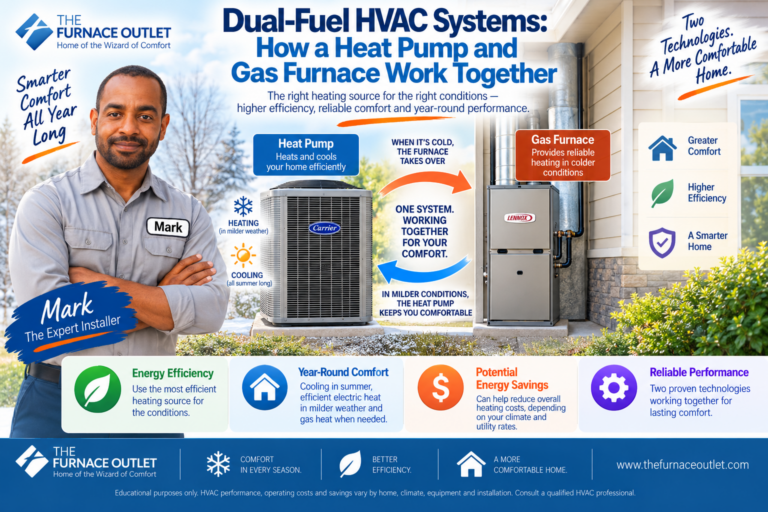
Another possibility is a dual-fuel system, where the heat pump operates through milder and moderately cold conditions while a gas furnace is available when outdoor temperatures become severe or when operating economics favor the furnace. The ideal switchover strategy should not be chosen using an arbitrary outdoor temperature. It should consider heat-pump capacity, house heating load, electricity prices, fuel prices and the efficiency of the backup equipment.
This is also why statements such as “heat pumps stop working at 20°F” or “modern heat pumps never need backup heat” are both too simplistic. A well-designed system should be evaluated using actual performance data and the heating requirements of the particular home.

I would never recommend selecting a heat pump by square footage alone, and I become even more cautious about that shortcut when we are discussing cold-climate installations. Two houses with exactly 2,000 square feet can have dramatically different heating requirements depending on their insulation, windows, air leakage, ceiling height, orientation and construction.
A contractor should perform a proper residential heating and cooling load calculation. The heating side of that calculation needs to use appropriate local winter design conditions rather than an arbitrary outdoor temperature. Once we know approximately how many BTUs per hour the home requires under those conditions, we can compare that requirement with the proposed heat pump’s low-temperature capacity.
This can sometimes reveal an opportunity that has nothing to do with buying larger HVAC equipment. If air sealing, attic insulation or duct repairs reduce the home’s heat loss, the heat pump has less work to do. A house that previously required substantial supplemental heat may be able to operate much more of the winter on the heat pump alone after sensible building-envelope improvements.
In other words, cold-climate heat-pump sizing should begin with the house, not with the equipment catalog.
I hesitate to call any heat pump the universal “best” because the best equipment on paper can become a poor choice if it is incorrectly sized, badly matched or installed by someone unfamiliar with the system. Product availability also varies by region, and specifications can differ across capacities within the same product family.
That said, there are several systems I would want included in the conversation when evaluating equipment for a colder region.
For homeowners who already have conventional ductwork and want a system specifically designed around low-temperature performance, the Bosch IDS Ultra deserves serious consideration. Bosch lists the system at up to 19 SEER2 and 10 HSPF2 and states that it can deliver 100% heating capacity at 5°F with a COP of 2.1 under specified conditions. Bosch also lists operation down to -13°F and notes that the IDS Ultra was developed in connection with the U.S. Department of Energy’s Residential Cold Climate Heat Pump Challenge. Bosch IDS Ultra
What interests me about those specifications is not simply the high seasonal efficiency. The 5°F performance gives us useful information about what the system can actually deliver when outdoor conditions become difficult. For a homeowner replacing a traditional ducted furnace-and-air-conditioner arrangement, this is the type of cold-weather data I would want to compare against competing proposals.
Mitsubishi Electric has built a strong reputation around inverter heat pumps, and its Hyper-Heating technology is specifically relevant to colder regions. The company’s PUZ-HA equipment uses flash-injection technology intended to help maintain heating output as outdoor temperatures decline. Mitsubishi lists certain configurations at up to 20.2 SEER2 and 8.8 HSPF2 and states that the system can maintain 100% heating performance at 5°F, with heating operation extending to -13°F under specified conditions. Mitsubishi Electric PUZ-HA Hyper-Heating
One advantage of looking at Mitsubishi is the variety of applications available within its broader heat-pump lineup. Depending on the home, a contractor may be considering ducted, ductless or specialized configurations. I would still insist on checking the performance of the exact indoor and outdoor equipment combination rather than assuming that every product carrying the Hyper-Heating name has identical specifications.
The American Standard AccuComfort Platinum 20 is another system worth comparing when the homeowner wants high seasonal efficiency combined with variable-speed operation. American Standard lists current models at up to 22.4 SEER2 and 10.5 HSPF2, with published cold-weather information showing 100% heating capacity at 32°F and approximately 70% capacity at 5°F for applicable configurations. American Standard Platinum 20
Those numbers illustrate an important point about cold-climate shopping. The Platinum 20 has excellent headline efficiency ratings, but I would still compare its low-temperature capacity against the home’s heating load and against systems specifically engineered around very severe winter operation. A homeowner in Pennsylvania may reach a different conclusion than a homeowner in northern Minnesota, even when both are evaluating the same equipment.
The Carrier Infinity 24 with Greenspeed Intelligence is another premium variable-speed system I would consider when comfort, efficiency and quiet operation are priorities. Carrier lists the 25VNA4 at up to 23 SEER2 and 10.5 HSPF2, with a variable-speed compressor designed to adjust capacity across a broad operating range. Carrier Infinity 24 Heat Pump
For a genuinely severe cold-climate installation, however, I would not select this—or any other premium heat pump—based solely on SEER2, HSPF2 and the words variable speed. I would ask the contractor for the manufacturer’s low-ambient performance tables for the exact proposed system. Premium seasonal efficiency and strong low-temperature capacity can exist together, but they are not automatically the same thing.
When homeowners receive several HVAC proposals, it is tempting to put the SEER2 and price beside each other and choose from there. For a cold-climate installation, that leaves too much important information out of the decision.

I would want the comparison to look more like this:
| What to check | Why I care about it |
|---|---|
| HSPF2 | Helps compare seasonal heating efficiency |
| COP at 5°F | Shows how efficiently the system produces heat during serious cold |
| Heating capacity at 5°F | Shows how many BTUs remain available |
| Capacity retention | Helps reveal how quickly heating output falls as temperatures decline |
| Low-temperature operating range | Shows the manufacturer’s stated operating limits |
| Compressor technology | Influences modulation and part-load operation |
| Backup heating strategy | Determines what happens when heat-pump capacity is insufficient |
| AHRI Certified Reference Number | Helps verify the exact matched equipment combination |
| Heating-load calculation | Determines how much heat the house actually requires |
| Installer experience | Strongly influences whether sophisticated equipment performs properly |
Notice that minimum operating temperature is only one row in that table. That is deliberate. A heat pump that can technically continue running at -15°F is not automatically better than another system unless we know how much heat it can produce and how efficiently it produces that heat under those conditions.
One of the easiest specifications to market is the lowest outdoor temperature at which the manufacturer says a heat pump can operate. “Heating down to -13°F” certainly sounds impressive, and it is useful information, but I would never make the purchase decision from that number alone.
Suppose Heat Pump A continues operating at -15°F but has lost a large percentage of its heating capacity by 5°F. Heat Pump B may have a similar operating limit but retain considerably more capacity at 5°F. If your local winter design temperature is around 5°F, the second specification may be far more meaningful to your comfort and energy consumption than knowing what happens at -15°F.
That is why I keep returning to capacity retention and COP. Capacity tells us whether the equipment can provide enough heat, while COP helps tell us how efficiently it is doing the job. When those numbers are compared with the home’s calculated heating requirement, the conversation becomes much more useful than simply asking, “How cold can this heat pump go?”

Heat-pump discussions sometimes become so focused on equipment that we forget the other half of the heating system: the building itself. Your heat pump is replacing heat that escapes from the house. If the home loses heat rapidly through an under-insulated attic, air leaks, poorly sealed ductwork or inefficient building components, even excellent HVAC equipment has to work harder.
Before spending heavily on premium cold-climate equipment, I would therefore look at obvious opportunities to reduce the heating load. Air sealing and insulation improvements can sometimes provide benefits every hour of every winter, regardless of which heating system is installed. Duct leakage is particularly worth investigating because losing conditioned air into an attic, crawlspace or other unconditioned area wastes heat that the equipment has already paid to produce.
This does not mean every homeowner needs a major energy retrofit before installing a heat pump. It means the equipment and the house should be considered together. Improving the building envelope may reduce supplemental-heat use, improve comfort and, in some cases, change the size of equipment required.
Cold-climate heat pumps are sophisticated pieces of equipment, but sophisticated equipment still depends on basic HVAC fundamentals. Proper airflow, refrigerant procedures, controls, commissioning, duct design and equipment matching all influence what happens after the installer leaves.
Outdoor-unit placement becomes especially important in snowy regions. The unit needs adequate airflow and sufficient elevation or clearance so that normal snow accumulation does not bury the coil. It should not sit directly beneath a roof edge where water can repeatedly drip onto it and freeze, and the contractor needs to consider drainage from normal defrost operation.
I would also ask how much experience the installer has with the specific cold-climate equipment being proposed. An experienced contractor should be comfortable discussing low-temperature capacity, backup heat, control settings, balance points and commissioning rather than talking only about tonnage and SEER2.
When I compare two proposals, a slightly less glamorous system installed by an excellent contractor can easily be the better choice than premium equipment installed poorly.

Modern cold-climate heat pumps have moved far beyond the old idea that air-source heat pumps belong only in mild regions. Inverter compressors, improved refrigeration technology and better controls have allowed today’s equipment to maintain meaningful heating output at temperatures where older systems could struggle. ENERGY STAR’s cold-climate requirements also give homeowners a much better way to distinguish verified low-temperature performance from broad marketing claims.
The important thing is not to replace one oversimplification with another. “Heat pumps don’t work in cold weather” is outdated, but “any modern heat pump can handle any winter” is not a useful buying rule either. The right system depends on how much heat your house needs, what temperatures your area experiences, how much capacity the proposed equipment retains at those temperatures and what happens when the heat pump can no longer carry the entire load by itself.
If I were buying for a cold-region home, I would start with a proper heating-load calculation and then compare the actual low-temperature performance of the proposed systems. I would pay particular attention to heating capacity at 5°F, COP at 5°F, capacity retention, HSPF2, backup-heat requirements and the AHRI-certified equipment match. Only after those fundamentals were established would I start deciding whether one brand or premium feature justified spending more.
Cold-climate heat pumps can now be a very serious heating option for homes that once would have depended almost automatically on furnaces or boilers. The technology has improved enormously, but getting the best result still comes down to something HVAC has always depended on: choosing the right equipment for the right house and installing it correctly.
For a broader look at heat-pump efficiency, sizing, compressor technology and equipment choices, continue with Best Heat Pumps of 2026: The Complete Homeowner Buying Guide on TheFurnaceOutlet.com.
— Jake Lawson, HVAC Specialist | The Furnace Outlet
Best Heat Pumps of 2026: The Complete Homeowner Buying Guide – The Furnace Outlet
For additional research, start with ENERGY STAR’s Air-Source Heat Pump criteria for current efficiency and Cold Climate requirements. The U.S. Department of Energy’s Heat Pump Systems guide provides useful background on heat-pump operation and compressor technology, while the AHRI Directory can be used to verify certified matched-system performance.
For equipment discussed in this article, current technical information is available directly from Bosch Home Comfort and Mitsubishi Electric Trane HVAC US. Always verify the specifications for the exact capacity and indoor/outdoor combination being proposed because performance can vary within a product family.
Editorial Disclosure: The Furnace Outlet is not associated with, affiliated with, endorsed by, or sponsored by any HVAC manufacturer or brand mentioned in this article. We do not receive compensation from manufacturers for inclusion or rankings. Brand and product discussions are provided for independent educational and editorial purposes.