Newsletter Subscribe
Enter your email address below and subscribe to our newsletter

HVAC made simple
By Jake Lawson | HVAC Specialist | The Furnace Outlet
Updated October 2026 | Indoor Air Quality & HVAC Filtration
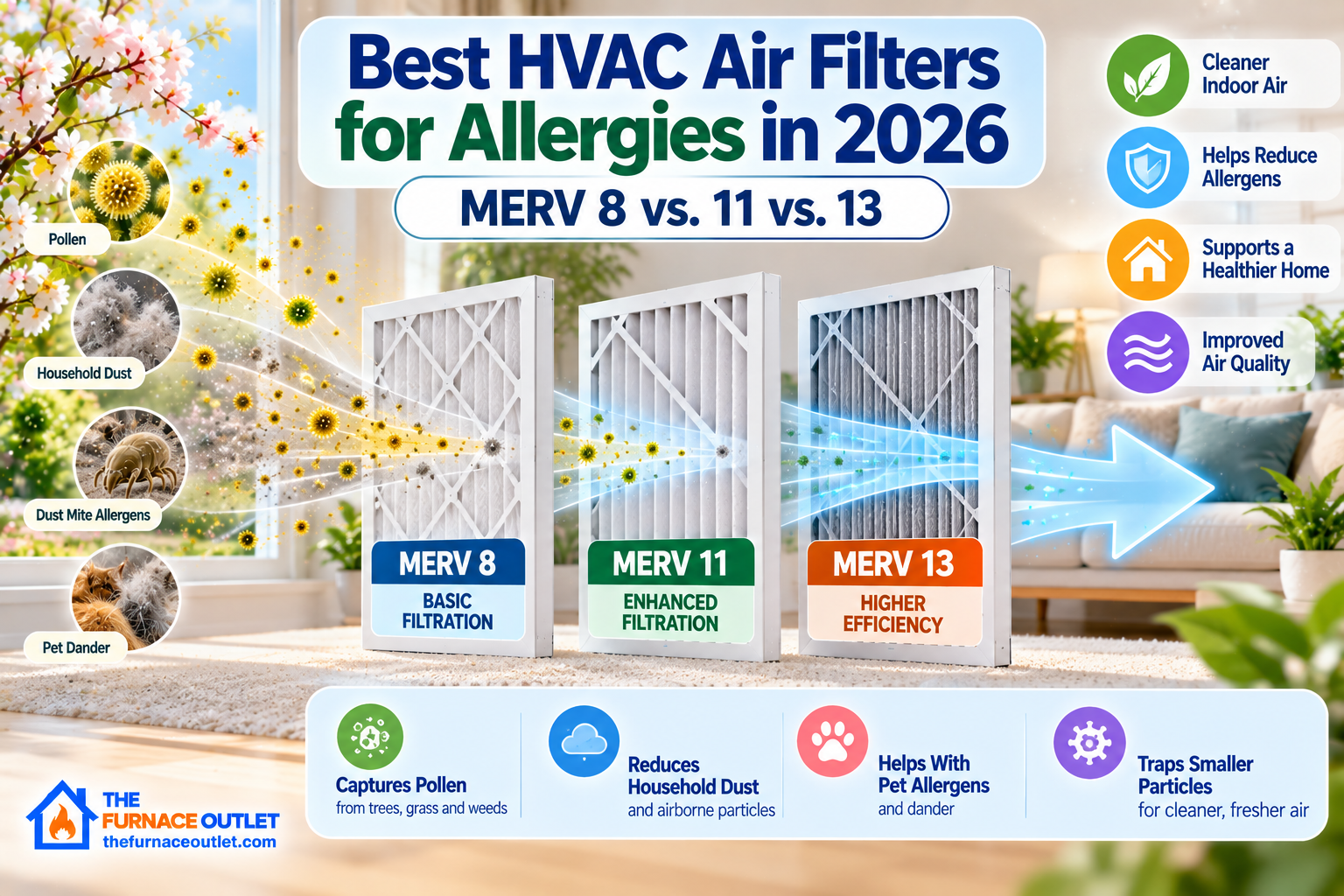
Choosing the right HVAC air filter can make a meaningful difference in how effectively your heating and cooling system captures airborne particles. For homeowners dealing with seasonal pollen, household dust, pet allergens, or other indoor air quality concerns, understanding the difference between MERV 8, MERV 11, and MERV 13 filters is particularly important. Although higher-rated filters generally capture smaller particles more efficiently, selecting the highest MERV rating without considering your equipment can create airflow problems and potentially reduce heating or cooling performance.
As an HVAC specialist with more than 10 years of residential and commercial experience, I frequently encounter homeowners who assume that installing a thicker or more expensive filter will automatically produce cleaner indoor air. The reality is more complicated. Filter efficiency matters, but so do filter dimensions, airflow resistance, installation quality, system runtime, and the amount of airborne contamination present in the home. An excellent filter installed incorrectly or used in an incompatible system may deliver disappointing results.
In this guide, I will compare MERV 8, MERV 11, and MERV 13 filters, explain their practical differences for allergy-sensitive households, and help you determine which filtration level makes sense for your HVAC system. I will also discuss filter replacement, portable HEPA purifiers, energy consumption, and common filtration mistakes so you can make an informed decision without compromising comfort or equipment reliability.
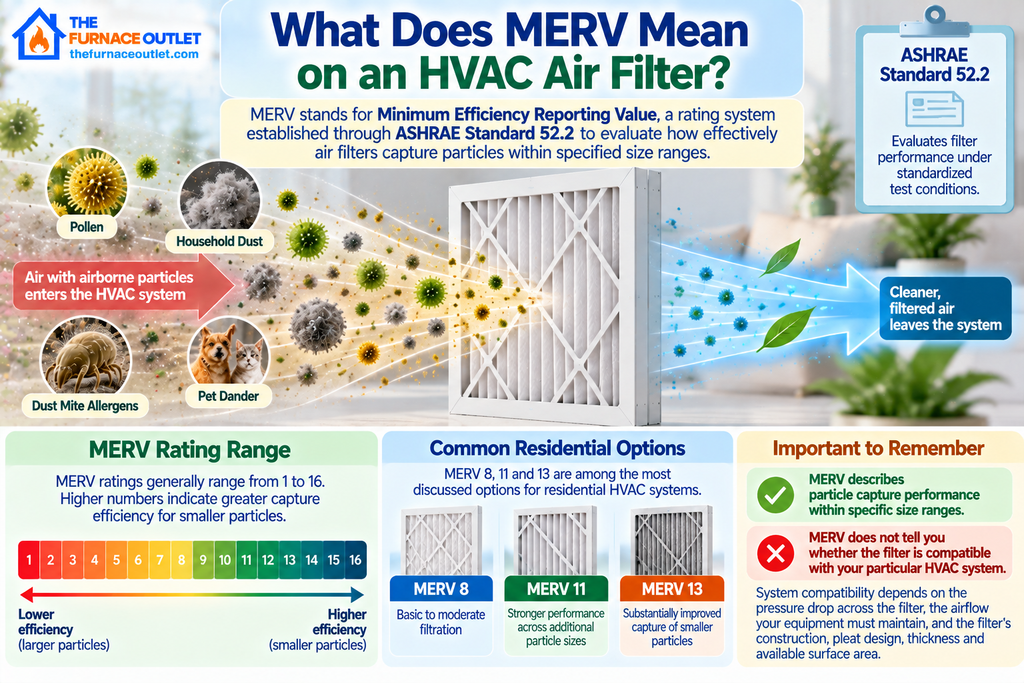
MERV stands for Minimum Efficiency Reporting Value, a rating system established through ASHRAE Standard 52.2 to evaluate how effectively air filters capture particles within specified size ranges. The rating considers particle removal performance across standardized test conditions, providing a useful way to compare different filtration products.
MERV ratings generally range from 1 to 16 for filters evaluated under this system. Higher numbers indicate greater capture efficiency for smaller particles, although the rating does not tell you everything about a filter’s operating characteristics. Two filters with the same MERV rating may have different airflow resistance because of differences in media construction, pleat design, thickness, and available surface area.
For residential HVAC systems, MERV 8, MERV 11, and MERV 13 are among the most commonly discussed options. MERV 8 provides basic-to-moderate particle filtration, MERV 11 offers stronger performance across additional particle sizes, and MERV 13 provides substantially improved capture of smaller particles under the standardized test.
The important distinction is that MERV describes particle capture performance, not whether a filter is compatible with your particular HVAC system. That compatibility depends on the pressure drop across the filter and the airflow your equipment must maintain.
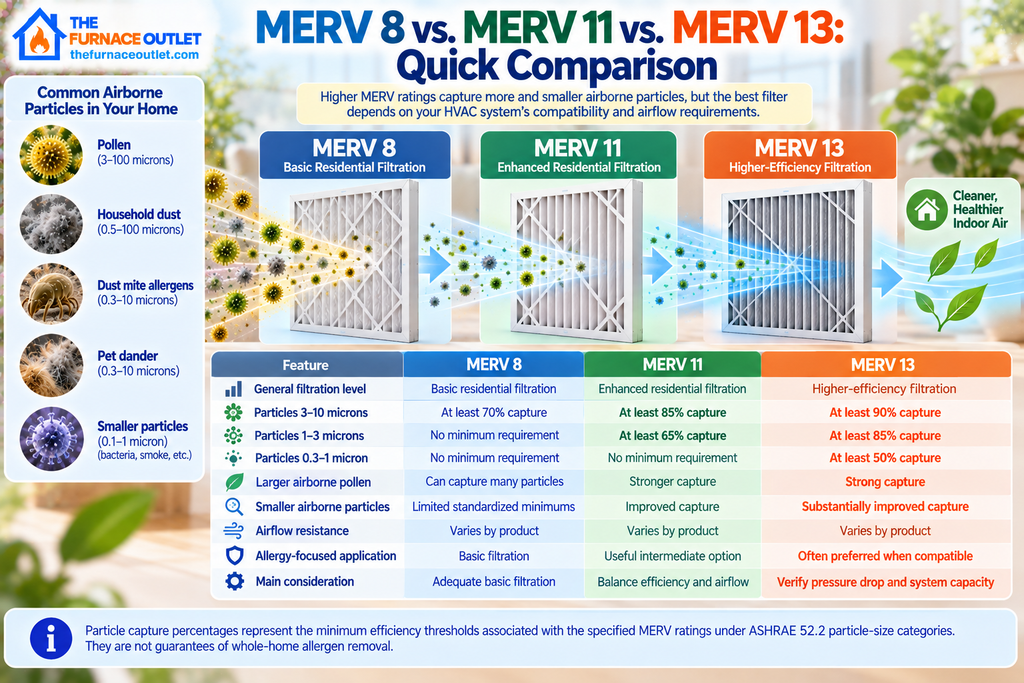
| Feature | MERV 8 | MERV 11 | MERV 13 |
|---|---|---|---|
| General filtration level | Basic residential filtration | Enhanced residential filtration | Higher-efficiency filtration |
| Particles 3–10 microns | At least 70% capture | At least 85% capture | At least 90% capture |
| Particles 1–3 microns | No minimum requirement | At least 65% capture | At least 85% capture |
| Particles 0.3–1 micron | No minimum requirement | No minimum requirement | At least 50% capture |
| Larger airborne pollen | Can capture many particles | Stronger capture | Strong capture |
| Smaller airborne particles | Limited standardized minimums | Improved capture | Substantially improved capture |
| Airflow resistance | Varies by product | Varies by product | Varies by product |
| Allergy-focused application | Basic filtration | Useful intermediate option | Often preferred when compatible |
| Main consideration | Adequate basic filtration | Balance efficiency and airflow | Verify pressure drop and system capacity |
Particle capture percentages represent the minimum efficiency thresholds associated with the specified MERV ratings under ASHRAE 52.2 particle-size categories. They are not guarantees of whole-home allergen removal.
This comparison shows why MERV 13 is attractive for homeowners concerned about smaller airborne particles. However, the best filter is not determined by capture efficiency alone. A properly sized, low-resistance MERV 13 media filter may perform very well in a compatible system, while a restrictive one-inch filter could create difficulties in equipment with limited available static pressure.
MERV 8 filters are widely used in residential heating and cooling systems because they provide useful capture of larger airborne particles while remaining available in many common sizes and constructions. They can help collect larger dust particles, lint, and a portion of airborne pollen moving through the return-air system.
For households primarily concerned with protecting HVAC equipment from ordinary dust accumulation, a properly installed MERV 8 filter may be sufficient. It can also contribute to reducing some airborne particles, particularly when the system circulates air regularly and the filter is maintained correctly.
However, MERV 8 does not have the same standardized capture requirements for smaller particles as MERV 11 or MERV 13. Some allergen-associated particles may remain airborne and pass through lower-efficiency filtration, depending on their size and the filter’s actual performance.
I generally consider MERV 8 a reasonable starting point when equipment compatibility is uncertain or when the manufacturer specifies a relatively low-resistance filter. Homeowners with significant allergy concerns may benefit from evaluating a filtration upgrade, but that decision should follow an assessment of airflow and equipment requirements rather than assuming the existing filter is inadequate.
MERV 11 filters provide improved capture across additional particle size ranges compared with MERV 8. Under the ASHRAE rating system, MERV 11 filters must meet minimum efficiency thresholds for particles in the 1–3 micron range, giving them an advantage for capturing certain smaller airborne particles.
This makes MERV 11 worth considering for households with pets, moderate dust concerns, or seasonal pollen exposure. It may provide a useful improvement over basic filtration without requiring the highest available residential filter rating.
However, homeowners should not assume that every MERV 11 filter creates less airflow resistance than every MERV 13 filter. A well-designed, deeper MERV 13 filter can have a lower pressure drop than a poorly designed or undersized MERV 11 product. The physical construction of the filter and the airflow passing through it matter considerably.
My recommendation is to consider MERV 11 when you want stronger particle capture than MERV 8 but need to evaluate the compatibility of higher-efficiency filtration. The decision should be supported by manufacturer specifications and, where appropriate, professional airflow measurements.
MERV 13 filters offer stronger particle capture across smaller size ranges than MERV 8 or MERV 11. Under ASHRAE 52.2, they must capture at least 50% of particles in the 0.3–1 micron range, at least 85% in the 1–3 micron range, and at least 90% in the 3–10 micron range under the applicable test conditions.
For homeowners concerned about airborne pollen, dust-associated particles, and other fine particulate matter, this higher filtration efficiency can be valuable. The EPA recommends using a filter rated MERV 13, or the highest rating the system can accommodate, when upgrading central HVAC filtration for indoor particle reduction.
Nevertheless, MERV 13 should not be treated as a universal drop-in upgrade. Some residential systems have small filter slots, undersized return ducts, or blower configurations that cannot accommodate additional airflow resistance without affecting performance. In such installations, a larger media filter cabinet or other system modification may be necessary.
I favor MERV 13 when the HVAC equipment can maintain its required airflow with the selected product. That conclusion should be based on actual filter pressure-drop information and system capability, not simply the number printed on the packaging.
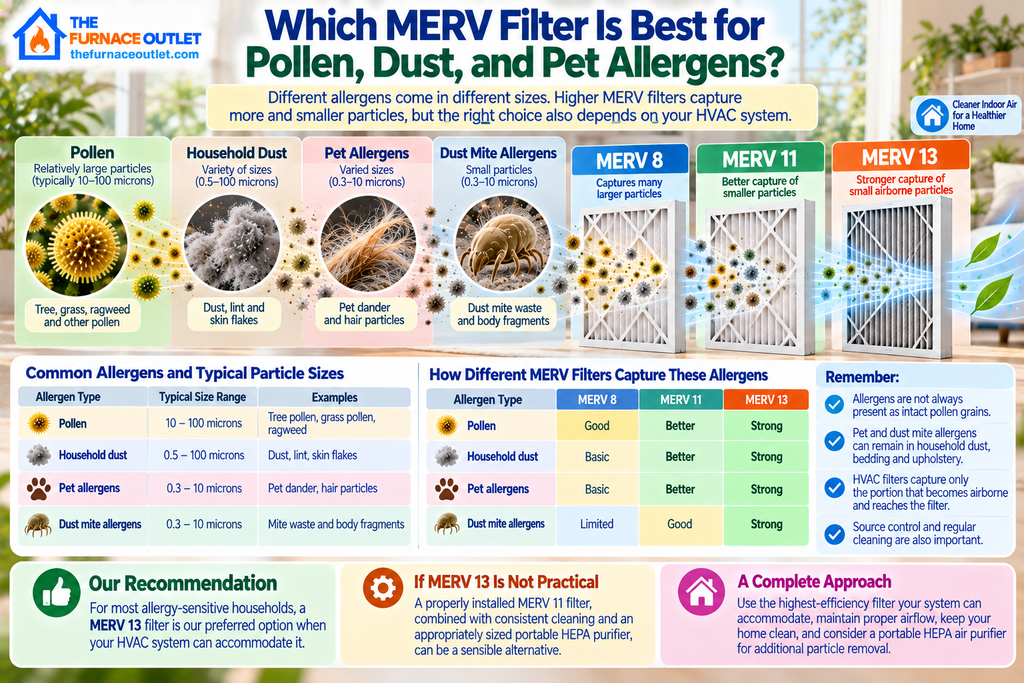
The ideal filtration choice depends partly on the types and sizes of airborne particles you want to capture. Tree pollen, grass pollen, and ragweed pollen are often relatively large compared with fine combustion-related particles, so even moderate-efficiency filters can capture many pollen grains that pass through them.
For households experiencing recurring allergy problems, I would generally evaluate MERV 13 first when equipment compatibility allows it. If that is not practical, a properly installed MERV 11 filter combined with consistent cleaning and appropriately sized portable HEPA filtration may offer a sensible alternative.
Yes. Higher-efficiency filters can create greater airflow resistance, although the relationship is not determined by MERV rating alone. Airflow resistance depends on filter media, pleat geometry, surface area, thickness, loading condition, and the volume of air moving through the filter.
Before upgrading, I recommend checking the equipment’s airflow requirements and the proposed filter’s published pressure-drop data at the expected airflow. A qualified technician can measure system static pressure and determine whether the filtration arrangement is suitable.
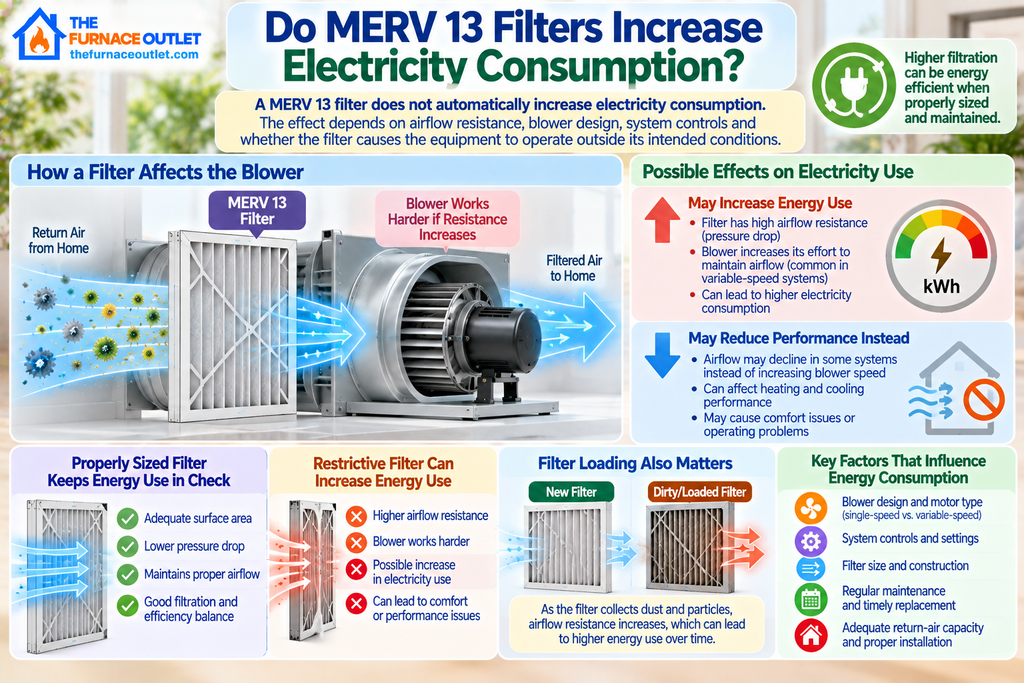
A MERV 13 filter does not automatically increase electricity consumption simply because its rating is higher. The effect depends on airflow resistance, blower design, system controls, and whether the filter causes the equipment to operate outside its intended conditions.
I recommend evaluating the complete filtration system rather than comparing MERV ratings in isolation. Proper filter sizing, adequate return-air capacity, and regular maintenance are essential for balancing filtration performance with energy efficiency.
Filter replacement frequency depends on the product’s construction, operating conditions, household dust levels, pets, and HVAC runtime. Many disposable residential filters have manufacturer-recommended replacement intervals of approximately 60–90 days, although some require more frequent attention and larger media filters may last considerably longer.
I recommend inspecting accessible filters monthly during periods of heavy heating or cooling use. If the filter appears heavily loaded, airflow seems weaker than usual, or the manufacturer specifies a shorter interval, replacement may be necessary sooner. The ENERGY STAR heating and cooling guidance reinforces the importance of inspecting filters and maintaining equipment regularly.
One technical clarification is worth making when comparing MERV ratings: under ASHRAE’s published classification table, MERV 8 has a minimum 20% efficiency requirement for 1–3 micron particles, and MERV 11 has a minimum 20% requirement for 0.3–1 micron particles. The earlier quick comparison omitted these two thresholds. The remaining minimums shown there are correct.
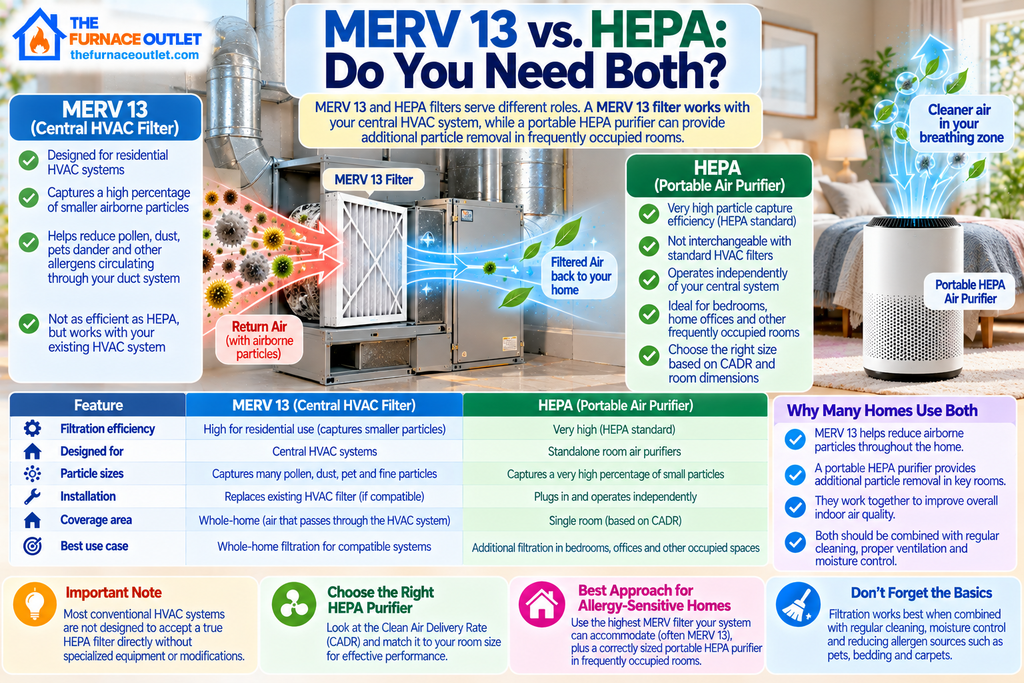
HEPA filtration provides very high particle capture efficiency under its applicable testing standard, but it is not interchangeable with ordinary residential MERV filters. Most conventional central HVAC systems are not designed to accept a true HEPA filter directly without specialized equipment or modifications.
Portable HEPA air purifiers offer a practical alternative for homeowners who want additional particle removal in bedrooms, home offices, or other frequently occupied spaces. Their operation is independent of the central heating and cooling system, which can be especially useful during mild spring and fall weather.
When choosing a portable purifier, I recommend reviewing its Clean Air Delivery Rate, or CADR, and matching that performance to the room’s dimensions. For many allergy-sensitive households, compatible MERV 13 central filtration combined with a correctly sized portable HEPA purifier provides a useful approach. However, neither technology eliminates the need for cleaning, moisture control, and reducing allergen sources.
One frequent mistake is purchasing a filter based solely on its advertised MERV rating without checking dimensions, installation requirements, or airflow resistance. A filter that does not fit snugly can allow air to bypass the filtration material, while an excessively restrictive product may interfere with equipment operation.
Another mistake is assuming that installing a higher-rated filter automatically removes all allergens from the home. Many allergens accumulate on bedding, carpets, upholstery, and other surfaces. HVAC filtration only captures particles that become airborne and pass through the system.
I also caution against ignoring maintenance intervals or washing disposable filters that are not designed for cleaning. Reusing damaged filtration material or installing filters incorrectly can reduce performance. Always follow the manufacturer’s instructions and arrange professional evaluation when airflow problems persist.
MERV 13 has higher minimum capture efficiency across important smaller particle ranges, making it an attractive option for improving airborne particle filtration. However, the selected filter must be compatible with the HVAC system, and better filtration does not guarantee relief from allergy symptoms.
MERV 8 can capture many larger pollen particles that pass through the filter. However, MERV 11 and MERV 13 offer stronger standardized performance across additional particle sizes, which may be useful when smaller airborne particles are also a concern.
A compatible MERV 13 filter should not damage equipment merely because of its rating. Problems can arise when filter resistance causes airflow to fall outside the manufacturer’s operating requirements. A technician can evaluate airflow and static pressure when compatibility is uncertain.
No. Price alone does not establish filtration performance or system compatibility. Compare the MERV rating, published pressure drop, dimensions, construction quality, and manufacturer requirements rather than relying on premium marketing claims.
Longer fan operation can increase the amount of air passing through the filter, but it may also increase electricity consumption or affect humidity control in certain systems. Evaluate your equipment’s operating characteristics before selecting continuous operation.
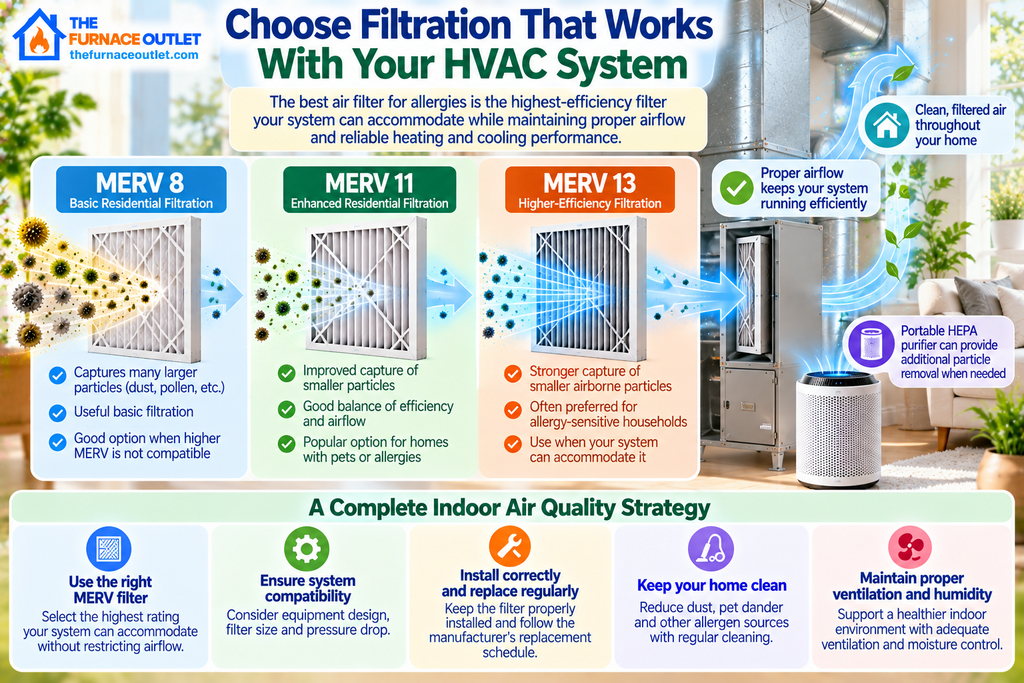
When comparing MERV 8, MERV 11, and MERV 13 filters, I recommend looking beyond the rating printed on the package. MERV 8 provides useful basic residential filtration, MERV 11 improves particle capture across additional size ranges, and MERV 13 offers stronger filtration of smaller airborne particles. For homeowners particularly concerned about airborne allergens and fine particles, MERV 13 is generally my preferred option when the system can accommodate it.
However, I would never sacrifice proper airflow simply to install a higher-rated filter. Equipment compatibility, correct installation, filter surface area, maintenance, and household conditions all influence the final result. Where central filtration cannot be upgraded sufficiently, a suitable portable HEPA purifier may provide additional particle removal without modifying the HVAC system.
The best HVAC air filter for allergies is the highest-efficiency filter your system can accommodate while maintaining proper airflow and reliable heating and cooling performance. Combine that filtration with regular cleaning, appropriate ventilation, and moisture control for a more complete indoor air quality strategy.
This article is published by The Furnace Outlet for general educational purposes and does not constitute medical advice. HVAC filtration may help reduce exposure to certain airborne particles, but it does not diagnose, treat, or cure allergies, asthma, or other respiratory conditions. Consult a qualified healthcare professional about persistent or severe symptoms.
Air filter upgrades and HVAC modifications should comply with manufacturer specifications and applicable safety requirements. Professional assistance is recommended when filtration changes affect airflow, static pressure, or equipment performance. The Furnace Outlet provides independent educational content, and references to external organizations do not imply sponsorship or endorsement.
© 2026 The Furnace Outlet. All rights reserved.