Newsletter Subscribe
Enter your email address below and subscribe to our newsletter

HVAC made simple
By Tony Marino | HVAC Technician & Cooling Specialist | The Furnace Outlet | Updated November 2026
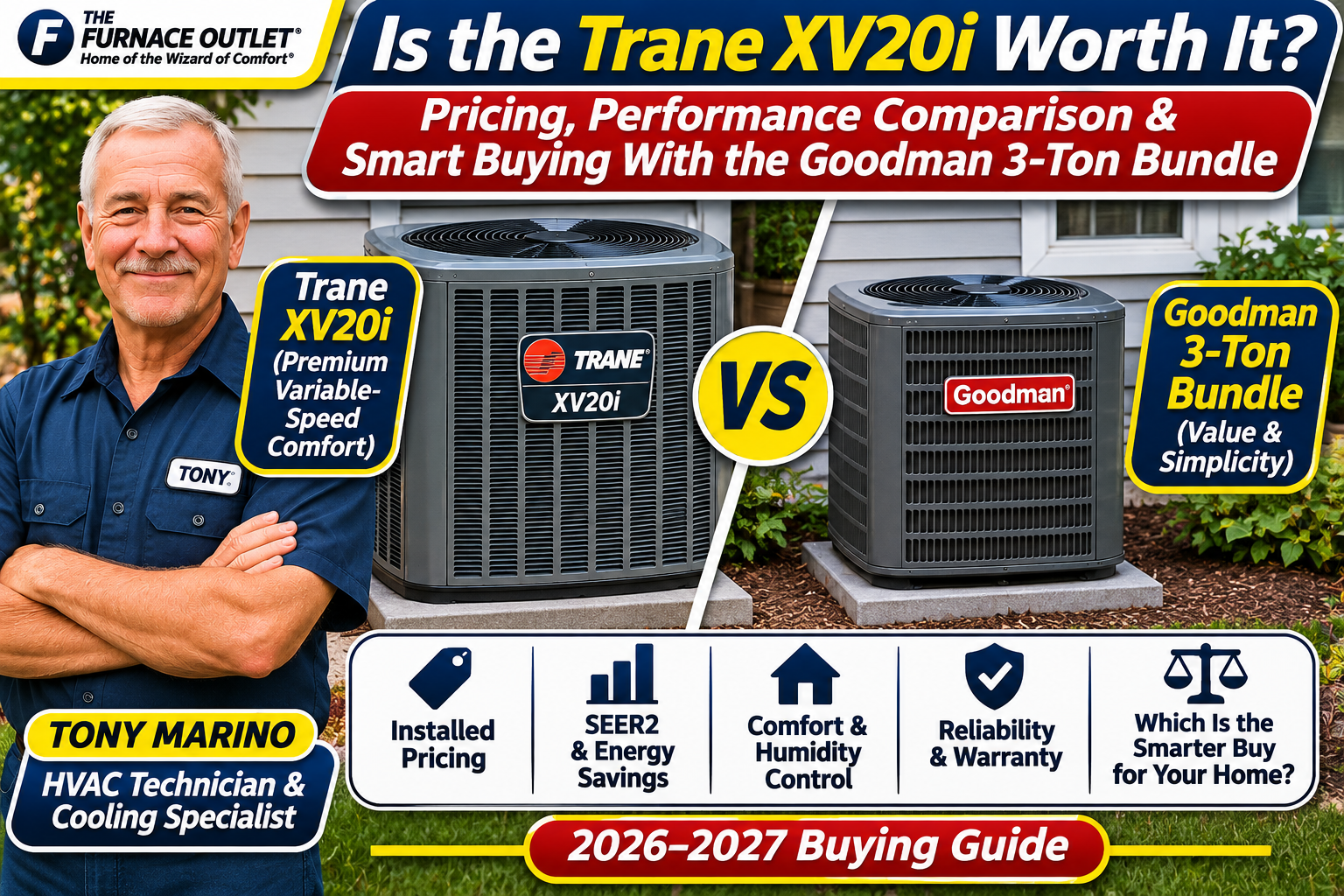
When homeowners compare a premium Trane XV20i air conditioner with a more affordable Goodman 3-ton system, the price difference can be surprising. Both systems are designed to cool a home, but they approach that job differently. The Trane XV20i emphasizes sophisticated variable-speed technology, precise temperature control, and premium comfort features, while a conventional Goodman 3-ton bundle focuses on delivering dependable cooling at a substantially lower initial cost.
I’ve always told homeowners that buying the most expensive air conditioner doesn’t automatically mean making the smartest investment. A premium system can deliver real advantages, particularly in humid climates or homes with long cooling seasons, but those benefits must justify the additional expense. Likewise, a lower-priced Goodman system isn’t necessarily a compromise in reliability when it’s properly sized, installed, and maintained.
For this comparison, I’ll examine the Trane XV20i alongside a typical Goodman 3-ton single-stage air-conditioning bundle, while also considering Goodman’s newer inverter-driven alternatives. I’ll explain what each system offers, how installation costs compare, and which option makes more financial sense for different homeowners.
The Trane XV20i is a premium central air conditioner built around the company’s TruComfort variable-speed technology. Unlike a conventional single-stage system that runs at full cooling capacity whenever the thermostat calls for cooling, the XV20i can adjust compressor output across a broad operating range.
Trane’s published XV20i specifications describe capacity modulation from approximately 30% to 100%, with adjustments in very small increments. This allows the system to respond more closely to changing indoor cooling demand rather than repeatedly switching between full output and shutdown.
The XV20i also incorporates a Climatuff variable-speed compressor, an all-aluminum Spine Fin outdoor coil, and communicating controls designed to coordinate system operation. These features help explain why it occupies a premium position in Trane’s residential cooling lineup.
One important consideration for 2026–2027 buyers is that Trane has introduced newer TruComfort equipment as part of its refreshed product portfolio. The XV20i remains relevant when evaluating an existing system, a dealer quotation, or available inventory, but homeowners should confirm the exact model, refrigerant, manufacturing date, and current replacement options before purchasing.
A typical Goodman 3-ton air-conditioning bundle includes a 36,000-BTU-per-hour nominal cooling-capacity outdoor condenser and a compatible indoor evaporator coil. Some packages also include an air handler or gas furnace, creating a more complete heating and cooling system.
This distinction matters because Goodman bundles sold online can contain very different equipment combinations. A condenser-and-coil package is not equivalent to a condenser, coil, and high-efficiency furnace package. Likewise, a Goodman inverter system with a variable-speed air handler isn’t directly comparable to an entry-level single-stage bundle.
For homeowners prioritizing affordability, Goodman’s conventional 3-ton systems can offer an attractive starting point. However, buyers should examine the exact model numbers, certified efficiency ratings, refrigerant type, indoor equipment, and included accessories before comparing prices.
The most significant difference is compressor operation. The XV20i adjusts cooling output to match the home’s changing requirements, while a conventional Goodman single-stage system operates at full available capacity whenever cooling is requested.
In practical terms, the Trane may operate for longer periods at lower output during moderate weather. This can improve temperature consistency and humidity control when the system is properly designed and commissioned. It may also reduce the noticeable temperature swings associated with frequent compressor cycling.
A single-stage Goodman system uses a simpler operating approach. It can still provide effective cooling, but it generally offers less precise capacity control. For homeowners who maintain a consistent thermostat setting and don’t experience major humidity problems, this difference may not justify a large additional investment.
Goodman also offers inverter-driven systems, so the comparison changes when a higher-end Goodman bundle is selected. A variable-speed Goodman system may narrow the comfort gap while remaining competitively priced.
Trane’s published specifications for the XV20i identify maximum efficiency ratings reaching approximately 21.5 SEER2 in qualifying matched configurations. A conventional Goodman 3-ton bundle may offer approximately 13.4–15.2 SEER2, depending on the condenser, indoor coil, and certified system combination. Higher SEER2 ratings indicate greater seasonal cooling efficiency under standardized testing conditions. However, maximum advertised ratings shouldn’t be treated as the guaranteed performance of every installation. The actual certified efficiency depends on the specific outdoor and indoor equipment combination.
For example, comparing a 21.5 SEER2 system with a 14.3 SEER2 system suggests a theoretical reduction in seasonal cooling electricity consumption of approximately 33% under comparable rated cooling loads. Actual household savings can be smaller or larger depending on climate, thermostat settings, installation quality, and operating patterns.
The important question isn’t simply which system has the higher rating. It’s whether the additional energy savings are large enough to justify the higher purchase price over the homeowner’s expected ownership period.
Premium variable-speed equipment carries a substantial price premium because of its compressor technology, electronics, communicating controls, and matched-system requirements. For preliminary U.S. budgeting, a Trane XV20i installation may cost approximately $12,000–$22,000, depending on capacity, available inventory, indoor equipment, labor rates, and installation complexity. A straightforward replacement can fall below the upper end of that range, while a complete system upgrade involving a new furnace, air handler, ductwork, or electrical modifications may cost considerably more.
These are broad planning estimates rather than guaranteed current dealer quotations. Since the XV20i belongs to an earlier Trane product generation, homeowners should also ask whether a quoted unit is remaining inventory and whether a newer TruComfort model offers better overall value.
The complete proposal should identify the outdoor condenser, matched indoor equipment, communicating thermostat, installation labor, refrigerant requirements, permits, and warranty coverage.
Goodman 3-ton equipment is often substantially less expensive upfront, particularly when purchased as a conventional single-stage condenser-and-coil package. For budgeting purposes, a basic Goodman 3-ton air-conditioning replacement may cost approximately $4,500–$8,500 installed under relatively straightforward conditions. A more complete package that includes a new furnace or upgraded indoor equipment may cost approximately $6,500–$12,000 or more, depending on the components and installation requirements.
As a current equipment-price example, Goodman 3-ton condenser, coil, and high-efficiency furnace bundles have been advertised by HVAC distributors at equipment-only prices around $5,500. Such prices do not represent the final installed cost and may exclude permits, labor, controls, additional materials, and local code-related modifications.
Homeowners should be particularly careful when comparing an online Goodman bundle price with a fully installed Trane dealer quotation. The difference may appear enormous because the two prices represent different scopes of work.
Suppose a homeowner currently uses approximately 4,000 kilowatt-hours of electricity annually for air conditioning with a 14.3 SEER2 system. If a properly matched 21.5 SEER2 system delivered the same seasonal cooling load under comparable conditions, the theoretical electricity consumption would decrease to approximately 2,660 kilowatt-hours.
That represents an estimated annual reduction of about 1,340 kilowatt-hours. At an electricity rate of $0.16 per kilowatt-hour, the annual savings would be approximately $214. If the Trane installation costs $7,000 more than the Goodman alternative, the simple energy-only payback would exceed 30 years under these assumptions. Even with higher annual cooling demand, the additional investment may take many years to recover through electricity savings alone.
This example is illustrative rather than a prediction for a particular home. It doesn’t account for differences in maintenance, financing, future electricity prices, or the comfort value of variable-speed operation. Nevertheless, it demonstrates why I don’t recommend purchasing a premium air conditioner based exclusively on promised utility savings.
The strongest argument for the XV20i is often comfort rather than financial payback. Variable-speed operation allows the system to maintain cooling output closer to the home’s actual demand, potentially reducing temperature fluctuations and improving moisture removal. This can be especially valuable in humid regions where indoor comfort depends on both temperature and relative humidity. A correctly configured variable-speed system may run at reduced capacity for longer periods, helping maintain a steadier indoor environment.
A conventional Goodman single-stage system can still cool a home effectively, particularly when properly sized and paired with suitable airflow. However, it generally doesn’t offer the same level of compressor modulation.
Homeowners who experience uneven temperatures, noticeable cycling, or persistent humidity complaints may appreciate the Trane’s additional control. Before purchasing, though, I would verify that those problems aren’t primarily caused by poor insulation, duct leakage, or inadequate ventilation.
Trane has a strong reputation for durable residential HVAC equipment, and its premium systems incorporate advanced engineering and extensive manufacturer testing. Goodman also produces widely used residential cooling equipment and can provide dependable service when correctly installed. However, there isn’t enough publicly available, model-specific failure-rate information to conclude that every XV20i installation will outlast every Goodman 3-ton system. Reliability depends on installation workmanship, environmental exposure, maintenance, electrical conditions, and component availability.
One important consideration is repair complexity. Variable-speed compressors, inverter electronics, and communicating controls can be more expensive to diagnose or replace than conventional single-stage components. That doesn’t mean the Trane is inherently unreliable, but homeowners should understand the potential financial consequences of a major repair after warranty coverage expires.
For a homeowner seeking a straightforward system with manageable service complexity, a conventional Goodman installation may be appealing. For someone prioritizing advanced comfort, the XV20i’s additional technology may justify the trade-off.
Trane’s published XV20i documentation describes a registered limited warranty that can include 12 years of compressor coverage and 10 years of coverage for qualifying outdoor coil and functional parts, subject to registration and warranty terms.
Goodman residential equipment commonly offers limited parts warranties that may extend to 10 years with qualifying registration. Some Goodman models also provide additional compressor-related coverage, but the exact terms vary by product family and model. Neither brand’s standard parts warranty should automatically be assumed to include installation labor. Homeowners may still be responsible for diagnostic charges, refrigerant, labor, or other excluded expenses.
Before purchasing, ask the contractor for the complete warranty documentation and confirm registration deadlines, transferability, labor protection, and the process for obtaining service.
Refrigerant selection deserves particular attention when comparing older premium equipment with newer Goodman bundles. Many earlier XV20i configurations were designed for R-410A, while newer Goodman residential systems increasingly use R-32. Trane’s refreshed residential portfolio also includes newer lower-global-warming-potential refrigerant equipment.
These refrigerants aren’t interchangeable. A system must be installed and serviced according to its approved refrigerant design, and the indoor and outdoor components must be compatible. For 2026–2027 purchases, I recommend asking the dealer whether the proposed Trane XV20i is older inventory, whether the system uses R-410A, and how replacement-part and refrigerant support will be handled over the equipment’s expected service life.
A premium Trane system cannot compensate for serious installation mistakes. Incorrect refrigerant charging, poor airflow, mismatched indoor components, restrictive ductwork, and inadequate electrical connections can undermine efficiency, reliability, and comfort.
The same principle applies to Goodman equipment. A properly sized and professionally installed Goodman system can deliver excellent practical value, while an incorrectly installed premium unit may create recurring service problems. I recommend requiring a professional Manual J load calculation, verification of duct airflow, appropriate equipment matching, refrigerant-system commissioning, and documentation of operating performance.
For variable-speed systems, proper control configuration is especially important. The contractor must understand the communicating system and ensure that the indoor equipment and thermostat work together as intended.
The XV20i makes the strongest case when a homeowner prioritizes precise comfort, quieter operation under reduced-load conditions, and advanced humidity management. It may be particularly attractive in homes with long cooling seasons, substantial humidity, or occupants who are sensitive to temperature fluctuations.
It can also make sense when the homeowner plans to remain in the property for many years and values comfort improvements independently of electricity savings. A premium HVAC system is not always a purely financial investment. However, I would be cautious about paying a substantial premium for older XV20i inventory without comparing it against Trane’s current TruComfort models. The newer equipment may offer improved specifications, updated refrigerant technology, or better long-term support.
For homeowners working within a limited budget, a Goodman 3-ton bundle can provide substantial value. If the home has relatively straightforward cooling requirements and the existing ductwork is in good condition, a properly selected single-stage Goodman system may deliver dependable performance without the high cost of premium variable-speed equipment.
The savings can also be used for improvements that affect comfort and energy consumption throughout the home. Air sealing, attic insulation, duct repairs, and proper ventilation may deliver greater practical benefits than spending the entire budget on a more expensive condenser.
I would also consider a Goodman inverter-driven bundle for homeowners who want variable-speed comfort without automatically moving into Trane’s premium pricing category. This creates a more balanced comparison between equipment with similar operating technology.
If I were advising a homeowner whose primary goal was dependable cooling at a reasonable installed cost, I would begin with the Goodman 3-ton bundle. When properly sized and installed, it can deliver the essential cooling performance most households need while leaving room in the budget for other important home improvements.
If the homeowner’s priority was premium comfort, better humidity management, and sophisticated variable-speed control, I would seriously consider the Trane XV20i or its current TruComfort successor. Those advantages can be meaningful, particularly in demanding climates. However, I wouldn’t automatically recommend paying thousands more for the Trane based on energy savings alone. The financial payback may be lengthy, and the additional technology can increase repair complexity.
My recommendation for 2026–2027 is to obtain detailed quotations for a conventional Goodman 3-ton system, a Goodman inverter alternative, and a current Trane variable-speed system. Compare the complete installed costs, certified efficiency ratings, warranty terms, control requirements, and contractor experience before making the final decision. The smartest HVAC purchase isn’t necessarily the cheapest or most expensive system. It’s the one that delivers the comfort, reliability, and long-term value your home actually needs.