Newsletter Subscribe
Enter your email address below and subscribe to our newsletter

HVAC made simple
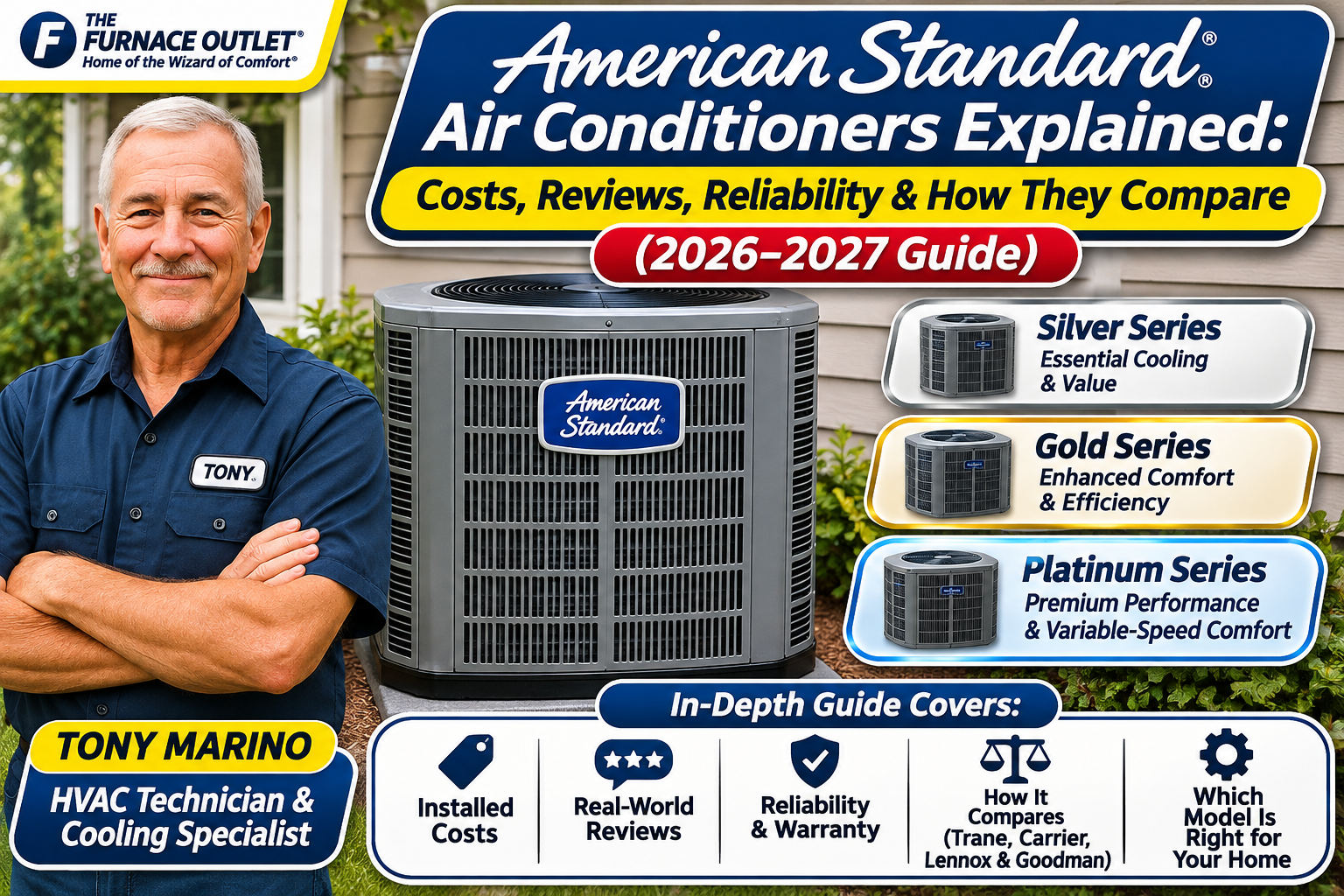
By Tony Marino | HVAC Technician & Cooling Specialist | The Furnace Outlet | Updated November 2026
When homeowners ask me whether American Standard makes a good air conditioner, my answer is generally yes. American Standard has established itself as a respected name in residential heating and cooling, offering everything from straightforward single-stage air conditioners to advanced variable-speed systems designed for better temperature control and energy efficiency.
However, choosing an American Standard air conditioner involves more than selecting a recognizable brand. The company offers several product families with substantial differences in efficiency, comfort features, operating noise, and installed cost. A basic Silver-series model may be perfectly suitable for one home, while another homeowner could benefit from the more sophisticated cooling technology available in the Gold or Platinum lines.
I’ve always believed that the quality of the installation matters just as much as the equipment itself. Even an expensive air conditioner can struggle when it’s oversized, incorrectly charged, connected to restrictive ductwork, or paired with incompatible indoor components. In this guide, I’ll explain what American Standard offers, how much its systems cost, and how they compare with other major HVAC brands.
American Standard Heating and Air Conditioning and Trane are closely related HVAC brands within Trane Technologies. Both benefit from shared engineering resources, manufacturing expertise, and technology platforms, although their product offerings, distribution arrangements, and specific configurations can differ.
This relationship is important because homeowners sometimes assume American Standard is an inexpensive imitation of Trane. That’s not an accurate description. American Standard is an established brand offering equipment built around many of the same engineering principles and technologies associated with Trane.
However, two units with similar specifications aren’t automatically identical in every component or feature. When comparing American Standard and Trane, I recommend examining actual model numbers, certified efficiency ratings, warranties, and contractor quotations rather than relying on brand reputation alone.
The Silver series is American Standard’s value-oriented residential air-conditioning range. These systems generally emphasize conventional cooling operation, familiar components, and a more accessible purchase price than the company’s premium variable-speed equipment.
The Silver 13 is listed with efficiency ratings reaching 13.4 SEER2, while the Silver 14 reaches approximately 14.3 SEER2 in qualifying configurations. The Silver 16 offers efficiency ratings reaching approximately 17 SEER2, depending on the matched indoor equipment. These models use single-stage cooling, making them relatively straightforward compared with more advanced variable-capacity systems.
For homeowners replacing an older air conditioner in a moderate climate, a properly selected Silver model can be a sensible investment. The main compromise is that single-stage equipment operates at its available cooling capacity rather than adjusting continuously to changing indoor demand. This can produce greater temperature variation and less precise humidity control than advanced variable-speed systems.
The Gold series occupies the middle of American Standard’s residential air-conditioning lineup. It is particularly attractive to homeowners who want improved comfort and efficiency without paying for the company’s most sophisticated equipment.
The Gold 17 Multi-Speed air conditioner offers inverter-driven operation and efficiency ratings reaching approximately 17.1 SEER2 in qualifying configurations. Its ability to adjust cooling output makes it different from traditional single-stage systems that operate at one fixed capacity whenever cooling is required.
In practical terms, multi-speed operation can help maintain steadier indoor temperatures and reduce unnecessary full-capacity operation during milder weather. For homes experiencing long cooling seasons, the Gold series deserves consideration because its comfort improvements may justify the additional purchase price.
American Standard’s Platinum series is designed for homeowners seeking advanced temperature control, high efficiency, and variable-speed operation. The AccuComfort Platinum 18 and Platinum 20 models represent the company’s premium residential cooling options.
The Platinum 18 offers efficiency ratings reaching approximately 18.1 SEER2, while the Platinum 20 is advertised with ratings reaching approximately 23.6 SEER2 in qualifying system combinations. These are maximum ratings, not guarantees for every installation, because the actual certified efficiency depends on the matched indoor equipment and system configuration.
Variable-speed operation allows the air conditioner to adjust cooling output more precisely as indoor demand changes. Rather than repeatedly cycling between full operation and shutdown, the equipment can operate at reduced capacity for extended periods. This can improve temperature consistency, humidity management, and overall comfort.
I generally recommend considering Platinum equipment when homeowners place a high value on comfort, live in areas with substantial cooling demand, or are willing to invest more upfront for advanced technology. However, the additional cost should be compared against realistic energy savings and the homeowner’s expected length of ownership.
American Standard air-conditioner pricing depends on equipment capacity, product family, installation complexity, location, and whether indoor components also require replacement. For preliminary U.S. budgeting, a Silver-series central air conditioner may cost approximately $3,500–$6,000 installed, while a Gold-series installation may fall around $5,500–$9,000.
Premium Platinum systems can cost approximately $7,000–$12,000 or more installed, particularly when communicating controls, compatible indoor equipment, or extensive installation modifications are required. These ranges are broad planning estimates rather than guaranteed dealer prices.
A complete system replacement involving a furnace, air handler, evaporator coil, duct modifications, or electrical upgrades can cost substantially more than an outdoor condenser replacement alone. Homeowners should therefore request quotations that identify every included component.
My recommendation is to obtain at least three detailed contractor estimates using comparable equipment capacities and installation scopes. Comparing a condenser-only quotation with a complete HVAC system proposal can make one contractor appear dramatically cheaper even when the offers aren’t equivalent.
SEER2, or Seasonal Energy Efficiency Ratio 2, measures the seasonal cooling efficiency of an air-conditioning system under standardized testing conditions. Higher ratings generally indicate that a system can deliver more cooling for each unit of electricity consumed.
For example, replacing an older 10 SEER system with a substantially more efficient modern unit may reduce cooling electricity consumption, assuming comparable operating conditions. However, the actual savings depend on climate, thermostat settings, equipment sizing, duct leakage, maintenance, and local electricity prices.
A high-efficiency air conditioner also costs more upfront, so homeowners should consider the financial payback rather than automatically choosing the highest available rating. A moderately efficient Gold system may offer a better balance of purchase price and energy savings than a Platinum model in a home with relatively limited cooling demand.
The U.S. Department of Energy’s air-conditioning guidance provides additional information about cooling efficiency and energy-saving practices.
American Standard has a generally favorable reputation among established residential HVAC brands, supported by its engineering heritage and broad contractor network. However, reliability isn’t determined by brand name alone, and independent failure-rate data for every current model are not publicly available.
The company uses technologies such as SpineFin outdoor coils and advanced compressor controls in selected equipment. These design features are intended to support heat transfer, efficiency, and dependable operation, although real-world longevity still depends heavily on installation and maintenance.
In my experience, the most important reliability factors include correct refrigerant charging, proper airflow, sound electrical connections, suitable equipment sizing, and routine servicing. An improperly installed premium system can develop more problems than a correctly installed entry-level model.
For long-term planning, homeowners often use approximately 12–18 years as a reasonable service-life range for central air conditioners, although actual equipment may last less or considerably longer. Climate, usage, maintenance, and environmental exposure can all influence longevity.
When evaluating homeowner reviews, I recommend separating product performance from installation and service experiences. Positive feedback often focuses on dependable cooling, comfortable indoor temperatures, and the improved operation of variable-speed systems. Homeowners upgrading from older equipment may also notice lower electricity consumption and reduced operating noise.
Common complaints across the residential HVAC industry include expensive repairs, contractor service delays, warranty misunderstandings, and disappointment when a premium system doesn’t deliver the expected savings. These experiences are worth considering, but an individual review doesn’t establish that a particular model has a widespread manufacturing defect.
Installation quality can also influence customer satisfaction. A homeowner may blame the air conditioner for uneven temperatures when the actual problem involves undersized return ducts, poor insulation, or an incorrectly located thermostat.
For this reason, I place considerable weight on the installing contractor’s reputation, technical competence, and willingness to explain the system design. Reliable local service support is often more valuable than a small difference in published efficiency ratings.
American Standard and Trane share corporate ownership and engineering resources, making this one of the closest comparisons in residential HVAC. Both brands offer conventional and premium cooling systems, including advanced compressor technology and communicating controls in selected product families.
The practical differences may involve available model configurations, dealer networks, pricing, and promotional offers. In some markets, one brand may be more competitively priced or supported by a stronger local contractor.
I wouldn’t pay a substantial premium for either name without identifying a meaningful equipment or installation advantage. If two comparable systems offer similar efficiency, warranty coverage, and features, I would generally favor the proposal from the contractor with the stronger installation plan and service reputation.
Carrier is another established premium HVAC manufacturer offering single-stage, multi-stage, and variable-speed central air conditioners. Its Comfort, Performance, and Infinity product families provide alternatives to American Standard’s Silver, Gold, and Platinum lines.
Both brands offer equipment capable of delivering high efficiency and comfortable indoor conditions. The better choice depends on the exact models being compared, particularly their cooling capacity, certified efficiency, sound ratings, controls, and installed cost.
For a homeowner comparing premium variable-speed systems, I would examine the complete matched equipment combinations rather than focusing exclusively on the outdoor condenser. The indoor blower, evaporator coil, thermostat, and installation quality can substantially affect overall system performance.
Lennox competes strongly in the premium residential cooling market, particularly through its high-efficiency and variable-capacity equipment. Homeowners evaluating American Standard Platinum systems may also consider comparable Lennox models.
Both manufacturers offer advanced cooling technology, but service arrangements and replacement-part costs can differ by equipment family and local market. Some homeowners prioritize maximum efficiency, while others prefer simpler equipment with widely available service support.
My recommendation is to compare actual installed costs, certified efficiency ratings, control requirements, and warranty terms. A premium Lennox or American Standard system may be worthwhile, but only when its advantages justify the additional investment.
Goodman is generally positioned as a more value-oriented residential HVAC brand, making it a common alternative for homeowners who want dependable cooling without spending heavily on premium equipment.
American Standard may appeal to buyers seeking advanced comfort features, particular dealer-support arrangements, or a premium product lineup. Goodman can be attractive when upfront affordability is the primary consideration.
However, neither brand should be judged solely by its price. A correctly installed Goodman system can provide satisfactory long-term performance, while a poorly installed American Standard unit can experience avoidable problems.
If your budget is limited, I would prioritize proper sizing, a qualified installer, and a dependable warranty before paying extra for advanced features that may not significantly improve comfort in your particular home.
American Standard generally provides a Base Limited Warranty covering qualifying manufacturer defects, often for five years, while eligible registered equipment may receive extended parts coverage of approximately ten years. The company currently specifies a 60-day registration window for its Registered Limited Warranty, subject to product terms and applicable jurisdictional exceptions.
Certain models or components may have different coverage periods, so homeowners should never assume that every American Standard air conditioner carries identical protection. Standard parts warranties also generally exclude labor, meaning a homeowner may still face repair charges even when a replacement component is covered.
Optional extended warranty arrangements may provide additional protection depending on the plan purchased. Before installation, I recommend reviewing the official American Standard warranty and registration information and confirming that all eligible equipment components are registered correctly.
The HVAC industry is transitioning toward refrigerants with lower global warming potential, and newer American Standard residential equipment includes systems designed for R-454B. This refrigerant has a lower global warming potential than R-410A and is classified as an A2L refrigerant, meaning it has lower toxicity and mild flammability under the applicable safety classification.
Newer systems incorporate equipment-specific safety provisions and installation requirements. Homeowners should confirm which refrigerant their proposed air conditioner uses and ensure that the installing contractor follows the manufacturer’s instructions.
An existing R-410A air conditioner shouldn’t be converted to R-454B simply by replacing the refrigerant. The system must be designed and approved for the refrigerant being used.
The U.S. Environmental Protection Agency’s HFC information explains the broader transition toward lower-global-warming-potential refrigerants.
American Standard offers residential air conditioners in multiple nominal capacities, commonly ranging from approximately 2 to 5 tons, depending on the product family. However, choosing equipment based solely on the size of the existing unit or the home’s square footage can lead to poor performance.
A professional Manual J load calculation considers insulation, windows, air leakage, climate, orientation, and other factors affecting the home’s cooling demand. Correct sizing helps improve comfort, humidity control, and equipment operation.
An oversized air conditioner may cool the house quickly without running long enough to remove adequate moisture, while an undersized system may struggle during extreme heat. The contractor should also evaluate ductwork, airflow, and the compatibility of indoor components before recommending a final system.
For homeowners seeking affordable, straightforward cooling, I would begin by comparing the Silver 14 and Silver 16 with similarly priced alternatives. These models can provide practical performance without the additional complexity and expense of premium variable-speed equipment.
For homeowners wanting a stronger balance between comfort and efficiency, the Gold 17 deserves serious consideration. Its multi-speed technology can offer meaningful comfort advantages, particularly in homes experiencing variable cooling demand throughout the day.
For buyers prioritizing premium comfort, precise temperature control, and advanced efficiency, the Platinum series is worth evaluating. However, I would calculate the expected operating savings and review the complete installation quotation before deciding that its higher purchase price is justified.
American Standard is a credible choice for homeowners who want established HVAC engineering, multiple efficiency options, and equipment supported by a professional dealer network. Its Silver, Gold, and Platinum families offer choices for different budgets and comfort expectations.
What I appreciate most is the range of equipment available. A homeowner doesn’t necessarily need to purchase the most expensive Platinum model to obtain dependable cooling, while someone seeking advanced temperature control can consider the company’s higher-end systems. My advice is to compare American Standard with Trane, Carrier, Lennox, and Goodman using actual model specifications and complete installed quotations. Pay particular attention to the contractor’s installation standards, warranty coverage, and local service support.
A properly sized, professionally installed American Standard air conditioner can be a worthwhile long-term investment. The best value, however, comes from selecting the right system for your home rather than paying extra for a brand name or efficiency rating you may never fully benefit from.