Newsletter Subscribe
Enter your email address below and subscribe to our newsletter

HVAC made simple
By Samantha Reyes | The Furnace Outlet
Choosing the right window air conditioner can make a significant difference in your home’s comfort, electricity consumption, and overall cooling expenses. A 12,000 BTU window air conditioner offers an attractive balance between cooling capacity, affordability, and energy efficiency, particularly for larger bedrooms, living rooms, apartments, and medium-sized residential spaces.
Modern window air conditioners offer considerably more than basic temperature control. Inverter compressor technology, Wi-Fi connectivity, energy-saving modes, improved humidity control, and quieter operation have made these systems increasingly competitive alternatives to traditional central air conditioning.
However, not all 12,000 BTU window air conditioners deliver the same performance. Understanding cooling capacity, energy efficiency ratings, electrical compatibility, noise levels, installation requirements, and long-term operating expenses can help homeowners select equipment that provides dependable comfort without unnecessary costs.
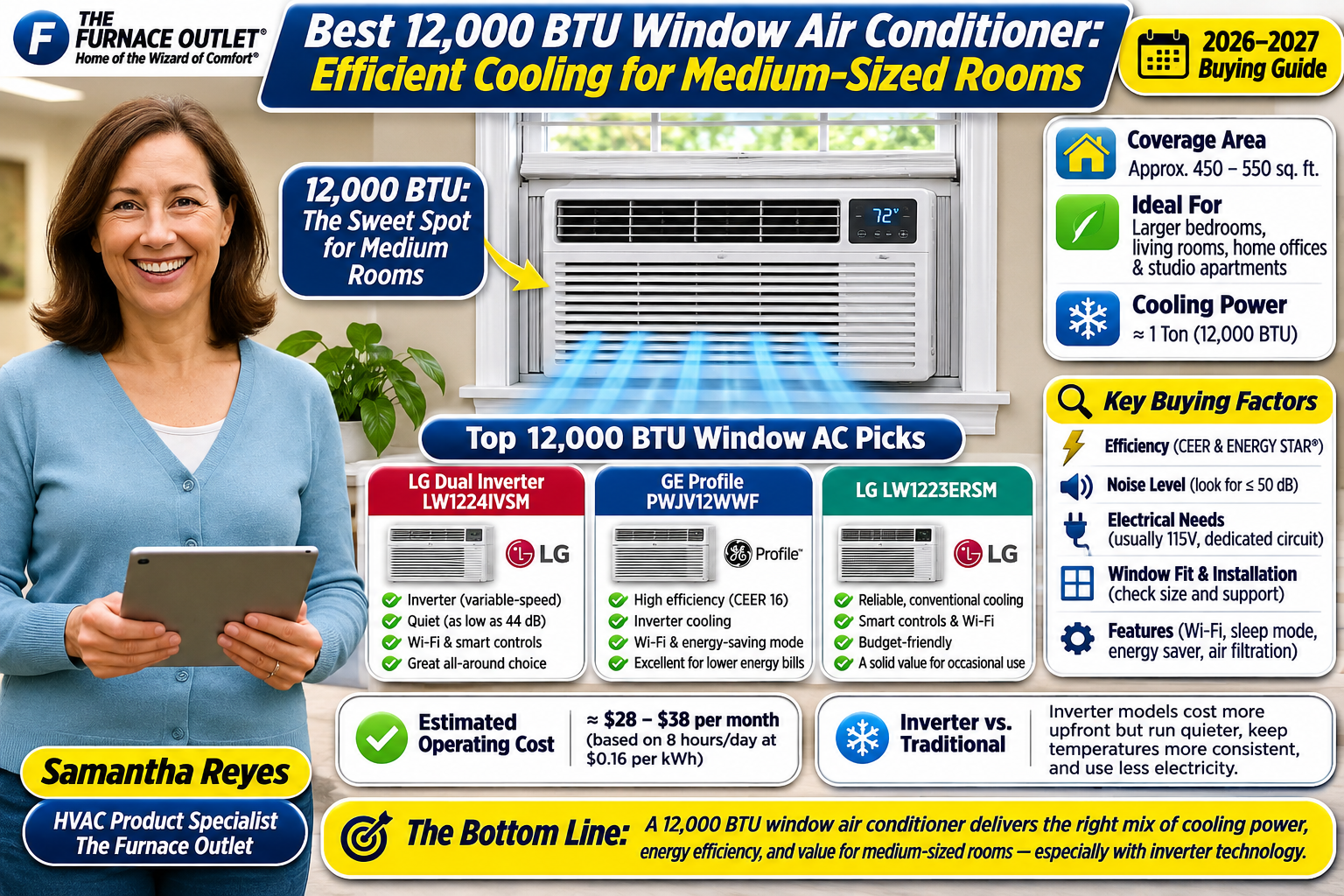
A 12,000 BTU window air conditioner provides approximately one ton of cooling capacity and is generally suitable for rooms measuring between 450 and 550 square feet under typical conditions. This makes it a practical option for spacious bedrooms, family rooms, home offices, studio apartments, and moderately sized living areas.
Actual cooling requirements depend on more than floor area. Ceiling height, insulation quality, sunlight exposure, outdoor temperatures, occupancy, and heat-generating appliances can significantly influence the required cooling capacity.
A well-insulated room measuring 550 square feet may remain comfortable with a 12,000 BTU unit, while a poorly insulated, sun-exposed room measuring 450 square feet may require additional cooling capacity. Selecting equipment based on realistic cooling demand helps prevent inadequate cooling, excessive energy consumption, and poor humidity management.
The ENERGY STAR room air conditioner sizing guide recommends 12,000 BTU of cooling capacity for spaces measuring approximately 450–550 square feet with standard eight-foot ceilings. It also recommends adjusting cooling capacity according to sunlight exposure, occupancy, and heat-generating activities. ENERGY STAR
A 12,000 BTU window air conditioner is particularly attractive for homeowners who need substantial cooling capacity without investing in central air conditioning or a permanently installed ductless mini split. These units combine the compressor, evaporator, condenser, and air circulation components within a single cabinet, eliminating the need for separately installed indoor and outdoor equipment.
Window air conditioners are also useful for supplemental cooling in homes where central HVAC systems struggle to maintain comfortable temperatures in particular rooms. Cooling only occupied spaces may help reduce household energy consumption when compared with cooling an entire property unnecessarily.
For renters and homeowners with suitable windows, these systems offer relatively straightforward installation and can provide several years of dependable cooling when properly maintained.
Traditional window air conditioners generally use fixed-speed compressors that cycle between full-capacity operation and complete shutdown. Although this technology is relatively affordable, frequent compressor cycling can produce noticeable temperature fluctuations and operating noise.
Inverter window air conditioners use variable-speed compressor technology to adjust cooling output according to real-time demand. Rather than repeatedly switching between full power and shutdown, an inverter compressor can continue operating at reduced capacity once the desired room temperature is reached.
This approach can improve temperature consistency, reduce operating noise, and lower electricity consumption under suitable conditions. Although inverter models generally cost more upfront, households that use air conditioning extensively may benefit from their improved operating efficiency.
The Combined Energy Efficiency Ratio, commonly known as CEER, is one of the most important specifications to evaluate when purchasing a window air conditioner. Unlike SEER2 ratings commonly associated with central air conditioning systems, CEER accounts for energy consumption during cooling and certain non-cooling operating modes.
A higher CEER indicates better standardized energy efficiency when comparing equipment within the same cooling capacity category. Buyers should examine both the CEER rating and the estimated annual electricity consumption displayed on the equipment’s EnergyGuide label.
The ENERGY STAR room air conditioner certification criteria provide efficiency requirements for different equipment capacities and configurations. ENERGY STAR certification can help homeowners identify efficient equipment, although actual savings depend on usage patterns, climate, and electricity rates. ENERGY STAR
The LG LW1224IVSM Dual Inverter Window Air Conditioner is an attractive all-around option for homeowners seeking energy efficiency, quiet operation, and smart connectivity. Its variable-speed compressor adjusts cooling performance according to indoor temperature requirements, making it particularly suitable for frequently occupied rooms.
The system offers Wi-Fi connectivity, adjustable airflow, automatic restart, sleep mode, and programmable operation. LG advertises sound levels as low as 44 dB under specified operating conditions, making it worth considering for bedrooms and home offices.
According to the official LG product specifications, this model is designed for spaces up to 550 square feet. Its primary disadvantage is the higher initial purchase price compared with conventional fixed-speed alternatives. LW1224IVSM
The GE Profile PWJV12WWF 12,000 BTU Inverter Window Air Conditioner combines variable-speed cooling technology with smart controls and a conventional window-mounted cabinet. Its CEER rating of 16 makes it particularly attractive to households concerned about long-term electricity consumption.
The equipment features adjustable airflow, remote operation, Wi-Fi connectivity, an energy-saving mode, and R-32 refrigerant. Its 115V electrical configuration makes it compatible with many residential applications, provided the circuit meets the manufacturer’s requirements.
The official GE Appliances product specifications provide detailed information about its electrical requirements and operating performance. GE Appliances
The LG LW1223ERSM 12,000 BTU Smart Window Air Conditioner is worth considering for homeowners who prefer conventional cooling technology without paying the premium associated with advanced inverter equipment. Its straightforward design makes it suitable for guest rooms, rental properties, and spaces that require occasional cooling.
This model provides electronic temperature management and smart connectivity, offering a practical balance between traditional cooling performance and modern convenience. However, homeowners who operate their air conditioners throughout extended summer seasons should compare its standardized energy consumption against more efficient inverter alternatives. LG USA
The Midea 12,000 BTU U-Shaped Inverter Window Air Conditioner features an innovative cabinet configuration that allows compatible windows to close partially between the indoor and outdoor sections. This arrangement can improve acoustic separation while preserving greater window functionality.
However, buyers must be aware that certain Midea U and U+ window air conditioners were recalled in June 2025 because inadequate drainage could contribute to mold growth. The recall includes several 12,000 BTU models and equipment distributed under other brand names.
Before purchasing new, refurbished, or secondhand equipment, consult the official U.S. Consumer Product Safety Commission recall notice. Purchase only equipment confirmed to be unaffected by the recall or appropriately remedied according to the manufacturer’s instructions. U.S. Consumer Product Safety Commission
For preliminary budgeting, conventional 12,000 BTU window air conditioners may cost approximately $250–$450, while inverter models generally warrant a budget of $350–$600. Premium equipment with advanced noise reduction, specialized mounting configurations, and smart controls can cost $500–$750 or more.
Professional installation may add approximately $100–$250, depending on equipment weight, window accessibility, mounting requirements, and regional labor rates. Electrical modifications and specialized support brackets can increase the total installation expense.
These figures are illustrative US budgeting estimates rather than guaranteed retail prices. Seasonal promotions, local availability, utility rebates, and manufacturer pricing changes can significantly influence the actual purchase cost.
A 12,000 BTU window air conditioner’s electrical consumption depends on compressor technology, operating efficiency, outdoor conditions, and cooling demand. Conventional equipment may consume approximately 1,000–1,200 watts during active cooling, while efficient inverter systems can operate at substantially lower power levels when full capacity is unnecessary.
For example, a window air conditioner averaging 1,000 watts over eight operating hours daily would consume approximately 240 kWh over a 30-day month. At an electricity rate of $0.16 per kWh, the estimated monthly cooling expense would be $38.40.
An efficient inverter system averaging 750 watts under comparable conditions would consume approximately 180 kWh monthly, resulting in an estimated electricity expense of $28.80. This represents a potential monthly saving of $9.60, although actual savings depend on operating conditions and equipment performance.
The financial benefits of inverter technology depend largely on how frequently the air conditioner operates. Homeowners living in hot climates or using their equipment throughout extended cooling seasons may recover the additional purchase expense through reduced electricity consumption.
For example, if an inverter model costs $150 more than a conventional alternative and saves approximately $9.60 monthly during six cooling months annually, the potential annual electricity savings would be $57.60. Under these illustrative assumptions, the additional investment could be recovered in approximately 2.6 years.
Households requiring only occasional air conditioning may experience a considerably longer payback period. Nevertheless, improved temperature consistency and quieter operation can justify the additional investment even when financial savings are relatively modest.
Many 12,000 BTU window air conditioners sold in North America operate on nominal 115V electrical supplies. However, equipment voltage, current requirements, plug configurations, and circuit protection specifications vary by manufacturer and model.
Homeowners should verify the equipment nameplate and installation manual before connecting an air conditioner to an existing household outlet. Avoid extension cords, power strips, and incompatible electrical adapters, as these can introduce overheating and electrical fire hazards.
If an existing outlet becomes unusually warm, the circuit breaker repeatedly trips, or the electrical system cannot accommodate the equipment’s requirements, discontinue operation and consult a qualified electrician.
Noise performance deserves particular attention when purchasing a window air conditioner for a bedroom, home office, or entertainment area. Because the compressor and fan components occupy the same cabinet, window air conditioners can transmit operational noise directly into occupied spaces.
Inverter compressors generally provide quieter operation at reduced speeds, while improved cabinet insulation and vibration management can further enhance indoor comfort. Premium equipment may advertise operating noise in the mid-40 dB range under particular conditions, although noise levels increase with cooling demand and fan speed.
Always compare manufacturer sound ratings under equivalent operating conditions. A minimum sound rating recorded in sleep mode should not be directly compared with another manufacturer’s full-capacity operating measurement.
Most conventional window air conditioners are designed for vertically opening single-hung or double-hung windows. Sliding windows, casement windows, and unusually narrow openings may require specialized equipment or manufacturer-approved installation arrangements.
Before purchasing a unit, measure the available window width, opening height, sill depth, and surrounding clearance. Ensure that the window and supporting structure can safely accommodate the equipment’s weight.
Follow the manufacturer’s instructions regarding support brackets, cabinet positioning, drainage, weather sealing, and outdoor airflow clearance. Incorrect mounting can cause excessive vibration, water intrusion, equipment damage, or serious safety hazards.
A window air conditioner generally offers an economical cooling solution for households with suitable window openings. Its integrated cabinet design allows the condenser to reject heat directly outdoors without requiring a separate exhaust hose.
Portable air conditioners provide greater flexibility for properties where window-mounted equipment is prohibited. However, buyers should compare portable equipment using its DOE seasonally adjusted cooling capacity, known as SACC, rather than relying solely on its advertised conventional BTU rating.
Ductless mini splits typically offer greater installation flexibility, quieter indoor operation, and excellent efficiency potential. Their primary disadvantages are higher upfront installation expenses and the need for permanently installed indoor and outdoor equipment.
One of the most common purchasing mistakes is selecting an air conditioner based exclusively on cooling capacity or purchase price. Homeowners may overlook electricity consumption, noise performance, window compatibility, maintenance accessibility, and long-term warranty support.
Oversizing is another important concern. Installing a 12,000 BTU air conditioner in a small bedroom that requires substantially less cooling capacity may result in poor humidity control and unnecessary equipment cycling, particularly with fixed-speed equipment.
Homeowners should also avoid assuming that all smart air conditioners use inverter technology. Wi-Fi connectivity provides remote control functionality but does not necessarily indicate improved compressor efficiency.
Regularly inspect and clean the air filter according to the manufacturer’s maintenance schedule. Restricted airflow can reduce cooling performance, increase energy consumption, and contribute to evaporator coil freezing.
Keep the outdoor-facing condenser area free from vegetation, debris, and airflow restrictions. Inspect window seals periodically to prevent warm outdoor air and moisture from entering the conditioned space.
Unusual odors, persistent indoor water leakage, electrical problems, or declining cooling performance should be investigated promptly. Sealed refrigerant circuits and internal electrical components should be serviced only by appropriately qualified professionals.
Is a 12,000 BTU window AC sufficient for a 500-square-foot room?
Yes, a 12,000 BTU unit is generally appropriate for a 500-square-foot room with standard ceilings and typical insulation. High ceilings, significant sunlight exposure, and unusually high heat loads may require additional capacity.
Can a 12,000 BTU window air conditioner cool two rooms?
It may provide some cooling to an adjoining room when the spaces are openly connected. However, walls, closed doors, and restricted air circulation can prevent consistent temperature distribution.
Is a 12,000 BTU window AC expensive to operate?
Operating expenses depend on electricity rates, compressor efficiency, and daily consumption. A unit averaging 1,000 watts over eight hours daily would cost approximately $38.40 monthly at an electricity rate of $0.16 per kWh.
Can a 12,000 BTU window AC run on a regular outlet?
Many models operate on 115V residential electrical supplies. Nevertheless, the outlet, wiring, and circuit protection must satisfy the specific equipment manufacturer’s electrical requirements.
How long does a window air conditioner last?
A properly maintained window air conditioner may provide approximately 8–12 years of service. Actual equipment lifespan varies according to manufacturing quality, operating conditions, climate, corrosion exposure, and maintenance practices.
For homeowners seeking dependable cooling in a medium-sized room, a properly sized 12,000 BTU inverter window air conditioner offers an excellent combination of comfort, energy efficiency, and convenient operation. Households with frequent cooling requirements should prioritize high CEER ratings, variable-speed compressors, and dependable manufacturer support.
The LG Dual Inverter and GE Profile inverter models are particularly attractive options based on their published features and efficiency specifications. Budget-conscious homeowners who require occasional cooling may find conventional fixed-speed equipment more economical upfront.
Ultimately, the best 12,000 BTU window air conditioner is one that matches your room’s cooling requirements, electrical infrastructure, window configuration, household budget, and expectations for long-term comfort.
Before purchasing a 12,000 BTU window air conditioner, homeowners should verify their existing electrical infrastructure and circuit capacity. Understanding 115V HVAC power compatibility can help prevent electrical overload, installation complications, and unnecessary equipment replacement expenses.
This article provides general educational and purchasing guidance. Equipment recommendations are based on published specifications rather than independent hands-on testing. Prices and operating expenses are illustrative, and homeowners should verify current equipment availability, warranty conditions, recall status, and installation requirements before purchasing.
Editorial Disclosure: The Furnace Outlet is not associated with, affiliated with, endorsed by, or sponsored by Carrier, Trane, Lennox, Bryant or any other manufacturer mentioned in this article. We do not receive manufacturer compensation for inclusion or rankings.
The Furnace Outlet
For educational purposes only. HVAC equipment removal, refrigerant handling, recycling and disposal requirements can vary by equipment and location. Consult a qualified HVAC professional and applicable federal, state and local requirements before removing or disposing of HVAC equipment.
© 2026 The Furnace Outlet | www.thefurnaceoutlet.com