Newsletter Subscribe
Enter your email address below and subscribe to our newsletter

HVAC made simple

By Jake Lawson | HVAC Specialist | The Furnace Outlet
Updated October 2026 | Indoor Air Quality & Seasonal Allergy Guide
Your heating and cooling system plays an important role in maintaining a comfortable indoor environment, but can it actually make allergies worse? For homeowners experiencing sneezing, nasal congestion, itchy eyes, coughing, or other allergy-related symptoms, it is reasonable to question whether the HVAC system is contributing to the problem. After all, central heating and cooling equipment circulates air throughout the home, and that air may contain pollen, household dust, pet allergens, mold spores, and other airborne particles.
As an HVAC specialist with more than 10 years of residential and commercial experience, I have encountered many situations where homeowners blame their furnace or air conditioner for worsening allergy symptoms. Sometimes the HVAC system is contributing to airborne particle exposure because of poor filtration, dirty components, duct leakage, or moisture problems. In other cases, the equipment is operating normally, but household allergens are entering through open windows, clothing, pets, or building air leaks.
An HVAC system does not inherently cause allergies, but certain installation, maintenance, and operating problems can increase exposure to airborne allergens and irritants. Understanding those problems is the first step toward improving indoor air quality without investing unnecessarily in expensive equipment.
In this guide, I will explain how HVAC systems can contribute to allergy-related discomfort, identify the most common causes, and recommend practical solutions involving filtration, ductwork, humidity control, ventilation, cleaning, and professional maintenance.

The short answer is yes, under certain conditions. An HVAC system can contribute to allergy-related problems when it circulates contaminated air, allows unfiltered particles to enter the ductwork, or creates moisture conditions that support microbial growth. However, it is important to distinguish between an HVAC system generating contaminants and a system transporting particles that already exist inside the home. In most residential applications, the equipment circulates indoor air through return ducts, conditions that air, and distributes it through supply registers.
If airborne pollen, dust, or pet-associated particles are present in the living space, some may enter the return-air system. A properly selected and installed filter can capture a portion of those particles, while particles that bypass the filter or are not captured may continue circulating. An HVAC system with appropriate filtration, adequate airflow, sound ductwork, and effective moisture control can actually help reduce airborne particle exposure. The objective is therefore not to stop using heating and cooling equipment, but to ensure the system operates in a way that supports indoor air quality.

| Potential problem | How it affects indoor air quality | Recommended solution |
|---|---|---|
| Dirty or ineffective air filter | Allows more airborne particles to circulate | Install a compatible filter and replace it as required |
| Filter bypass | Air passes around the filter instead of through it | Correct filter fit and seal bypass gaps |
| Leaky return ducts | May draw dust and contaminants from unconditioned spaces | Inspect and seal duct leakage |
| Dirty evaporator coil | Accumulated dirt and moisture can contribute to contamination | Inspect and clean when necessary |
| Condensate drainage problems | Standing water may encourage microbial growth | Repair drainage and moisture problems |
| Excessive indoor humidity | Supports mold and dust mite conditions | Manage humidity and correct moisture sources |
| Inadequate ventilation | Allows certain indoor pollutants to accumulate | Provide appropriate outdoor air exchange |
| Poor HVAC maintenance | Allows filtration and equipment problems to persist | Schedule periodic professional inspection |
| Disturbed household dust | Air movement may redistribute some settled particles | Improve cleaning and source control |
These problems do not affect every home equally. The importance of each issue depends on the equipment, building design, household activities, local climate, and specific allergens affecting occupants.

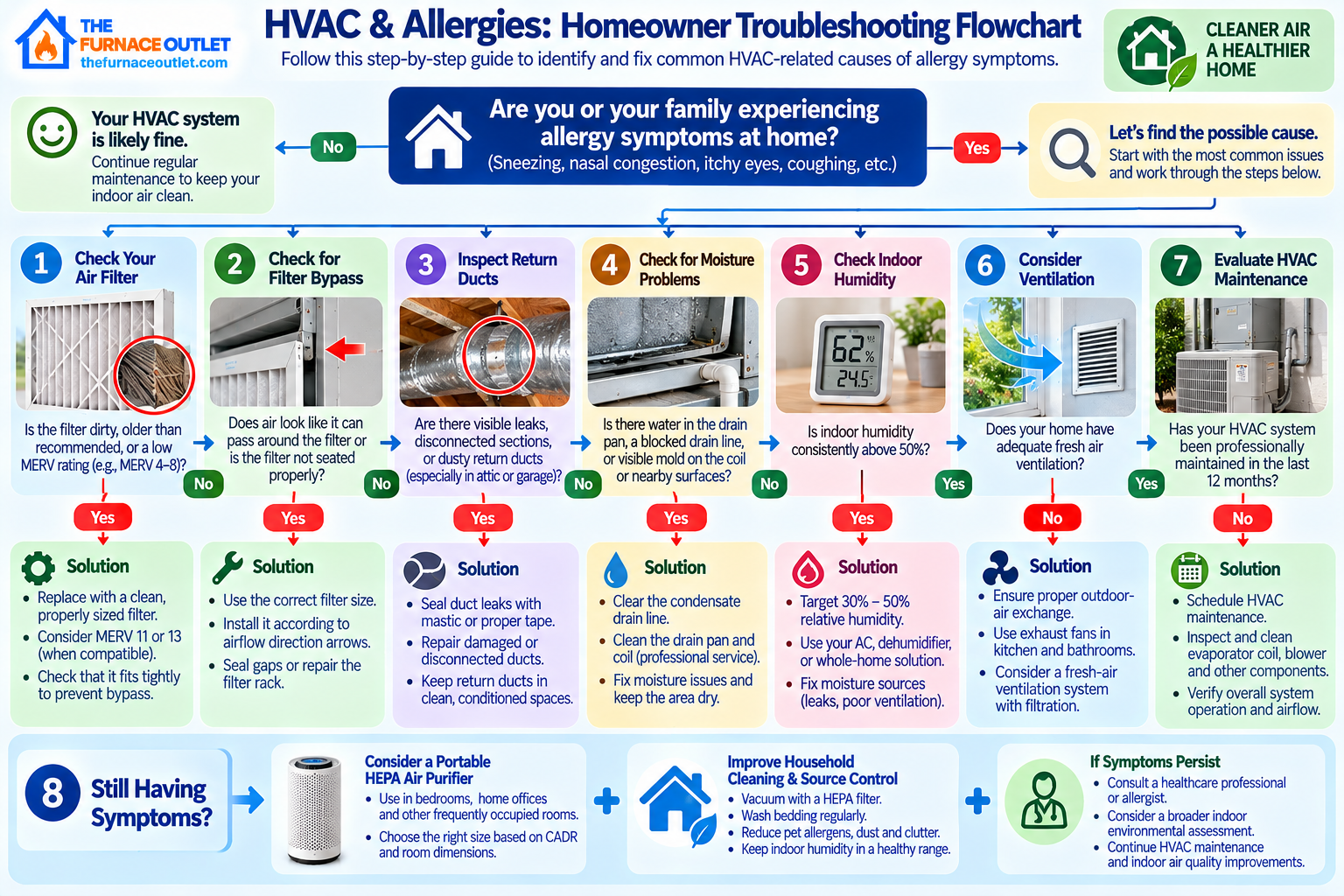
One of the first components I inspect when evaluating indoor air quality complaints is the HVAC filter. A dirty or poorly maintained filter can interfere with airflow, while a low-efficiency or improperly fitted filter may allow more airborne particles to pass through the system.
For a detailed comparison, see our related guide, Best HVAC Air Filters for Allergies in 2026: MERV 8 vs. 11 vs. 13. The EPA’s Guide to Air Cleaners in the Home provides additional information about residential filtration and particle removal.
Even an efficient filter cannot perform properly when air flows around its edges instead of through the filtration material. This condition, commonly called filter bypass, can occur when the filter is undersized, installed incorrectly, or positioned inside a poorly sealed filter rack.
In a typical forced-air system, return air should pass through the filter before reaching sensitive internal components. When gaps are present, unfiltered particles may enter the air handler and accumulate on the blower, coil, or other surfaces. Filter bypass can also reduce the practical benefit of purchasing a higher-MERV product. A premium filter with significant installation gaps may perform worse in the installed system than a properly fitted lower-rated filter.
I recommend checking that the filter matches the required dimensions, sits securely in its designated location, and follows the manufacturer’s airflow-direction instructions. If the filter rack has substantial gaps or damaged components, a qualified HVAC technician should evaluate appropriate corrections.

Duct leakage is another potential contributor to poor indoor air quality. Return ducts operating under negative pressure may draw air from surrounding spaces when connections, seams, or duct materials are damaged. This becomes particularly important when return ducts pass through dusty attics, crawlspaces, garages, or other unconditioned areas. Leakage can introduce unwanted particles and odors into the return-air stream, depending on the building configuration.
Not every duct leak causes allergy symptoms, and the severity depends on its location and operating conditions. Nevertheless, return-side leakage can undermine filtration and introduce contaminants that would otherwise remain outside the occupied space. I recommend having suspicious duct connections inspected, especially when visible damage, disconnected sections, or significant dust accumulation are present. Proper sealing and repair can improve system performance while reducing unwanted air movement.
The ENERGY STAR guidance on sealing and insulating ducts explains why duct integrity matters for comfort and efficiency.
Air-conditioning systems remove moisture from indoor air as humid air passes over the cold evaporator coil. Under normal conditions, condensed water collects in a drain pan and exits through a properly functioning condensate drainage system.
I recommend including the evaporator coil, condensate pan, and drain line in appropriate HVAC maintenance. Persistent musty odors, recurring drainage problems, or visible contamination should be assessed by a qualified professional. Homeowners should avoid spraying unapproved chemicals into the air handler or attempting invasive coil cleaning without understanding the equipment’s electrical and mechanical hazards.
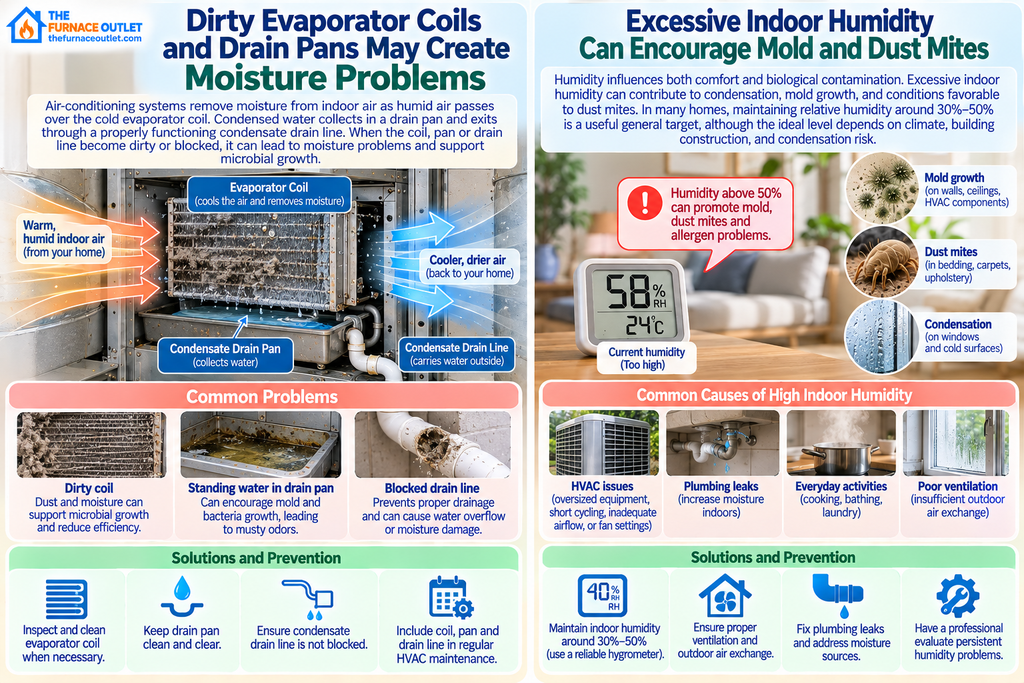
Humidity is an important part of indoor air quality management because moisture influences both comfort and biological contamination. Excessive indoor humidity can contribute to condensation, mold growth, and conditions favorable to dust mites.
In many homes, maintaining indoor relative humidity around 30%–50% is a useful general target, although the appropriate level depends on climate, building construction, and condensation risk. During cooling season, oversized equipment, short cycling, inadequate airflow, or inappropriate fan operation may affect moisture removal. However, humidity problems can also originate from plumbing leaks, inadequate ventilation, groundwater intrusion, and everyday household activities.
I recommend using a reliable hygrometer to monitor actual conditions and investigating persistent moisture rather than assuming the air conditioner is responsible. The EPA’s mold guidance emphasizes correcting moisture problems as the foundation of mold prevention. If humidity remains high despite normal cooling operation, professional evaluation may be appropriate to identify equipment, ventilation, or building-related causes.
Running the central HVAC fan continuously can increase the amount of indoor air passing through a properly installed filter. This may improve airborne particle removal when filtration is effective and the duct system is in good condition.
However, continuous operation is not automatically beneficial for every household. It may increase blower electricity consumption, and certain cooling systems can experience humidity-related effects when the fan continues operating after the cooling cycle ends. Duct leakage can also influence the result. If the return system draws contaminants from dusty or unconditioned spaces, additional fan runtime may increase unwanted air movement.
Some modern systems offer circulation modes that operate the fan periodically rather than continuously. I recommend reviewing the equipment’s design and operating characteristics before permanently selecting the ON setting. For most homeowners, correcting filter bypass, duct leakage, and moisture problems should take priority over increasing fan runtime.
Many homeowners assume that a central air conditioner automatically supplies fresh outdoor air. In reality, most conventional residential forced-air systems primarily recirculate indoor air unless they incorporate a dedicated outdoor-air ventilation arrangement.
Without appropriate ventilation, certain pollutants generated inside the home may accumulate. Cooking activities, cleaning products, building materials, furnishings, and other household sources can contribute to indoor pollutant concentrations. Ventilation must also be balanced against outdoor conditions. Opening windows during high-pollen periods may introduce allergens, while poorly designed mechanical ventilation can create unwanted humidity or pressure problems.
I recommend evaluating whether the home has adequate outdoor-air exchange and whether existing exhaust fans and ventilation equipment operate correctly. In some installations, controlled mechanical ventilation with suitable filtration can provide a more predictable approach than relying entirely on uncontrolled air leakage. The EPA’s indoor air quality resources explain the importance of source control, ventilation, and filtration in managing indoor pollutants.

Homeowners sometimes notice increased dust or unusual odors when they begin operating their heating systems in autumn. This can create the impression that the furnace is producing allergens, although the actual explanation may involve several factors.
Air movement through supply registers can disturb settled particles near vents, furniture, or other surfaces. Heating-season changes may also coincide with reduced window opening, different indoor humidity levels, and increased time spent indoors. A brief dusty odor during initial operation is not necessarily evidence of significant contamination. However, persistent musty smells, visible smoke, burning electrical odors, or unusual equipment behavior should be investigated promptly. Before the heating season begins, I recommend inspecting filters, cleaning accessible registers, removing obstructions around return grilles, and scheduling appropriate equipment maintenance.
For fuel-burning equipment, combustion safety is especially important. Carbon monoxide alarms and professional inspection are essential safety measures, although carbon monoxide itself is not an allergen.
Air duct cleaning is frequently promoted as a solution for allergies, but the relationship between duct dust and occupant exposure is more complicated than many advertisements suggest.
Dust may accumulate inside ductwork without necessarily becoming airborne in significant quantities. Routine duct cleaning has not been established as a reliable method for preventing health problems in every household. However, certain conditions warrant investigation. These include substantial debris entering occupied rooms, vermin infestation, or suspected significant microbial contamination associated with moisture problems.
The EPA’s guidance on residential duct cleaning explains when cleaning may deserve consideration and why routine cleaning is not universally recommended. I prefer to inspect filtration, return duct leakage, moisture conditions, and equipment cleanliness before recommending duct cleaning. If cleaning is justified, it should be performed using appropriate procedures that avoid damaging duct materials or spreading contamination.

Portable HEPA air purifiers can provide additional particle removal in bedrooms, home offices, and other frequently occupied spaces. They are particularly useful when central HVAC filtration cannot be upgraded or when the heating and cooling system operates infrequently during mild weather.
A properly sized purifier captures airborne particles passing through the device. Its effectiveness depends on airflow, room dimensions, placement, operating speed, and how consistently it runs. I recommend evaluating Clean Air Delivery Rate, or CADR, rather than relying exclusively on marketing claims about filtration stages. A purifier that is too small for the room may provide limited benefit even when its filter media is highly efficient.
Portable filtration cannot eliminate allergens embedded in carpeting, bedding, or upholstery. It also cannot correct mold growth caused by moisture or prevent pollen from entering through open windows. For many allergy-sensitive households, compatible central HVAC filtration combined with a suitable portable HEPA purifier provides a practical approach to airborne particle reduction.
One limitation of HVAC filtration is that it captures only particles that become airborne and reach the filter. Many important allergens accumulate on household surfaces, where they may remain until disturbed by movement or cleaning.
Pet allergens can collect in upholstery and carpeting, while dust mite allergens are commonly associated with bedding and fabric-rich environments. Pollen may enter on clothing, shoes, pets, and outdoor equipment before settling on indoor surfaces.
I recommend regular cleaning using methods that minimize particle redistribution. Damp dusting, effective vacuum filtration, washing suitable bedding, and cleaning frequently occupied rooms can help reduce allergen reservoirs. Household source control should complement filtration rather than compete with it. Even a high-efficiency HVAC filter cannot compensate completely for persistent moisture problems, significant dust accumulation, or continuous introduction of outdoor pollen.
Professional evaluation is appropriate when indoor air quality concerns occur alongside equipment problems such as weak airflow, persistent musty odors, recurring condensate leaks, unusually dirty filters, or visible duct damage.
A qualified technician can inspect filter installation, measure system static pressure, evaluate airflow, examine accessible coils and drain components, and identify potential duct leakage.
It is important to understand that HVAC technicians do not diagnose allergies. Their role is to evaluate mechanical systems and building-related conditions that may contribute to pollutant exposure. If household members experience persistent respiratory symptoms, consult a qualified healthcare professional or allergist. When symptoms appear strongly associated with a particular building, a broader indoor environmental assessment may also be appropriate.

| Homeowner action | Recommended approach |
|---|---|
| Inspect HVAC filters | Check regularly and replace according to manufacturer instructions |
| Consider improved filtration | Evaluate MERV 11 or MERV 13 when compatible |
| Prevent filter bypass | Confirm proper fit and installation |
| Inspect return ducts | Repair damaged or leaking connections |
| Check condensate drainage | Address standing water and blocked drains |
| Monitor indoor humidity | Generally target 30%–50%, as appropriate |
| Clean bedrooms and bedding | Reduce settled allergen reservoirs |
| Use portable HEPA filtration | Match CADR to room size |
| Maintain ventilation | Provide appropriate outdoor-air exchange |
| Schedule HVAC maintenance | Verify equipment cleanliness, airflow, and operation |
I recommend starting with straightforward maintenance and source-control measures before purchasing additional indoor air quality equipment. Filter compatibility, proper airflow, moisture management, and household cleaning often deserve attention before more expensive upgrades.
Air conditioning can contribute to airborne particle exposure when filtration, ductwork, or moisture control is inadequate. However, a properly maintained system with compatible filtration may help reduce indoor pollen and other airborne particles.
A dirty or ineffective filter may contribute to indoor particle exposure, although sneezing can have many causes. Symptoms alone cannot establish that the filter is responsible, so persistent concerns should be discussed with a healthcare professional.
MERV 13 provides stronger standardized capture of smaller airborne particles than MERV 8 or MERV 11. It is often worth considering when the HVAC system can accommodate the filter without excessive airflow resistance.
Mold can develop on susceptible materials where moisture and suitable conditions persist. Condensate drainage problems, wet insulation, and other moisture issues should be investigated and corrected promptly.
Routine annual duct cleaning is not generally necessary for every home. Cleaning may be appropriate under specific contamination conditions, but filtration, duct integrity, and moisture control should also be evaluated.
Yes. A correctly sized portable HEPA purifier can provide additional particle removal in frequently occupied rooms. It should complement, not replace, appropriate HVAC maintenance and household source control.
When homeowners ask whether their HVAC system is making allergies worse, I recommend evaluating the complete indoor environment rather than immediately blaming the furnace or air conditioner. Dirty filters, filter bypass, return duct leakage, moisture problems, and inadequate maintenance can contribute to airborne particle exposure, but household cleaning, ventilation, outdoor pollen entry, and other building conditions are equally important.
My preferred approach begins with verifying that the HVAC system operates correctly. I would inspect filtration, confirm adequate airflow, evaluate duct integrity, check condensate drainage, and identify persistent moisture problems before considering additional equipment. When appropriate, compatible MERV 13 filtration and portable HEPA air purifiers may provide useful supplemental particle removal.
A properly maintained HVAC system should be part of your indoor air quality solution, not an overlooked source of avoidable problems. By combining reliable equipment operation with compatible filtration, appropriate ventilation, moisture control, and consistent household cleaning, homeowners can reduce exposure to certain airborne allergens while maintaining dependable heating and cooling performance.
This article is published by The Furnace Outlet for general educational purposes and does not constitute medical advice. HVAC filtration and indoor air quality improvements may reduce exposure to certain airborne particles, but they do not diagnose, treat, or cure allergies, asthma, or other respiratory conditions. Individuals experiencing persistent, severe, or worsening symptoms should consult a qualified healthcare professional.
HVAC maintenance, duct repairs, electrical work, combustion-system inspection, and equipment modifications should follow manufacturer specifications and applicable safety requirements. Qualified professionals should perform work involving internal equipment components, electrical hazards, refrigerants, or combustion safety.
The Furnace Outlet publishes independent educational content. References to external agencies and organizations are provided for informational purposes and do not imply sponsorship, affiliation, or endorsement.
© 2026 The Furnace Outlet. All rights reserved.