Newsletter Subscribe
Enter your email address below and subscribe to our newsletter

HVAC made simple

By Jake Lawson | HVAC Specialist | The Furnace Outlet
Updated October 2026 | Indoor Air Quality & HVAC Maintenance
When allergy season arrives, homeowners often focus on keeping windows closed, cleaning bedrooms, and avoiding outdoor pollen. However, one of the simplest ways to support better indoor air quality is to maintain the air filter inside your heating and cooling system. Whether you are dealing with spring tree pollen, summer grass pollen, fall ragweed, household dust, or pet allergens, your HVAC filter plays an important role in capturing airborne particles that circulate through the equipment.
One question I frequently hear from homeowners is How often should I change my HVAC filter during allergy season? Some people replace their filters every month, while others follow a three-month schedule regardless of household conditions. Neither approach is universally correct because filter replacement depends on the type of filter, its physical size, HVAC runtime, household dust levels, pets, and the amount of airborne material entering the system.
As an HVAC specialist with more than 10 years of residential and commercial experience, I recommend treating filter maintenance as a condition-based process supported by manufacturer guidance. A filter that becomes heavily loaded may restrict airflow, while replacing a clean, properly functioning filter unnecessarily can increase maintenance costs without providing a meaningful benefit.
In this guide, I will explain practical replacement intervals for allergy season, compare common filter types, identify warning signs of filter loading, and discuss how MERV ratings, pets, outdoor pollen, and HVAC operation affect maintenance decisions. My goal is to help homeowners maintain effective filtration without compromising heating and cooling performance.
For many homes using standard disposable one-inch pleated filters, checking the filter every 30 days during allergy season and considering replacement approximately every 30–90 days is a practical starting point. However, this is a general maintenance guideline rather than a universal requirement.
Some households may need more frequent replacements because of heavy dust exposure, multiple pets, renovation activity, or extended HVAC operation. Other homes using larger four- or five-inch media filters may have manufacturer-recommended service intervals of six months or longer, depending on operating conditions.
I recommend separating two activities that homeowners often confuse: inspecting a filter and replacing it. Inspection should occur regularly enough to identify excessive loading, damage, or installation problems, while replacement should follow the manufacturer’s instructions and the actual condition of the filter.
A filter should also be replaced when it becomes damaged, wet, improperly seated, or excessively loaded, even if its expected service interval has not ended. If airflow problems or unusually rapid loading continue, the underlying system conditions deserve professional evaluation.
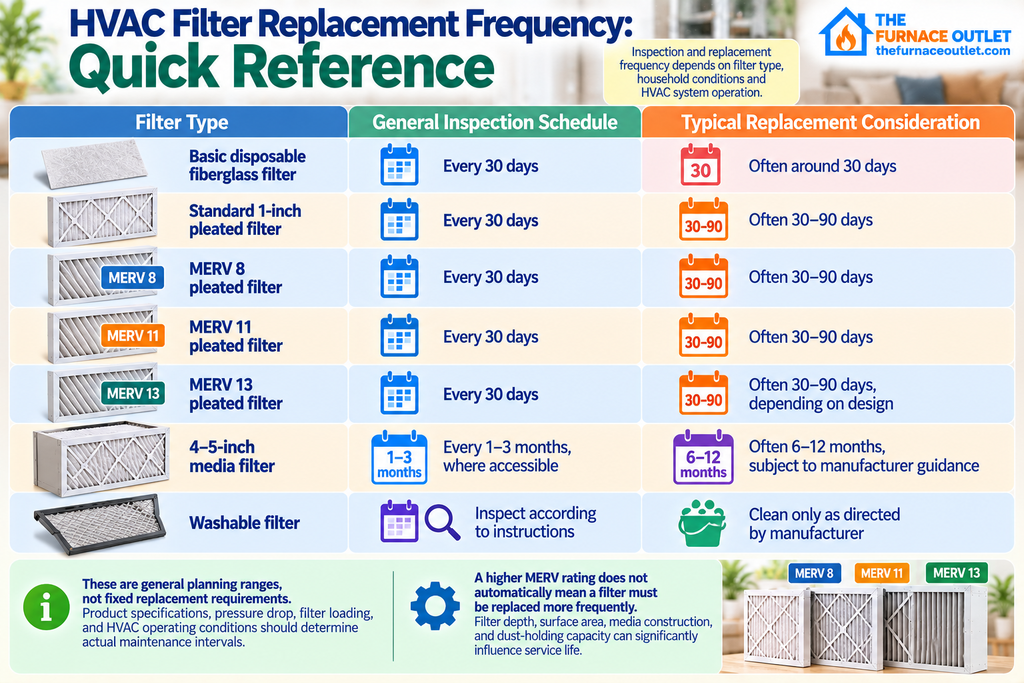
| Filter type | General inspection schedule | Typical replacement consideration |
|---|---|---|
| Basic disposable fiberglass filter | Every 30 days | Often around 30 days |
| Standard 1-inch pleated filter | Every 30 days | Often 30–90 days |
| MERV 8 pleated filter | Every 30 days | Often 30–90 days |
| MERV 11 pleated filter | Every 30 days | Often 30–90 days |
| MERV 13 pleated filter | Every 30 days | Often 30–90 days, depending on design |
| 4–5-inch media filter | Every 1–3 months, where accessible | Often 6–12 months, subject to manufacturer guidance |
| Washable filter | Inspect according to instructions | Clean only as directed by manufacturer |
These are general planning ranges, not fixed replacement requirements. Product specifications, pressure drop, filter loading, and HVAC operating conditions should determine actual maintenance intervals.
A higher MERV rating does not automatically mean a filter must be replaced more frequently. Filter depth, surface area, media construction, and dust-holding capacity can significantly influence service life.
During spring and fall, outdoor pollen concentrations can increase substantially depending on local vegetation, weather, and geographic conditions. Tree pollen is often prominent during spring, while ragweed and other weed pollens contribute to fall allergy exposure across many parts of the United States.
Outdoor particles may enter homes through open windows, exterior doors, uncontrolled building air leaks, and materials carried indoors on clothing or pets. Once airborne inside the home, some particles may pass through the HVAC return system and become trapped by the filter. However, elevated outdoor pollen does not automatically mean every HVAC filter will become heavily loaded. Filter loading depends on the amount of material actually reaching the filtration system, how efficiently the filter captures it, and how frequently the blower operates.
I recommend monitoring local pollen conditions while continuing regular filter inspections. The American College of Allergy, Asthma & Immunology provides information about seasonal allergy triggers and exposure patterns. For homeowners with recurring pollen concerns, reducing outdoor particle entry may be just as important as increasing filter replacement frequency.

Not necessarily. MERV stands for Minimum Efficiency Reporting Value, a classification system that describes particle capture performance under standardized testing conditions. MERV 13 filters generally capture smaller airborne particles more efficiently than MERV 8 filters, but that does not establish a universal difference in replacement frequency.
A high-quality MERV 13 filter with a large surface area may have substantial dust-holding capacity. Conversely, a small, thin filter operating in a dusty environment may become restrictive relatively quickly, regardless of its rating. I recommend reviewing the manufacturer’s published service guidance and pressure-drop specifications rather than assuming that a higher MERV number requires monthly replacement.
For households concerned about allergies, MERV 13 is often worth considering when the HVAC system can accommodate it while maintaining acceptable airflow. If compatibility is uncertain, consult the equipment manufacturer or a qualified HVAC technician. Our related guide, Best HVAC Air Filters for Allergies in 2026: MERV 8 vs. 11 vs. 13, explains these differences in more detail.
Dogs and cats can contribute hair, dander-associated particles, tracked-in dust, and other materials to the household environment. Homes with multiple pets may therefore experience faster filter loading than homes with fewer particle sources.
However, pet hair and pet allergens behave differently. Large hairs often settle on surfaces, while smaller allergen-containing particles may remain airborne or become attached to household dust. Regular grooming, cleaning upholstered furniture, vacuuming effectively, and washing suitable pet bedding can reduce the amount of material accumulating indoors. These measures also help limit the burden placed on HVAC filtration.
For households with pets, I generally recommend checking one-inch filters every month and adjusting the replacement schedule based on actual loading. More frequent replacement may be appropriate, but it should not substitute for cleaning and source control.

Filter service life depends partly on how much air passes through the filtration material. A system operating frequently during hot summers or cold winters may move substantially more air through the filter than one operating occasionally during mild weather.
During spring and fall, heating and cooling demand may be relatively low. If the blower operates infrequently, fewer airborne particles may reach the central filter, even when outdoor pollen concentrations are elevated. Continuous fan operation changes this pattern by increasing the amount of air circulated through the filter. It may improve airborne particle removal in some installations, but it can also increase electricity consumption and affect humidity behavior in certain cooling systems.
I recommend evaluating fan operation, filtration efficiency, and equipment design together. Running the blower continuously solely to address allergies is not automatically the best approach for every household.
A heavily loaded filter may show visible accumulation of dust or debris, although appearance alone cannot reliably establish its remaining service life. Some filters become restrictive before they look exceptionally dirty, while others can hold substantial dust without exceeding acceptable resistance.
Homeowners should also pay attention to changes in airflow, unusual blower operation, or reduced heating and cooling performance. These symptoms can have several causes, so they should not automatically be attributed to the filter. A filter that is wet, damaged, collapsed, or incorrectly installed should be addressed promptly. Moisture and structural damage can undermine filtration and may create additional equipment concerns.
I recommend inspecting the filter according to the manufacturer’s instructions and documenting replacement dates. If filters become unusually dirty within a short period, investigate possible return duct leakage, renovation dust, or other particle sources.
A dirty or ineffective filter can contribute to indoor air quality problems, but the relationship is not always straightforward. As a filter captures particles, its resistance may increase, potentially reducing airflow or changing blower operation.
A heavily loaded filter may interfere with the volume of air circulating through the system, reducing the amount of room air receiving filtration. Filter bypass, damage, or poor installation may also allow some particles to travel around the media. However, a filter does not necessarily become less efficient at capturing particles simply because it contains dust. In some filtration media, particle capture efficiency may initially increase as material accumulates, even while airflow resistance rises.
The important maintenance objective is to replace filters before loading creates unacceptable pressure drop or other operating problems. Allergy symptoms alone are not a reliable indicator of filter condition. The EPA’s Guide to Air Cleaners in the Home explains how filtration can reduce certain airborne particles and why equipment performance matters.

Before replacing a filter, turn the HVAC system off according to the manufacturer’s instructions so the blower is not operating during removal. Locate the designated filter compartment, which may be at a return grille, air handler, furnace cabinet, or separate media filter housing.
Check the existing filter’s dimensions and installation orientation. Most disposable filters include an airflow-direction arrow that should point toward the equipment along the return-air path. Remove the used filter carefully to minimize disturbing accumulated dust. Install the replacement securely, ensuring that it fits the intended opening without significant gaps around the edges.
After installation, close the filter compartment properly and restore normal operation. If the replacement filter does not fit, appears excessively restrictive, or causes noticeable airflow changes, stop and verify compatibility rather than forcing the product into place. I recommend recording the installation date and keeping the manufacturer’s replacement instructions accessible.
High-pollen days do not automatically require immediate filter replacement. Outdoor pollen concentrations can change quickly, but the filter’s condition depends on cumulative particle loading and system operation rather than a single day’s forecast.
For example, a home with closed windows, controlled ventilation, effective cleaning, and limited outdoor particle entry may experience relatively little additional filter loading during a short pollen event. Conversely, a home with frequent window opening, substantial outdoor activity, pets, or significant air leakage may introduce more particles into the indoor environment.
I recommend responding to high-pollen conditions by limiting unnecessary pollen entry, maintaining normal filter inspections, and keeping bedrooms clean. Replace the filter when its condition or manufacturer guidance indicates that replacement is necessary.
Deeper pleated media filters can provide more filtration surface area than many one-inch products. When properly designed, this can improve dust-holding capacity and help manage pressure drop while maintaining useful particle capture efficiency. However, filter thickness alone does not guarantee better performance. A four-inch filter requires an appropriately designed housing, and homeowners should not attempt to force a deeper filter into a slot intended for a thinner product.
In compatible installations, larger media filters may offer longer service intervals and more stable airflow performance as particles accumulate. This can be particularly useful for households seeking higher-efficiency filtration without frequent replacement. I recommend evaluating filter depth, media design, published pressure-drop information, and equipment compatibility together before upgrading.

Most disposable fiberglass and pleated media filters are not designed to be washed or reused. Washing can damage filtration media, alter its structure, or reduce performance, even if the filter appears cleaner afterward. Some products are specifically manufactured as washable or reusable filters. These should be cleaned only according to the manufacturer’s instructions and allowed to dry completely before reinstallation.
A washable filter is not automatically equivalent to a higher-efficiency disposable filter. Homeowners should compare verified filtration performance, maintenance requirements, and airflow resistance rather than assuming reusability means superior indoor air quality. I generally recommend using manufacturer-approved filtration products and avoiding improvised cleaning methods that could damage the filter or HVAC equipment.
A filter that becomes heavily loaded every two weeks may indicate unusually high particle exposure or a system condition that deserves investigation. Construction activity, remodeling dust, pet hair, and substantial household dust can contribute to rapid loading.
Return duct leakage is another possible factor, especially when the system draws air from dusty attics, crawlspaces, or other unconditioned areas. Poor filter fit or inadequate filter surface area may also contribute to recurring maintenance problems. I recommend identifying the particle source before simply committing to frequent replacements indefinitely. A qualified HVAC technician can evaluate duct integrity, filter sizing, airflow, and static pressure.
Correcting the underlying issue may improve both filtration performance and equipment reliability.
During mild spring and fall weather, central HVAC systems may operate less frequently because the home requires relatively little heating or cooling. This reduces the amount of indoor air passing through the central filter. Portable HEPA air purifiers can provide additional particle removal in bedrooms and other frequently occupied rooms independently of the thermostat.
When choosing a purifier, I recommend reviewing its Clean Air Delivery Rate, or CADR, and selecting a model appropriate for the room’s dimensions. Consistent operation and unobstructed airflow are important considerations. Portable filtration does not replace central HVAC maintenance or remove allergens embedded in bedding and carpeting. However, it can complement compatible central filtration when additional airborne particle removal is desired.

| Homeowner action | Recommended approach |
|---|---|
| Inspect one-inch filters | Check approximately every 30 days |
| Follow manufacturer guidance | Use specified replacement intervals and compatible products |
| Monitor filter loading | Look for damage, excessive accumulation, and airflow concerns |
| Check filter fit | Prevent air from bypassing the filtration material |
| Consider MERV 13 | Upgrade only when the system can accommodate it |
| Manage pet-related particles | Groom pets and clean household surfaces regularly |
| Reduce outdoor pollen entry | Keep windows closed during elevated pollen conditions |
| Monitor HVAC runtime | Consider how frequently air passes through the filter |
| Investigate rapid loading | Check for dust sources and possible duct leakage |
| Schedule HVAC maintenance | Verify airflow, filtration, and equipment condition |
This checklist provides a practical starting point for seasonal maintenance without encouraging unnecessary filter purchases. The objective is to maintain effective particle capture and reliable airflow throughout the year.
Not necessarily. Monthly inspection is a useful practice, but replacement depends on filter type, manufacturer guidance, actual loading, and system operation. Some filters require monthly replacement, while others can remain serviceable longer.
Replacing a clean filter every two weeks does not necessarily improve allergy control. Frequent replacement may be justified in unusually dusty conditions, but filtration efficiency, proper installation, and reducing allergen sources are also important.
Service life varies with filter depth, surface area, construction, dust exposure, and HVAC runtime. Some one-inch MERV 13 filters may require replacement within 30–90 days, while larger media filters may have substantially longer manufacturer-recommended intervals.
Yes. Excessive particle loading can increase filter resistance and affect airflow, depending on blower design and system conditions. Persistent airflow problems should be evaluated rather than automatically attributed to the filter.
Checking the filter before major seasonal changes is a sensible maintenance practice. Replacement is appropriate when the filter is due according to manufacturer instructions or its condition indicates that replacement is necessary.
No. HVAC filtration can capture certain airborne particles passing through the system, but it cannot eliminate all allergens from indoor surfaces or prevent outdoor pollen from entering the home. Medical evaluation may also be necessary for persistent symptoms.

When homeowners ask how frequently they should replace HVAC filters during allergy season, I recommend avoiding rigid schedules that ignore actual operating conditions. A 30-day inspection routine is useful for many residential systems, particularly those using one-inch disposable filters, but replacement frequency should reflect manufacturer guidance, filter loading, household dust exposure, pets, and HVAC runtime.
For allergy-sensitive households, I also recommend evaluating filtration efficiency and system compatibility. A properly installed MERV 13 filter may offer stronger capture of smaller airborne particles when the equipment can accommodate it, while portable HEPA filtration can provide additional particle removal in frequently occupied rooms.
The best allergy-season filter maintenance strategy is to inspect regularly, replace filters before excessive loading affects airflow, and reduce the sources of airborne particles entering your home. Consistent filtration maintenance, household cleaning, moisture control, and appropriate ventilation can support better indoor air quality without unnecessary equipment expense.
This article is published by The Furnace Outlet for general educational purposes and does not constitute medical advice. HVAC filtration may help reduce exposure to certain airborne particles, but it does not diagnose, treat, or cure allergies, asthma, or other respiratory conditions. Individuals experiencing persistent or severe symptoms should consult a qualified healthcare professional.
Filter selection, maintenance, and equipment modifications should follow manufacturer instructions and applicable safety requirements. A qualified HVAC technician should evaluate concerns involving airflow, static pressure, duct leakage, or equipment performance.
The Furnace Outlet publishes independent educational content. External references are provided for informational purposes and do not imply sponsorship, affiliation, or endorsement.
© 2026 The Furnace Outlet. All rights reserved.