Newsletter Subscribe
Enter your email address below and subscribe to our newsletter

HVAC made simple

By Jake Lawson | HVAC Specialist | The Furnace Outlet
Updated October 2026 | Indoor Air Quality & Seasonal Allergies
Every spring and fall, millions of American homeowners face the familiar discomfort of seasonal allergies. Sneezing, nasal congestion, itchy eyes, and respiratory irritation can make everyday activities uncomfortable, particularly when outdoor pollen concentrations rise. While avoiding outdoor exposure may help, pollen does not necessarily stay outside. It can enter homes through windows, doors, ventilation openings, clothing, pets, and small gaps in the building envelope.
One question I frequently hear is whether an air purifier can actually help with ragweed and pollen allergies. Homeowners often see advertisements promising cleaner air, advanced filtration, and allergy relief, but it can be difficult to determine which claims are supported by filtration science and which are primarily marketing.
As an HVAC specialist with more than 10 years of residential and commercial experience, I recommend looking at air purifiers as one component of a broader indoor air quality strategy. A properly selected purifier can capture many airborne pollen particles and other allergens passing through its filtration system. However, it cannot prevent pollen from entering the home, remove every allergen embedded in household fabrics, or guarantee relief from allergy symptoms.
The short answer is yes: a properly sized air purifier with effective particle filtration can help reduce airborne pollen exposure indoors, but its benefits depend on filtration performance, room size, placement, operating time, and household conditions.
In this guide, I will explain how air purifiers work against ragweed and other seasonal pollens, compare HEPA filtration with HVAC filters, discuss Clean Air Delivery Rate (CADR), and share practical recommendations for choosing and operating an air purifier during allergy season.

Ragweed is one of the most important contributors to fall seasonal allergies across much of the United States. Its pollen is lightweight enough to become airborne and travel considerable distances, meaning homeowners can experience exposure even when ragweed plants are not growing directly beside their properties.
However, the purifier only removes particles that reach its intake. Reducing pollen entry and maintaining clean indoor surfaces remain important parts of managing exposure.
Most effective residential particle air purifiers use mechanical filtration. A fan draws room air into the appliance, moves it through one or more filters, and returns filtered air to the surrounding space.
Larger particles, including many intact pollen grains, can be captured by suitable filtration media. Smaller airborne particles may also be removed depending on filter efficiency, airflow, and the purifier’s overall design. A typical portable purifier may include a prefilter to capture larger debris and a high-efficiency particle filter for smaller airborne material. Some models also include activated carbon for certain gases and odors, although carbon filtration is not the primary technology responsible for capturing pollen.
The important distinction is that air purification reduces the concentration of particles passing through the device. It does not sterilize an entire room, remove all contaminants instantly, or prevent new pollen from entering. The EPA’s Guide to Air Cleaners in the Home explains how portable air cleaners and HVAC filtration can contribute to improved indoor particle removal.
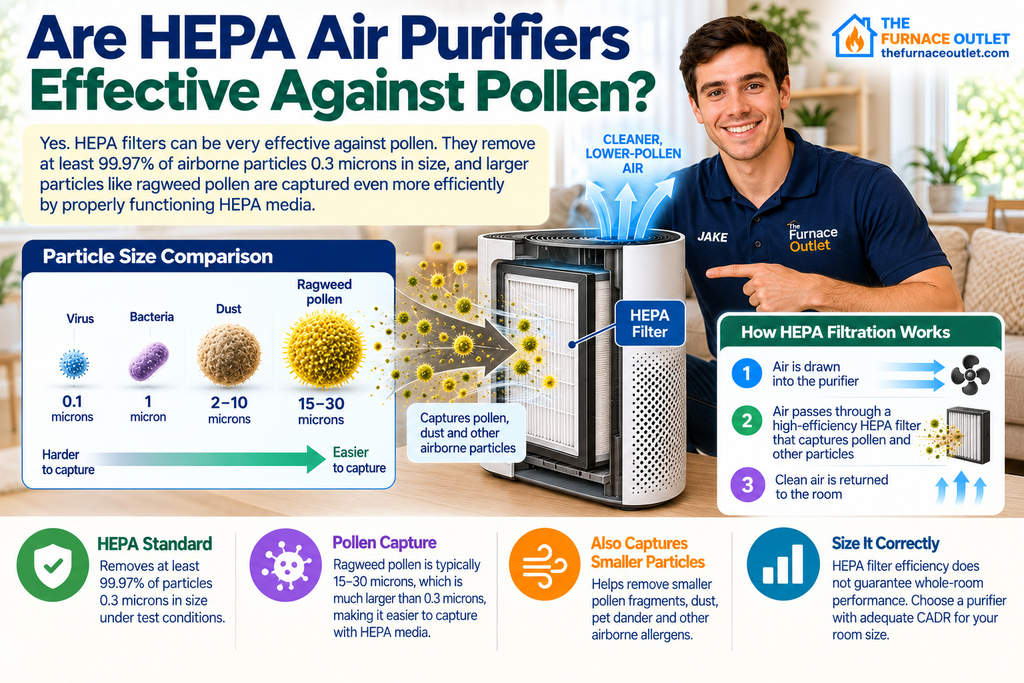
HEPA stands for High-Efficiency Particulate Air. Under the commonly referenced U.S. HEPA definition, qualifying filters remove at least 99.97% of airborne particles measuring 0.3 microns under specified test conditions. This particle size is important because 0.3 microns is near the most penetrating particle size for many HEPA filter designs. Larger particles, including intact pollen grains, are generally captured very efficiently by properly functioning HEPA media.
Ragweed pollen grains are typically much larger than 0.3 microns, making them suitable targets for mechanical filtration. However, pollen allergens may also occur in smaller fragments or associated particles, so filtration across multiple particle sizes is valuable. I generally prefer portable purifiers using genuine HEPA filtration when homeowners are primarily concerned about airborne pollen, dust, and other particulate allergens.
Nevertheless, HEPA media efficiency is not the same as whole-room cleaning performance. A purifier with excellent filter media but insufficient airflow may clean a large room slowly, while a properly sized unit can circulate and filter a greater volume of room air. For this reason, I recommend evaluating CADR alongside the filter specification.
Clean Air Delivery Rate, or CADR, describes the rate at which a portable air cleaner delivers air cleaned of a particular particle category under standardized testing conditions. CADR is commonly reported for smoke, dust, and pollen. Higher CADR values generally indicate greater particle-cleaning capacity, although the appropriate rating depends on room size and operating conditions.
When comparing air purifiers, I recommend paying attention to pollen CADR and smoke CADR rather than relying solely on claims such as “medical-grade filtration” or “multi-stage purification.” A purifier must move enough air through its filtration system to make a meaningful difference in the room. A compact desktop purifier may contain efficient filter media but provide insufficient cleaned airflow for a large living room.

| Room size | Approximate minimum CADR for 4.8 air changes per hour |
|---|---|
| 100 sq. ft. | 65 CFM |
| 150 sq. ft. | 98 CFM |
| 200 sq. ft. | 131 CFM |
| 250 sq. ft. | 163 CFM |
| 300 sq. ft. | 196 CFM |
| 400 sq. ft. | 261 CFM |
| 500 sq. ft. | 326 CFM |
Illustrative values assume an 8-foot ceiling and approximately 4.8 equivalent air changes per hour from the purifier. Actual performance depends on room geometry, airflow, placement, and operating conditions.
A practical sizing formula is: Required CADR (CFM) = Room area (sq. ft.) × Ceiling height (ft.) × Target air changes per hour ÷ 60
For example, a 200-square-foot bedroom with an 8-foot ceiling contains approximately 1,600 cubic feet of air. At a target of 4.8 equivalent air changes per hour, the required clean-air delivery is approximately 128 CFM. I recommend allowing some additional capacity because manufacturers may publish ratings at the highest fan setting, which homeowners may find too noisy for continuous operation.

Both portable air purifiers and central HVAC filters can capture airborne particles, but they operate differently. A central HVAC filter removes particles when air passes through the heating and cooling system. The amount of filtration depends on filter efficiency, system airflow, ductwork conditions, and how frequently the blower operates.
A portable purifier operates independently of the central thermostat. It can provide room-level filtration even when the furnace or air conditioner is not actively heating or cooling.
| Feature | Central HVAC filter | Portable HEPA purifier |
|---|---|---|
| Main coverage | Air circulating through the central system | Individual room or connected space |
| Operating time | Depends on blower operation | Can operate independently |
| Filtration standard | Commonly MERV-rated | Often HEPA-rated |
| Best application | General household particle reduction | Additional filtration in occupied rooms |
| Main limitation | Requires compatible airflow and system operation | Limited by CADR, placement, and room conditions |
| Maintenance | Replace HVAC filter as specified | Replace or clean purifier filters as directed |
For allergy-sensitive households, I often recommend evaluating compatible MERV 13 central filtration alongside a properly sized portable HEPA purifier for bedrooms or other important living spaces.
These approaches complement one another rather than competing. Neither eliminates the need to control pollen entry, clean household surfaces, or maintain suitable ventilation.

Air purifier placement can influence how effectively the device circulates and cleans room air. A purifier positioned behind furniture, pressed against curtains, or installed in a tightly enclosed corner may experience restricted airflow.
For homes with several allergy-sensitive occupants, multiple appropriately sized units may provide more consistent coverage than one undersized purifier placed in a hallway.
Consistent operation can improve particle removal because airborne pollen and other particles may continue entering or becoming resuspended throughout the day. A purifier that operates for only a short period may reduce airborne particle concentrations temporarily, but new particles can accumulate after the unit is switched off.
I generally recommend operating a suitable purifier consistently during periods of elevated pollen exposure, particularly in frequently occupied rooms. However, homeowners should consider fan speed, noise, electricity consumption, and manufacturer instructions. Automatic modes may adjust fan speed according to built-in particle sensors, but not every sensor responds equally to pollen or all allergen-containing particles. A low particle reading does not necessarily mean every relevant allergen has been removed.
For bedrooms, a quiet operating setting that provides meaningful airflow may be more practical than a powerful setting that disrupts sleep. The objective is sustained particle removal, not simply purchasing the highest-rated purifier available.
Portable air purifiers capture particles suspended in air and passing through the device. They do not directly remove pollen that has settled into carpeting, mattresses, bedding, upholstery, or other household materials. This limitation is important because pollen can accumulate on surfaces after entering the home. Walking across carpets, changing bedding, or moving upholstered furniture may disturb some settled material and return particles to the air.
Regular cleaning therefore remains essential. I recommend washing suitable bedding, damp dusting hard surfaces, and using a vacuum cleaner with effective particle containment. Removing outdoor shoes, changing clothes after substantial outdoor exposure, and grooming pets appropriately can also reduce the amount of pollen transferred indoors. An air purifier works best when combined with these measures. It should not be treated as a substitute for source control or ordinary household cleaning.

Nighttime symptoms can be particularly frustrating because nasal congestion and respiratory discomfort may interfere with sleep. A properly sized portable HEPA purifier may help reduce airborne pollen and other particles in the bedroom while it operates. However, the degree of symptom improvement varies between individuals and depends on their actual allergy triggers.
I recommend keeping bedroom windows closed during elevated pollen conditions, cleaning bedding regularly, and minimizing unnecessary transfer of outdoor clothing into sleeping areas. The purifier should be positioned so its airflow is unobstructed and its noise level is comfortable for sleeping. It is also worth recognizing that bedroom symptoms may involve dust mite allergens, pet allergens, mold, or other factors rather than pollen alone. Persistent or severe symptoms should be evaluated by a qualified healthcare professional.
Not every product marketed as an air purifier relies primarily on mechanical filtration. Some devices use ionization, electrostatic processes, ultraviolet light, or other technologies. For pollen and other airborne particles, I generally prefer mechanical filtration with published performance information because its operation is easier for homeowners to evaluate. Ozone-producing air cleaners deserve particular caution. Ozone is a lung irritant and should not be intentionally introduced into occupied indoor spaces as an allergy-control strategy.
The EPA’s information on ozone generators sold as air cleaners explains the concerns associated with ozone exposure and limitations of ozone-based air cleaning. Homeowners should also be cautious about devices promising to eliminate every allergen, virus, odor, and pollutant without clearly documented performance. When the main objective is pollen removal, a properly sized mechanical HEPA purifier is usually a more straightforward choice.

HEPA filter replacement frequency varies substantially between manufacturers and product designs. Some portable purifiers recommend replacement after approximately six to twelve months, while others specify different intervals based on operating hours or environmental conditions. Prefilters may require more frequent cleaning or replacement because they capture larger debris, hair, and dust before particles reach the main filtration media.
I recommend following the manufacturer’s maintenance schedule and checking for unusual loading, damage, or airflow reduction. Do not wash a disposable HEPA filter unless the manufacturer explicitly states that the filter is designed for that procedure. A dirty or damaged filter can interfere with airflow and overall purifier performance. However, replacing a clean filter unnecessarily does not guarantee better allergy control.
Homeowners should also consider ongoing filter replacement costs when comparing models, because maintenance expenses can become significant over several years.
No. Particle filtration and ventilation serve different purposes. An air purifier can reduce certain airborne particles within a room, but most portable particle purifiers do not supply fresh outdoor air or remove carbon dioxide generated by occupants. Ventilation helps dilute or remove certain indoor pollutants, while filtration captures particles passing through the device. Both may be important for maintaining healthy indoor conditions.
During high-pollen periods, uncontrolled window opening may increase allergen exposure. In suitable homes, controlled mechanical ventilation with appropriate filtration may provide a more predictable way to introduce outdoor air. I recommend evaluating the building’s ventilation needs separately from air purifier performance rather than assuming one appliance solves every indoor air quality concern.
One common mistake is choosing a purifier based only on the number of filtration stages advertised. A five-stage product is not automatically more effective than a simpler purifier with a strong CADR and appropriate HEPA filtration. Another mistake is buying a unit that is too small for the room. A compact purifier may operate continuously but still deliver insufficient cleaned air for a large living space.
Homeowners also sometimes overlook replacement filter availability, noise levels, electricity consumption, and the cost of maintaining the device. I recommend avoiding products that rely on vague claims about eliminating allergies or providing medical treatment. Air purification can reduce certain airborne exposures, but clinical outcomes depend on individual circumstances. Finally, an air purifier should never be used to ignore water leaks, visible mold, persistent dampness, or significant building contamination. Those problems require source correction rather than filtration alone.

| Homeowner action | Recommended approach |
|---|---|
| Choose effective filtration | Prefer genuine HEPA mechanical filtration |
| Review CADR | Match clean-air delivery to room size |
| Prioritize bedrooms | Start with frequently occupied sleeping areas |
| Position the purifier correctly | Keep air intakes and outlets unobstructed |
| Run it consistently | Maintain useful airflow during allergy season |
| Maintain filters | Follow manufacturer cleaning and replacement guidance |
| Reduce outdoor pollen entry | Keep windows closed during elevated pollen conditions |
| Clean household surfaces | Remove pollen from bedding, floors, and furniture |
| Evaluate HVAC filtration | Consider compatible MERV 13 central filtration |
| Avoid ozone generators | Do not intentionally introduce ozone into occupied spaces |
| Maintain ventilation | Address outdoor-air exchange separately |
| Monitor symptoms | Seek medical guidance for persistent allergy problems |
This checklist helps homeowners focus on practical performance rather than expensive marketing features. Effective filtration, adequate clean-air delivery, consistent operation, and household source control are more important than complicated product descriptions.
A properly sized air purifier with effective mechanical filtration can reduce airborne ragweed pollen and other particles passing through the device. However, the amount of symptom relief varies, and air purification should complement other exposure-reduction measures.
HEPA and MERV 13 are different filtration classifications used in different applications. HEPA media provides very high particle capture efficiency under its test standard, while MERV 13 is commonly used in compatible central HVAC systems. Both can contribute to particle reduction when properly installed and operated.
The appropriate CADR depends on floor area, ceiling height, and the desired rate of cleaned-air delivery. For a typical 200-square-foot bedroom with an eight-foot ceiling, approximately 130 CFM provides around 4.8 equivalent air changes per hour under idealized assumptions.
Consistent overnight operation can provide continued airborne particle removal in the bedroom. Choose a fan setting that balances useful airflow with acceptable noise and electricity consumption.
Not directly. Portable purifiers remove airborne particles passing through their filters. Settled pollen generally requires cleaning, although some particles may become airborne again when surfaces are disturbed.
No. Air purifiers do not cure allergies or replace medical treatment. They may reduce exposure to certain airborne allergens, but persistent symptoms should be discussed with a healthcare professional.
Usually not for a typical multiroom home. Portable air purifiers are generally designed for individual rooms or connected spaces, and effective coverage depends on airflow, layout, doors, and room dimensions.

When homeowners ask whether air purifiers are worth purchasing for ragweed and pollen allergies, I recommend focusing on measurable particle-cleaning performance rather than marketing claims. A properly sized portable HEPA purifier can help reduce airborne pollen in bedrooms, living rooms, and other frequently occupied spaces, particularly when central HVAC filtration operates infrequently during mild weather.
However, I would never recommend relying on an air purifier alone. Keeping windows closed during high-pollen conditions, reducing pollen transfer on clothing and pets, maintaining clean bedding, and addressing building air leaks are equally important. Compatible central HVAC filtration can provide additional particle removal throughout the home, while portable HEPA filtration offers targeted support where occupants spend the most time.
The most effective strategy combines reduced pollen entry, properly sized air purification, compatible HVAC filtration, consistent household cleaning, and appropriate ventilation. By following these principles, homeowners can reduce exposure to certain airborne allergens and support a more comfortable indoor environment throughout spring and fall.
This article is published by The Furnace Outlet for general educational purposes and does not constitute medical advice. Air purifiers and HVAC filtration may reduce exposure to certain airborne particles, but they do not diagnose, treat, prevent, or cure seasonal allergies, asthma, or other respiratory conditions. Individuals experiencing persistent, severe, or worsening symptoms should consult a qualified healthcare professional.
Air purifier selection, filter maintenance, and HVAC modifications should follow manufacturer specifications and applicable safety requirements. Professional assistance is recommended when equipment changes affect airflow, electrical safety, ventilation, or HVAC performance.
The Furnace Outlet publishes independent educational content. References to external agencies and organizations are provided for informational purposes and do not imply sponsorship, affiliation, or endorsement.
© 2026 The Furnace Outlet. All rights reserved.