Newsletter Subscribe
Enter your email address below and subscribe to our newsletter

HVAC made simple
By Jake Lawson — The HVAC Specialist
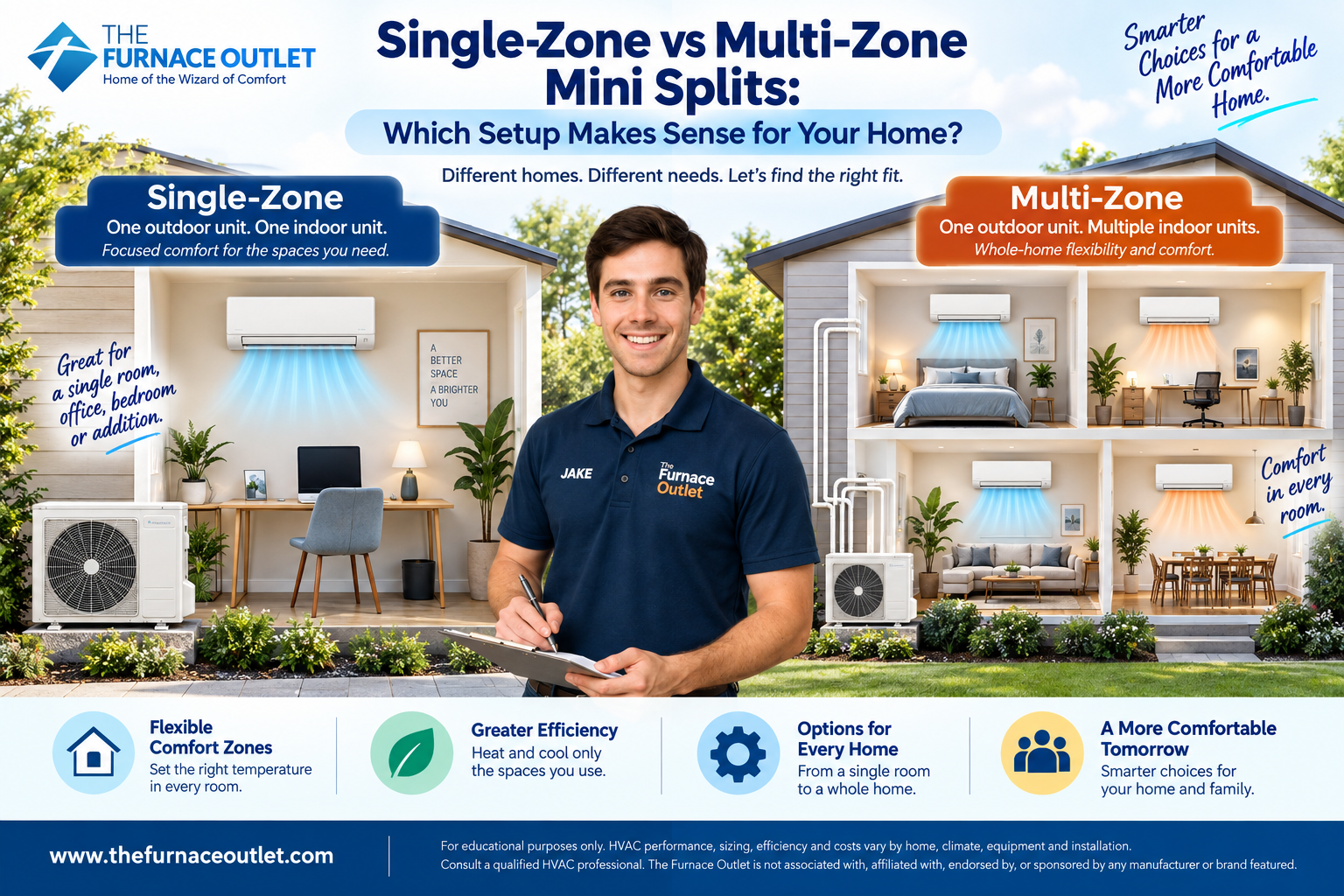
When homeowners first start researching ductless mini splits, the conversation usually begins with efficiency, BTUs or brand names. But there is another decision that can have just as much influence on comfort and long-term satisfaction: should you install a single-zone or multi-zone mini split system? At first glance, the distinction seems simple. A single-zone system connects one outdoor unit to one indoor unit. A multi-zone system connects one outdoor unit to two or more indoor units. That basic definition is correct, but it does not tell you which configuration will work better in a particular home.
The right answer depends on the number of rooms you want to condition, their individual heating and cooling loads, the home’s layout, outdoor-unit placement, climate, electrical capacity, installation constraints and how independently you want each space to operate. This is also why I would not automatically choose a multi-zone system simply because you have several rooms. Sometimes several carefully selected single-zone systems provide better flexibility. In another house, one properly designed multi-zone system may produce a much cleaner and more practical installation.
The objective is not to install the fewest outdoor units or the greatest number of indoor heads. It is to design a system that matches the way your home actually uses heating and cooling.
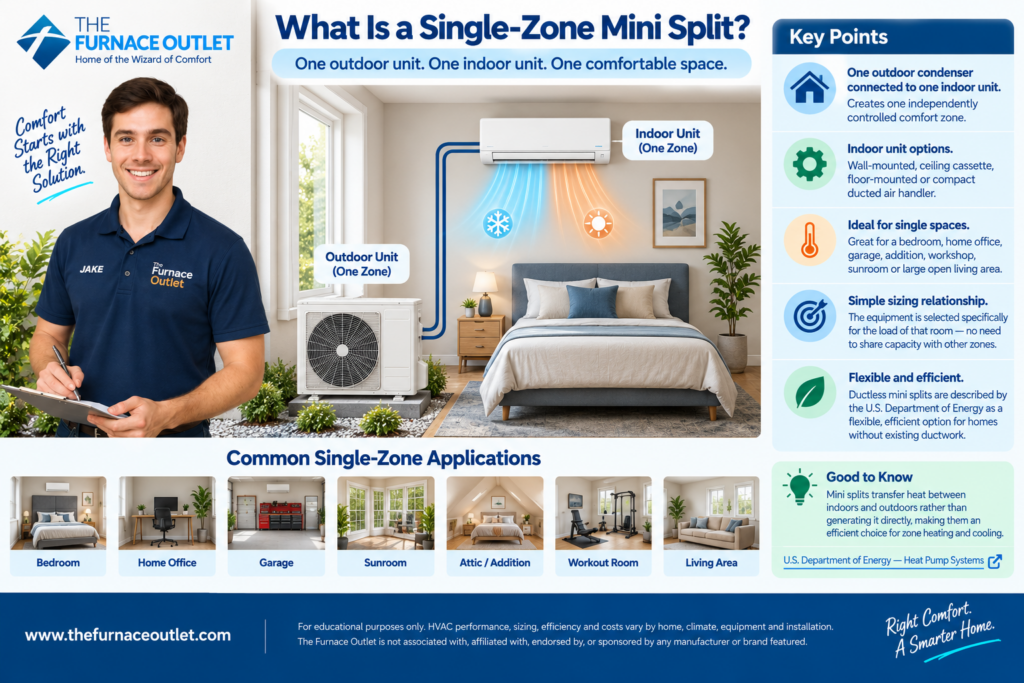
A single-zone mini split is the simplest ductless configuration. One outdoor condenser is connected to one indoor air-handling unit, creating one independently controlled comfort zone. That indoor unit might be a familiar wall-mounted head, but depending on the equipment family it could also be a ceiling cassette, floor-mounted unit or compact ducted air handler. The important point is that one outdoor system serves one indoor zone.
This arrangement works particularly well when you have one clearly defined area that needs heating and cooling. Common examples include a finished garage, home office, bedroom addition, converted attic, workshop, sunroom or large open living area. The U.S. Department of Energy describes ductless air-source heat pumps as flexible options for homes without existing ductwork and notes their usefulness for zone heating. Mini splits transfer heat between indoors and outdoors rather than generating heat in the same way as electric resistance equipment.
U.S. Department of Energy — Heat Pump Systems
One advantage of the single-zone arrangement is that the relationship between the load and the equipment is relatively easy to understand. If a bedroom has a calculated heating and cooling requirement within the operating range of a particular system, the contractor can evaluate an outdoor and indoor unit specifically for that room. There is no need to determine how one outdoor unit’s available capacity will be shared among several zones operating simultaneously.
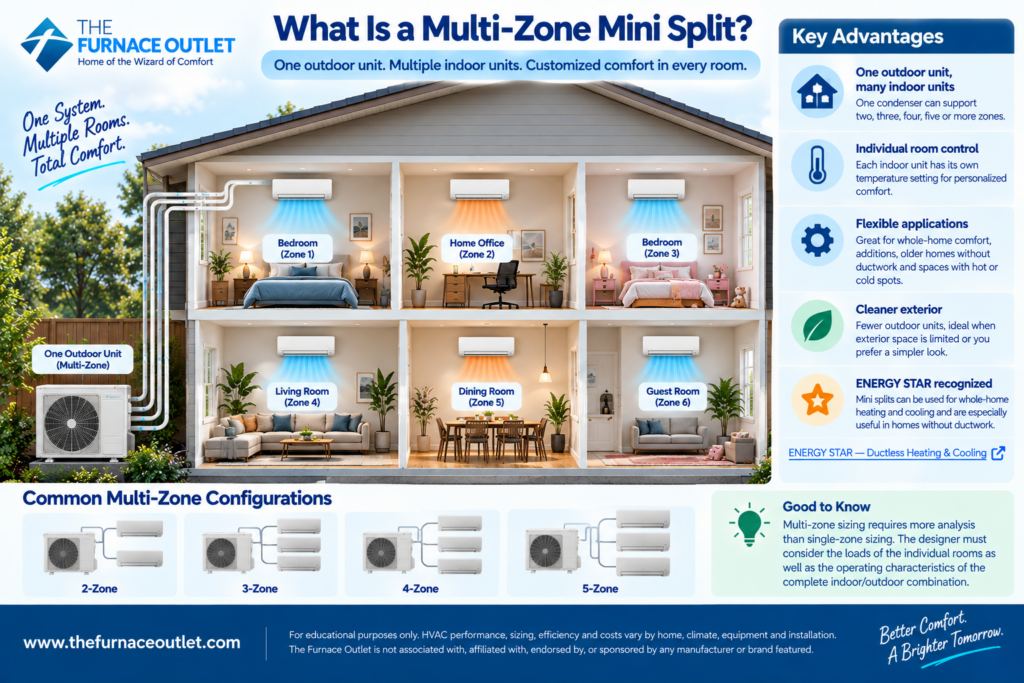
A multi-zone—or multi-split—system connects one outdoor unit to multiple indoor units. Depending on the product family, an outdoor condenser may support two, three, four, five or even more indoor zones. Each indoor unit normally has its own temperature control, allowing the homeowner to establish different comfort settings in different areas. A bedroom might be kept cooler overnight while an unused office requires little conditioning, for example.
This flexibility is one of the reasons ductless technology is attractive. ENERGY STAR notes that mini splits can be used for whole-home heating and cooling as well as for supplementing an existing HVAC system. They can be especially useful in older homes without ductwork, additions, outbuildings and homes with persistent hot or cold spots.
ENERGY STAR — Ductless Heating & Cooling
The major visual difference is outside the house. Instead of having an outdoor condenser for every indoor unit, several indoor units share one outdoor condenser. That can make a multi-zone installation appealing when exterior space is limited or when the homeowner does not want several condensers positioned around the property.
But fewer outdoor units do not automatically mean a simpler HVAC design. In many cases, multi-zone sizing requires more analysis than single-zone sizing because the designer must consider the loads of the individual rooms as well as the operating characteristics of the complete indoor/outdoor combination.
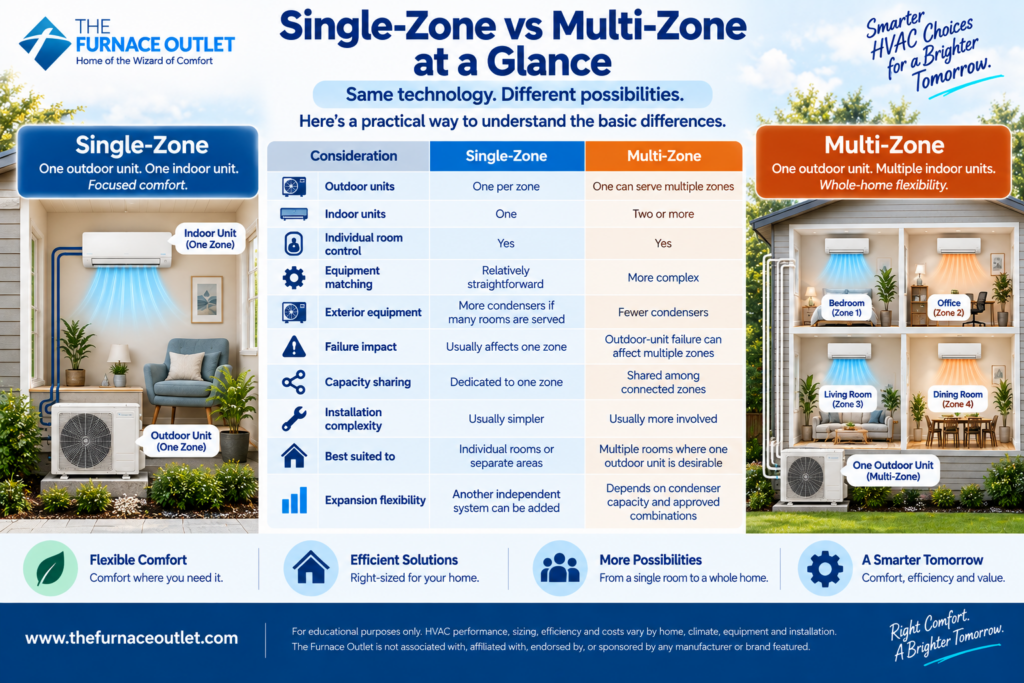
Here is a practical way to understand the basic differences.
| Consideration | Single-Zone | Multi-Zone |
|---|---|---|
| Outdoor units | One per zone | One can serve multiple zones |
| Indoor units | One | Two or more |
| Individual room control | Yes | Yes |
| Equipment matching | Relatively straightforward | More complex |
| Exterior equipment | More condensers if many rooms are served | Fewer condensers |
| Failure impact | Usually affects one zone | Outdoor-unit failure can affect multiple zones |
| Capacity sharing | Dedicated to one zone | Shared among connected zones |
| Installation complexity | Usually simpler | Usually more involved |
| Best suited to | Individual rooms or separate areas | Multiple rooms where one outdoor unit is desirable |
| Expansion flexibility | Another independent system can be added | Depends on condenser capacity and approved combinations |
These are general characteristics rather than rules. Equipment architecture varies considerably by manufacturer and model, so the actual performance data and installation requirements should always take priority.
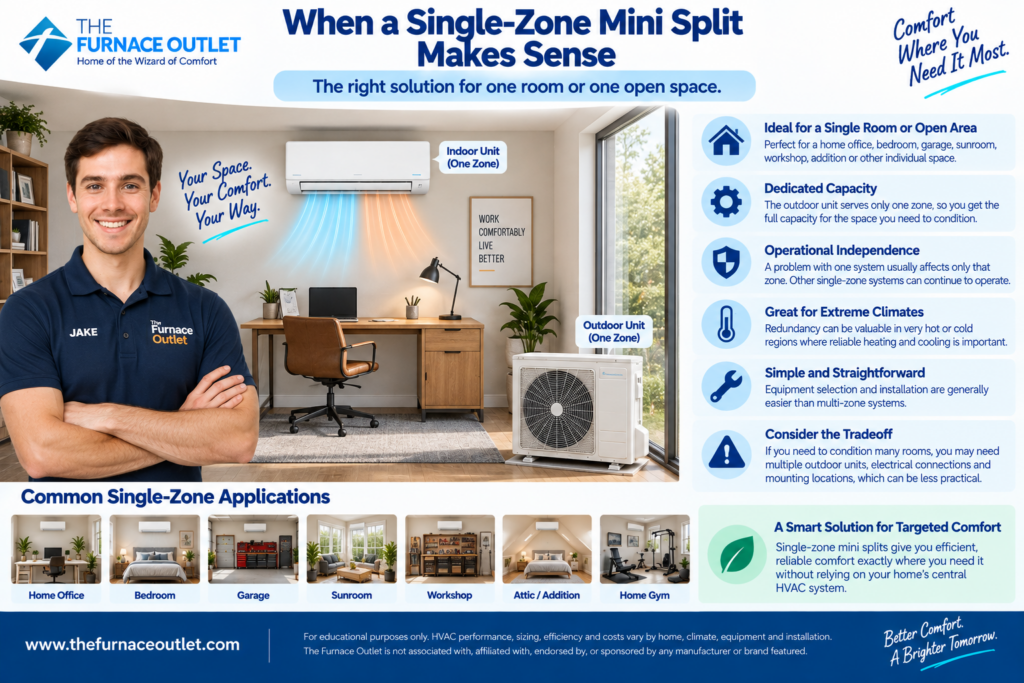
If you are conditioning one room or one relatively open area, I would usually begin by evaluating a single-zone system. Imagine you convert an attached garage into a home office. Extending the central ductwork may be impractical, and the room has different occupancy patterns from the rest of the house. A dedicated mini split gives that room its own heating and cooling system without forcing the home’s central equipment to condition the office whenever the rest of the house needs HVAC.
The same logic can apply to a bedroom above a garage, workshop, home gym, sunroom or addition. A single-zone system also gives the outdoor compressor responsibility for only one zone. When that room needs substantial capacity, it does not have to share the condenser’s available output with several other indoor units.
Another benefit is operational independence. If you have three separate single-zone systems and one outdoor unit develops a problem, the other two systems can normally continue operating. With a multi-zone arrangement, a problem affecting the common outdoor condenser can potentially interrupt conditioning in every room connected to it.
That redundancy can be particularly valuable in very hot or cold climates. The tradeoff is obvious when the project grows. Four individually conditioned rooms could require four outdoor condensers. That means more equipment around the house, more electrical connections, more mounting locations and potentially a less attractive exterior. So while single-zone systems can be wonderfully straightforward, they are not automatically the most practical choice for every whole-home project.
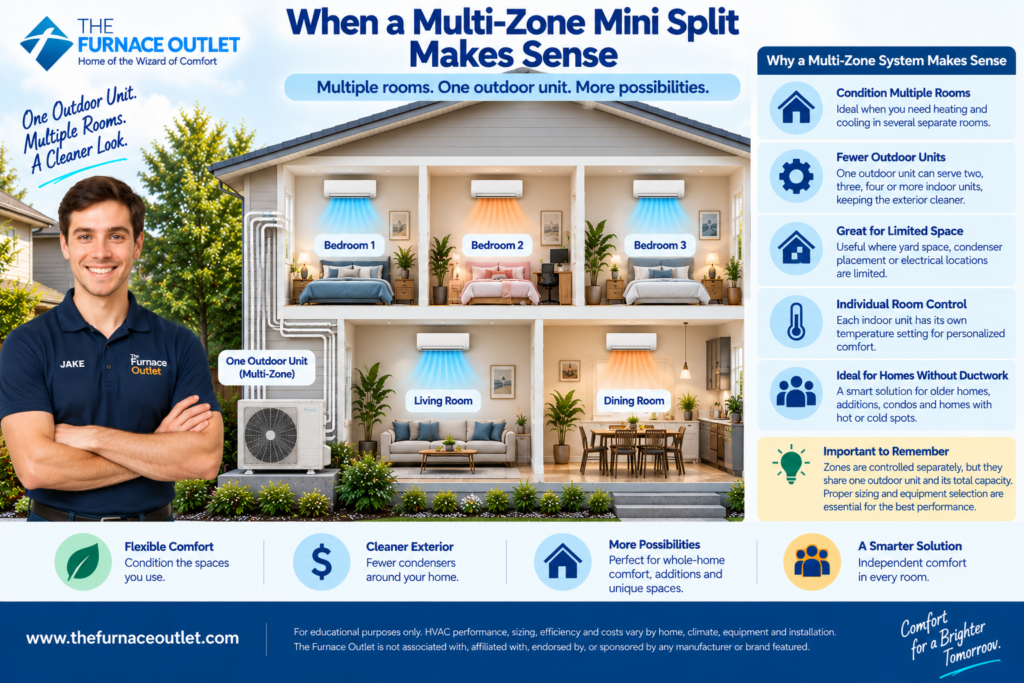
Multi-zone systems become particularly attractive when you need to condition several separate rooms but want to minimize the number of outdoor condensers. Consider an older two-story house without central ductwork. The homeowner wants air conditioning in three bedrooms and a downstairs living area. Installing four separate outdoor units may be physically possible, but the exterior could become crowded.
A multi-zone condenser could provide a cleaner alternative. This can also be useful where there are restrictions on condenser placement. A narrow side yard, condominium rules, architectural considerations or limited electrical service locations may make several outdoor units undesirable.
Multi-zone systems also preserve room-level temperature control. Unlike a traditional central system controlled by one thermostat, each indoor unit can respond to the comfort requirements of its zone, subject to the operating rules and available capacity of the particular multi-zone system. That last qualification matters. The individual zones are controlled separately, but they are not completely independent mechanical systems. They share an outdoor unit, and therefore share the capacity and operating characteristics of that condenser. This distinction becomes extremely important during equipment selection.
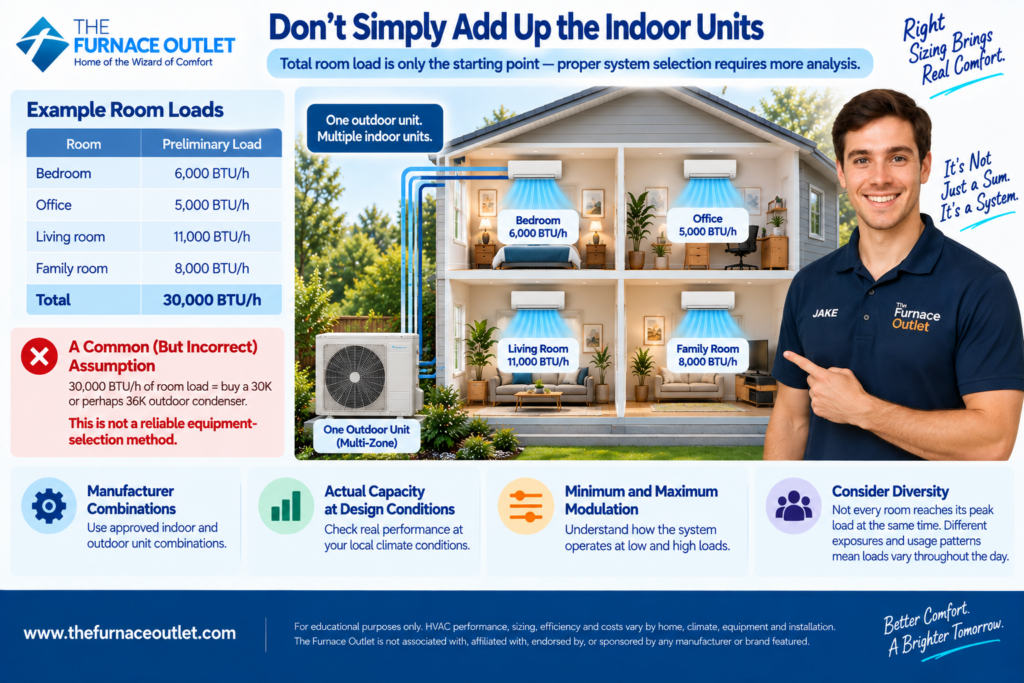
This is one of the biggest misconceptions I see around multi-zone mini splits. Suppose a home’s preliminary room-by-room load calculation looks like this:
| Room | Preliminary Load |
|---|---|
| Bedroom | 6,000 BTU/h |
| Office | 5,000 BTU/h |
| Living room | 11,000 BTU/h |
| Family room | 8,000 BTU/h |
| Total | 30,000 BTU/h |
It is tempting to look at the total and conclude: 30,000 BTU/h of room load = buy a 30K or perhaps 36K outdoor condenser.
That is not a reliable equipment-selection method. The contractor needs to evaluate the manufacturer’s approved combinations of indoor and outdoor units, actual system capacity at design conditions, connected capacity limits, minimum and maximum modulation and how the outdoor unit distributes capacity when multiple indoor units are operating.
The designer should also consider diversity—the reality that every room does not necessarily experience its maximum heating or cooling load at exactly the same moment. A west-facing living room might experience its strongest cooling load late in the afternoon, while another zone has a different exposure and load profile. Bedrooms may have very different occupancy patterns from daytime living areas. That is why simply adding the nominal model numbers printed on four indoor heads can produce a misleading answer.
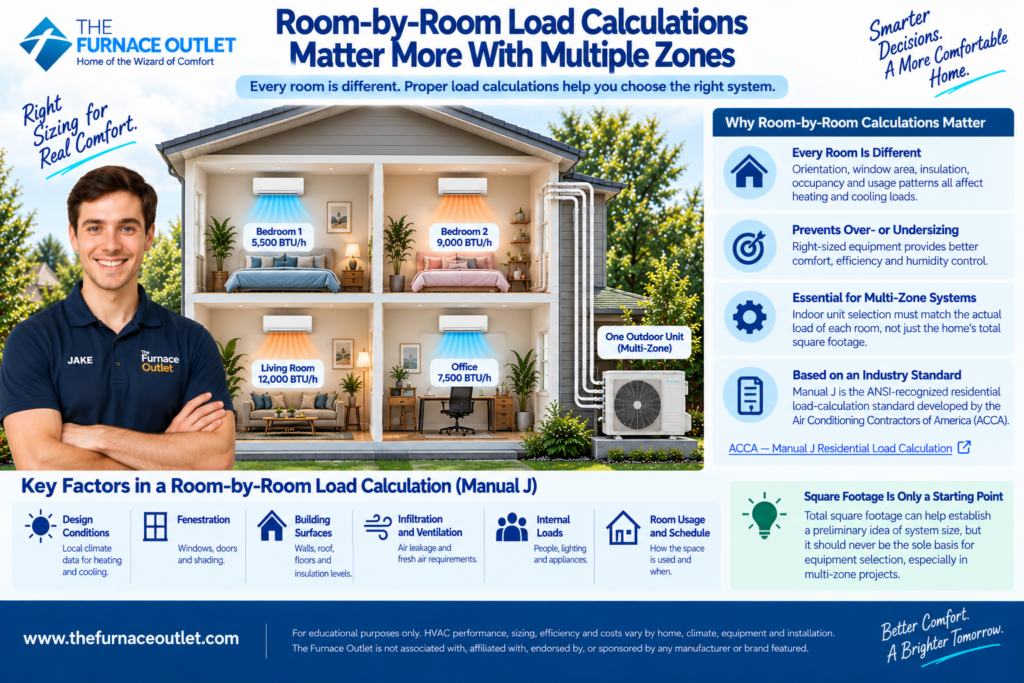
Square footage can help establish a preliminary idea of system size, but I would not use it as the final basis for either single-zone or multi-zone equipment selection. For a multi-zone project, a room-by-room load calculation becomes especially valuable.
The Air Conditioning Contractors of America describes Manual J as the ANSI-recognized residential load-calculation standard. It accounts for numerous factors affecting heating and cooling demand, including design conditions, fenestration, opaque building surfaces, infiltration, ventilation and internal loads. ACCA’s materials specifically distinguish whole-building or block loads from room-level calculations.
ACCA — Manual J Residential Load Calculation
Suppose the entire second floor requires 18,000 BTU/h. That figure alone does not tell us whether three bedrooms each need 6,000 BTU/h. One sunny corner bedroom may have a much greater cooling load than a shaded interior-facing bedroom. Indoor-unit selection needs to reflect those differences. This is where multi-zone design becomes much more sophisticated than dividing the home’s square footage by the number of indoor units.
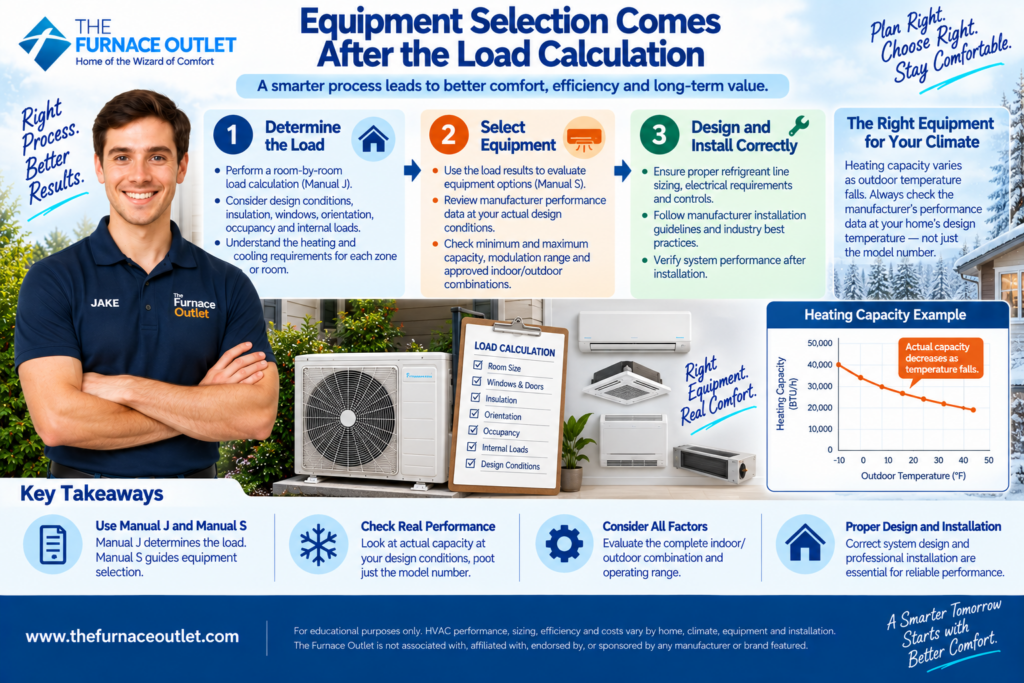
I like to think about the process in three stages: First, determine the load. Then select equipment capable of meeting that load under the required operating conditions. Finally, design and install the system correctly.
ACCA makes essentially the same distinction between Manual J and Manual S. Manual J establishes residential heating and cooling loads, while Manual S addresses equipment selection using those loads together with original-equipment-manufacturer performance information.
ACCA — Residential HVAC System Design Review
This matters with inverter mini splits because the capacity shown in a product name is only part of the story. Actual output varies with operating conditions. Heating capacity is especially important in colder climates because the system’s available heating output can change as outdoor temperature falls. So if your home needs 30,000 BTU/h of heat at its winter design temperature, the question is not simply whether the outdoor unit says “36K.”
The better question is: How much heating capacity does this exact indoor/outdoor combination provide at the outdoor temperature my home was designed around? That is the performance number that matters.
Modern inverter-driven mini splits can vary compressor output rather than operating only at full capacity and switching off. The Department of Energy notes that inverter-driven systems can adjust capacity across a broad operating range, helping equipment operate closer to the heating or cooling demand. That ability is one of the great strengths of mini splits. However, every system still has a minimum operating capacity. This can become relevant in multi-zone installations because a large outdoor condenser may sometimes be serving only one small zone. Imagine a four-zone system during a mild spring evening when only one small bedroom is calling for cooling.
The condenser may have far more potential capacity than that bedroom requires. Manufacturers design sophisticated controls to deal with changing zone demand, but minimum modulation and multi-zone operating behavior still deserve attention. A contractor should therefore examine not only maximum capacity but also how the system behaves under low-load conditions.
This is one reason several single-zone systems can sometimes be an attractive alternative to one large multi-zone condenser. Each compressor is more closely paired with its individual zone. That does not mean single-zone is universally more efficient. It means system configuration affects operating behavior, and efficiency should be evaluated using the actual certified combination rather than assumptions.
If aesthetics are important, multi-zone has an obvious advantage. Imagine four bedrooms on one side of a house. Four single-zone systems could mean four outdoor condensers, mounting pads or brackets, disconnects and sets of refrigerant lines. A multi-zone system might serve those rooms using one outdoor condenser.
For many homeowners, that is a significant improvement. It may also solve practical installation problems when the property has limited outdoor space. Townhouses, small urban lots and homes with carefully landscaped yards may simply not have good locations for multiple condensers. However, consolidating equipment outside often creates additional complexity elsewhere. Refrigerant piping has to reach several indoor units, condensate drainage must be planned for each indoor location and line lengths, elevation differences and manufacturer requirements must all be respected.
So the visual simplicity outside does not necessarily mean the mechanical design is simpler.
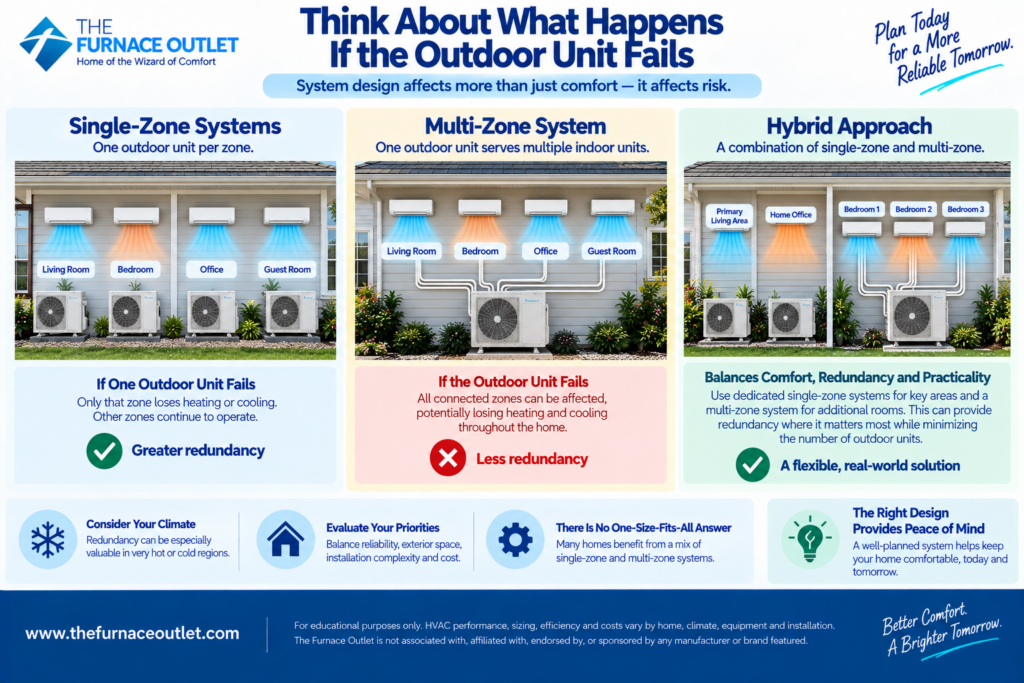
Reliability is not only about which brand you choose. System architecture also determines the consequences of a failure. With four independent single-zone systems, one compressor failure usually means losing heating or cooling in one zone while the other systems remain available. With four indoor units connected to one multi-zone condenser, an outdoor-unit failure can potentially take all four zones out of operation.
For many homes, that risk is perfectly acceptable. For others—particularly properties in extreme climates—it may influence system design. Some homeowners therefore choose a hybrid approach rather than going entirely single-zone or entirely multi-zone. For example, two important areas might receive dedicated single-zone systems while three bedrooms share a multi-zone condenser. The result can balance exterior space, redundancy, modulation and installation cost. There is no requirement that an entire home use only one configuration.
If the mini split will primarily provide air conditioning, summer load may dominate the conversation. If it will serve as a major heating source, winter performance deserves equal or greater attention.
ENERGY STAR notes that newer cold-climate mini splits use advanced compressors and refrigerants designed to improve low-temperature heating performance. Its current cold-climate criteria include specific low-ambient performance requirements rather than relying solely on a seasonal efficiency number.
ENERGY STAR — Heat Pump Equipment Key Product Criteria
That means homeowners in colder areas should ask their contractor for more than the nominal BTU capacity. Ask for the system’s heating capacity at the local winter design temperature, and determine whether supplemental heat is needed. This is important with both single-zone and multi-zone systems, but the analysis becomes particularly important when several rooms depend on one outdoor condenser. A 36K multi-zone condenser should not be assumed to deliver 36,000 BTU/h of usable heat under every outdoor condition merely because “36” appears in the model designation.

Mini splits are systems, not isolated boxes.
An outdoor condenser, indoor unit or collection of indoor units needs to be evaluated as an approved combination. This is particularly important with multi-zone equipment because changing one indoor unit can change the characteristics of the complete system.
The AHRI Directory of Certified Product Performance includes categories for variable-speed mini-split and multi-split air conditioners and heat pumps, allowing contractors and consumers to verify certified equipment combinations and performance data.
AHRI Directory of Certified Product Performance
When reviewing a proposal, ask for the exact outdoor model and every indoor model—not simply the brand and total nominal capacity. That gives you something concrete to verify.
It is easy to assume that one large multi-zone condenser must be more efficient than several smaller outdoor units because there is less equipment outside. HVAC efficiency is not that simple. The answer depends on the specific equipment combination, load profile, climate and how the system operates throughout the year. A multi-zone condenser frequently serving several rooms may behave differently from the same system serving only one small zone much of the time.
Single-zone systems can benefit from having compressor capacity closely matched to each individual space, while a properly designed multi-zone system can efficiently serve a home with diverse zone requirements. The useful comparison is therefore not: one condenser versus three condensers. It is the certified performance and expected operation of System Design A versus System Design B in your particular home.
A great equipment selection can still perform poorly if the installation is weak. Refrigerant piping must be installed correctly, connections must be properly made and tested, the system must be evacuated and commissioned according to manufacturer requirements, condensate must drain reliably and indoor units must be positioned so conditioned air can reach the intended space.
Outdoor units also need appropriate clearances and support. The Department of Energy notes that mini splits use an outdoor compressor/condenser connected to indoor equipment, while ENERGY STAR emphasizes correct equipment sizing as essential to performance and comfort.
For multi-zone systems, installation planning becomes even more important because multiple refrigerant and condensate routes have to be coordinated. Do not let an attractive equipment specification distract from installer quality.
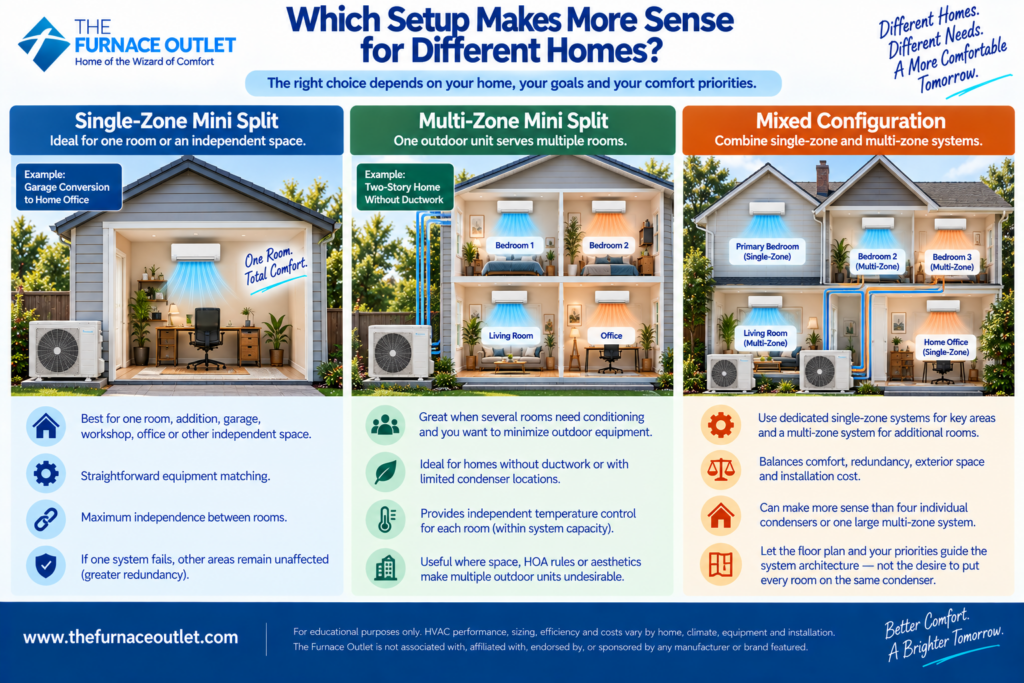
A single-zone mini split deserves serious consideration when you are conditioning one room, an addition, garage, workshop, office or other independent space. It can also make sense when you want maximum independence between rooms, straightforward equipment matching or redundancy between different areas of the home.
A multi-zone system becomes attractive when several separate rooms need conditioning and minimizing outdoor equipment is an important goal. It may be especially practical in homes without ductwork where several rooms need independent temperature control but exterior condenser locations are limited.
For larger projects, I would also consider a mixed configuration. Two single-zone systems plus one smaller multi-zone system can sometimes make more sense than either four individual condensers or one large condenser serving the entire house. The floor plan should guide the system architecture—not the desire to force every room onto the same condenser.
Before choosing between single-zone and multi-zone equipment, I would discuss these points with the contractor:
Those questions move the discussion away from simply comparing equipment prices and toward evaluating the complete HVAC design.
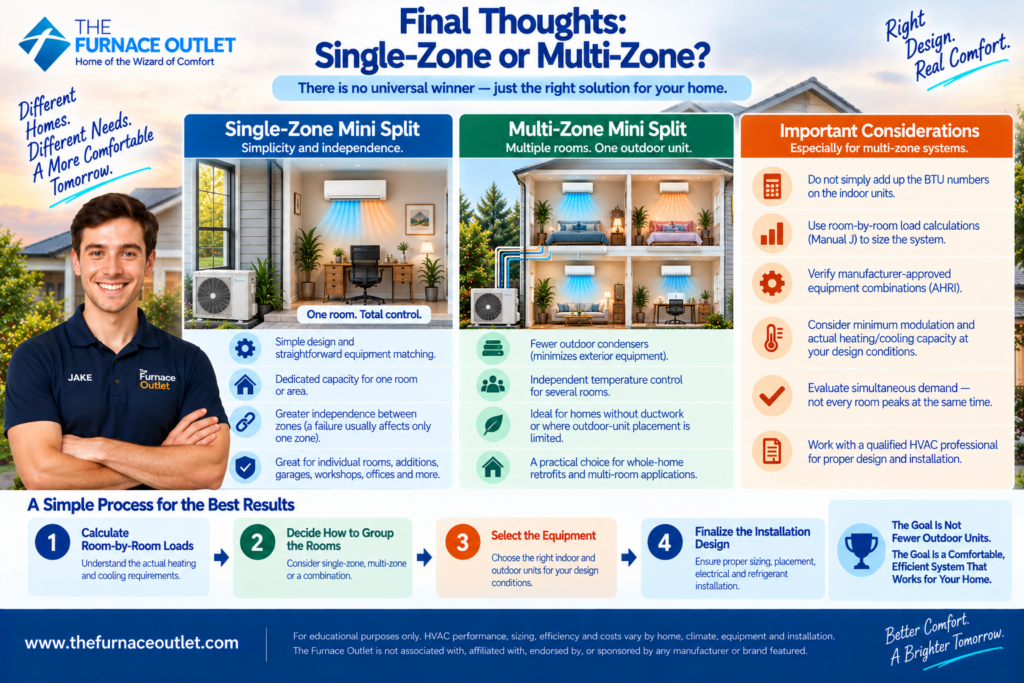
There is no universal winner between single-zone and multi-zone mini splits because they solve different design problems.
But multi-zone design requires more than adding together the BTU numbers printed on the indoor units. The contractor needs to consider individual room loads, simultaneous demand, equipment combinations, minimum modulation and actual heating and cooling capacity at the home’s design conditions.
My preferred sequence is therefore straightforward: calculate the room-by-room loads first, decide how those rooms should be grouped second, and select the equipment third. Only after those decisions should the installation design be finalized. That approach may lead to one multi-zone condenser. It may lead to several single-zone systems. It may lead to a combination of both. The number of outdoor units is not the objective. Comfort, appropriate capacity and a system that works well in your actual home are the objectives.
https://thefurnaceoutlet.com/best-mini-split-systems-of-2026-complete-brand-model-comparison/
This article is for educational purposes only. HVAC sizing, efficiency, capacity, operating costs and performance vary according to the home, climate, equipment combination, installation and operating conditions. A qualified HVAC professional should perform appropriate load calculations and evaluate manufacturer performance data before equipment is selected.
The Furnace Outlet is not associated with, affiliated with, endorsed by or sponsored by any manufacturer or brand referenced in our editorial content. We do not receive manufacturer compensation for inclusion or rankings.