Newsletter Subscribe
Enter your email address below and subscribe to our newsletter

HVAC made simple
— Jake Lawson, HVAC Specialist | The Furnace Outlet
Mini-split systems have moved well beyond their original reputation as a solution for converted garages, home additions and rooms that never feel comfortable. Today’s ductless heat pumps can provide efficient cooling, dependable heating, precise room-by-room temperature control and remarkably quiet operation. Some cold-climate models can even serve as a primary heating system in regions where winter temperatures regularly fall below zero.
That broader capability also makes choosing a mini split more complicated. A homeowner may compare Mitsubishi, Daikin and Fujitsu for premium performance, then discover more affordable systems from Senville, Pioneer, Gree or Cooper & Hunter. MRCOOL adds another consideration by offering systems specifically designed to make installation more approachable for capable do-it-yourself homeowners.
After working around HVAC systems for more than a decade, I have learned that the best mini split is rarely determined by the largest efficiency number or the lowest online price. Correct sizing, low-temperature capacity, installation quality, replacement-parts availability and local service support can matter just as much as the brand name printed on the outdoor unit.
In this guide, I will compare some of the most notable mini-split brands and product families available in 2026. The goal is not to declare that one manufacturer is automatically right for every house. It is to help you understand which systems deserve consideration for your climate, budget, installation plans and long-term comfort expectations.
Editorial Disclosure: The Furnace Outlet is not associated with, affiliated with, endorsed by or sponsored by any manufacturer or brand discussed in this article. We do not receive manufacturer compensation for inclusion or rankings. Product specifications, warranties and availability can change, and ratings may vary by the exact indoor-and-outdoor equipment combination. Verify current specifications before purchasing.
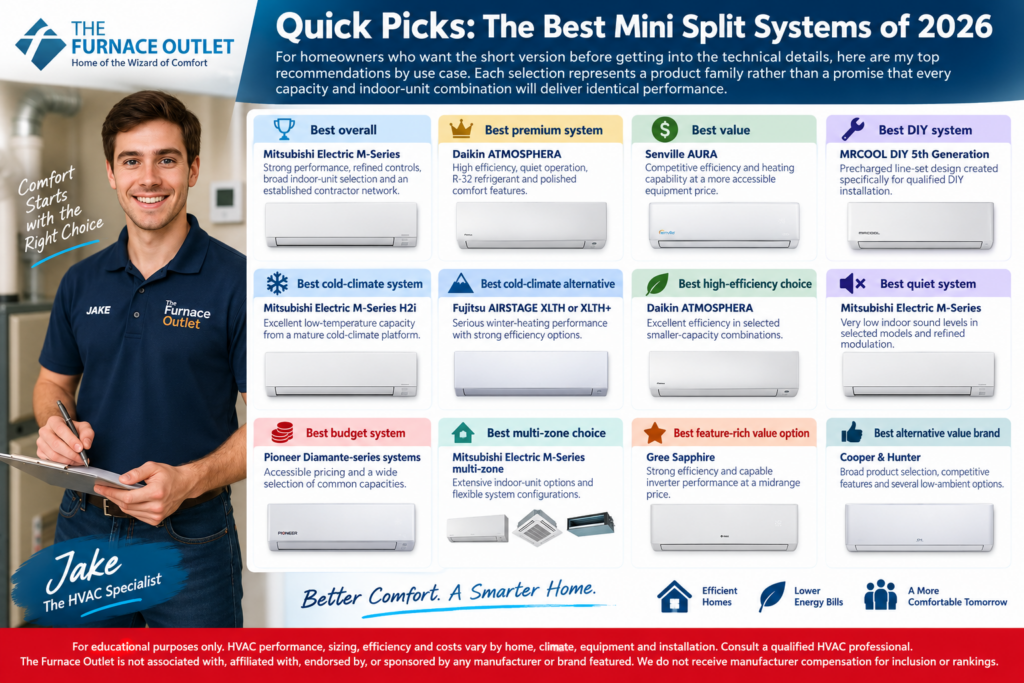
For homeowners who want the short version before getting into the technical details, these are my leading choices by use case. Each selection represents a product family rather than a promise that every capacity and indoor-unit combination will deliver identical performance.
| Category | Recommended brand or series | Why it stands out |
|---|---|---|
| Best overall | Mitsubishi Electric M-Series | Strong performance, refined controls, broad indoor-unit selection and an established contractor network |
| Best premium system | Daikin ATMOSPHERA | High efficiency, quiet operation, R-32 refrigerant and polished comfort features |
| Best value | Senville AURA | Competitive efficiency and heating capability at a more accessible equipment price |
| Best DIY system | MRCOOL DIY 5th Generation | Precharged line-set design created specifically for qualified DIY installation |
| Best cold-climate system | Mitsubishi Electric M-Series H2i | Excellent low-temperature capacity from a mature cold-climate platform |
| Best cold-climate alternative | Fujitsu AIRSTAGE XLTH or XLTH+ | Serious winter-heating performance with strong efficiency options |
| Best high-efficiency choice | Daikin ATMOSPHERA | Excellent efficiency in selected smaller-capacity combinations |
| Best quiet system | Mitsubishi Electric M-Series | Very low indoor sound levels in selected models and refined modulation |
| Best budget system | Pioneer Diamante-series systems | Accessible pricing and a wide selection of common capacities |
| Best multi-zone choice | Mitsubishi Electric M-Series multi-zone | Extensive indoor-unit options and flexible system configurations |
| Best feature-rich value option | Gree Sapphire | Strong efficiency and capable inverter performance at a midrange price |
| Best alternative value brand | Cooper & Hunter | Broad product selection, competitive features and several low-ambient options |
These rankings are starting points, not substitutes for matching the equipment to the home. A properly sized and carefully commissioned value-oriented system can outperform a premium unit that was selected by guesswork or installed incorrectly.
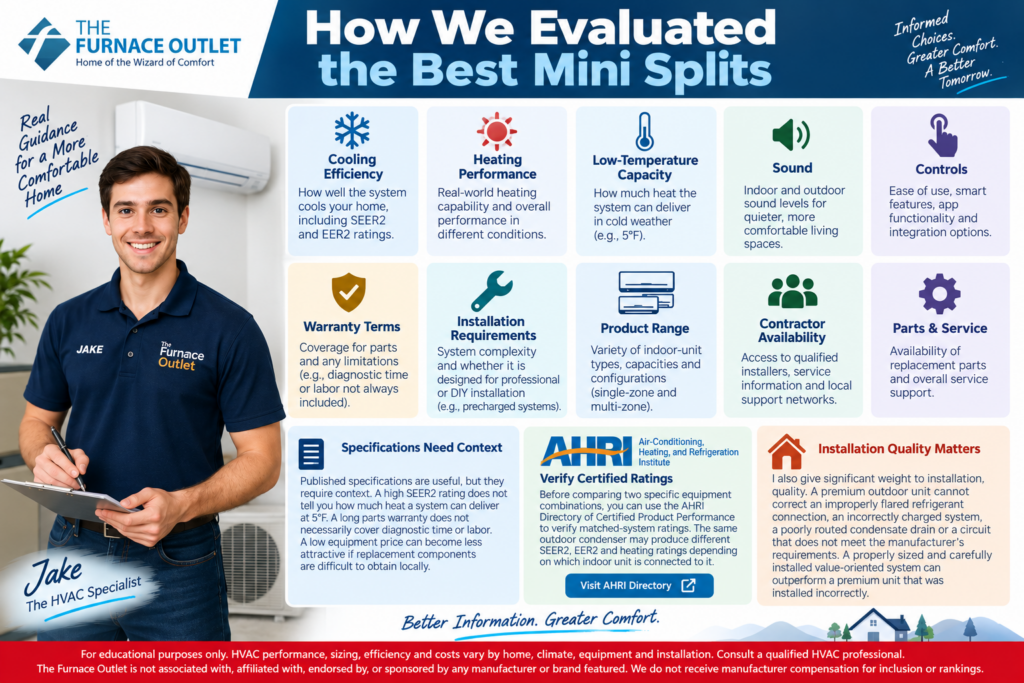
I evaluated these brands according to the factors that most directly affect homeowner satisfaction: cooling efficiency, heating performance, low-temperature capacity, sound, controls, warranty terms, installation requirements, product range and the availability of contractors, service information and replacement parts.
Published specifications are useful, but they require context. A high SEER2 rating does not tell you how much heat a system can deliver at 5°F, for example. A long parts warranty does not necessarily cover diagnostic time or labor. A low equipment price can also become less attractive if replacement components are difficult to obtain locally.
Certification matters as well. Before comparing two specific equipment combinations, homeowners or contractors can use the AHRI Directory of Certified Product Performance to verify matched-system ratings. This is important because the same outdoor condenser may produce different SEER2, EER2 and heating ratings depending on which indoor unit is connected to it.
I also give significant weight to installation quality. A premium outdoor unit cannot correct an improperly flared refrigerant connection, an incorrectly charged system, a poorly routed condensate drain or a circuit that does not meet the manufacturer’s requirements.
Mitsubishi Electric remains my best overall mini-split choice for 2026 because the M-Series combines dependable inverter technology, a wide range of indoor-unit styles, excellent comfort control and strong cold-climate options. Mitsubishi is not usually the least expensive route, but it offers the kind of complete product ecosystem that makes it suitable for everything from a single bedroom to a carefully designed multi-zone home.
The M-Series includes wall-mounted units as well as floor-mounted, ceiling-cassette and compact-ducted options. That variety matters because not every room should automatically receive a high-wall air handler. A floor-mounted unit may make more sense in an upstairs room with sloped ceilings, while a concealed ducted unit may provide a more traditional appearance for several nearby rooms.
Selected Mitsubishi Hyper-Heating INVERTER, or H2i, systems are designed to maintain stronger heating capacity as outdoor temperatures fall. This makes them particularly valuable in northern climates, where a mini split must do more than provide efficient cooling and mild-weather heating.
The strongest argument for Mitsubishi is not one headline specification. It is the combination of modulation, low-temperature capability, quiet operation, equipment choices and an established professional installation channel. The main drawback is cost. Mitsubishi equipment and qualified installation often carry a premium, especially when a home requires multiple indoor units, branch components or electrical upgrades.
Mitsubishi is particularly well suited to homeowners who want a professionally designed system, expect to use the heat pump for substantial winter heating and value long-term serviceability. It is also one of the first brands I would investigate for a complex multi-zone layout or a project requiring something other than standard wall-mounted indoor units.
Daikin ATMOSPHERA is one of the most polished premium single-zone options in the current ductless market. Selected configurations offer excellent efficiency, quiet operation, inverter-driven temperature control and R-32 refrigerant.
Daikin has used R-32 in ductless equipment for years, giving the company meaningful experience with the refrigerant and the associated equipment design. ATMOSPHERA is a strong choice for homeowners who want high cooling efficiency without giving up heating capability or comfort features.
The system’s biggest appeal is balance. Rather than being a one-purpose product, ATMOSPHERA brings together efficiency, low sound, refined air distribution and useful control features. Smaller-capacity combinations tend to post the most impressive efficiency ratings, while larger capacities may have lower—but still respectable—numbers.
That last point is worth emphasizing. Do not assume that a 9,000-BTU system and a 24,000-BTU system from the same product family have the same SEER2, heating capacity or sound rating. Always compare the precise indoor-and-outdoor match listed in the proposal.
Daikin’s warranty and service value may also depend on proper registration and installation through an eligible contractor. Read the current written warranty rather than relying on a product-page summary.
ATMOSPHERA deserves a close look when efficiency, low sound and premium comfort are priorities. It is particularly attractive for bedrooms, home offices, primary living areas and other spaces where temperature stability and quiet operation matter more than finding the lowest equipment price.
Cold-climate mini splits require a different evaluation process from ordinary cooling-focused systems. A unit may be capable of operating at a very low outdoor temperature but produce considerably less heat as it approaches that limit. The more useful questions are how much capacity remains at 5°F, 0°F or −5°F and how efficiently that heat is being produced.
Mitsubishi H2i earns my primary cold-climate recommendation because of its established low-temperature platform, broad equipment selection and strong contractor support in many markets. It is a natural candidate for homeowners who want a mini split to carry a meaningful portion of the winter heating load rather than operate only during shoulder seasons.
Fujitsu AIRSTAGE XLTH systems are equally serious contenders. Fujitsu states that selected XLTH equipment is engineered for operation down to −15°F, while newer product families may offer even stronger capacity retention under very cold conditions. The exact rating still depends on the model and matched indoor unit, so “XLTH” should begin the comparison rather than end it.
For either brand, winter design must consider the home’s calculated heat loss, the system’s rated capacity at the local design temperature and the need for supplemental heat. A 24,000-BTU label is usually a nominal rating, not a guarantee that the unit will deliver exactly 24,000 BTU per hour at every outdoor temperature.
The ENERGY STAR cold-climate heat-pump guidance can help homeowners understand efficiency and low-temperature performance, but final sizing should still be based on the building rather than an online square-footage chart.
Cold-climate equipment makes the most sense for homeowners in regions with sustained freezing weather, especially when the mini-split will be a primary heat source. In a mild climate where temperatures rarely approach freezing, paying extra for maximum low-ambient performance may not provide the same practical benefit.
MRCOOL occupies a distinctive place in the mini-split market because the DIY series is deliberately designed to reduce one of the largest barriers to ductless installation: connecting and commissioning the refrigerant circuit. The fifth-generation DIY platform uses precharged components and line sets intended to be connected without the conventional evacuation procedure required by most mini splits.
That design does not mean the entire project is as simple as plugging in a portable air conditioner. The homeowner must still mount the indoor and outdoor equipment securely, create a properly sealed wall penetration, route the line set without damaging it, provide condensate drainage and arrange electrical work that complies with the installation manual and local code. Permits and licensed electrical work may still be required.
MRCOOL offers single-zone and multi-zone DIY configurations, common capacities and smart-control features. It is the clearest choice for a capable homeowner who specifically wants a system engineered around a DIY installation path.
The tradeoff is that precharged line sets are less flexible than custom-cut refrigerant piping. Excess tubing must be handled according to the manufacturer’s instructions, and the available line-set lengths can influence equipment placement. Homeowners should also confirm how self-installation affects warranty eligibility and who will provide service if troubleshooting is needed later.
MRCOOL DIY is appropriate for homeowners who are comfortable with substantial home-improvement projects, understand that electrical and code requirements still apply and have verified that local service will be available if the system develops a problem. A homeowner who wants custom line routing, concealed piping or a more complex whole-home design may be better served by professionally installed equipment.
Senville AURA systems appeal to buyers who want inverter-driven heating and cooling, competitive efficiency and low-ambient capability without moving directly into premium-brand pricing. The product family is available in several common capacities and can be a practical option for workshops, additions, finished basements and other clearly defined zones.
The strongest case for Senville is equipment value. Buyers can often access features that would cost more through a premium dealer-oriented brand. Selected AURA systems also offer useful heating capability in colder weather, although exact operating limits and capacity retention should be checked by model.
The important question is not whether Senville can heat and cool effectively—it can when selected and installed properly. The question is whether parts, warranty support and qualified local service meet your expectations. In some markets, a Mitsubishi, Daikin or Fujitsu contractor may be easier to locate than a technician who routinely services Senville equipment.
A lower purchase price can still represent excellent value, but only when the installation is done correctly and the homeowner has a realistic plan for future service.
Pioneer has become a familiar option for online mini-split shoppers because it offers common capacities and competitive equipment prices. Diamante-series systems can be attractive for a garage, workshop, sunroom, bonus room or other area where the homeowner wants inverter-based heating and cooling without making a premium-brand investment.
Pioneer’s broad online availability makes it relatively easy to compare specifications and purchase complete equipment packages. The brand also offers both 115-volt and 208/230-volt choices in selected smaller capacities, which can be useful when planning a straightforward single-zone installation.
The budget classification comes with familiar cautions. Installation is generally not the same as MRCOOL’s purpose-built DIY process. Conventional systems may require refrigerant tools, proper evacuation, leak testing and commissioning by a qualified technician. Buyers should also investigate warranty procedures and parts availability before ordering.
Pioneer makes the most sense when the application is straightforward, the buyer understands the installation requirements and equipment cost carries more weight than obtaining the broadest local dealer network.
Gree is one of the world’s major air-conditioning manufacturers, and the Sapphire series has earned attention for combining strong efficiency, inverter performance and useful cold-weather capability in a relatively accessible package.
Selected Sapphire systems can deliver high cooling-efficiency ratings, particularly in smaller capacities. They also offer low indoor sound levels and the ability to modulate output rather than repeatedly cycling at full capacity.
Gree sits in an interesting middle ground. It can offer performance approaching more expensive systems, but contractor familiarity and distributor support vary by region. Before selecting one, I would check which local company will install it, who stocks replacement components and how warranty claims are handled.
For buyers with good local Gree support, Sapphire can be an excellent alternative to a premium Japanese brand. Without that support, the efficiency advantage may be less valuable over the system’s service life.
Cooper & Hunter offers a wide selection of mini-split systems, including conventional single-zone units, multi-zone platforms and models designed for improved low-temperature heating. The brand often includes attractive comfort features and competitive efficiency at prices below many premium systems.
Its strength is choice. Homeowners can find multiple capacities and performance tiers, making Cooper & Hunter suitable for both ordinary cooling applications and more demanding heating needs. Selected systems also include Wi-Fi capability or make it available without requiring an entirely separate control platform.
As with other value-oriented brands, local support deserves careful investigation. The warranty may look generous on paper, but homeowners should ask who performs covered service, whether labor is included and how quickly model-specific parts can be obtained.
Cooper & Hunter can be a sensible value when installed by a technician who knows the equipment and has a dependable supply channel. Buying the system first and searching for an installer afterward is a much riskier approach.
Although Fujitsu already appears in the cold-climate category, the brand deserves broader recognition. Its AIRSTAGE lineup includes efficient single-zone and multi-zone systems with several indoor-unit options. Fujitsu can be an excellent all-around premium choice even when extreme winter performance is not the deciding factor.
Senville also offers more than a single value series, with options for basic cooling-and-heating applications as well as stronger low-temperature performance. The key is to compare the exact product tier rather than judge every unit carrying the same brand name as equivalent.
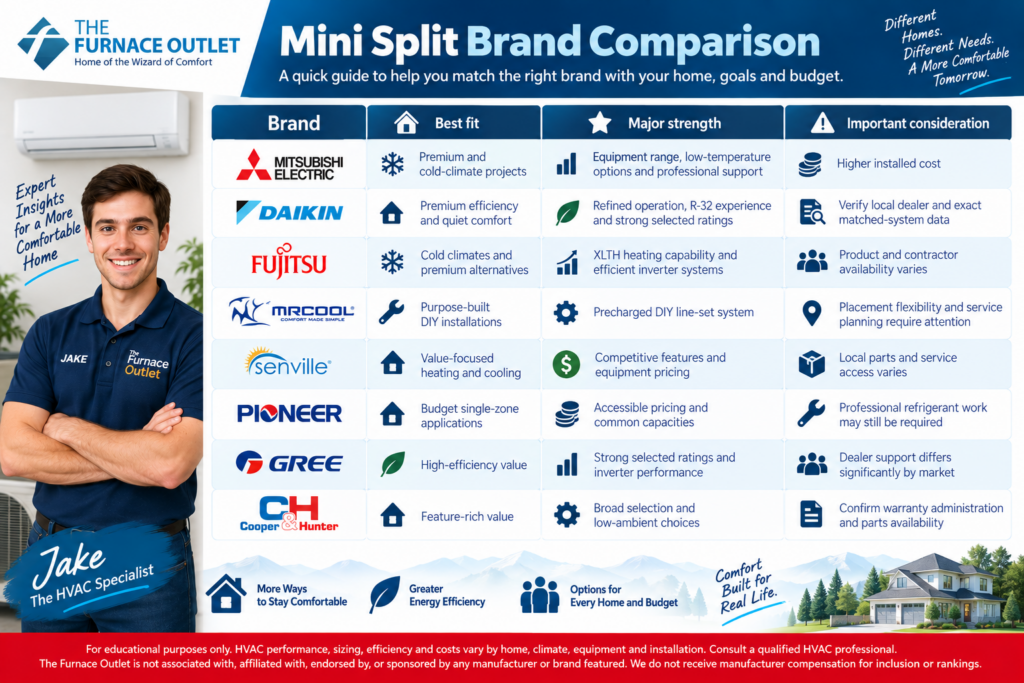
| Brand | Best fit | Major strength | Important consideration |
|---|---|---|---|
| Mitsubishi Electric | Premium and cold-climate projects | Equipment range, low-temperature options and professional support | Higher installed cost |
| Daikin | Premium efficiency and quiet comfort | Refined operation, R-32 experience and strong selected ratings | Verify local dealer and exact matched-system data |
| Fujitsu | Cold climates and premium alternatives | XLTH heating capability and efficient inverter systems | Product and contractor availability varies |
| MRCOOL | Purpose-built DIY installations | Precharged DIY line-set system | Placement flexibility and service planning require attention |
| Senville | Value-focused heating and cooling | Competitive features and equipment pricing | Local parts and service access varies |
| Pioneer | Budget single-zone applications | Accessible pricing and common capacities | Professional refrigerant work may still be required |
| Gree | High-efficiency value | Strong selected ratings and inverter performance | Dealer support differs significantly by market |
| Cooper & Hunter | Feature-rich value | Broad selection and low-ambient choices | Confirm warranty administration and parts availability |
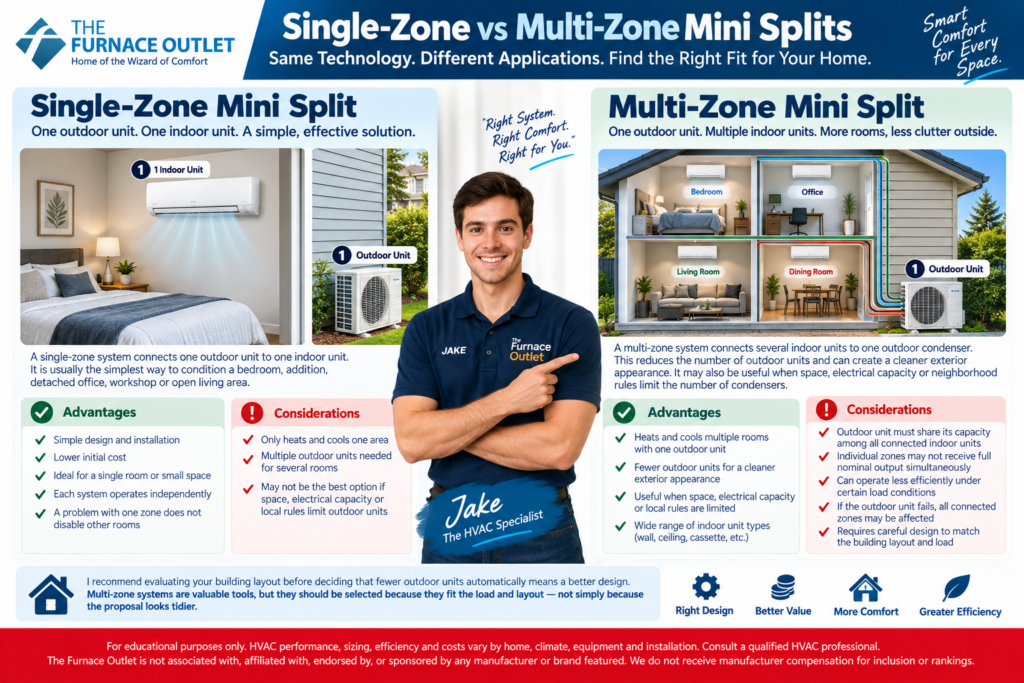
A single-zone system connects one outdoor unit to one indoor unit. It is usually the simplest way to condition a bedroom, addition, detached office, workshop or open living area. Each system operates independently, and a problem with one zone does not automatically disable every room.
A multi-zone system connects several indoor units to one outdoor condenser. This reduces the number of outdoor units and can create a cleaner exterior appearance. It may also be useful when space, electrical capacity or neighborhood rules limit the number of condensers.
Multi-zone systems come with tradeoffs. The outdoor unit must distribute its available capacity among the connected indoor units, and individual zones may not receive their full nominal output simultaneously. Multi-zone systems can also operate less efficiently under certain load conditions than well-selected single-zone systems.
Another issue is redundancy. If a single-zone outdoor unit fails, only one area loses heating or cooling. If a multi-zone condenser serving four rooms fails, all four zones may be affected.
I generally recommend evaluating the building layout before deciding that fewer outdoor units automatically means a better design. Multi-zone systems are valuable tools, but they should be selected because they fit the load and layout—not simply because the proposal looks tidier.

Mini splits are commonly offered in nominal capacities such as 9,000, 12,000, 18,000, 24,000 and 36,000 BTU per hour. Those sizes are often described as suitable for broad square-footage ranges, but square footage alone is not enough for responsible sizing.
A 400-square-foot room with shaded windows, eight-foot ceilings and good insulation may have a very different load from a 400-square-foot room with west-facing glass, a vaulted ceiling and significant air leakage. Climate, occupancy, appliances, insulation, windows and exposure all affect the result.
The U.S. Department of Energy’s ductless mini-split guidance explains that correct installation and placement are important to performance. For a professional design, ask for a room-by-room load calculation using accepted methods such as ACCA Manual J rather than allowing the installer to size equipment only from floor area or the capacity of the old system.
Oversizing is not harmless. An oversized mini split may reach the thermostat setting quickly, but it can spend more time at its lowest operating limit or cycle more often during mild weather. That can affect humidity control, comfort and efficiency. An undersized system may run continuously and still fail to maintain the desired temperature during extreme weather.
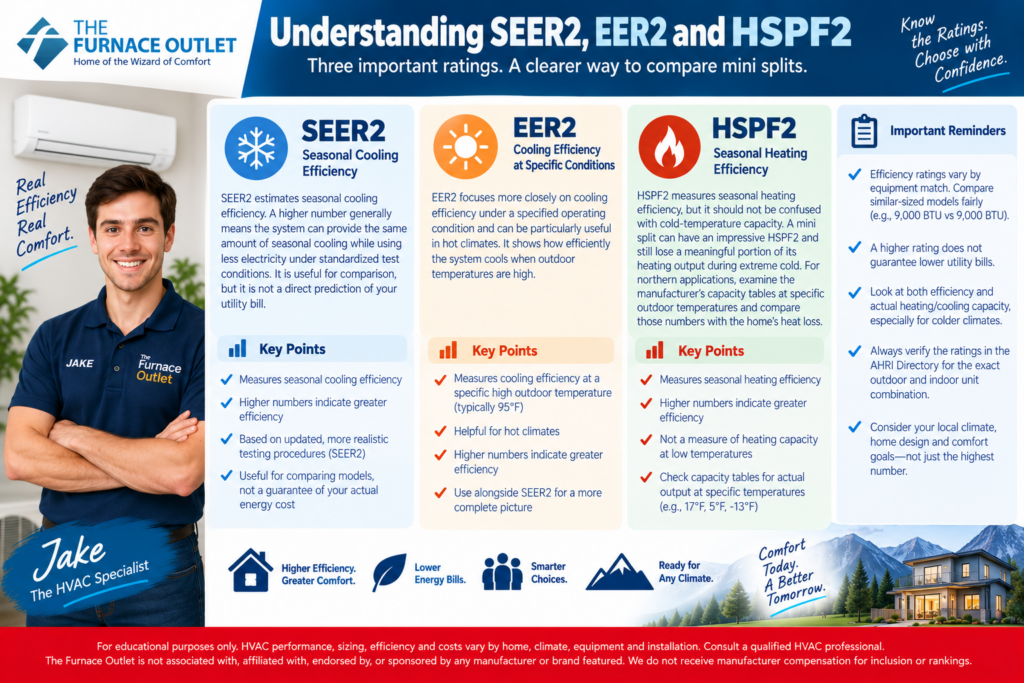
SEER2 estimates seasonal cooling efficiency. A higher number generally means the system can provide the same amount of seasonal cooling while using less electricity under standardized test conditions. It is useful for comparison, but it is not a direct prediction of your utility bill.
EER2 focuses more closely on cooling efficiency under a specified operating condition and can be particularly useful in hot climates. HSPF2 measures seasonal heating efficiency, but it should not be confused with cold-temperature capacity. A mini split can have an impressive HSPF2 and still lose a meaningful portion of its heating output during extreme cold. For northern applications, examine the manufacturer’s capacity tables at specific outdoor temperatures and compare those numbers with the home’s heat loss.
Efficiency also varies by equipment match. Never compare one brand’s best 9,000-BTU rating with another brand’s ordinary 24,000-BTU model and treat that as a fair brand-wide comparison.
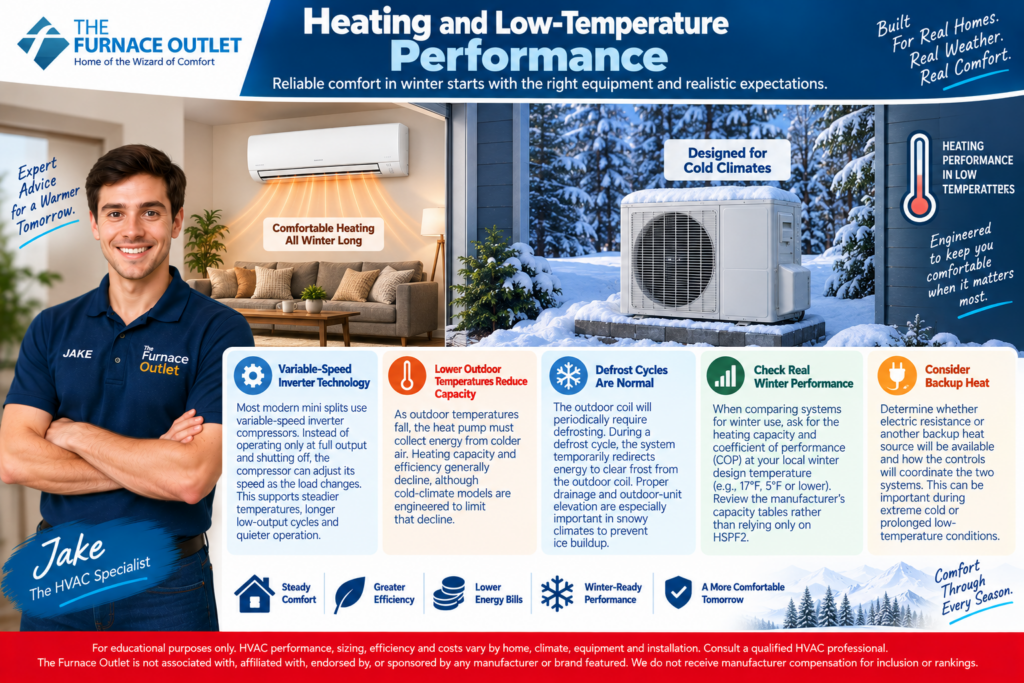
Most modern mini splits use variable-speed inverter compressors. Instead of operating only at full output and shutting off, the compressor can adjust its speed as the heating or cooling load changes. This supports steadier temperatures, longer low-output cycles and quieter operation.
During cold weather, the heat pump must collect energy from increasingly cold outdoor air. Heating capacity and efficiency generally decline as the outdoor temperature falls, although cold-climate models are engineered to limit that decline.
The outdoor coil will also periodically require defrosting. During a defrost cycle, the system temporarily redirects energy to clear frost from the outdoor coil. Proper drainage and outdoor-unit elevation are especially important in snowy climates because refrozen water and accumulated snow can obstruct airflow.
When comparing systems for winter use, ask for the heating capacity and coefficient of performance at the local winter design temperature. Also determine whether backup heat will be available and how the controls will coordinate the two systems.
Smaller mini splits are sometimes available in 115-volt configurations, while larger capacities generally require 208/230-volt power. A 115-volt system can be convenient in certain applications, but it should not be treated like an ordinary plug-in appliance unless the manufacturer specifically supplies and approves that arrangement.
Most mini splits require a dedicated circuit, correctly sized breaker, disconnect and wiring that meet both the installation instructions and local electrical code. Larger systems use 208/230 volts partly because the higher voltage allows the equipment to deliver more capacity without requiring impractically high current.
Do not choose voltage based only on which outlet is nearby. Have the electrical requirements reviewed before ordering the equipment. An electrical-panel upgrade, new circuit or long wiring run can materially change the project budget.
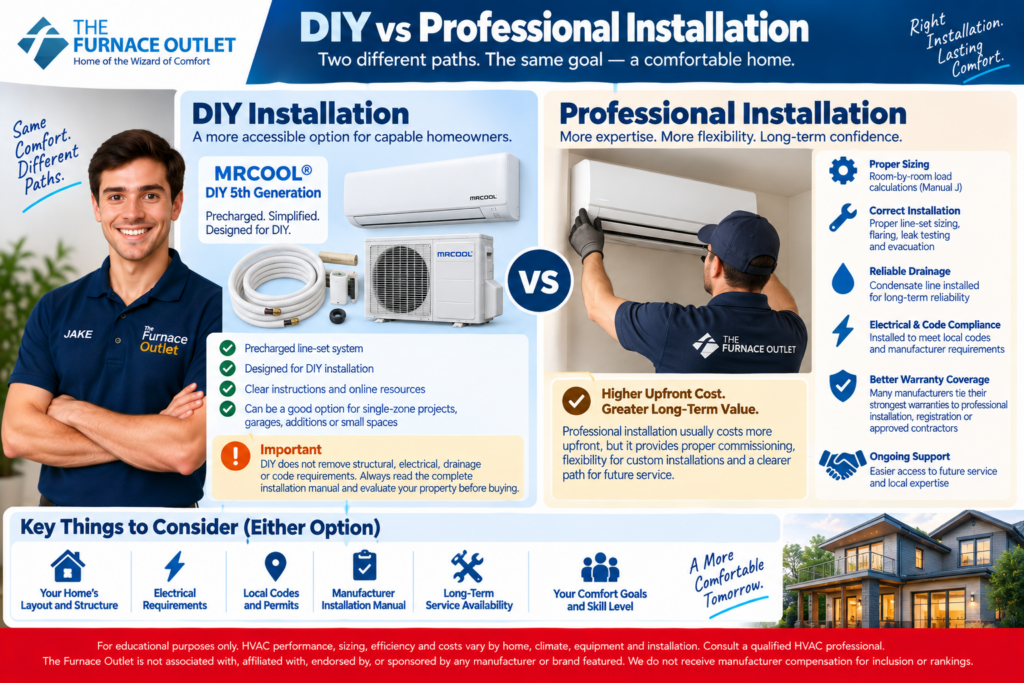
A conventional mini split requires more than mounting two boxes and connecting wires. The refrigerant tubing must be sized, routed, flared, leak-tested and evacuated correctly. The condensate line needs reliable drainage, the indoor unit must be positioned for good air distribution and the outdoor unit needs proper clearances and support.
MRCOOL DIY changes part of that process through its precharged connection system, but it does not remove structural, electrical, drainage or code considerations. A homeowner should still read the complete installation manual before buying, because the property may present challenges that are not obvious in a promotional video.
Professional installation usually costs more upfront, but it provides access to custom line-set work, proper commissioning equipment, load calculations and a clearer path for future service. Some manufacturers also tie their strongest warranty coverage to professional installation, registration or installation by an approved contractor.
The line set carries refrigerant between the indoor and outdoor units. Its diameter, length and elevation difference must remain within the manufacturer’s limits. Some systems require additional refrigerant beyond a specified line length, while others arrive with a charge intended for a defined range.
The line set should be protected from physical damage, weather and ultraviolet exposure. Tight bends, crushed insulation and poorly made flare connections can create serious performance or reliability problems.
Condensate management is just as important. During cooling and dehumidification, the indoor coil removes water from the air. That water normally drains by gravity, but some locations require a condensate pump. A poorly pitched drain can leak inside the wall, stain ceilings or encourage biological growth.
A neat installation is not merely cosmetic. Properly supported piping, sealed wall penetrations and well-planned drainage all contribute to reliability.
Many 2026 mini splits include Wi-Fi controls or offer an optional adapter. Mobile apps can be useful for changing temperature settings, creating schedules and checking a system while away from home.
The limitation is that a manufacturer’s app may not provide the same integration as a conventional smart thermostat. Mini splits often use proprietary communication between the indoor unit and the controller. Installing a generic thermostat through an interface may reduce access to certain modulation or comfort features.
Before buying, determine whether Wi-Fi is built in, requires an accessory or relies on an infrared controller. Also review compatibility with the home-automation platform you already use. “Smart capable” does not always mean that every feature works with every ecosystem.
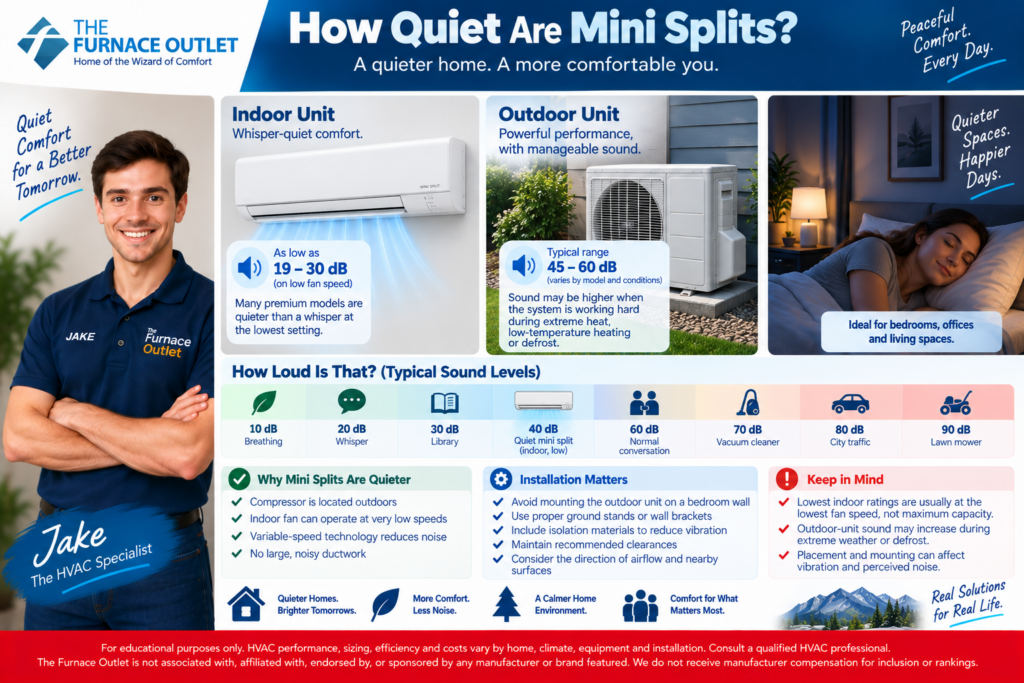
Mini splits are generally quieter than window air conditioners because the compressor is outdoors and the indoor fan can operate at very low speeds. Premium wall-mounted units can be exceptionally quiet at their lowest setting, which makes them attractive for bedrooms and offices.
Published sound ratings still require context. The lowest indoor number usually applies to the lowest fan speed, not maximum capacity. Outdoor-unit sound may increase when the system is working hard during extreme heat, low-temperature heating or defrost.
Placement affects the experience as well. An outdoor condenser mounted to a bedroom wall may transmit vibration even when its airborne sound rating appears low. Ground stands, wall brackets, isolation materials and clearances should be selected carefully.
Mini-split warranties commonly distinguish between parts and compressor coverage, while labor may be excluded. Registration deadlines, professional-installation requirements and maintenance obligations can also affect coverage.
Before buying, ask who will diagnose the system, who processes the warranty claim and who pays for labor, refrigerant and shipping. A replacement circuit board supplied under warranty is less helpful if no local technician will install it or if the homeowner must wait weeks for the part.
Premium brands often benefit from established distributor and contractor networks, but support is regional. A brand with excellent representation in one city may be difficult to service in another. This is why I recommend choosing the equipment and installer together rather than buying a system online and assuming any HVAC company will work on it later.
Mini-split pricing varies too much by location and project scope for one national figure to describe every installation responsibly. Equipment capacity, brand, number of zones, indoor-unit style, line-set length, electrical work, permits, mounting method and labor market all influence the total.
A straightforward single-zone wall-mounted system will usually cost much less than a four-zone project with concealed ducts, ceiling cassettes, condensate pumps and long refrigerant runs. Cold-climate equipment and premium brands can also raise the initial price.
When comparing estimates, make sure each quote identifies the exact indoor and outdoor model numbers, electrical work, line-set treatment, condensate plan, equipment mounting, permits, warranty, startup procedure and disposal responsibilities. A low quote that omits necessary work is not automatically a better value.
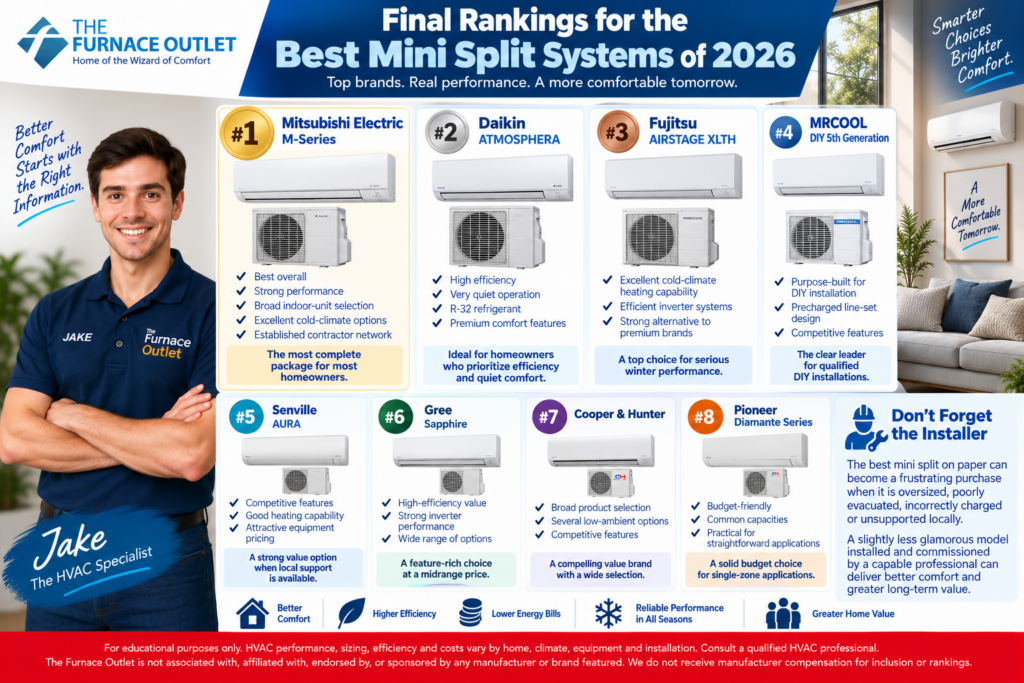
For the strongest overall combination of performance, product depth, cold-climate options and long-term professional support, Mitsubishi Electric M-Series takes the top position. Daikin ATMOSPHERA follows closely for homeowners prioritizing high efficiency, quiet comfort and a premium R-32 platform.
Fujitsu AIRSTAGE XLTH remains one of the best alternatives for serious cold-climate heating. MRCOOL DIY 5th Generation is the clear leader when a purpose-designed DIY installation is the priority. Senville AURA, Gree Sapphire and Cooper & Hunter offer compelling value when local installation and service support are available, while Pioneer remains a practical budget choice for straightforward single-zone applications.
My most important advice is to rank the installer alongside the equipment. The best mini split on paper can become a frustrating purchase when it is oversized, poorly evacuated, incorrectly charged or unsupported locally. A slightly less glamorous model installed and commissioned by a capable professional can deliver better comfort and greater long-term value.
If you remember only one principle from this guide, make it this: buy a complete comfort solution, not a specification sheet. The right mini split must fit the room, climate, electrical system, installation conditions and service market where it will operate.
Mitsubishi, Daikin and Fujitsu lead many premium and cold-climate comparisons because they combine strong equipment with mature professional networks. MRCOOL has created a legitimate alternative for qualified DIY homeowners, while Senville, Pioneer, Gree and Cooper & Hunter can provide excellent value when installation and ongoing support are carefully planned.
Before signing a contract or ordering equipment, verify the matched-system ratings, request a load calculation, confirm low-temperature capacity where relevant and read the actual warranty. Those steps are less exciting than comparing Wi-Fi apps or headline SEER2 numbers, but they are usually what separates a mini split that merely works from one that keeps the home comfortable for years.
— Jake Lawson, HVAC Specialist | The Furnace Outlet
Editorial Disclosure: The Furnace Outlet is not associated with, affiliated with, endorsed by, or sponsored by any manufacturer or brand mentioned in this article. We do not receive compensation from manufacturers for inclusion or rankings. Brand and product discussions are provided for independent educational and editorial purposes.
Homeowners who want to research mini-split sizing, efficiency ratings, cold-climate performance and refrigerant changes in greater detail can consult the following independent and industry-recognized resources:
These resources can help homeowners verify equipment ratings and better understand efficiency terminology, cold-weather capacity and current refrigerant requirements. They should supplement—not replace—a professional load calculation, a review of manufacturer specifications and an evaluation by a qualified local HVAC contractor.