Newsletter Subscribe
Enter your email address below and subscribe to our newsletter

HVAC made simple

By Jake Lawson — The HVAC Specialist
Shopping for a mini split in 2026 means encountering a long list of efficiency numbers. SEER2 may be the one that gets the most attention, but you may also see EER2, HSPF2, COP, estimated annual energy use and several capacity ratings. It is easy to assume that the system with the largest SEER2 number must automatically be the best choice.
That is not how I would evaluate a mini split.
SEER2 is useful because it gives homeowners a standardized way to compare the seasonal cooling efficiency of air conditioners and heat pumps. However, it does not tell you everything about real-world operating cost, heating performance, comfort, equipment sizing or how efficiently a system will operate in your particular climate.
A high-SEER2 mini split can be an excellent system, but the rating needs context. In this guide, I will explain what SEER2 measures, how it differs from the older SEER rating, why mini splits can achieve impressive efficiency numbers and what else homeowners should examine before making a purchasing decision.
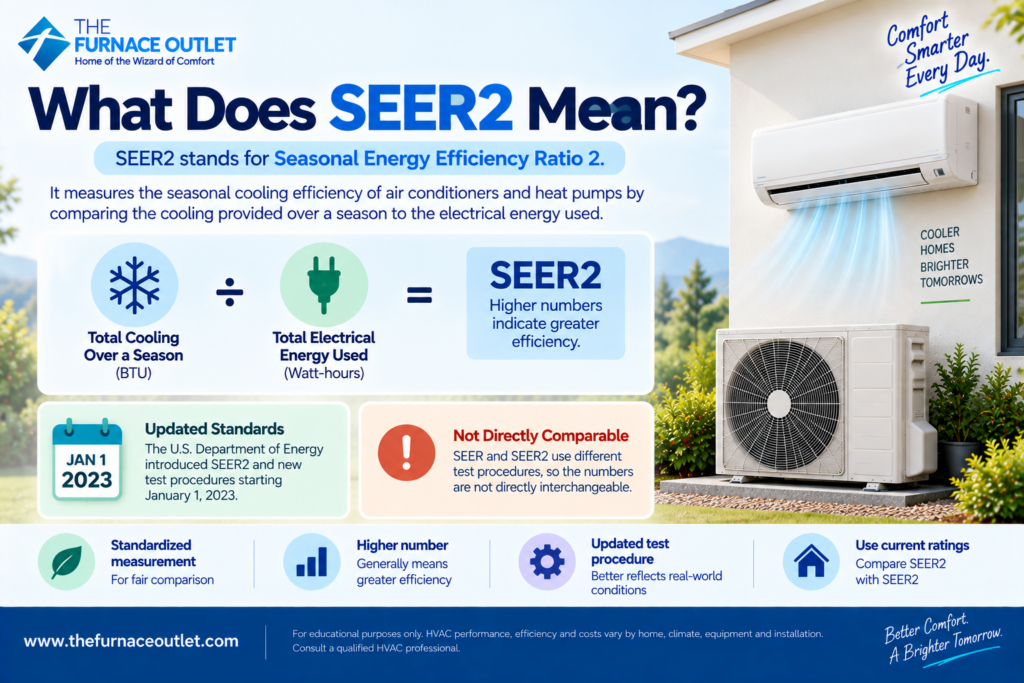
SEER2 stands for Seasonal Energy Efficiency Ratio 2. It is a standardized measure used to describe the seasonal cooling efficiency of certain air-conditioning and heat-pump equipment. Conceptually, SEER2 compares the amount of cooling a system provides over a representative cooling season with the electrical energy required to provide that cooling. A higher number generally indicates greater seasonal cooling efficiency under the standardized test procedure.
The U.S. Department of Energy introduced updated efficiency metrics and test procedures beginning January 1, 2023. The change included the transition from familiar ratings such as SEER to SEER2 and was intended to better represent external static pressure and field operating conditions for applicable equipment.
The important thing for homeowners to understand is that SEER and SEER2 are not simply two names for exactly the same test. Because the test procedures changed, you should avoid casually comparing an older SEER rating with a newer SEER2 rating as though the numbers were directly interchangeable.
U.S. Department of Energy — Central Air Conditioners and Heat Pumps
Suppose you are comparing two mini splits and one carries a 17 SEER2 rating while another is rated at 20 SEER2. Under the standardized seasonal cooling test, the 20 SEER2 system demonstrates greater seasonal cooling efficiency.
That is meaningful information. What it does not mean is that the 20 SEER2 system will automatically use a predictable percentage less electricity in your particular home. Your actual electricity consumption depends on many variables, including climate, thermostat settings, operating hours, equipment capacity, indoor and outdoor temperatures, insulation, solar exposure, occupancy, maintenance and installation quality.
A homeowner in a mild coastal climate may operate the system very differently from someone experiencing months of hot, humid weather. Two identical mini splits installed in those homes will therefore not necessarily produce identical annual energy bills. I think of SEER2 primarily as a standardized comparison tool, rather than a promise about your future utility bill.
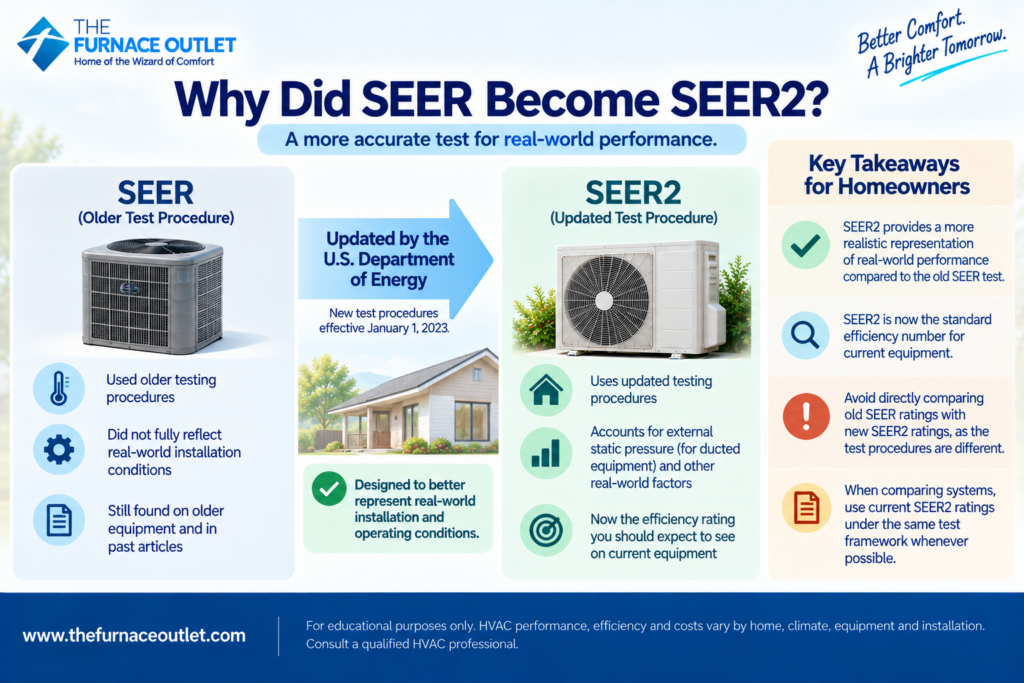
The transition was more than a marketing change. DOE updated the testing procedures used for residential air conditioners and heat pumps, including changes intended to better represent real-world installation conditions. One notable part of the revised procedure involves the external static pressure used during testing for ducted equipment.
For homeowners researching ductless systems, the practical takeaway is simpler: equipment manufactured under the newer regulatory framework is evaluated using the updated metrics, so SEER2 is now the efficiency number you should expect to encounter when comparing current equipment.
That also means old articles claiming that a certain SEER number is the universal benchmark for a “high-efficiency” system can be misleading when applied directly to today’s SEER2-rated equipment. When comparing systems, compare current ratings under the same test framework whenever possible.
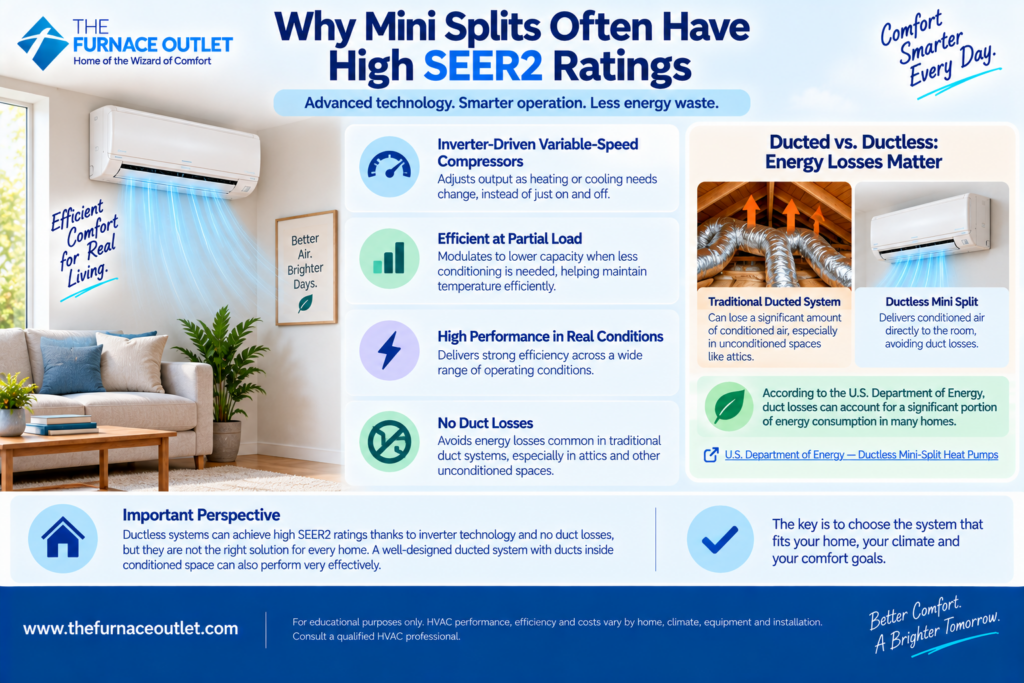
Many mini splits use inverter-driven variable-speed compressors. Instead of operating only at full output and then shutting off, an inverter system can adjust compressor operation as the heating or cooling requirement changes.
Imagine a room requires substantial cooling during a hot afternoon. The system may operate at relatively high capacity. Later, as outdoor conditions moderate and the room approaches the thermostat setting, the compressor can reduce output rather than repeatedly switching between maximum output and off.
That ability to modulate can help the equipment maintain temperature while operating efficiently at partial load. Mini splits also avoid the energy losses associated with traditional duct systems serving unconditioned spaces. The Department of Energy notes that duct losses can account for a significant portion of energy consumption associated with space conditioning, particularly when ducts are located in spaces such as attics.
That does not mean ductless automatically wins in every house. A well-designed ducted system with ducts inside conditioned space can perform very effectively. It simply explains one reason ductless technology can be attractive in suitable applications.
U.S. Department of Energy — Ductless Mini-Split Heat Pumps
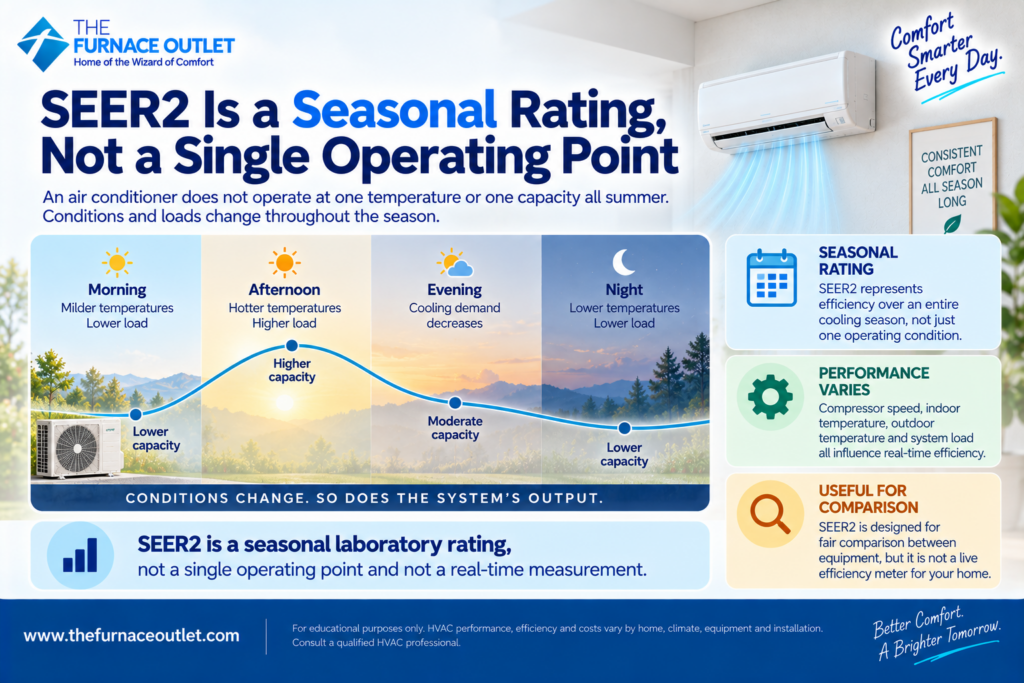
The word seasonal is important. An air conditioner does not experience one outdoor temperature or operate at one capacity throughout summer. Loads change from morning to afternoon, from cloudy days to sunny days and from mild spring weather to peak summer conditions.
SEER2 is intended to provide a seasonal efficiency representation rather than describing performance at only one operating condition. That makes it useful for broad equipment comparison, but it also means SEER2 should not be interpreted as the efficiency the system achieves every minute it operates. A mini split’s instantaneous performance changes as operating conditions change. Compressor speed, indoor temperature, outdoor temperature and system load can all influence how the equipment performs at a particular moment.
For homeowners, the distinction is important: SEER2 is a seasonal laboratory rating, not a live efficiency meter attached to your house.
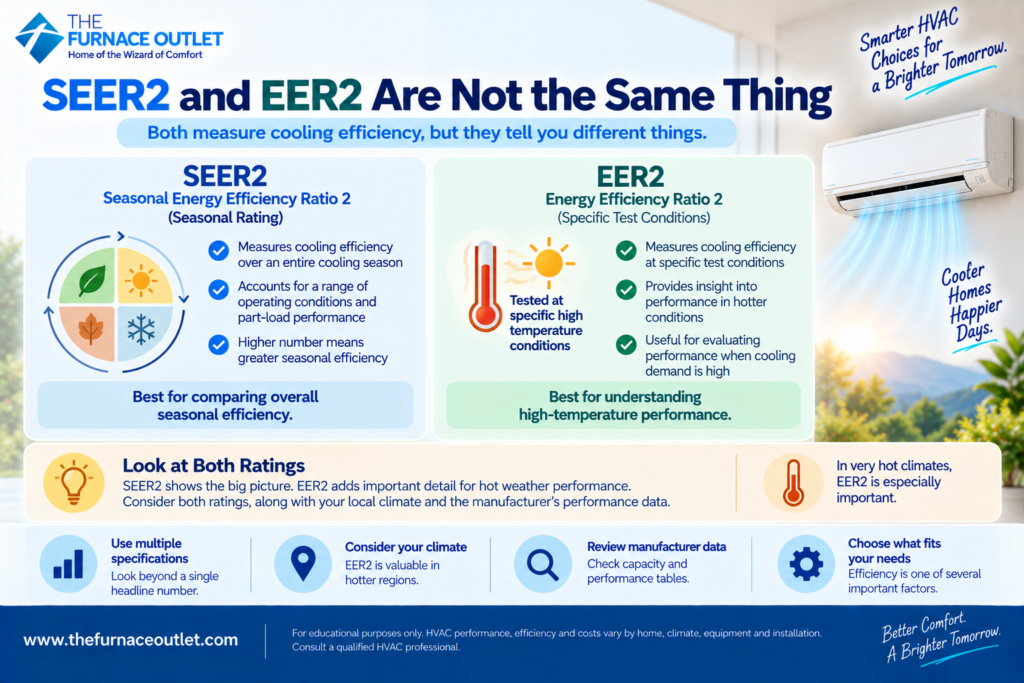
You may also see an EER2 rating on mini-split specifications. While SEER2 represents seasonal cooling efficiency, EER2 evaluates cooling efficiency at specified test conditions. This can provide another useful perspective on equipment performance, particularly when thinking about operation under relatively demanding cooling conditions.
A system can have an impressive SEER2 rating because it performs extremely efficiently across a range of seasonal and part-load conditions, while its EER2 gives additional insight into performance under the applicable test point. Homeowners in very hot climates should therefore avoid focusing on SEER2 alone. If air conditioning will spend substantial time operating during high outdoor temperatures, EER2 and manufacturer performance data deserve attention as well. I would rather evaluate several meaningful specifications than choose equipment based on one headline efficiency number.
This is especially important when buying a mini split heat pump. SEER2 measures cooling efficiency. It does not tell you how efficiently the system heats your home during winter.
For seasonal heating efficiency, another important rating is HSPF2, or Heating Seasonal Performance Factor 2. As with SEER2, higher HSPF2 generally indicates better seasonal efficiency under the applicable standardized test procedure. If you live somewhere with significant winter heating demand, I would look at both sides of the system.
A mini split with excellent cooling efficiency may not necessarily be the strongest choice for a cold-climate heating application. Low-temperature heating capacity, HSPF2, coefficient of performance at relevant temperatures and the manufacturer’s capacity tables can become extremely important. ENERGY STAR’s criteria for air-source heat pumps also include specific requirements for cold-climate products, making its current specifications useful when evaluating systems intended for colder regions.
This is one of the most important points in the entire discussion. You could purchase an extremely efficient mini split on paper and still end up disappointed if the equipment is poorly sized for the room. An oversized system may have far more capacity than the space requires. Although modern inverter technology can reduce output substantially, every system has operating limits. Excessive capacity can contribute to undesirable operating behavior, potentially affecting humidity control and comfort.
An undersized system creates the opposite problem. It may perform adequately during moderate conditions but struggle to maintain the desired temperature during the hottest summer afternoons or coldest winter periods. That is why I would never select between an 18K and 24K mini split because one happens to offer the more attractive SEER2 rating. Determine the load first. Select appropriately sized equipment second. Compare efficiency among suitable systems third. ACCA’s Manual J methodology provides an industry-standard framework for residential heating and cooling load calculations.
ACCA — Manual J Residential Load Calculation
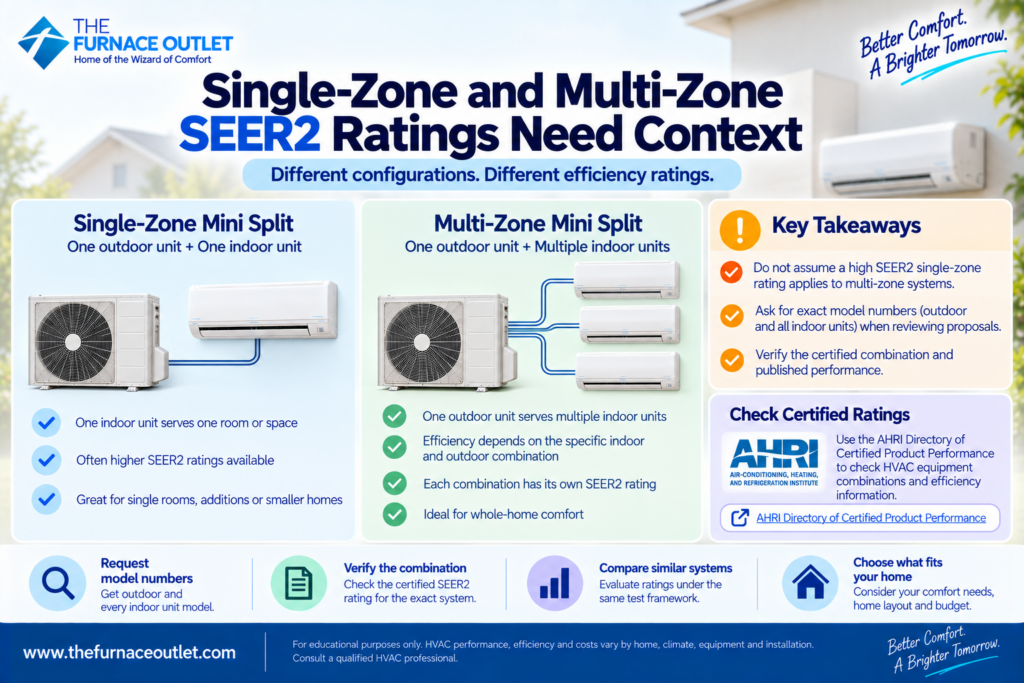
Mini-split efficiency becomes particularly interesting when comparing single-zone and multi-zone configurations. A single-zone system pairs one outdoor condenser with one indoor unit. A multi-zone system connects several indoor units to one outdoor condenser. Do not assume that because a manufacturer offers a very high-efficiency single-zone system, every multi-zone combination from that manufacturer will carry the same rating.
Efficiency can depend on the specific indoor and outdoor equipment combination. This is one reason I encourage homeowners to request exact model numbers when reviewing proposals. “Brand X 36K multi-zone” is not enough information for a serious comparison. Ask for the outdoor model number and every indoor-unit model number. Then verify the certified combination and its published performance. The AHRI Directory of Certified Product Performance is an important resource for checking certified HVAC equipment combinations and efficiency information.
AHRI Directory of Certified Product Performance
All else being equal, more efficient equipment requires less electrical energy to provide a given amount of cooling under the rating framework. But in an actual house, all else is rarely equal. Consider two systems: one rated 18 SEER2 and another rated 24 SEER2. Looking only at those numbers makes the 24 SEER2 model attractive. But suppose the 18 SEER2 system is correctly sized, properly installed and operated sensibly, while the 24 SEER2 system is oversized, installed poorly or used with aggressive thermostat settings. The rating alone cannot predict which homeowner will receive the better real-world result.
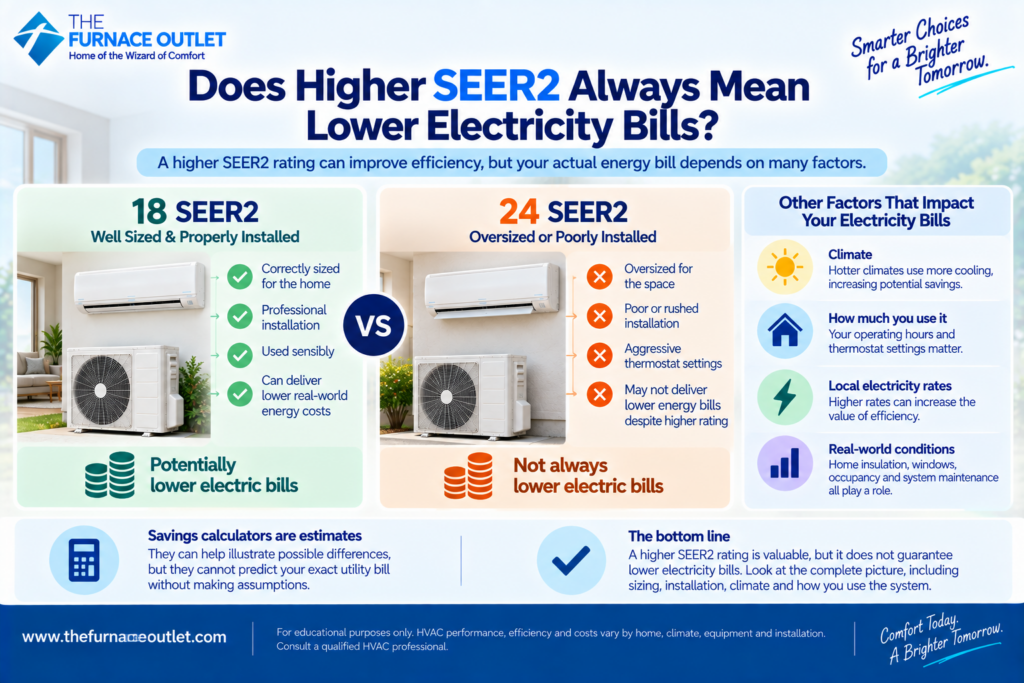
Climate matters too. The economic value of moving to a higher-efficiency system generally depends partly on how much cooling you actually use and local electricity prices. This is why simplistic “SEER2 savings calculators” should be treated as estimates. They can help illustrate possible differences, but they cannot predict your exact utility bill without making assumptions.
Maximum capacity receives most of the attention in HVAC sales conversations, but with inverter mini splits I also want to know how low the system can operate. Imagine a system capable of delivering a large amount of cooling during peak conditions. That capacity is valuable when the house actually needs it. During mild weather, however, the cooling load may be much smaller.
An inverter system that can reduce output to follow that smaller load may be able to operate steadily and efficiently rather than repeatedly satisfying the thermostat and cycling. This is particularly relevant in small rooms and multi-zone systems where only one or two indoor units may be calling at a particular time. SEER2 helps summarize seasonal efficiency, but it does not replace examination of the system’s capacity range and operating characteristics.
The SEER2 number belongs to equipment tested under standardized conditions. Your house is not a laboratory. Refrigerant piping, electrical work, condensate drainage, indoor-unit location, outdoor-unit clearances and system commissioning all influence whether the installation performs as intended. Airflow around the indoor unit matters. Outdoor equipment needs adequate clearance. Refrigerant lines need to comply with manufacturer requirements, and the system needs to be properly evacuated and commissioned.
Even equipment with an excellent published efficiency rating cannot compensate for every installation mistake. For that reason, I would rather own a properly sized, professionally installed system with a slightly lower SEER2 rating than chase the highest number while treating installation quality as an afterthought.
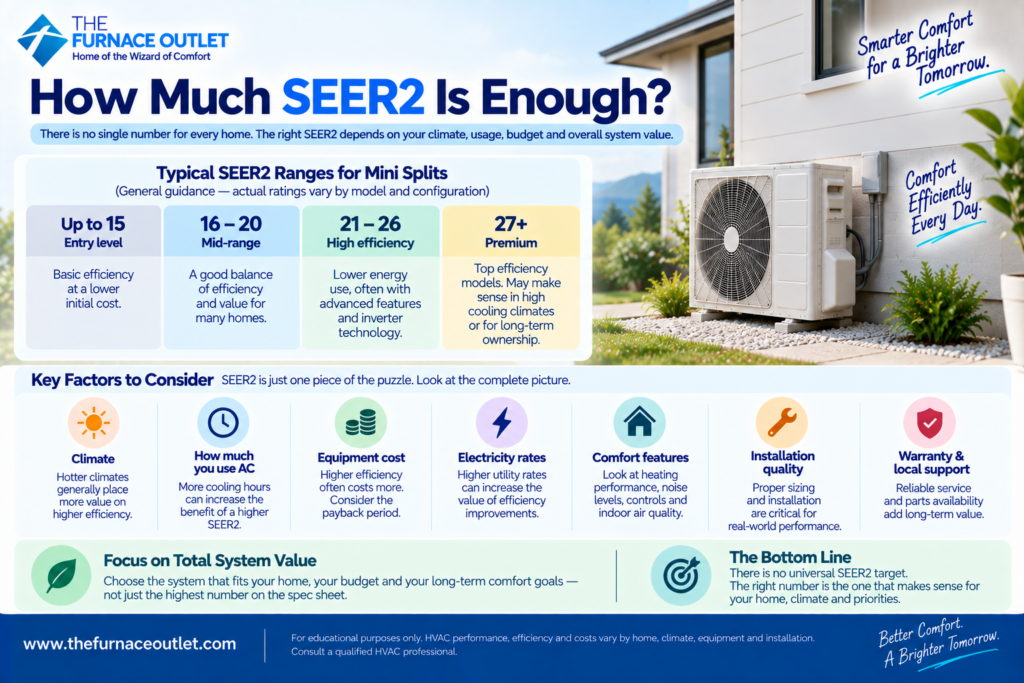
There is no single SEER2 number that every homeowner should target. The sensible range depends on climate, cooling hours, equipment cost, electricity rates, available models and how long you expect to own the system. A homeowner in an extremely cooling-intensive climate may place greater financial value on incremental efficiency than someone who runs air conditioning only occasionally.
Price differences matter as well. Moving from an entry-level system to a moderately high-efficiency model may make sense in one application, while paying a substantial premium for the last few points of SEER2 may have a very long financial payback in another. Efficiency should therefore be evaluated as part of total system value, not as a competition to purchase the largest number on the specification sheet. Comfort features, heating capability, noise, warranty, local service support, controls, equipment sizing and installation quality can all matter alongside SEER2.
When comparing two or three mini splits in 2026, I would begin by making sure all candidates are appropriately sized for the calculated load. There is little value in comparing efficiency ratings between systems that are fundamentally wrong for the space. Next, compare the exact certified indoor/outdoor combinations. Look at SEER2 for seasonal cooling efficiency and EER2 for additional cooling-performance context. If heating matters, examine HSPF2 and low-temperature capacity rather than assuming SEER2 says anything about winter performance.
Then look beyond the efficiency labels. Compare modulation range, sound levels, warranty terms, controls, installer support and equipment performance at your local design temperatures. For multi-zone equipment, pay particular attention to how the selected indoor units interact with the outdoor condenser. Nominal indoor-unit capacities should not simply be added together and treated as proof that the system is correctly designed. Finally, evaluate the installer. Correct sizing, proper refrigerant practices, equipment placement and commissioning can have more influence on your satisfaction than a small difference between two SEER2 numbers.
Before buying a mini split, I would want the proposal to identify the exact indoor and outdoor model numbers and the certified efficiency ratings for that particular combination. I would also want to know whether the contractor performed an appropriate load calculation rather than selecting equipment from square footage alone.
For cooling-focused applications, review SEER2 and EER2 together with capacity at relevant outdoor conditions. For heat-pump applications, add HSPF2, low-temperature heating capacity and any applicable cold-climate performance information to the discussion.
If two properly sized systems have similar features but different SEER2 ratings, you can then compare the additional purchase price with your expected cooling use and local electricity cost. That creates a much more useful economic comparison than simply assuming the highest SEER2 number must deliver the best value. Most importantly, make sure you are comparing complete systems rather than isolated model names. The certified indoor/outdoor combination is what matters.
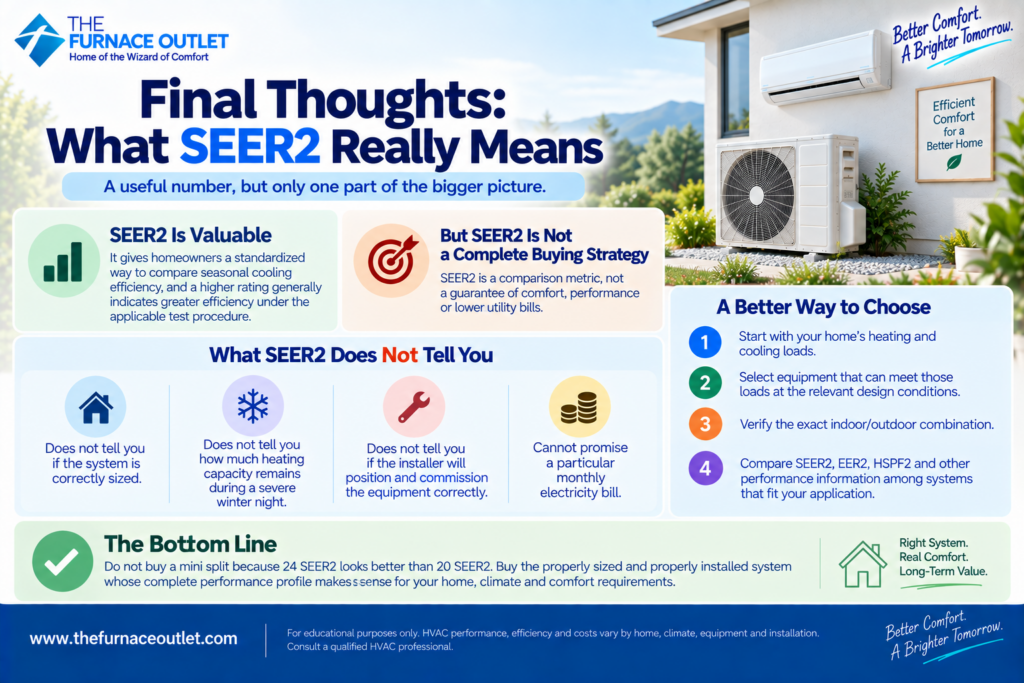
SEER2 is valuable. It gives homeowners a standardized way to compare the seasonal cooling efficiency of current mini-split systems, and a higher rating generally indicates greater cooling efficiency under the applicable test procedure.
But SEER2 is a comparison metric, not a complete HVAC buying strategy.
It does not tell you whether a mini split is correctly sized for your room. It does not tell you how much heating capacity remains during a severe winter night. It does not tell you whether the installer will position and commission the equipment correctly, and it cannot promise a particular monthly electricity bill.
For a better decision, start with the home’s heating and cooling loads. Select equipment capable of meeting those loads at the relevant design conditions. Verify the exact indoor/outdoor combination, then compare SEER2, EER2, HSPF2 and other performance information among the systems that actually fit the application.
In other words, do not buy a mini split because 24 SEER2 looks better than 20 SEER2. Buy the properly sized and properly installed system whose complete performance profile makes sense for your home, climate and comfort requirements. That is when the efficiency number becomes genuinely useful rather than simply impressive.
https://thefurnaceoutlet.com/best-mini-split-systems-of-2026-complete-brand-model-comparison/
This article is for educational purposes only. HVAC efficiency, capacity, energy consumption, operating costs and performance vary by home, climate, equipment combination, installation, maintenance and operating conditions. Consult a qualified HVAC professional for load calculations, equipment selection and installation.
The Furnace Outlet is not associated with, affiliated with, endorsed by or sponsored by any manufacturer or brand referenced in our editorial content. We do not receive manufacturer compensation for inclusion or rankings.