Newsletter Subscribe
Enter your email address below and subscribe to our newsletter

HVAC made simple
By Jake Lawson — The HVAC Specialist
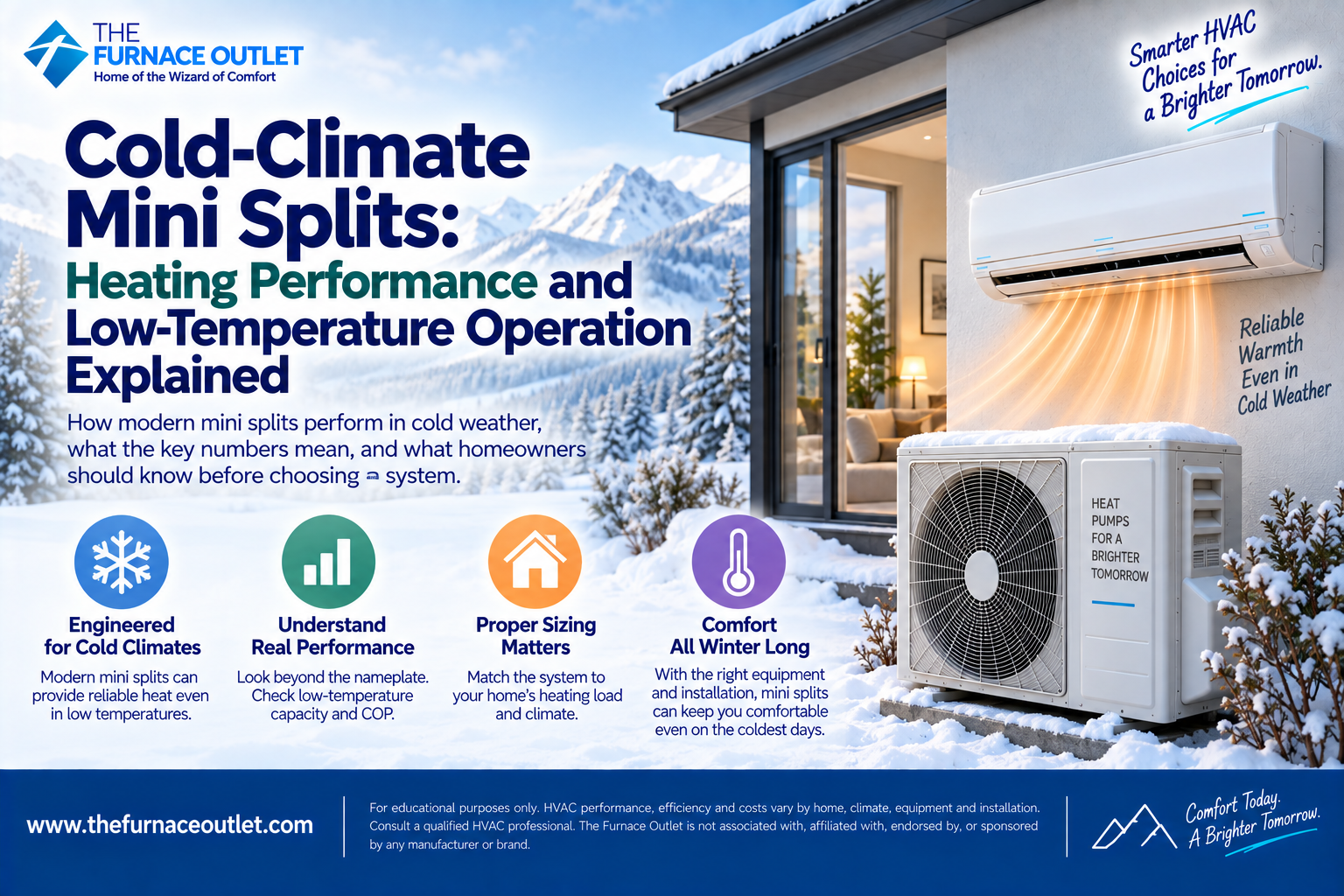
Mini splits have changed the way I think about heat pumps in cold climates. Years ago, homeowners in northern regions often treated an air-source heat pump as primarily an air conditioner that could provide some useful heat during milder weather. Modern cold-climate equipment has changed that conversation considerably.
Today’s variable-speed mini-split heat pumps can operate at temperatures that would have been challenging for earlier generations of equipment. Some are specifically engineered and certified for cold-climate applications, but that does not mean every mini split performs equally well when temperatures fall.
The most important lesson is this: do not judge cold-weather performance from the nominal BTU number, SEER2 rating or marketing description alone. What matters is how much heating capacity the exact system can deliver at your home’s winter design temperature, how efficiently it produces that heat and whether the system has been correctly sized for the building.
In this guide, I will explain what happens inside a mini split as temperatures fall, how to interpret low-temperature capacity, why COP and HSPF2 matter, what defrost does and what homeowners should verify before choosing a system for a genuinely cold climate.
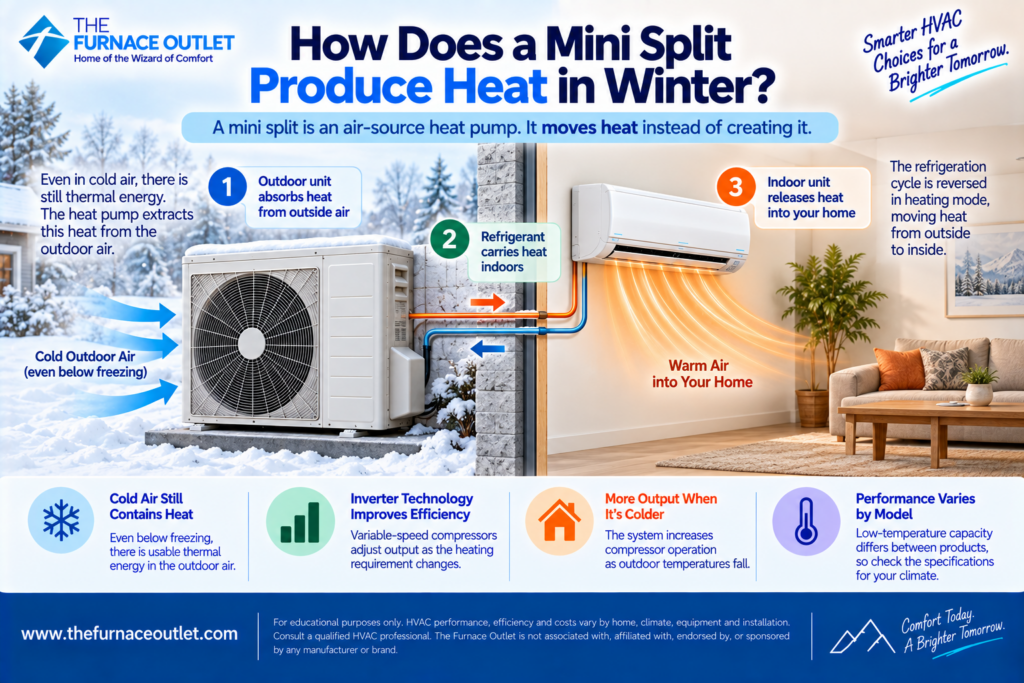
A mini split used for heating is an air-source heat pump. Instead of creating heat by burning fuel, it uses a refrigeration cycle to transfer heat from one location to another. During cooling, heat is moved from inside the home to the outdoors. During heating, that process is reversed and the system extracts heat from outdoor air and transfers it indoors.
That may sound strange when the outdoor temperature is below freezing, but cold air still contains thermal energy. The challenge is that extracting and transferring that energy becomes more demanding as outdoor temperatures fall.
Modern inverter-driven compressors are particularly useful here. Rather than simply switching between full capacity and off, variable-speed equipment can adjust compressor operation as the heating requirement changes. During relatively mild conditions, the compressor may operate at lower output. As outdoor temperatures fall and the house requires more heat, the system can increase its output.
The important question is how much useful capacity remains when conditions become severe. That varies significantly among products, which is why the words “heat pump” or “mini split” alone tell us very little about winter capability.
U.S. Department of Energy — Heat Pump Systems
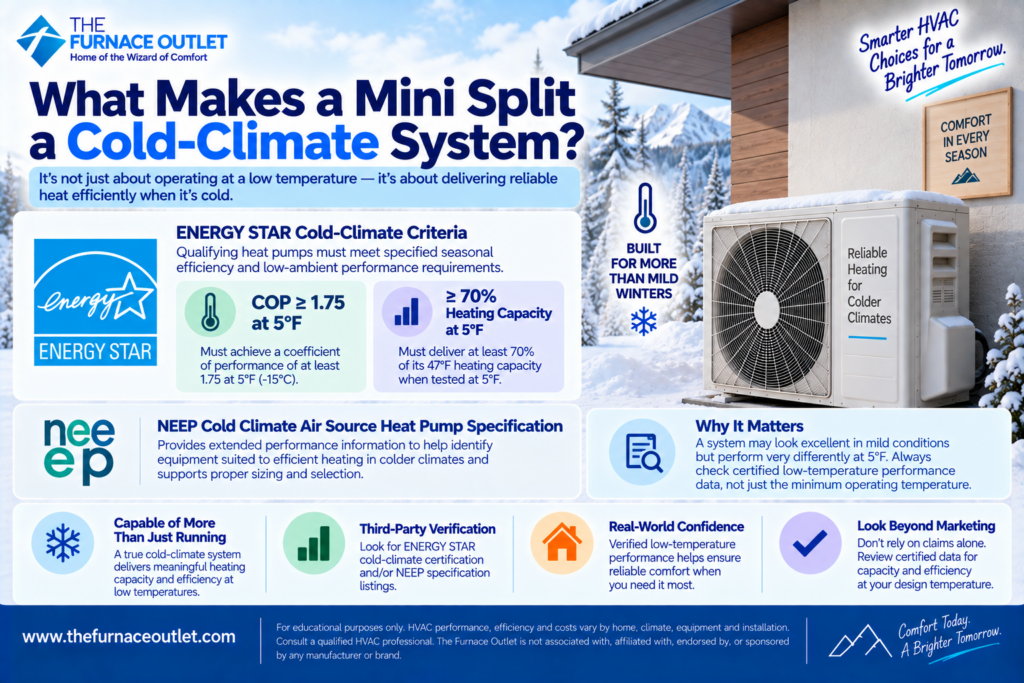
“Cold climate” should mean more than a manufacturer saying that its equipment operates at a low outdoor temperature. There is an important distinction between a system being capable of running at a certain temperature and being capable of delivering enough heat efficiently at that temperature.
ENERGY STAR provides a useful benchmark. Under its current cold-climate criteria for residential heat pumps, qualifying split systems must meet specified seasonal efficiency requirements and demonstrate low-ambient performance. Among the criteria, a cold-climate system must have a coefficient of performance, or COP, of at least 1.75 at 5°F and deliver at least 70% of its 47°F heating capacity when tested at 5°F under the applicable procedure.
Those figures help illustrate why low-temperature performance deserves separate attention. A system might look excellent when evaluated at relatively mild conditions but behave differently when the outdoor temperature reaches 5°F (-15°C).
NEEP’s Cold Climate Air Source Heat Pump specification provides another useful resource. It was developed specifically to help identify equipment suited to efficient heating in colder climates and to make extended performance information available for sizing and selection.
ENERGY STAR — Heat Pump Equipment Key Product Criteria
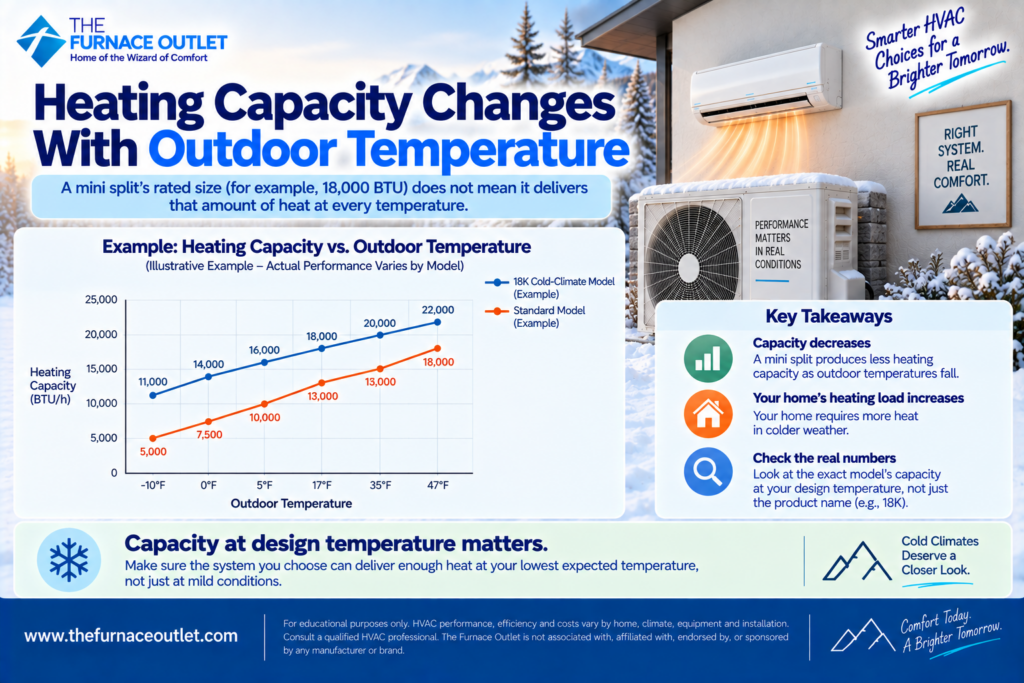
This is one of the most important concepts for anyone shopping for a cold-climate mini split. Imagine a mini split marketed as an “18,000 BTU” system. That description gives you a useful general indication of its size, but it does not mean the equipment will deliver exactly 18,000 BTU/h of heating at every outdoor temperature. Heat-pump capacity changes with operating conditions. The exact behavior depends on the equipment design, compressor operating range, indoor temperature, outdoor temperature and other factors.
Suppose your house requires 17,000 BTU/h of heat at its winter design temperature. Knowing that a mini split belongs to an 18K product family is therefore not enough. You need to determine what that exact indoor/outdoor combination can actually produce at or near the design temperature. A system might have plenty of capacity during a 35°F winter afternoon but face a much greater challenge at 5°F. Cold-climate equipment is specifically designed to maintain stronger output as temperatures fall, but performance still varies by model.
This is why capacity at design temperature matters more than the number printed on the product name.
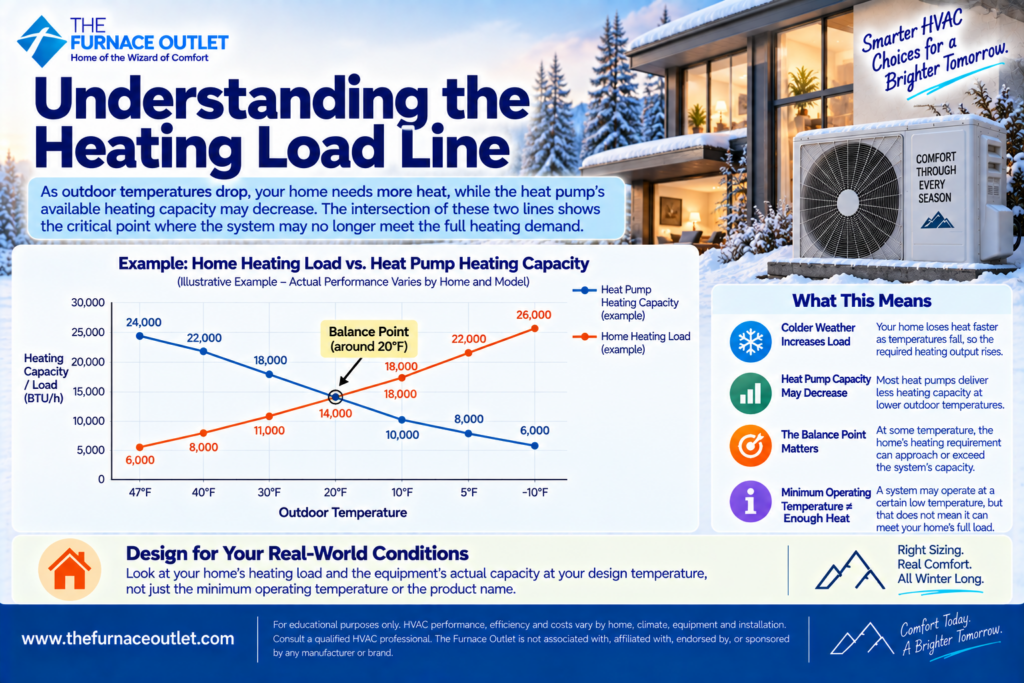
There are two things happening simultaneously as the weather gets colder. The house generally requires more heat, while the heat pump’s available heating capacity may change. Think about a simple example. At 40°F outdoors, a well-insulated home might require only a modest amount of heat. The mini split can easily satisfy that demand and spend much of its time operating at partial capacity.
At 20°F, the building loses heat faster. The required heating output rises. At 5°F, the home’s heating load may be substantially greater. At the same time, the heat pump is operating under much more demanding conditions.
The critical point occurs where the building’s heating requirement approaches or exceeds the amount of heat the system can provide. This relationship is much more informative than asking whether an equipment brochure says the unit “operates down to -13°F” or some other temperature. A minimum operating temperature tells you that the equipment may operate there. It does not, by itself, tell you whether it can carry your home’s heating load there.
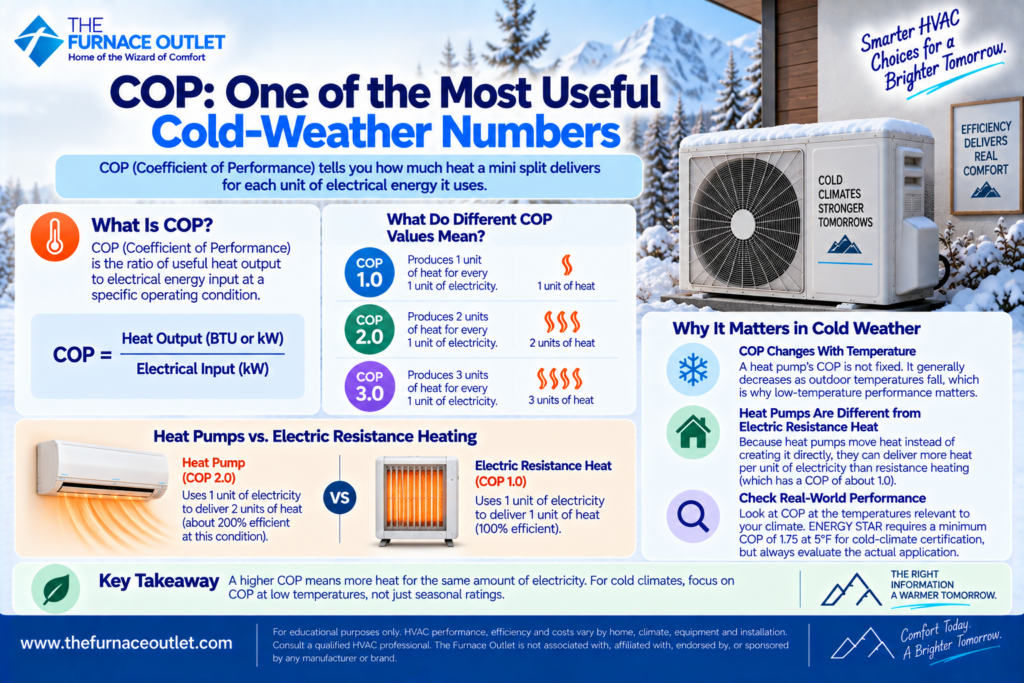
COP stands for Coefficient of Performance. It describes the relationship between useful heat delivered and electrical energy consumed at a particular operating condition.
A COP of 1 would correspond to one unit of useful heat output per unit of electrical energy input. A COP of 2 indicates roughly two units of useful heat output for each unit of electrical energy input under the specified test condition. This is one reason heat pumps can be so efficient compared with electric resistance heating: they are primarily moving heat rather than converting electricity directly into heat.
But COP is not fixed. It changes with operating conditions, and cold-weather performance deserves particular attention. When evaluating equipment for a cold climate, I therefore want more than one impressive seasonal efficiency number. I want to know how efficiently the system operates at temperatures relevant to the house. ENERGY STAR’s requirement of at least 1.75 COP at 5°F for its cold-climate designation is useful context, but certification criteria should not replace analysis of the actual application.
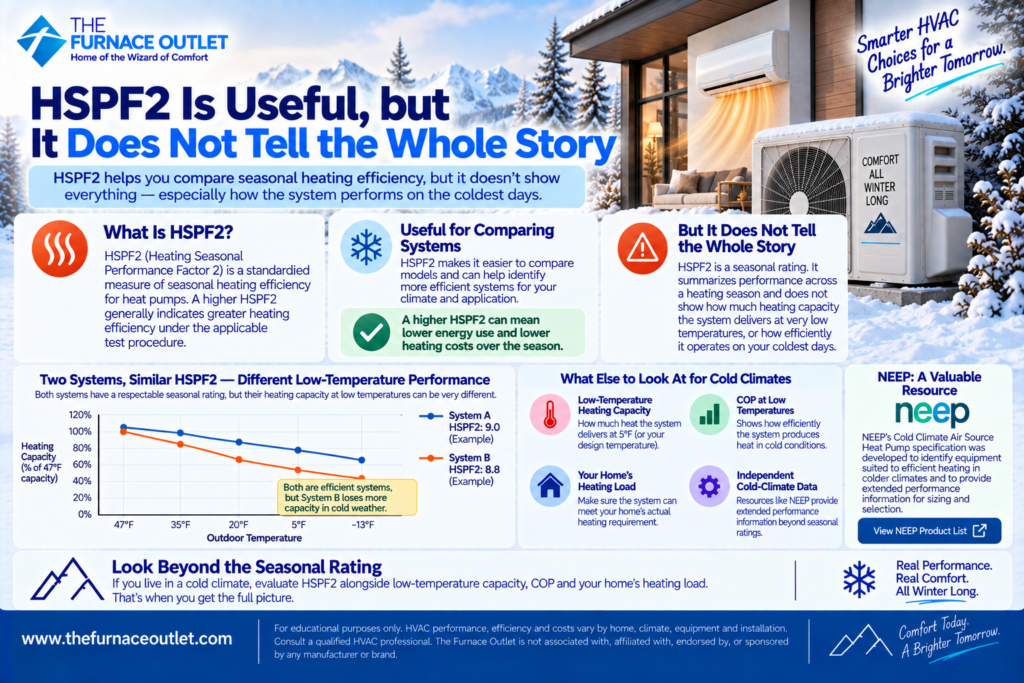
HSPF2 stands for Heating Seasonal Performance Factor 2. While SEER2 deals with seasonal cooling efficiency, HSPF2 provides a standardized measure of seasonal heating efficiency. A higher HSPF2 generally indicates greater seasonal heating efficiency under the applicable test procedure. That makes it useful when comparing heat pumps. But there is an important limitation: a seasonal rating summarizes performance across a heating season. It does not answer every question about operation during your coldest weather.
Two systems can have respectable seasonal ratings yet differ in the amount of heating capacity they retain at very low temperatures. If you live in an area where winter design conditions are severe, low-temperature capacity and COP deserve attention alongside HSPF2. NEEP developed its cold-climate specification partly because stakeholders needed better standardized information about low-temperature performance than a seasonal heating metric alone could provide.
NEEP — Cold Climate Air Source Heat Pump Specification & Product List
When I review a cold-climate mini split, 5°F (-15°C) is an especially useful reference point because standardized cold-climate criteria provide performance information around this temperature. Suppose System A delivers 100% of a particular reference heating capacity at 47°F but retains only a relatively small portion as conditions become much colder. System B maintains a much larger percentage of its capacity at 5°F.
Those systems may look similar if you only compare nominal size or even seasonal efficiency. In a mild climate, that difference might rarely matter. In a location that regularly experiences temperatures around 5°F, it can be extremely important.
That is why I would ask a contractor for the equipment’s actual low-temperature performance data rather than accepting a statement such as, “This is an 18K unit, so it gives you 18,000 BTUs.” The useful question is: How many BTU/h can this exact system deliver at my winter design temperature?
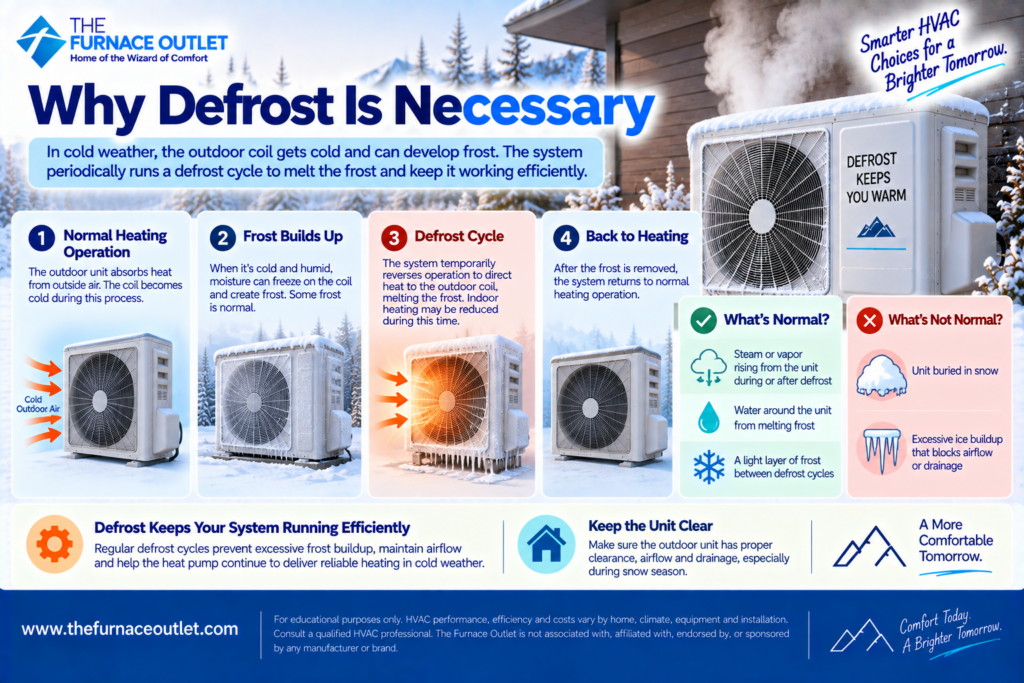
Cold-weather heat-pump operation introduces another process homeowners should understand: defrost. During heating operation, the outdoor coil becomes cold because it is absorbing heat from outside air. Under suitable temperature and humidity conditions, moisture can freeze on that coil and create frost.
Some frost is normal. Too much frost can restrict airflow and interfere with heat transfer, so the system periodically needs to remove it. A heat pump can accomplish this by temporarily changing its refrigeration operation so heat is directed toward the outdoor coil. During that period, normal indoor heating can be reduced or temporarily interrupted depending on the equipment and system design.
Seeing steam rising from an outdoor unit during or immediately after a defrost cycle can therefore be normal. Water around the unit can also result from melting frost. What is not normal is allowing the outdoor unit to become buried in snow or surrounded by ice that prevents proper airflow or drainage.
Where the outdoor condenser is installed can make a meaningful difference in cold climates. The unit needs sufficient airflow, appropriate manufacturer-specified clearances and a location that allows defrost water to drain. In areas with significant snowfall, installers may elevate the condenser so accumulated snow does not block the coil.
Roof runoff deserves attention too. Placing equipment where water repeatedly falls onto it and freezes can create avoidable problems. Likewise, homeowners should not build tight decorative enclosures around outdoor units simply to hide them. Heat pumps move substantial volumes of air, and restricted airflow can interfere with performance.
The manufacturer’s installation instructions should determine clearances and mounting requirements. Cold-climate installations require the contractor to think about the site in January, not merely how convenient the location looks on installation day in July.
If heating will be a major responsibility of the mini split, proper load calculation becomes essential. A rule such as “20 BTU per square foot” cannot adequately account for winter design temperature, insulation, windows, air leakage, ceiling height, building orientation and numerous other variables affecting heat loss.
Two 1,500-square-foot houses can have dramatically different heating requirements. ACCA describes Manual J as the ANSI-recognized standard for producing residential HVAC equipment-sizing loads. The methodology addresses both heating and cooling loads and includes building and weather information that simple square-foot rules cannot capture.
For a ductless project serving several rooms, room-by-room calculations become especially useful because the whole-house heating load does not reveal how much capacity each individual space requires.
ACCA — Manual J Residential Load Calculation
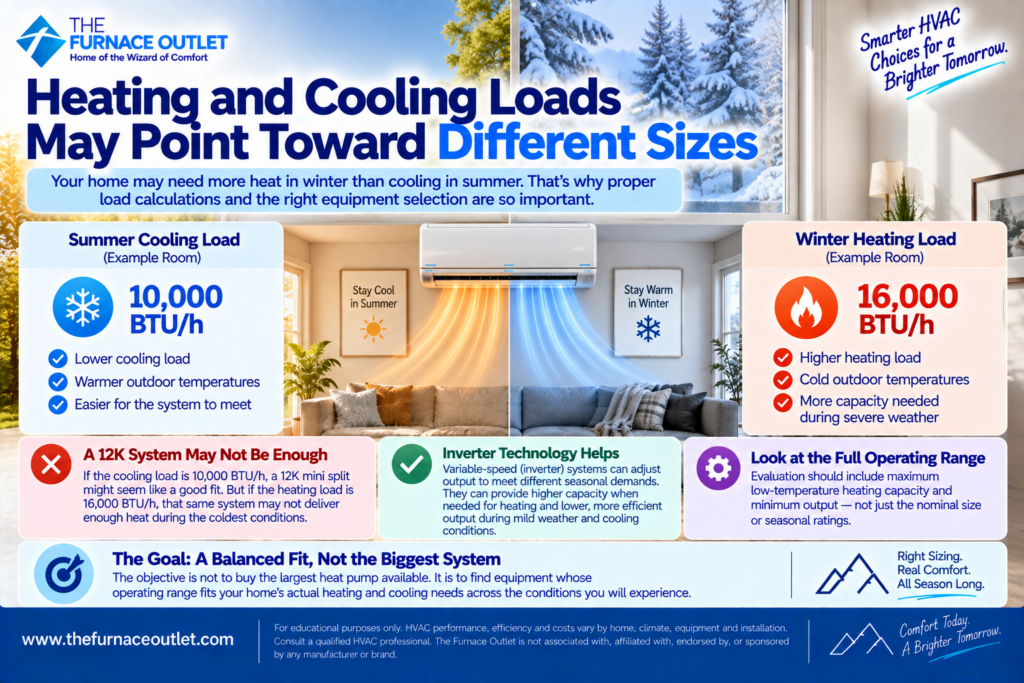
A house might require considerably more capacity for winter heating than for summer cooling, particularly in a cold climate. Suppose a room has a calculated cooling load of 10,000 BTU/h but a heating load of 16,000 BTU/h at the winter design condition. Simply installing a conventional 12K mini split because the cooling load appears to fit could leave insufficient heating capacity during severe weather.
But automatically installing a much larger system creates another potential problem. The larger equipment still has to operate effectively during mild weather and summer cooling conditions. This is where inverter modulation and careful equipment selection become important. The designer needs to examine maximum low-temperature heating capacity and minimum output, rather than focusing on only one end of the operating range.
The objective is not to buy the largest heat pump available. It is to find equipment whose operating range fits the building across the conditions it will actually experience.
The term balance point can be useful when discussing heat pumps. In simplified terms, a building balance point in this context can describe the outdoor condition where the home’s heating requirement and the heat pump’s available heating capacity intersect. Below the relevant capacity balance point, the heat pump alone may no longer provide enough heat to satisfy the full building load.
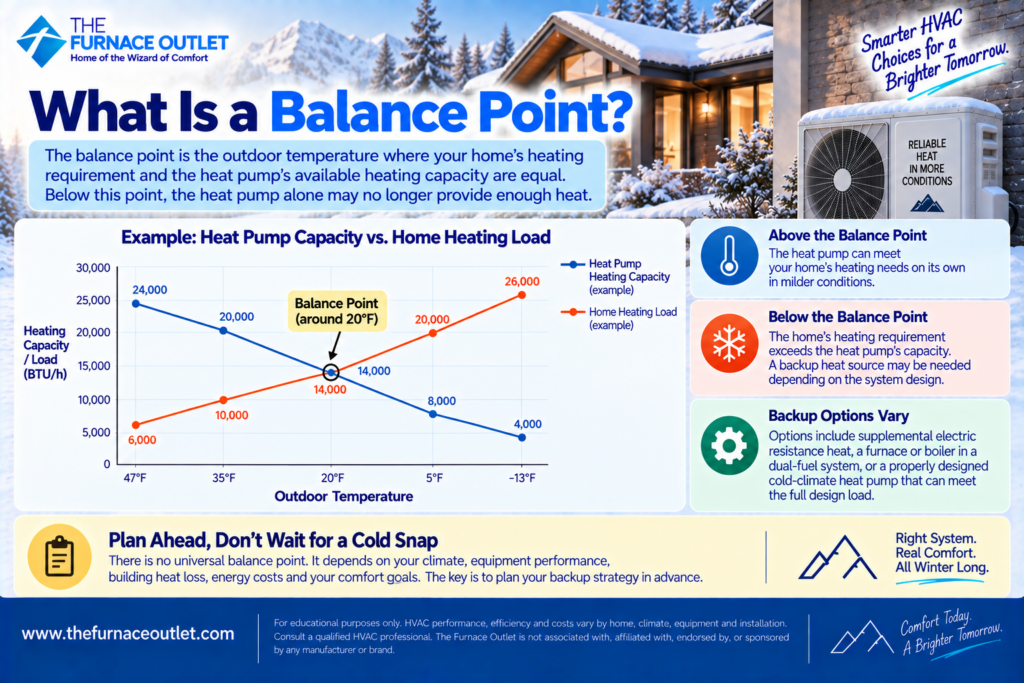
What happens after that depends on the system design. Some homes have supplemental electric resistance heat. Others retain a furnace or boiler as part of a dual-fuel or hybrid arrangement. Some properly designed cold-climate heat-pump systems can cover the intended design heating load without a conventional backup system.
There is no universal answer because climate, equipment performance, building heat loss, electricity prices, fuel costs and homeowner priorities vary. What matters is that the backup strategy should be planned, not discovered during the first severe cold snap.
Cold-weather buyers also need to distinguish between single-zone and multi-zone equipment. A manufacturer’s high-performing single-zone mini split should not automatically be assumed to represent the performance of its multi-zone systems. Multi-zone equipment shares outdoor-unit capacity among multiple indoor units, and performance depends on the specific approved combination.
If three indoor heads are connected to one condenser, ask for the exact model numbers of all four pieces of equipment. Then review the certified combination and extended performance information where available. NEEP’s cold-climate resources are useful because the product list is intended not merely to identify qualifying equipment but also to provide extended performance data that can support sizing and selection.
This becomes particularly important when several rooms may require substantial heating simultaneously on a very cold morning.
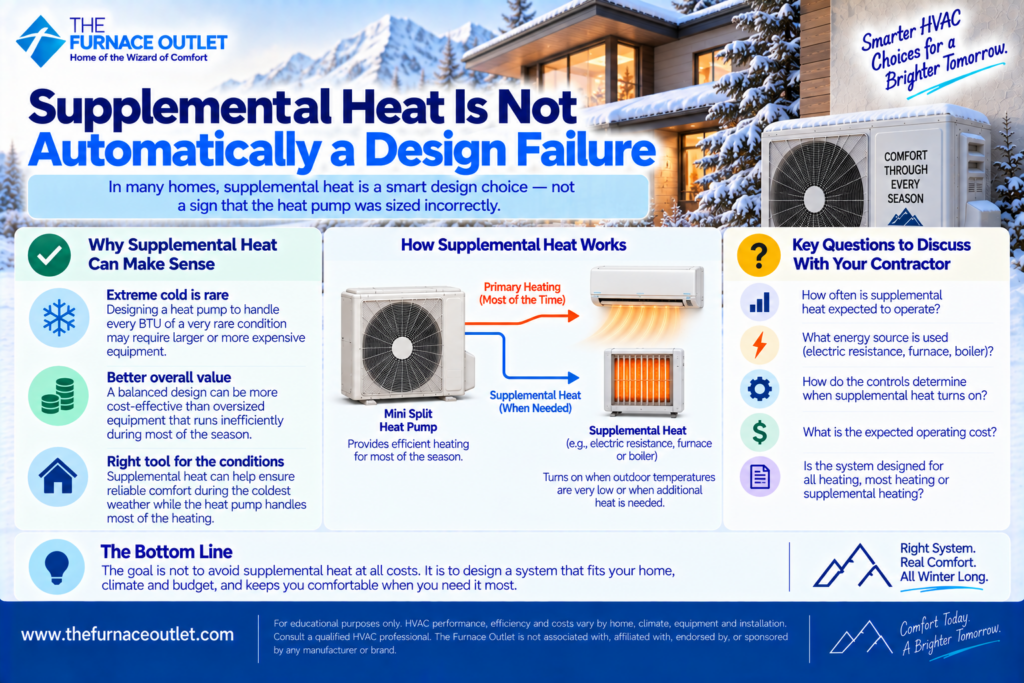
Homeowners sometimes assume that needing any supplemental heat means the heat pump was poorly selected. That is too simplistic. In some applications, designing a heat pump to cover every BTU of an extremely rare weather condition could require larger or more expensive equipment that is less appropriate during the overwhelming majority of operating hours.
A carefully designed supplemental-heating strategy may therefore make sense. The important questions are how frequently supplemental heat is expected to operate, what energy source it uses, how controls determine when it operates and whether the homeowner understands the expected operating cost.
A contractor should be able to explain whether the proposed mini split is intended to provide all heating, most heating or supplemental heating alongside another system.
When comparing cold-climate mini splits, I would request the exact outdoor and indoor model numbers and then look beyond the headline specifications. Start with the calculated heating load at the local winter design condition. Next, determine the system’s available heating capacity near that temperature. Review COP or other efficiency information at relevant low-temperature points, HSPF2, minimum and maximum capacity, and the manufacturer’s specified operating range.
For a certified cold-climate product, check applicable ENERGY STAR information and extended cold-weather performance resources such as the NEEP product list. Certified combinations and manufacturer engineering data should take priority over generic statements about a product family. ACCA’s system-design framework follows the same general logic: Manual J establishes the loads, while equipment selection should use those loads together with OEM performance information.
Modern cold-climate mini splits can provide effective heating at outdoor temperatures that once made air-source heat pumps difficult to consider as a primary heating system. Variable-speed compressors, improved controls and equipment specifically designed for low-temperature operation have significantly expanded where heat pumps can be practical.
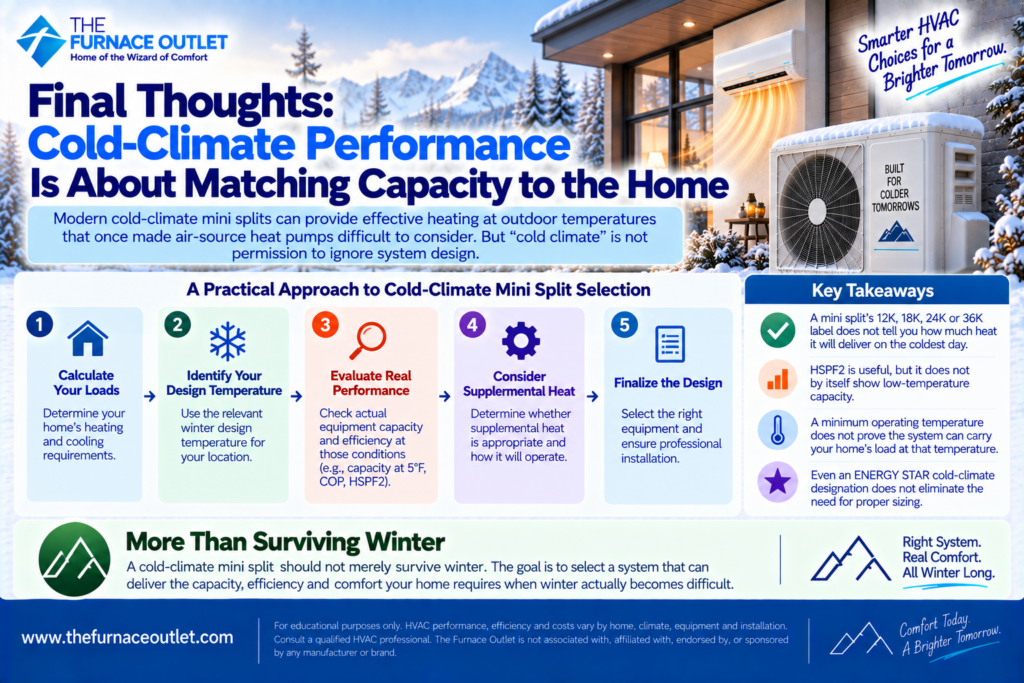
But “cold climate” is not permission to ignore system design. A mini split’s nominal 12K, 18K, 24K or 36K designation does not tell you how much heat it will deliver on the coldest design day. HSPF2 does not by itself describe low-temperature capacity. A minimum operating temperature does not prove that the system can carry your home’s load at that temperature, and even an ENERGY STAR cold-climate designation does not eliminate the need for proper sizing.
The sequence I prefer is straightforward: calculate the home’s heating and cooling loads, identify the relevant winter design temperature, evaluate actual equipment capacity and efficiency at those conditions, determine whether supplemental heat is appropriate, and only then finalize the equipment and installation design.
A cold-climate mini split should not merely survive winter. The objective is to select a system that can deliver the capacity, efficiency and comfort your home requires when winter actually becomes difficult.
https://thefurnaceoutlet.com/best-mini-split-systems-of-2026-complete-brand-model-comparison/
This article is for educational purposes only. Heating capacity, efficiency, low-temperature operation, energy consumption and operating costs vary by climate, building characteristics, equipment combination, installation and operating conditions. Consult a qualified HVAC professional for load calculations, equipment selection and installation.
The Furnace Outlet is not associated with, affiliated with, endorsed by or sponsored by the manufacturers or brands that may be discussed in our editorial content. We do not receive manufacturer compensation for inclusion or rankings