Newsletter Subscribe
Enter your email address below and subscribe to our newsletter

HVAC made simple

By Jake Lawson — The HVAC Specialist
When homeowners compare mini splits, the conversation usually starts with efficiency, heating capacity, noise, smart controls and price. Those are all important. But there is another question I would put surprisingly high on the list: What happens if the system needs a repair five or eight years from now?
A mini split is not simply an appliance you hang on the wall and forget about. It is a long-term HVAC system containing a compressor, electronic controls, sensors, fan motors, circuit boards and other model-specific components. Eventually, any mechanical system can need service. That is why I would never choose a mini-split brand solely because it offers an impressive efficiency rating or an attractive purchase price. I also want to understand the warranty, who can service the equipment locally, how warranty claims are handled and whether replacement parts are realistically obtainable.
A long warranty can provide valuable protection, but warranty length is only one part of the ownership story.
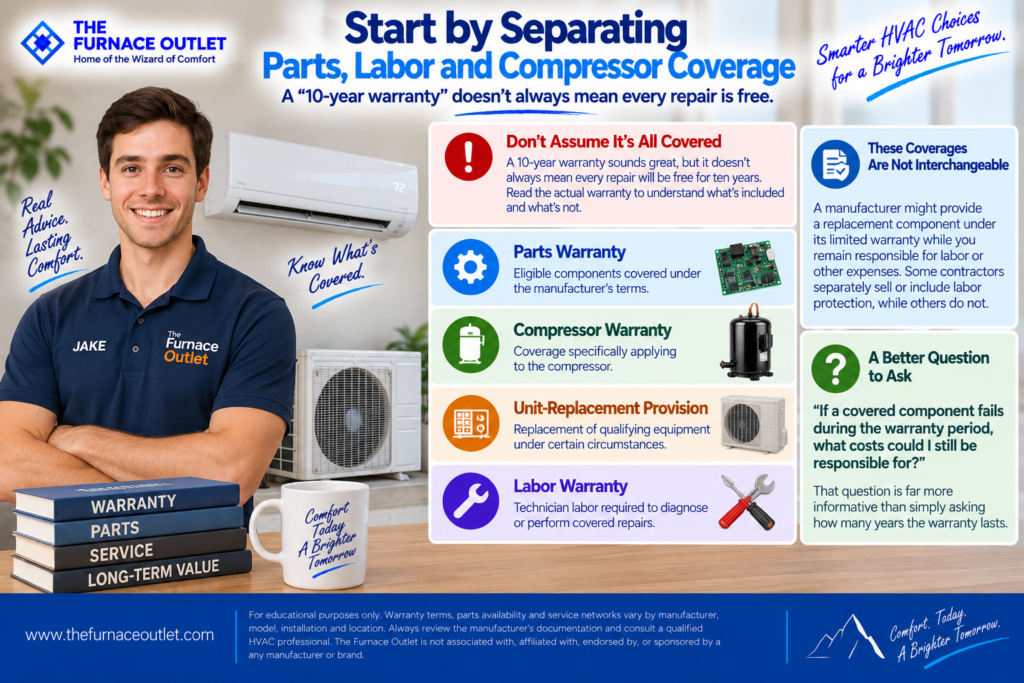
One of the easiest warranty mistakes is seeing a phrase such as “10-year warranty” and assuming virtually every repair will be free for ten years. That may not be what the warranty says.
Mini-split warranties can contain several different types of protection. Depending on the manufacturer, model and program, you may encounter coverage for:
| Coverage | What It Generally Refers To |
|---|---|
| Parts warranty | Eligible components covered under the manufacturer’s terms |
| Compressor warranty | Coverage specifically applying to the compressor |
| Unit-replacement provision | Replacement of qualifying equipment under certain circumstances |
| Labor warranty | Technician labor required to diagnose or perform covered repairs |
These categories should not be treated as interchangeable. A manufacturer might provide a replacement component under its limited warranty while the homeowner remains responsible for labor or other expenses associated with the repair. Some contractors separately sell or include labor protection, while others do not.
Before purchasing, ask: “If a covered component fails during the warranty period, what costs could I still be responsible for?”
That question is far more informative than simply asking how many years the warranty lasts.

Marketing material needs to communicate quickly. Warranty documents have a different job: they explain the actual terms, conditions, limitations and exclusions. That difference matters.
For example, current Daikin warranty information shows how coverage can vary by equipment and how registration can affect additional warranty terms. Daikin states for applicable products that registration within the specified period may provide additional coverage, while also noting that laws in certain states and provinces affect whether warranty coverage can be conditioned on registration.
GENERAL’s current AIRSTAGE mini-split warranty information provides another example. Its published U.S./Canada information lists different standard and extended coverage depending on installation, registration and contractor status, and it includes specific restrictions concerning internet purchases. The lesson is not that one warranty structure is universally preferable.
It is that the headline number does not tell you the whole story. Before making a decision, download the current warranty document for the exact equipment being quoted.

After a new HVAC system is installed, homeowners understandably want to start enjoying it rather than filling out paperwork. Do not overlook registration. Some manufacturers provide an initial level of coverage and offer additional warranty terms when qualifying equipment is registered within a specified period.
For example, Daikin’s current registration information says registration is not required for its initial term warranty, but qualifying additional coverage requires timely registration, subject to exceptions where applicable law provides otherwise. GENERAL likewise publishes extended AIRSTAGE warranty terms associated with qualifying installation and product registration.
Requirements differ by manufacturer, product and jurisdiction, so never assume one brand’s rules apply to another. My preference is simple: make registration part of the installation closeout process. Save the confirmation along with the invoice, model numbers and serial numbers.
Mini splits require proper installation, and warranty documents can contain installation-related conditions. That is another reason the contractor matters almost as much as the equipment.
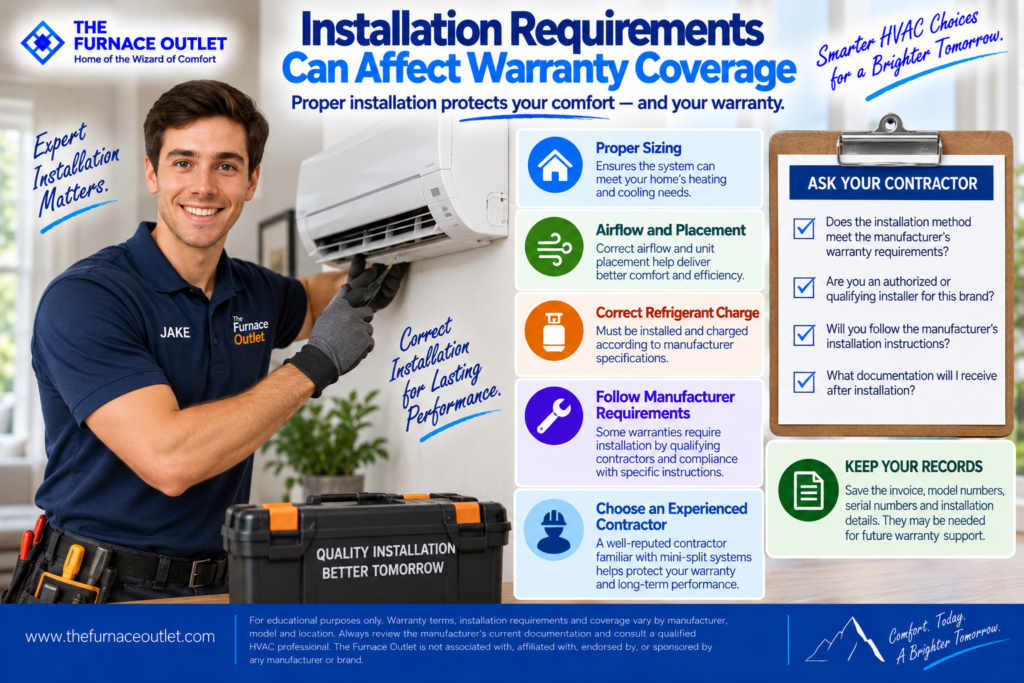
ENERGY STAR recommends choosing a well-reputed contractor familiar with ductless or mini-split systems. Its HVAC guidance emphasizes correct equipment sizing, airflow, refrigerant charge and installation practices as important elements of system performance. Some manufacturer warranty terms also specify installation requirements. GENERAL, for example, states conditions involving installation by qualifying contractors and compliance with applicable instructions and requirements for certain warranty coverage.
Before installation, ask the contractor whether the proposed installation method satisfies the manufacturer’s current warranty requirements. Do not wait until a claim occurs years later to discover that documentation is missing.
Where you purchase the equipment can matter. This has become particularly important because mini splits are widely available online. A low internet price can look attractive compared with a contractor-supplied system. But purchasing equipment through an unauthorized sales channel may affect warranty eligibility for some brands.
GENERAL’s current U.S./Canada AIRSTAGE warranty page, for example, explicitly states restrictions concerning systems purchased over the internet or through online retailers. That does not mean every manufacturer has the same policy. It means you should check before buying. If purchasing equipment separately from installation, ask the manufacturer in writing whether the seller is authorized and whether purchasing from that source preserves the warranty applicable to the product. Saving a few hundred dollars upfront becomes much less attractive if it creates uncertainty about future warranty support.
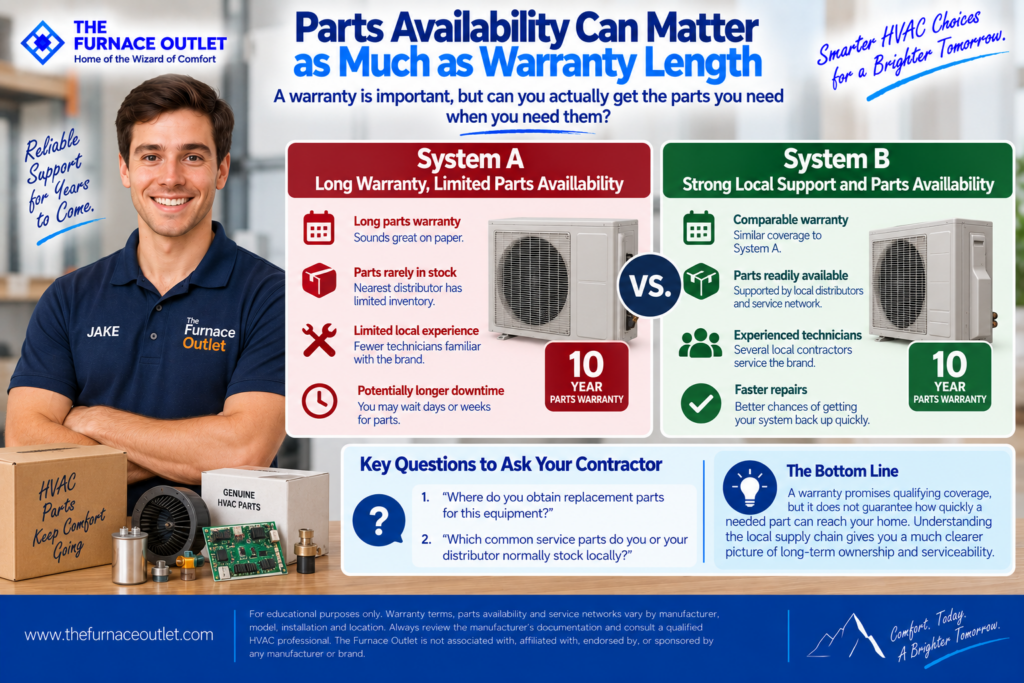
Imagine two systems. System A has a long parts warranty, but the nearest distributor rarely stocks its components and local technicians have limited experience with the brand. System B has comparable equipment supported by several local contractors and an established distribution channel in your area.
Which ownership experience would you rather have when the air conditioner stops working during a heat wave? A warranty promises qualifying coverage under defined conditions. It does not automatically tell you how quickly a needed part can reach your home.
Before choosing a brand, I would ask the contractor: “Where do you obtain replacement parts for this equipment?”
Then follow with: “Which common service parts do you or your distributor normally stock locally?”
You are not expecting every component to sit on a nearby shelf. Modern HVAC systems contain many model-specific parts. But understanding the local supply chain gives you a much better picture of potential serviceability.
Modern inverter mini splits rely heavily on electronics. Depending on the system, components can include control boards, inverter electronics, temperature sensors, communication components, fan-motor controls and Wi-Fi or interface hardware.
That makes electronic-parts support worth discussing. A system can have an excellent compressor and still become unusable temporarily if another essential component fails. Ask whether the contractor regularly services the brand and whether it has a reliable process for identifying and ordering model-specific electronic parts.
I would also ask how long the contractor has worked with that manufacturer. Experience does not guarantee that every repair will be easy, but a technician familiar with the brand’s diagnostic procedures and controls may have an easier time troubleshooting the equipment than someone encountering it for the first time.

A manufacturer can have a strong national presence while contractor coverage varies substantially from one location to another. That distinction is important. A homeowner in one city might have several experienced dealers nearby, while someone living in a rural area could have far fewer options.
Before choosing equipment, search the manufacturer’s current contractor locator and then ask potential contractors about their actual service practices. ENERGY STAR recommends checking references and selecting contractors experienced with the equipment being considered. It also advises homeowners comparing bids to consider warranty information rather than evaluating price alone.
I would want to know: Who will service this system if the original installer is unavailable five years from now?
That question can reveal more about long-term ownership than another small difference in an efficiency rating.
Homeowners sometimes assume they must use the original installer forever. The actual process depends on the manufacturer’s warranty program and dealer network. Before buying, determine how warranty service works if your installer closes, relocates or simply stops servicing that particular brand.
GENERAL’s support resources, for example, provide product registration, warranty lookup, documentation, troubleshooting resources and a contractor-location service. Look for similar support infrastructure when evaluating other manufacturers.
A mature service ecosystem should make it reasonably clear how an owner obtains technical documentation, finds service and starts a warranty claim.
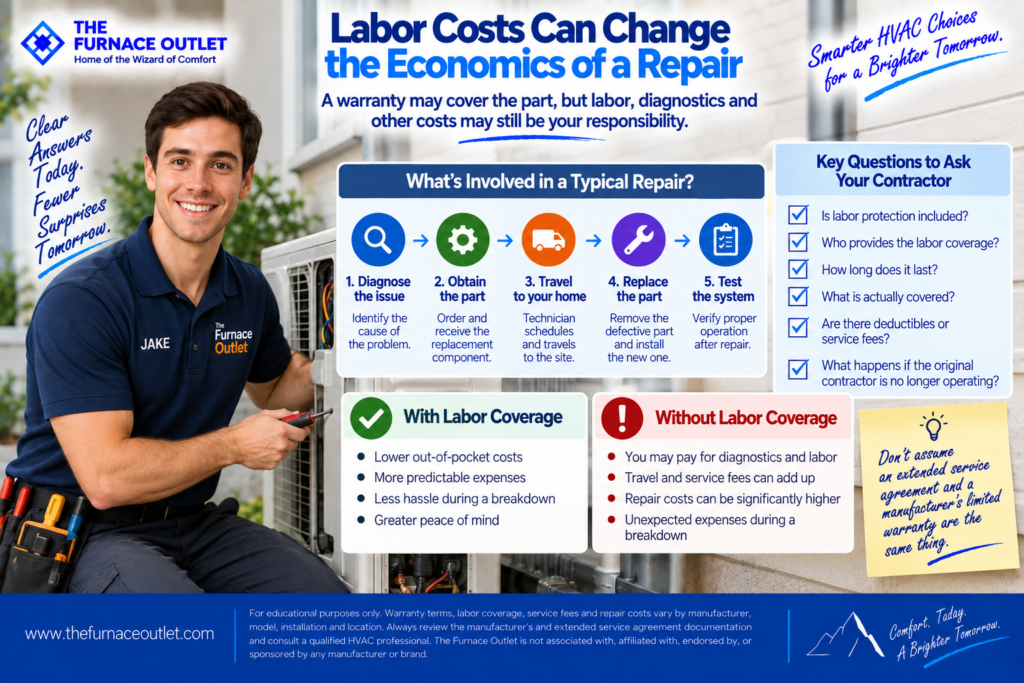
Suppose an eligible replacement part is provided under warranty. Someone still has to diagnose the failure, obtain the component, travel to the home, remove the defective part, install the replacement and test the system. Depending on the warranty and service arrangement, some or all of that work may not be covered by the manufacturer’s parts warranty.
There can also be other expenses depending on the repair and warranty terms. This is why I recommend getting a straightforward answer from the contractor: “What labor protection is included, who provides it and how long does it last?”
If an extended labor plan is offered, read its terms too. Determine who actually backs the agreement, what is covered, whether deductibles or service fees apply and what happens if the original contractor is no longer operating. Do not assume that an extended service agreement and a manufacturer’s limited warranty are the same thing.
Regular maintenance is sensible regardless of warranty requirements. Filters need attention, outdoor equipment should remain unobstructed and the system should be inspected when operating problems appear. ENERGY STAR recommends regular maintenance to help prevent future problems and unwanted costs.
But some warranty provisions can include more specific conditions. A current Daikin warranty document, for example, describes maintenance-related requirements for a particular unit-replacement provision. That does not mean every Daikin product has identical conditions, nor does it establish a rule for other brands.
It demonstrates why reading the specific warranty certificate matters. If maintenance records could become relevant to coverage, keep invoices and service reports rather than relying on memory.
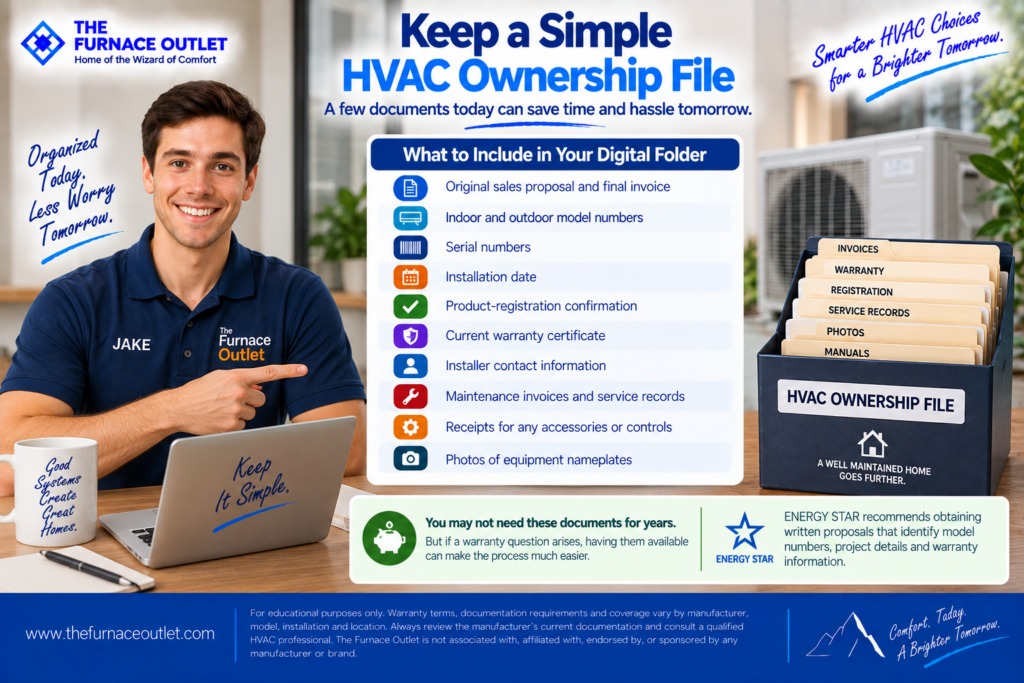
This is one of the easiest things a homeowner can do.
After installation, create a digital folder containing:
You may not need those documents for years.
But if a warranty question eventually arises, having them available can make the process much easier. ENERGY STAR recommends obtaining written proposals that identify model numbers, project details and warranty information.
Suppose one mini split advertises twelve years of qualifying parts coverage while another advertises ten. The two-year difference sounds significant. But imagine that the second brand has multiple experienced service contractors nearby, strong distributor support and parts readily obtainable in your region.
The first has almost no local support. The longer warranty does not automatically create the better ownership experience.
I would evaluate warranty coverage alongside: equipment suitability + installation quality + contractor expertise + parts distribution + service availability.
That combination provides a much more realistic picture of long-term ownership.
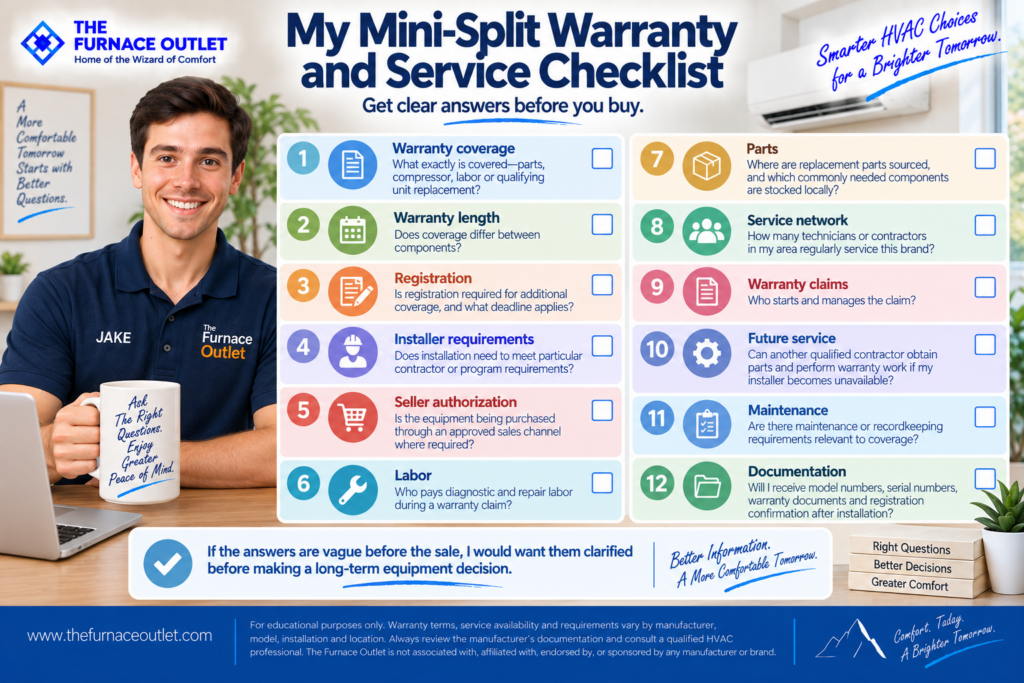
Before signing a proposal, I would ask the contractor or manufacturer to confirm the following:
If the answers are vague before the sale, I would want them clarified before making a long-term equipment decision.
It is easy to become impressed by a mini split with exceptional efficiency numbers, advanced cold-weather performance, whisper-quiet operation and a polished smartphone app. Those features matter. But five or ten years after installation, you may care much more about whether a technician answers the phone and whether the required replacement part can be obtained.
That is why I think homeowners should evaluate the support ecosystem, not just the equipment. A warranty is valuable, but it works within specific terms. Parts coverage is useful, but the component still has to be identified and obtained. Advanced technology is attractive, but somebody nearby needs to understand how to diagnose and service it.
Before choosing a mini-split brand, look beyond the brochure. Read the warranty. Verify registration requirements. Understand labor coverage. Investigate local contractors. Ask where parts come from. Keep your documentation. ENERGY STAR’s consumer guidance similarly emphasizes contractor quality, proper installation, regular maintenance and consideration of warranty information when evaluating HVAC proposals.
The mini split you choose should not only perform well on installation day. It should be a system you can realistically maintain, repair and support for years to come.
https://thefurnaceoutlet.com/best-mini-split-systems-of-2026-complete-brand-model-comparison/
This article is for educational purposes only. Warranty terms, registration requirements, exclusions, labor coverage, dealer requirements, maintenance conditions, parts availability and service networks vary by manufacturer, model, installation, location and applicable law. Manufacturer policies can also change. Always review the current written warranty for the exact equipment being considered and verify requirements directly with the manufacturer and a qualified HVAC professional.
The Furnace Outlet is not associated with, affiliated with, endorsed by or sponsored by any manufacturer or brand referenced in our editorial content, and we do not receive manufacturer compensation for inclusion or rankings.
More reference study material:
ENERGY STAR — 10 Tips for Hiring a Heating and Cooling Contractor — Excellent support for your sections on contractor selection, references, written estimates, equipment details and warranties.
ENERGY STAR — 10 Tips for Hiring a Heating and Cooling Contractor
Daikin — Official Limited Warranty — Useful primary-source material for explaining the difference between initial warranty coverage and additional registered coverage, registration deadlines, and jurisdiction-specific exceptions.
Daikin — Limited Warranty Certificate
Daikin — Product Registration — Supports your recommendation to register equipment and retain the registration certificate with the homeowner’s HVAC records.
Daikin — Product Registration
GENERAL — AIRSTAGE Mini-Split Warranty — Particularly valuable because it demonstrates how parts/compressor coverage can change according to registration and contractor status. It also documents the manufacturer’s policy regarding internet purchases.
GENERAL — AIRSTAGE Mini-Split Warranty Information
Mitsubishi Electric — Product Registration & Warranty Eligibility — Another useful manufacturer example showing how registration, installation circumstances and contractor status can affect available warranty terms.
Mitsubishi Electric — Register Your Product