Newsletter Subscribe
Enter your email address below and subscribe to our newsletter

HVAC made simple

A 24,000 BTU mini split can be an excellent choice for a large room, open-concept living area, finished basement, garage, workshop, studio, or addition. With approximately 2 tons of nominal capacity, it provides considerably more heating and cooling output than the smaller 9K, 12K, and 18K capacity classes. That additional capacity is valuable when the building actually needs it, but it can become a disadvantage when a 24K system is installed in a space with a substantially smaller heating and cooling load.
One of the most common assumptions I hear is that buying a larger mini split provides extra protection during extreme weather. The reasoning sounds sensible: if 18K might be enough, why not install 24K and have additional capacity available? Modern inverter technology makes that argument more complicated because mini splits can modulate their output rather than operating only at full capacity. However, inverter operation does not make equipment sizing irrelevant.
Every mini split has an operating range. There is a minimum amount of capacity the system can provide, a rated capacity, and a maximum output under specified conditions. If a 24K system’s minimum output is still greater than what the room requires for significant portions of the year, the system cannot simply continue reducing its capacity indefinitely. It may eventually cycle off and restart later.
That is why my question is never simply, “Can a 24K mini split cool this room?” A sufficiently large system probably can. The more useful question is, “Does the operating range of this particular 24K system match the heating and cooling loads of this particular space?”
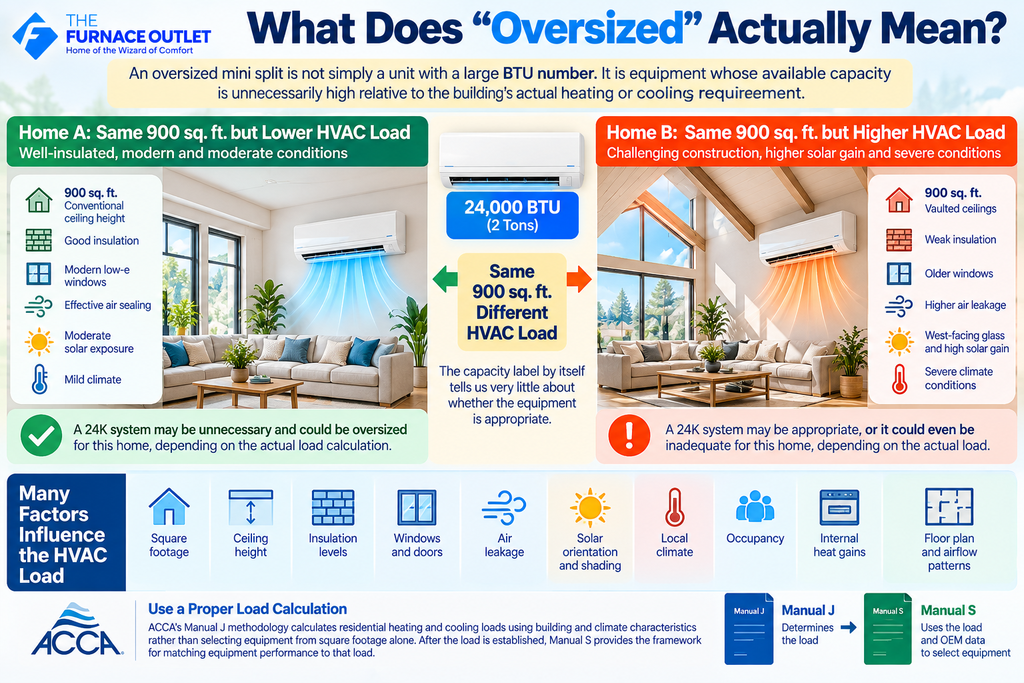
An oversized mini split is not simply a unit that has a large BTU number. It is equipment whose available capacity is unnecessarily high relative to the building’s actual heating or cooling requirement. A 24K system could be oversized in one home and correctly sized in another. It could even be inadequate for an unusually demanding space. The capacity label by itself therefore tells us very little about whether the equipment is appropriate.
Consider two 900-square-foot spaces. The first has conventional ceilings, excellent insulation, modern low-e windows, effective air sealing, moderate solar exposure, and a mild climate. The second has vaulted ceilings, older windows, weak insulation, substantial air leakage, west-facing glass, and extreme outdoor conditions.
Both spaces have identical floor area, yet their calculated loads can be very different. Installing the same 24K system in both buildings simply because they are each 900 square feet ignores most of the factors that determine HVAC demand.
ACCA’s Manual J methodology is designed to calculate residential heating and cooling loads using building and climate characteristics rather than selecting equipment from square footage alone. After the load is established, Manual S provides the framework for matching equipment performance to that load.
HVAC equipment is different from many products where buying additional capability has little downside. If you purchase a computer with more storage than you need, the extra capacity generally sits unused without affecting how the computer operates. HVAC equipment has to interact continuously with a changing building load.
On a very hot afternoon, your room may require substantial cooling. During a mild morning, it may need only a fraction of that amount. The ideal inverter mini split adjusts its output as the load changes and operates for long periods at an appropriate capacity.
A correctly selected system therefore needs enough upper-end capacity to handle design conditions while also being capable of reducing output sufficiently during milder conditions. This balance is why I would not select 24K merely because it is larger than 18K. The objective is not to maximize BTUs. The objective is to match equipment performance to the building across a useful range of operating conditions.
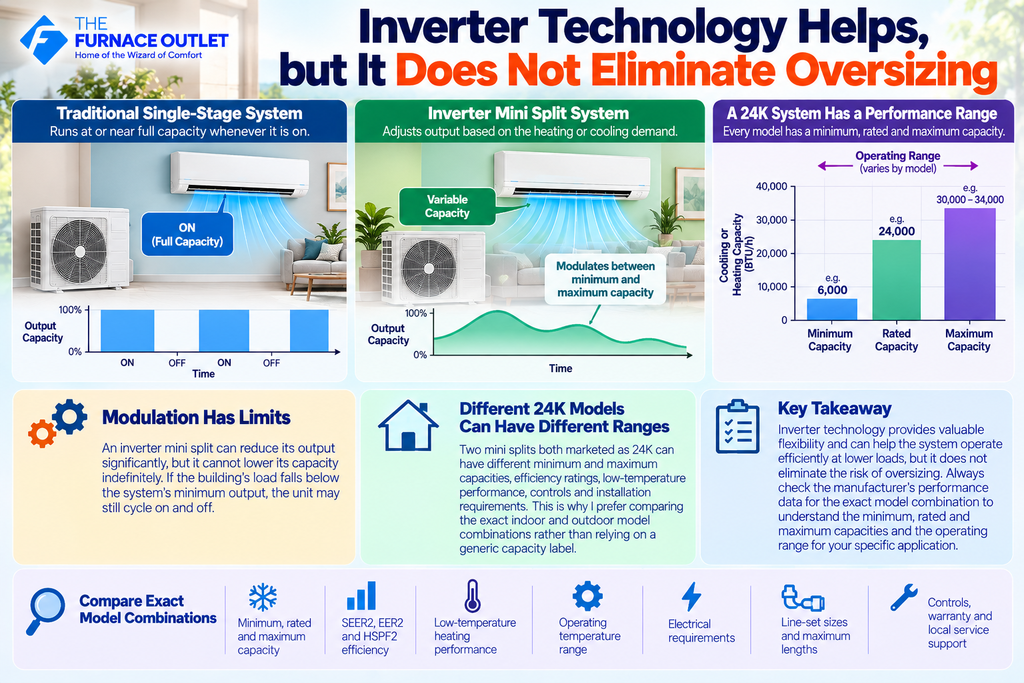
Traditional single-stage air conditioners generally operate at or near full compressor capacity whenever they are running. Inverter mini splits are much more flexible because their variable-speed compressors can adjust output as heating or cooling demand changes.
That flexibility is one of the major advantages of modern ductless equipment. A nominal 24K mini split does not necessarily deliver exactly 24,000 BTU/h every minute it operates. However, modulation has limits. Every specific indoor/outdoor combination has a manufacturer-defined performance envelope that includes minimum, rated, and maximum capacities. The system cannot reduce its output indefinitely.
Imagine that a particular 24K system can modulate substantially below its nominal rating. That may allow it to operate efficiently in a space whose load frequently falls below 24,000 BTU/h. Another 24K model could have a different minimum output and behave differently in the same building.
This is why I prefer comparing exact model combinations rather than generic capacity labels. Two products both marketed as 24K can have different operating ranges, efficiency ratings, low-temperature performance, controls, and installation requirements.
One traditional consequence of oversized HVAC equipment is short cycling. The system starts, delivers more capacity than the building needs, reaches the thermostat setpoint relatively quickly, shuts down, and then starts again when the indoor temperature drifts away from the setpoint.
An inverter mini split may reduce this problem by lowering compressor speed instead of immediately shutting down. But if the required load falls below the equipment’s minimum stable output, cycling can still occur.
The degree to which this matters depends on the specific system and application. I would therefore avoid making a universal claim that every oversized inverter mini split will constantly short cycle. The more accurate principle is that the wider and lower the useful modulation range relative to the building load, the better the opportunity for sustained low-output operation. Proper sizing gives the equipment a better chance of operating within the range for which its variable-capacity technology was designed.

Cooling a building involves both reducing temperature and removing moisture from indoor air. The evaporator coil must remain cold while air passes across it for moisture to condense and drain away. In humid climates, equipment runtime can therefore influence moisture removal. A system that satisfies the sensible cooling requirement extremely quickly and repeatedly stops operating may provide different dehumidification performance from equipment that operates for longer periods at an appropriate capacity.
Inverter mini splits complicate the traditional oversizing discussion because they can operate at reduced output for extended periods, which may improve runtime compared with an oversized fixed-capacity system. Some models also include dedicated dry or dehumidification modes. Even so, I would not assume that a large 24K system automatically provides excellent humidity control simply because it has inverter technology. I would examine the exact equipment, its minimum cooling capacity, control strategy, climate, latent load, and how the space will be used.
ENERGY STAR recommends proper sizing of ductless heating and cooling systems and emphasizes professional evaluation rather than relying solely on equipment capacity labels.
ENERGY STAR ductless heating and cooling guidance
An oversized system can create a situation where the area near the indoor unit becomes comfortable quickly while other portions of the room respond more slowly. This is particularly important with wall-mounted mini splits because they deliver conditioned air directly into the occupied space rather than distributing it through a network of ducts.
Suppose a 24K indoor head is mounted at one end of a moderately sized room. If the system delivers substantial output over a relatively short period, the thermostat or temperature sensor may be satisfied before distant areas have experienced the same degree of conditioning. This should not be confused with a pure capacity problem. Indoor-unit location, fan speed, room shape, furniture, ceiling height, and airflow patterns also influence comfort.
A larger indoor unit does not automatically distribute air better. Sometimes the problem is not insufficient BTUs but where those BTUs are being delivered.
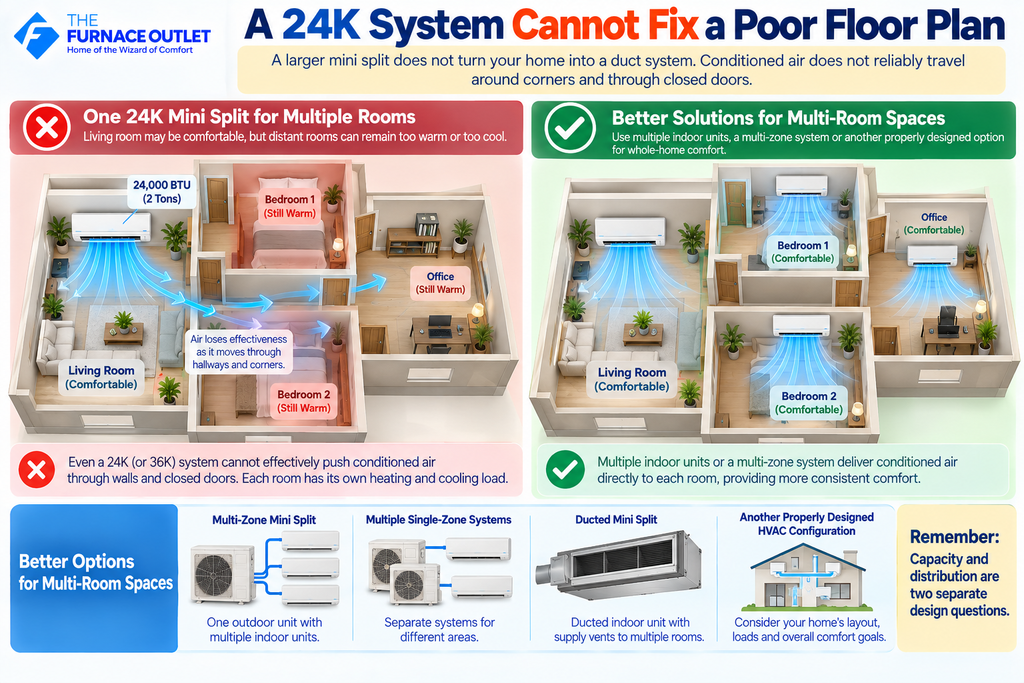
This becomes even more important when homeowners attempt to use one large mini split to serve several enclosed rooms. Imagine a 1,000-square-foot area containing a living room, hallway, two bedrooms, and an office. Someone may reason that because a 24K system is often associated with relatively large spaces, installing one 24K head in the living room should condition the entire 1,000 square feet. That is not how ductless air distribution works.
The living room may reach the desired temperature while a bedroom around the corner remains uncomfortable. Closing the bedroom door makes the problem even more obvious. Increasing capacity to 24K—or even 36K—does not cause conditioned air to travel effectively through walls and closed doors. If the heating and cooling load is distributed among several enclosed rooms, multiple indoor units, a multi-zone system, a ducted mini split, or another properly designed HVAC configuration may provide better comfort than one oversized wall-mounted head.
Capacity and distribution should always be treated as two separate design questions.
This is exactly the type of question where I would resist giving a universal yes or no. For a typical well-insulated residential room with conventional ceilings and moderate climate conditions, 24K may be considerably more capacity than 600 square feet requires. However, 600 square feet can describe very different buildings.
A 600-square-foot workshop with a 12-foot ceiling, weak insulation, large overhead doors, substantial air leakage, strong afternoon solar exposure, and heat-producing machinery may have a much higher cooling load than a 600-square-foot finished basement surrounded partly by earth and conditioned portions of the house.
The correct approach is therefore not to ask whether 24K is universally too large for 600 square feet. I would ask what the calculated design load of that particular 600-square-foot space actually is.
At approximately 800 square feet, the answer remains highly dependent on construction and climate. A high-performance 800-square-foot space may have a load that can be satisfied by an appropriate 18K system or potentially another capacity. A more challenging 800-square-foot space could move toward 24K.
Ceiling height becomes especially important here. An 800-square-foot room with an 8-foot ceiling contains approximately 6,400 cubic feet of volume, while the same floor area with a 12-foot ceiling contains approximately 9,600 cubic feet. HVAC sizing is not determined from room volume alone, but the comparison illustrates why floor area can conceal substantial physical differences.
Windows, orientation, insulation, infiltration, occupancy, internal heat sources, and local design temperatures all need to be considered before deciding that 24K is oversized.
Around 1,000 square feet is where 24K becomes a particularly common capacity to investigate, especially for a genuinely open floor plan. But even here, I would not automatically recommend it. A well-insulated 1,000-square-foot open space in a moderate climate may have a substantially lower load than a similarly sized great room with a vaulted ceiling, extensive west-facing glass, weak insulation, and severe summer conditions.
The floor plan matters as well. A genuinely open 1,000-square-foot great room is very different from 1,000 square feet divided among several bedrooms and hallways. For preliminary planning, 24K may certainly deserve consideration around this size. Final selection, however, should come from the load calculation and the performance characteristics of the exact equipment.
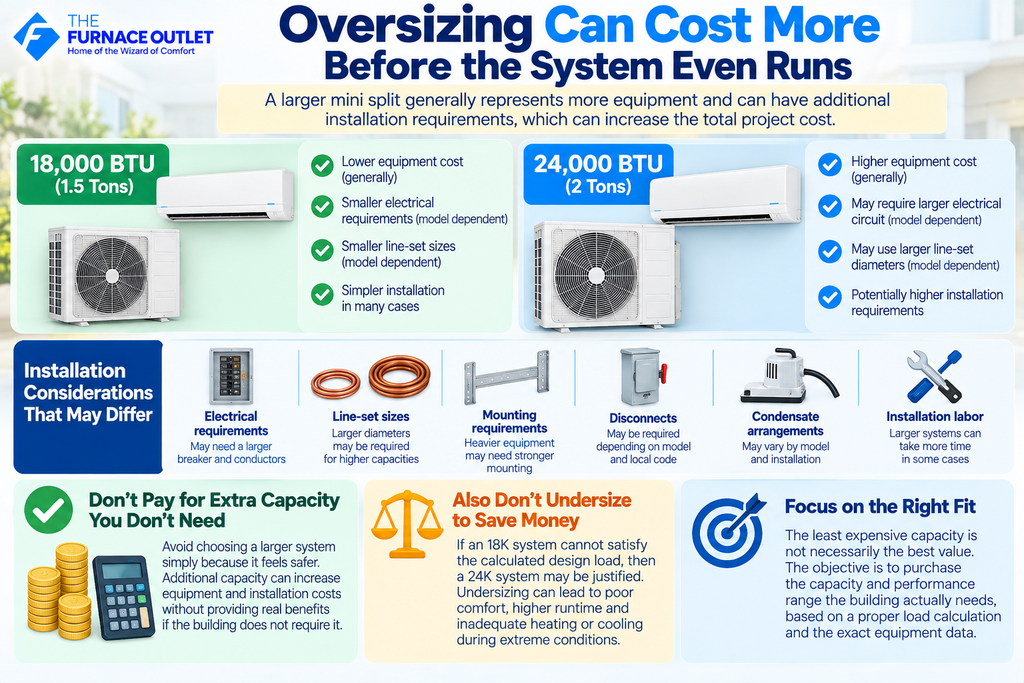
A larger mini split generally represents more equipment than a smaller capacity class, and the financial consequences can extend beyond the equipment price. Depending on the exact model, a 24K system may have different electrical requirements, line-set dimensions, mounting requirements, disconnects, and other installation considerations compared with an 18K system. Those differences can affect total project cost.
I would therefore avoid paying for additional capacity that the building does not require simply because it feels safer. At the same time, I would not deliberately undersize a system to reduce the purchase price. If an 18K system cannot satisfy the calculated design load, then 24K may be entirely justified.
The least expensive capacity is not necessarily the best value. The objective is to purchase the capacity and performance range the building actually needs.
When homeowners compare mini splits, they often focus on maximum output. I think minimum capacity deserves almost equal attention, particularly when deciding whether a 24K unit may be too large. Suppose two 24K systems can both satisfy the building’s peak cooling load. One can reduce compressor output much further during mild weather than the other. Those systems may behave differently during spring, autumn, nighttime operation, or days when outdoor conditions are far below peak design temperature.
This is why I would record the exact indoor and outdoor model numbers and compare the manufacturer’s expanded performance data whenever available.I wa nt to know the rated capacity, minimum capacity, maximum capacity, efficiency ratings, operating-temperature limits, and low-temperature heating output. I would also verify the exact matched combination rather than assuming that specifications from another system in the same product family apply.
The AHRI Directory of Certified Product Performance can also be useful for verifying certified ratings for specific matched equipment combinations.
A system that appears oversized from its cooling requirement may present a different picture when winter heating is considered. Heat-pump capacity changes with outdoor temperature, and different mini splits retain different amounts of heating output as temperatures fall. If the mini split will provide primary heating, I want to compare the building’s winter design load with the equipment’s actual output at relevant outdoor temperatures.
This can create an interesting sizing challenge. A smaller system may satisfy the summer cooling load but lack sufficient heating output during extreme winter conditions. A larger cold-climate system may satisfy the heating requirement but require careful consideration of its minimum cooling output during mild summer conditions.
There is no universal rule that resolves this tradeoff. It requires comparing the heating and cooling loads with the complete performance envelope of the exact equipment.
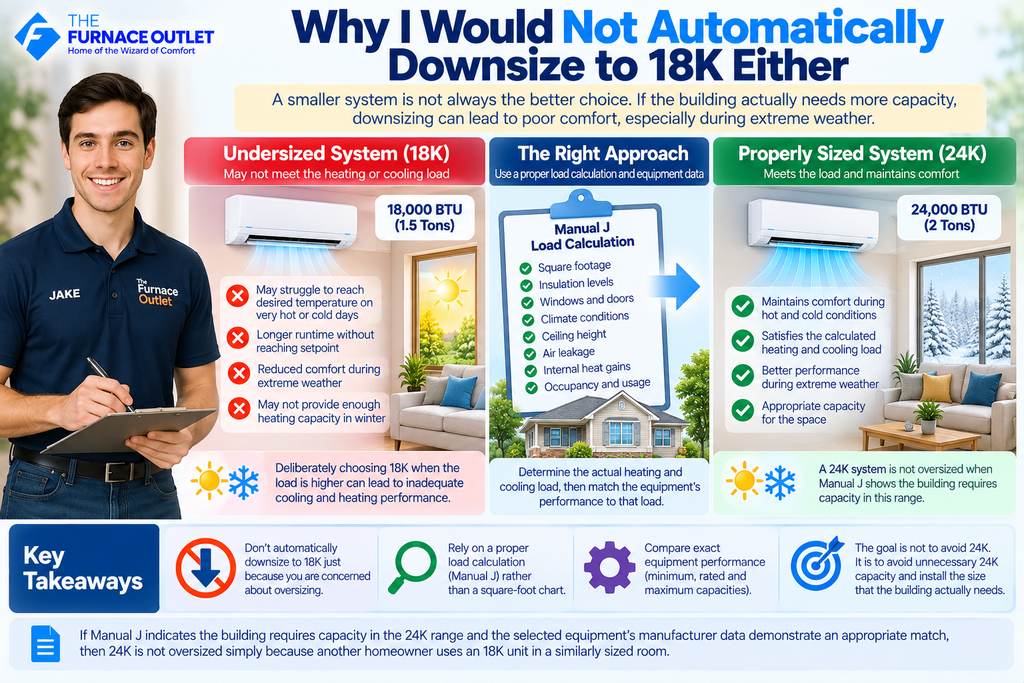
Once people learn about oversizing, they sometimes move too far in the opposite direction and assume smaller equipment is always preferable. That is not my approach either.
If the calculated cooling load is near or above what an 18K system can deliver under local design conditions, deliberately choosing 18K can leave the space unable to maintain the desired temperature during extreme weather. The same issue applies to winter heating. The correct goal is not to avoid 24K. It is to avoid unnecessary 24K capacity.
If Manual J indicates that the building requires capacity in the 24K range and the selected equipment’s manufacturer data demonstrate an appropriate match, then 24K is not oversized simply because another homeowner uses an 18K unit in a similarly sized room.
Before purchasing a 24K system, I would first determine the heating and cooling loads rather than relying on a square-foot chart. I would evaluate floor area, ceiling height, insulation, windows, solar orientation, air leakage, climate, occupancy, internal heat gains, and the intended use of the space. I would then study the floor plan and indoor-unit location. If the load is spread among several enclosed rooms, I would investigate zoning rather than expecting additional capacity from one head to overcome airflow barriers.
Finally, I would compare exact equipment combinations. Minimum, rated, and maximum cooling and heating capacities, SEER2, EER2, HSPF2, low-temperature heating output, operating limits, sound levels, refrigerant, electrical requirements, line-set limitations, controls, warranty terms, parts availability, and local service support all deserve consideration.
ACCA’s design framework provides a useful way to think about this process: Manual J determines the load, while Manual S uses that load together with manufacturer performance information to select appropriate equipment. ACCA HVAC technical manuals

A 24,000 BTU mini split is not inherently too large. It is approximately a 2-ton nominal system, and there are many large rooms, open living areas, basements, additions, garages, studios, and workshops where that capacity can be entirely appropriate. The problem begins when 24K is selected as insurance rather than because the building load supports it.
Modern inverter technology gives mini splits considerable ability to modulate, so oversizing is more nuanced than it was with traditional fixed-capacity equipment. Nevertheless, every inverter system has operating limits, including a minimum capacity. An unnecessarily large system may spend more time operating near that lower limit or cycling when the building requires less output than the equipment can continuously provide.
I would therefore avoid both extremes. Do not choose 24K merely because “bigger is safer,” and do not automatically choose 18K because you are afraid of oversizing. Calculate the load, evaluate the floor plan, and compare the operating range of the exact equipment.
The right mini split is the one that has enough capacity to satisfy the building at design conditions while still being capable of operating effectively when the heating or cooling demand is much lower. That balance—not the largest BTU number—is what I would look for.
Yes. Inverter technology allows the compressor to reduce output, which can make variable-capacity equipment more tolerant of changing loads than traditional fixed-capacity equipment. However, every system has a minimum operating capacity. If the building frequently requires less output than the system can provide at its minimum, oversizing can still matter.
For a typical individual residential bedroom, 24K would generally be an unusually large capacity to investigate. However, the appropriate size should still be determined from the room’s actual load rather than a universal rule. Large loft-style bedrooms or unusual construction can have different requirements.
It may be in a well-insulated space with conventional ceilings and moderate climate conditions, but 800 square feet alone cannot answer the question. High ceilings, extensive glass, air leakage, weak insulation, severe climate, or substantial internal heat gains can increase the load.
It can, particularly when the building load falls below the system’s minimum output. Inverter systems can reduce compressor speed and may therefore avoid some cycling that would occur with fixed-capacity equipment, but their modulation range is not unlimited.
Greater available capacity can reduce temperature more quickly under some conditions, but faster cooling is not the primary objective of HVAC sizing. Comfort, humidity management, modulation, airflow distribution, efficiency, and performance across changing conditions are more important than simply reaching the thermostat setting as quickly as possible.
Not automatically. Have the heating and cooling loads calculated and compare those loads with the actual performance of specific 18K and 24K systems. The correct capacity could be 18K, 24K, or another size depending on the building and climate.
A proper load calculation is the strongest starting point. Then compare the calculated cooling and heating requirements with the exact mini split’s minimum, rated, and maximum capacities and its performance at relevant outdoor temperatures. The combination of load calculation plus exact equipment data is much more useful than a generic BTU-per-square-foot chart.
Editorial & Educational Disclosure: The Furnace Outlet is not associated with, affiliated with, endorsed by, or sponsored by any manufacturer or brand mentioned in this article and does not receive manufacturer compensation for inclusion or rankings. This content is for educational purposes only. HVAC sizing, capacity, efficiency, electrical requirements, costs, humidity performance, and comfort vary by building, climate, equipment, controls, and installation. Verify current specifications for the exact equipment combination and consult a qualified HVAC professional before selecting or installing a mini-split system.
https://thefurnaceoutlet.com/best-24000-btu-mini-splits-of-2026-top-2-tonne-systems-compared/