Newsletter Subscribe
Enter your email address below and subscribe to our newsletter

HVAC made simple

By Jake Lawson — The HVAC Specialist
A 24,000 BTU mini split sits in an important part of the ductless HVAC market. With a nominal capacity of 2 tons, this size can provide enough heating and cooling for applications that have moved beyond the comfortable territory of many 12,000- and 18,000-BTU systems, while still offering the zoning flexibility and relatively compact installation that make ductless systems attractive. Large living rooms, open-concept spaces, finished basements, garages, workshops, additions and other substantial single-zone areas are all potential applications for a 24K mini split, provided the equipment is properly sized for the actual heating and cooling load.
As an HVAC specialist, however, I would never recommend selecting a 24,000 BTU system simply because a room looks large or because an online sizing chart places its square footage within a particular range. At this capacity, sizing becomes especially important. A properly selected 24K inverter mini split can provide excellent comfort while modulating its output as conditions change, but an oversized system can still create comfort, humidity and cycling problems. An undersized system, meanwhile, may struggle during peak summer or winter conditions. The correct decision has to consider climate, insulation, windows, air leakage, ceiling height, solar exposure, occupancy, internal heat gains and the layout of the conditioned area.
The 24K category also introduces several practical considerations that may be less significant with smaller mini splits. Most systems in this capacity class use 208/230-volt electrical service, electrical loads become more substantial, refrigerant piping may be larger, and indoor airflow becomes increasingly important. A single 24K wall-mounted head may work extremely well in a genuinely open space, but it may perform poorly if someone expects it to condition several rooms separated by walls and doorways. In those situations, two smaller indoor units or a multi-zone system may produce better comfort even when the total installed capacity is similar.
For this 2026 comparison, I am therefore looking beyond the number printed on the product specification sheet. My goal is to help homeowners understand what makes a good 24K system, where this capacity makes sense, when it becomes too large or too small, and how current equipment should be compared before making a significant HVAC investment.
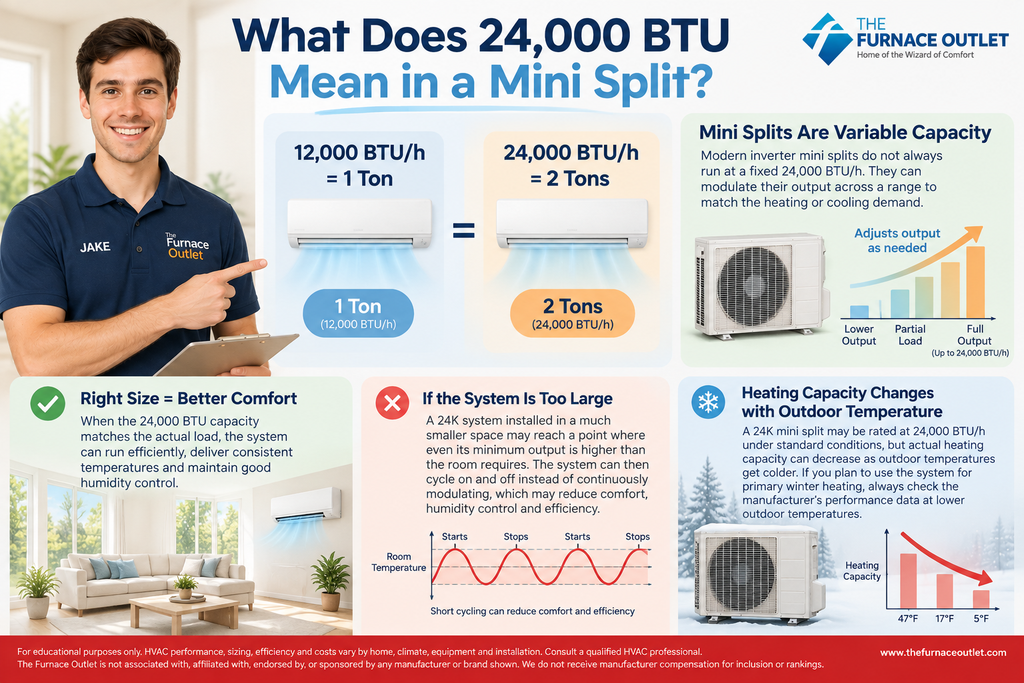
HVAC capacity is commonly expressed in British thermal units per hour, or BTU/h. One ton of nominal air-conditioning capacity equals approximately 12,000 BTU/h, which means a 24,000 BTU mini split is commonly described as a 2-ton system. This does not mean that every 24K inverter system constantly produces exactly 24,000 BTU/h. Modern variable-capacity mini splits can adjust compressor operation across a range of outputs, allowing the equipment to respond more closely to changing loads rather than repeatedly operating at full capacity and shutting down.
That modulation is one of the major advantages of modern ductless technology, but it should not be used as an excuse for careless sizing. Every inverter system has operating limits, including minimum and maximum capacities under different conditions. A 24K system installed in a space with a much smaller load may eventually reach a point where even its minimum output exceeds what the room requires. The system can then cycle rather than continuously modulating, reducing some of the comfort advantages that led the homeowner to choose inverter equipment in the first place.
The opposite situation is equally important. A 24K mini split may be described as capable of serving a large area, but its actual capacity can change with outdoor temperature, particularly during heating operation. Anyone expecting a 24K heat pump to provide primary winter heating should therefore examine manufacturer performance data at colder outdoor temperatures rather than relying only on its nominal 24,000 BTU designation.
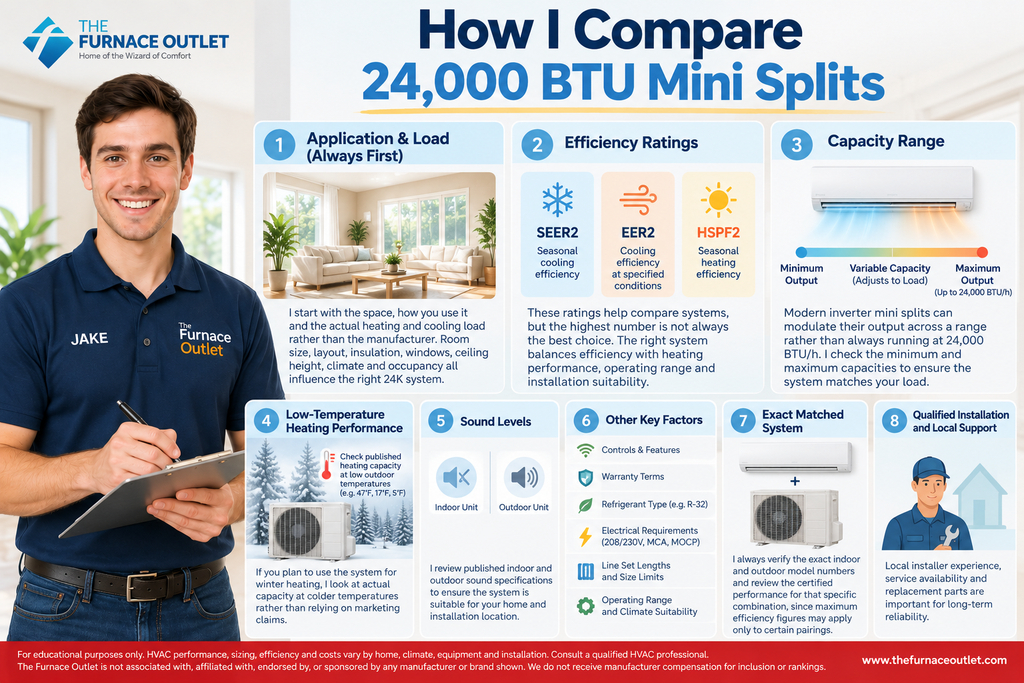
When I evaluate a 24K mini split, I start with the application and load rather than the manufacturer. I want to understand the space being conditioned, how people use it, where the indoor unit can be positioned, how air will move through the room, what outdoor conditions the equipment will experience and whether heating or cooling is the dominant requirement. Only after answering those questions does comparing individual systems become genuinely useful.
Efficiency is certainly part of the comparison. SEER2 helps describe seasonal cooling efficiency, EER2 provides another measure of cooling performance under specified test conditions, and HSPF2 relates to seasonal heating efficiency. These ratings are useful for comparing properly matched systems, but the highest number does not automatically identify the best system for every home. A slightly less efficient unit that has better cold-weather capacity, stronger local service support or a more suitable operating range may make more sense for a particular installation.
I also examine minimum and maximum capacity, low-temperature heating performance, indoor and outdoor sound specifications, controls, warranty terms, refrigerant type, electrical requirements, allowable refrigerant piping lengths and the availability of qualified local installers. For systems expected to heat during a cold winter, I place considerable emphasis on published capacity at low outdoor temperatures rather than relying on marketing descriptions such as “cold climate.”
Most importantly, I verify the exact indoor and outdoor combination. Manufacturers frequently publish an impressive maximum SEER2 or HSPF2 figure for an equipment family, but that figure may apply only to certain matched combinations. The system installed in your home should be evaluated using the specifications and certification applicable to its exact indoor and outdoor model numbers.
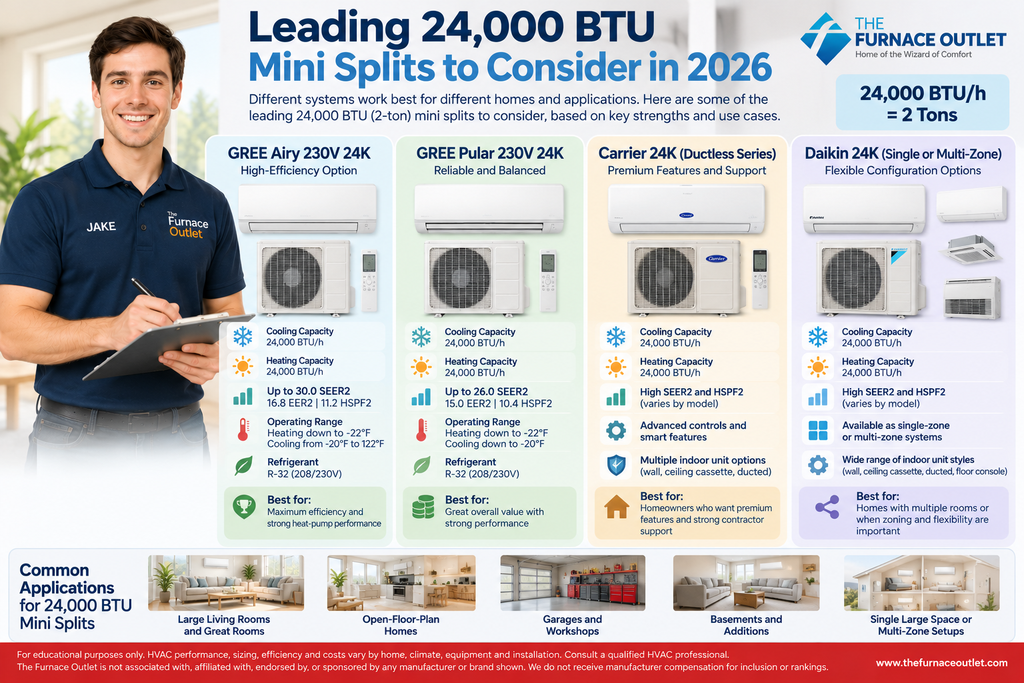
The current 24K market includes equipment from established ductless manufacturers as well as lower-cost alternatives, and there is no single product that automatically fits every application. For that reason, I prefer to think in terms of use cases rather than declaring that one system is universally superior. A homeowner prioritizing cold-weather heating may reach a different conclusion from someone conditioning a workshop in a predominantly cooling climate, while a homeowner seeking premium controls and contractor support may prioritize different features again.
GREE’s current 24K offerings provide useful examples of how much performance can vary even within one manufacturer’s lineup. The company’s Airy 230V 24K configuration is positioned as a high-efficiency option, with GREE publishing ratings of up to 30.0 SEER2, 16.8 EER2 and 11.2 HSPF2 for the applicable 24K combination. GREE also publishes heating and cooling operating ranges that extend into demanding outdoor temperatures. Those numbers make the Airy worth examining when efficiency and heat-pump operation are major priorities, although the exact current matched combination and certification should always be confirmed before purchase.
GREE’s Pular 230V family offers another approach. Current manufacturer information lists a 24,000 BTU model using 208/230-volt power and R-32 refrigerant, with efficiency specifications that remain strong but differ from the Airy. For many buyers, the important lesson is not that one GREE series automatically defeats another; it is that even products from the same manufacturer can have substantially different efficiency ratings, controls, operating characteristics and pricing. The correct comparison therefore needs to be made at the model level.
Carrier also maintains a broad ductless portfolio spanning different performance levels and configurations. For homeowners considering Carrier equipment, I would pay particular attention to the exact matched indoor/outdoor combination, heating specifications, controls, sound ratings and local contractor support. Carrier’s own ductless buying guidance emphasizes factors such as capacity, efficiency, room characteristics and system configuration rather than suggesting that homeowners select equipment solely according to a brand-level efficiency claim.
Daikin deserves similar consideration because of its extensive experience with ductless and variable-refrigerant technology. The company’s product range illustrates another important point for 24K buyers: a 24,000 BTU outdoor system does not necessarily have to serve one 24K wall-mounted indoor head. Depending on the equipment family and design, capacity can instead be distributed among multiple indoor units. That possibility becomes increasingly important when a homeowner is trying to condition several distinct areas rather than one genuinely open room.
Rather than reducing the buying process to a simple first-, second- and third-place ranking, I would use these systems as starting points for comparing actual certified combinations available in your area. Contractor familiarity, replacement-part availability and local service capability can matter considerably over the 10- to 15-plus-year period that homeowners may hope to operate their equipment.

This is probably the most common question I hear about 24K equipment, and unfortunately it is also one of the questions most likely to produce an oversimplified answer. Many sizing charts associate 24,000 BTU with roughly 900 to 1,200 square feet, while Carrier provides an approximate 900-to-1,100-square-foot range as a preliminary guideline in its ductless buying information. Those numbers can be useful for early planning, but they should not be treated as a substitute for a residential load calculation.
Imagine two homes with identical 1,000-square-foot open living areas. One is well insulated, relatively airtight, shaded from intense afternoon sun and located in a moderate climate. The other has high ceilings, substantial west-facing glass, poor insulation, noticeable air leakage and a location that experiences extreme summer temperatures. The two spaces can have dramatically different cooling requirements despite having identical floor areas.
Heating introduces even more variables. Outdoor design temperature, insulation, glazing, infiltration and the heat pump’s capacity at low ambient temperatures all influence whether a particular 24K system can maintain the desired indoor temperature. This is why ACCA Manual J remains such an important reference for residential HVAC sizing. A proper load calculation considers the characteristics of the actual building rather than assigning equipment capacity from floor area alone.
For homeowners, the practical takeaway is that square footage should be used as an initial screening tool rather than the final sizing method. If your space appears to fall near the boundary between 18K and 24K, or between 24K and 36K, a proper load calculation becomes even more valuable because the consequences of guessing incorrectly become larger.

A large single room is one of the strongest potential applications for a 24,000 BTU mini-split. Great rooms, substantial family rooms, large finished basements, additions and similar spaces can benefit from the combination of high capacity and direct ductless delivery, especially when installing conventional ductwork would require extensive remodeling.
The word “single,” however, is important. A large open room allows a wall-mounted indoor unit to discharge conditioned air across the occupied area without numerous walls and doors interfering with circulation. If the head is correctly positioned and the room’s calculated load matches the system, a 24K unit can provide effective heating and cooling while maintaining the simplicity of one indoor unit.
Ceiling height should be included in the calculation rather than ignored. A 1,000-square-foot room with an 8-foot ceiling contains considerably less air volume than a similarly sized great room with a vaulted ceiling. Large windows and exterior doors can further increase loads, while solar orientation can create substantial afternoon heat gain. These factors help explain why I would not recommend choosing a 24K system merely because a room falls within a published square-footage range.
Indoor-unit location also deserves careful thought. The head should have an unobstructed path for distributing air through the room while complying with manufacturer clearances. Placing a powerful 24K unit in a corner where furniture, architectural features or walls restrict airflow can undermine the comfort that the homeowner expected from the larger capacity.
Open-concept living areas are frequently excellent candidates for 24K mini splits, but the shape of the space matters almost as much as its total area. A compact, relatively square open-plan kitchen and living area may allow one indoor unit to distribute air effectively, whereas a long L-shaped floor plan of the same square footage can create substantial temperature differences between different parts of the space.
The location of the indoor head should therefore be evaluated from an airflow perspective. I want to see where the supply air will travel, whether furniture or walls interrupt that path and whether the unit can serve the occupied areas without creating an uncomfortable high-velocity zone directly in front of the head. A ceiling fan can sometimes help mix room air, particularly in spaces with high ceilings, but it should complement good HVAC design rather than compensate for a poorly selected equipment location.
An open floor plan also does not necessarily mean that adjacent bedrooms or offices will receive adequate conditioning. Air does not reliably turn corners, move through narrow hallways and pass through closed doors simply because the outdoor condenser has enough BTU capacity. This distinction becomes crucial when deciding between one 24K head and multiple smaller indoor units.

Garages and workshops are another application where 24,000 BTU systems frequently appear. These spaces often have no existing ductwork, making a ductless heat pump an attractive way to add heating and cooling without extending the home’s central HVAC system. A well-designed mini split can transform a garage from a seasonally uncomfortable storage space into a usable workshop, gym, hobby area or workspace.
Garage sizing nevertheless requires more than measuring floor area. The overhead garage door can represent a major source of heat gain and heat loss, particularly if it is poorly insulated or has significant air leakage. Exterior wall and ceiling insulation also matter, as does the frequency with which the garage door is opened. A garage that remains closed most of the day behaves very differently from a workshop where a large door is repeatedly opened.
Internal loads can be significant as well. Power tools, machinery, lighting, computers and other equipment can add heat that would not be present in an ordinary living room. Carrier notes in its garage mini-split guidance that a typical two-car garage can fall approximately within the 12,000-to-24,000-BTU range depending on factors including climate and insulation, which demonstrates why the garage itself needs to be evaluated rather than automatically assigning 24K to every two-car space.
Buyers moving from smaller mini splits into the 24K category should pay particular attention to electrical requirements. Many 24,000 BTU mini splits sold in the United States operate on 208/230-volt power rather than the 115-volt circuits available with some smaller systems. Current 24K models in GREE’s Airy and Pular families, for example, specify 208/230V operation.
This usually means planning for a dedicated circuit and appropriate disconnect, wiring and overcurrent protection. The exact requirements must come from the equipment nameplate and manufacturer’s installation instructions. It is not appropriate to assume that every 24K system uses the same breaker simply because the cooling capacity is identical.
Two specifications are particularly useful when reviewing the electrical documentation: minimum circuit ampacity, commonly abbreviated MCA, and maximum overcurrent protection, or MOCP. These manufacturer-provided values help determine the electrical requirements of the exact equipment. A qualified installer or electrician should use those specifications together with applicable electrical codes and installation conditions.
This is especially important in older homes. Adding a 24K heat pump may require evaluating the available electrical panel capacity rather than merely checking whether there is an empty breaker position. Homeowners considering a larger ductless system should therefore include electrical work in the project budget rather than treating the equipment purchase price as the complete installed cost.
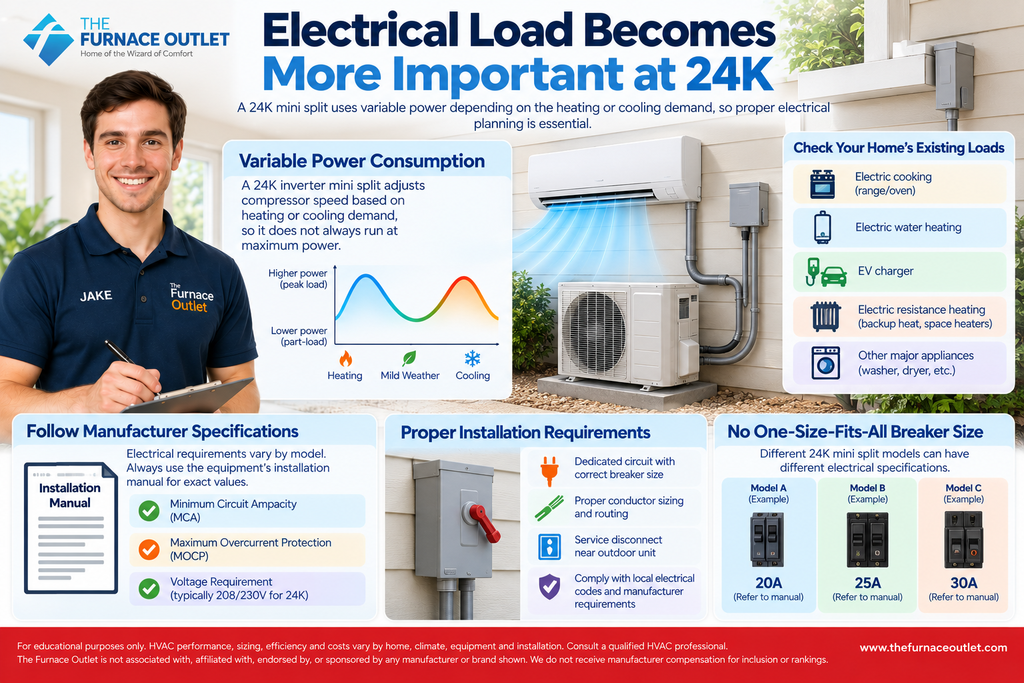
A 24K inverter system does not simply consume a fixed amount of electricity whenever it operates. Compressor speed and electrical consumption vary as the system responds to the heating or cooling demand. That is one reason inverter-driven equipment can provide good part-load efficiency, but it does not eliminate the need for properly designed electrical service.
The home’s existing loads should be considered when planning the installation, particularly if the property has electric cooking, electric water heating, an EV charger, electric resistance heating or other significant loads. The installer should also determine the appropriate conductor routing and disconnect location and verify that all electrical work meets the equipment manufacturer’s requirements and applicable codes.
I would therefore resist generic advice such as saying that every 24K mini split requires a particular breaker size. Two 24,000 BTU systems from different manufacturers can have different electrical specifications, and even related models can differ. The model’s actual MCA, MOCP and installation documentation should control the decision.
Refrigerant piping becomes another important consideration as mini-split capacity increases. The indoor and outdoor units are connected by refrigerant lines, and those lines must have the dimensions specified by the manufacturer. A homeowner replacing a smaller mini split should never assume that an existing line set can automatically be reused with a new 24K system.
The correct liquid and gas line diameters depend on the specific equipment. Maximum line length, vertical separation, insulation requirements and additional refrigerant requirements can also vary substantially. Some current systems allow surprisingly long piping runs, but that does not mean line length can be ignored. Longer runs can influence installation complexity, refrigerant charging procedures and the practical location of the condenser.
The line-set route should ideally be planned before equipment is purchased. If the indoor head is located on an exterior wall directly above or near the outdoor condenser, the installation may be relatively straightforward. If refrigerant piping must cross a large portion of the building, rise several stories or navigate numerous bends, the manufacturer limits become much more important.
Proper evacuation, leak testing and commissioning are equally important. A high-quality 24K system connected through poorly installed refrigerant piping will not deliver the performance its specification sheet suggests.
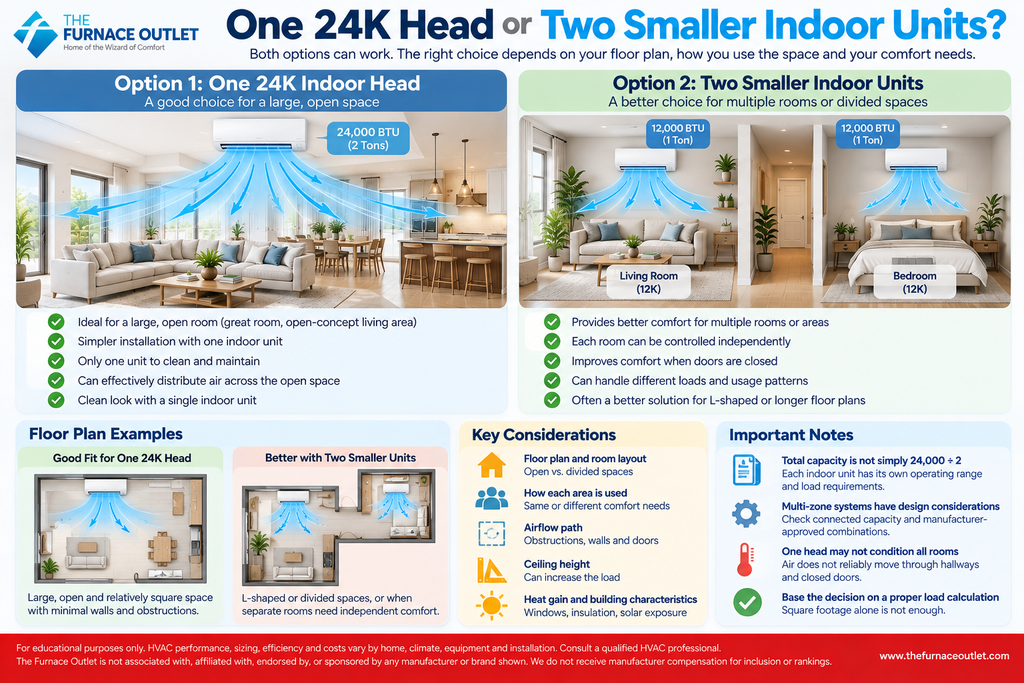
For many homeowners, this is the most important design question in the entire article. Suppose the calculated total load is around 24,000 BTU/h. Should you install one large 24K indoor head, or should you distribute the capacity between two smaller indoor units?
If the area is genuinely open, one large head has several advantages. Installation can be simpler, there is only one indoor unit to clean and maintain, and the system can provide a straightforward solution for a large room. A properly located head can distribute air effectively across an open living area without requiring multiple pieces of equipment on the walls.
The calculation changes when the floor plan is divided. A living room and bedroom may have a combined load that appears suitable for a 24K system, but placing one large head in the living room does not guarantee comfort in the bedroom. Closing the bedroom door can make the problem even more obvious. In this situation, two appropriately sized indoor units may provide much better temperature control even if their combined nominal capacity is similar.
Multi-zone systems introduce their own design considerations. The outdoor unit has a total capacity, while individual indoor heads have their own operating ranges and loads. Diversity, connected capacity and manufacturer-approved combinations need to be considered. The answer is therefore not simply to divide 24,000 by two and automatically install two 12K heads.
For an open great room, I would seriously consider the simplicity of a single 24K head. For multiple rooms or areas with different comfort requirements, I would investigate zoning before committing to one large indoor unit.
The assumption that bigger HVAC equipment provides better comfort is one of the most persistent sizing mistakes. A larger system can certainly provide greater maximum capacity, but the objective of HVAC design is not to install the largest machine the electrical panel can support. The objective is to match equipment performance to the building’s load.
The U.S. Department of Energy’s Building Science Education resources caution against rule-of-thumb sizing because oversized HVAC systems can increase costs, waste energy and cycle excessively. Modern inverter mini splits reduce some of these concerns because they can modulate their output, but modulation does not make correct sizing irrelevant. Every system eventually reaches a minimum operating output.
Cooling comfort involves moisture removal as well as temperature. In humid climates, an oversized system that satisfies the sensible cooling requirement too quickly may not provide the dehumidification performance the homeowner expects. The room can reach the thermostat setpoint while still feeling humid.
Oversizing can also increase initial equipment and installation costs unnecessarily. If an 18K system can comfortably satisfy the calculated load while operating within a suitable modulation range, installing 24K solely for an extra “safety margin” may provide little practical benefit.
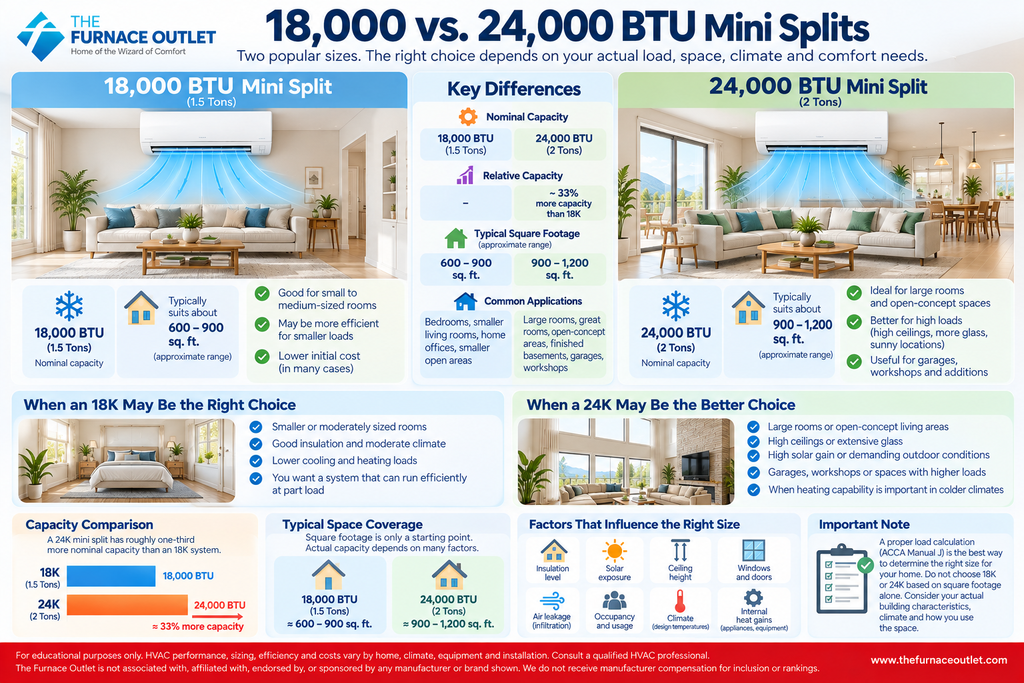
The difference between an 18K and 24K mini split is substantial enough to deserve careful analysis. An 18,000 BTU system represents approximately 1.5 tons of nominal capacity, while 24,000 BTU represents 2 tons. The 24K unit therefore has roughly one-third more nominal capacity than an 18K system.
That additional capacity can be valuable when the load actually requires it. A large room with extensive glass, high ceilings, significant solar gain or demanding outdoor conditions may exceed what an 18K system can reasonably handle. Garages and workshops can similarly have unusually high loads because of weak insulation, large doors or heat-producing equipment.
However, the fact that a space falls near an arbitrary square-foot boundary between 18K and 24K does not mean homeowners should automatically choose the larger system. If a load calculation shows that the peak requirement is comfortably within the performance of an appropriate 18K model, the smaller system may provide excellent comfort while potentially offering a better part-load relationship.
Heating performance makes the comparison more complicated because the equipment’s output changes with outdoor temperature. If winter heating matters, compare the actual 18K and 24K candidates at the relevant outdoor design conditions rather than comparing only their nominal capacity labels.
The step from 24K to 36K is even more significant because a 36,000 BTU system represents approximately 3 tons of nominal capacity. This is not a minor upgrade. It is a 50% increase in nominal capacity compared with 24K, so the decision should be supported by the building load rather than by a desire to purchase the larger system “just in case.”
As the required capacity approaches 36K, I would also examine whether one large indoor head remains the best distribution strategy. A very large open commercial-style space may be well suited to a high-capacity single-zone system, but a large residential floor containing several rooms may benefit far more from multiple indoor units.
This is where system design becomes more important than the headline capacity. If a homeowner needs approximately 30,000 to 36,000 BTU across several rooms, a properly designed multi-zone arrangement may offer better comfort than one oversized wall-mounted unit attempting to serve the entire area from a single location.
The load calculation should therefore answer the first question—how much capacity does the building need—while the floor plan answers the second question—where should that capacity be delivered?

A homeowner purchasing a 24K mini split primarily for air conditioning can focus heavily on cooling performance, but anyone planning to use the system as a major heat source needs to look deeper into the specifications. Heat-pump capacity changes as outdoor temperature falls, and two systems with identical nominal 24K ratings can behave very differently during cold weather.
I look for published heating capacity at temperatures such as 47°F, 17°F and 5°F when the manufacturer provides those values. These figures offer a much clearer picture of winter capability than the nominal rating alone. Some modern cold-climate mini splits can retain a large percentage of their rated heating capacity at low temperatures, while other systems experience greater capacity reduction.
ENERGY STAR’s cold-climate heat-pump criteria provide a useful framework for understanding this issue. Current criteria include requirements related to low-temperature capacity and coefficient of performance, which helps distinguish equipment designed to provide meaningful heat under colder conditions from systems whose primary strengths may lie elsewhere.
Defrost performance should also be considered. Frost can accumulate on the outdoor coil during certain winter conditions, requiring the system to periodically enter a defrost cycle. Proper equipment design, drainage and outdoor-unit installation are therefore particularly important in cold climates.
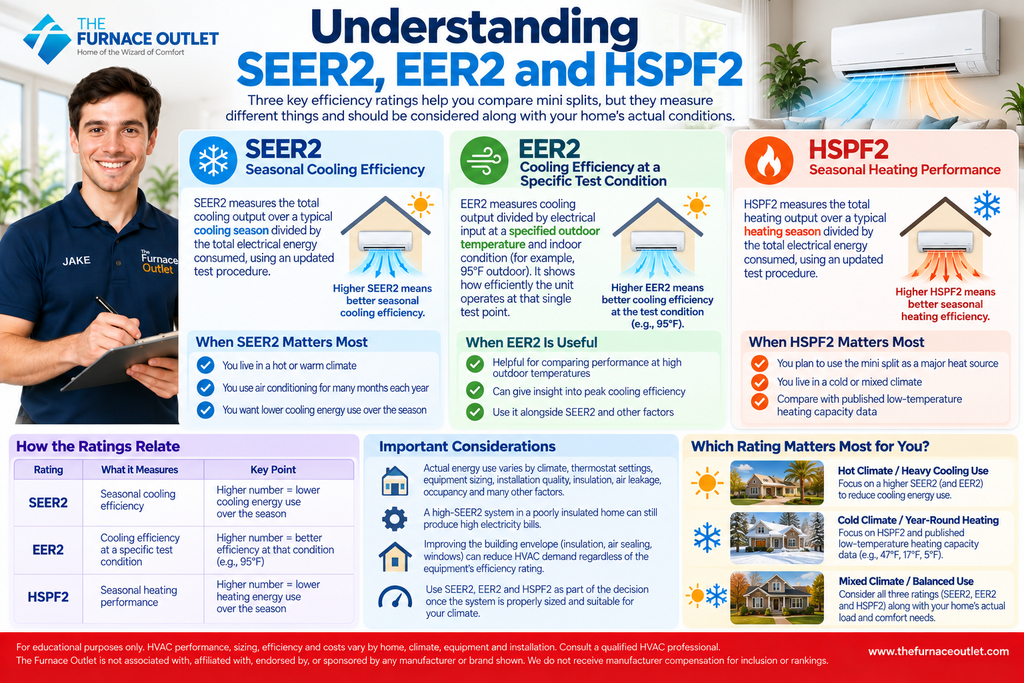
Efficiency ratings are valuable, but they need to be interpreted correctly. SEER2 represents seasonal cooling efficiency, EER2 provides cooling efficiency under a specified test condition, and HSPF2 represents seasonal heating performance. These metrics make it easier to compare equipment using standardized procedures, but they do not predict exactly what an individual homeowner will pay for electricity.
Actual consumption depends on climate, thermostat settings, equipment sizing, installation quality, building insulation, air leakage, occupancy and many other variables. A high-SEER2 system installed in a poorly insulated building can still produce substantial electricity bills, while improving the building envelope can sometimes reduce HVAC demand regardless of equipment efficiency.
I would therefore use efficiency ratings as one part of the decision rather than the entire decision. Once I have narrowed the choices to systems that are properly sized and suitable for the climate, efficiency becomes a useful way to distinguish among them.
For a homeowner in a hot climate who uses air conditioning heavily, a higher SEER2 rating can be particularly attractive. For someone relying on the mini split throughout a cold winter, HSPF2 and low-temperature heating data deserve greater attention.
One of the most expensive mistakes homeowners can make is buying premium equipment while treating installation as an afterthought. The performance printed on a specification sheet assumes that the system is correctly installed and commissioned. Refrigerant piping, evacuation, leak testing, electrical connections, condensate drainage, indoor and outdoor clearances and equipment configuration all influence real-world performance.
The outdoor unit needs adequate airflow and must be installed according to manufacturer requirements. In snow-prone areas, placement may need to account for accumulation and drainage. The indoor unit must also be installed with the required clearances and in a location where supply air can reach the intended area.
Condensate management is especially important during cooling operation. The indoor coil removes moisture from the air, and that water has to drain reliably. Poor drain design can lead to leakage, water damage or biological growth.
Refrigerant work in the United States also has regulatory implications. EPA Section 608 establishes technician-certification requirements for covered activities involving stationary air-conditioning and refrigeration equipment. Homeowners should understand the distinction between purpose-designed DIY equipment and conventional systems requiring field refrigerant work rather than assuming that every mini split sold online is intended for complete homeowner installation.
The mini-split market continues to change as manufacturers introduce equipment using lower-global-warming-potential refrigerants. R-32 is now found in a growing number of ductless systems, including current products from manufacturers such as GREE, while other equipment may use different refrigerants depending on model and generation.
I would not choose a system simply because it uses a particular refrigerant. Instead, I would verify that qualified service is available locally, that the installer is familiar with the equipment and refrigerant, and that the installation complies with manufacturer instructions and applicable codes.
The refrigerant transition also makes older online advice increasingly unreliable. Articles written around previous generations of equipment may list specifications, installation practices or refrigerants that no longer apply to current 2026 models. Manufacturer documentation for the exact equipment being purchased should therefore take priority.

Before purchasing a 24K mini split, I would first confirm the heating and cooling load and determine whether 24,000 BTU is actually the correct capacity class. I would then examine the floor plan to decide whether one large indoor head can distribute air effectively or whether multiple zones would provide better comfort. Those two decisions should occur before comparing cosmetic features or smart-home controls.
Once the configuration is established, I would record the exact indoor and outdoor model numbers and verify the matched system’s efficiency and capacity data. I would check SEER2, EER2 and HSPF2, but I would also look at minimum and maximum capacities and low-temperature heating performance when relevant. If an AHRI-certified combination is available, I would verify that the certificate corresponds to the exact equipment combination being proposed.
Next, I would review electrical requirements, including voltage, MCA and MOCP, and confirm whether the existing electrical service can support the equipment. Refrigerant piping requirements should then be checked, including pipe diameters, maximum line length, vertical separation and additional charge requirements where applicable.
Finally, I would investigate installation support, warranty registration, replacement-part availability and local service. A mini split is a long-term mechanical system rather than a disposable appliance, so the ability to obtain competent service several years after installation deserves consideration alongside the purchase price.
For a large, genuinely open room, I would generally begin by evaluating a high-quality single-zone 24K inverter heat pump with a broad modulation range and appropriate performance for the local climate. This configuration keeps the installation relatively straightforward while delivering substantial heating and cooling capacity directly into the space.
For a garage or workshop, I would pay additional attention to insulation, door leakage, internal heat loads and operating-temperature requirements. A workshop in a cold northern climate has very different needs from an insulated garage in a warm region used primarily for summer cooling.
For an open floor plan that begins to branch into separate rooms, I would seriously compare one large head with a multi-zone design. Capacity alone cannot overcome poor air distribution, and installing additional indoor units may produce better comfort even if the project becomes more expensive.
For cold-climate heating, I would prioritize low-temperature capacity and certified cold-weather performance rather than choosing solely from SEER2. A system that retains useful heating output at the local winter design temperature can be more valuable than one whose strongest specification is an exceptional cooling-efficiency number.
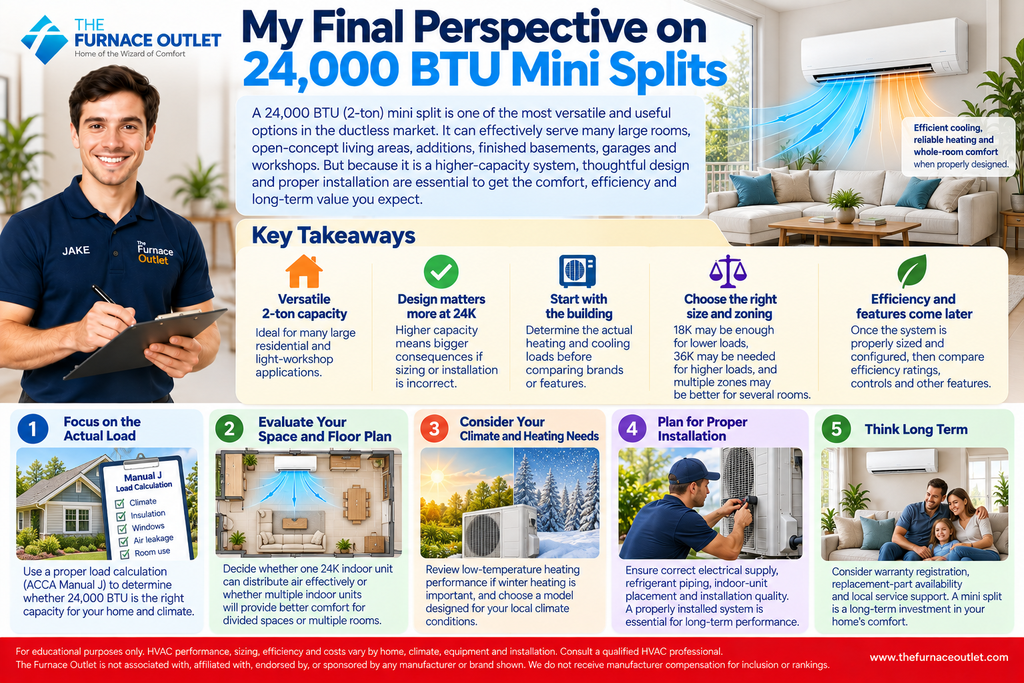
The 24,000 BTU category is one of the most versatile parts of the ductless market because 2 tons of nominal capacity can serve many substantial residential and light-workshop applications without requiring conventional ductwork. The same capacity that makes these systems useful, however, also makes thoughtful design increasingly important. A 24K system is large enough that mistakes in sizing, air distribution, electrical planning or indoor-head placement can become expensive.
I would therefore begin every 24K project with the building rather than the equipment catalog. Determine the heating and cooling loads, examine the floor plan, decide whether the capacity belongs in one zone or several zones, and identify the local climate conditions the heat pump will face. Only then should you start comparing brands, efficiency ratings and features.
If the calculated load falls comfortably within an 18K system’s capability, moving to 24K simply for additional capacity may not improve comfort. If the load approaches 36K, a larger system or a different zoning strategy may be necessary. If the total load is around 24K but spread across several enclosed rooms, one large indoor head may still be the wrong solution.
That is why I would not describe the “best” 24,000 BTU mini split of 2026 as one universal model. The better system is the correctly sized, properly configured and professionally installed equipment whose certified performance matches the building and climate. Efficiency, controls and features matter, but they become meaningful only after those fundamentals are correct.
A well-designed 24K mini split can deliver efficient cooling, capable heat-pump heating, quiet operation and excellent comfort for years. The objective should not be to buy the biggest unit that fits the budget or the model with the most impressive headline rating. It should be to build a system in which the capacity, equipment, electrical supply, refrigerant piping, indoor-unit placement and installation quality all work together.
Yes. One ton of nominal HVAC cooling capacity corresponds to approximately 12,000 BTU/h, so a 24,000 BTU mini split is generally described as a 2-ton system. Modern inverter mini splits do not necessarily operate continuously at their nominal capacity, however, because compressor output can modulate according to the load. This is why the minimum and maximum operating capacities of the exact system are useful specifications when comparing models.
A rough starting range frequently used for 24K systems is around 900 to 1,100 square feet, and some preliminary sizing guides extend the estimate somewhat further. I would not use that range to make the final equipment selection. Climate, insulation, air leakage, windows, ceiling height, solar exposure and internal loads can substantially change the required capacity. ACCA Manual J or another appropriate professional load calculation should be used to determine the actual requirement.
It can be, but square footage alone cannot answer the question. An efficient, well-insulated 800-square-foot space in a moderate climate could have a load substantially below 24,000 BTU/h, while a difficult space with extensive glass, high ceilings, poor insulation or extreme outdoor conditions could require considerably more capacity. The load calculation, rather than floor area alone, should determine whether 24K is appropriate.
Many 24K mini splits sold in the United States operate on 208/230V power, including current examples from major manufacturers, but you should verify the exact model rather than treating this as a universal rule. The equipment documentation should also provide the electrical information required for circuit design, including minimum circuit ampacity and maximum overcurrent protection where applicable.
The choice should be based primarily on the calculated load and the equipment’s actual performance. If an 18K system can satisfy the design load under expected outdoor conditions, moving to 24K merely as a safety margin may result in unnecessary oversizing. If the load is beyond the realistic capability of the 18K candidate, a 24K system may be the appropriate next capacity class.
A 36K system provides approximately 50% more nominal capacity than a 24K system, so this should not be treated as a minor upgrade. If the load genuinely approaches the 3-ton range, 36K equipment may be appropriate, but the larger requirement should also prompt a closer look at air distribution. Multiple indoor units can sometimes provide a better solution than one very large wall-mounted head, particularly when the conditioned area contains separate rooms.
It may help condition adjoining spaces, but I would not design a multi-room system around the assumption that air will reliably move through doorways and hallways. A 24K indoor head works best when it has a clear airflow path through the area it is intended to serve. Multiple enclosed rooms generally strengthen the case for multiple indoor units or another distribution strategy.
It can be an excellent option, but a two-car garage does not automatically require 24,000 BTU. Insulation, garage-door construction, air leakage, ceiling height, climate and internal equipment loads all influence the requirement. A well-insulated garage in a mild climate may require less capacity, while a poorly insulated workshop in an extreme climate can require more.
Many modern mini-split heat pumps can operate below freezing, and some cold-climate models are designed to maintain substantial heating capacity at very low outdoor temperatures. Performance varies significantly between systems, so I would examine published heating capacity at temperatures such as 17°F and 5°F where available rather than relying only on the nominal 24K rating or minimum operating-temperature claim.
Not necessarily. A higher SEER2 indicates better standardized seasonal cooling efficiency, but the financial value depends on climate, electricity prices, annual cooling demand, price difference and how long the equipment remains in service. Correct sizing, good installation and appropriate system configuration should generally take priority over chasing the highest available efficiency rating.
Some systems are specifically engineered and marketed for certain types of DIY installation, while conventional mini splits may require refrigerant-circuit work, evacuation, leak testing and commissioning. Electrical work also has safety and code implications. In the United States, EPA Section 608 requirements apply to covered refrigerant-handling activities, so homeowners should understand the installation method and regulatory boundaries of the exact system before beginning a project.
Service life depends on equipment quality, climate, runtime, installation, maintenance and operating conditions, so I would avoid promising a fixed number of years. Keeping filters and coils clean, maintaining unobstructed outdoor airflow, addressing drainage problems promptly and having developing mechanical issues diagnosed before they become major failures can all contribute to reliable long-term operation.
For readers who want to verify the technical principles behind this guide, I recommend starting with ENERGY STAR’s ductless heating and cooling guidance, which covers ductless heat-pump applications and sizing considerations. ENERGY STAR also publishes air-source heat-pump efficiency and cold-climate criteria, which is useful when comparing heating performance rather than looking only at cooling efficiency.
For sizing, ACCA’s Manual J information explains the recognized residential load-calculation methodology, while the U.S. Department of Energy’s HVAC sizing guidance provides additional information about proper sizing and the disadvantages of relying on simple rules of thumb. For refrigerant-related installation requirements, homeowners and installers can refer directly to EPA Section 608 technician-certification requirements. Current product specifications should always be checked against the relevant manufacturer’s technical documentation and the exact matched system being purchased.
Editorial Disclosure: The Furnace Outlet is not associated with, affiliated with, endorsed by, or sponsored by any manufacturer or brand mentioned in this article. Manufacturer inclusion does not constitute a universal recommendation, and specifications, efficiency ratings, refrigerants, warranties, availability and product configurations can change. HVAC performance, sizing and operating costs vary according to the home, climate, equipment and installation, so homeowners should verify current product information and consult a qualified HVAC professional before selecting or installing equipment