Newsletter Subscribe
Enter your email address below and subscribe to our newsletter

HVAC made simple
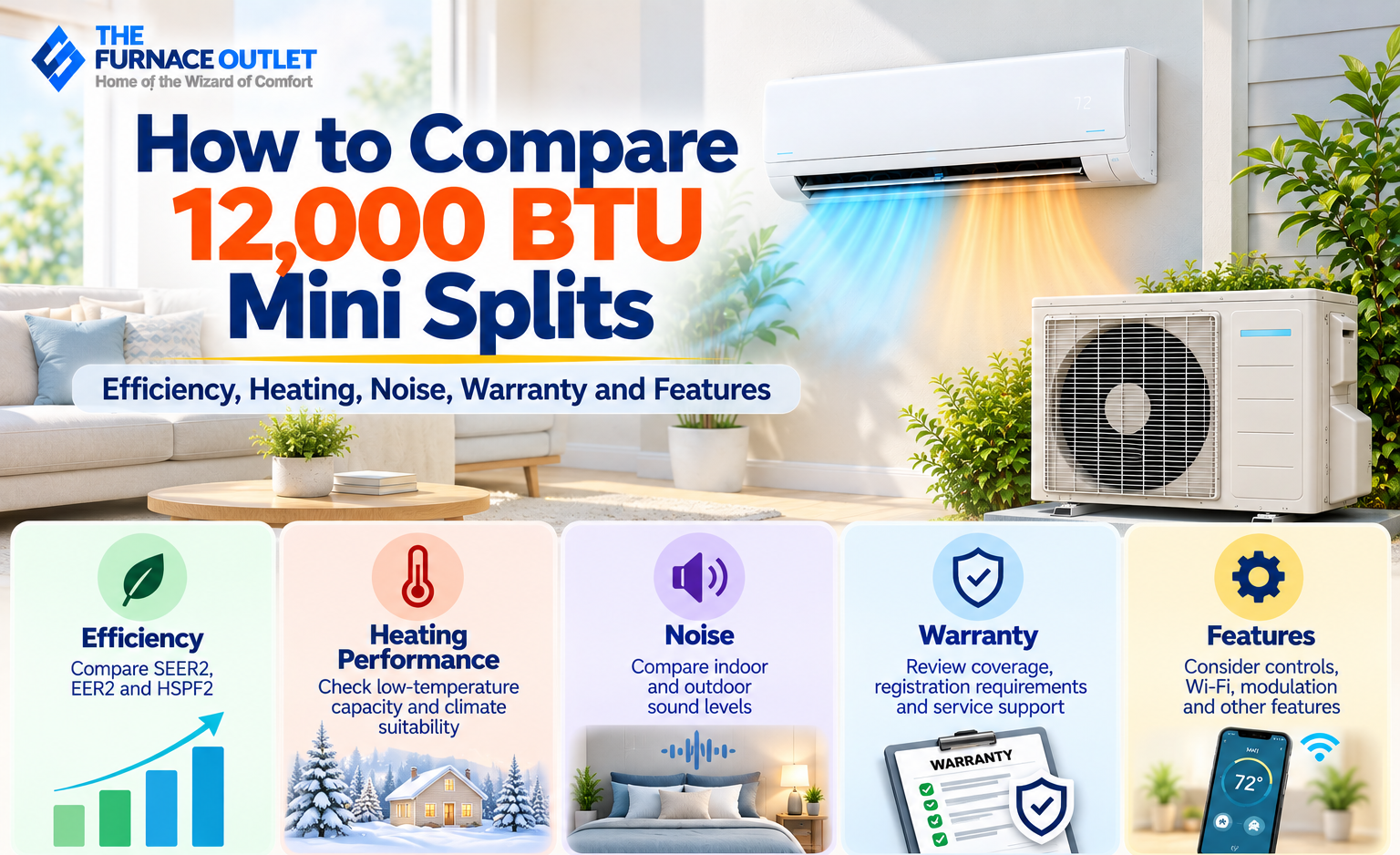
Shopping for a 12,000 BTU mini-split becomes confusing surprisingly quickly. Two systems can both be advertised as “12K,” both use inverter compressors and both promise efficient heating and cooling, yet their actual performance, sound levels, cold-weather capability, warranty requirements and installation needs can be very different.
That is because 12,000 BTU/h primarily identifies a nominal capacity class. It does not tell you how efficiently the system operates, how much heating capacity it retains at 5°F, how quietly the indoor unit runs, how far the compressor can modulate, how strong the warranty is or how easily the equipment can be serviced in your area.
When I compare 12K mini splits, I therefore avoid starting with brand names or the highest efficiency number. I first confirm that approximately one ton is appropriate for the space, then compare the actual indoor/outdoor equipment combinations across the specifications that matter for the intended application.
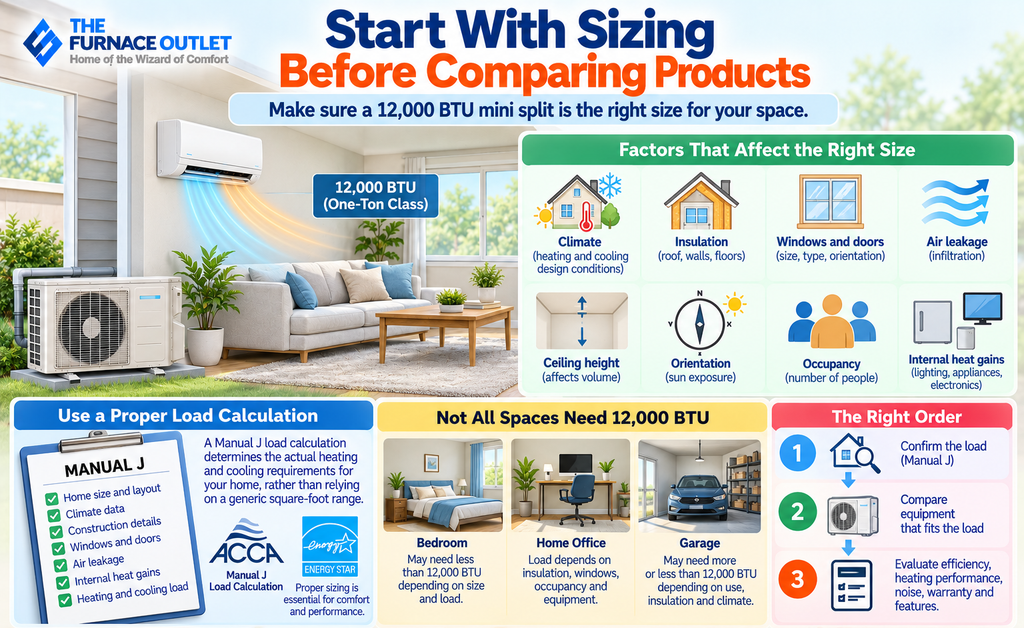
Before comparing SEER2 ratings, Wi-Fi controls or warranties, make sure a 12,000 BTU mini split is actually an appropriate capacity for the space.
A 12K mini split belongs to the nominal one-ton capacity class, but that does not mean every bedroom, garage, office or living room within a certain square-foot range needs one ton. Heating and cooling loads are influenced by climate, insulation, windows, air leakage, ceiling height, orientation, solar exposure, occupancy and internal heat gains.
ENERGY STAR emphasizes that properly sized HVAC equipment is important for comfort and performance and specifically points homeowners toward Manual J load calculations when determining heating and cooling requirements. ACCA identifies Manual J as its residential load-calculation methodology, while Manual S uses calculated loads, local conditions and manufacturer performance data to select appropriate equipment.
This gives me my first rule for comparing 12K systems: confirm the load first and compare equipment second. There is little value in finding an exceptionally efficient one-ton mini split if one ton is fundamentally wrong for the room.
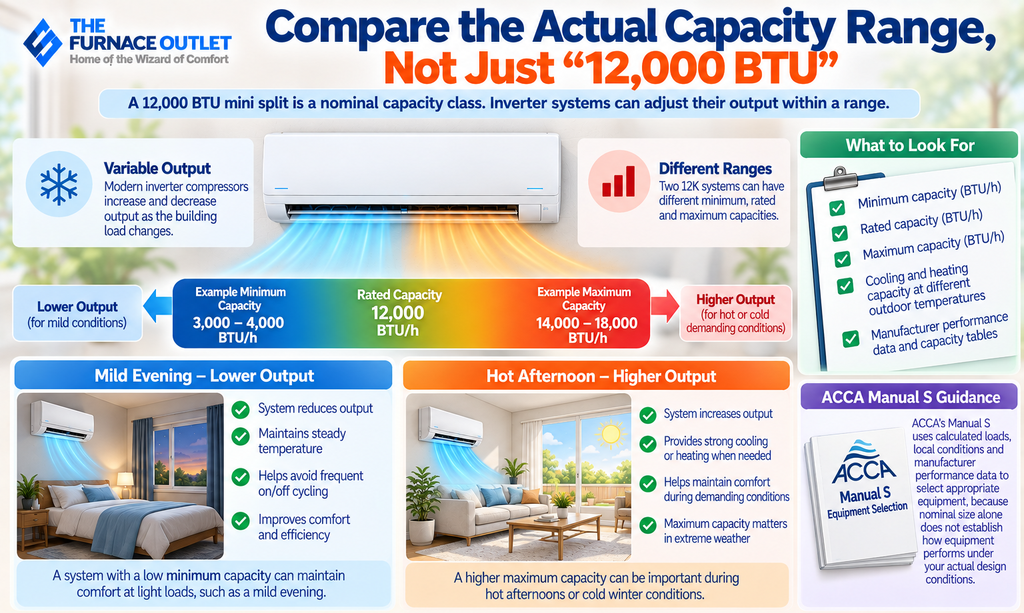
Modern inverter mini splits do not simply switch between zero and 12,000 BTU/h. Their variable-speed compressors can increase and decrease output as the building load changes. Consequently, two nominally 12K systems may have different minimum and maximum capacities. This can have practical implications for comfort and operation.
Imagine a room that requires substantial cooling on a hot afternoon but only a small amount during a mild evening. A system capable of reducing its output substantially may be able to maintain the temperature steadily at light loads rather than repeatedly changing operating state. At the opposite extreme, maximum available output can become important during demanding cooling or heating conditions. The 12K number alone does not describe this entire operating envelope.
I therefore look for manufacturer-expanded performance information and minimum/rated/maximum capacity data where available. ACCA’s Manual S specifically incorporates manufacturer performance data into equipment selection because nominal equipment size alone does not establish how equipment performs under a home’s actual design conditions.
Once I’ve established that the systems belong in the appropriate capacity range, I look at SEER2, or Seasonal Energy Efficiency Ratio 2. SEER2 represents seasonal cooling output relative to electrical energy input under the applicable standardized test procedure. Within the rating framework, a higher SEER2 generally represents greater rated seasonal cooling efficiency.
For example, if two appropriately sized 12K systems have SEER2 ratings of 18 and 24, the 24-SEER2 system has the higher rated seasonal cooling efficiency. However, I would not turn that difference directly into a promised percentage reduction in the homeowner’s electricity bill. Actual consumption depends on climate, room load, thermostat settings, operating hours, installation, maintenance and how frequently an inverter system operates at different capacities.
For reference, current ENERGY STAR criteria for qualifying split-system heat pumps specify at least 15.2 SEER2, together with other efficiency requirements. I treat such thresholds as useful reference points rather than a definition of the ideal mini split for every homeowner.
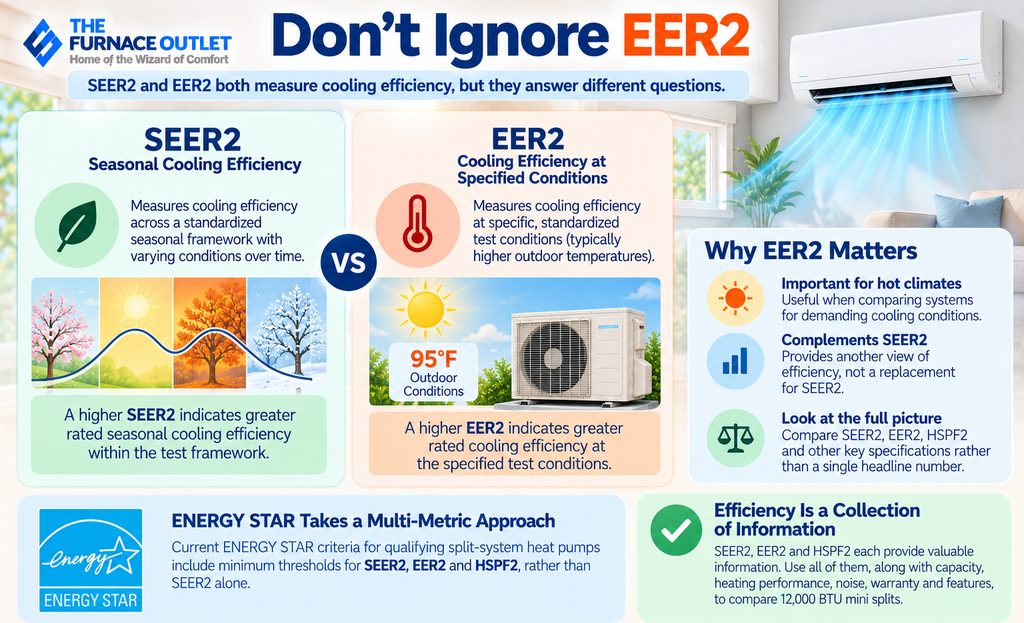
SEER2 gets much of the marketing attention, but I also check EER2, or Energy Efficiency Ratio 2. The two ratings answer related but different questions. SEER2 represents cooling efficiency across a standardized seasonal framework, while EER2 represents cooling efficiency under specified rating conditions.
This additional perspective can be particularly useful when comparing equipment intended for demanding cooling climates. A system with an impressive seasonal number should still be evaluated across its broader set of performance specifications rather than being selected from SEER2 alone.
Current ENERGY STAR criteria demonstrate this multi-metric approach. Qualifying split-system heat pumps are currently subject to thresholds across SEER2, EER2 and HSPF2, rather than a SEER2 requirement alone. That is similar to how I would approach a homeowner comparison: efficiency is a collection of information, not a single headline number.
If the mini split will provide meaningful winter heating, HSPF2 deserves considerably more attention. HSPF2, or Heating Seasonal Performance Factor 2, represents seasonal heating output relative to electrical energy consumption under the applicable rating methodology. A higher HSPF2 generally represents greater rated seasonal heating efficiency within that framework.
Current ENERGY STAR criteria require at least 7.8 HSPF2 for qualifying split-system heat pumps. For non-ducted split systems carrying the ENERGY STAR Cold Climate designation, the current threshold is at least 8.5 HSPF2, together with additional cold-climate requirements.
However, I would not select a cold-climate mini split from HSPF2 alone. Seasonal heating efficiency does not tell you exactly how much heating capacity remains available during severe outdoor conditions. That requires another layer of comparison.
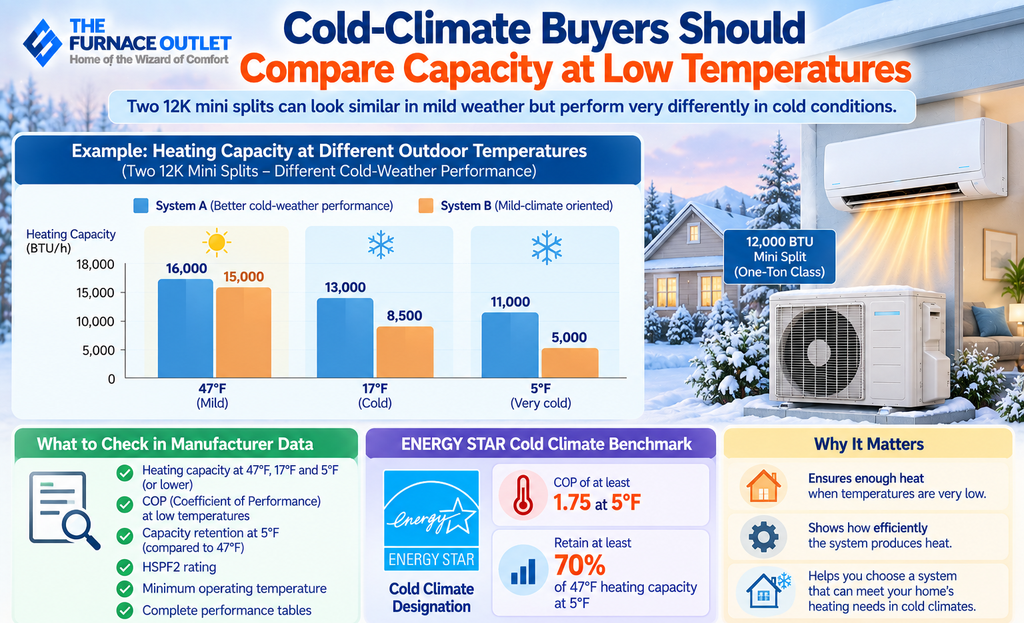
Two 12K mini splits can look similar during mild weather and behave very differently when temperatures fall substantially below freezing. For a cold-climate installation, I want manufacturer performance information showing heating output at multiple outdoor temperatures. Depending on the documentation, this may include capacity at 47°F, 17°F and 5°F, plus lower-temperature information for equipment designed for severe winter conditions.
The critical question is not merely whether the compressor continues operating. I want to know how much heating capacity remains available and how efficiently the system produces that heat.
ENERGY STAR’s current Cold Climate designation provides a useful benchmark. Qualifying heat pumps must demonstrate a COP of at least 1.75 at 5°F and retain at least 70% of their specified 47°F heating capacity at 5°F under the applicable test procedures.
Those criteria illustrate why I compare low-temperature capacity and COP alongside HSPF2. A homeowner depending heavily on the mini split for winter heat needs a much deeper comparison than someone buying equipment primarily for summer cooling.
Manufacturers often publish a minimum outdoor operating temperature for heating and sometimes cooling. This specification is useful, but it can also be misunderstood. A statement that a system can “operate down to” a particular temperature does not necessarily tell you how much heating it provides at that temperature or how efficiently it operates.
Suppose a product is listed as operating at a very low outdoor temperature. I would still look for the corresponding capacity and performance data. The ability to remain operational is not the same thing as providing enough heat for the building.
This is another area where Manual S principles become valuable. ACCA explains that equipment selection should incorporate the calculated heating and cooling loads, manufacturer performance data and local design conditions rather than relying on nominal ratings or marketing claims. For cold climates, I would therefore compare minimum operating temperature, low-temperature capacity, COP, HSPF2 and the building’s actual heating requirement together.
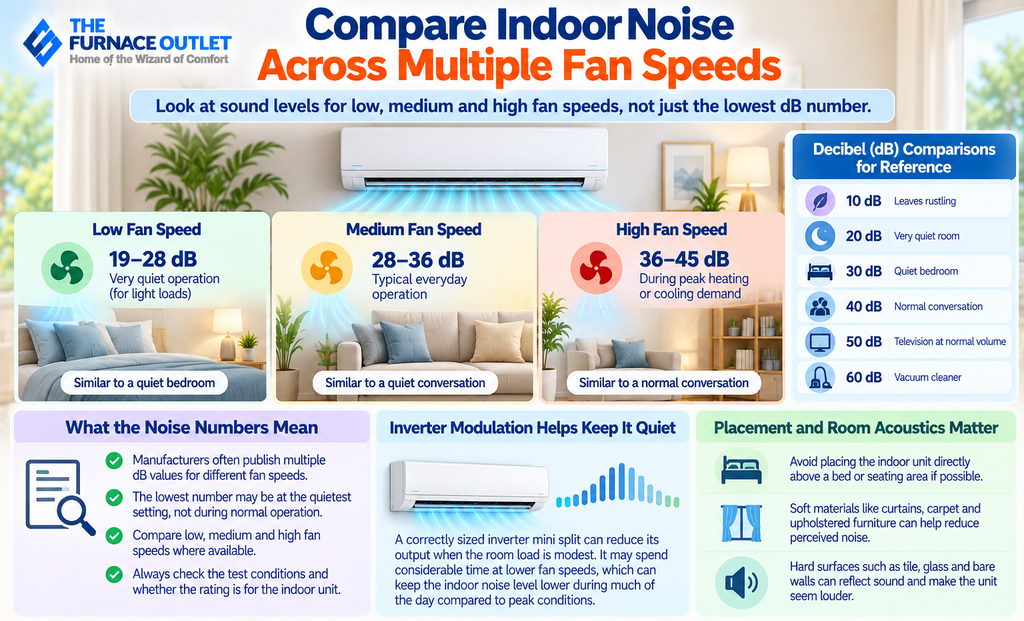
Mini splits have a strong reputation for quiet operation, but comparing noise specifications requires more than finding the smallest dB number. Manufacturers may publish several indoor sound levels corresponding to different fan speeds or operating modes. The lowest number can represent the indoor unit operating at its quietest setting rather than the condition it will experience while delivering substantial heating or cooling.
For a bedroom, nursery or home office, I would look for sound data across low, medium and high fan speeds, where available.
I also consider the equipment’s modulation characteristics. A correctly sized inverter mini split maintaining a modest room load may spend considerable time at reduced output. That can create a different acoustic experience from the same equipment working hard during peak conditions.
Placement matters too. A wall unit directly above a bed can seem more noticeable than the same unit installed farther away, while hard surfaces can reflect sound differently from curtains, carpet and upholstered furniture. The lowest published decibel number is useful information, but it should always be interpreted in context.
Indoor quietness is only half of the acoustic comparison. The outdoor condenser contains the compressor and fan, and its location can affect both the homeowner and nearby properties.
I pay particular attention when the outdoor unit will be installed near a bedroom window, patio, property boundary or acoustically reflective walls. Another important detail is the type of sound specification being published. Sound pressure and sound power are not interchangeable measurements. When comparing two systems, make sure the numbers represent equivalent quantities and comparable test conditions.
Installation can also influence perceived noise. Poor mounting, vibration transmission, loose panels or piping contact with the building can transform otherwise normal mechanical operation into an irritating buzz or resonance. For a genuinely quiet installation, I want good equipment specifications and thoughtful placement and mounting.
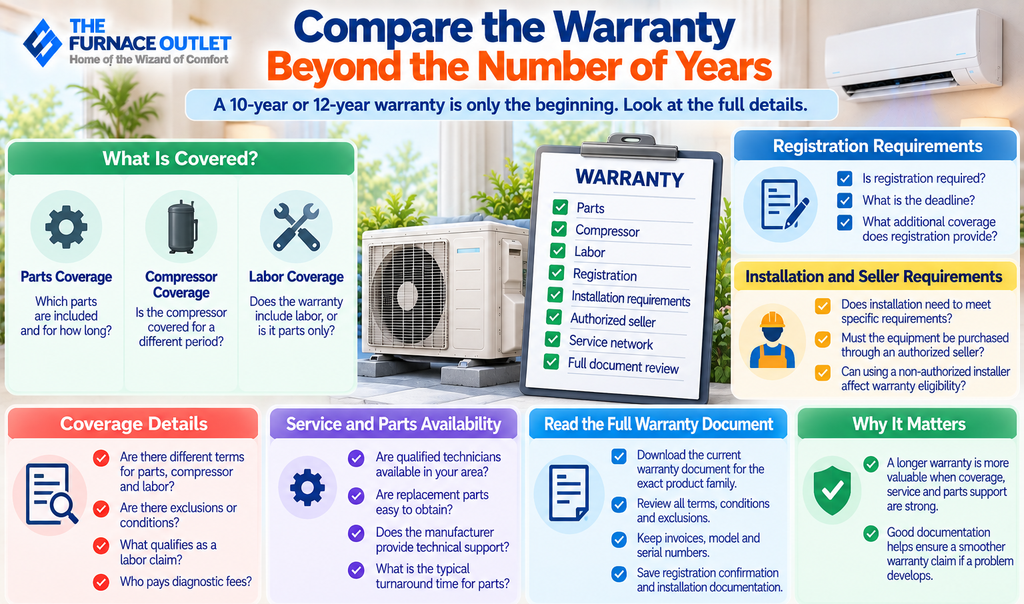
A statement such as “10-year warranty” or “12-year warranty” is not enough information for me to judge warranty quality. I want to know what is covered. Parts, compressor and labor coverage may have different terms. Some warranties may provide enhanced coverage after registration, while others can contain installer, seller or maintenance requirements.
I would check whether registration is required and the applicable deadline, whether installation conditions affect eligibility, whether equipment needs to be purchased through a particular sales channel and who pays diagnostic and labor costs if a component fails.
Serviceability matters just as much. A long parts warranty becomes less attractive if qualified local technicians rarely work on the equipment or replacement components are difficult to obtain. Before buying, download the current warranty document for the exact product family. Keep invoices, model and serial numbers, registration confirmation and installation documentation rather than relying on the retailer’s warranty summary.
Modern mini splits can offer an impressive collection of features: Wi-Fi, smartphone applications, scheduling, sleep modes, occupancy sensing, adjustable louvers, energy monitoring, freeze-protection modes and integrations with smart-home platforms. I consider these useful, but I place them below core HVAC performance.
A polished smartphone application does not compensate for inadequate heating capacity, poor sizing or weak service support. At the same time, controls can meaningfully improve convenience when the underlying equipment is already suitable.
For a bedroom, sleep-oriented controls and quiet fan operation may matter more than extensive smart-home integration. For a vacation property, remote temperature monitoring can be much more valuable. For a home office, scheduling and precise airflow control may be particularly useful. I therefore compare features against the homeowner’s actual use case, rather than counting how many features appear on a specification sheet.
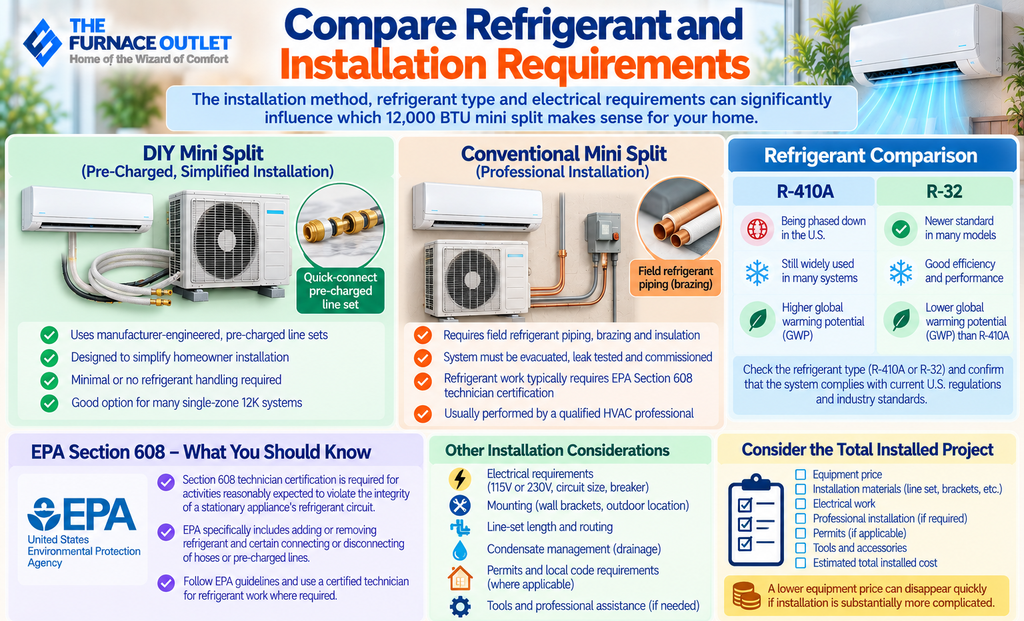
The installation method can significantly influence which 12K mini split makes sense. A purpose-designed DIY system can use a manufacturer-engineered connection arrangement intended to simplify homeowner installation. A conventional mini split may require field refrigerant piping, evacuation, leak testing and commissioning.
In the United States, refrigerant work also has regulatory implications. EPA states that Section 608 technician certification is required for activities reasonably expected to violate the integrity of a stationary appliance’s refrigerant circuit. EPA specifically includes adding or removing refrigerant and certain connecting or disconnecting of hoses or pre-charged lines.
I would therefore compare not merely the equipment price but the complete installed project. Include electrical requirements, mounting, line-set work, condensate management, permits where applicable, tools and professional assistance. A lower equipment price can disappear quickly if installation is substantially more complicated.
This is one specification you may never find on an efficiency label, yet it can strongly influence long-term ownership. Before buying, I would ask who can service the system locally. Are replacement control boards, fan motors, sensors and other components reasonably obtainable? Does the manufacturer provide technical support? Are local contractors familiar with the product?
This becomes particularly important with equipment purchased online. A very attractive purchase price and impressive SEER2 rating can lose some appeal if a technician is unwilling to work on the equipment several years later. I would rather know the service situation before installation than discover it during a mid-summer or mid-winter failure.
Mini-split specifications should be tied to the actual indoor/outdoor combination being purchased. Do not assume every indoor unit paired with a particular outdoor product family produces identical efficiency, capacity or sound results. Model combinations matter.
Record the complete model numbers and verify the applicable certified and manufacturer performance information. Retailer pages are convenient for initial research, but I would use manufacturer documentation and recognized certification information for the final technical comparison.
This is particularly important when comparing efficiency ratings, because the headline number on a shopping page may not necessarily describe every available equipment combination.
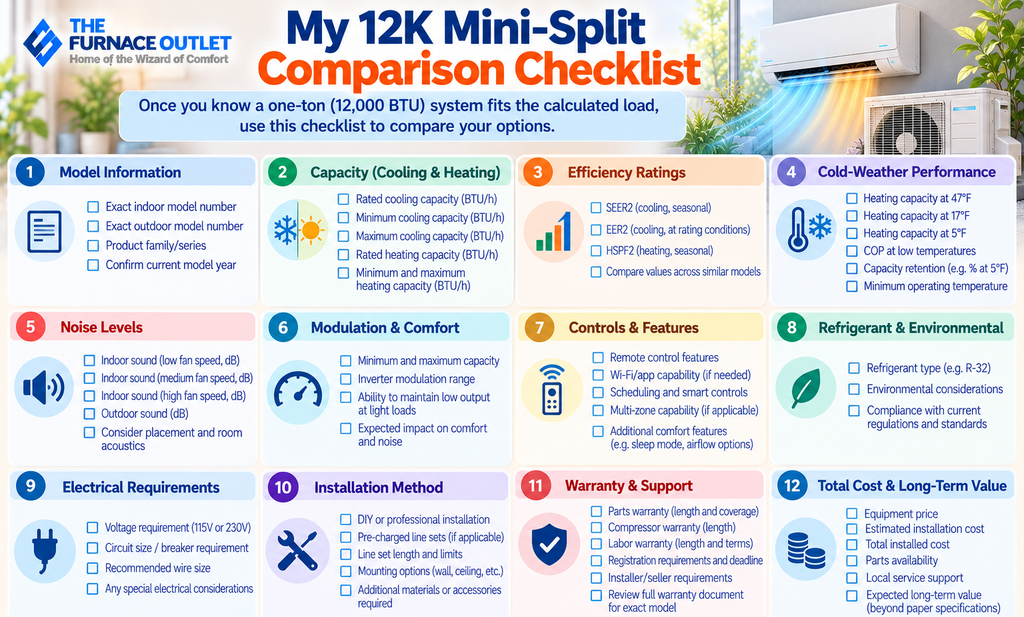
Once I know that approximately one ton fits the calculated load, my comparison becomes much more systematic. I first record the exact indoor and outdoor model numbers, then compare rated, minimum and maximum cooling and heating capacities. I look at SEER2 and EER2 for cooling efficiency and HSPF2 for seasonal heating efficiency.
For winter applications, I add heating capacity and COP at low outdoor temperatures, capacity retention and minimum operating temperature. For bedrooms and offices, I compare indoor sound at several fan speeds and examine outdoor sound specifications as well.
I then review modulation range, controls, Wi-Fi capabilities where relevant, refrigerant type, electrical requirements, installation method, warranty terms, registration requirements, parts availability and local service support. Finally, I compare total installed cost rather than equipment price alone. The best paper specification is not necessarily the best overall system if installation, service or warranty requirements make ownership substantially more difficult.
Is a higher-SEER2 12K mini split always the better choice?
Not necessarily. Higher SEER2 indicates greater rated seasonal cooling efficiency within the applicable test framework, but sizing, heating performance, modulation, sound, installation quality, warranty and service support also matter. The better comparison is between complete systems that are appropriate for the home’s load and climate.
What matters most for a 12K mini split in a cold climate?
I would pay particular attention to the calculated heating load, low-temperature heating capacity, capacity retention, COP at low temperatures, HSPF2 and minimum operating temperature. ENERGY STAR’s Cold Climate criteria provide useful performance benchmarks, but the equipment still needs to match the home’s actual heating requirement.
Should I choose the mini split with the lowest indoor dB rating?
Not from that number alone. Determine the fan speed and operating condition associated with the published value and compare equivalent specifications. Equipment sizing, modulation and installation location can also influence how noticeable the system is.
Is a longer warranty automatically better?
Warranty duration is only one consideration. Check which components are covered, whether labor is included, registration deadlines, installer or seller requirements and how easily warranty service and replacement parts can be obtained.
Should I compare 12K mini splits by price?
Price matters, but I recommend comparing completed-project costs. Equipment, mounting materials, electrical work, refrigerant-related installation, condensate management, permits and professional commissioning can substantially change the final cost.
A 12,000 BTU label gives you a capacity category, not a complete picture of the mini split. Once a proper load calculation establishes that approximately one ton is suitable, the meaningful comparison begins.
I would evaluate capacity range, SEER2, EER2, HSPF2, low-temperature heating performance, indoor and outdoor sound, modulation, warranty, controls, installation requirements, service support and total installed cost. ACCA’s Manual S reinforces this broader approach by using building loads, local design conditions and manufacturer performance data to select residential equipment rather than relying on nominal size alone.
For further research, useful authoritative resources include ENERGY STAR Ductless Heating & Cooling guidance, ENERGY STAR Heat Pump Key Product Criteria, ACCA Manual S equipment-selection guidance and EPA Section 608 homeowner guidance. Together, these resources provide a much stronger basis for comparison than retailer headlines alone.
Editorial & HVAC Disclaimer: This article is for educational purposes only. HVAC performance, sizing, efficiency, sound, costs and heating capability vary by home, climate, equipment and installation. Specifications, warranty terms, certifications and product availability can change, so verify current information for the exact equipment combination before purchasing. The Furnace Outlet is not associated with, affiliated with, endorsed by, or sponsored by any manufacturer or brand mentioned and does not receive manufacturer compensation for inclusion or rankings. Consult a qualified HVAC professional for system sizing, selection and installation
https://thefurnaceoutlet.com/best-12000-btu-mini-splits-of-2026-1-ton-systems-compared/