Newsletter Subscribe
Enter your email address below and subscribe to our newsletter

HVAC made simple
By Jake Lawson — The HVAC Specialist
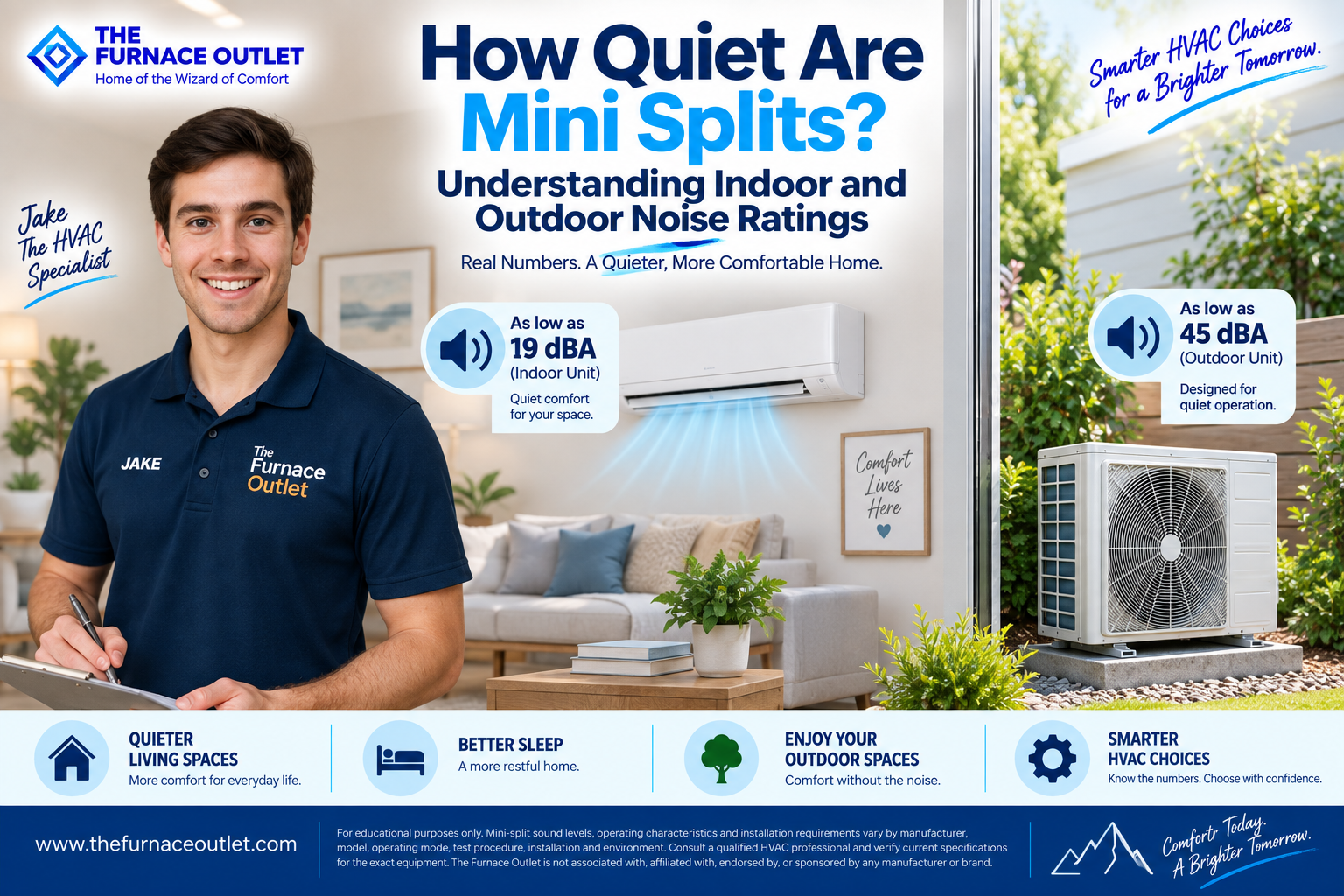
Noise is one of those HVAC specifications that homeowners often ignore until the equipment is installed. Efficiency ratings, heating capacity and price naturally attract attention first, but the sound a system makes can affect everyday comfort just as much—especially when an indoor unit is installed in a bedroom, office or media room, or when an outdoor condenser sits near a patio or bedroom window.
Mini splits have an important advantage here. Because there is no large central blower pushing conditioned air through a network of ducts, ductless systems can provide relatively quiet indoor operation. ENERGY STAR describes mini splits as providing quiet air conditioning, but that does not mean every mini split—or every operating condition—is equally quiet.
The number printed beside “sound level” on a specification sheet is useful, but it needs context. Indoor and outdoor ratings can be measured differently, sound changes with operating speed, installation affects what you hear, and two machines with similar decibel ratings can still sound noticeably different.
Here is how I would evaluate mini-split noise before buying.
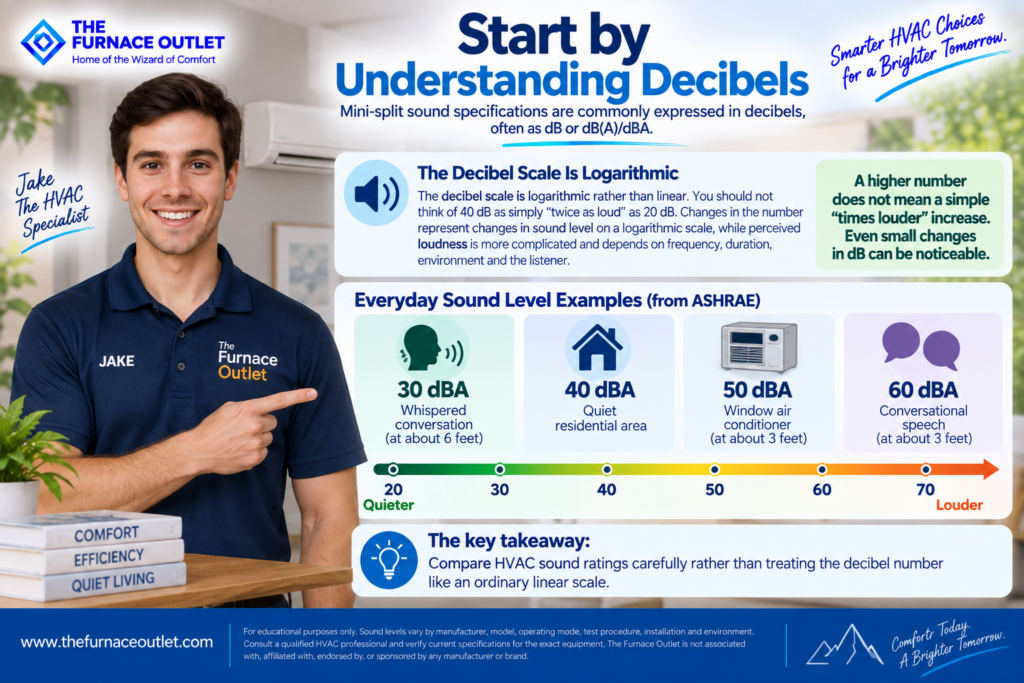
Mini-split sound specifications are commonly expressed in decibels, often as dB or dB(A)/dBA. The decibel scale is logarithmic rather than linear. That means you should not think of 40 dB as simply “twice as loud” as 20 dB. Changes in the number represent changes in sound level on a logarithmic scale, while perceived loudness is more complicated and depends on frequency, duration, environment and the listener.
ASHRAE provides some useful reference points for sound pressure levels: whispered conversation at about 6 feet is around 30 dBA, a quiet residential area around 40 dBA, a window air conditioner at about 3 feet around 50 dBA and conversational speech at about 3 feet around 60 dBA. These are reference examples rather than targets for a particular mini split.
The important lesson is simple: compare HVAC sound ratings carefully rather than treating the decibel number like an ordinary linear scale.
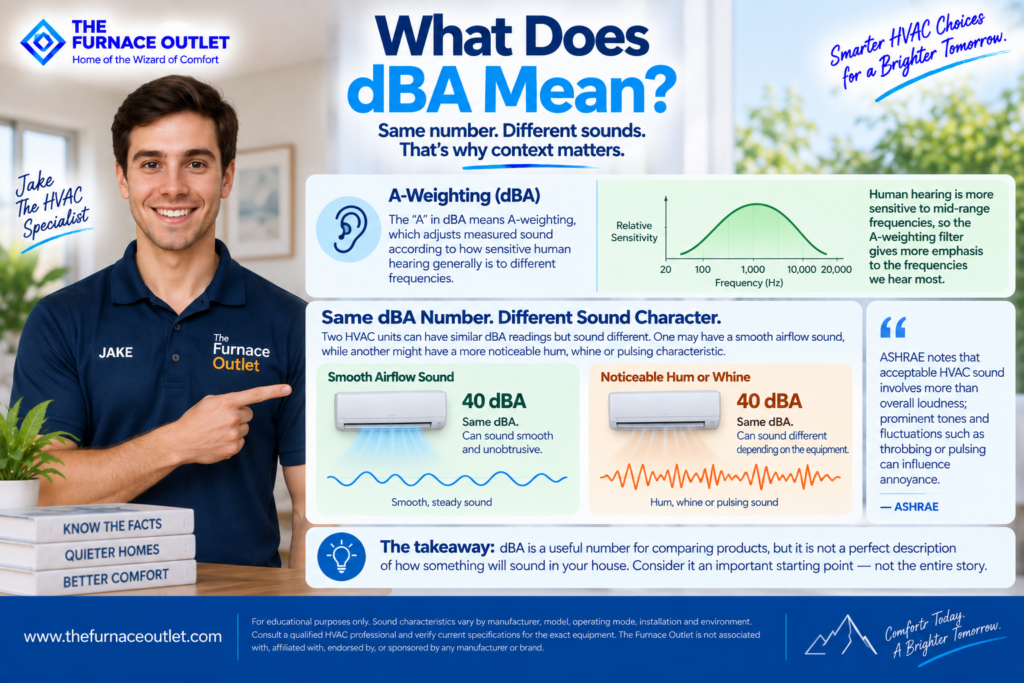
You will frequently see mini-split sound levels written as dBA.
The “A” indicates A-weighting, which adjusts measured sound according to how sensitive human hearing generally is to different frequencies. ASHRAE notes that A-weighted sound level has long been used as a single-number measure of relative loudness, particularly for environmental noise.
That makes dBA useful for comparing products, but it is not a perfect description of how something will sound in your house. Two pieces of HVAC equipment can produce similar dBA readings while having different sound characteristics. One might create a smooth airflow sound, while another has a more noticeable hum, whine or pulsing characteristic. ASHRAE specifically notes that acceptable HVAC sound involves more than overall loudness; prominent tones and fluctuations such as throbbing or pulsing can influence annoyance.
So I would consider the published dBA number an important starting point—not the entire story.
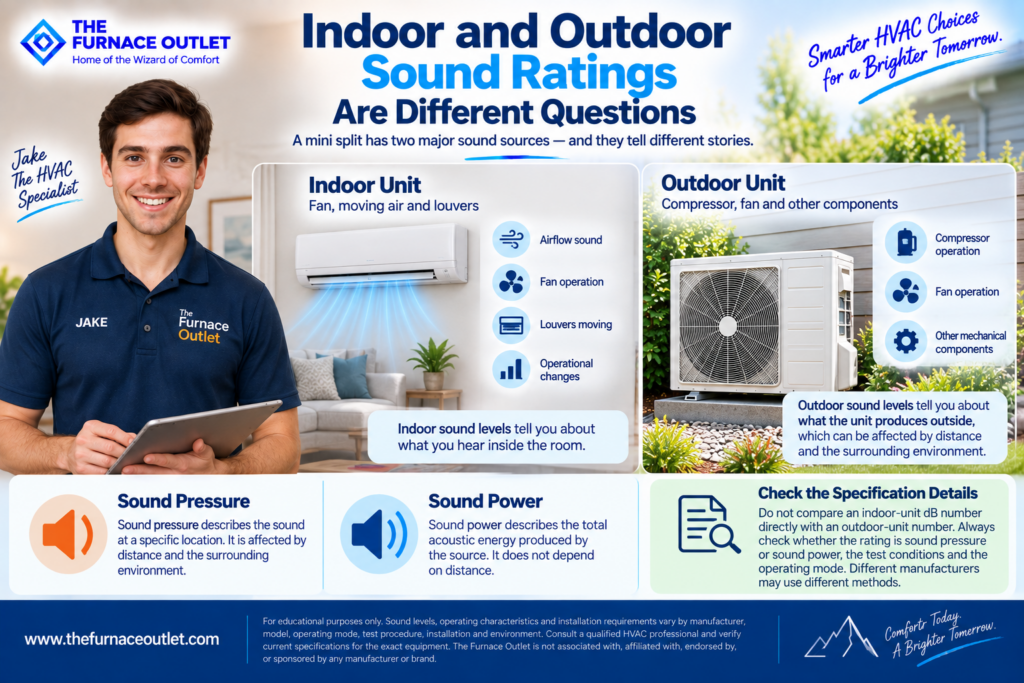
A mini split has at least two major sound sources.
Do not compare an indoor-unit sound number directly with an outdoor-unit number unless you understand how both values were determined. Sound specifications can refer to sound pressure or sound power, and those are not interchangeable.
Sound power describes acoustic energy produced by the source. Sound pressure describes the sound at a particular location and is affected by distance and the surrounding environment. ASHRAE emphasizes that decibels are used for several different sound descriptors, so the context of the published number matters. That distinction becomes particularly important when comparing specification sheets from different manufacturers.
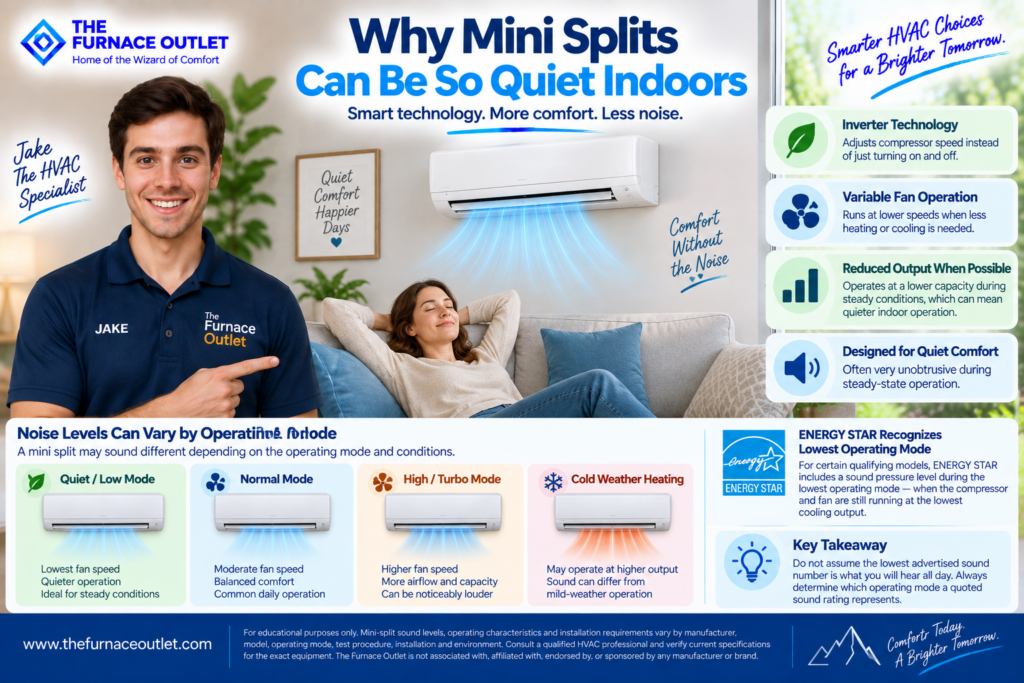
One reason mini splits can provide quiet operation is their ability to modulate. Many modern systems use inverter-driven compressors and variable fan operation rather than operating only at maximum output and then shutting completely off. When the room requires relatively little heating or cooling, the equipment may operate at a reduced output. The indoor fan can consequently operate at a lower speed under appropriate conditions.
That can make the system particularly unobtrusive during steady-state operation. However, you should not assume the lowest advertised sound number represents what you will hear all day. A system responding to a large temperature difference may increase its fan speed and output. Heating operation during very cold conditions can differ from mild-weather operation. Turbo, powerful or high-fan modes may also sound different from quiet or low-fan modes.
ENERGY STAR’s product data framework recognizes this distinction: for certain qualifying models it includes a field for sound pressure level during the lowest operating mode, defined as an operating condition where the compressor and fan are still running at the lowest cooling output. That reinforces an important buying principle: always determine which operating mode a quoted sound rating represents.
Noise that seems insignificant in a living room during the afternoon may become much more noticeable at midnight. Bedrooms usually have lower background noise than busy living spaces. A person lying several feet from an indoor head may also be more sensitive to changes in fan speed, airflow or mechanical sounds. ASHRAE’s guidance reflects the importance of low background sound in residential environments. Its HVAC acoustics guidance lists approximate background-sound targets for residential living areas, although these are design criteria for room background noise and should not be confused with a manufacturer’s equipment sound rating.
For a bedroom installation, I would therefore look beyond the headline minimum dBA number. Check the manufacturer’s sound data at multiple fan speeds if available, understand where the unit will be positioned relative to the bed, and consider whether the airflow itself may be distracting. Quiet equipment placed poorly can still create an uncomfortable bedroom.
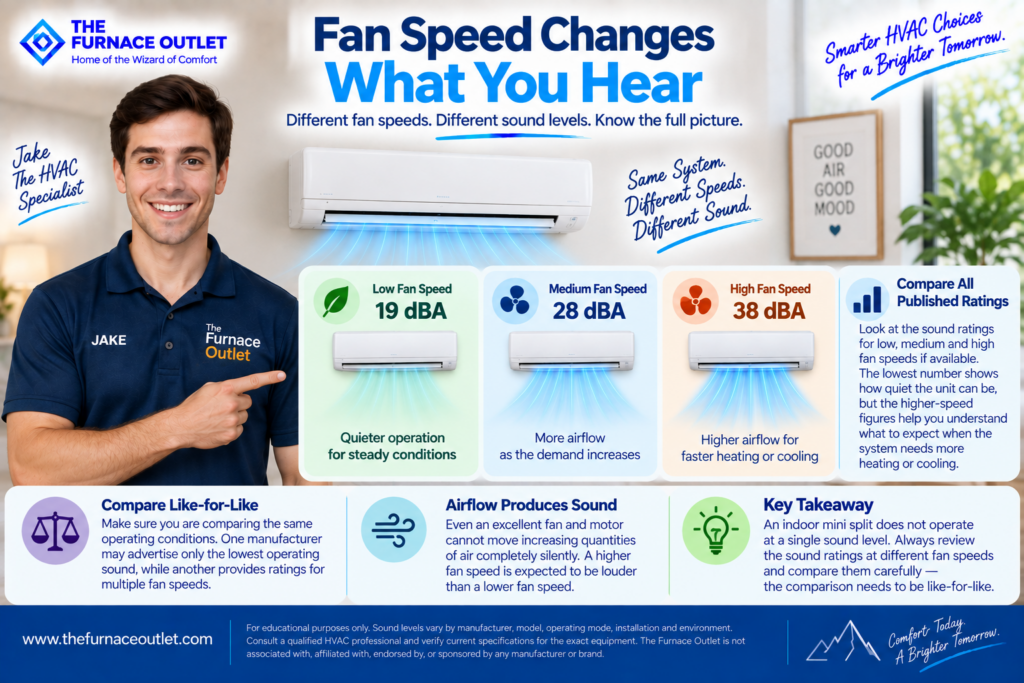
An indoor mini split does not necessarily operate at one fixed sound level. If the manufacturer publishes sound ratings for low, medium and high fan speeds, compare all of them. The lowest number tells you something about quiet operation, but the higher-speed figures help you understand what the equipment may sound like when the room needs more heating or cooling.
This is particularly important if a homeowner is comparing two products and one manufacturer prominently advertises its lowest operating sound while another specification sheet presents several operating conditions. The comparison needs to be like-for-like. Also remember that airflow itself produces sound. Even an excellent fan and motor cannot move increasing quantities of air completely silently.

Homeowners sometimes focus almost entirely on indoor sound because that is where they spend their time. But poor outdoor-unit placement can create another problem. A condenser positioned immediately outside a bedroom window may become more noticeable at night. Equipment beside a patio can affect outdoor enjoyment. A unit installed between closely spaced walls may interact acoustically with those surfaces differently from one installed in a more open location.
Local noise ordinances may matter as well. ASHRAE notes that outdoor HVAC equipment can affect nearby buildings and properties and that local noise requirements may impose A-weighted limits, often with more restrictive nighttime requirements.
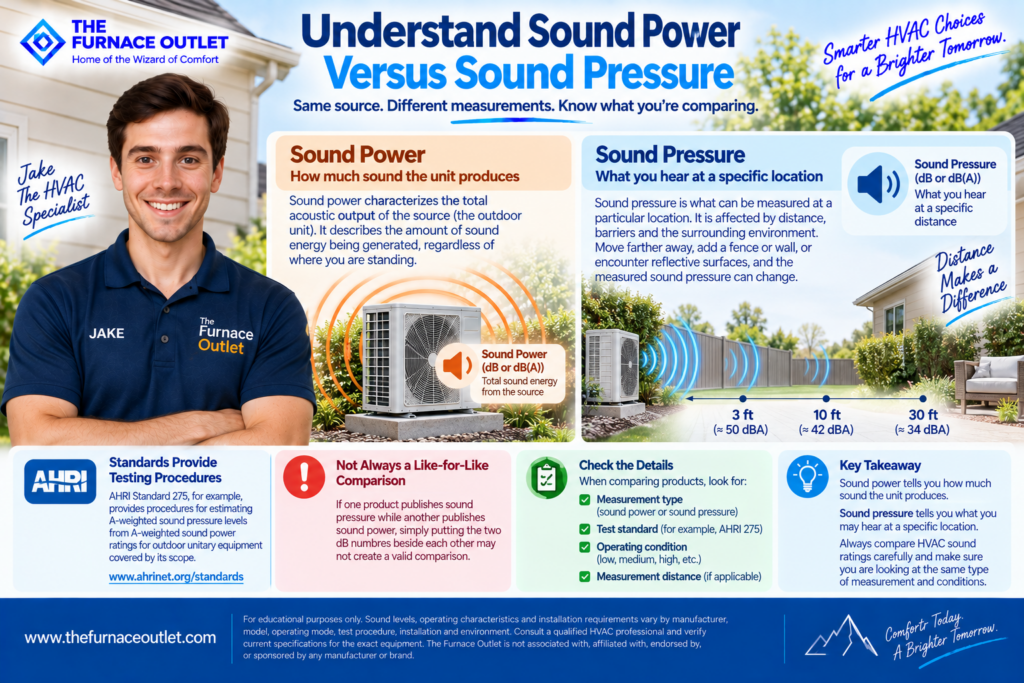
This is one of the easiest areas for consumers to misunderstand. Imagine an outdoor unit as the source of sound.
AHRI maintains standards for rating outdoor HVAC equipment sound. AHRI Standard 275, for example, provides procedures for estimating A-weighted sound pressure levels from A-weighted sound power ratings for outdoor unitary equipment covered by its scope.
AHRI — HVACR Standards & Guidelines
Consequently, if Product A publishes sound pressure while Product B publishes sound power, simply putting the two dB numbers beside each other may not create a valid comparison.
Look for the measurement type, test standard, operating condition and measurement distance where applicable.
Sound pressure at your ear is not necessarily the same as the sound pressure measured close to the equipment. As distance from a sound source increases in an open environment, sound generally diminishes. Real homes complicate the picture because walls, fences, landscaping and other surfaces can absorb, block or reflect sound. This is another reason I would be cautious with internet charts claiming that every mini split at a particular dBA rating will sound exactly like a whisper, refrigerator or library.
Those comparisons can help give people an intuitive sense of sound, but they are approximations. The measurement conditions matter.
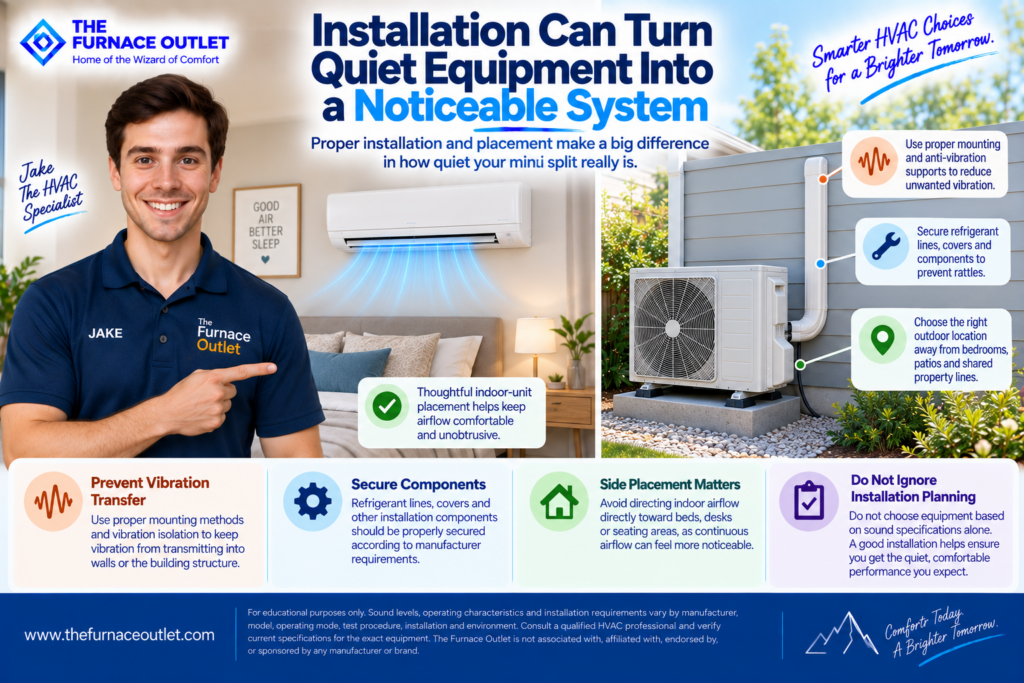
Published sound specifications describe equipment under defined conditions. Your home is not a laboratory. Installation quality and placement can influence what you actually experience. An outdoor unit should be mounted using an appropriate method for the equipment and structure. Unwanted vibration transmitted into a wall or building assembly can make the system more noticeable indoors.
Refrigerant lines, covers and other installation components should also be secured and installed according to manufacturer requirements. Loose components can potentially create rattles or vibration. Indoor-unit placement matters as well. A unit blowing directly toward a bed or desk may seem more intrusive because the occupant experiences the airflow continuously. This is why I would never choose equipment based on sound specifications while ignoring installation planning.
Suppose one mini split advertises a slightly lower minimum indoor sound rating than another. Does that automatically make it the better system? No. The difference may occur under a specific fan setting or operating condition. The systems might also differ in heating capacity, efficiency, cold-weather performance, controls, indoor-unit design, service availability and compatibility with the home’s actual load.
Noise is one part of equipment selection. The objective is to select a properly sized system that provides the required heating and cooling performance while meeting the homeowner’s comfort priorities. A system should not be oversized simply because a particular model appears quieter on paper. Likewise, choosing inadequate capacity to obtain a lower advertised sound figure would be a poor trade.
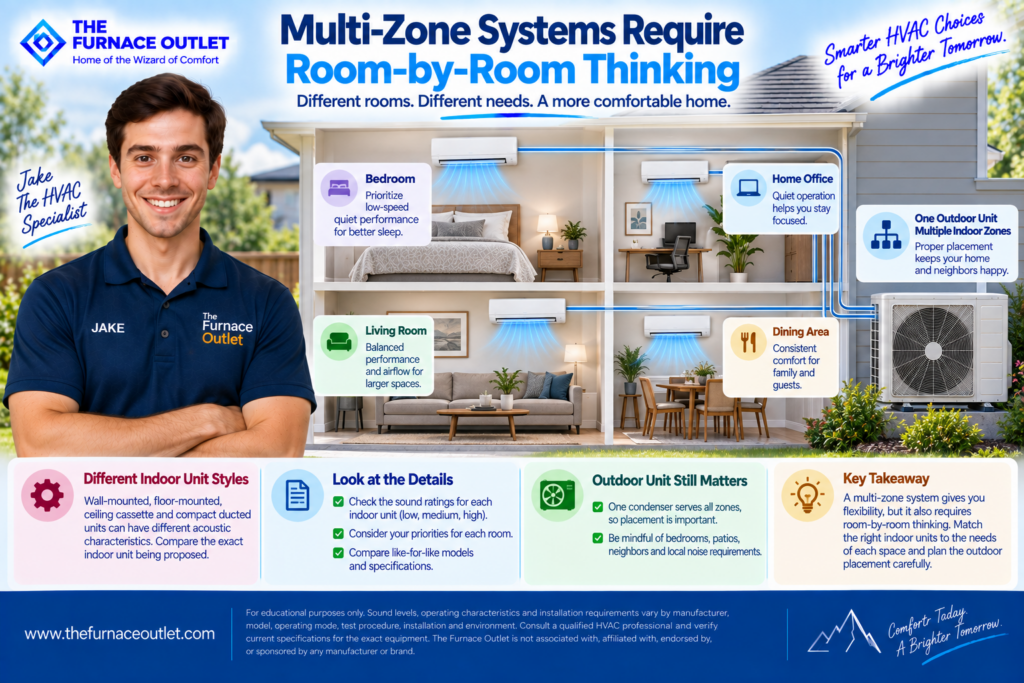
With a multi-zone system, sound considerations become more individualized. A living-room indoor unit and a bedroom indoor unit do not necessarily need identical priorities. The bedroom may benefit from particular attention to low-speed sound performance, while airflow distribution might dominate the decision in a large living area.
The outdoor system also serves several indoor zones, so condenser placement remains important. And remember that different indoor-unit styles—wall-mounted, floor-mounted, ceiling cassette or compact ducted—may have different acoustic characteristics. Compare the exact indoor unit being proposed, not merely the brand name of the outdoor system.
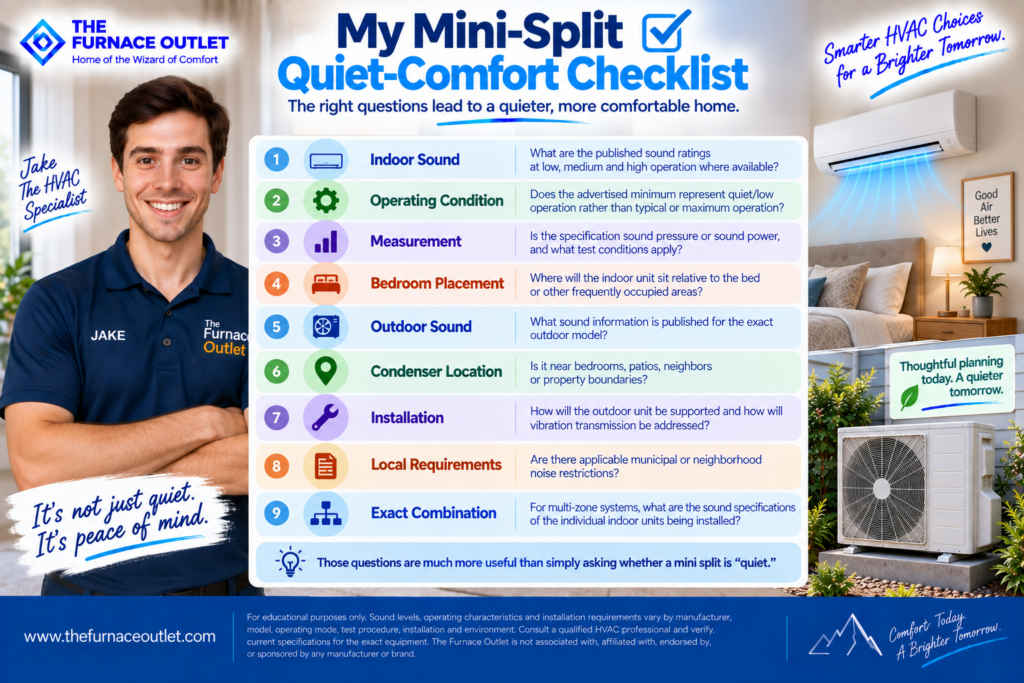
Before purchasing a mini split, I would ask the contractor or verify the manufacturer’s documentation for these points:
Those questions are much more useful than simply asking whether a mini split is “quiet.”
Mini splits can provide impressively quiet comfort, particularly when they are properly selected and allowed to operate at lower output for extended periods. ENERGY STAR itself identifies quiet air conditioning as one of the advantages of ductless heat-pump systems.
But I would never judge a system from its lowest advertised decibel number alone. Look at indoor and outdoor ratings separately. Determine whether you are reading sound pressure or sound power. Check the operating mode associated with the specification. Consider bedrooms, patios and neighbors. And remember that installation and placement influence how noticeable the equipment may ultimately be.
ASHRAE’s acoustics guidance makes another valuable point: sound quality matters as well as loudness. A hum, tone or pulsing sound can be more noticeable than a smooth background sound at a similar overall level. The goal is therefore not to chase the smallest number on a specification sheet.
The goal is a correctly sized, properly installed system whose sound characteristics fit the rooms—and the home—where it will actually operate.
https://thefurnaceoutlet.com/best-mini-split-systems-of-2026-complete-brand-model-comparison/
This article is for educational purposes only. Mini-split sound levels, operating characteristics and installation requirements vary by manufacturer, model, operating mode, test procedure, installation and environment. Verify current specifications for the exact indoor/outdoor equipment combination and consult a qualified HVAC professional when planning an installation.
The Furnace Outlet is not associated with, affiliated with, endorsed by or sponsored by any manufacturer or brand referenced in our editorial content, and we do not receive manufacturer compensation for inclusion or rankings.