Newsletter Subscribe
Enter your email address below and subscribe to our newsletter

HVAC made simple
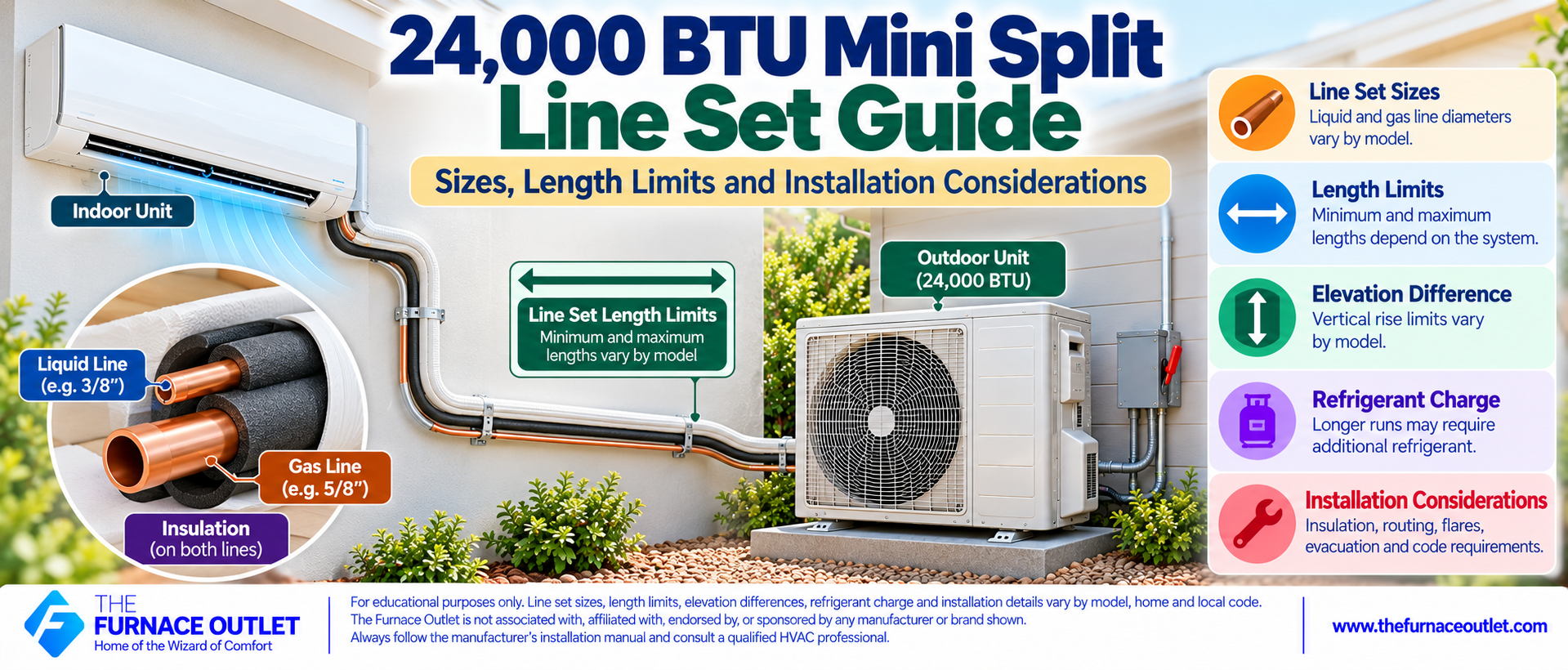
A 24,000 BTU mini split may look relatively simple from the outside: an indoor air handler, an outdoor condenser, and a pair of refrigerant lines connecting them. In reality, that line set is one of the most important parts of the installation. Its diameter, total length, vertical rise, insulation, routing, flare connections, evacuation, and refrigerant charge can all affect whether the finished system operates as the manufacturer intended.
One mistake I would avoid is assuming that every 24K mini split uses the same line-set dimensions. You may encounter 24,000 BTU systems using combinations such as 1/4-inch liquid and 5/8-inch gas lines, but other 24K equipment can specify different dimensions. Even within a manufacturer’s product range, piping requirements can vary by series and exact indoor/outdoor combination.
The same caution applies to line-set length. There is no universal rule that a 24K mini split can have a 25-foot, 50-foot, 100-foot, or 150-foot line set. Manufacturers specify minimum and maximum piping lengths, allowable elevation differences, factory-charge allowances, and additional-refrigerant requirements for individual systems.
My rule is therefore simple: choose the exact mini split first and design the refrigerant piping around its installation manual—not around a generic 24,000 BTU label.
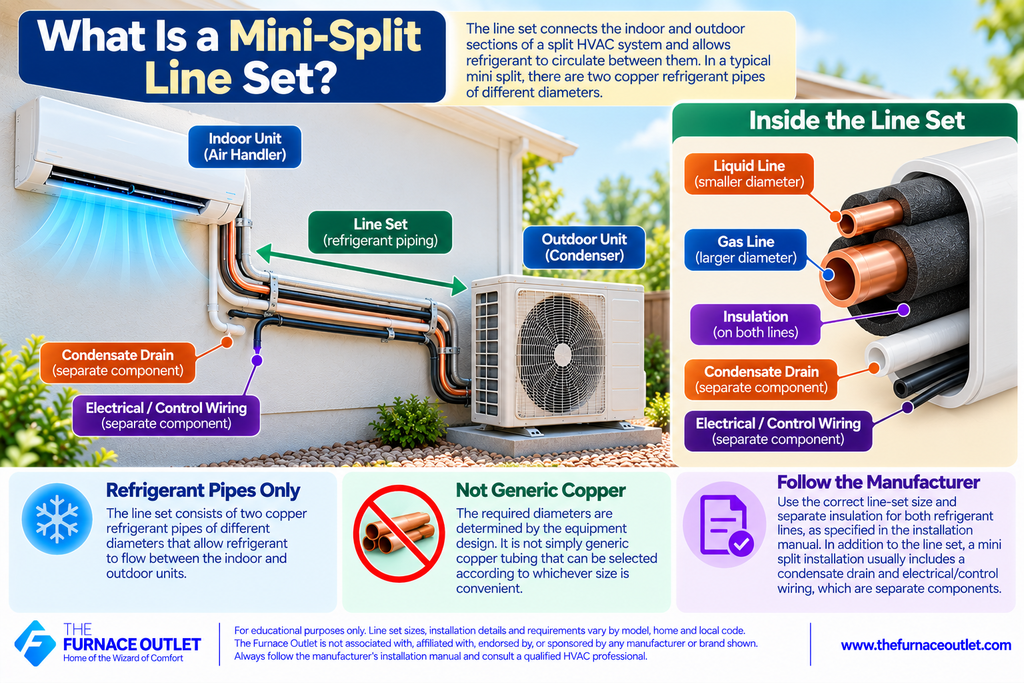
The line set connects the indoor and outdoor sections of a split HVAC system and allows refrigerant to circulate between them. In a typical mini split, there are two copper refrigerant pipes of different diameters.
The smaller line and larger line perform different functions within the refrigeration cycle, and their required diameters are determined by the equipment design. The line set is therefore not simply generic copper tubing that can be selected according to whichever size happens to be convenient.
GREE describes refrigerant line sets as the connection that allows refrigerant to circulate between the indoor air handler and compressor and specifically advises installers to use the correct line-set size for the equipment. Its current installation guidance also calls for copper refrigerant piping and separate insulation of the refrigerant lines. GREE Comfort
Alongside the refrigerant piping, a mini-split installation usually involves a condensate drain and electrical/control wiring, but these are separate components. When I refer to the line set in this guide, I am primarily discussing the refrigerant piping between the indoor and outdoor equipment.
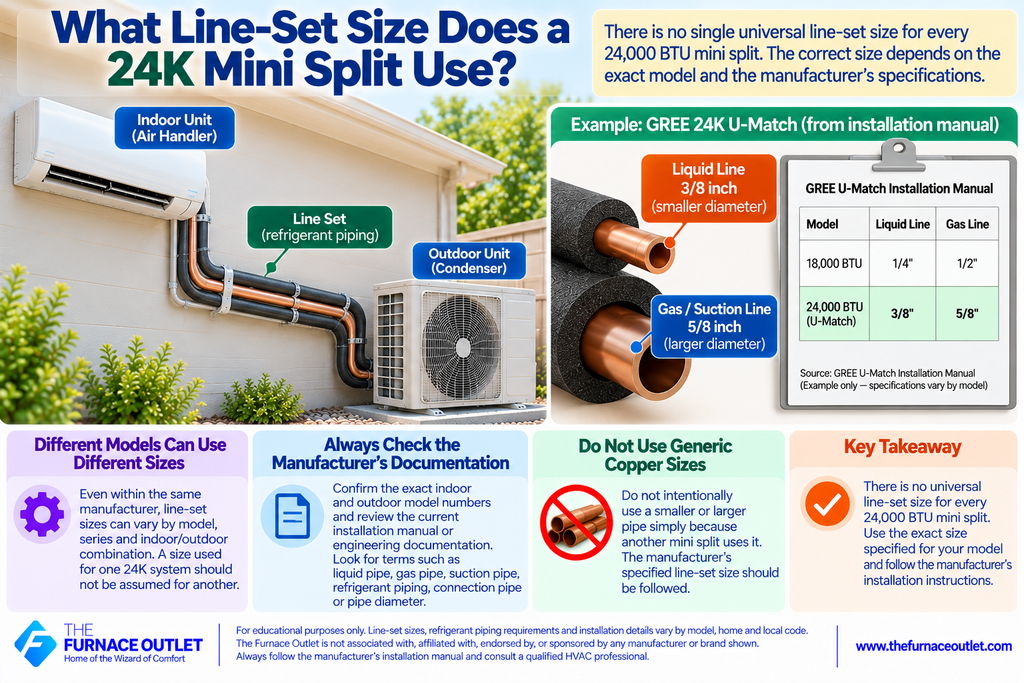
There is no single universal line-set size for every 24,000 BTU mini split. As a real-world example of why model-specific specifications matter, one GREE installation manual lists its 24,000 BTU U-Match configuration with a 3/8-inch liquid line and 5/8-inch gas/suction line. That same manual lists different piping dimensions for its 18K configuration. GREE Comfort
That does not mean 3/8 × 5/8 should be treated as the specification for every 24K mini split. Other product families can use different connections. I would therefore check both the indoor and outdoor model numbers and locate the manufacturer’s current installation manual or engineering documentation. Look specifically for terms such as liquid pipe, gas pipe, suction pipe, refrigerant piping, connection pipe, or pipe diameter.
If the manufacturer specifies a particular diameter, I would not intentionally substitute a smaller or larger pipe simply because another mini split uses it.
Refrigerant piping is part of an engineered refrigeration circuit. Changing its diameter can affect refrigerant velocity, pressure drop, oil return, capacity, and overall system operation. This is different from selecting a larger water pipe because you want more flow. Bigger is not automatically better in a refrigeration system, and smaller is certainly not automatically acceptable.
The compressor, metering arrangement, indoor coil, outdoor coil, and piping are intended to operate together. The manufacturer’s engineering data account for those relationships when specifying allowable pipe sizes and lengths.
For this reason, I would be cautious about adapters being used simply to make an incorrect line set fit. There are legitimate manufacturer-approved piping arrangements and reducers in certain applications, but the fact that two pieces of copper can physically be connected does not mean the resulting configuration is approved for the system.
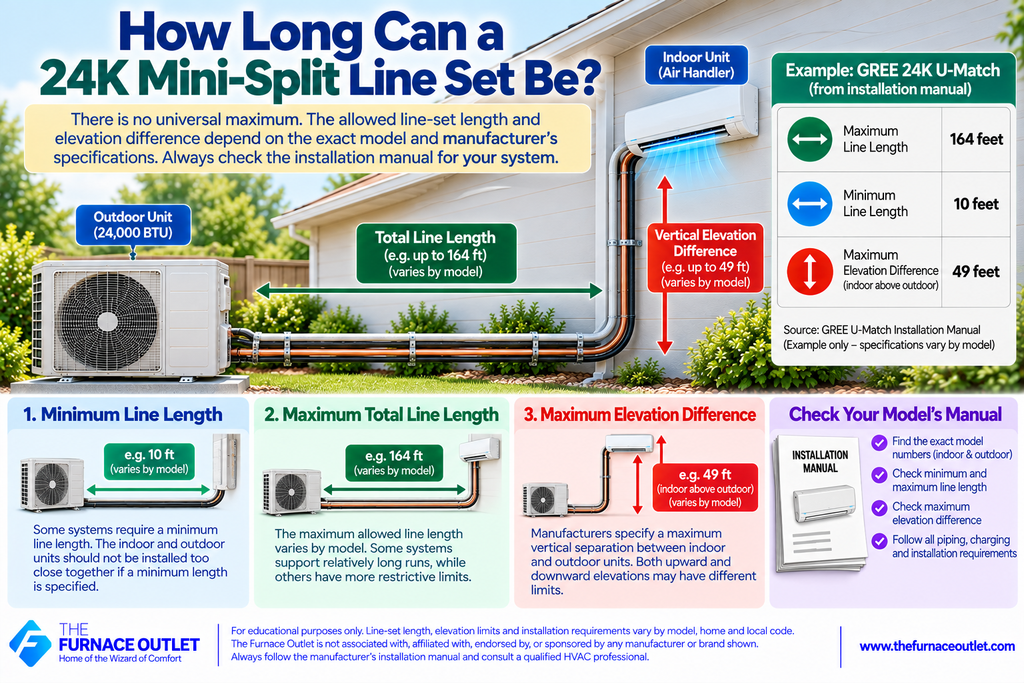
Again, there is no universal maximum. Some systems permit relatively long refrigerant runs, while others have more restrictive limits. As one example—not a general rule—the GREE U-Match installation manual referenced above lists a maximum line length of 164 feet for its 24K configuration, along with a minimum length of 10 feet and a maximum elevation difference of 49 feet when the indoor unit is above the outdoor unit. GREE Comfort
Those figures illustrate something important: three different piping limits may need to be checked. You may have a minimum line length, a maximum total line length, and a maximum vertical separation between the indoor and outdoor units. Passing one limit does not mean the design automatically passes the others.
A 90-foot run might be within a particular system’s maximum total length but could still violate an elevation restriction if the indoor and outdoor units are separated vertically by too much distance. The exact installation manual must make that determination.
Homeowners usually worry about a line set being too long, but a line can also be shorter than the manufacturer permits. This can become relevant when the indoor unit is mounted on the inside of the same wall where the condenser sits immediately outside. The physical distance between the two units might be extremely short.
Do not assume that shortening the refrigerant pipes as much as physically possible is automatically desirable. If the installation manual specifies a minimum piping length, the completed installation should respect it.
The correct solution is not necessarily to create a tight coil of unnecessary tubing behind the outdoor unit. Excessive loops, poor support, or awkward bends can create their own problems. The piping should be routed according to the manufacturer’s instructions and accepted installation practices.
This distinction causes considerable confusion. A mini split may permit a maximum line-set length that is much greater than the length covered by its factory refrigerant charge.
For example, the previously cited GREE U-Match manual lists a 164-foot maximum piping length for its 24K configuration, but its factory charge covers only the first 25 feet of piping. Additional refrigerant is specified beyond that precharged length. GREE Comfort
Therefore, statements such as “this mini split supports a 100-foot line set” do not necessarily mean you can install 100 feet of piping without changing the refrigerant charge. I would always look for two separate specifications: maximum permitted piping length and factory-charge piping allowance. They answer different questions.
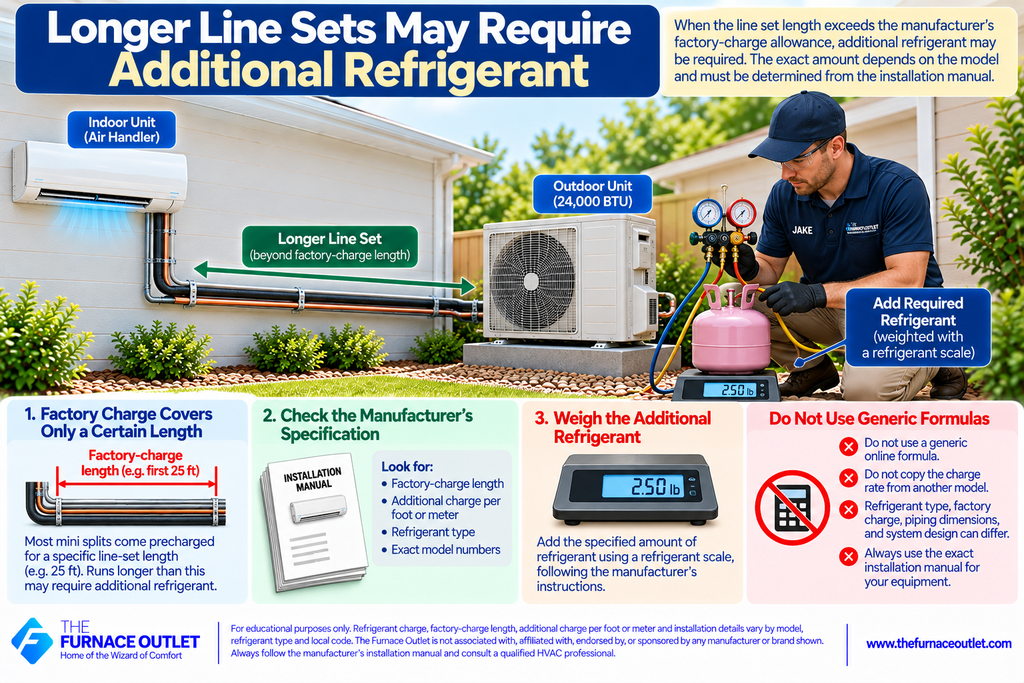
When a refrigerant run exceeds the manufacturer’s factory-charge allowance, additional refrigerant may need to be weighed into the system according to a specified quantity per additional foot or meter. That amount is equipment-specific. GREE documentation, for example, instructs technicians to determine additional charge from the particular model and piping length and to weigh the required refrigerant with a refrigerant scale.
This is another area where I would not use a generic online formula. If one 24K system specifies a particular additional charge per foot, that number should not automatically be transferred to a different 24K system. Refrigerant type, factory charge, piping dimensions, system design, and manufacturer requirements can differ. Use the exact installation manual.
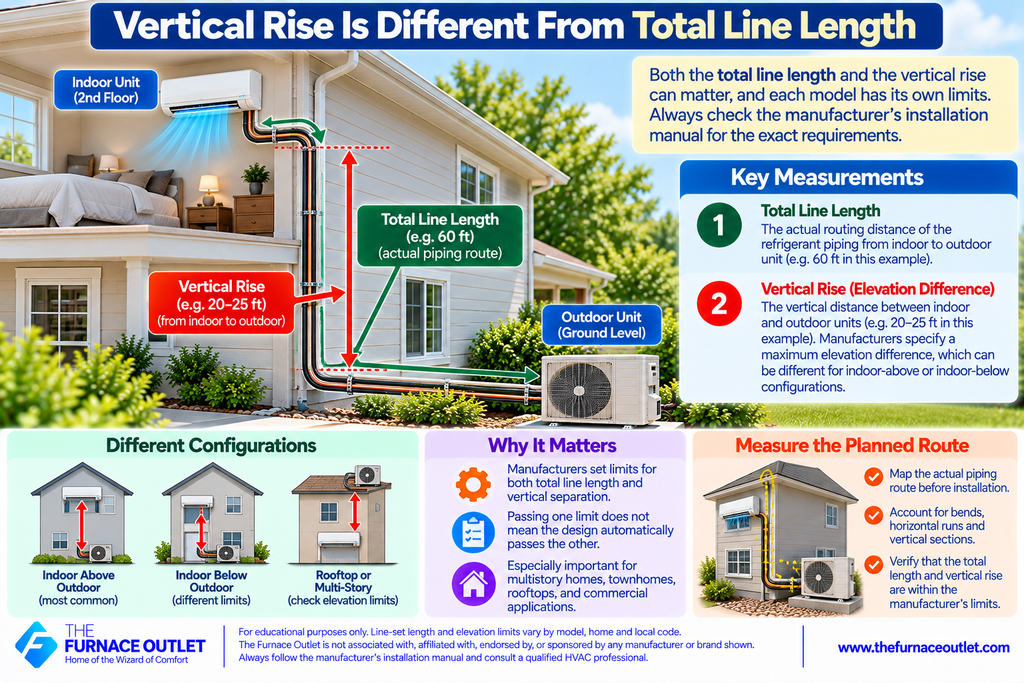
Imagine an indoor unit on the second floor with the outdoor condenser at ground level. The refrigerant line may travel 60 feet overall, but perhaps 20 or 25 feet of that distance is vertical. Both measurements can matter. Manufacturers may specify a maximum total equivalent or actual piping length and a separate maximum elevation difference between indoor and outdoor equipment. Some documentation can also distinguish between configurations where the indoor unit is above versus below the outdoor unit.
This becomes especially important in multistory houses, townhomes, rooftop installations, tall workshops, and commercial-style applications. I would measure the proposed route before selecting the final condenser location rather than discovering after installation begins that the equipment cannot accommodate the required vertical separation.
The shortest possible route is not always practical, but the line set should generally be routed cleanly and deliberately. Every bend needs to be formed without kinking or flattening the copper. Long horizontal runs need appropriate support. Exterior piping should be protected from physical damage and weather exposure, and penetrations through the building envelope should be properly sealed.
GREE’s installation guidance advises using piping within the system’s minimum and maximum limits and avoiding sagging, bending, and unnecessary vertical loops. A neat line-hide cover can improve appearance and provide protection on exterior walls, but appearance should come after correct routing. I would not create a series of unnecessary bends simply to force the piping into an attractive path.
Insulation is not cosmetic. Refrigerant piping operates at temperatures different from the surrounding air, and inadequate insulation can contribute to unwanted heat transfer and condensation.
GREE’s installation guidance specifically states that refrigerant lines should be insulated separately. Outdoor insulation also needs to survive the environment in which it is installed. Sunlight, moisture, pests, landscaping equipment, and physical contact can degrade exposed insulation over time.
During routine maintenance, I would inspect accessible line-set insulation rather than looking only at filters and coils. Damaged or missing insulation deserves attention.
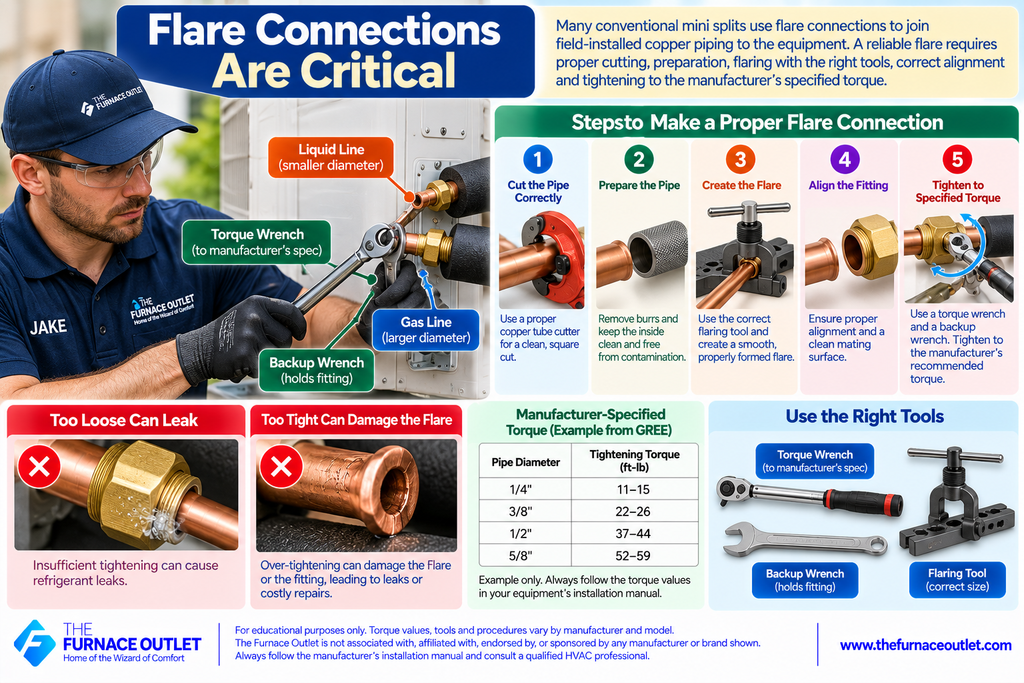
Many conventional mini splits use flare connections to join field-installed copper piping to the equipment. Creating a reliable flare involves more than simply expanding the end of a copper tube. The pipe needs to be cut correctly, prepared without contamination, flared using appropriate tools, aligned properly, and tightened to the manufacturer’s specified torque.
Too loose can leak. Too tight can damage the flare or connection. Current GREE installation guidance, for example, publishes different tightening-torque ranges for different pipe diameters and specifically calls for torque and backup wrenches when tightening flare connections. GREE Comfort
I would therefore resist the temptation to treat flare connections as ordinary plumbing fittings that should simply be tightened until they “feel right.”
Once the piping is connected, a conventional mini split is not ready to operate merely because the copper looks good. The refrigerant circuit needs to be checked for leaks and evacuated according to the manufacturer’s procedure. Evacuation removes air and moisture from the field-installed piping before the service valves are opened and the system is commissioned.
GREE’s current installation guidance calls for nitrogen pressure testing and evacuation below 500 microns with a hold period in its stated procedure. Those numbers should be treated as that manufacturer’s guidance rather than automatically applied to every system; the exact installation manual governs. Moisture and non-condensable gases do not belong inside a properly commissioned refrigeration circuit. This is why a professional installation involves more than connecting two copper tubes and opening the valves.
Some purpose-designed DIY mini splits use manufacturer-engineered pre-charged or quick-connect line arrangements. These should not be confused with a conventional field-installed line set.
A conventional system may require cutting copper to length, creating flare connections, pressure testing, evacuation, and potentially adding refrigerant. A purpose-designed pre-charged connection system follows a different manufacturer-defined installation process. I would never modify, shorten, extend, or substitute a pre-charged line assembly unless the manufacturer specifically permits that procedure. The fact that a line set arrives with refrigerant or sealed connections does not turn it into generic tubing.
In the United States, refrigerant work also involves federal requirements. EPA states that Section 608 technician certification is required for activities reasonably expected to violate the integrity of a stationary appliance’s refrigerant circuit. EPA specifically identifies activities including adding or removing refrigerant and attaching or disconnecting hoses, and its mini-split guidance says connecting or disconnecting pre-charged lines can require certification. US EPA
EPA Section 608 Technician Certification Requirements
EPA also prohibits intentional venting of covered refrigerants during servicing, maintenance, repair, or disposal, subject to specified exceptions. US EPA
That is one reason I would distinguish between homeowner-friendly mounting work and actual refrigerant-circuit work. The latter should be handled in accordance with federal requirements, manufacturer instructions, and applicable state and local rules.
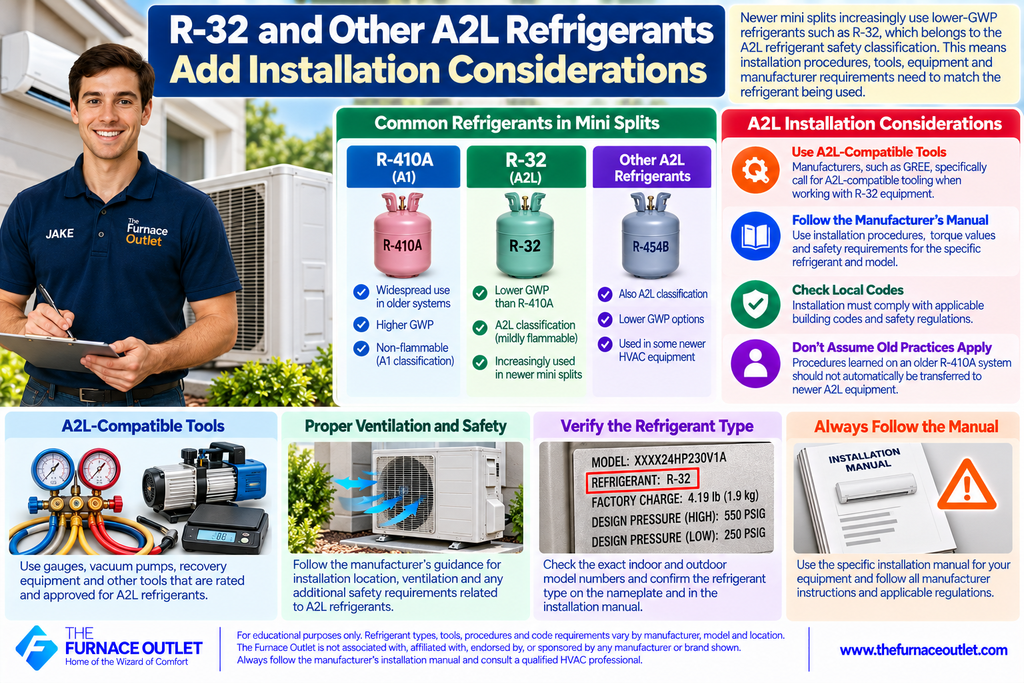
Newer mini splits increasingly use lower-GWP refrigerants such as R-32, which belongs to the A2L refrigerant safety classification. That does not mean homeowners should be afraid of an R-32 system, but it does mean installation procedures, tools, equipment, and manufacturer requirements need to match the refrigerant being used.
For example, GREE’s current installation materials specifically call for A2L-compatible tooling when working with R-32 equipment.
I would therefore verify the refrigerant type before purchasing installation tools, line-set accessories, or service equipment. Procedures learned on an older R-410A system should not automatically be transferred to newer equipment without checking current requirements.
Before installation, I would write down the exact indoor and outdoor model numbers and obtain the current installation manual. I would then confirm the required liquid and gas pipe diameters, minimum line length, maximum line length, maximum allowable elevation difference, factory-charge allowance, and additional refrigerant requirement beyond that allowance.
Next, I would map the actual route from indoor unit to condenser. I would account for vertical rise, bends, wall penetrations, exterior exposure, line-hide requirements, condensate routing, electrical interconnection, and access for future servicing. The chosen condenser location should make sense for the entire installation rather than merely providing the shortest refrigerant route.
Finally, I would verify approved copper piping, insulation, flare requirements, specified torque, leak-testing procedure, evacuation requirements, refrigerant type, and commissioning procedure.
That process takes longer than asking, “What size line set does a 24K mini split use?” but it produces a far more reliable answer.
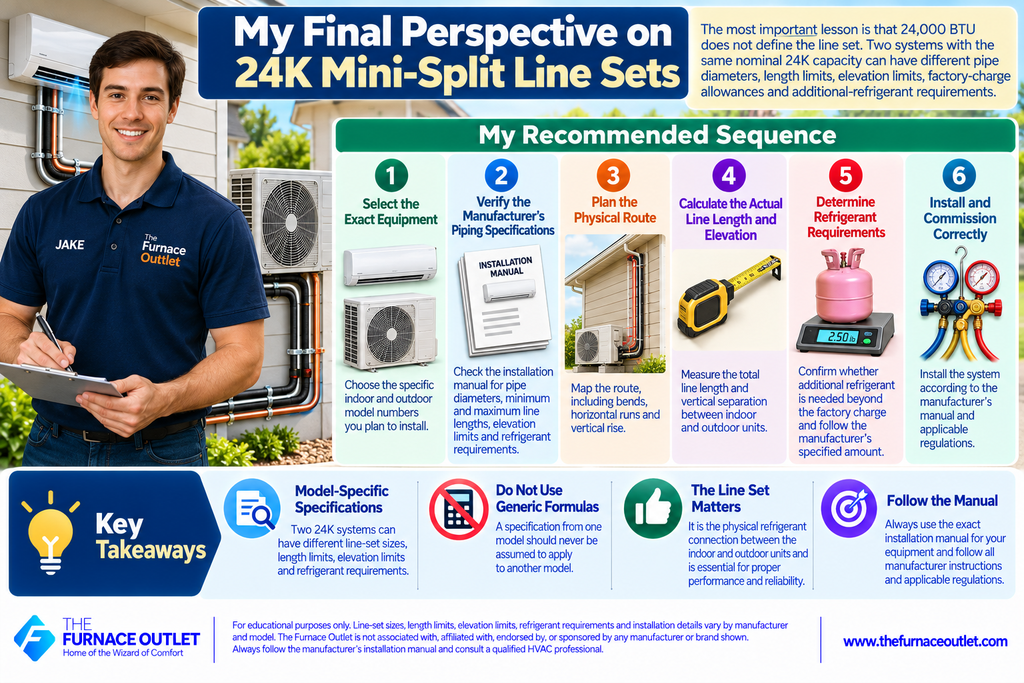
The most important lesson is that 24,000 BTU does not define the line set. Two systems with the same nominal 24K capacity can have different pipe diameters, minimum lengths, maximum lengths, elevation limits, factory-charge allowances, and additional-refrigerant requirements. A specification taken from one model should therefore never be assumed to apply to another.
I would follow a simple sequence: select the exact equipment, verify the manufacturer’s piping specifications, plan the physical route, calculate the actual line length and elevation, determine whether additional refrigerant is required, and then install and commission the system according to the manual and applicable regulations.
The line set may look like a small part of the project, but it is the physical refrigerant connection between the indoor and outdoor halves of the system. Getting it right is fundamental to achieving the performance, reliability, and service life the equipment was designed to provide.
There is no universal size. Some 24K systems use combinations such as 3/8-inch liquid and 5/8-inch gas piping, while other models can specify different dimensions. Always verify both the indoor and outdoor model documentation before purchasing the line set.
Only if the manufacturer specifies or expressly approves those dimensions for the exact equipment combination. Do not choose refrigerant piping solely because the connections can physically be adapted.
It varies substantially by model. As one example, a specific GREE 24K U-Match configuration permits up to 164 feet, but that figure does not apply universally to 24K systems. Does a longer line set need more refrigerant?
Often, once piping exceeds the length covered by the factory charge, additional refrigerant is required. The threshold and additional charge per foot or meter are model-specific, so use the exact manufacturer’s charging table.
Yes. Some manufacturers specify minimum piping lengths. Verify the minimum before placing the indoor and outdoor units extremely close together.
I would not use coiling as a universal solution. Manufacturers may specify routing requirements and minimum lengths, while unnecessary loops can create installation and service issues. Follow the exact piping instructions rather than improvising.
Follow the exact manufacturer’s instructions. For example, GREE’s installation guidance calls for both refrigerant lines to be separately insulated.
Do not cut, modify, or extend a purpose-designed pre-charged or quick-connect line set unless the manufacturer explicitly permits it and provides the required procedure.
For U.S. installations, EPA says Section 608 certification is required for covered activities reasonably expected to violate the integrity of the refrigerant circuit, including adding/removing refrigerant and certain connecting or disconnecting of hoses or pre-charged lines.
Editorial & Safety Disclosure: The Furnace Outlet is not associated with, affiliated with, endorsed by, or sponsored by any manufacturer or brand mentioned in this article and does not receive manufacturer compensation for inclusion. This article is for educational purposes only. Line-set sizes, piping lengths, elevation limits, refrigerant charge, flare requirements, evacuation procedures, and installation requirements vary by model and refrigerant. Always follow the current installation manual for the exact equipment and applicable codes and refrigerant regulations.
https://thefurnaceoutlet.com/best-24000-btu-mini-splits-of-2026-top-2-tonne-systems-compared/