Newsletter Subscribe
Enter your email address below and subscribe to our newsletter

HVAC made simple
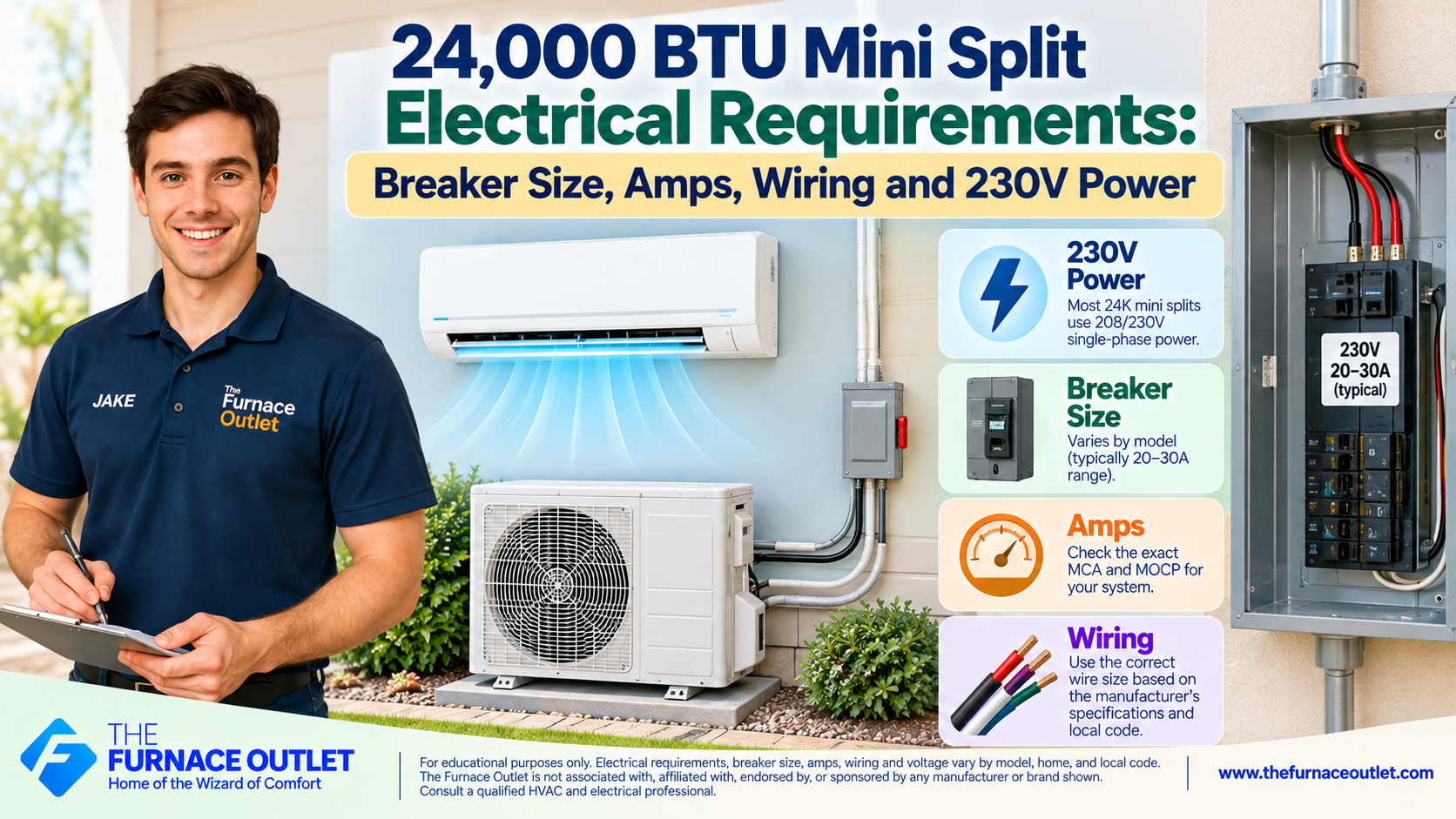
A 24,000 BTU mini split is large enough that its electrical requirements deserve careful attention before the equipment is purchased or installed. In the U.S. market, many 24K ductless systems operate on 208/230-volt single-phase power, but that does not mean every 24K system uses the same breaker, draws the same amperage, or requires the same wire size. Carrier likewise notes that many ductless systems require 220V or higher and their own breaker, while exact electrical specifications vary by model. Carrier
When I evaluate the electrical requirements of a 24K mini split, I therefore do not begin with a rule such as “all 24K units need a 30-amp breaker.” I begin with the exact indoor and outdoor model numbers and then locate the manufacturer’s electrical data. Two systems with the same nominal 24,000 BTU capacity can have different compressor designs, efficiency levels, maximum outputs, controls, and electrical requirements.
The two specifications I pay particular attention to are Minimum Circuit Ampacity (MCA) and Maximum Overcurrent Protection (MOCP/MOP). Those numbers are far more useful for planning the electrical circuit than trying to calculate breaker and wire sizes from the 24,000 BTU capacity label.
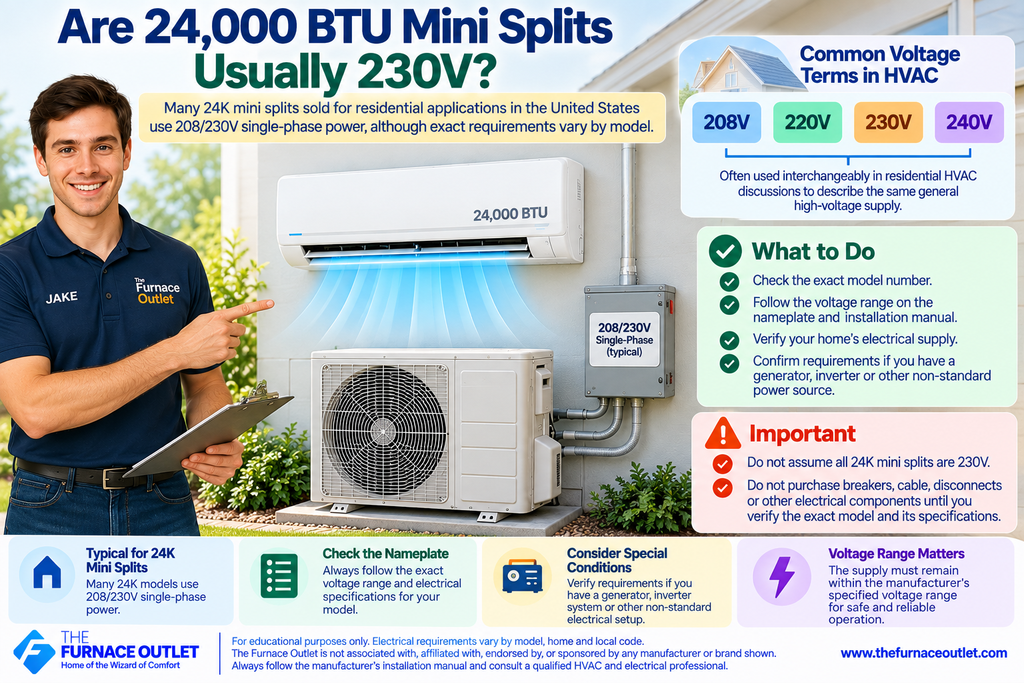
Many 24K mini splits sold for residential applications in the United States use 208/230V single-phase power. For example, GREE’s current Sapphire product family includes a 24K model designated SAP24HP230V, while Daikin publishes numerous HVAC products designed around 208/230V electrical supplies. GREE Comfort
You may also see the electrical supply described informally as 220V, 230V, or 240V. In everyday HVAC conversations those terms are sometimes used loosely to describe the same general residential high-voltage supply arrangement, but I would follow the voltage range printed on the equipment nameplate and installation documentation rather than relying on terminology.
This is especially important if the property has unusual service voltage, a generator, inverter system, or other electrical conditions. The equipment has an acceptable voltage range, and the supply needs to remain within the manufacturer’s requirements. I would therefore assume that a 24K mini split may require a 208/230V circuit for planning purposes, but I would never purchase breakers, cable, disconnects, or other electrical components until verifying the exact model.
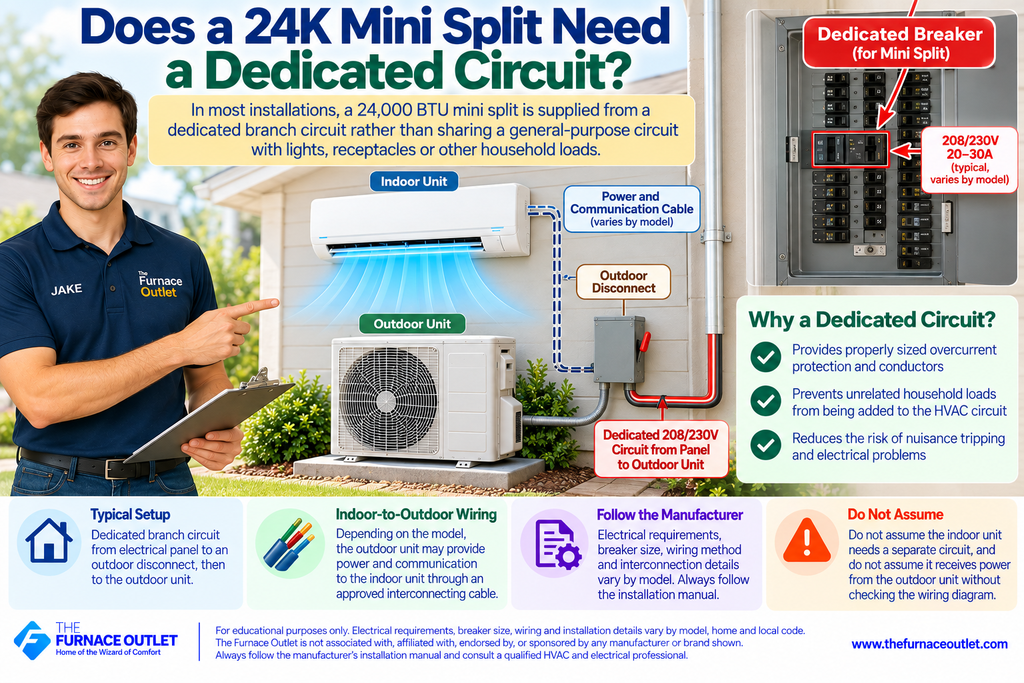
In typical installations, the mini split is supplied from a dedicated branch circuit rather than sharing a general-purpose household circuit with lights, receptacles, or unrelated appliances. Carrier’s installation guidance notes that many ductless systems require the higher-voltage supply on their own breaker and stresses following the electrical specifications for the particular model. Carrier
This dedicated-circuit arrangement gives the equipment properly sized overcurrent protection and conductors while preventing unrelated household loads from being added to the HVAC circuit. The circuit commonly runs from the electrical panel to an outdoor disconnect located near the condenser. From there, power is supplied to the outdoor equipment according to the manufacturer’s wiring arrangement. Depending on the mini split, the outdoor unit may then provide power and communication to the indoor unit through an approved interconnecting cable.
That last point matters because mini splits are not all wired identically. Never assume that the indoor head needs a separate branch circuit simply because it is a separate piece of equipment, and never assume that it receives power from the outdoor unit without checking the wiring diagram.
This is probably the electrical question I would be most cautious about answering with a universal number. You will frequently encounter 24K mini splits installed on circuits with breaker sizes somewhere around the 20-to-30-amp range, but that should be viewed only as context, not as a specification for your equipment. Other designs can require different protection. The correct breaker or fuse requirement comes from the maximum overcurrent protection value specified by the manufacturer for the exact outdoor unit.
If the equipment data states a maximum overcurrent protection value of 25 amps, I would not substitute a 30-amp breaker merely because another 24K mini split uses one. Likewise, if a different system legitimately specifies 30 amps, the fact that another product uses 20 or 25 amps tells us nothing about the correct protection for that system.
This is one reason I dislike generic online tables saying: 24K mini split = 30A breaker.
That shortcut removes the most important information from the decision—the electrical requirements of the actual equipment being installed.
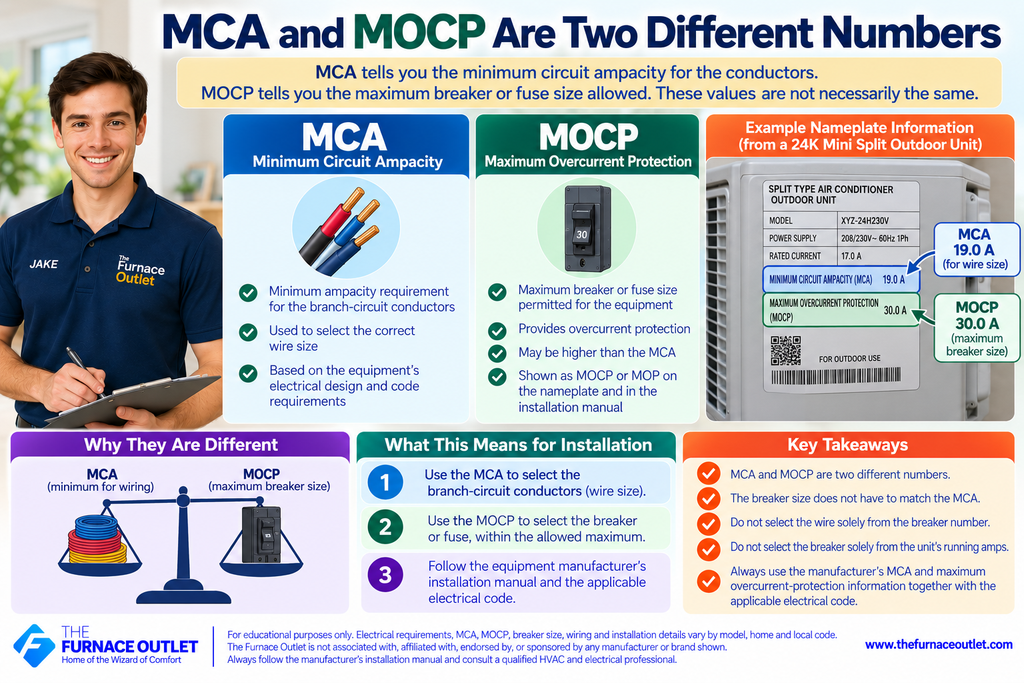
Understanding MCA and MOCP makes mini-split electrical specifications considerably easier to interpret. MCA means Minimum Circuit Ampacity. In simplified terms, it provides the minimum ampacity requirement used when selecting the branch-circuit conductors for the equipment. MOCP, sometimes shown as MOP or maximum fuse/circuit-breaker size, identifies the maximum overcurrent protective device permitted for that equipment.These values are not necessarily the same.
For example, an equipment data plate could hypothetically show an MCA in the high teens while permitting a higher maximum breaker size. That does not mean somebody made an error or that the breaker must numerically match the MCA. HVAC compressor circuits are subject to motor and refrigeration-equipment electrical rules that differ from the simple assumptions homeowners sometimes use for ordinary resistive loads.
The practical lesson is simple: do not select the wire solely from the breaker number, and do not select the breaker solely from the equipment’s running amps. Use the manufacturer’s MCA and maximum overcurrent-protection information together with the applicable electrical code.
There is no universal amperage for a 24,000 BTU mini split. One reason is that BTU/h measures heating or cooling capacity, while amps describe electrical current. They are not interchangeable measurements. Two 24K mini splits can deliver similar nominal cooling capacity while consuming different amounts of electricity because their efficiencies, compressors, fan motors, operating conditions, and control strategies differ.
Inverter technology adds another layer. A modern variable-speed compressor changes its operating speed as the building load changes, so current draw is not necessarily constant throughout the day. During mild conditions, the compressor may operate at reduced output and consume substantially less power than it does during demanding conditions. During startup, defrost, very hot weather, or very cold-weather heating, the electrical behavior may differ again.
I therefore prefer to distinguish among operating current, rated electrical input, MCA, and MOCP rather than trying to describe a 24K system with one generic amperage number.
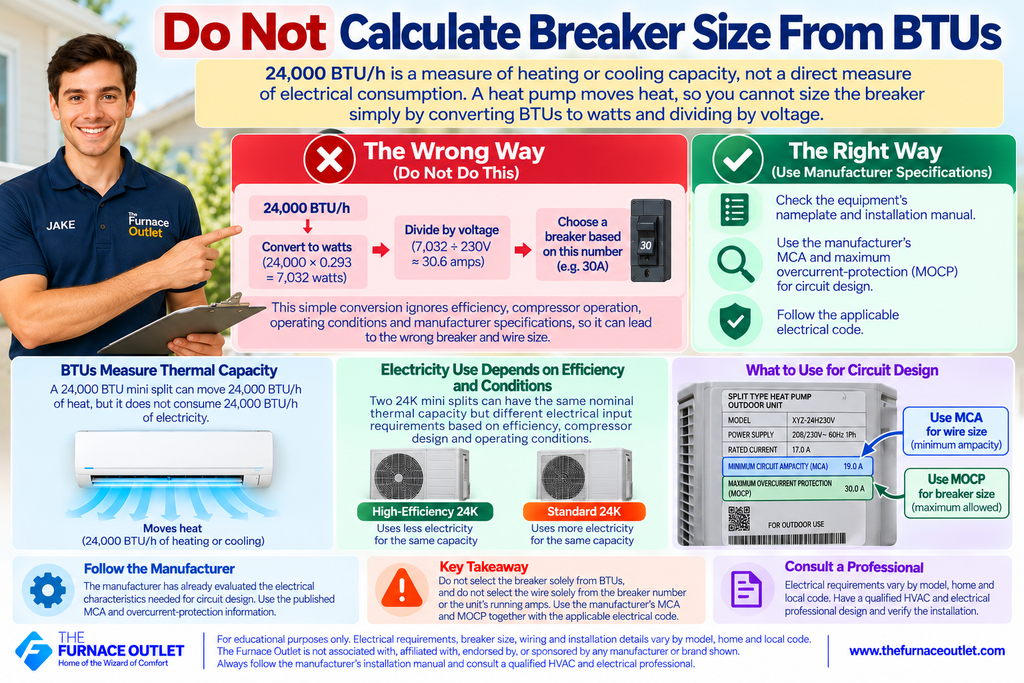
A calculation sometimes seen online starts with 24,000 BTU/h, converts that figure to watts, divides by voltage, and then uses the resulting amperage to select a breaker. I would not size a mini-split circuit that way.
The 24,000 BTU/h rating represents the system’s thermal capacity, not its direct electrical consumption. A heat pump moves heat rather than converting every watt of electrical input directly into one watt of heating or cooling output. Its electrical consumption therefore depends heavily on efficiency and operating conditions.
A high-efficiency 24K mini split and a less efficient 24K system can have the same nominal thermal capacity but different electrical input requirements. The equipment manufacturer has already evaluated the electrical characteristics needed for circuit design and publishes the relevant MCA and overcurrent-protection information. That is the information I would use.
Wire size is another area where generic answers can cause trouble. You may encounter statements claiming that every 24K mini split requires 10 AWG wire, while another source may recommend 12 AWG. Neither should be accepted without examining the equipment and installation.
The conductor must be selected for the MCA of the exact system, applicable electrical-code provisions, conductor material and temperature ratings, terminals, installation method, and other relevant conditions. Distance can matter as well because long conductor runs introduce voltage drop. A conductor that satisfies the basic ampacity requirement may need further consideration when the outdoor unit is a long distance from the electrical panel.
Daikin installation documentation, for example, provides conductor-distance guidance based on MCA and voltage-drop considerations while instructing installers to follow the applicable NEC or Canadian Electrical Code and the unit rating plate. Daikin Comfort
That illustrates why I would not publish a rule stating: 20A = 12 AWG, 30A = 10 AWG, therefore choose wire from the breaker.
Ordinary residential branch-circuit rules are useful background knowledge, but HVAC compressor circuits require equipment-specific application of electrical requirements. The electrician should use the nameplate, installation manual, applicable code, conductor conditions, and installation details to determine the final wiring.
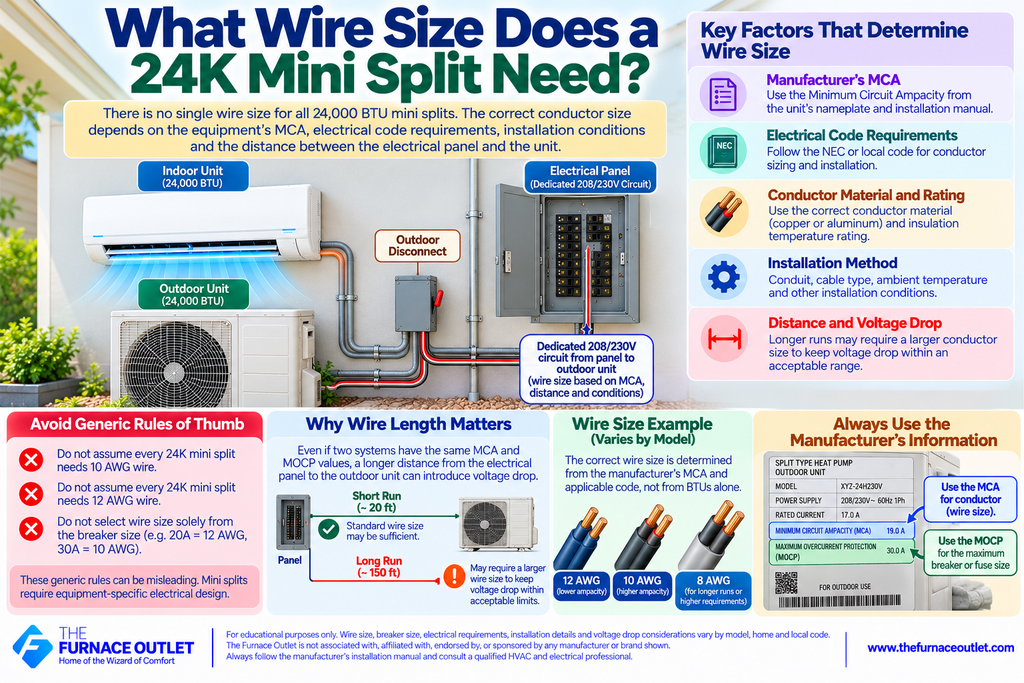
Imagine that the electrical panel is only 20 feet from the condenser in one installation but 150 feet away in another. Even if both systems have identical MCA and MOCP values, the long run deserves additional voltage-drop consideration. Excessive voltage drop can affect equipment operation, especially when compressors and motors are involved.
The conductor size may therefore be increased beyond what would otherwise satisfy the basic ampacity requirement to keep voltage drop within an appropriate range. That does not mean every long mini-split circuit automatically requires the next larger conductor. It means distance is another factor the electrician should evaluate rather than selecting cable solely from a generic breaker-size chart.
A typical mini-split installation includes a disconnecting means near the outdoor condenser so that power can be shut off for servicing. The exact disconnect arrangement depends on the equipment, circuit, applicable code, and local requirements. The disconnect may be fused or non-fused depending on the design and required overcurrent protection.
Carrier’s installation guidance specifically identifies electrical verification and required disconnects as part of a proper ductless installation and emphasizes following model-specific electrical requirements and local codes. Carrier
I would therefore include the disconnect when estimating installation cost. The electrical project is not simply “add a breaker.” It can involve the panel, conductors, conduit or approved cable method, disconnect, grounding, outdoor-rated components, equipment connections, and interconnecting wiring.
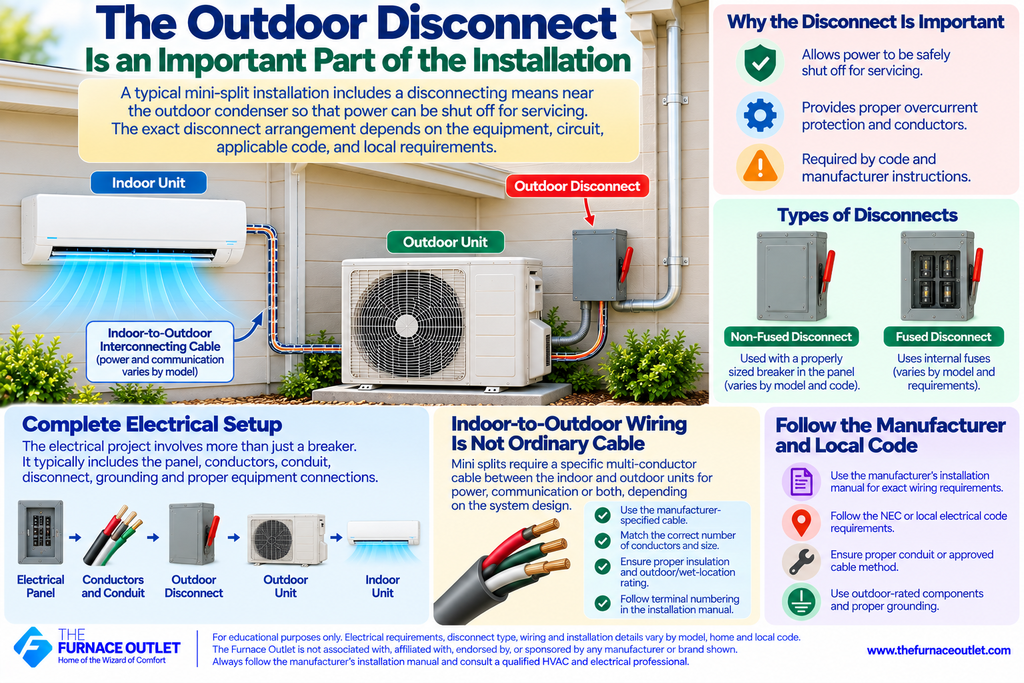
A mini split normally requires wiring between the indoor and outdoor units for power, communication, or both, depending on system design. Carrier notes that many ductless systems use multi-conductor stranded cable between components, while also emphasizing that actual wiring requirements vary and that conduit may be required by local code. Carrier
This cable should not be substituted casually with whatever wire happens to be available. The number of conductors, conductor size, insulation rating, voltage rating, outdoor/wet-location suitability, communication requirements, and shielding requirements where applicable should all match the manufacturer’s instructions and electrical code.
I would pay particular attention to terminal numbering as well. Mini splits often use corresponding terminals between indoor and outdoor equipment, and incorrect connections can damage electronics.
Not necessarily. Many 208/230V mini-split outdoor units are supplied by two ungrounded conductors plus an equipment grounding conductor and do not require a neutral for the primary equipment supply. Other equipment configurations can differ. This is another reason not to prewire a mini split simply because you know its capacity.
Before the electrical work begins, I want the electrician to have the exact model number and wiring diagram. The wiring requirements should determine what is installed rather than assumptions about what a typical 240V appliance might need.
The breaker is only one part of the electrical picture. The home’s electrical service and panel also need to accommodate the proposed equipment. An electrician may evaluate the available panel spaces, existing loads, service capacity, panel condition, grounding and bonding, circuit route, and whether other electrical work is required.
A homeowner may discover that installing the mini split is straightforward because adequate capacity and panel space already exist. Another property may need considerably more work. This is especially worth checking when a home is simultaneously adding other major electric loads such as an EV charger, heat-pump water heater, induction range, electric dryer, or additional HVAC equipment.
I would rather identify those issues during project planning than after the mini split has been delivered.
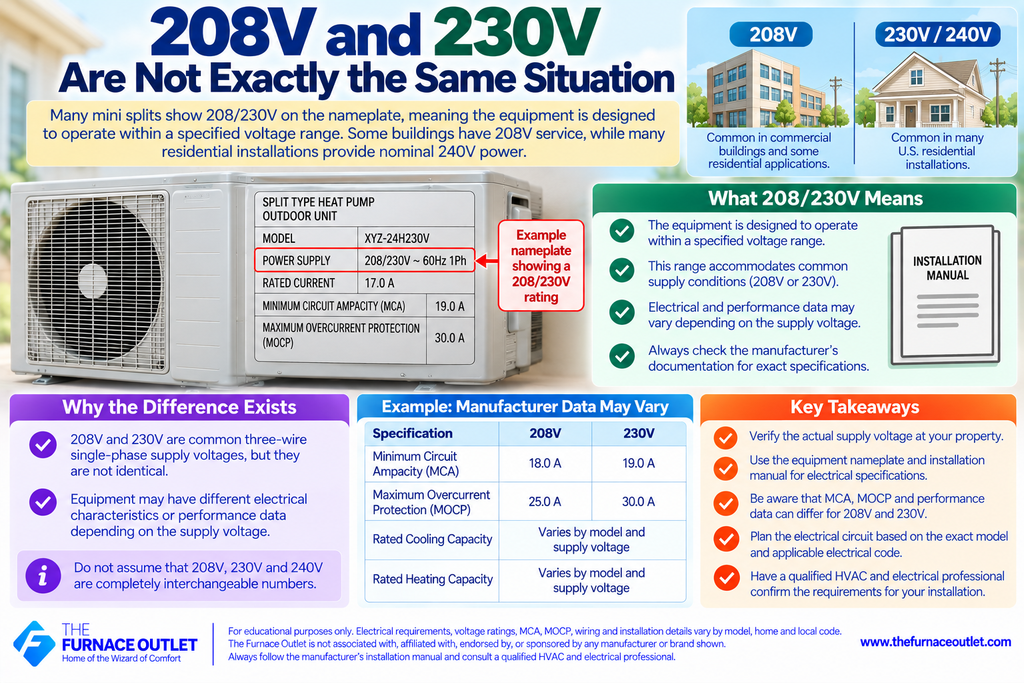
Many HVAC nameplates show 208/230V, meaning the equipment is designed to operate within a specified voltage range that accommodates common supply conditions. This is particularly relevant because some buildings receive 208V service while many residential installations provide nominal 240V power.
The equipment documentation may provide different electrical or performance data depending on supply voltage. Daikin documentation, for example, shows equipment with 208/230V ratings and, for some products, separate MCA or overcurrent information for the two supply voltages. Daikin Comfort
I would therefore verify the actual supply rather than treating 208V, 230V, and 240V as completely interchangeable numbers.
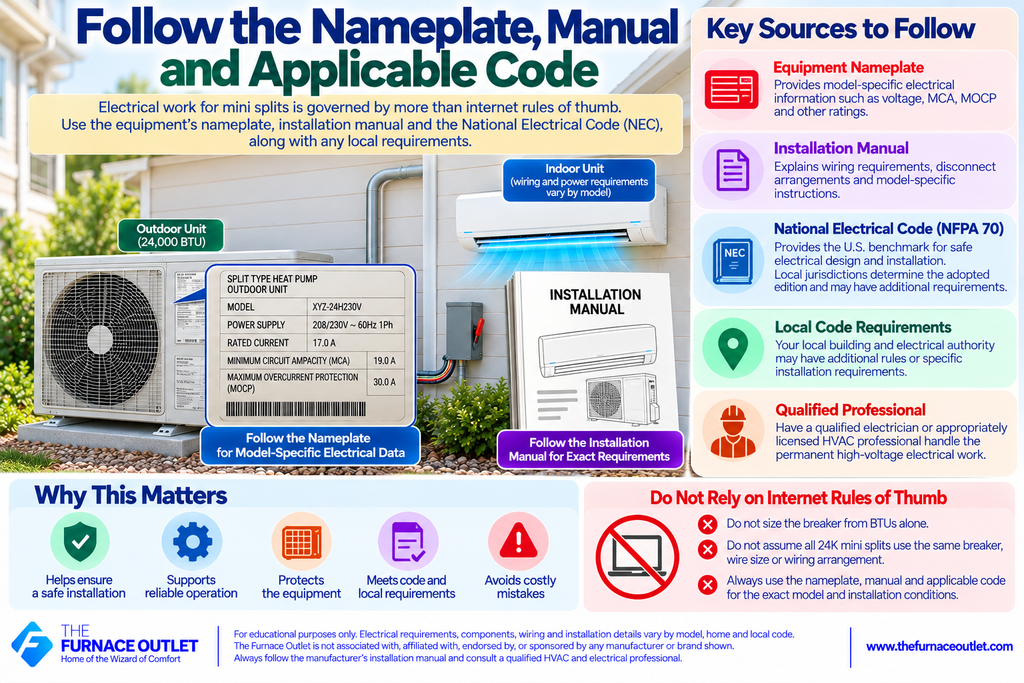
Electrical work for HVAC equipment is governed by more than internet rules of thumb. In the United States, the National Electrical Code (NFPA 70) provides the benchmark for safe electrical installations, while local jurisdictions determine the edition adopted and may impose additional requirements. NFPA identifies the NEC as the U.S. benchmark for safe electrical design and installation. NFPA
NFPA 70 — National Electrical Code
The equipment’s listing, nameplate, installation instructions, and local code all matter. Carrier similarly states that exact electrical requirements vary by model and that installers should follow the applicable installation instructions and local codes. Carrier
This is why I would have a qualified electrician or appropriately licensed HVAC professional handle the permanent high-voltage electrical work.
Before installing a 24,000 BTU mini split, I would record the exact indoor and outdoor model numbers and obtain the current installation manual. From there, I would confirm the rated supply voltage and phase, MCA, maximum overcurrent protection, manufacturer-required conductor arrangement, grounding requirements, indoor-to-outdoor cable specification, and any special wiring instructions.
I would then have the electrical side of the project evaluated for panel capacity, breaker space, conductor size, circuit length and voltage drop, disconnect requirements, conduit or cable method, outdoor exposure, and applicable local-code requirements. The installer should also confirm whether the outdoor unit supplies the indoor unit or whether the particular system uses another power arrangement.
Finally, I would verify the completed installation against the equipment nameplate and wiring diagram before commissioning. A checklist like this takes more effort than simply asking, “What breaker does a 24K mini split need?” but it is also far less likely to produce an incorrect electrical installation.
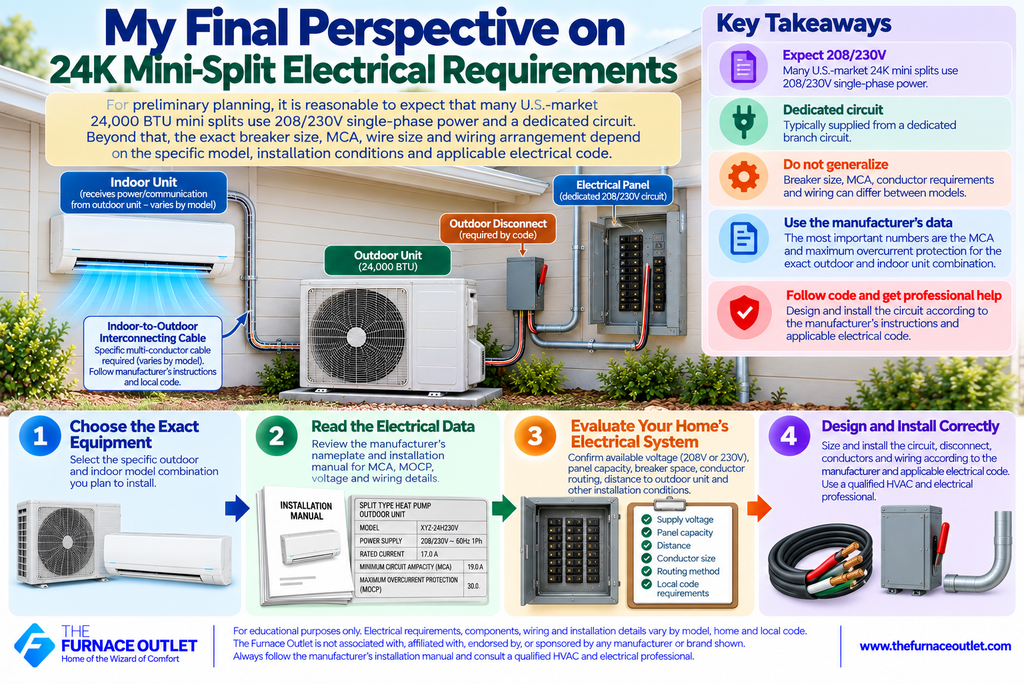
For preliminary planning, it is reasonable to expect that many U.S.-market 24,000 BTU mini splits use 208/230V single-phase power and a dedicated circuit. Beyond that, I would stop generalizing. The breaker could differ from one 24K system to another, the MCA can differ, conductor requirements can differ, and the indoor-to-outdoor wiring arrangement can differ. Carrier
The most important numbers are not simply “24,000 BTU” and “230 volts.” They are the electrical specifications published for the exact outdoor and indoor equipment combination, particularly the MCA and maximum overcurrent protection.
My preferred sequence is therefore choose the exact equipment, read its electrical data, evaluate the home’s electrical system, and then size and install the circuit according to the manufacturer and applicable code. Do not reverse that process by installing a generic 30-amp circuit first and hoping the mini split you eventually purchase happens to match it.
Correct electrical design protects the equipment, supports reliable operation, and—most importantly—helps provide a safe installation.
No. Although 30-amp circuits are encountered with some equipment in this general capacity range, breaker requirements vary by model. Use the exact unit’s maximum overcurrent-protection specification and applicable electrical requirements rather than selecting a breaker from BTU capacity alone.
Many U.S. 24K systems are designed for 208/230V power, while homeowners and installers may colloquially describe residential high-voltage circuits as 220V, 230V, or 240V. The equipment nameplate and installation manual should determine the acceptable supply voltage.
There is no single amperage for all 24K mini splits. Electrical consumption depends on the specific equipment, efficiency, compressor operation, outdoor conditions, heating or cooling demand, and other factors. For circuit design, check MCA and maximum overcurrent protection for the exact model.
Possibly, but capacity alone cannot determine whether 10 AWG is required or appropriate. Conductor sizing depends on the unit’s MCA, conductor and terminal characteristics, installation method, circuit length, applicable electrical code, and other conditions. Have the final conductor size determined from the actual equipment specifications.
Many systems require a dedicated circuit and their own breaker. Confirm the requirement in the installation instructions for the exact model. Carrier notes that many ductless systems use higher-voltage power on their own breaker.
Many 208/230V mini-split outdoor units do not require a neutral for their primary supply, but wiring arrangements vary. Check the manufacturer’s wiring diagram rather than assuming the conductor configuration.
I would avoid doing so unless the electrical design is based on a specific planned model. Selecting the exact equipment first allows the electrician to work from its voltage, MCA, MOCP, conductor, disconnect, and interconnection requirements instead of designing around assumptions.
Editorial & Safety Disclosure: The Furnace Outlet is not associated with, affiliated with, endorsed by, or sponsored by any manufacturer or brand mentioned and does not receive manufacturer compensation for inclusion. This article is for educational purposes only and is not an electrical-installation guide. Electrical requirements vary by equipment, building, jurisdiction, and installation. Permanent HVAC wiring should comply with the equipment manufacturer’s instructions and applicable electrical codes and should be performed or verified by a qualified professional.
https://thefurnaceoutlet.com/best-24000-btu-mini-splits-of-2026-top-2-tonne-systems-compared/