Newsletter Subscribe
Enter your email address below and subscribe to our newsletter

HVAC made simple
By Jake Lawson — The HVAC Specialist
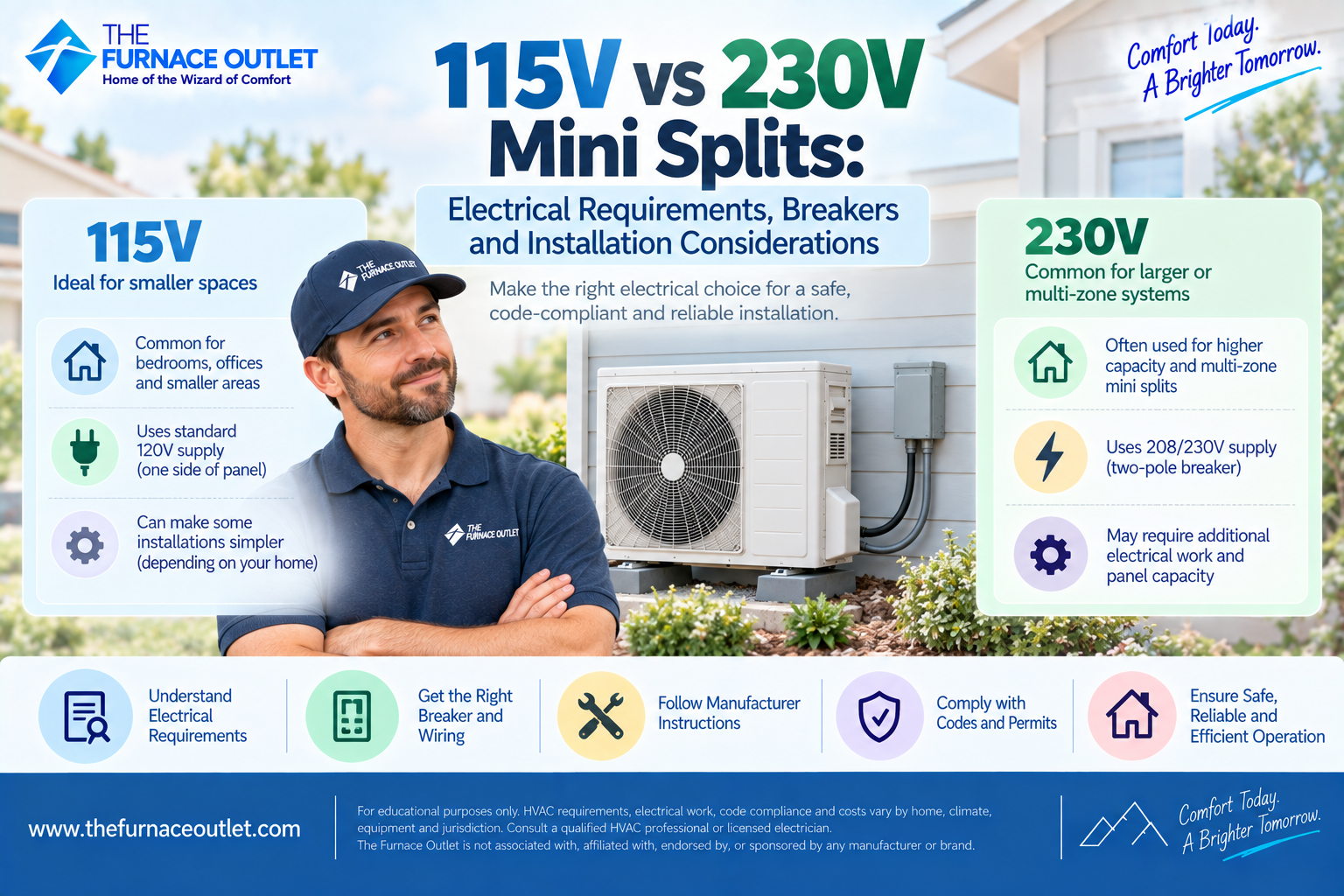
When homeowners compare mini splits, voltage often appears somewhere near the bottom of the specification sheet. Cooling capacity, SEER2, HSPF2, sound ratings and Wi-Fi features usually receive far more attention, while a line reading 115V or 208/230V can look like little more than an installation detail.
It deserves considerably more attention than that.
The electrical requirements of a mini split affect where the equipment can be installed, what type of branch circuit may be required, how much electrical work the project involves and whether the existing service panel can accommodate the system. Choosing between a 115V and 230V model is therefore not simply a matter of deciding which voltage sounds better.
It is also important to understand that voltage alone does not tell you what breaker a mini split requires. Two systems with similar cooling capacities can have different electrical requirements, and two 230V mini splits should not automatically be placed on identical breakers. The equipment nameplate and manufacturer’s installation documentation ultimately determine the applicable electrical specifications.
For homeowners, the safest way to approach this subject is to understand what the numbers mean, recognize the limits of rules of thumb and have the electrical installation verified by a qualified professional when required.
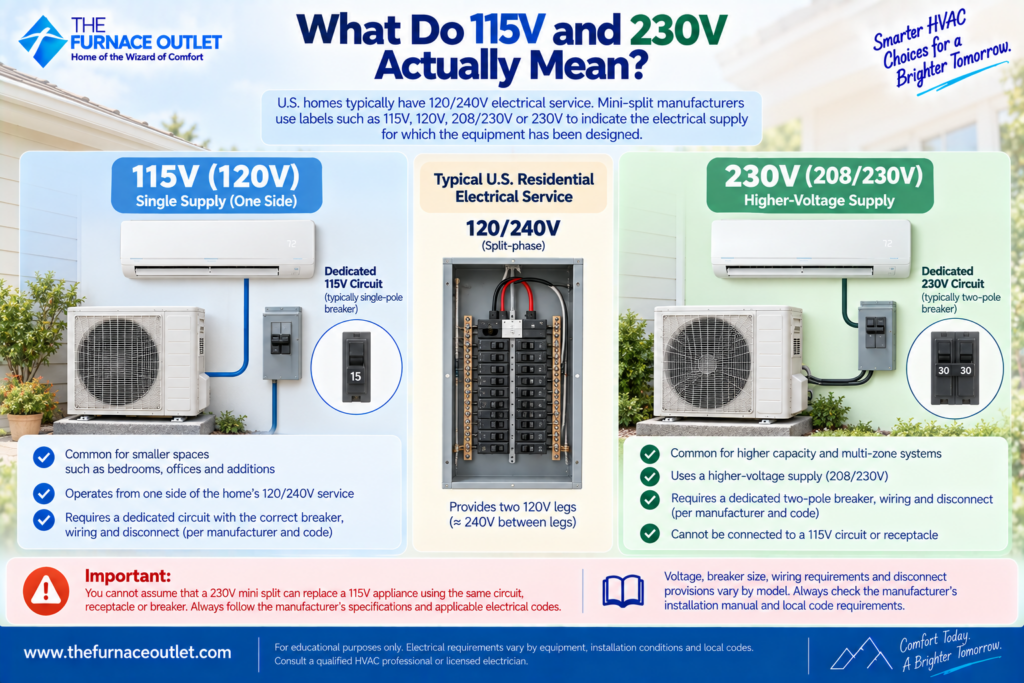
Residential electrical service in the United States commonly provides approximately 120/240 volts. Mini-split manufacturers may nevertheless describe equipment using labels such as 115V, 120V, 208/230V or 230V. Those descriptions refer to the electrical supply for which the equipment has been designed rather than suggesting that every home supplies precisely the number printed in the product name.
A 115V-class mini split generally operates from one side of a residential 120/240V service, while a 208/230V-class unit normally uses a higher-voltage supply arrangement. The exact permitted voltage range should always be confirmed in the manufacturer’s specifications because equipment tolerances vary.
From the homeowner’s perspective, the important point is that these systems require different electrical arrangements. You cannot purchase a 230V mini split and assume it can simply replace a 115V appliance using the same branch circuit, receptacle or breaker.
Likewise, finding a convenient 120V outlet near the proposed condenser does not establish that a 115V mini split can be connected to it. Most conventional mini-split installations have specific branch-circuit, overcurrent-protection, disconnect and wiring requirements that must be followed.
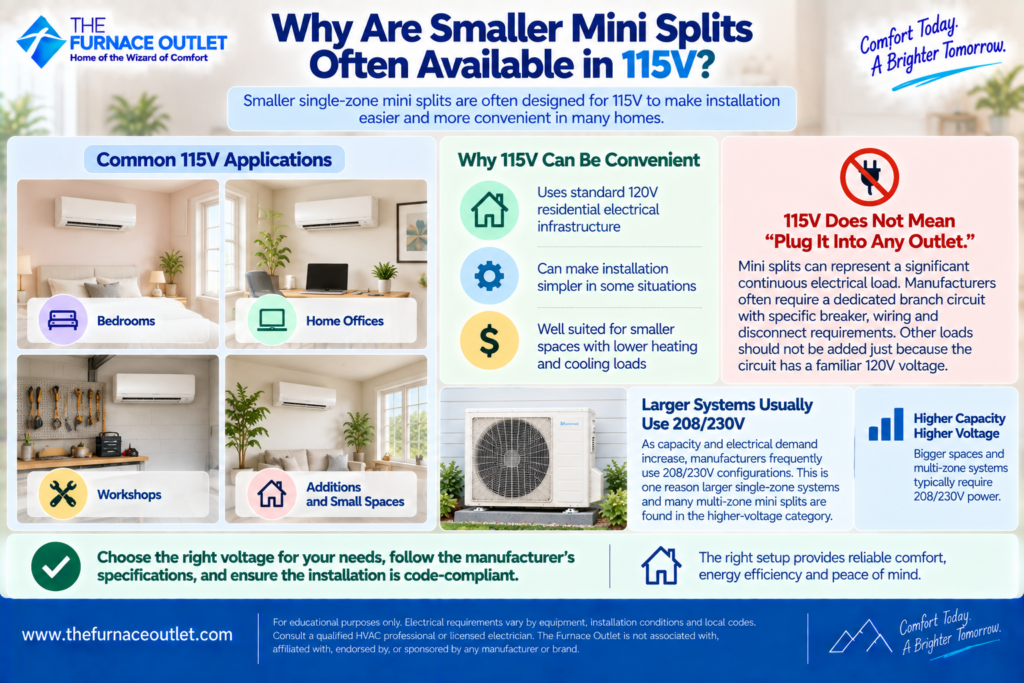
Many smaller single-zone mini splits are offered in 115V versions because that voltage can make certain residential installations more convenient. These systems are commonly considered for bedrooms, home offices, workshops, additions and other relatively small areas where the heating and cooling load does not require a large-capacity system.
The attraction is easy to understand. A home may already have substantial 120V electrical infrastructure, and in some situations installing a suitable 115V circuit can be less complicated than adding a higher-voltage circuit.
However, 115V does not mean “plug it into any outlet.”
A mini split can represent a significant continuous electrical load, and the manufacturer’s requirements may call for a dedicated branch circuit with specific conductor sizing, overcurrent protection and disconnecting provisions. Other loads should not simply be added because the circuit happens to have a familiar voltage.
As capacity and electrical demand increase, manufacturers frequently use 208/230V configurations. This is one reason larger single-zone systems and many multi-zone mini splits are commonly found in the higher-voltage category.

One electrical concept helps explain why higher-capacity HVAC equipment commonly operates at higher voltage. Electrical power is related to voltage and current. Without trying to turn a homeowner buying guide into an electrical-engineering textbook, the useful principle is that delivering a similar amount of electrical power at a higher voltage can generally be accomplished with lower current.
That does not mean you should calculate your own mini-split breaker by dividing watts by voltage. HVAC equipment contains compressors, fan motors, inverter electronics and other components, and applicable electrical sizing requirements involve more than a simple household wattage calculation.
What the concept does explain is why 230V becomes attractive as equipment demand increases. Higher voltage can allow equipment to deliver substantial power without requiring the same current that would be necessary at approximately half the voltage.
The equipment manufacturer has already accounted for these characteristics when specifying the electrical requirements. Your job as the homeowner is not to reverse-engineer them; it is to make sure the installation follows them.
One misconception worth clearing up is that a 230V mini split must automatically be more energy efficient than a 115V mini split simply because its operating voltage is higher.
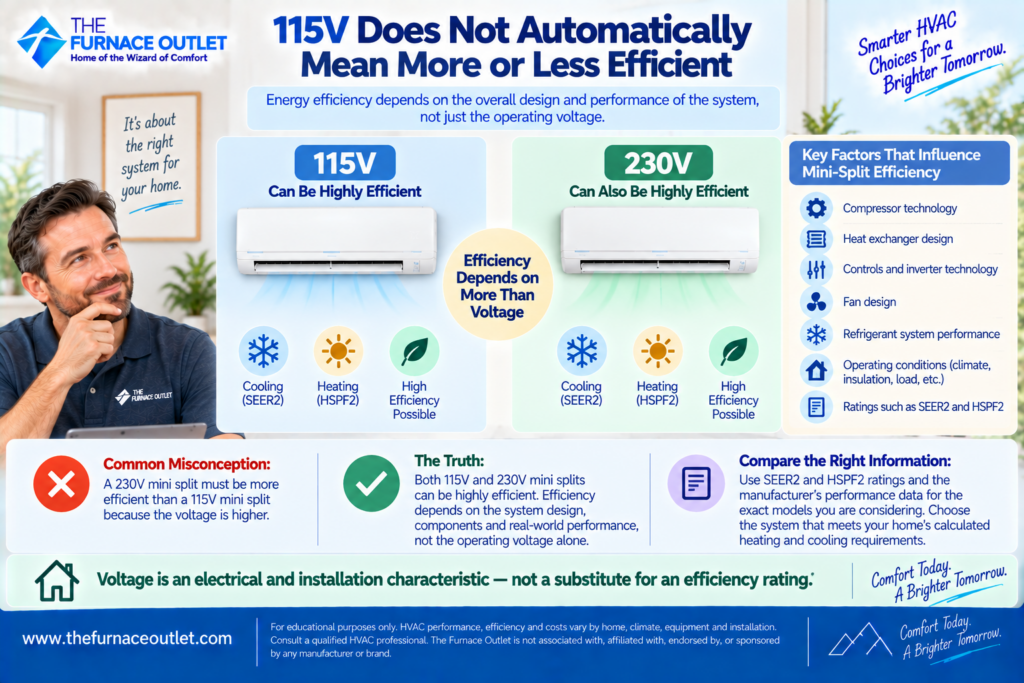
That comparison is too simplistic. Mini-split efficiency depends on compressor technology, heat exchangers, controls, fan design, refrigerant system performance, operating conditions and many other engineering factors. Ratings such as SEER2 and HSPF2 are much more useful when comparing cooling and seasonal heating efficiency than voltage alone.
A 115V system can be highly efficient, and a 230V system can also be highly efficient. Voltage should primarily be viewed as an electrical and installation characteristic, not as a substitute for an efficiency rating. The appropriate comparison is between the performance data for the exact systems that meet the home’s calculated heating and cooling requirements.
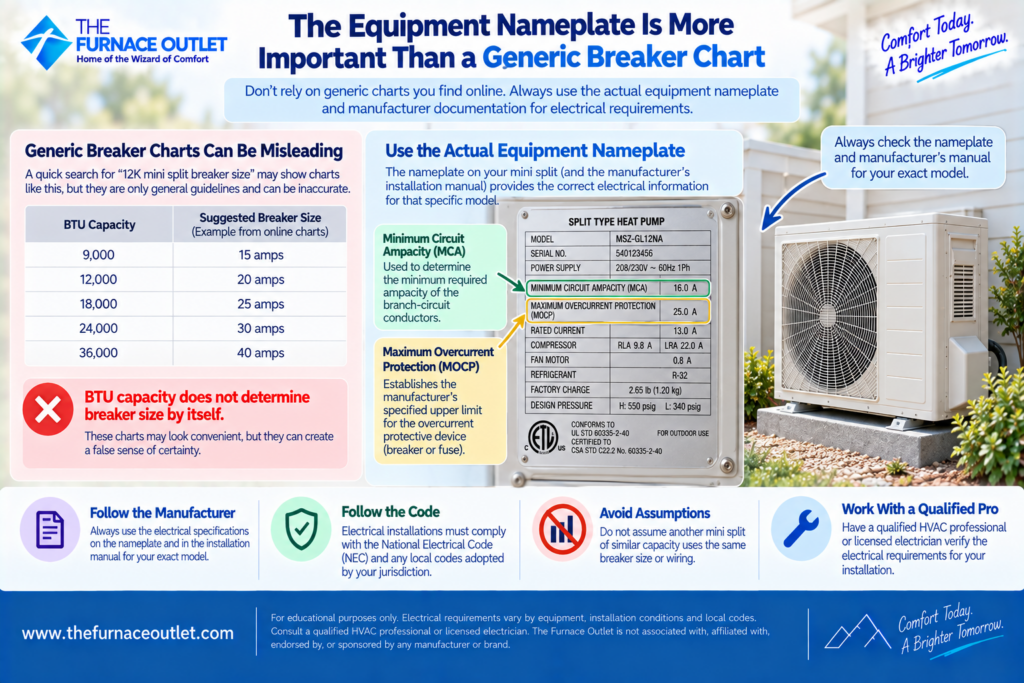
This is probably the most important electrical point in this article. Search online for “12K mini split breaker size” and you will find plenty of charts suggesting that a particular BTU capacity requires a particular breaker. Those charts may look convenient, but they can create a false sense of certainty.
BTU capacity does not determine breaker size by itself. The equipment nameplate and manufacturer documentation commonly provide electrical values such as Minimum Circuit Ampacity (MCA) and Maximum Overcurrent Protection (MOCP or MOP). Depending on the manufacturer, you may also see rated current, maximum fuse size or other electrical information.
MCA is used when determining the minimum required ampacity of the branch-circuit conductors under the applicable requirements. MOCP establishes the manufacturer’s specified upper limit for the overcurrent protective device for the equipment. Those numbers should not be casually replaced with assumptions based on another mini split of similar capacity.
The National Fire Protection Association publishes the National Electrical Code (NEC), which contains requirements for electrical installations, including air-conditioning and refrigeration equipment. Requirements can also be modified or supplemented by the electrical code adopted by the local authority having jurisdiction.
NFPA — National Electrical Code resources
Suppose two homeowners both purchase 230V mini splits. One assumes that every 230V mini split uses the same breaker because the voltage is identical. That assumption can be wrong. One system might have different compressor electronics, capacity, minimum circuit ampacity or maximum overcurrent-protection requirements than another. Even different combinations within the same manufacturer’s product family can have different specifications.
This is why statements such as “all 12K mini splits need a 15-amp breaker” or “all 24K units need a 30-amp breaker” should make you cautious. There may be products for which those numbers happen to be correct, but capacity alone is not enough information to establish the electrical requirement. Start with the exact indoor and outdoor model numbers. Then obtain the manufacturer’s current installation manual and equipment data before deciding what circuit needs to be installed.
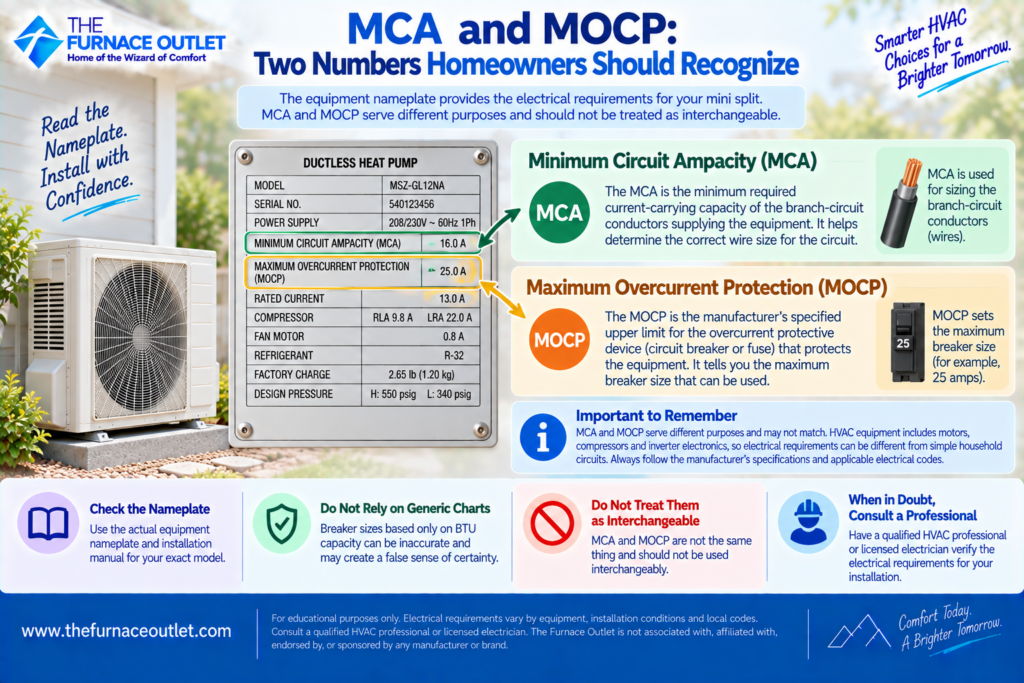
You do not need to become an electrician to benefit from recognizing these two abbreviations. Imagine that the specification sheet lists an MCA and an MOCP. Those figures serve different purposes and should not be treated as interchangeable recommendations.
The Minimum Circuit Ampacity relates to the required current-carrying capacity of the circuit supplying the equipment. The Maximum Overcurrent Protection relates to the maximum permitted rating of the fuse or circuit breaker protecting that equipment under the manufacturer’s listing and applicable requirements.
This can occasionally produce combinations that look surprising to someone accustomed to simple household circuits. HVAC equipment includes motor and compressor loads whose electrical rules differ from the assumptions people sometimes make about ordinary lighting or receptacle circuits. For that reason, homeowners should resist trying to redesign the circuit from a generic wire-and-breaker table found online. Have the nameplate requirements interpreted within the applicable electrical code and installation conditions.
A conventional mini split is generally treated as permanently installed HVAC equipment rather than another household appliance that happens to need electricity. The electrical plan therefore needs to consider the branch circuit supplying the equipment, the manufacturer’s instructions, applicable code provisions and other installation requirements. Depending on the system, power may be supplied to the outdoor unit and then distributed to the indoor unit through the manufacturer’s specified interconnecting wiring, although equipment designs vary.
Do not assume the indoor and outdoor units each need an ordinary receptacle simply because both contain electrical components. Likewise, do not assume an existing circuit is suitable merely because its breaker rating appears large enough. Conductor size, existing loads, wiring method, circuit configuration, equipment requirements and code compliance all need to be considered. This is one area where having a qualified electrician or appropriately licensed HVAC professional review the project can prevent an expensive mistake.
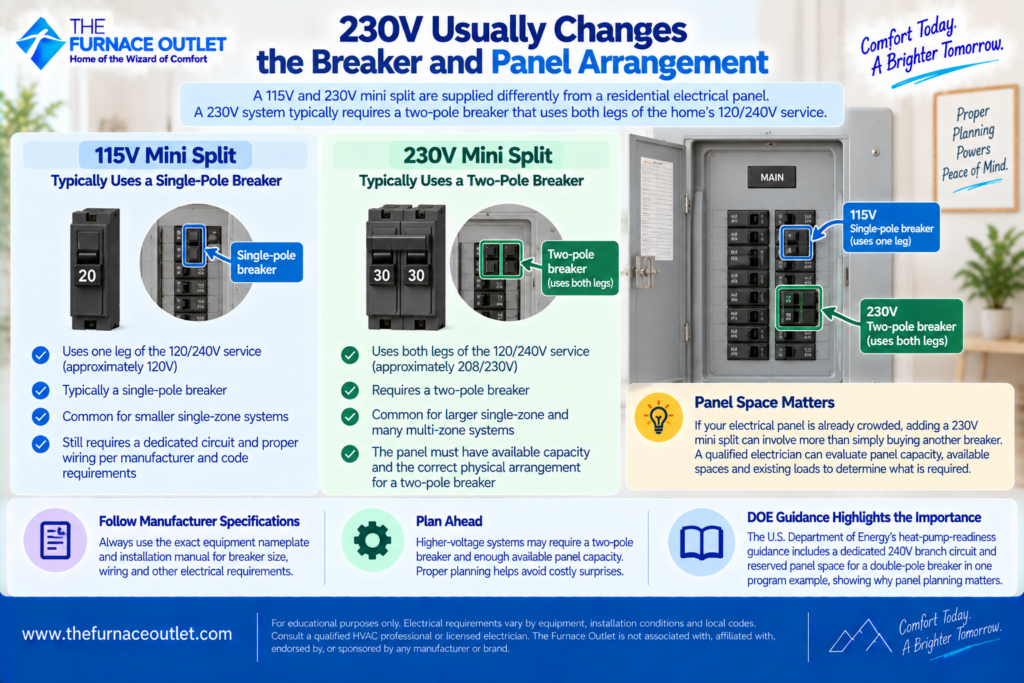
A typical 115V-class circuit and a 230V-class circuit are supplied differently from a residential electrical panel. A 230V mini split commonly requires a two-pole circuit breaker that uses both legs of the home’s 120/240V electrical service. This means the panel needs the appropriate capacity and physical arrangement for the required circuit.
The U.S. Department of Energy illustrates this concept in its heat-pump-readiness guidance. In one DOE Zero Energy Ready Home program example, future heat-pump readiness includes a dedicated 240V branch circuit and reserved panel space for a double-pole breaker. The specific requirements in that program are not a universal mini-split installation rule, but they demonstrate why panel planning matters when preparing a home for higher-voltage heat-pump equipment.
U.S. Department of Energy — Heat-Pump Electrical Readiness Guidance
If the electrical panel is already crowded, adding a 230V mini split can therefore involve more than simply buying another breaker. A professional may need to evaluate panel capacity, available spaces, existing loads and whether additional electrical work is appropriate.
The breaker in the main electrical panel is not necessarily the only means of disconnecting the equipment. Air-conditioning and refrigeration equipment is subject to requirements for a disconnecting means near the equipment so that technicians can safely isolate power while servicing it. NEC Article 440 addresses air-conditioning and refrigeration equipment, including disconnecting means. NFPA material describing Section 440.14 states that the disconnecting means is generally to be located within sight of and accessible from the equipment, subject to the applicable provisions and exceptions.
You have probably seen these disconnects without thinking about them. They are often housed in a small weather-resistant enclosure mounted on the exterior wall near an outdoor condenser. Whether the disconnect is fused or non-fused and how it is rated depends on the equipment and installation design. The manufacturer’s documentation and applicable electrical code should guide the decision. A disconnect is not decorative hardware. It is part of making the equipment serviceable and electrically safe.
Another common DIY shortcut is choosing wire solely from a generic chart that pairs breaker sizes with conductor sizes. Electrical conductor sizing is more nuanced than that. The equipment MCA is important, but conductor material, temperature ratings, terminal limitations, wiring method, installation environment, length and applicable code requirements can also matter. Voltage drop may deserve consideration on unusually long circuit runs.
This is particularly relevant when the outdoor condenser is far from the electrical panel. A detached workshop, distant addition or condenser located on the opposite side of a large home may require substantially more cable than a straightforward installation next to the service equipment. Do not automatically increase breaker size because a circuit run is long. Voltage-drop considerations and overcurrent protection are related electrical-design issues, but they are not solved by arbitrarily installing a larger breaker.
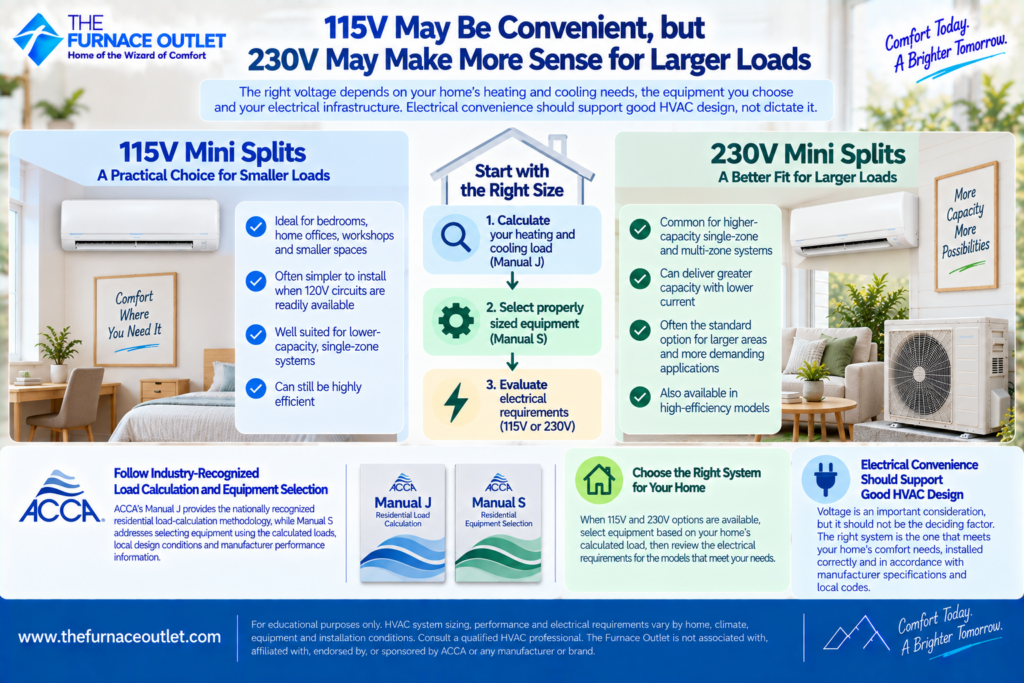
When both voltage versions are available for equipment capable of satisfying the calculated load, installation conditions can become part of the selection process. A 115V system may be appealing for a relatively small single-zone application, particularly when the electrical infrastructure makes the required circuit straightforward. A 230V system may make more practical sense for higher-capacity applications or when the manufacturer’s equipment lineup is primarily designed around that voltage.
But I would not select equipment voltage before selecting the appropriate HVAC capacity. The correct sequence is to determine the building’s heating and cooling requirements, identify equipment capable of meeting those loads and then evaluate the electrical requirements of the suitable models.
ACCA’s Manual J provides the nationally recognized residential load-calculation methodology, while Manual S addresses selecting equipment using the calculated loads, local design conditions and manufacturer performance information. ACCA’s current Manual S also includes guidance for ductless single-split and multi-split systems.
ACCA — Manual J and HVAC Technical Manuals
ACCA — Manual S Residential Equipment Selection
Electrical convenience should support good HVAC design rather than dictate it.
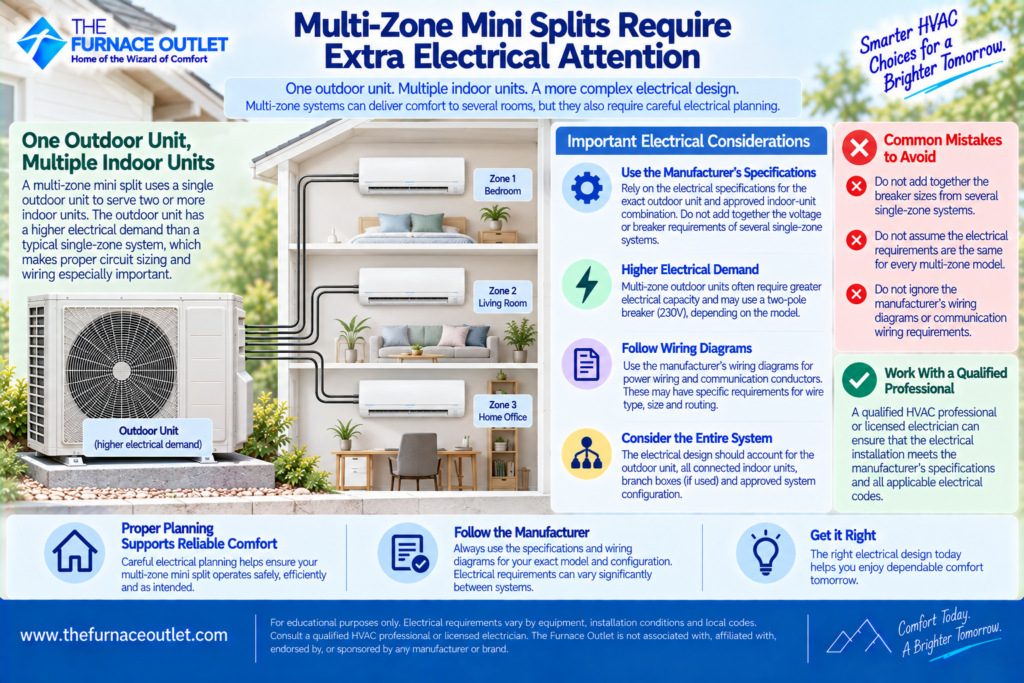
Multi-zone systems make electrical planning even more important because one outdoor unit may serve several indoor units and have considerably greater electrical demand than a small single-zone system.
Do not add together the voltage or breaker requirements of several unrelated single-zone systems and assume the result applies to a multi-zone condenser. The electrical specifications of the exact outdoor unit and approved indoor-unit combination should be used.
The same principle applies to branch-box systems and other more complicated configurations. Follow the manufacturer’s wiring diagrams because communication conductors and power wiring between components may have very specific requirements. Incorrect interconnecting wiring can prevent equipment from operating correctly even when the main supply circuit itself is properly sized.
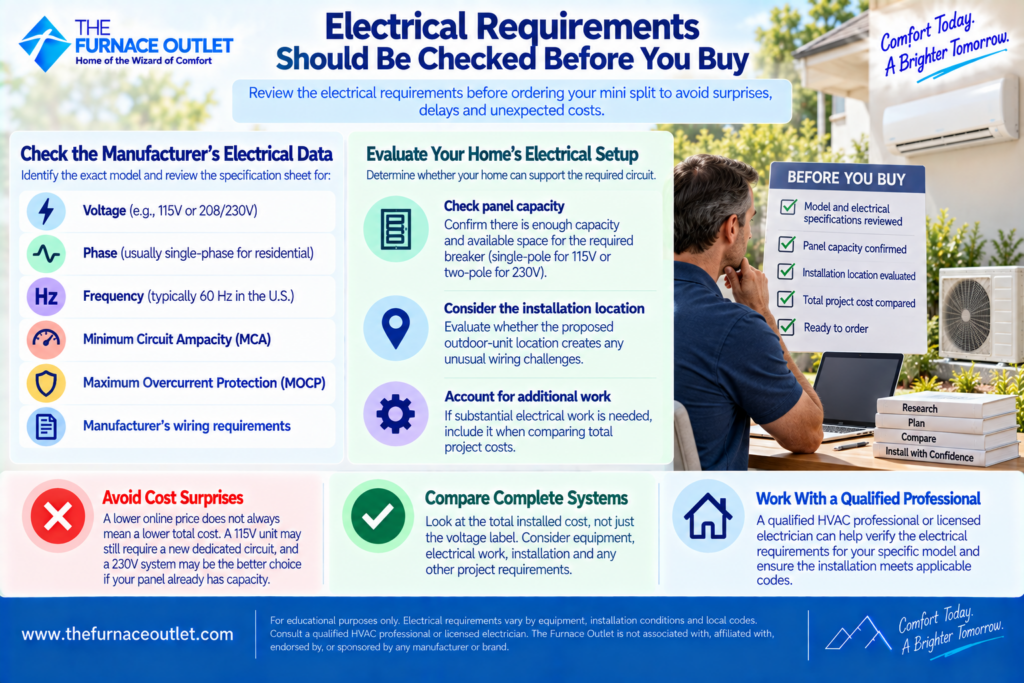
One of the worst times to discover that your home cannot easily accommodate a mini split is after the equipment has arrived. Before ordering, identify the exact model and review its electrical data. Confirm voltage, phase, frequency, MCA, maximum overcurrent protection and the manufacturer’s wiring requirements. Then determine whether the existing panel can accommodate the required circuit and whether the proposed outdoor-unit location creates any unusual wiring challenges.
If substantial electrical work is necessary, include it when comparing project costs. A 115V unit with a lower online purchase price is not necessarily the least expensive completed project if the home still needs a new dedicated circuit. Likewise, a 230V system should not automatically be rejected because it requires a double-pole breaker if the panel already has appropriate capacity and the installation is straightforward.
Compare complete installed systems, not voltage labels.
The NEC provides a widely used foundation for electrical safety in the United States, but electrical requirements are enforced through the codes adopted by states and local jurisdictions. Local amendments, permit procedures and inspection requirements can therefore affect an installation. This is why an installation method that was acceptable for a friend’s mini split in another state, county or city may not automatically apply to your project.
ACCA notes that proper residential HVAC load calculations are required by national building codes and most state and local jurisdictions, reinforcing the broader point that HVAC installations exist within a code and permitting framework rather than being purely equipment-purchase decisions. Before installation begins, determine which permits and inspections are required and who is responsible for obtaining them.
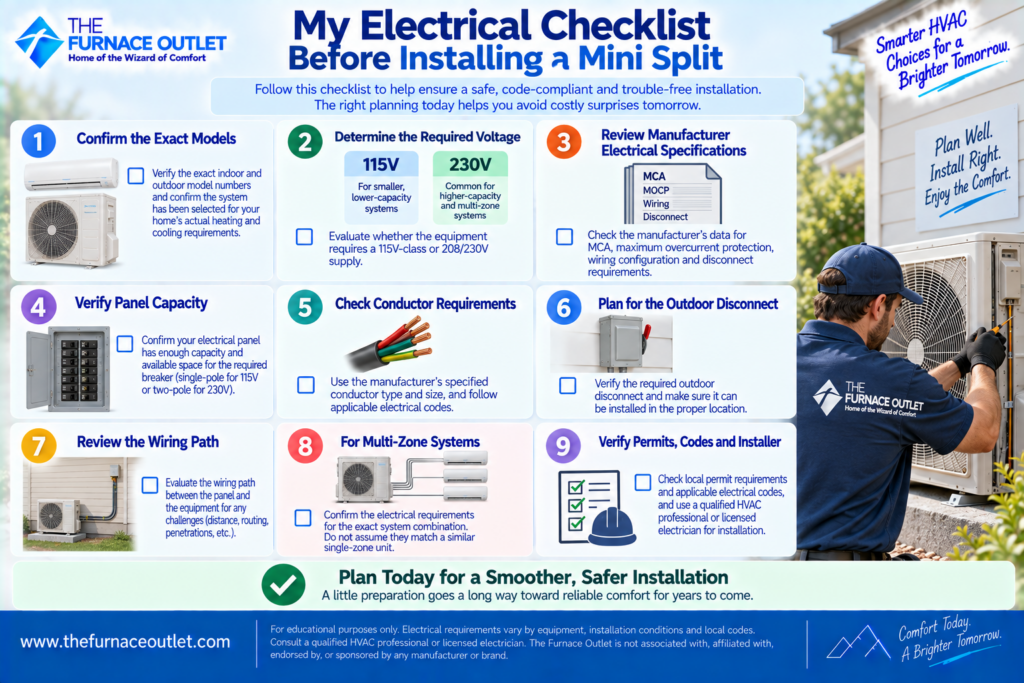
Before approving a mini-split installation, I would first confirm the exact indoor and outdoor model numbers and make sure the system has been selected for the home’s actual heating and cooling requirements. Only after that would I evaluate whether the equipment requires a 115V-class or 208/230V supply. Next, I would review the manufacturer’s electrical specifications for MCA, maximum overcurrent protection, wiring configuration and disconnect requirements. I would also verify panel capacity, breaker configuration, conductor requirements, outdoor disconnect location and the wiring path between the panel and equipment.
For multi-zone equipment, I would confirm the electrical requirements for the exact system combination rather than assuming they match a similar single-zone unit. Finally, I would verify applicable local permits, electrical-code requirements and installer qualifications before work begins. That sequence removes much of the guesswork that causes problems in DIY and poorly planned professional installations.
The difference between a 115V and 230V mini split is important, but voltage is only the beginning of the electrical conversation. A 115V mini split is not automatically a plug-and-play appliance, and a 230V mini split is not automatically difficult to install. Neither voltage tells you the required breaker size, conductor size or complete electrical configuration by itself.
The exact equipment specifications are what matter.
Start with proper heating and cooling load calculations. Select equipment capable of satisfying those loads. Then review the manufacturer’s voltage, MCA, maximum overcurrent protection and wiring requirements and determine what your home’s electrical system needs to support them. When electrical work requires a new circuit, panel modifications, disconnect installation or other substantial changes, involve a qualified professional and follow the requirements of the authority having jurisdiction.
The objective is not to choose 115V because it seems easier or 230V because it sounds more powerful. The objective is to choose the right HVAC equipment for the home and provide the electrical infrastructure that allows that equipment to operate safely, reliably and as its manufacturer intended.
https://thefurnaceoutlet.com/best-mini-split-systems-of-2026-complete-brand-model-comparison/
This article is for educational purposes only and is not a substitute for the National Electrical Code, locally adopted electrical or mechanical codes, manufacturer installation instructions or advice from a qualified HVAC contractor or licensed electrician. Electrical requirements vary by equipment, installation conditions and jurisdiction, and homeowners should verify the requirements for their exact equipment before installation.
The Furnace Outlet is not associated with, affiliated with, endorsed by or sponsored by the organizations or manufacturers referenced in its editorial content. Equipment specifications and code requirements can change, so current manufacturer documentation and requirements from the local authority having jurisdiction should always take precedence.