Newsletter Subscribe
Enter your email address below and subscribe to our newsletter

HVAC made simple
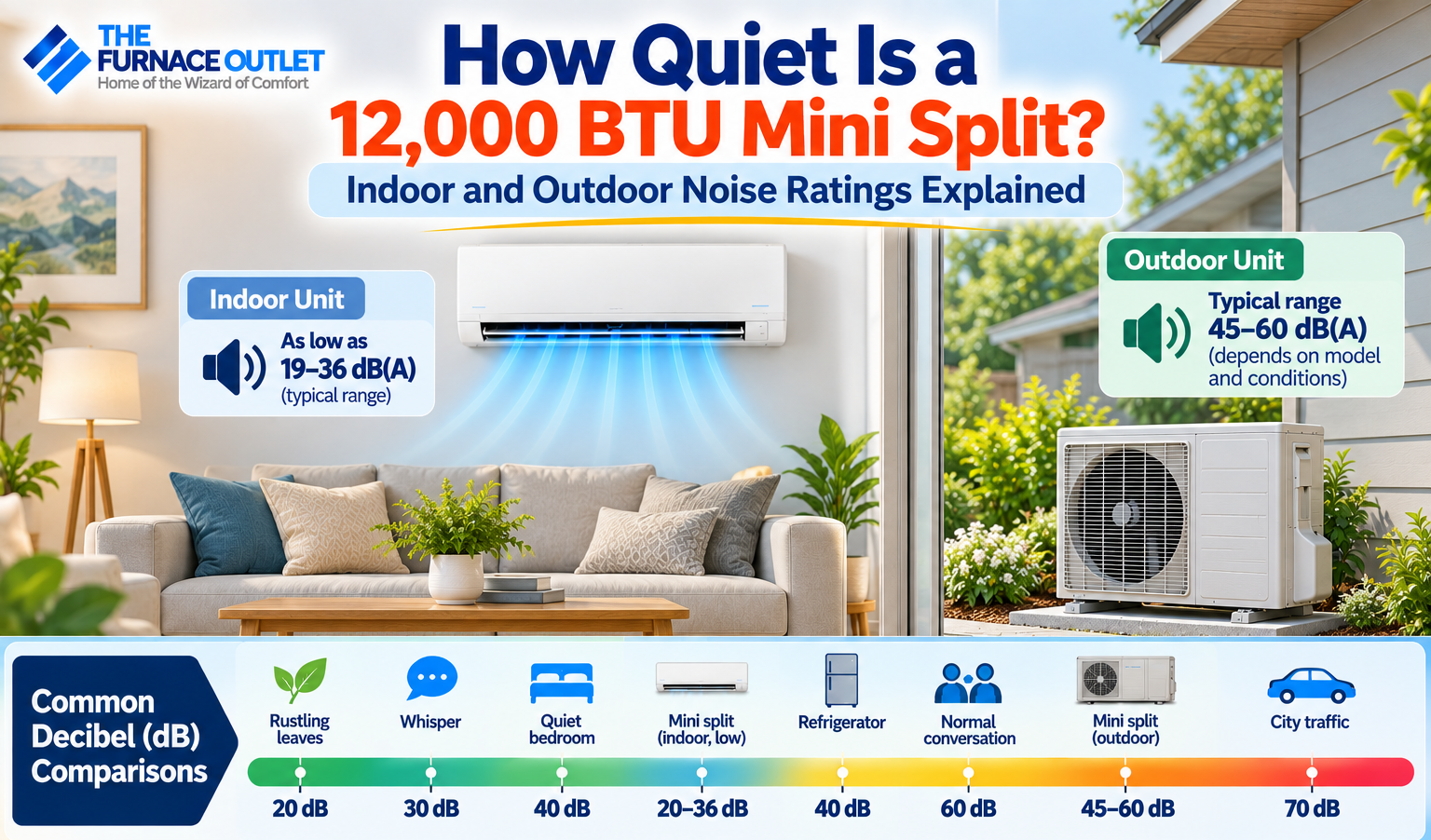
One of the reasons homeowners are attracted to ductless mini splits is their reputation for quiet operation. A well-selected 12,000 BTU mini split can be remarkably unobtrusive, particularly when its inverter compressor is operating at reduced capacity and the indoor fan is running at a low speed. But the word “quiet” is relative, and a single decibel number rarely tells the complete story.
When I compare 12K mini splits, I look at indoor and outdoor sound specifications separately. I also check whether the published figure represents a minimum fan setting, rated operation or another test condition. The equipment’s location, mounting method, operating speed, room acoustics and surrounding surfaces can all influence what you actually hear after installation.
The main lesson is simple: don’t buy a mini split based solely on the lowest dB number in a product listing. Understand what the rating represents, compare equivalent specifications and think about how the system will operate in the room where you intend to install it.
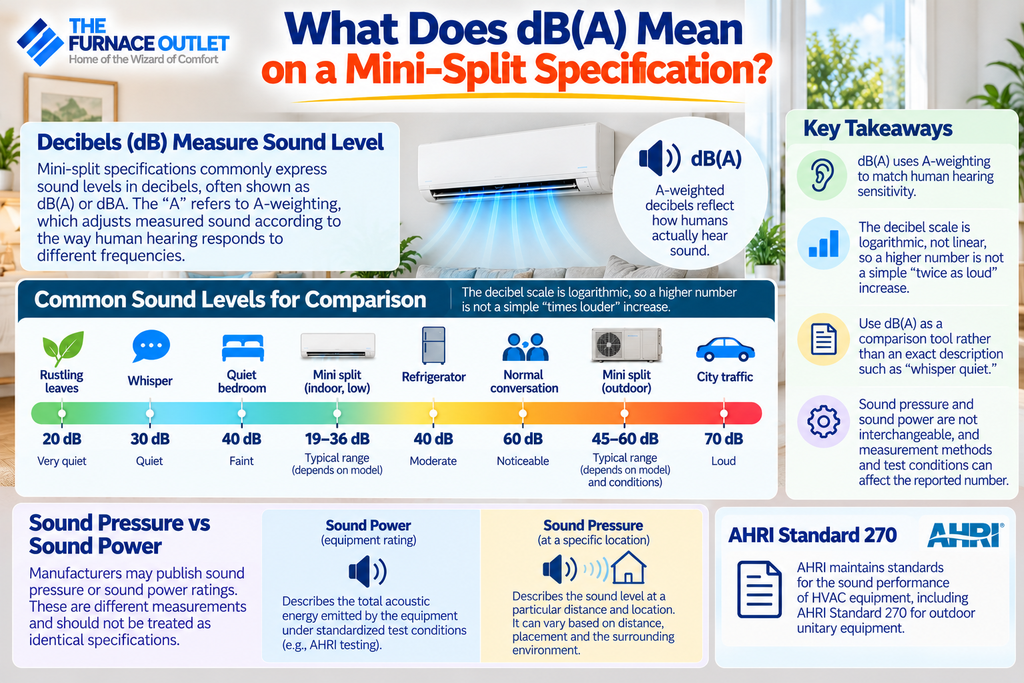
Mini-split specifications commonly express sound levels in decibels, often shown as dB(A) or dBA. The “A” refers to A-weighting, which adjusts measured sound according to the way human hearing responds to different frequencies.
The decibel scale is logarithmic rather than linear. This is important because a change in the published number should not be interpreted as though 40 dB is simply “twice as loud” as 20 dB. Human perception of loudness is more complicated, and the character and frequency content of the sound also influence how noticeable equipment seems.
When evaluating specifications, I therefore use dB(A) as a comparison tool rather than trying to translate every number into an exact subjective description such as “whisper quiet.”
The measurement method also matters. Sound pressure and sound power are not interchangeable specifications, and the distance and test conditions associated with a measurement can affect the reported number. AHRI maintains standards for sound performance of HVAC equipment, including AHRI Standard 270 for outdoor unitary equipment.
A mini split contains sound-producing components on both sides of the wall. Indoors, you primarily hear the indoor fan, moving air and sometimes subtle refrigerant-flow or expansion noises. Outdoors, the compressor and fan become major contributors.
That means I would never evaluate a system using a single “noise level” without determining which component the specification describes.
For a bedroom installation, indoor-unit sound can be especially important because the equipment may operate only a few feet from someone sleeping. For an outdoor condenser installed near a bedroom window, patio or neighboring property, outdoor sound can become equally important.
A system with an exceptionally quiet indoor head but a noticeably louder outdoor unit may still be unsuitable for a particular installation. Conversely, a quiet outdoor condenser does not compensate for an indoor unit whose airflow is objectionable at the speed required to condition the room.
There is no universal indoor sound level for all 12,000 BTU mini splits. Published specifications vary by product, operating mode and fan speed.
Many manufacturers publish several indoor sound levels corresponding to settings such as quiet, low, medium and high fan speed. The lowest advertised number may therefore represent the unit operating under its quietest available setting rather than the sound level you will experience while the system is delivering substantial cooling or heating.
This distinction matters when comparing products. Suppose one manufacturer’s headline specification highlights its lowest fan-speed sound level while another specification sheet prominently displays a rated or higher-speed figure. Comparing those two numbers directly could create a misleading impression.
I would look for the complete sound-level table across multiple indoor fan speeds whenever the manufacturer provides it. That tells you much more about how the system might sound during both light-load and high-load operation.
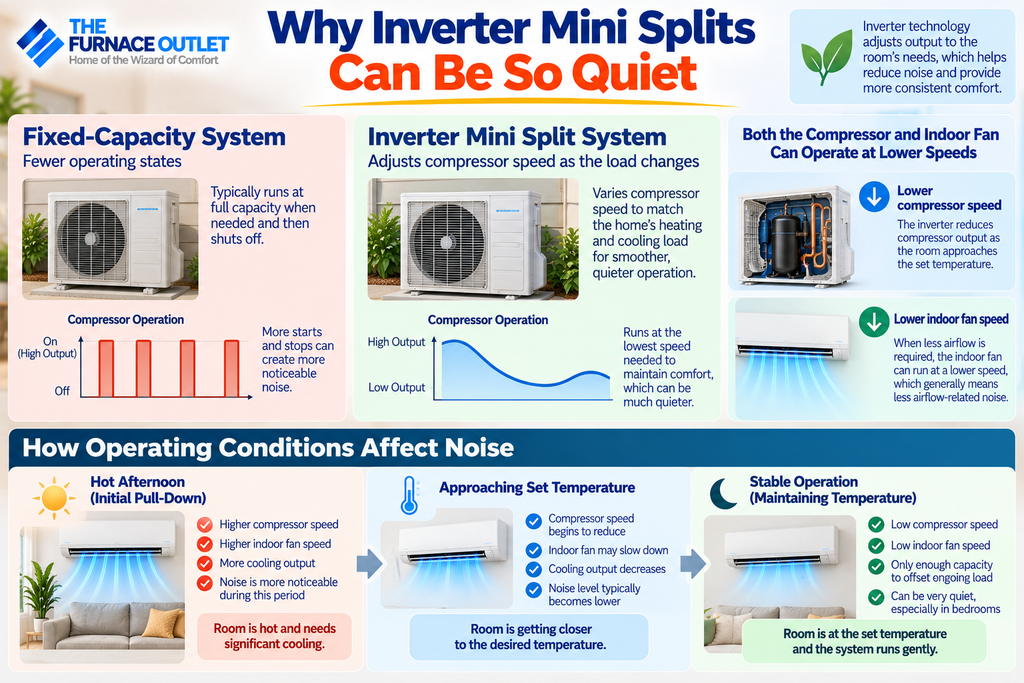
Variable-speed technology is one of the reasons mini splits can provide excellent acoustic comfort. A traditional fixed-capacity system generally has fewer operating states. An inverter mini split can instead adjust compressor speed as the room’s load changes. Once the room approaches the desired temperature, the system may reduce output rather than repeatedly operating at full capacity and shutting down.
The indoor fan can also operate at lower speeds when less airflow is required. Lower fan speed generally means less airflow-related noise, although the exact relationship depends on the indoor-unit design.
Imagine a properly sized 12K system maintaining a bedroom overnight. If the room has a modest load, the equipment may be able to operate gently at reduced capacity. That operating condition can sound dramatically different from the same system working hard to cool a hot room on a summer afternoon.
This is why I would not assume the system has one fixed noise level. Like its electrical consumption and capacity, an inverter mini split’s sound can change as its operating condition changes.
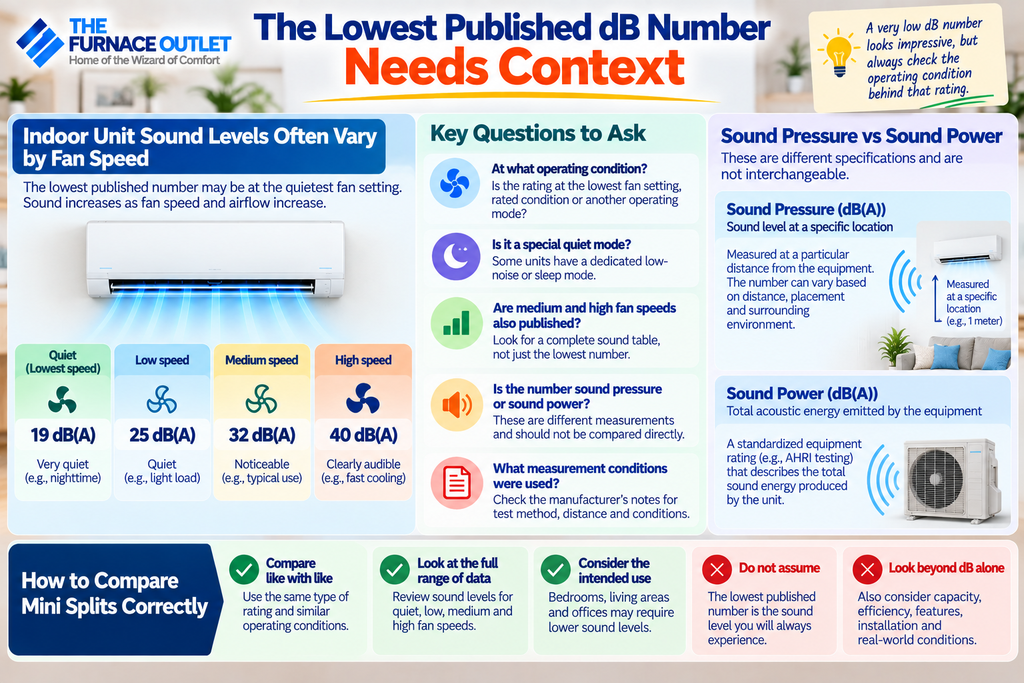
A very low headline sound rating looks impressive on a product page, but I immediately ask: At what operating condition?
Was the indoor unit operating at its lowest fan setting? Was it in a special quiet mode? Does the manufacturer publish sound data at medium and high fan speeds? Is the number sound pressure or sound power? What measurement conditions were used?
These questions are important because a homeowner might buy a unit based on an extremely low minimum number and then discover that the equipment normally operates at a higher fan speed in the actual room.
This does not mean low published ratings are meaningless. They can provide valuable information when compared correctly. The key is to compare like with like and avoid treating a minimum value as a guaranteed sound level under every condition.
Equipment sizing and acoustic comfort are connected. If a 12K mini split is substantially undersized for the room, it may need to spend more time operating at high output during demanding conditions. Higher compressor and fan operation can make both indoor and outdoor equipment more noticeable.
An oversized system creates a different problem. Although inverter equipment can modulate, it still has minimum operating limits. An unnecessarily large unit may not always be able to settle into the type of stable low-load operation you expected.
That is one reason I prefer to establish the room’s load before becoming overly focused on sound specifications. ACCA identifies Manual J as the ANSI-recognized residential methodology for calculating heating and cooling loads. Manual S then uses calculated loads together with manufacturer performance data when selecting residential equipment. The quietest system on paper is not necessarily the quietest solution if it is poorly matched to the room.
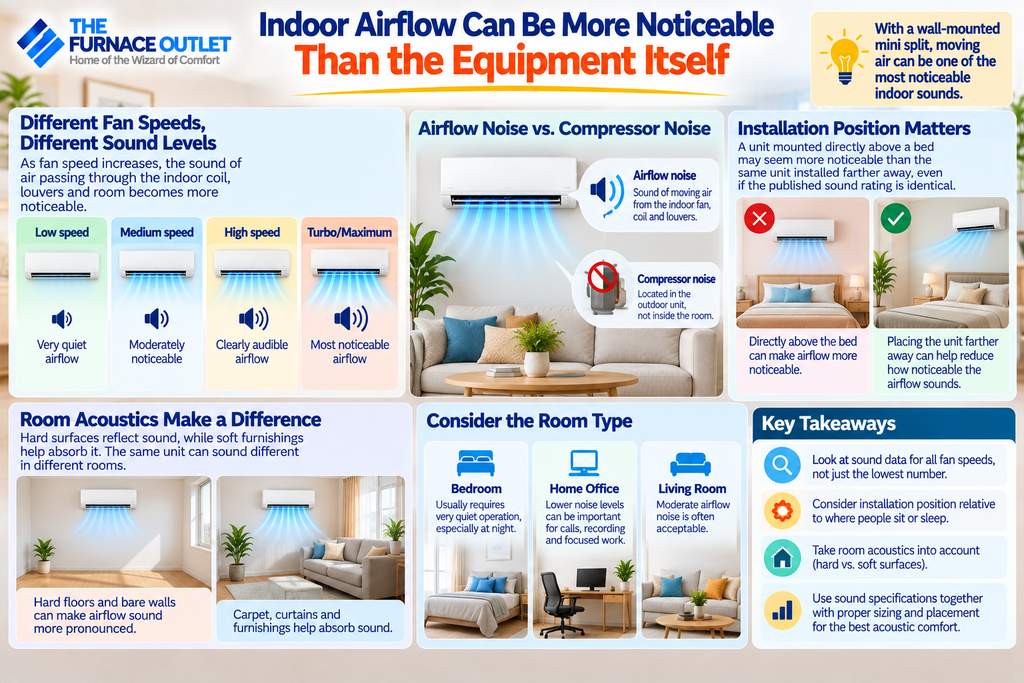
When homeowners think about HVAC noise, they often imagine the compressor. With a wall-mounted mini split, however, moving air can be one of the most noticeable indoor sounds.
At low fan speed, airflow may be extremely subtle. As fan speed increases, the sound of air passing through the indoor coil, louvers and room becomes more noticeable. Installation position can influence your perception of this sound. A unit mounted directly above a bed may seem more noticeable than identical equipment located farther away, even though the equipment’s published sound specification has not changed.
Room acoustics also matter. Hard floors, bare walls and sparse furnishings can reflect sound differently from carpet, curtains and upholstered furniture. For bedrooms and recording or work spaces where acoustic comfort is particularly important, I would consider both the manufacturer’s sound specifications and the physical placement of the indoor unit.
The outdoor condenser has a different acoustic profile because it contains the compressor and outdoor fan.
AHRI Standard 270 establishes definitions, test requirements, rating requirements and published-rating requirements for the sound performance of covered outdoor unitary air-conditioning and heat-pump equipment. The current standard includes overall A-weighted sound power levels as part of its rating framework.
AHRI also publishes Standard 275, which addresses the application of outdoor-unit A-weighted sound-power ratings and procedures for estimating sound-pressure levels from those ratings.
This distinction is useful because the number measured or experienced at a particular location is influenced by more than the equipment itself. Distance, placement and the surrounding environment matter.
Consequently, when comparing outdoor units, verify what type of sound rating the manufacturer is publishing before putting two numbers side by side.
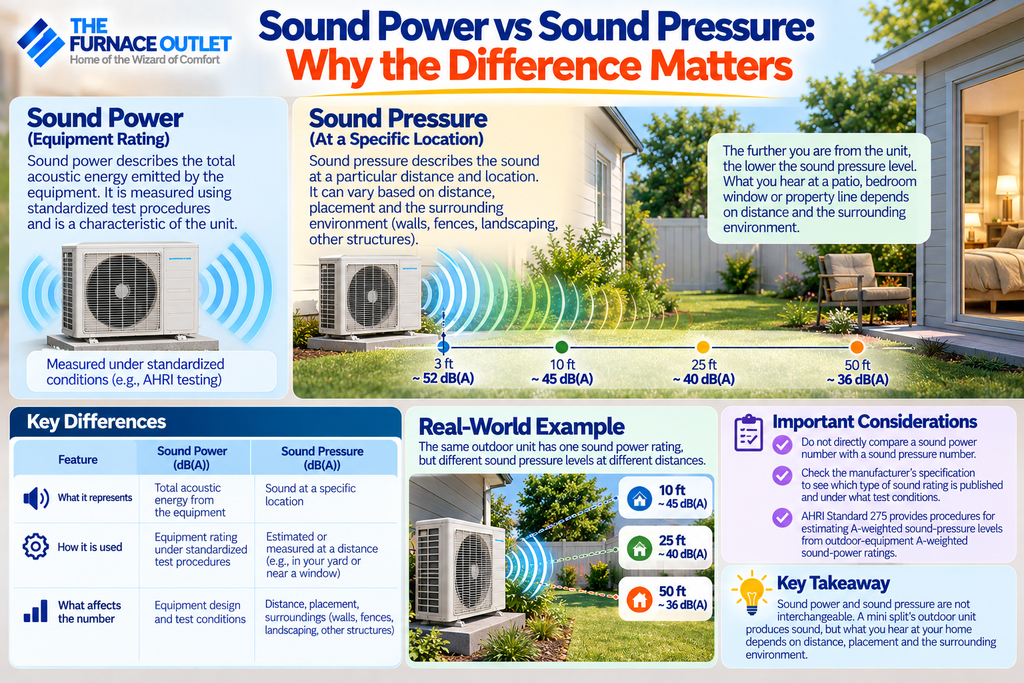
This is one of the more technical parts of mini-split noise specifications, but it is worth understanding.
Sound power describes acoustic energy emitted by the source and is a characteristic used to rate equipment under standardized procedures. Sound pressure describes the sound at a particular location and can vary with distance and the acoustic environment.
Think of it this way: the outdoor condenser produces sound, but what you hear at your patio, bedroom window or property line depends on how that sound travels from the equipment to you.
AHRI Standard 275 specifically provides procedures for estimating A-weighted sound-pressure levels from outdoor-equipment A-weighted sound-power ratings, which reinforces why the two quantities should not simply be treated as identical.
If one manufacturer publishes sound pressure while another publishes sound power, I would not directly compare the numbers without understanding the underlying measurement methods.
Even a relatively quiet condenser can become annoying if it is poorly positioned.
I would think carefully before placing an outdoor unit immediately outside a bedroom window, next to a frequently used patio or in a confined location surrounded by hard reflective surfaces. Sound can reflect from walls, fences and other structures, making the equipment seem more noticeable in particular locations.
The outdoor unit also requires manufacturer-specified clearances for airflow and service. I would never compromise those requirements merely to hide the condenser acoustically.
Local requirements can matter as well. Municipalities, homeowner associations and other jurisdictions may impose restrictions concerning equipment placement, setbacks or permissible noise. These requirements vary, so they should be checked for the installation location rather than assumed from a national guideline.
A good installation balances airflow, service access, drainage, structural support, manufacturer clearances and acoustic considerations.
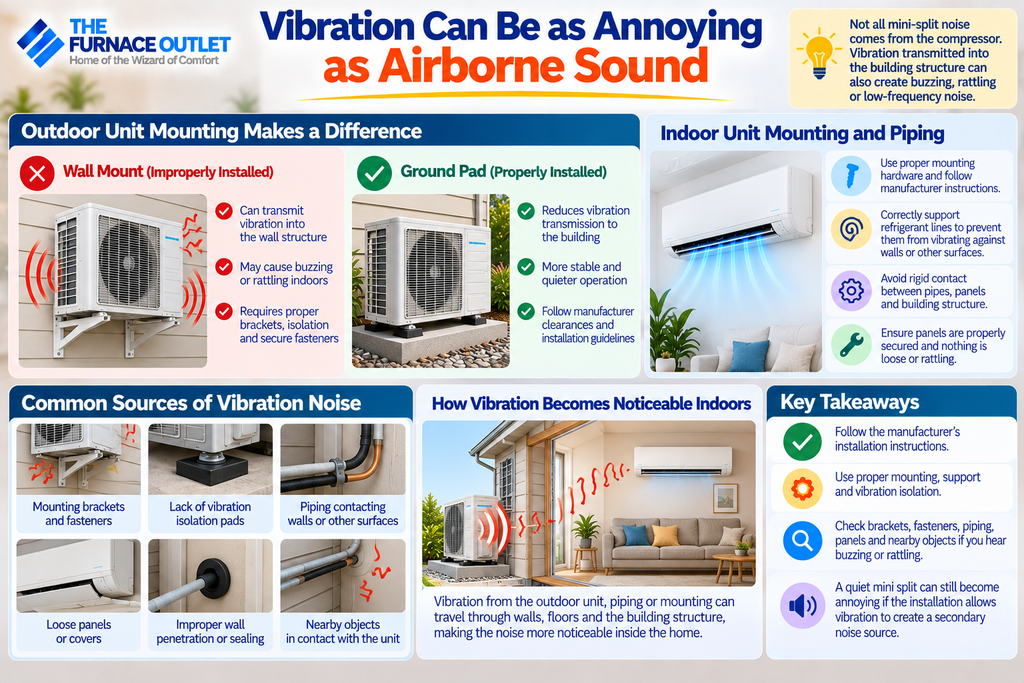
Sometimes the noise attributed to a mini split is actually vibration transmitted into the building structure.
An outdoor unit mounted on a wall bracket can potentially transmit vibration differently from one installed on an appropriately designed ground pad. Indoor-unit mounting and refrigerant-line installation can also influence whether mechanical vibration becomes noticeable.
The solution is not simply to add random padding. Equipment needs to be supported and installed according to the manufacturer’s instructions and applicable requirements.
When I hear complaints involving buzzing, rattling or structural resonance, I would investigate mounting, fasteners, piping contact points, panels and nearby objects rather than assuming that the compressor itself is inherently loud.
A technically quiet unit can become irritating if something in the installation turns normal mechanical vibration into a secondary noise source.
If your 12K mini split is a heat pump, do not judge its year-round acoustics entirely from summer cooling operation.
During winter, compressor speed and outdoor fan behavior can change with outdoor conditions and heating demand. Cold-climate systems may work harder as temperatures fall.
Defrost adds another operating condition. Frost can accumulate on the outdoor coil under certain combinations of temperature and humidity, and the heat pump periodically initiates a defrost cycle to restore heat transfer. During this process, operating sounds can temporarily change.
These noises do not automatically indicate a fault. The important distinction is between normal operating changes and unusual sounds such as persistent rattling, grinding or other behavior that should be inspected.
For homeowners who are particularly sensitive to noise, I would consider heating, cooling and defrost behavior rather than evaluating the system only during mild-weather operation.
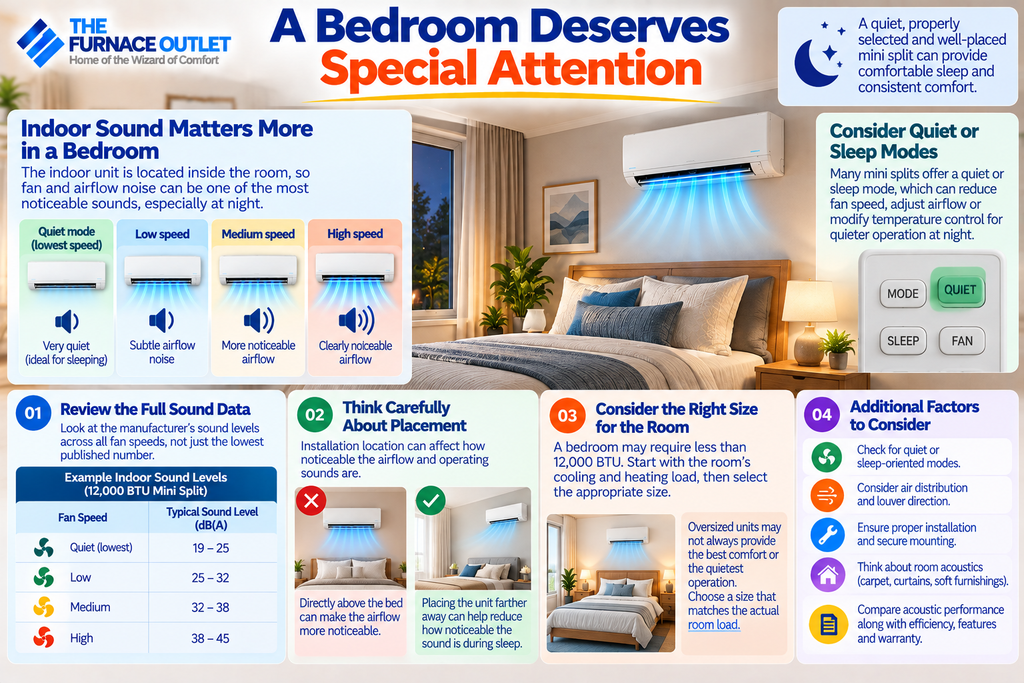
If I’m selecting a 12K mini split for a bedroom, indoor sound becomes one of my major comparison criteria.
I would review the manufacturer’s sound data across several fan speeds rather than looking only at the minimum advertised value. I would also investigate whether the system provides a quiet or sleep-oriented operating mode and understand what that mode actually changes.
Placement deserves equal attention. I generally would not choose the indoor-unit location solely because it creates the shortest refrigerant-line route. Air distribution, service access and how directly the airflow and equipment sound reach the sleeping area should all be considered.
The room’s load matters too. If a bedroom genuinely requires much less than 12K, choosing a one-ton unit merely because it has an impressive minimum dB rating may miss the larger sizing question.
Start with the load, select appropriate equipment and then compare acoustic performance among suitable systems.
Home offices can also benefit substantially from quiet mini-split operation, particularly where the room is used for video calls, recording or concentrated work.
However, offices may have higher internal heat gains than bedrooms. Multiple monitors, computers, lighting, printers and occupants can increase the cooling load, causing the mini split to operate at higher capacity during the working day.
A sound rating measured at minimum fan speed therefore may not describe the condition you experience while the office is occupied and all the equipment is operating.
For this application, I would look particularly closely at low, medium and high fan-speed sound data, while also making sure the mini split has enough capacity to handle the actual internal load.
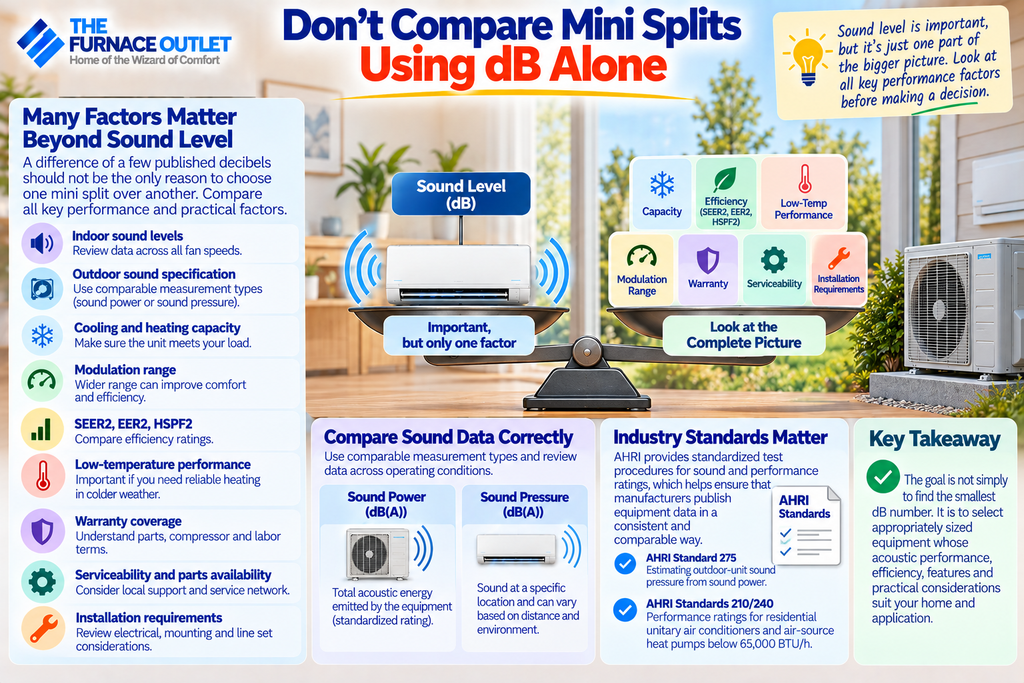
Sound level deserves attention, but I would not let a difference of a few published decibels dominate the entire purchasing decision without understanding the test conditions.
I would compare cooling and heating capacity, modulation range, SEER2, EER2, HSPF2, low-temperature performance, warranty, serviceability and installation requirements alongside sound.
I would then examine the indoor sound levels across operating speeds and the outdoor-unit sound specification using comparable measurement types.
AHRI’s sound standards demonstrate why standardized definitions and testing procedures matter when manufacturers publish equipment sound data. The broader AHRI 210/240 framework likewise establishes standardized performance-rating requirements for residential unitary air conditioners and air-source heat pumps below 65,000 BTU/h.
The goal is not simply to find the smallest number. It is to find appropriately sized equipment whose acoustic performance suits the application.
When I evaluate a 12,000 BTU mini split for quiet operation, I first make sure 12K is actually an appropriate capacity for the room. Once sizing is established, I compare the indoor sound ratings across multiple fan speeds rather than focusing exclusively on the lowest advertised figure.
Next, I determine whether the published outdoor specification represents sound power or sound pressure and check the associated test information where available. I consider condenser placement relative to bedrooms, patios, neighboring properties and reflective surfaces, while still respecting manufacturer clearance and airflow requirements.
For bedrooms and offices, I pay particular attention to the sound produced during the operating conditions the room is likely to experience most often. I also consider vibration isolation, mounting quality and whether heating and defrost operation could introduce additional sounds during winter.
Finally, I compare noise alongside the specifications that determine whether the equipment will actually perform well: capacity range, efficiency, heating performance, controls, warranty and service support. A mini split should be quiet because it is well designed, correctly selected and properly installed—not merely because a product page advertises an unusually low decibel number.
A 12,000 BTU mini split can provide exceptionally quiet comfort, but there is no universal noise rating for every one-ton system. Indoor sound changes with fan speed and operating load, outdoor sound comes from a different set of components, and the published numbers may represent different measurement methods or operating conditions.
For a meaningful comparison, determine whether the specification refers to indoor or outdoor sound, sound pressure or sound power, and minimum, rated or higher-speed operation. Then consider how installation location, room acoustics, mounting and operating conditions could affect what you actually hear.
For further research, useful authoritative references include AHRI Standard 270 — Sound Performance Rating of Outdoor Unitary Equipment, AHRI Standard 275 — Application of Outdoor Equipment Sound Ratings, AHRI Standard 210/240 — Air-Conditioner and Heat-Pump Performance Ratings, ACCA Manual J and ACCA Manual S.
Editorial & HVAC Disclaimer: This content is for educational purposes only. HVAC sound, performance, sizing, efficiency and comfort vary by equipment, operating condition, installation, building construction and environment. Published sound ratings should be interpreted according to the manufacturer’s stated measurement method and test conditions. The Furnace Outlet is not associated with, affiliated with, endorsed by, or sponsored by any manufacturer or brand mentioned and does not receive manufacturer compensation for inclusion or rankings. Verify current equipment specifications and local requirements and consult a qualified HVAC professional for equipment selection and installation.
https://thefurnaceoutlet.com/best-12000-btu-mini-splits-of-2026-1-ton-systems-compared/