Newsletter Subscribe
Enter your email address below and subscribe to our newsletter

HVAC made simple
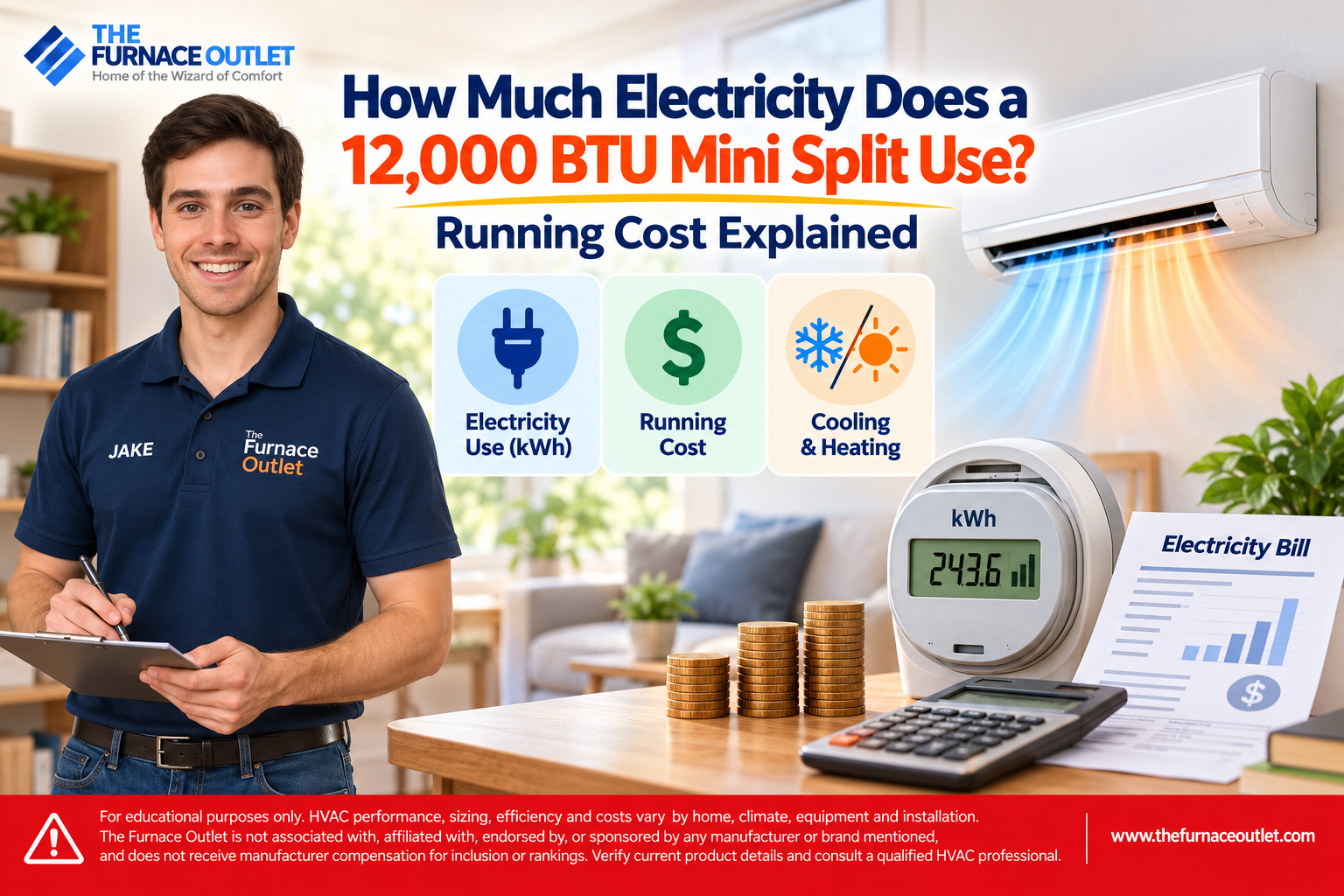
A 12,000 BTU mini split does not have one fixed electricity-consumption number. Although 12,000 BTU per hour identifies the system’s nominal cooling-capacity class—commonly called one ton—it does not tell you how many watts the system continuously draws. Actual electricity use changes with the efficiency of the equipment, indoor and outdoor temperatures, thermostat setting, building load, compressor speed and whether the system is cooling or heating.
This distinction becomes especially important with modern inverter mini splits. Instead of operating continuously at one fixed electrical input, an inverter-driven system can increase or decrease compressor speed as the load changes. A 12K mini split working hard on a very hot afternoon may consume substantially more electricity than the same system maintaining temperature during mild evening conditions.
Rather than asking only, “How many watts does a 12K mini split use?” I prefer asking three questions: How efficient is the actual system, how much heating or cooling does the room require, and how many kilowatt-hours does the equipment consume over the period being measured? Those answers provide a much more realistic picture of running cost.
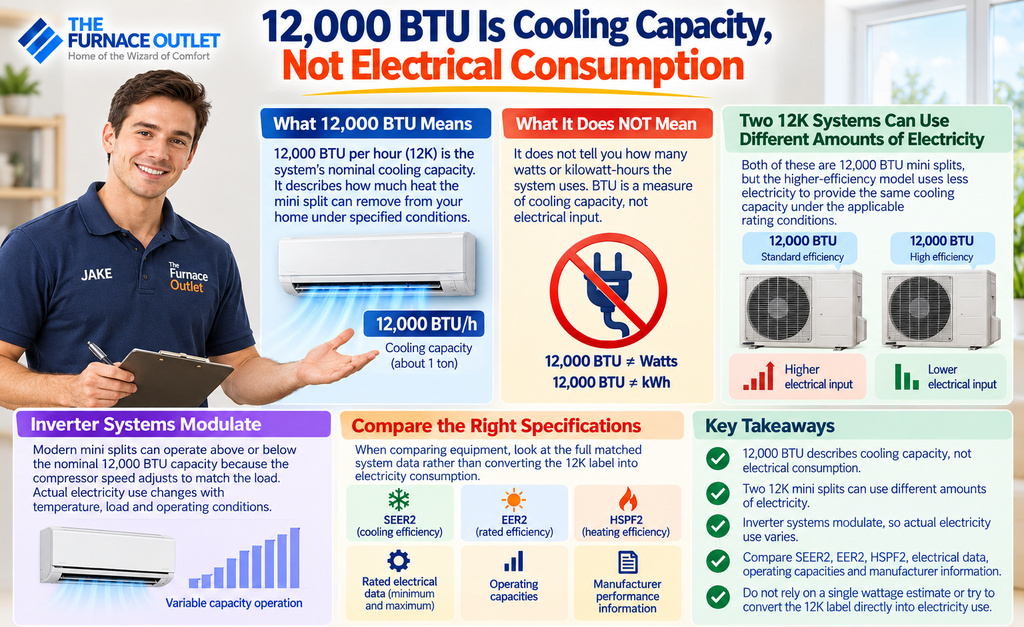
One of the easiest mistakes to make is treating 12,000 BTU/h as though it were an electrical-input rating. It is not. The BTU figure describes the nominal amount of heat the system is capable of moving under specified conditions.
Two mini splits can therefore both be classified as 12,000 BTU systems while using different amounts of electricity to provide comparable cooling. A higher-efficiency model generally requires less electrical input for a given amount of cooling under the applicable rating conditions than a less-efficient model.
The actual system may also operate above or below its nominal capacity because modern inverter compressors modulate. This means that neither the nominal 12,000 BTU capacity nor a single wattage figure from a product listing provides a complete description of real-world electricity consumption.
When comparing equipment, I would look at the exact matched system’s SEER2, EER2, HSPF2, rated electrical data, minimum and maximum operating capacities and manufacturer performance information rather than trying to convert the 12K label directly into electricity consumption.
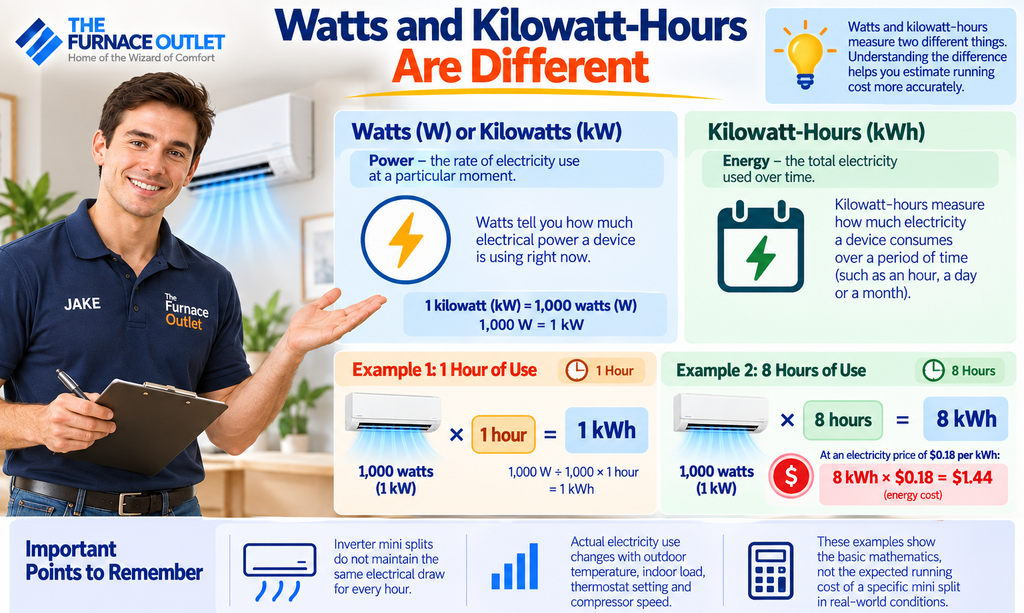
Before calculating running cost, it helps to separate power from energy. Watts and kilowatts describe the rate at which electricity is being used at a particular moment. Kilowatt-hours, or kWh, measure electrical energy consumed over time and are normally what your utility uses when calculating the energy portion of your electricity bill.
One kilowatt equals 1,000 watts. If an appliance actually draws 1,000 watts continuously for one hour, it consumes: 1,000 watts ÷ 1,000 × 1 hour = 1 kWh
If that same 1,000-watt load operated continuously for eight hours, it would consume 8 kWh. At an illustrative electricity price of $0.18 per kWh, the energy cost would be: 8 kWh × $0.18 = $1.44
The important qualification is that an inverter mini split generally does not maintain the same electrical draw for every hour it is switched on. The example explains the mathematics, not how a particular mini split will necessarily operate.
There is no responsible universal answer because electrical input is model- and condition-dependent. You may encounter simplified online estimates claiming that every 12K mini split uses a particular number of watts. I would treat those figures cautiously. A system’s electrical input can change as compressor speed changes, outdoor temperature changes and the equipment responds to the room’s load.
A high-efficiency inverter system maintaining an already comfortable room can operate very differently from the same system starting in a hot room after the air conditioning has been off all afternoon. Heating operation at a mild outdoor temperature can also look very different from heating during severe cold weather.
If you need the electrical characteristics of a particular product, use its manufacturer specifications, nameplate information and certified matched-system data. Do not assume that every one-ton mini split shares the same electrical consumption simply because the capacity labels match.
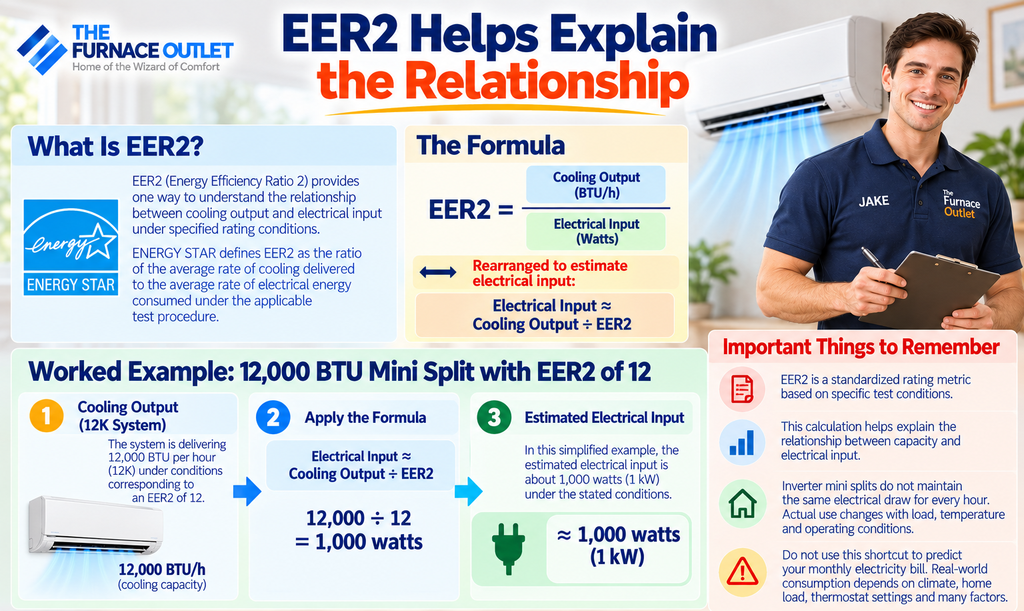
EER2, or Energy Efficiency Ratio 2, provides one useful way to understand the relationship between cooling output and electrical input under specified rating conditions. ENERGY STAR defines EER2 as the ratio of the average rate of cooling delivered to the average rate of electrical energy consumed under the applicable test procedure.
Conceptually: EER2 = Cooling Output ÷ Electrical Input
If you rearrange that relationship for an illustrative calculation: Electrical Input ≈ Cooling Output ÷ EER2
Suppose, purely as a simplified example, that a system is delivering 12,000 BTU/h under conditions corresponding appropriately to an EER2 of 12. The arithmetic would be approximately: 12,000 ÷ 12 = 1,000 watts
This is useful for understanding the relationship between capacity and efficiency, but I would not use this shortcut to predict your monthly bill. EER2 is a standardized rating metric, while an inverter mini split operates across changing loads and conditions in an actual home.
SEER2 looks at cooling efficiency across a standardized cooling season rather than only one operating condition. ENERGY STAR defines SEER2 in terms of total seasonal heat removal divided by total seasonal electrical energy consumed.
That makes SEER2 particularly useful for comparing the rated seasonal efficiency of two appropriately sized systems. If two 12K mini splits have different SEER2 ratings, the system with the higher SEER2 has the higher rated seasonal cooling efficiency within that test methodology.
However, SEER2 should not be converted into a guaranteed annual utility bill. Your actual consumption depends on climate, room load, thermostat setting, equipment sizing, installation, operating schedule and other factors that a standardized rating cannot reproduce exactly. I would use SEER2 primarily as a comparison metric, not a promise of a specific dollar saving.
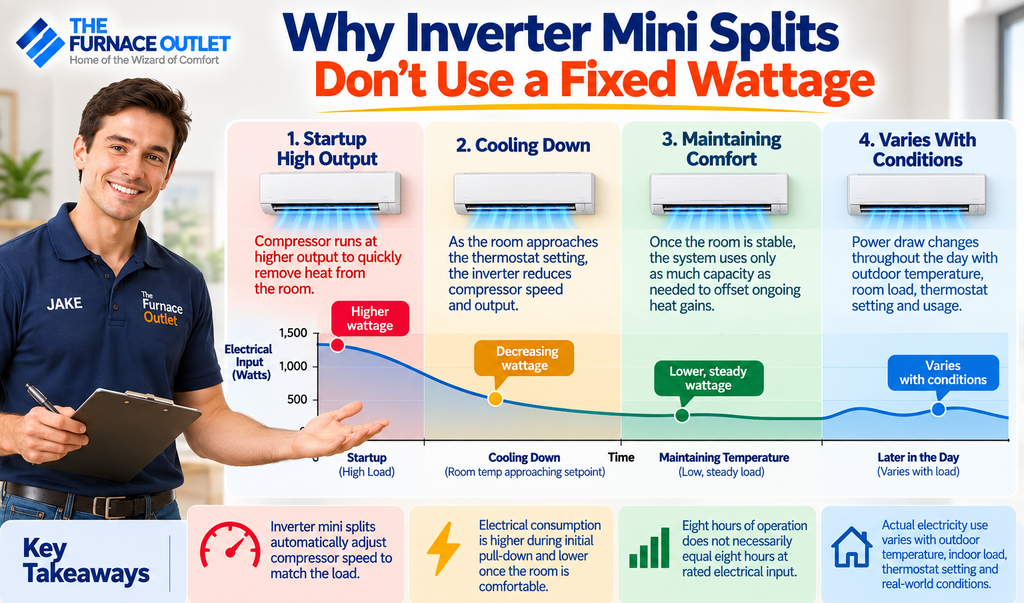
Inverter technology is one of the biggest reasons simple running-cost calculations can be misleading. Imagine a home office that has become hot during the afternoon. When the mini split starts cooling, the compressor may initially operate at relatively high output because there is a substantial load to remove. As the room approaches the thermostat setting, the inverter can reduce compressor speed and cooling output.
Once the room is stable, the equipment may need only enough capacity to offset the heat continually entering through walls, windows, air leakage, occupants and electronics. Its electrical consumption during that period can be much lower than during the initial pull-down.
This means eight hours of operation does not necessarily equal eight hours at rated electrical input. Runtime and electricity consumption are related, but they are not interchangeable.
If you know the actual energy consumption, calculating the energy-cost portion is straightforward: Running Cost = Electricity Used in kWh × Electricity Rate per kWh
For example, suppose a mini split consumed 250 kWh during one month, and the applicable electricity energy rate was $0.18/kWh. The illustrative energy calculation would be: 250 kWh × $0.18 = $45
That calculation is valid for the stated assumptions. What I would not do is claim that every 12K mini split costs $45 per month to operate. Another household might use the equipment far less, while a system facing extreme temperatures and a difficult building load could use considerably more electricity.
Your utility tariff can also include fixed charges, taxes, tiered pricing, time-of-use rates or other adjustments. Multiplying kWh by an electricity rate is therefore best viewed as an estimate of the relevant energy charge, not necessarily the entire utility bill.
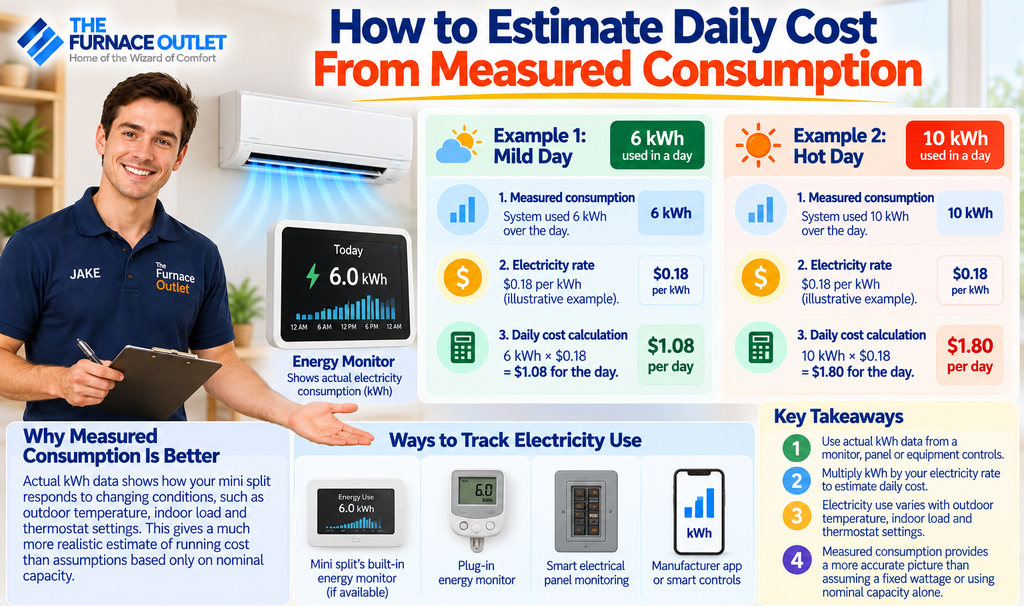
If you can measure or obtain the mini split’s actual electricity consumption, your estimate becomes much more useful. Suppose monitoring shows that the system used 6 kWh over a particular day. At an illustrative energy price of $0.18/kWh: 6 kWh × $0.18 = $1.08 for that day’s energy
If another, hotter day required 10 kWh: 10 kWh × $0.18 = $1.80
This demonstrates why I prefer actual kWh data over assumptions based purely on nominal capacity. The equipment is responding to a changing load, and measured energy consumption captures that behavior much better. If your electrical panel, energy-monitoring system or equipment controls provide reliable consumption data, you can track kWh across mild and extreme weather and develop a far more realistic picture of operating cost.
A 12K mini split installed in Seattle does not face the same cooling conditions as identical equipment installed in Phoenix. Similarly, winter heating conditions in a mild climate bear little resemblance to those experienced in northern cold-climate regions.
As the difference between outdoor and desired indoor temperature grows, the building generally requires more heating or cooling. Solar gain, humidity and other conditions can further affect the load.
This is why geographic comparisons of “average mini-split running cost” can be misleading. Even within the same city, two homes can produce very different consumption because of insulation, windows, air leakage, orientation and occupant behavior. DOE’s Energy Saver guidance emphasizes that heat-pump performance and savings depend on factors including climate and the characteristics of the home.
The mini split can only respond to the load presented by the building. A well-insulated bedroom with efficient windows and controlled air leakage may require relatively little cooling once it reaches the desired temperature. An equally sized room with weak insulation, leaky windows and strong afternoon solar exposure may require substantially more cooling.
The same principle applies in winter. If heated air escapes quickly and outdoor air infiltrates continuously, the heat pump has to replace that lost heat. Before spending substantially more for extremely high-efficiency equipment, I would therefore consider the building envelope as part of the efficiency discussion. Improving obvious insulation and air-sealing deficiencies can reduce the underlying heating and cooling load rather than merely asking the HVAC system to work harder.

A thermostat setting is not just a comfort preference; it influences the workload imposed on the system. Maintaining an unusually low indoor temperature during very hot weather generally creates a greater cooling requirement than maintaining a more moderate setting. Similarly, maintaining a very warm indoor temperature during severe winter weather increases the heating requirement.
This does not mean there is one perfect thermostat setting for every homeowner. Comfort requirements differ. The important point is that operating-cost comparisons should use comparable thermostat behavior. A homeowner maintaining one temperature cannot reliably compare bills with someone operating identical equipment under very different settings.
Most modern mini splits are reversible heat pumps, so electricity-consumption discussions should include winter as well as summer. During heating operation, performance changes with outdoor temperature. A heat pump may operate very efficiently during mild weather but face more challenging conditions as temperatures fall. Available heating capacity and COP can also change.
For cold climates, I therefore examine HSPF2, low-temperature COP and heating capacity at relevant outdoor temperatures, not just SEER2. ENERGY STAR’s cold-climate heat-pump criteria include specific low-temperature requirements, illustrating that severe-weather heating performance needs separate consideration from general seasonal efficiency.
A 12K mini split’s winter electricity consumption therefore cannot be predicted reliably from its summer cooling data.
A larger mini split is not automatically more expensive to operate every minute, nor is a smaller unit automatically cheaper. The equipment has to be matched appropriately to the room’s load. An undersized system may operate near high output for extended periods and still struggle during peak conditions. An unnecessarily oversized inverter system can reduce output, but only down to its minimum operating capability. If the normal room load frequently falls below that minimum, stable modulation may become more difficult.
For this reason, I would establish the heating and cooling load before comparing energy consumption. ACCA identifies Manual J as the ANSI-recognized methodology for calculating residential HVAC loads, while Manual S uses those loads with manufacturer performance information for equipment selection.
Correct sizing provides a much stronger foundation for efficiency than choosing capacity from a generic square-foot chart.
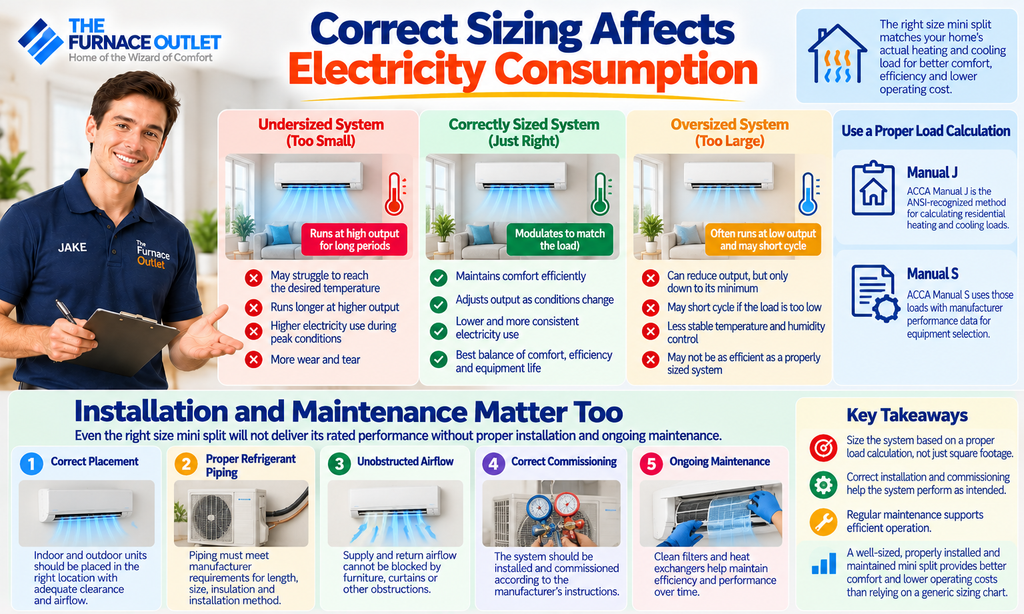
Published ratings assume standardized testing, but actual systems operate in real buildings. Installation quality can influence the performance you ultimately receive. Refrigerant piping needs to meet manufacturer requirements, indoor and outdoor units need appropriate placement, airflow cannot be unnecessarily obstructed and the system needs to be commissioned correctly. Filters and heat exchangers also need appropriate maintenance.
DOE advises that proper installation and maintenance affect heat-pump performance, reinforcing why efficiency should not be treated purely as a product specification. A high-SEER2 mini split is therefore not a substitute for sound system design and installation.
If you are comparing electricity consumption between 12K mini splits, verify that you are comparing the actual indoor and outdoor equipment combination. AHRI’s certification resources allow users to search certified HVAC equipment and examine ratings for qualifying matched systems. This is more dependable than assuming a headline efficiency number applies universally across every indoor unit that can be connected to a particular outdoor condenser.
I would record the complete indoor and outdoor model numbers before making an efficiency comparison. Then verify SEER2, EER2, HSPF2 and relevant capacity information for that particular combination. This becomes especially important with multi-zone systems, where system configuration can make simple comparisons even less useful.
When I want to estimate the operating cost of a 12K mini split, I start with the home’s calculated load and the exact equipment rather than a generic wattage estimate. I review SEER2 and EER2 for cooling, HSPF2 and low-temperature performance for heating, and the manufacturer’s electrical and performance information.

I then use the home’s actual electricity price. If measured kWh consumption is available, that is even better because it captures how the system behaves in that particular room, climate and operating schedule. For a system already installed, comparing monthly or daily kWh against outdoor weather can be particularly informative. It helps distinguish standardized equipment ratings from what the homeowner is actually purchasing from the utility.
Most importantly, I would not compare two mini splits by asking which one “uses fewer watts” without specifying the operating condition. Inverter systems change output continually, so efficiency, load and total energy consumption provide the more meaningful picture.
There is no universal answer to how much electricity a 12,000 BTU mini split uses. 12,000 BTU describes nominal capacity, while electricity consumption depends on efficiency, load, weather and operation. A modern inverter mini split can vary its electrical input substantially as conditions change.
For estimating running cost, the most useful number is eventually kilowatt-hours, because that is the energy quantity you can multiply by your applicable electricity rate. A simple example such as 250 kWh × $0.18/kWh = $45 demonstrates the calculation, but it should never be presented as the expected monthly cost of every 12K system.
For further technical research, useful authoritative resources include ENERGY STAR heat-pump efficiency criteria, U.S. Department of Energy Energy Saver heat-pump guidance, ACCA Manual J, ACCA Manual S and AHRI Directory of Certified Product Performance.
Editorial & HVAC Disclaimer: This content is for educational purposes only. HVAC electricity use, performance, sizing, efficiency and costs vary by home, climate, equipment, installation, utility tariff and operating conditions. Illustrative electricity-cost calculations are examples, not predictions of actual utility bills. The Furnace Outlet is not associated with, affiliated with, endorsed by, or sponsored by any manufacturer or brand mentioned and does not receive manufacturer compensation for inclusion or rankings. Verify current equipment specifications, certified ratings and local electricity prices, and consult a qualified HVAC professional when selecting equipment
https://thefurnaceoutlet.com/best-12000-btu-mini-splits-of-2026-1-ton-systems-compared/