Newsletter Subscribe
Enter your email address below and subscribe to our newsletter

HVAC made simple
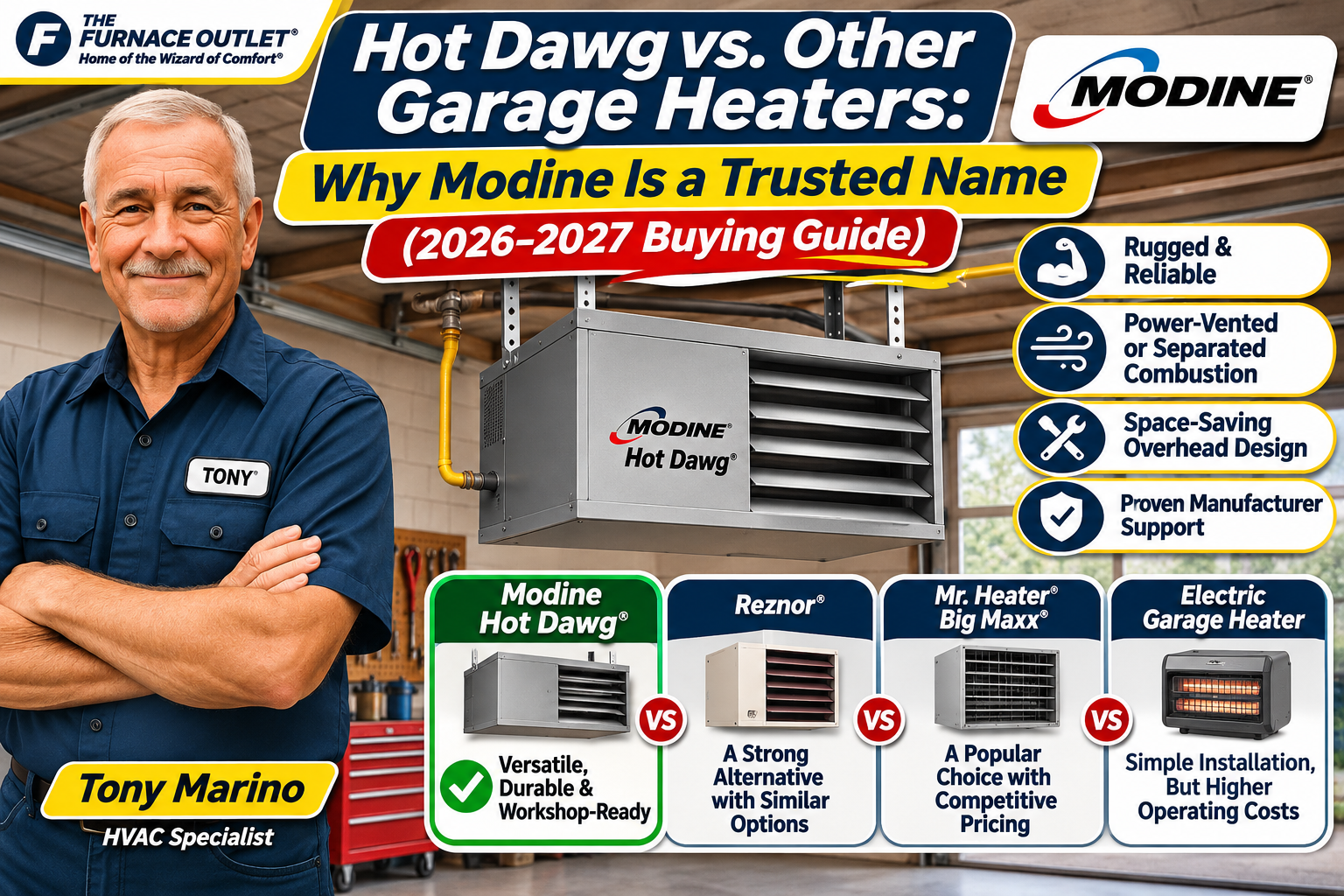
By Tony Marino | The Trusted HVAC Tech | The Furnace Outlet | Updated November 2026
When winter arrives, an unheated garage can become one of the most uncomfortable spaces in your home. Whether you’re repairing your car, working on woodworking projects, exercising, or simply trying to protect equipment from freezing temperatures, dependable garage heating makes a noticeable difference. Over my years working with heating equipment, I’ve seen homeowners choose everything from inexpensive portable electric heaters to professionally installed gas-fired unit heaters. Each has advantages, but Modine’s Hot Dawg series has earned a strong reputation among contractors who need reliable heating for garages and workshops.
What makes Hot Dawg interesting isn’t simply its heating capacity. It’s the combination of compact construction, overhead mounting, flexible venting, and multiple configurations for different applications. But is Modine necessarily better than Reznor, Mr. Heater, or an electric garage heater? Not always. The right choice depends on your garage size, insulation, available fuel, installation budget, and how frequently you need heat. Let’s examine where Hot Dawg stands out, where competitors make sense, and what homeowners should consider before investing.
The Modine Hot Dawg is a permanently installed unit heater designed to warm garages, workshops, and light commercial spaces. Unlike a portable heater that sits on the floor, most Hot Dawg gas-fired models mount overhead, preserving valuable workspace. The standard Hot Dawg HD series uses natural gas or propane and includes a powered exhaust system that vents combustion products outdoors. The HDS series adds separated combustion, drawing combustion air from outside rather than relying on air inside the garage.
Modine offers different heating capacities, commonly ranging from 30,000 to 125,000 BTU per hour of gas input, depending on the model. The company’s official Hot Dawg HD/HDB product information explains its low-profile design, heating options, and residential applications. For homeowners who regularly use their garage during winter, this type of fixed heating system can be considerably more practical than repeatedly moving portable heaters around the room.
Modine is an established HVAC manufacturer with extensive experience producing heating and ventilation equipment for residential, commercial, and industrial applications. That background matters because garage heaters operate in environments that can be challenging. Temperature fluctuations, dust, humidity, and frequent door openings place demands on heating equipment that may differ from those in a typical living room. Hot Dawg heaters are designed around durable metal cabinets, gas-fired heat exchangers, and components intended for permanent installation.
Modine also provides installation manuals, troubleshooting information, replacement-part resources, and technical support for contractors. I wouldn’t claim that a Modine heater never breaks down. Every mechanical system eventually requires maintenance or repairs. However, established product documentation and access to qualified service support are meaningful advantages when buying equipment expected to operate for years.
One of the most important decisions within the Hot Dawg lineup is choosing between the standard power-vented HD model and the separated-combustion HDS model. The HD series draws combustion air from the installation space and uses a power exhauster to vent combustion products outdoors. It can be suitable for garages where the manufacturer’s combustion-air, ventilation, and installation requirements are satisfied. The HDS series draws combustion air directly from outdoors through a dedicated intake system. This arrangement is especially useful in workshops where airborne dust, humidity, or certain contaminants could affect combustion equipment.
For example, a homeowner who occasionally parks a car in a clean, well-ventilated garage may find the standard HD series appropriate. Someone operating a woodworking shop or a frequently used repair workspace may benefit from the HDS configuration. Modine explains these distinctions in its Hot Dawg separated-combustion product guide.
Separated combustion does not make a heater suitable for every hazardous environment. Spaces containing flammable vapors, combustible dust hazards, or corrosive chemicals require specific safety evaluation and equipment selection.
Reznor is one of Modine’s strongest competitors in the gas-fired unit heater category. Both brands manufacture equipment intended for garages, workshops, and commercial applications. Reznor’s UDAP series offers power-vented heating, while the UDAS series provides separated-combustion options. This gives buyers a choice similar to Modine’s HD and HDS configurations. Both manufacturers offer multiple capacities, overhead installation options, and equipment designed for dependable heating in demanding environments.
According to Reznor’s unit heater product comparison, selected models provide thermal efficiencies up to approximately 83%, with higher-efficiency options available in other product families. Modine’s standard Hot Dawg lineup offers comparable conventional gas unit heater performance, with the HDS/HDC series advertised at efficiencies up to approximately 82%. These are manufacturer-rated figures, not guarantees of identical operating costs in every installation.
In my experience, the deciding factors between Modine and Reznor are often local contractor familiarity, parts availability, installation requirements, equipment pricing, and service support. I wouldn’t automatically reject either brand. A properly sized and installed Reznor can be an excellent alternative to a Hot Dawg.
Mr. Heater’s Big Maxx series is another popular option among homeowners shopping for fixed gas garage heaters. Big Maxx models are commonly marketed toward residential garages and workshops, with straightforward overhead installation designs and several heating capacities. The main attraction is often the initial equipment price. Depending on the model and retailer, Big Maxx may be less expensive than a comparable Modine installation.
However, comparing equipment prices alone can be misleading. A complete gas heater installation may require gas piping, electrical work, venting materials, thermostat wiring, mounting hardware, and professional labor. Those costs can exceed the difference between two heater brands. Modine may appeal more strongly to buyers prioritizing a broader commercial-style product lineup and specialized separated-combustion configurations.
Mr. Heater may be worth considering when the application is straightforward, the approved model meets the installation requirements, and qualified local service is available. Neither brand should be selected solely because one advertises a higher BTU number.
Electric garage heaters offer a different set of advantages. They don’t burn fuel at the heater, so they don’t require combustion-air piping or flue-gas venting. That can simplify installation, particularly in garages without natural gas service. However, electric resistance heaters can require substantial electrical capacity. A 5,000-watt heater, for example, provides approximately 17,060 BTU per hour of heat while consuming 5 kWh of electricity for each hour it operates continuously.
A gas-fired Hot Dawg may deliver greater heating capacity with less electrical demand, although it still requires electricity for its fan and controls. Operating costs depend on local electricity and fuel prices, heater efficiency, and usage patterns. For a small, well-insulated garage used occasionally, electric heating may be the more economical overall choice because it avoids gas piping and vent installation.
For a larger garage requiring regular heating through a long winter, a properly sized gas unit heater may be attractive where natural gas is available at favorable rates.
One of the biggest mistakes homeowners make is assuming that more BTUs automatically mean better heating. An oversized garage heater can raise the temperature quickly but may cycle frequently, producing uneven comfort and unnecessary wear. An undersized heater may run continuously during cold weather without maintaining the desired temperature.
Modine’s homeowner FAQ and sizing guidance associates its 30,000 BTU models with smaller garages, 45,000 BTU models with typical two-car garages, and larger capacities with bigger spaces. These are general application examples, not substitutes for a heat-loss calculation.
A well-insulated 500-square-foot garage in a moderate climate may require considerably less heat than an uninsulated garage of the same size in Minnesota. Ceiling height, garage door insulation, air leakage, windows, desired temperature, and frequency of door opening all influence heating demand. I recommend having a contractor calculate the garage’s heating load before selecting a model.
Hot Dawg heaters require professional installation because they involve combustible fuel, electrical connections, and venting of combustion gases. The installer must verify gas supply capacity, approved venting materials, required clearances, mounting strength, combustion-air provisions, and local code requirements. Garages used for vehicle storage have additional placement considerations because gasoline vapors and other flammable materials may be present.
The heater must be installed according to its listing, manufacturer instructions, and applicable codes. Requirements for ignition-source elevation and protection against vehicle impact can vary with the application. A suitable carbon monoxide alarm should also be installed as required by local rules and applicable safety guidance. Modine specifically advises that qualified contractors handle Hot Dawg installation and troubleshooting. This isn’t equipment I would recommend treating as a casual weekend DIY project.
A well-installed Hot Dawg should receive periodic professional inspection, particularly before the heating season. Maintenance typically includes checking burner operation, inspecting the heat exchanger, examining vent connections, verifying safety controls, and evaluating fan operation. Dust accumulation around the heater should be addressed, and airflow openings must remain unobstructed.
If the heater develops unusual noises, repeated ignition failures, soot, or unexplained shutdowns, arrange professional service rather than repeatedly resetting the equipment. Good maintenance cannot eliminate every possible failure, but it helps technicians identify problems before they become more expensive.
Warranty coverage is another reason to compare the actual products rather than relying on brand reputation alone. Modine’s homeowner information describes limited warranty protection that generally includes 10 years for the heat exchanger and two years for other components on applicable Hot Dawg equipment. Warranty coverage does not automatically include labor or damage caused by improper installation.
The applicable certificate, model, purchase circumstances, and installation conditions determine the actual protection. Before buying, ask the dealer for the current written warranty, registration requirements, and details about any separate contractor labor guarantee. A good manufacturer’s warranty is useful, but local service availability can be just as important when a heater fails during winter.
For homeowners who use their garage as a workshop, hobby area, or regularly occupied space, a professionally installed Hot Dawg can be a worthwhile long-term investment. Its overhead design preserves floor space, its gas-fired heating capacity suits many cold-weather applications, and the availability of separated-combustion models provides flexibility for more demanding environments.
However, a Hot Dawg isn’t automatically the best financial choice for every garage. If you only need occasional heat in a small insulated space, a properly sized electric heater may cost less overall. If another established gas-heater manufacturer offers comparable specifications with better local installation support, that alternative deserves consideration. The best value comes from matching the equipment to the building rather than choosing a brand based entirely on reputation.
Is Modine Hot Dawg better than Reznor? Both are established manufacturers of gas-fired unit heaters. Modine offers a well-known compact garage heater lineup, while Reznor provides comparable conventional and separated-combustion options. Installation quality, equipment specifications, and local service support matter more than brand preference alone.
Can a Hot Dawg heat a two-car garage? Yes, appropriately sized Hot Dawg models can heat many two-car garages. The required capacity depends on insulation, climate, ceiling height, and the desired indoor temperature.
Is a Modine Hot Dawg expensive to operate? Operating expenses depend on fuel prices, heat loss, equipment efficiency, and usage. A properly sized gas heater may be economical for frequent heating, but it should be compared against local electric-heating costs.
How long does a Modine Hot Dawg last? There is no guaranteed lifespan. Installation quality, maintenance, operating conditions, and usage affect longevity. A properly maintained unit may provide many years of service.
Can I install a Hot Dawg myself? Modine recommends qualified professional installation because gas connections, electrical work, combustion safety, and venting must meet manufacturer requirements and applicable codes.
After working with garage heating equipment for years, I’ve learned that the best heater isn’t necessarily the most expensive one or the model with the highest BTU rating. Modine Hot Dawg deserves its reputation because it offers practical heating configurations, compact construction, established manufacturer support, and options for both ordinary garages and more demanding workshops.
For a typical residential garage, I would compare the standard HD model against similarly sized Reznor and Mr. Heater units. For dusty or challenging workshop environments, I would give serious consideration to a properly specified separated-combustion model such as the Hot Dawg HDS. Before making the final decision, calculate the heating load, compare complete installed costs, verify local service support, and review the warranty.
A correctly sized, professionally installed heater from a reputable manufacturer will usually serve you better than an oversized unit chosen simply because it looks powerful.