Newsletter Subscribe
Enter your email address below and subscribe to our newsletter

HVAC made simple
By Tony Marino | The Trusted HVAC Tech | The Furnace Outlet | Updated November 2026
When homeowners buy a new Goodman air conditioner, heat pump, or furnace, the manufacturer’s warranty is often one of the biggest selling points. You’ll hear phrases like 10-year parts coverage, lifetime compressor protection, and unit replacement warranties. They sound reassuring, but what do they actually mean when your equipment stops working?
After decades of working with residential heating and cooling equipment, I’ve learned that warranty misunderstandings can be just as frustrating as mechanical failures. A homeowner might assume a covered compressor means the entire repair is free, only to discover that labor, refrigerant, and related expenses are separate.
Goodman offers competitive limited warranty protection, but coverage depends on the equipment model, registration status, installation circumstances, ownership, and the specific warranty certificate. Understanding these details before a breakdown can save considerable money and frustration.
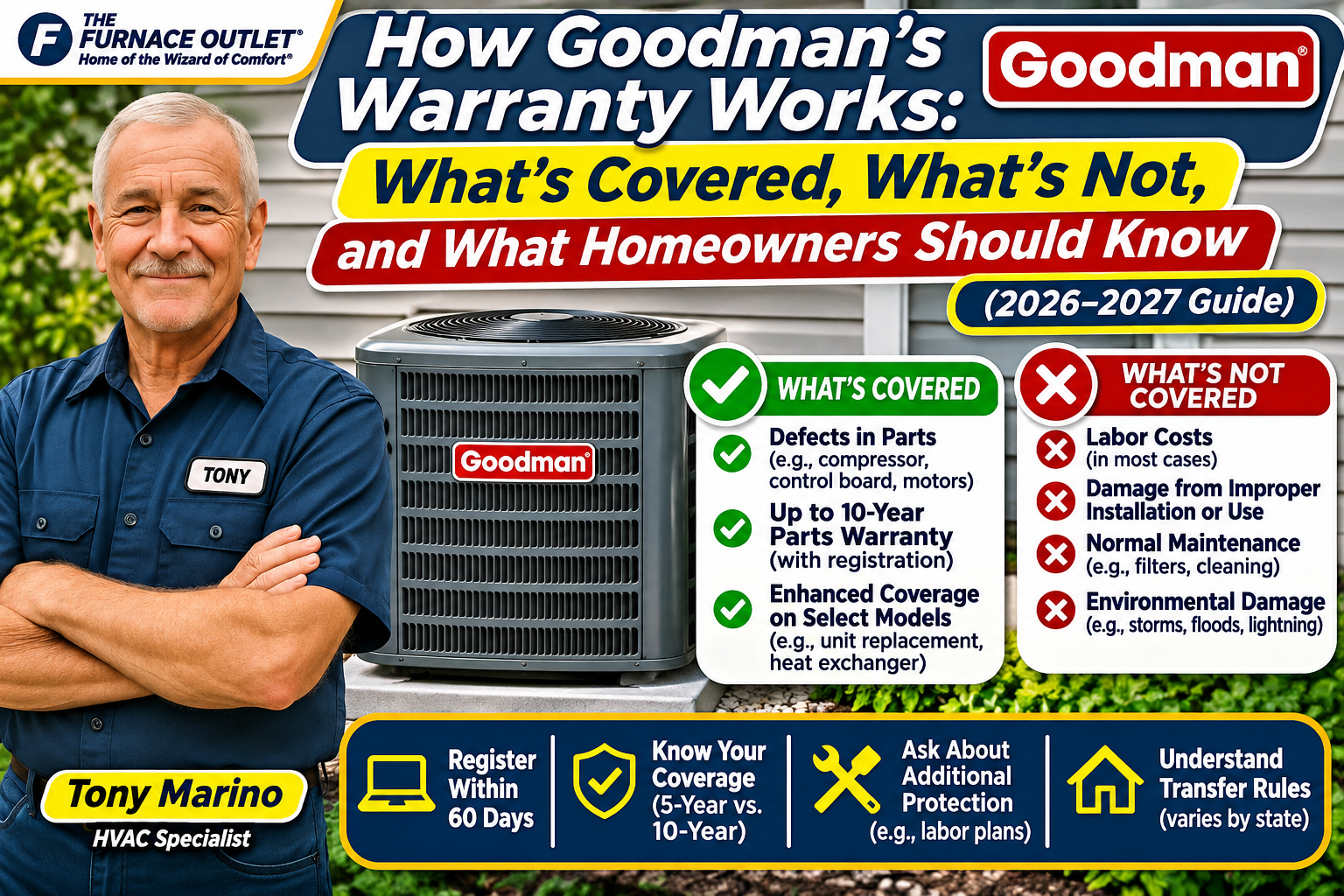
Goodman’s standard limited warranties generally protect against defects in materials or workmanship affecting covered equipment components during the applicable warranty period. For many qualifying residential air conditioners, heat pumps, and furnaces, Goodman offers a 10-year parts limited warranty when registration and other eligibility requirements are satisfied. Without qualifying registration, the standard parts warranty is commonly five years, although state-specific protections and individual warranty terms can change that outcome.
A covered component might include a compressor, fan motor, control board, contactor, or another factory-installed functional part. However, coverage depends on whether the failure meets the conditions described in the product’s warranty certificate. Goodman’s official limited warranty explanation describes how registration affects protection and why homeowners should review their exact model documentation. The important distinction is that a parts warranty generally provides an eligible replacement component. It does not automatically cover every expense associated with diagnosing, removing, or installing that component.
One of the most important things to understand is the difference between standard and enhanced warranty coverage. Many Goodman residential systems come with a five-year parts limited warranty as their baseline protection. Eligible products may qualify for a 10-year parts limited warranty when properly registered within 60 days of installation and when the other warranty conditions are met. For example, imagine you purchase a Goodman air conditioner and its control board fails during the seventh year. If your equipment qualifies for the 10-year parts warranty, the defective board may be eligible for replacement under the manufacturer’s warranty.
If the same unit only carries five-year coverage, the component may no longer be covered. Registration requirements are not identical everywhere. California, Florida, Georgia, and Quebec have protections that prevent applicable Goodman warranty benefits from being conditioned on registration for qualifying installations. This is why I recommend checking both the installation date and the warranty certificate rather than assuming every Goodman system follows the same rules.
For homeowners whose coverage depends on registration, the process should be completed promptly after installation. Goodman’s online registration generally requires the homeowner’s contact information, installation address, installation date, model and serial numbers, and installing contractor details. You can find the manufacturer’s registration information through the Goodman warranty and registration resources.
Your HVAC contractor may offer to register the system, but don’t assume the paperwork has been completed. Ask for confirmation and retain a copy with your installation invoice. I also recommend photographing the equipment nameplates because outdoor labels can become difficult to read after years of exposure to weather. Keep records for each major component, including the outdoor condenser, indoor air handler, evaporator coil, and furnace, where applicable.
Some higher-efficiency Goodman equipment has offered enhanced compressor protection, but a lifetime compressor warranty is not standard across the entire product lineup. Depending on the model and its applicable warranty certificate, enhanced coverage may involve compressor replacement or replacement of the outdoor unit following a qualifying compressor failure. The original homeowner, residence requirements, registration status, and other limitations can affect eligibility.
A lifetime warranty also doesn’t necessarily mean every expense will be paid for the rest of your life. The protection may be tied to ownership and occupancy of the original installation property. For newer equipment, including R-32 systems, don’t rely on warranty claims made for older models. Check the warranty certificate associated with the exact model being purchased. Before spending more for a premium condenser, I would ask the dealer to explain precisely what happens if the compressor fails after the standard parts warranty period.
The heat exchanger is one of the most important components in a gas furnace. It separates combustion gases from the air circulated through the home. Goodman offers enhanced heat exchanger warranties on qualifying furnace models. Depending on the equipment, these may include extended heat exchanger coverage or special unit replacement protection. However, the length and type of protection vary by furnace model and applicable warranty terms.
A qualifying heat exchanger failure does not automatically mean the homeowner receives a completely free furnace installation. Labor, additional materials, and installation modifications may still involve expenses. If a technician identifies a cracked or otherwise unsafe heat exchanger, the furnace should not continue operating until the condition has been professionally evaluated and addressed. Warranty eligibility should never take priority over combustion safety.
This is probably the most common warranty misunderstanding I encounter. Goodman’s standard manufacturer parts limited warranty generally does not include the labor required to diagnose a failure, remove the defective component, and install its replacement. Suppose a covered compressor fails after six years. The replacement component may qualify for warranty coverage, but the homeowner could still face charges for troubleshooting, labor, refrigerant handling, and other necessary work.
Depending on the repair, those expenses can be substantial. Some HVAC contractors provide separate labor warranties with new installations. Goodman also offers optional extended service arrangements through its Asure program, subject to plan terms and availability. The Goodman customer support page explains the distinction between standard warranty protection and extended service plans. Before purchasing a new system, ask whether the quoted installation includes a labor warranty, how long it lasts, and who administers it.
A manufacturer’s limited warranty is designed to address eligible product defects, not every problem that can happen to an HVAC system. Goodman identifies several common exclusions, including damage resulting from improper installation, incorrect equipment application, inadequate maintenance, incompatible components, and improper servicing.
Damage from floods, fires, lightning, severe weather, accidents, and corrosive environments is generally excluded from the manufacturer’s limited warranty. Normal maintenance, such as cleaning coils and replacing air filters, is also the homeowner’s responsibility. Electrical supply problems, certain nonapproved refrigerants, and failures caused by unsuitable accessories may fall outside coverage. Goodman’s official warranty exclusions FAQ provides additional details about circumstances that may not qualify for warranty repairs.
The key distinction is between a manufacturing defect and damage caused by outside conditions, installation problems, or neglect.
Refrigerant leaks are another area where homeowners often become confused. If a covered factory component develops a leak because of a qualifying manufacturing defect, the defective component may be eligible for replacement. However, leaks caused by damaged field-installed refrigerant piping, improper brazing, poor installation practices, or accidental damage may not qualify.
Even when a replacement coil is covered, the warranty may not pay for refrigerant, leak diagnosis, recovery, evacuation, or labor. This distinction is particularly important with modern R-32 equipment, where proper refrigerant handling and equipment compatibility are essential. If your system develops a leak, ask the technician to document its exact location and suspected cause before assuming the entire repair is covered.
Improper installation can affect warranty coverage, especially when the resulting damage is directly related to installation errors. For example, incorrect refrigerant charging, inadequate airflow, improper electrical connections, or an incompatible indoor-outdoor equipment combination may contribute to failures. If those problems cause equipment damage, the manufacturer may determine that the resulting repair is excluded.
However, homeowners should not assume that every installation imperfection automatically cancels all warranty protection. The applicable warranty language and circumstances of the failure matter. A qualified installer should follow the manufacturer’s instructions, applicable building codes, and accepted HVAC commissioning practices. I recommend keeping the original installation invoice, equipment matching information, and commissioning records. They can be useful if a warranty question arises years later.
Warranty transferability is more complicated than many homeowners realize. Certain enhanced warranty benefits may be restricted to the original registered homeowner or spouse and may depend on continued ownership and occupancy of the original residence. However, state laws can require warranty transfer rights in specific circumstances.
According to Goodman’s January 2026 warranty information, applicable warranty transfer protections exist in Florida, Georgia, and Texas for qualifying installations and property transfers.
The relevant installation dates, property transfer dates, and legal requirements vary by state. If you’re purchasing a home with an existing Goodman system, request the equipment model and serial numbers and verify the available coverage instead of relying on the seller’s statement that the unit still has a 10-year warranty.
If you’re unsure whether your equipment is still covered, begin by locating the model and serial numbers on the equipment nameplate. Next, identify the installation date and gather any available registration confirmation or purchase records. Goodman provides warranty lookup resources through its website, and an authorized dealer can help confirm the equipment’s applicable coverage.
Remember that an equipment manufacturing date is not necessarily the same as its installation date. If the manufacturer’s records appear incorrect, installation documents may help establish when the system was placed into service. For older systems, always review the warranty terms applicable to that product rather than assuming current warranty programs apply retroactively.
When a Goodman system develops a problem, the first step is to contact a qualified HVAC service provider. The technician should diagnose the failure, identify the defective component, and determine whether the issue appears to qualify for warranty consideration. The contractor can then help verify coverage and arrange the applicable manufacturer’s parts claim or replacement process.
Depending on the repair, the defective component may need to be returned or otherwise handled according to the warranty procedure. Before authorizing work, request a written explanation of what the manufacturer is expected to cover and what you will need to pay. If a claim is denied, ask for the specific reason and the warranty provision supporting that decision.
An extended service agreement may be worth considering when it provides meaningful protection against labor expenses or other costs excluded from the standard manufacturer warranty. However, not every extended plan offers the same value. Some plans cover specified parts and labor, while others contain limitations involving maintenance, deductibles, covered repairs, service providers, or transferability.
Compare the agreement’s total price with its coverage period and exclusions. Also consider the labor warranty already included by your installing contractor. For homeowners purchasing a higher-efficiency system with expensive components, additional labor protection may provide useful financial predictability. My advice is to evaluate the written agreement rather than purchasing extended coverage solely because a salesperson recommends it.
Does every Goodman air conditioner have a 10-year warranty? No. Many qualifying residential models offer 10-year parts coverage when eligibility requirements are satisfied, but actual protection depends on the model, registration rules, and applicable warranty certificate.
What happens if I forget to register my Goodman AC? Where registration is required for enhanced benefits, missing the deadline may leave the equipment with its standard warranty. Certain jurisdictions prohibit conditioning applicable coverage on registration.
Does Goodman replace the entire AC unit if the compressor fails? Some qualifying models offer enhanced unit replacement protection, but this is not universal. Check the exact warranty certificate.
Are service calls covered under the Goodman warranty? Standard parts limited warranties generally do not cover diagnostic visits or labor. Separate contractor warranties or service agreements may provide additional protection.
Does annual maintenance affect my Goodman warranty? Damage caused by improper maintenance may be excluded. Follow the manufacturer’s maintenance requirements and keep service records.
When homeowners ask me whether Goodman has a good warranty, my answer is that Goodman offers valuable protection on many models, but the details matter more than the advertising. 10-year parts warranty can save you the cost of an expensive replacement component. However, that doesn’t mean the repair will be completely free. Before buying a Goodman system, confirm the exact model’s warranty certificate, understand the registration requirements, and ask your contractor about labor coverage. If you already own Goodman equipment, verify your registration and keep your installation and maintenance records together. A good warranty is valuable, but knowing exactly how to use it is what helps protect your investment.