Newsletter Subscribe
Enter your email address below and subscribe to our newsletter

HVAC made simple
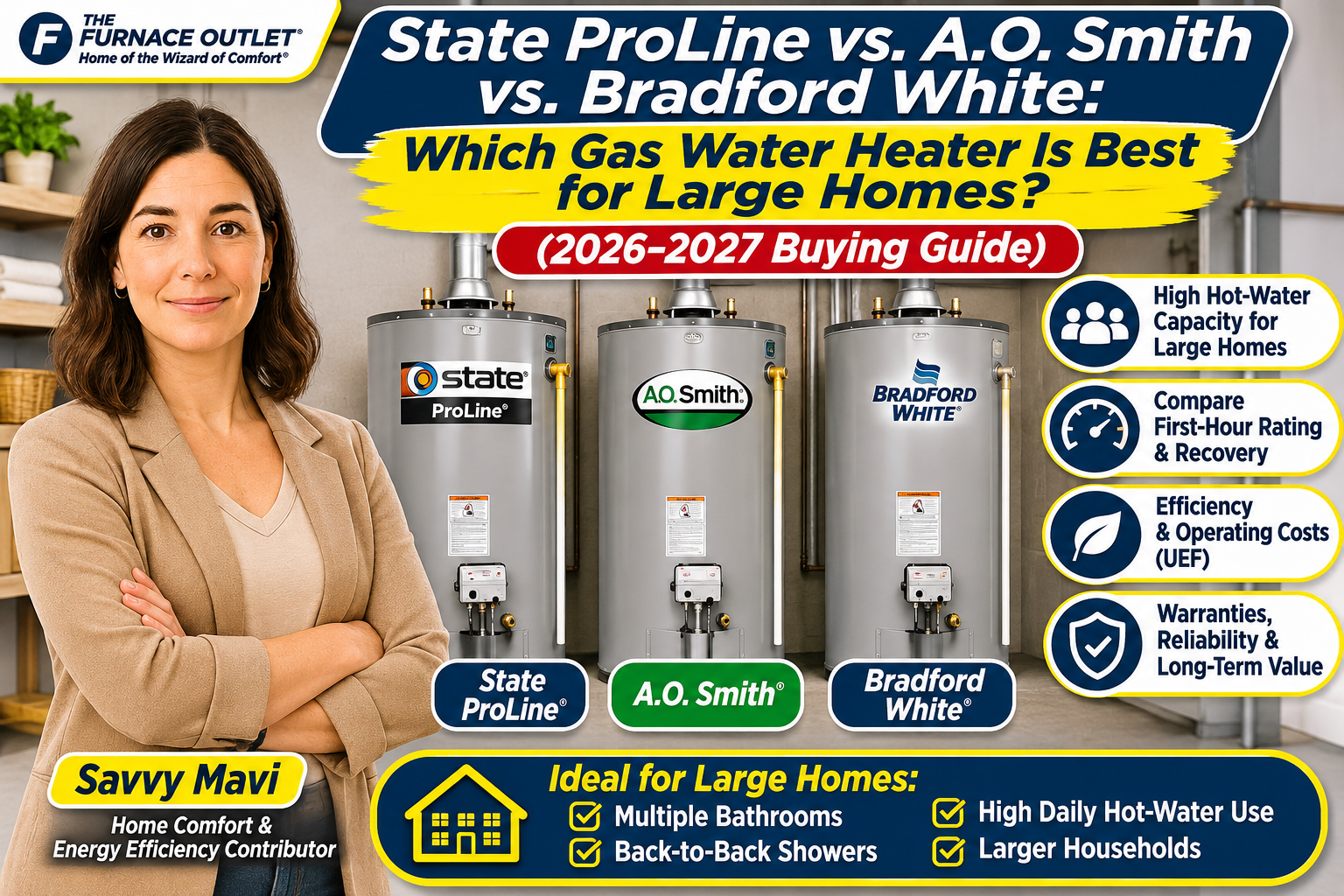
By Savvy Mavi | Home Comfort & Energy Efficiency Contributor | The Furnace Outlet | Updated November 2026
When you live in a large home, running out of hot water can quickly become frustrating. Between multiple bathrooms, back-to-back showers, laundry, dishwashing, and oversized bathtubs, your water heater may need to supply considerably more hot water than a typical household system. Three names frequently appear when homeowners compare high-capacity gas water heaters: State ProLine, A.O. Smith, and Bradford White. All three offer residential gas water-heating equipment, but their product configurations, efficiency ratings, warranties, and installation requirements vary.
One important detail often gets overlooked: State and A.O. Smith belong to the same corporate family. According to A.O. Smith’s official brand information, State is part of its water-heating portfolio. This means the comparison isn’t between three entirely independent manufacturers. For a large household, the most important questions are how much hot water the heater can deliver during peak demand, how quickly it recovers, and how efficiently it operates.
State ProLine water heaters are designed primarily for professional installation and distribution. The lineup includes conventional atmospheric-vent, power-vent, and other gas-fired configurations, depending on the product family. For large homes, selected high-capacity models offer larger storage tanks and higher burner inputs than standard residential heaters. These features can help support simultaneous showers and frequent hot-water use. State’s biggest advantage is its range of contractor-oriented equipment. A qualified plumber can recommend a model based on the home’s plumbing configuration, available gas supply, and hot-water demand.
However, the ProLine name alone doesn’t guarantee exceptional performance. A basic 50-gallon model may deliver considerably less hot water than a high-input 75-gallon configuration. Homeowners should compare the actual first-hour rating, recovery capacity, efficiency, and warranty of the specific model being quoted.
A.O. Smith is one of North America’s established water-heating manufacturers, offering conventional storage heaters, high-efficiency gas systems, tankless models, and other water-heating technologies. Its residential ProLine family includes different performance tiers designed for varying household requirements. For large homes, A.O. Smith’s broader selection can be useful because homeowners may choose between higher-capacity storage systems and high-efficiency alternatives.
The manufacturer’s residential water heater selection guide provides information about available configurations and explains the differences between storage and tankless water heating. One potential advantage is the availability of high-efficiency equipment that can reduce fuel consumption compared with conventional gas storage models.
However, these systems may cost more initially and require specialized venting or condensate drainage. Since State and A.O. Smith share corporate ownership, I wouldn’t assume one brand automatically offers better construction or reliability. Comparing individual models is much more meaningful.
Bradford White takes a particularly contractor-focused approach to water heater distribution and installation. The company manufactures residential and commercial water-heating equipment, including conventional gas storage heaters and higher-performance configurations. Its residential gas lineup includes models with different venting arrangements, burner capacities, and recovery characteristics.
For homeowners with large families, Bradford White’s higher-input gas models can provide strong first-hour delivery when properly sized. Bradford White also emphasizes professional installation and established plumbing distribution networks. This can be valuable when future servicing or replacement parts are required. You can explore the company’s product families through the official Bradford White website.
The main limitation is that availability and installation pricing depend heavily on local plumbing contractors. You may have fewer opportunities to purchase the equipment independently compared with some retail-oriented water heater brands.
A common mistake is choosing a water heater based entirely on its storage capacity. A 75-gallon heater sounds more powerful than a 50-gallon heater, but tank size alone doesn’t tell the whole story. The first-hour rating, or FHR, estimates how much hot water a fully heated storage water heater can deliver during an hour of heavy use.
This figure accounts for both stored hot water and the heater’s ability to replenish it. For example, a high-input 50-gallon gas heater may deliver more hot water during the first hour than a lower-input 75-gallon model. The U.S. Department of Energy’s water heater sizing guidance recommends selecting a storage water heater with a first-hour rating that meets the household’s peak-hour demand.
For large homes, this is one of the most useful specifications to compare across State, A.O. Smith, and Bradford White.
Consider a five-person household with three bathrooms. During a busy morning, several people may shower while someone uses hot water in the kitchen. If three showers each consume approximately 15 gallons of mixed water, the household could use 45 gallons during that period. However, not all of that water comes directly from the hot-water tank. Shower water is typically mixed with cold water, so actual hot-water demand depends on the water-heater temperature, incoming cold-water temperature, and shower settings.
Laundry, dishwashing, and large bathtubs can increase demand further. A household with six or more occupants, multiple simultaneous showers, or a large soaking tub may require substantially greater capacity. Rather than assuming every large home needs a 75- or 100-gallon tank, calculate peak-hour hot-water demand and compare it against manufacturer-rated first-hour delivery.
All three brands offer gas water heaters suitable for demanding residential applications, but performance depends on the exact equipment. State ProLine offers professionally distributed storage models with different burner inputs and tank capacities. A.O. Smith provides a similarly broad range, including conventional and higher-efficiency equipment.
Bradford White offers contractor-supplied gas models with several recovery and venting configurations. The biggest performance differences often come from burner input, recovery rate, storage capacity, and operating efficiency rather than the brand name. A 75,000-BTU-per-hour gas heater can generally recover hot water faster than a similarly efficient 40,000-BTU-per-hour model, assuming comparable operating conditions. For a large household, faster recovery may be more valuable than simply purchasing the largest tank available.
Energy efficiency is particularly important when a large family uses substantial quantities of hot water every day. Conventional gas storage water heaters lose some heat through the tank and venting system, even when no hot water is being used. High-efficiency condensing gas systems can recover more heat from combustion gases, reducing fuel consumption under suitable operating conditions.
The Uniform Energy Factor, or UEF, helps homeowners compare the rated efficiency of water heaters within the appropriate usage category. A higher UEF generally indicates better rated energy performance, although actual savings depend on hot-water consumption, installation conditions, and local fuel prices. State, A.O. Smith, and Bradford White each offer different efficiency levels across their product ranges.
For a household with heavy daily hot-water consumption, the long-term energy savings from a higher-efficiency model may help justify its additional installation cost.
Homeowners often ask which of these brands will last the longest. Unfortunately, there isn’t reliable evidence supporting a universal lifespan ranking across all models. Water quality, installation workmanship, operating temperature, maintenance, and usage patterns strongly influence service life. Storage water heaters typically use protective tank linings and sacrificial anode rods to reduce corrosion.
In areas with hard water, mineral buildup can reduce performance and increase maintenance requirements. Regular inspection, appropriate flushing where recommended, and timely anode maintenance can help protect the system. A properly installed midrange heater may outperform an expensive premium model that receives little maintenance.
I would prioritize water quality, service access, and local technician expertise over unsupported claims that one brand always lasts longer.
Warranty terms vary considerably across these manufacturers and their individual product lines. Some residential models carry six-year limited tank warranties, while selected higher-tier products may offer longer coverage. However, a longer tank warranty doesn’t necessarily mean labor, diagnostic visits, or all installation expenses are included.
Before purchasing, review the actual warranty certificate and ask whether the installer provides additional labor protection. The ENERGY STAR water heater guidance also helps homeowners evaluate energy-efficient alternatives and understand why operating expenses matter alongside the purchase price. For a large home, a more expensive but efficient system may deliver better long-term value when hot-water consumption is consistently high.
The final installed price depends on far more than the equipment itself. A high-capacity gas water heater may require changes to gas piping, venting, drainage, electrical connections, or the installation space. Replacing an existing atmospheric-vent heater with a similar approved model may be relatively straightforward. Switching to a condensing power-vent system can involve additional installation work.
Large tanks also require adequate floor space, structural support, and service access. Ask contractors for complete written quotations that identify the equipment model, installation materials, labor, permits, warranty coverage, and any required modifications. Comparing complete installed costs is much more useful than comparing equipment prices alone.
For a large household with predictable daily hot-water demand, I would start by comparing high-recovery storage models from all three brands. State ProLine is worth considering when a trusted local plumber recommends an appropriately sized model and provides strong installation support. A.O. Smith may be particularly attractive when the homeowner wants a wider selection of conventional and high-efficiency configurations.
Bradford White is a strong candidate when a qualified plumbing contractor offers an appropriate high-input model with dependable local service. My preference would be the system with the best combination of verified first-hour delivery, suitable recovery capacity, efficiency, installation quality, and total ownership cost. I would not pay a substantial premium solely for a brand name.
Is State ProLine better than A.O. Smith? Neither is universally better. Both belong to the A.O. Smith corporate family, and individual specifications, pricing, and contractor support matter more than the label.
Is Bradford White better for large families? Bradford White offers models suitable for large households, but the correct choice depends on first-hour rating, recovery capacity, and the home’s actual hot-water demand.
Is a 75-gallon gas water heater enough for six people? It may be, particularly with a high-input burner, but simultaneous showers and large bathtub usage can increase demand. Calculate peak-hour requirements before selecting capacity.
Should I choose a tankless heater instead? Tankless equipment may provide extended hot-water delivery, but simultaneous fixture demand, incoming water temperature, gas supply capacity, and installation costs must be evaluated.
When choosing a gas water heater for a large home, I recommend looking beyond brand reputation and tank capacity. Start with the number of occupants, bathrooms, simultaneous showers, and peak-hour hot-water usage. Then compare the first-hour ratings, recovery capacities, and efficiency specifications of the actual models being offered.
State ProLine, A.O. Smith, and Bradford White are all credible choices when properly matched to the application. For my money, the best water heater is the one that reliably supplies enough hot water during your busiest hour without creating unnecessary installation or operating expenses.