Newsletter Subscribe
Enter your email address below and subscribe to our newsletter

HVAC made simple
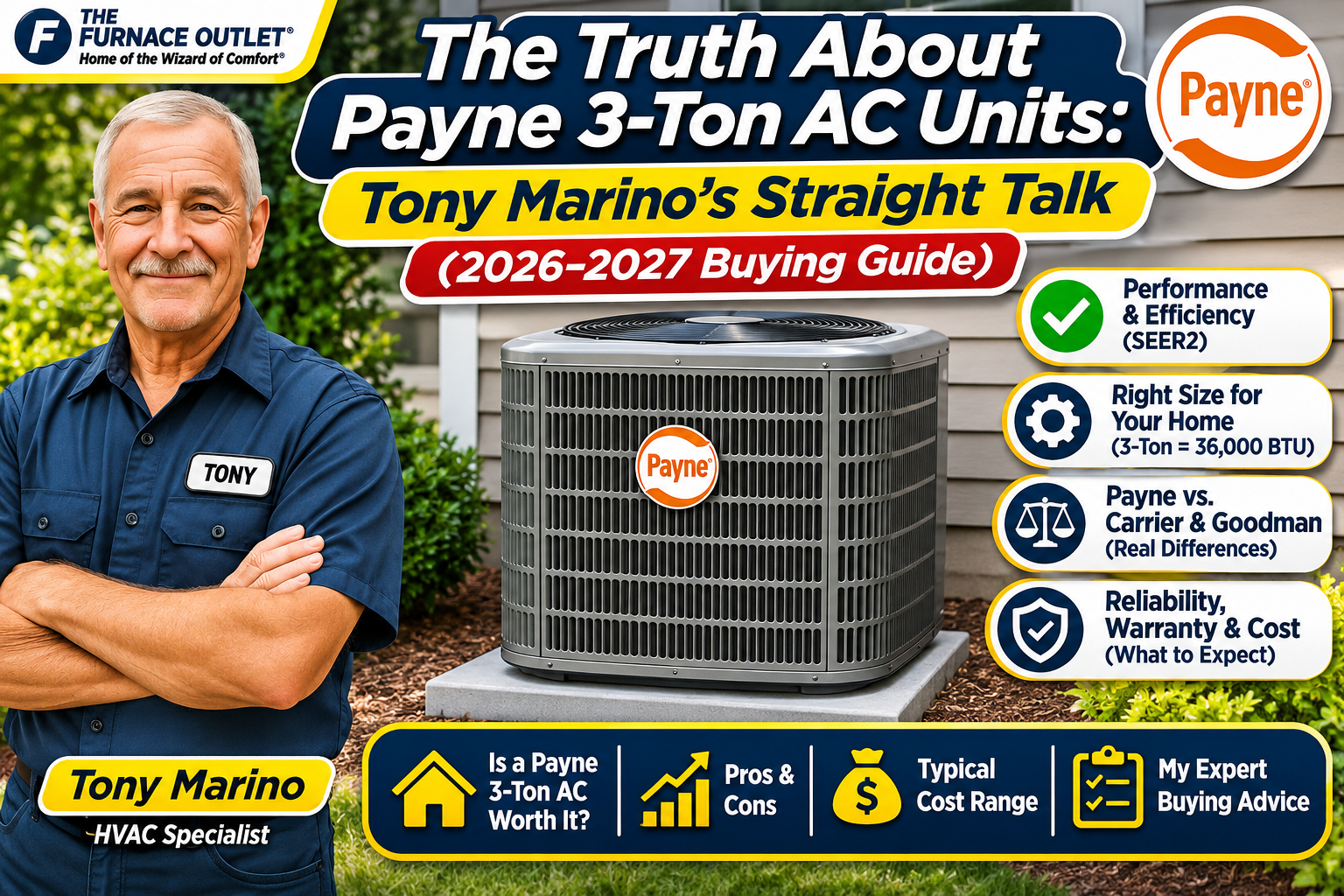
By Tony Marino | The Trusted HVAC Tech | The Furnace Outlet | Updated November 2026
When homeowners shop for a new central air conditioner, the conversation usually starts with familiar names like Carrier, Trane, Lennox, or Goodman. Payne doesn’t always get the same attention, but that doesn’t mean it should be overlooked. I’ve spent years working around residential heating and cooling equipment, and one thing I’ve learned is that a recognizable brand name doesn’t automatically guarantee better comfort or fewer repairs. Sometimes a straightforward, properly installed air conditioner can deliver exactly what a homeowner needs without the additional cost of premium features.
That’s where Payne enters the conversation. Payne focuses on relatively straightforward residential cooling equipment rather than an extensive lineup of high-end communicating systems. Its products are associated with Carrier’s broader manufacturing organization, which gives the brand an established industry background. But here’s the important question: Is a Payne 3-ton AC actually a smart purchase, or are you sacrificing too much performance to save money? Let’s look at what you’re getting, what you’re not getting, and when I’d recommend considering one.
A 3-ton central air conditioner has a nominal cooling capacity of approximately 36,000 BTU per hour. The word ton describes cooling capacity, not the equipment’s physical weight. Payne offers residential split-system air conditioners in different capacities, including nominal 3-ton configurations in applicable product families. A typical system includes an outdoor condensing unit, an indoor evaporator coil, refrigerant piping, a compatible indoor blower, and a thermostat.
The outdoor unit removes heat from the refrigerant and releases it outside, while the indoor coil absorbs heat from the air circulating through your home. Payne’s official residential air conditioner information provides an overview of its cooling equipment and available product configurations. One thing homeowners need to understand is that the outdoor unit alone doesn’t determine the complete system’s performance. Efficiency, delivered capacity, and proper operation depend on the approved combination of indoor and outdoor components.
Payne is part of Carrier’s family of HVAC brands, which is one reason many contractors consider it a legitimate alternative to more expensive equipment. However, this doesn’t mean a Payne air conditioner is identical to a premium Carrier model. Manufacturers frequently offer different product tiers with varying compressors, controls, sound-reduction features, cabinets, and efficiency ratings.
Payne generally concentrates on value-oriented systems that provide essential cooling performance without every advanced feature found in higher-priced equipment. For homeowners who want dependable basic cooling, that approach can make sense. I wouldn’t buy a Payne simply because it shares a corporate connection with Carrier, though. I’d judge the specific equipment on its efficiency rating, warranty, installation requirements, serviceability, and complete installed price.
Efficiency is one of the most important factors when comparing central air conditioners, especially in regions with long, hot summers. Modern air conditioners use SEER2 ratings to describe seasonal cooling efficiency under updated testing procedures. Higher SEER2 ratings generally indicate lower electricity consumption for the same amount of delivered cooling under standardized conditions. Payne’s efficiency ratings vary by model and matched indoor equipment. Some configurations emphasize basic efficiency and affordability, while other combinations may provide better seasonal performance.
The U.S. Department of Energy’s central air conditioning guide explains how cooling efficiency, installation quality, and equipment selection influence energy consumption. For example, replacing an older system rated at 10 SEER with a newer, substantially more efficient system can reduce cooling electricity use under comparable conditions. However, don’t assume the advertised efficiency of an outdoor unit is the rating your installation will achieve. Ask your contractor for the complete AHRI-certified matched-system rating, including the indoor coil and furnace or air handler. That’s the number worth comparing.
A common rule of thumb suggests that one ton of cooling serves approximately 400–600 square feet, but I strongly discourage using that estimate as your only sizing method. A 3-ton air conditioner might be suitable for some homes around 1,500–1,800 square feet, but it could be oversized or undersized for another home of similar size. Insulation, window area, ceiling height, air leakage, climate, ductwork, and indoor heat gains all affect the actual cooling requirement. A well-insulated home in a moderate climate may need less cooling capacity than a poorly insulated house in Arizona or Texas.
The correct approach is a residential cooling-load calculation using an accepted methodology such as ACCA Manual J. If a contractor recommends a 3-ton system without evaluating your home’s cooling load, ask how that capacity was determined. Oversizing can create short cycling, uneven temperatures, and inadequate humidity control. Undersizing can leave the system struggling during peak heat. Getting the capacity right matters more than choosing a famous logo.
Since Payne and Carrier are associated with the same manufacturer, homeowners naturally wonder whether buying Payne is simply a cheaper way to get Carrier equipment. The answer is more complicated. Carrier offers a broader selection of premium systems, including models with variable-speed technology, advanced comfort controls, and higher efficiency ratings. Payne generally focuses on simpler equipment configurations intended to provide essential cooling performance at a competitive price.
A basic Payne system may deliver satisfactory cooling in a properly insulated home with reasonably balanced ductwork. A premium Carrier system may provide advantages in sound levels, temperature consistency, humidity management, and energy efficiency, depending on the exact model. But premium features come at a price. If your home has straightforward cooling needs and your budget is limited, the additional cost of a sophisticated system may not always be justified. If you live in a very humid climate, have significant comfort problems, or place a high value on quiet operation, a higher-tier system deserves consideration.
Goodman is another major name in the value-oriented central air conditioning market. Both Goodman and Payne offer systems designed for homeowners who want practical cooling without necessarily paying premium-brand prices. Goodman has a broad range of residential cooling products, while Payne emphasizes straightforward equipment and established contractor distribution. Neither manufacturer can honestly be declared more reliable across every model and installation.
I’ve seen expensive systems develop problems because of poor workmanship, and I’ve seen relatively inexpensive equipment operate successfully for years when installed correctly. The important comparison involves the specific matched system, local contractor expertise, warranty coverage, parts availability, and installation quality. If two contractors offer similar Payne and Goodman systems, I’d compare the written quotations line by line rather than automatically choosing the lower equipment price.
Noise is an important consideration when the outdoor condenser sits near a bedroom, patio, or neighboring property. Payne’s simpler systems may not include the same acoustic treatments or variable-speed operation found on premium air conditioners. However, actual sound levels vary by model, capacity, installation location, and operating conditions. A properly installed unit on a stable base with suitable clearances can perform noticeably better than equipment placed in a restrictive or vibration-prone location.
Before purchasing, compare the manufacturer’s published sound ratings for the exact models under consideration. If quiet operation is a top priority, ask your contractor to demonstrate how the Payne system compares with higher-tier alternatives.
Refrigerant selection has become particularly important as the HVAC industry transitions toward lower-global-warming-potential alternatives. New residential air conditioning systems are increasingly designed around refrigerants such as R-454B and R-32, depending on the manufacturer and product. Payne’s refrigerant specification must be verified using the exact model number and current product documentation. Older Payne systems may use R-410A, while newer equipment may use a lower-GWP refrigerant.
The U.S. Environmental Protection Agency’s HFC phasedown information explains the broader regulatory transition affecting residential cooling equipment. Homeowners should understand that refrigerants aren’t interchangeable. A system designed for one refrigerant cannot simply be filled with another without an approved equipment design and procedure.
A qualified HVAC technician should handle refrigerant-related installation, service, and repairs.
Reliability is probably the biggest concern homeowners have when considering a budget-oriented air conditioner. Payne benefits from established HVAC manufacturing and distribution support, but that doesn’t guarantee every system will deliver the same service life. The compressor, fan motor, electrical components, refrigerant circuit, and installation conditions all influence long-term performance.
Poor airflow, incorrect refrigerant charge, contaminated refrigerant piping, and inadequate ductwork can shorten the life of almost any air conditioner. In my experience, installation quality is one of the most important factors homeowners can control. A carefully installed Payne system with proper airflow, correctly matched components, and regular maintenance may be a better investment than a premium unit installed carelessly. That doesn’t mean all brands or models are equal. It means reliability should be evaluated through equipment specifications, installation practices, and service support rather than marketing claims alone.
The cost of a Payne 3-ton central air conditioner depends on the model, regional labor rates, installation complexity, and whether the indoor equipment also needs replacement. For preliminary budgeting, a conventional 3-ton central AC replacement may fall somewhere around $4,000–$8,000 installed in many U.S. markets, although individual quotations can fall outside that range. This is a broad planning estimate, not a verified national Payne-specific price.
A straightforward outdoor condenser and coil replacement may cost less than a complete installation requiring a new air handler, ductwork modifications, electrical upgrades, or refrigerant-line replacement. The lowest quotation isn’t necessarily the best value. Ask for a written proposal that identifies the outdoor model, indoor coil, certified efficiency rating, labor scope, warranty, permit costs, and any required ductwork corrections. Comparing complete installations gives you a much clearer picture than comparing advertised condenser prices.
Warranty coverage is another area where homeowners should pay close attention to the details. Eligible Payne residential air conditioners commonly offer limited parts warranty protection, with longer coverage potentially available when applicable registration requirements are satisfied. The exact duration and conditions depend on the model, installation date, ownership, and warranty certificate.
A manufacturer’s parts warranty generally doesn’t mean every repair will be free. Labor, diagnostic charges, refrigerant, and certain installation-related expenses may remain the homeowner’s responsibility. Before purchasing, review Payne’s official warranty information and confirm the coverage associated with your exact equipment. I also recommend asking your installer whether they provide a separate labor warranty. That protection can be particularly valuable during the first few years of ownership.
The biggest advantage of Payne is its relatively straightforward approach to central cooling. Homeowners can obtain equipment from an established HVAC manufacturer without necessarily paying for sophisticated controls and premium comfort features they may not need. Payne can be particularly appealing for budget-conscious homeowners replacing an aging central air conditioner in a house with properly designed ductwork.
The trade-off is that its value-oriented models may offer fewer advanced comfort features, lower maximum efficiency, and less refined sound performance than premium alternatives. That doesn’t make Payne a poor choice. It simply means the equipment should be matched to the homeowner’s expectations. Someone looking for basic, dependable cooling may be satisfied with Payne. Someone prioritizing exceptionally quiet operation, precise humidity control, or maximum efficiency may benefit from comparing higher-tier systems.
I would seriously consider a Payne 3-ton system for a homeowner whose cooling-load calculation supports approximately 36,000 BTU per hour of nominal capacity, whose existing ductwork is suitable, and who wants a conventional central cooling system without unnecessary complexity. It can also make sense for homeowners who plan to remain in their property for several years but don’t want to invest heavily in premium features.
However, I would look more closely at other options if the home experiences major temperature differences between rooms, has significant humidity problems, or requires unusually quiet operation. Those problems may involve ductwork, insulation, or equipment sizing, so purchasing a more expensive air conditioner alone won’t necessarily solve them.
Is Payne a good air conditioner brand? Payne is an established value-oriented HVAC brand associated with Carrier. Its equipment can be a reasonable choice when properly sized, professionally installed, and maintained. Reliability depends on the specific model and installation conditions.
Is Payne the same as Carrier? Payne and Carrier belong to the same broader HVAC manufacturing organization, but their equipment lines aren’t necessarily identical. Carrier offers more premium configurations, while Payne generally emphasizes straightforward cooling equipment.
How many square feet will a Payne 3-ton AC cool? There is no universally accurate square-footage figure. A 3-ton unit may serve some homes around 1,500–1,800 square feet, but climate, insulation, windows, and other factors can change the requirement significantly. A Manual J calculation is the appropriate starting point.
How long should a Payne air conditioner last? Many residential central air conditioners provide roughly 10–15 years or more of service, but this is not a guaranteed Payne-specific lifespan. Climate, usage, maintenance, installation quality, and component failures all influence replacement timing.
Is a Payne AC cheaper than Carrier? Comparable value-oriented Payne systems may have lower purchase prices than premium Carrier models. However, the total installed price depends on equipment specifications, contractor pricing, and installation requirements.
Should I replace my furnace when installing a Payne 3-ton AC? Not necessarily. Your contractor should verify that the existing furnace blower, evaporator coil, controls, and ductwork are compatible with the proposed system. Replacing the furnace may be appropriate if it is aging or incompatible, but it isn’t automatically required.
If you’re considering a Payne 3-ton air conditioner, my advice is simple: don’t dismiss it because it isn’t a premium brand, and don’t buy it just because the price looks attractive. Payne can be a sensible choice for homeowners who want conventional central cooling from an established manufacturer. Its biggest appeal is straightforward equipment without the expense of every advanced comfort feature. But the brand name isn’t what keeps your house comfortable during a heatwave. Proper sizing, correct airflow, compatible indoor equipment, careful refrigerant-system installation, and dependable contractor support make the real difference.
Before signing a contract, ask for a Manual J cooling-load calculation, the complete matched-system efficiency rating, written warranty terms, and a detailed installation proposal. If a Payne 3-ton system meets your home’s cooling requirements and comes with a well-executed installation at a competitive price, I would have no objection to considering it. Just remember that the best air conditioner isn’t always the most expensive or the cheapest. It’s the one that delivers the comfort your home needs at a price that makes sense over its working life.