Newsletter Subscribe
Enter your email address below and subscribe to our newsletter

HVAC made simple
By Jake Lawson | Jake the HVAC Specialist, The Furnace Outlet
Updated: November 2026
If you’re shopping for a new central air conditioner, there’s a good chance somebody has recommended a 3-ton unit. Maybe your neighbor has one, your previous system was 3 tons, or a contractor took one look at your house and said that’s what you need.
Here’s what I want you to understand before spending thousands of dollars: a 3-ton air conditioner isn’t automatically the right choice just because your home falls within a certain square-footage range. I’ve spent more than a decade working with residential and commercial HVAC systems, and I’ve seen homeowners waste serious money on equipment that was too large, too small, or installed incorrectly. A properly selected 3-ton system can deliver excellent comfort, reasonable operating costs, and years of reliable cooling. But the equipment has to match your home’s cooling load, ductwork, climate, and actual usage patterns. Let’s separate the useful facts from the sales pitches.
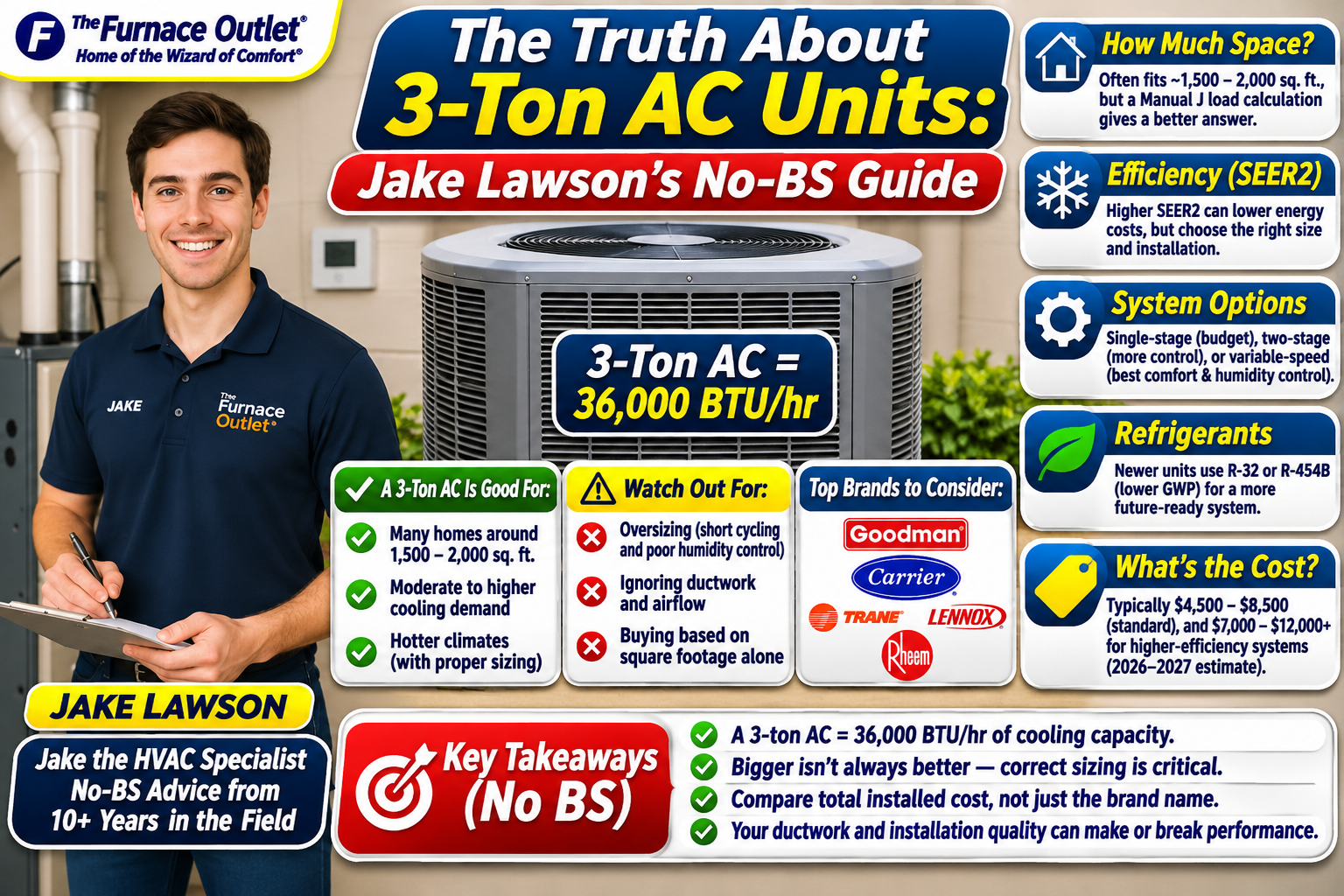
A 3-ton air conditioner has a nominal cooling capacity of 36,000 British thermal units (BTUs) per hour. One ton of cooling equals 12,000 BTU per hour, so multiplying that by three gives you 36,000 BTU per hour. The word ton has nothing to do with the equipment’s physical weight. It’s simply an industry measurement of cooling capacity. Most residential 3-ton central air conditioners use a split-system configuration. An outdoor condenser works with an indoor evaporator coil and a furnace blower or air handler to remove heat and moisture from your home.
However, 36,000 BTU per hour is a nominal capacity. Actual delivered cooling varies with outdoor temperature, indoor conditions, airflow, and the matched equipment combination. This distinction matters because the capacity printed on a product label isn’t always the exact amount of cooling your home receives under real operating conditions.
You’ll frequently see claims that a 3-ton air conditioner is suitable for approximately 1,500–2,000 square feet. That may describe some homes, but it’s not a dependable sizing formula. A well-insulated house with efficient windows, limited air leakage, and good attic insulation may need considerably less cooling than an older house of the same size.
Likewise, a home in Phoenix faces different cooling demands from a similar property in Seattle. Solar exposure, ceiling height, insulation quality, occupancy, and duct location all influence the cooling load. I wouldn’t recommend purchasing a 3-ton AC based on square footage alone. A contractor should perform an ACCA Manual J calculation and use the results to select appropriately sized equipment. The U.S. Department of Energy’s HVAC sizing guidance explains why relying on general rules of thumb can lead to oversized equipment, higher costs, and poor comfort.
One of the most persistent HVAC myths is that a larger air conditioner cools better. An oversized system may lower the thermostat temperature quickly, but that doesn’t necessarily mean your home will feel comfortable. Traditional single-stage equipment that’s too large may shut off before it has removed enough indoor humidity. The result can be a house that feels cold and clammy rather than comfortably cool.
Frequent starts and stops can also increase equipment wear and reduce operating efficiency. In some homes, temperature differences between rooms become more noticeable because the system doesn’t run long enough to distribute conditioned air effectively. An undersized unit creates different problems. It may run almost continuously during extreme weather and struggle to maintain the desired temperature. Variable-capacity systems can tolerate a wider range of loads, but they still need proper design and sizing.
The goal isn’t to buy the biggest unit you can afford. It’s to select the capacity and operating characteristics that match your home.
A single-stage 3-ton air conditioner runs its compressor at one fixed operating stage. It’s generally the least expensive option and can work very well in homes with straightforward cooling needs. A two-stage system provides more than one level of cooling output. During milder weather, it can operate at reduced capacity, potentially improving temperature stability and humidity control. Variable-capacity systems adjust compressor output across a broader range. They can maintain more consistent indoor temperatures and may operate more quietly during low-demand periods.
The trade-off is cost and complexity. Advanced equipment generally requires a higher initial investment and may use more sophisticated controls and replacement components. If your budget is limited and your home has a relatively simple cooling load, I wouldn’t dismiss a properly installed single-stage system. If humidity, noise, or temperature swings are ongoing problems, I would seriously consider a variable-capacity option.
SEER2 stands for Seasonal Energy Efficiency Ratio 2. It measures seasonal cooling efficiency under updated testing conditions. A higher SEER2 rating generally means the system can deliver more cooling for each unit of electricity consumed under standardized conditions. For example, suppose two otherwise comparable systems have ratings of 14.3 SEER2 and 17 SEER2. Using a simplified efficiency comparison, the 17 SEER2 system could require approximately 16% less cooling electricity for the same seasonal cooling output.
That’s a theoretical comparison, not a guaranteed reduction in your utility bill. Actual savings depend on climate, installation, operating hours, ductwork, and thermostat settings. I recommend checking both SEER2 and EER2, particularly in very hot climates. EER2 provides another useful perspective on efficiency at specified operating conditions. The ENERGY STAR central air conditioner specifications explain how these efficiency measurements are defined.
Homeowners often ask me to name the single best 3-ton AC brand. The answer is more complicated than most salespeople make it sound. Goodman is commonly associated with affordable equipment and straightforward cooling performance. Carrier offers multiple product tiers, including systems with advanced comfort controls. Trane emphasizes equipment engineering and durability, while Lennox offers a range of standard and premium high-efficiency options. Rheem also provides competitive systems across several efficiency levels.
Every manufacturer has basic models and more sophisticated equipment, so comparing brands without comparing specific models can be misleading. A properly installed entry-level air conditioner from one manufacturer may provide better real-world performance than an expensive unit installed with incorrect airflow or refrigerant charge. I would compare the actual equipment model, certified efficiency, sound rating, warranty terms, local service availability, and total installed price. Don’t pay a large premium simply because a brand name sounds impressive.
For 2026–2027, many new residential air conditioners use lower-global-warming-potential refrigerants such as R-32 and R-454B instead of the previously common R-410A. Both R-32 and R-454B belong to the A2L refrigerant safety classification, which means they are mildly flammable under specified testing conditions. Equipment using these refrigerants incorporates applicable safety design requirements. Goodman and some other manufacturers use R-32 in selected product lines, while Carrier, Trane, and other brands offer systems using R-454B.
Neither refrigerant automatically makes an air conditioner better or worse. The equipment’s overall design, certified efficiency, and installation quality remain more important to everyday performance. What matters is that the indoor and outdoor components are compatible and that the installer follows the manufacturer’s requirements for the specific refrigerant. Never assume an existing R-410A indoor coil can simply be connected to a new R-32 or R-454B outdoor unit.
For general U.S. budgeting, a straightforward professionally installed 3-ton central air conditioner replacement may cost approximately $4,500–$8,500, depending on the brand, efficiency, labor market, and existing system configuration. Higher-efficiency two-stage or variable-capacity systems may cost approximately $7,000–$12,000 or more when compatible indoor equipment and installation work are included.
These are illustrative planning ranges, not verified national averages or binding contractor quotations. Regional prices and project complexity can produce substantial differences. The outdoor condenser is only part of the expense. Your quotation may also include a matched indoor evaporator coil, refrigerant piping modifications, electrical work, condensate drainage, permits, and labor.
If the furnace or air handler needs replacement, or if the ductwork requires substantial modification, the total can increase considerably. I recommend obtaining multiple itemized quotes and making sure each contractor is pricing equivalent equipment and installation work.
A homeowner might see an attractive online price for a 3-ton outdoor condenser and assume the complete installation should cost only slightly more. Unfortunately, that’s not how most central AC projects work. A new system may require a compatible evaporator coil, refrigerant-line changes, a new disconnect, electrical circuit modifications, condensate safety devices, or updated duct connections.
Older homes may have undersized return ducts or restrictive supply systems that prevent a new unit from delivering its rated performance. The contractor may also need to recover the existing refrigerant, remove old equipment, obtain permits, and complete startup testing. None of these costs should be hidden. Ask the installer to explain the full scope before approving the work.
Here’s something I wish more homeowners understood: replacing the outdoor condenser won’t fix a poorly designed duct system. A nominal 3-ton air conditioner often operates near 1,200 cubic feet per minute of airflow under conventional design assumptions, but the actual target depends on the equipment, climate, and manufacturer’s instructions. If the ductwork can’t deliver the required airflow, cooling performance can suffer. Rooms may remain uncomfortable, efficiency can decline, and the indoor coil may experience problems.
A good contractor should evaluate supply and return airflow, external static pressure, filter restrictions, and duct leakage before recommending equipment. The ENERGY STAR HVAC quality installation guidance emphasizes proper sizing, airflow, and refrigerant charge as essential parts of an effective installation. I would rather see a homeowner spend money correcting serious airflow problems than purchase a premium AC that can’t perform properly because of the ducts.
A 3-ton air conditioner doesn’t consume 36,000 watts of electricity. Its 36,000-BTU rating represents cooling output, not electrical input. Actual power consumption depends on efficiency, operating conditions, compressor speed, and the indoor blower. For illustration, if a complete AC system averages 3 kilowatts of electrical demand while operating, six hours of equivalent full-load operation would consume approximately 18 kilowatt-hours.
At an electricity rate of $0.16 per kilowatt-hour, that would cost approximately $2.88 for the day. Over 30 similar days, the estimated electricity cost would be around $86.40. This is a simplified example rather than a prediction of actual seasonal energy use. A variable-capacity system may operate for more hours at reduced power, while a single-stage unit cycles between full output and off. That’s why operating hours alone don’t tell you which system will cost less. For a meaningful estimate, compare certified efficiency ratings, local electricity prices, and the home’s expected seasonal cooling demand.
A residential central air conditioner may last roughly 12–20 years, although actual service life varies significantly. Equipment in coastal areas may experience more corrosion, while systems in extremely hot climates can accumulate substantial operating hours. Installation quality, maintenance, electrical conditions, and airflow restrictions also influence longevity.
Regular filter replacement, clean coils, unobstructed outdoor airflow, and periodic professional maintenance can help prevent avoidable problems. If your existing system is approaching 15 years old and requires an expensive compressor or coil repair, I would compare repair costs with replacement rather than automatically investing more money in aging equipment.
Not automatically. An existing 3-ton air conditioner doesn’t prove your home needs 3 tons of cooling. The original installer may have oversized the system, or your home’s insulation, windows, and air sealing may have changed since installation. If you’ve experienced short cycling, uneven temperatures, high humidity, or unusually high electricity bills, those symptoms deserve investigation before selecting the replacement capacity.
A professional load calculation can help determine whether the correct choice is 2.5 tons, 3 tons, 3.5 tons, or another configuration. Equipment selection should then account for actual performance at local design conditions and the available capacity increments.
Is a 3-ton air conditioner enough for a 2,000-square-foot house?
It might be, but a 2,000-square-foot home could need more or less than 3 tons depending on its location, insulation, windows, air leakage, and layout. A properly performed Manual J calculation is more reliable than using square footage alone. I would never guarantee that 3 tons is appropriate without evaluating the home.
Is a 3-ton AC better than a 2.5-ton AC?
Neither size is inherently better. A 3-ton system provides greater nominal cooling capacity, but that additional capacity is only useful when the home requires it. If the cooling load is lower, a properly selected 2.5-ton system may deliver better comfort and humidity control, especially compared with an oversized single-stage 3-ton unit.
Is a 16 SEER2 air conditioner worth the extra money?
It can be worthwhile in homes with long cooling seasons and high electricity prices. However, the financial benefit depends on the installed price difference and expected energy savings. I would calculate the likely payback rather than assume every efficiency upgrade provides an attractive return.
Can I install a 3-ton AC myself?
Central AC installation involves electrical work, refrigerant handling, equipment matching, airflow verification, and commissioning. In the United States, refrigerant-related work may require EPA Section 608 certification, and local permits or licensing may also apply. For safety, performance, and warranty reasons, I recommend a qualified HVAC contractor.
Which 3-ton AC brand offers the best value?
There isn’t one universal winner. Goodman may appeal to budget-conscious buyers, while Carrier, Trane, Lennox, and Rheem offer alternatives with different efficiency levels and comfort features. I would choose based on the exact matched system, contractor expertise, total installed cost, and dependable local service support.
If you’re considering a 3-ton air conditioner, my recommendation is simple: don’t begin with the brand, and don’t begin with the price. Begin with the home’s actual cooling requirements. Ask for a Manual J calculation, verify that the ductwork can support the proposed system, and compare complete matched equipment combinations rather than outdoor condensers alone.
A well-installed, moderately priced 3-ton system can be an excellent investment when it’s the right capacity for the house. A premium system can also be worth the additional cost when its efficiency, humidity control, and noise reduction features match your priorities. But an oversized unit, poor airflow, or careless installation can undermine even the most expensive equipment. After more than a decade working with HVAC systems, that’s the lesson I keep coming back to: the right installation matters more than the fanciest nameplate.
This article provides general educational information about residential 3-ton central air conditioners in the United States. Equipment specifications, efficiency ratings, refrigerants, installation costs, and regulatory requirements vary by model, location, and installation date. All prices and operating-cost calculations are illustrative estimates. HVAC sizing, electrical work, refrigerant handling, and equipment installation should be performed by appropriately qualified professionals following applicable regulations and manufacturer instructions.
The following five authoritative sources support the article’s technical guidance:
1. U.S. Department of Energy — Proper HVAC Sizing — Manual J calculations, equipment sizing, and the consequences of oversized systems.
2. ENERGY STAR — HVAC Quality Installation — Correct airflow, refrigerant charge, sizing, and installation quality.
3. ENERGY STAR — Central AC Efficiency Specifications — Definitions and efficiency criteria for SEER2 and EER2.
4. U.S. Department of Energy — HVAC Quality Installation — Research and guidance on equipment matching, ductwork, refrigerant charging, and commissioning. B
5. U.S. Department of Energy — Consumer Guide to Home Heating and Cooling — Homeowner guidance on equipment selection, efficiency, sizing, and comfort.