Newsletter Subscribe
Enter your email address below and subscribe to our newsletter

HVAC made simple
By Tony Marino | Tony the Trusted Tech, The Furnace Outlet
Updated: November 2026
Choosing a 2.5-ton heat pump sounds straightforward until you start comparing Goodman, Carrier, and Trane. All three manufacturers offer equipment capable of heating and cooling a home, but their differences in efficiency, comfort features, pricing, and contractor support can make the final decision surprisingly complicated.
I’ve worked with residential HVAC equipment for decades, and one thing I always tell homeowners is that the most expensive heat pump isn’t automatically the best. A properly sized Goodman can outperform a poorly installed premium system, while a higher-end Carrier or Trane may justify its price when the home benefits from advanced temperature control.
For 2026–2027, the comparison also involves newer refrigerants, updated efficiency standards, and the cost of matching outdoor equipment with compatible indoor components. Let’s examine what each brand offers and where your money makes the biggest difference.
A 2.5-ton heat pump has a nominal cooling capacity of approximately 30,000 BTU per hour. The word ton refers to cooling capacity, not equipment weight. One ton equals 12,000 BTU per hour, so a 2.5-ton system represents 30,000 BTU per hour of nominal cooling. However, heating capacity isn’t necessarily identical to cooling capacity, particularly when outdoor temperatures fall. Actual performance varies with the equipment model, indoor coil, airflow, and weather conditions.
Some homeowners associate 2.5-ton systems with houses around 1,200–1,800 square feet. That’s only a rough illustration, not a reliable sizing recommendation. Insulation, windows, air leakage, local climate, and ductwork can change the required capacity considerably. Before comparing brands, I recommend an ACCA Manual J heating and cooling load calculation. It establishes whether 2.5 tons is appropriate and helps prevent the comfort problems associated with oversized or undersized equipment.
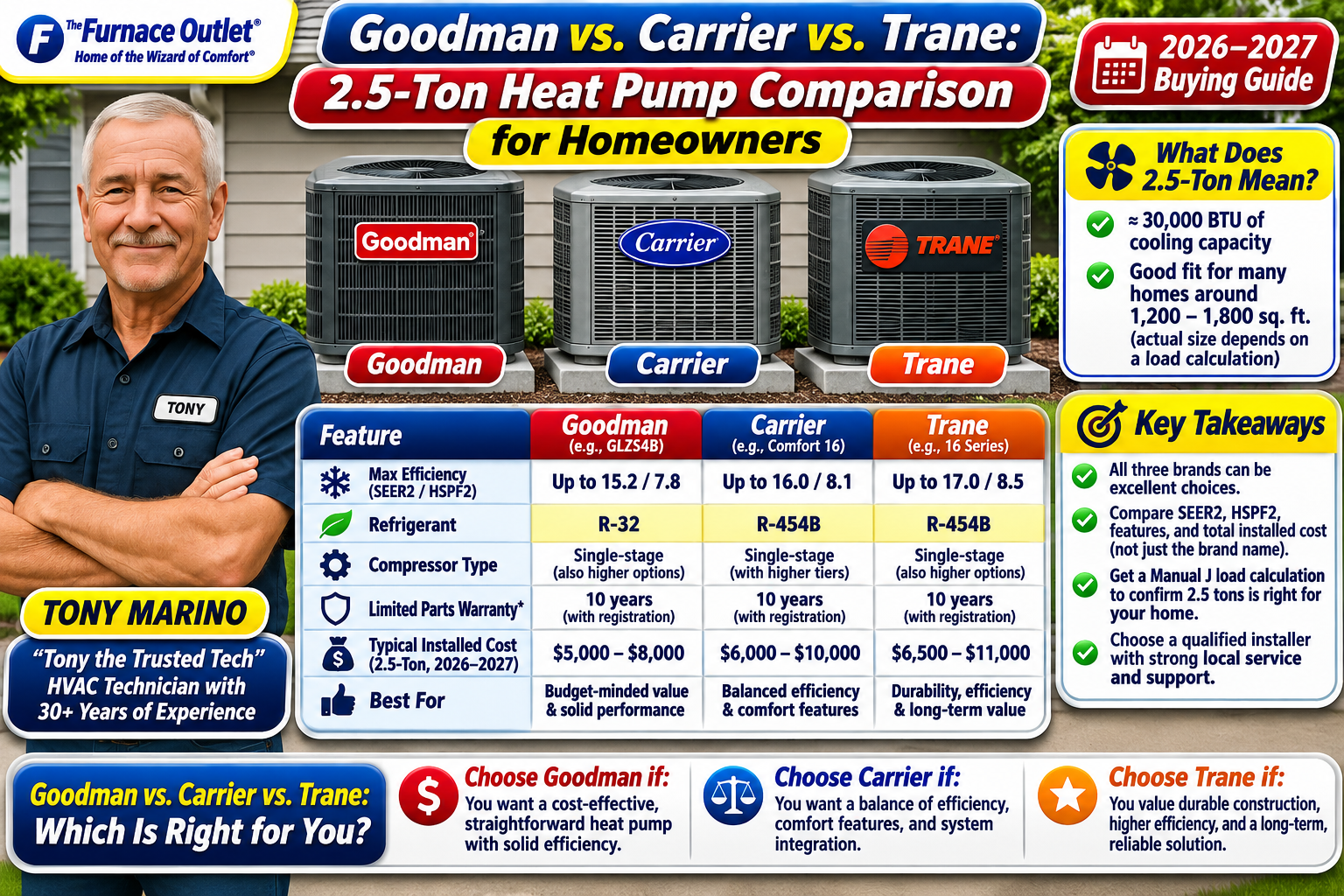
Goodman is generally associated with competitively priced residential HVAC equipment. Its heat pump lineup includes basic single-stage models and more advanced higher-efficiency systems. One relevant option is the Goodman GLZS4B R-32 split-system heat pump. The GLZS4B family offers up to 15.2 SEER2 and 7.8 HSPF2, depending on the matched configuration. It uses a single-stage compressor and incorporates SmartShift technology for defrost operation.
Goodman also offers the GLZS5B family, advertised at up to 16 SEER2 and 8.2 HSPF2, along with higher-performance variable-speed options. These alternatives are worth considering when efficiency or comfort is a priority. What I like about Goodman is the ability to obtain straightforward heating and cooling equipment without automatically paying for premium features. However, the quality of the installer remains extremely important.
A Goodman heat pump can represent strong value when a qualified contractor provides correct sizing, compatible indoor equipment, thorough commissioning, and dependable warranty support.
Carrier has a long-established reputation in residential heating and cooling. Its heat pump offerings range from value-oriented Comfort models to more sophisticated Performance and Infinity systems. Carrier’s Comfort lineup emphasizes conventional heating and cooling performance, while selected Performance and Infinity systems introduce additional efficiency, capacity control, and comfort features. The current Comfort 16 heat pump family is advertised at up to 16 SEER2 and 8.1 HSPF2. Higher-tier Carrier equipment can offer substantially greater efficiency and variable-speed operation, although not every model or configuration is available in exactly 2.5 tons.
One of Carrier’s advantages is its broader system-integration approach. Depending on the model, compatible controls, indoor equipment, and dual-fuel configurations can help manage comfort and operating costs. However, those advantages depend on buying a compatible complete system. Paying for an advanced outdoor unit without the appropriate indoor equipment or controls can limit the benefits. I would consider Carrier particularly attractive when an experienced local dealer offers a well-designed package and strong ongoing service support.
Trane is another established residential HVAC manufacturer, often recognized for its equipment construction and emphasis on durability. For a current 2.5-ton example, Trane’s 16 Single-Stage Heat Pump includes model 5TWR6030A1000A. This equipment uses R-454B refrigerant, a Climatuff compressor, an all-aluminum Spine Fin coil, and a corrosion-resistant basepan. The broader Trane 16 Single-Stage family is advertised at up to 17 SEER2 and 8.5 HSPF2. These are family-level maximum ratings, not guaranteed performance figures for the 2.5-ton model or every indoor-equipment combination.
Trane also offers more advanced heat pumps with enhanced capacity control, but some product families skip the 2.5-ton nominal size. Buyers should verify the exact available capacity rather than assume every premium Trane model comes in 30,000 BTU. Trane may be worth a higher price when the installation is handled by a strong local contractor and the equipment’s features genuinely suit the home. Still, I wouldn’t pay a substantial premium for the name alone. The complete system must justify the difference.
Energy efficiency is one of the most important factors when comparing heat pumps because these systems provide both summer cooling and winter heating. SEER2 measures seasonal cooling efficiency, while HSPF2 measures seasonal heating efficiency. Higher ratings generally indicate lower energy consumption under comparable conditions. Goodman’s GLZS4B offers up to 15.2 SEER2 and 7.8 HSPF2, while its GLZS5B family reaches up to 16 SEER2 and 8.2 HSPF2. Carrier’s Comfort 16 family reaches up to 16 SEER2 and 8.1 HSPF2, and Trane’s 16 Single-Stage family reaches up to 17 SEER2 and 8.5 HSPF2.
These numbers are useful for understanding product positioning, but they should not be treated as a direct comparison of three specific 2.5-ton installations. Actual certified ratings depend on the outdoor unit, indoor coil or air handler, and other matching requirements. For an accurate comparison, request the AHRI reference number and certified SEER2 and HSPF2 ratings for each proposed system. A higher efficiency rating may reduce operating costs, but whether it justifies a higher purchase price depends on local electricity rates and annual heating and cooling demand.
The transition to lower-global-warming-potential refrigerants is an important development in residential HVAC equipment. Goodman’s newer heat pump families commonly use R-32, while many current Carrier and Trane residential systems use R-454B. Both are classified as A2L refrigerants, meaning they have lower flammability than many conventional flammable refrigerants but require equipment designed specifically for their safe use.
R-32 is a single-component refrigerant, while R-454B is a blend. Both have substantially lower global warming potential than R-410A, although their environmental characteristics differ. For homeowners, neither refrigerant automatically guarantees better comfort or reliability. System engineering, installation quality, and service availability matter more. I recommend selecting the better overall heat pump rather than choosing a brand solely because it uses R-32 or R-454B.
One of the biggest differences between entry-level and premium heat pumps is how they control heating and cooling output. A single-stage heat pump operates at a fixed compressor stage when running. This design is relatively straightforward and can provide effective comfort when correctly sized. A variable-speed system adjusts its output to match changing heating and cooling demands. This can improve temperature consistency, reduce cycling, and provide more controlled operation during mild weather.
Variable-speed systems may also operate more quietly at reduced output and provide better humidity management when properly configured. However, the additional comfort comes with a higher purchase price and potentially more complex controls and repairs. For a homeowner replacing a basic single-stage system, another properly installed single-stage heat pump may offer the best value. For a household prioritizing quiet operation, humidity control, and consistent temperatures, a variable-speed model deserves consideration.
Installed prices vary considerably across the United States. The model, efficiency level, indoor equipment, electrical requirements, labor market, and existing ductwork all affect the final quotation. For general budgeting, a professionally installed 2.5-ton heat pump replacement may cost approximately $5,000–$9,000 for a relatively straightforward standard-efficiency system. More sophisticated variable-speed systems or installations requiring substantial modifications can exceed $10,000–$14,000.
These are broad illustrative planning ranges, not verified national averages or current model-specific contractor quotations. Goodman may be competitively priced in many markets, while Carrier and Trane proposals can cost more depending on the equipment tier and contractor. However, a basic Carrier or Trane system can sometimes be less expensive than a premium Goodman configuration. The correct comparison is the total installed price for equivalent equipment and services.
I recommend obtaining three itemized quotations and confirming whether they include the indoor air handler or coil, thermostat, electrical work, refrigerant-line modifications, permits, commissioning, and labor warranty.
Homeowners often ask whether Trane lasts longer than Goodman or whether Carrier is more dependable than both. I wouldn’t make a universal reliability claim without comparable, model-specific failure-rate data. All three manufacturers produce equipment that can perform well when properly installed and maintained. A heat pump’s service life depends on operating hours, climate, installation quality, maintenance, electrical conditions, and the availability of replacement parts. In coastal regions, corrosion resistance becomes important. In colder climates, defrost operation and low-temperature heating performance deserve greater attention.
I also consider local contractor support a major part of reliability. A system that can be diagnosed and repaired promptly may provide a better ownership experience than one whose parts or qualified service technicians are difficult to obtain. My advice is to choose the contractor and equipment together rather than evaluating the brand independently.
Goodman, Carrier, and Trane offer limited warranty coverage on qualifying residential heat pumps, but the details differ by product, registration status, installation date, and jurisdiction. Many Goodman systems offer a 10-year limited parts warranty when registration requirements are satisfied. Carrier and Trane also offer qualifying limited warranty programs, with specific terms depending on the model. Some equipment may offer additional coverage options, while others include different terms for compressors, parts, or replacement components.
A manufacturer parts warranty is not the same as a comprehensive labor warranty. Diagnostic charges, refrigerant, labor, and related installation expenses may remain the homeowner’s responsibility. Before purchasing, ask the contractor to explain the written warranty terms, registration deadlines, exclusions, and any separate workmanship or labor protection.
If you live in a region with freezing winters, cold-weather heating performance should carry more weight than the brand name or advertised cooling efficiency. Conventional heat pumps lose heating capacity as outdoor temperatures decline, although the degree varies by model. Some high-performance cold-climate systems are engineered to retain substantially more heating capacity at low temperatures. For cold-weather comparisons, request the equipment’s heating capacity and efficiency at 47°F, 17°F, and 5°F where available.
Also ask whether the system will require electric resistance backup heating or a dual-fuel furnace configuration. Backup heating can significantly influence winter electricity costs. ENERGY STAR’s cold-climate heat pump criteria provide useful performance benchmarks, but homeowners should confirm whether the exact proposed equipment combination qualifies. For homes in northern states, I would prioritize verified low-temperature heating performance over small differences in standard SEER2 ratings.
In states such as Florida, Texas, Georgia, and Louisiana, cooling performance and humidity management are major priorities. A properly sized Goodman, Carrier, or Trane heat pump can provide effective cooling. However, oversized equipment may cycle too frequently and remove less moisture than expected. Variable-speed systems can offer an advantage when they operate for longer periods at reduced capacity, although correct airflow and equipment configuration remain essential.
Duct leakage, insulation, attic heat gain, and thermostat settings can also affect indoor comfort. If I were comparing three systems for a humid climate, I would ask the contractors to explain how each proposal addresses latent cooling, airflow, and indoor humidity rather than focusing exclusively on the advertised SEER2 rating.
I’ve seen homeowners spend thousands more on premium equipment only to end up with disappointing performance because the installation was rushed. A proper heat pump installation should begin with accurate load calculations and verification that the duct system can deliver the required airflow. The contractor should also confirm compatible indoor and outdoor equipment, correct refrigerant piping, approved electrical connections, condensate drainage, and manufacturer-required safety measures.
With newer A2L refrigerants, the installation must follow the applicable equipment instructions and safety requirements. After installation, the technician should verify system operation in both heating and cooling modes, measure relevant operating conditions, and explain the thermostat and backup-heating settings. The best brand comparison in the world means little if the final system is incorrectly sized or poorly commissioned.
Is Goodman as good as Carrier or Trane?
Goodman can be an excellent value for homeowners who want straightforward heating and cooling without paying for premium features. Carrier and Trane offer additional product options and comfort technologies that may justify higher prices. The best choice depends on the exact model, installation quality, and local service support rather than brand reputation alone.
How much does a 2.5-ton heat pump cost to install?
For preliminary 2026–2027 budgeting, a standard professionally installed 2.5-ton heat pump replacement may cost approximately $5,000–$9,000, while premium systems and complex projects can exceed $10,000. Actual pricing depends on equipment, labor, electrical work, ductwork, and local conditions. Homeowners should obtain detailed quotations before establishing a final budget.
Is a 2.5-ton heat pump enough for a 1,500-square-foot home?
It may be, but square footage alone cannot determine the correct size. Climate, insulation, windows, air leakage, and ductwork all affect the required heating and cooling capacity. A professional Manual J calculation is the appropriate way to determine whether a 2.5-ton system will meet the home’s needs.
Which is better for cold weather: Goodman, Carrier, or Trane?
All three manufacturers offer heat pumps, but cold-weather performance depends on the specific model and configuration. A properly selected cold-climate system from one brand may outperform a standard-efficiency system from another. Compare certified low-temperature heating capacity, efficiency, and backup-heating requirements before choosing.
If I were choosing a 2.5-ton heat pump for a typical American home, I would start with Goodman when budget and straightforward performance are the main priorities. A properly installed Goodman system can offer strong value without requiring a premium-brand price. I would give Carrier serious consideration when a trusted dealer offers a well-matched system with the comfort features and support the homeowner wants. Trane would also be high on my list when equipment construction, contractor expertise, and long-term service support justify the quotation.
But I wouldn’t declare any of these brands the automatic winner. My recommendation is to compare three properly sized, AHRI-matched systems using the same installation requirements. Look at efficiency, cold-weather capacity, noise, warranties, total installed cost, and contractor reputation.
The best 2.5-ton heat pump isn’t necessarily the one with the most recognizable name. It’s the system that provides dependable heating and cooling, fits the home’s actual load, and offers the strongest long-term value for the money.
This article provides general educational information about Goodman, Carrier, and Trane residential heat pumps. Specifications, efficiency ratings, refrigerants, warranties, model availability, and installation prices vary by equipment and location. Cost figures are illustrative planning estimates, not guaranteed quotations. Heating and cooling load calculations, electrical work, refrigerant handling, and system installation should be performed by appropriately qualified professionals following manufacturer instructions and applicable regulations.
These five sources support the article’s brand comparisons and technical explanations.
1. Goodman — Heat Pump Product Lineup — Current Goodman models, R-32 refrigerant, compressor types, and efficiency specifications.
2. Carrier — How to Choose the Best Heat Pump — Carrier’s Comfort, Performance, and Infinity tiers, including efficiency and comfort features.
3. Trane — 16 Single-Stage Heat Pump — Current 2.5-ton model specifications, R-454B refrigerant, and equipment construction.
4. ENERGY STAR — Heat Pump Equipment Criteria — Efficiency benchmarks and cold-climate performance requirements.
5. U.S. Department of Energy — Energy-Efficient Residential Air-Source Heat Pumps — SEER2, HSPF2, electricity consumption, and long-term energy cost considerations.