Newsletter Subscribe
Enter your email address below and subscribe to our newsletter

HVAC made simple
By Tony Marino | HVAC Technician & Home Comfort Specialist | The Furnace Outlet | Updated November 2026
If you’re planning to replace an aging packaged air conditioner, a 2.5-ton Goodman unit can be an affordable and practical option for homes with moderate cooling requirements. However, one of the biggest mistakes homeowners make is focusing entirely on the equipment price without considering what it actually costs to have the system professionally installed. A packaged air conditioner may appear reasonably priced when advertised online, but once labor, electrical connections, ductwork adjustments, permits, and removal of the existing equipment are included, the final investment can be considerably higher.
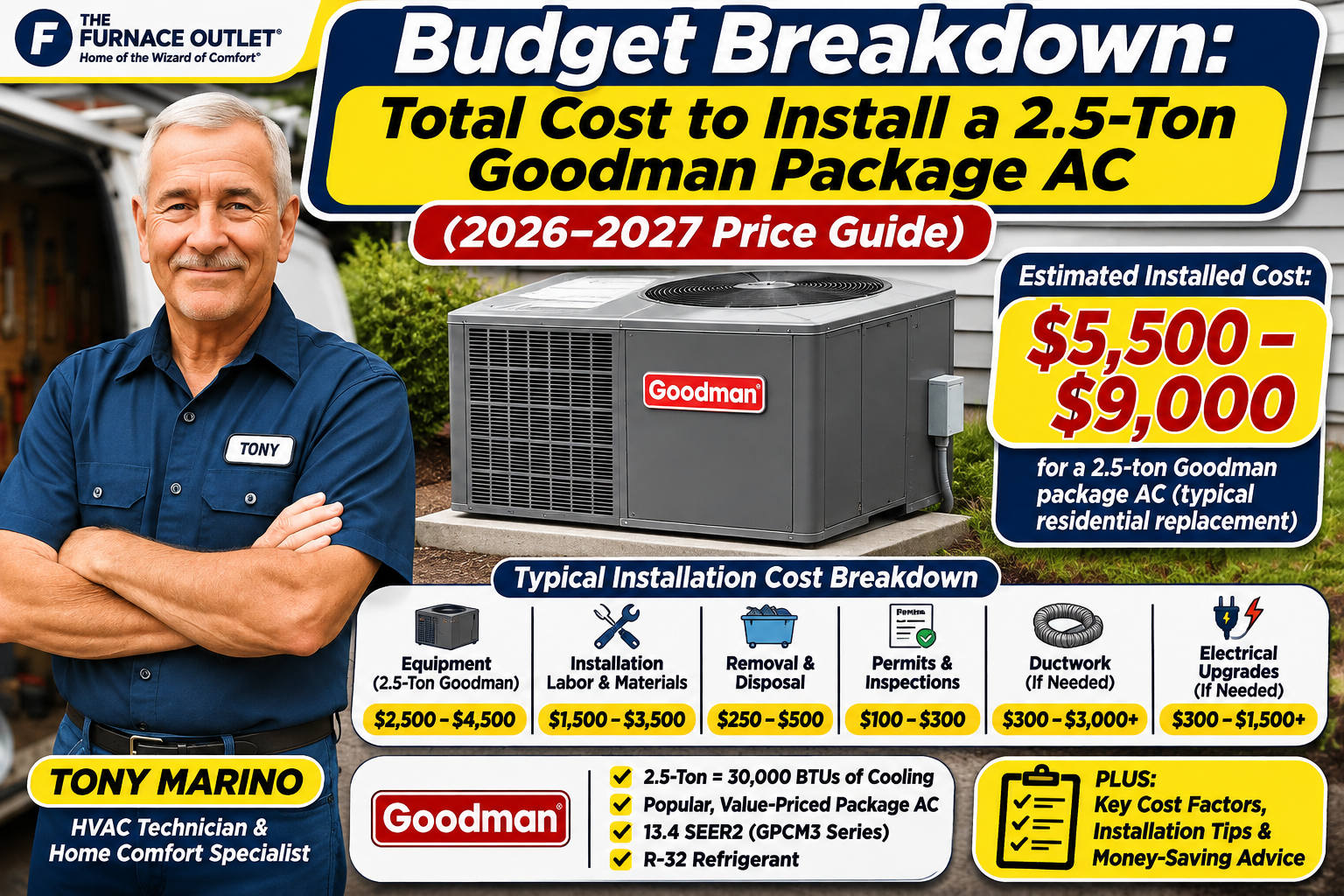
For 2026–2027 budgeting, homeowners should generally allow approximately $5,500–$9,000 for a professionally installed 2.5-ton Goodman packaged air conditioner under conventional residential replacement conditions. Straightforward installations with existing compatible ductwork and electrical connections may fall toward the lower end of that range, while rooftop installations, substantial duct modifications, or electrical upgrades can increase the final cost. These figures are broad U.S. planning estimates rather than fixed national prices, and local contractor quotations may differ.
After decades of working with residential heating and cooling systems, I’ve learned that the quality of the installation often matters just as much as the equipment itself. A properly installed Goodman package unit can deliver dependable cooling for many years, but an incorrectly sized system, poorly connected ductwork, or inadequate airflow can create expensive problems regardless of the manufacturer’s reputation. Understanding the complete installation budget will help you compare quotations intelligently and avoid unnecessary expenses.
A 2.5-ton air conditioner has a nominal cooling capacity of 30,000 British thermal units per hour, although actual performance varies with operating conditions and equipment specifications. The term ton refers to cooling capacity rather than the physical weight of the equipment. In practical terms, a 2.5-ton system may be appropriate for certain small or medium-sized homes, but square footage alone isn’t enough to determine whether this capacity is suitable. Insulation, windows, climate, ceiling height, and internal heat gains all influence the amount of cooling a home requires.
Unlike a conventional split air-conditioning system, which has separate indoor and outdoor components, a packaged air conditioner contains the compressor, condenser coil, evaporator coil, and indoor blower within one outdoor cabinet. The unit connects directly to the home’s ductwork and can be installed at ground level or on a suitable rooftop mounting arrangement. This design can simplify certain replacement projects, particularly when an existing packaged system is already installed, but it still requires careful attention to electrical safety, airflow, drainage, and equipment positioning.
Goodman offers packaged air-conditioning equipment in different capacities and configurations. Its GPCM3 R-32 packaged air conditioner family, for example, includes a 13.4 SEER2 rating, scroll-compressor technology, and a multi-speed ECM indoor blower. Homeowners should review the official Goodman packaged air conditioner information and confirm the exact model specifications before purchasing, since equipment availability and technical requirements can change.
The equipment itself may cost approximately $2,500–$4,500, depending on the model, distributor, refrigerant type, and included accessories. This estimate represents the price of the packaged air-conditioning equipment rather than the complete installed system. Some online retailers advertise equipment-only prices that exclude shipping, installation materials, thermostats, electric heating accessories, and professional labor, which can make the initial purchase appear less expensive than it actually is.
The exact equipment configuration also affects the price. A cooling-only packaged air conditioner generally differs in cost from a packaged heat pump or gas-electric combination system because those alternatives provide additional heating capabilities. Even within the same cooling capacity, differences in efficiency ratings, electrical specifications, cabinet design, and optional accessories can affect the purchase price. When comparing Goodman units, I recommend checking the complete model number and technical documentation rather than assuming every 2.5-ton packaged system has identical features.
Installation labor typically represents one of the largest expenses beyond the equipment purchase. For a conventional replacement, homeowners may need to budget approximately $1,500–$3,500 for professional labor and standard installation materials, although complex projects can exceed that range. The contractor must remove the existing system, prepare the installation area, position the replacement unit, connect the ductwork and electrical supply, verify drainage arrangements, and test the equipment under operating conditions.
A ground-level installation with convenient access and compatible existing connections is usually less complicated than replacing a unit located on a roof. Rooftop projects may require specialized lifting equipment, additional personnel, and more extensive safety precautions, particularly when the building is tall or access is restricted. The condition of the existing installation also matters because deteriorated duct transitions, damaged electrical components, or unsuitable mounting arrangements may need correction before the new equipment can operate safely.
For a straightforward replacement, installation may be completed within a working day, but projects involving significant modifications can take longer. I always advise homeowners to evaluate the contractor’s installation procedures rather than choosing solely on labor price. Proper airflow testing, electrical verification, equipment commissioning, and documentation can help prevent operating problems that become expensive after the installer leaves.
To understand how the expenses fit together, imagine replacing an older 2.5-ton packaged air conditioner in a home where the existing ductwork and electrical system are mostly suitable for reuse. Suppose the Goodman equipment costs $3,200 and the contractor charges $2,300 for installation labor and standard materials. Removing and disposing of the old unit adds approximately $350, while permits and inspection fees contribute another $200. Minor duct transitions and electrical corrections might add $650, bringing the estimated project total to $6,700.
Allowing an additional $300 for unexpected minor work creates a practical working budget of approximately $7,000. This example assumes there are no major structural repairs, extensive duct replacements, or complicated rooftop lifting requirements. It also assumes that the contractor has confirmed the new equipment is compatible with the home’s existing installation arrangement.
Although $7,000 is a useful illustrative budget, it shouldn’t be interpreted as a guaranteed price or national average. Actual quotations depend on local labor rates, equipment availability, installation complexity, and the amount of additional work required. The most reliable way to establish your budget is to obtain a detailed written quotation after the contractor inspects the property.
The location of your packaged air conditioner can make a substantial difference to the total installation cost. Ground-level replacements are often relatively straightforward when the existing concrete pad, electrical connections, and duct openings are compatible with the new unit. In these circumstances, the contractor may be able to remove the old equipment and position the replacement without specialized lifting machinery, reducing labor and equipment-handling expenses.
Rooftop installations can be considerably more complicated because the existing unit must be removed safely and the replacement positioned without damaging the roof or surrounding structure. Depending on the building, contractors may require a crane, mechanical lift, or specialized rigging equipment. These services can add several hundred dollars to more than $1,500, particularly where access is difficult or the building requires additional safety arrangements.
Another consideration is the roof curb, which supports the packaged equipment and connects it to the building’s ductwork. If the replacement Goodman unit doesn’t match the dimensions of the existing curb, a compatible adapter or new mounting arrangement may be necessary. I recommend having the contractor verify curb compatibility before ordering the equipment, because discovering a mismatch during installation can lead to delays and unexpected expenses.
A packaged air conditioner relies on the home’s supply and return ductwork to distribute conditioned air. If the existing ducts are correctly sized, properly sealed, and in good condition, much of the system may be suitable for reuse. However, replacing an older packaged unit doesn’t guarantee that the new cabinet’s duct connections will align perfectly with the original installation. Minor sheet-metal transitions may be required to connect the new equipment without creating airflow restrictions or excessive leakage.
Simple duct adjustments may add a few hundred dollars to the project, while substantial modifications can cost approximately $1,000–$3,000 or more. The final expense depends on accessibility, the condition of the existing ducts, and whether additional insulation, sealing, or structural work is necessary. In some homes, the contractor may also discover that the original duct system was poorly designed or insufficient for the equipment’s airflow requirements.
I strongly recommend addressing significant duct problems during replacement rather than assuming a new air conditioner will overcome them. Restricted airflow can reduce cooling performance, increase operating stress, and contribute to coil icing or other equipment problems. A properly connected and balanced duct system helps the Goodman unit deliver the performance homeowners are paying for.
Electrical compatibility is another important part of the installation budget. The new Goodman package unit must receive the voltage and electrical protection specified on its equipment nameplate, and the contractor should inspect the existing circuit, disconnect, wiring, and grounding before installation. When these components are already suitable and in good condition, electrical modifications may be minimal. However, damaged wiring, an incompatible disconnect, or changes in equipment requirements can increase the cost.
Minor electrical corrections may add several hundred dollars, while substantial circuit or panel modifications can be considerably more expensive. Thermostat replacement may also be necessary if the existing controls are outdated, damaged, or incompatible with the new system. A basic compatible thermostat may be relatively inexpensive, while a professionally installed smart thermostat can add approximately $150–$500 or more, depending on the model and wiring requirements.
Homeowners should also account for permits, inspections, removal of the old equipment, and any required installation accessories. These expenses are sometimes included in a contractor’s package price and sometimes listed separately. Before accepting a quotation, ask whether the total includes all work required to deliver a fully functioning, code-compliant system.
Not every Goodman packaged air conditioner includes heating, and this distinction is particularly important when replacing an existing system. A cooling-only packaged AC provides air conditioning, while certain models can be equipped with compatible electric resistance heating accessories. Goodman also manufactures packaged heat pumps and gas-electric systems, which are different equipment categories with different heating capabilities and installation requirements.
A packaged heat pump uses refrigerant-based technology to provide both cooling and heating, while a gas-electric package system combines air conditioning with a gas furnace. These alternatives can cost more than a cooling-only packaged air conditioner, but they may be necessary when the existing unit supplies the home’s primary heating. The appropriate choice depends on climate, available utilities, electrical capacity, and the home’s heating requirements.
Before purchasing, confirm exactly how your existing system heats the home and whether the proposed replacement will provide equivalent functionality. A low-priced cooling-only unit may not be a bargain if additional heating equipment must be purchased afterward.
Goodman’s GPCM3 R-32 packaged air conditioner family has a published efficiency rating of 13.4 SEER2. SEER2, or Seasonal Energy Efficiency Ratio 2, measures cooling efficiency under standardized testing conditions. A higher rating generally means the equipment uses less electricity to deliver the same amount of seasonal cooling, although actual household savings depend on climate, usage, installation quality, and electricity rates.
Packaged air conditioners have equipment-specific federal efficiency requirements that differ from those applying to conventional split-system air conditioners. Homeowners should therefore avoid assuming that every SEER2 minimum applies equally to all HVAC configurations. The contractor should verify that the proposed Goodman model meets the requirements applicable to the equipment category and installation location.
For homes with moderate cooling demand, a basic packaged air conditioner may provide reasonable value when its purchase price is significantly lower than that of premium alternatives. However, homeowners in hotter climates should also consider the potential long-term electricity savings from more efficient equipment. The best decision balances initial cost, expected energy consumption, comfort, and the period you expect to own the home.
Electricity consumption depends on the amount of cooling required rather than the equipment’s nominal tonnage alone. For example, suppose a home requires 24 million BTUs of cooling over an entire season. Using a simplified calculation based on a 13.4 SEER2 rating, the system would theoretically consume approximately 1,791 kilowatt-hours to provide that amount of cooling. At an electricity rate of $0.16 per kilowatt-hour, the estimated seasonal cooling expense would be approximately $287.
This calculation is intended to illustrate the relationship between efficiency and electricity consumption rather than predict an individual household’s bill. Real-world energy use depends on outdoor temperatures, insulation, thermostat settings, duct leakage, indoor humidity, and equipment performance under actual operating conditions. A home with poor insulation or substantial air leakage may require considerably more cooling energy than an otherwise similar property.
I recommend using actual electricity rates and realistic seasonal cooling requirements when comparing equipment. A higher-efficiency system may reduce operating expenses, but the savings should be weighed against its additional installed cost rather than assumed to justify any price premium.
Newer Goodman packaged air conditioners include models designed for R-32 refrigerant, which has a lower global warming potential than the R-410A refrigerant widely used in older residential HVAC systems. R-32 is classified as an A2L refrigerant, meaning it has lower toxicity and mild flammability under the applicable refrigerant safety classification. Equipment designed for R-32 incorporates appropriate safety and installation requirements, and contractors must follow the manufacturer’s instructions when installing or servicing these systems.
An older R-410A air conditioner shouldn’t simply be converted to R-32 by changing the refrigerant. Refrigerant compatibility involves equipment design, operating pressures, safety controls, and other technical considerations. When replacing an older Goodman package unit, ask the contractor to identify the refrigerant used by the proposed replacement and explain any installation requirements associated with the newer equipment.
Homeowners can review Goodman’s official product literature library for model-specific specifications, installation instructions, and technical documentation.
Goodman offers limited manufacturer warranties for qualifying residential packaged air conditioners, with coverage depending on the model, installation circumstances, and applicable registration requirements. Certain eligible systems may receive a 10-year parts limited warranty when properly registered within the required period, commonly 60 days after installation, subject to the written warranty terms and applicable exceptions.
However, a manufacturer parts warranty doesn’t necessarily include labor, diagnostic charges, refrigerant, or every expense associated with a repair. This distinction matters because replacing a covered component can still involve substantial service costs. Some HVAC contractors offer separate labor warranties or extended protection agreements, which may provide additional financial security.
Before purchasing, request the actual warranty certificate for the proposed model and confirm who will handle future service claims. I also recommend keeping the installation invoice, model and serial numbers, and registration confirmation in a safe place. Proper documentation can make warranty service considerably easier if problems develop later.
Reusing suitable components can help control the total installation cost, particularly when replacing an existing packaged air conditioner with a compatible model. A sound concrete pad, properly sized ductwork, suitable electrical connections, and compatible thermostat may not need replacement simply because the air conditioner is being upgraded. However, every reused component should be inspected to confirm that it remains safe and appropriate for the new equipment.
For rooftop systems, the existing mounting curb may be reusable if its dimensions and installation arrangement match the replacement unit. Otherwise, an adapter or new curb may be required. Ground-level installations also require adequate support, drainage, and clearance around the equipment. Reusing damaged or incompatible components to save money can create airflow problems, vibration, water leakage, and premature equipment failures.
My recommendation is to ask the contractor to identify which existing components can safely remain and which genuinely require replacement. A detailed explanation is much more useful than accepting either a blanket recommendation to replace everything or an unusually cheap quotation that ignores necessary corrections.
Goodman is commonly positioned as a value-oriented residential HVAC brand, making it attractive to homeowners who want dependable cooling without paying for unnecessary premium features. Carrier, Trane, and Rheem also offer packaged heating and cooling equipment, but their products differ in efficiency, construction, controls, warranty arrangements, and dealer networks. A lower equipment price doesn’t automatically mean inferior performance, just as a higher price doesn’t guarantee a longer lifespan.
When comparing manufacturers, make sure the quotations cover equivalent equipment categories. A Goodman cooling-only package AC shouldn’t be compared directly with a premium packaged heat pump or gas-electric system because their capabilities and costs differ substantially. Even when two units have the same nominal cooling capacity, their efficiency ratings, sound characteristics, and installation requirements may not be identical.
I recommend comparing complete installed prices, certified performance, warranty coverage, and contractor experience. A properly installed Goodman system may provide better practical value than a more expensive alternative if both meet the home’s requirements and the Goodman installation is supported by reliable local service.
For preliminary budgeting, homeowners may plan around approximately 12–18 years of service from a residential packaged air conditioner, although actual longevity can vary substantially. Some systems experience major failures earlier because of poor installation, inadequate maintenance, corrosion, or heavy operating demands, while others continue functioning beyond the expected planning range. This estimate is a general service-life assumption rather than a Goodman manufacturer guarantee.
Packaged systems place their major cooling components inside an outdoor cabinet, making protection from environmental exposure particularly important. Dirty coils, restricted airflow, deteriorated electrical connections, and drainage problems can reduce performance and increase wear. Regular maintenance helps identify these issues before they develop into expensive failures.
Homeowners should arrange periodic professional servicing and follow the manufacturer’s recommendations for filter replacement, coil cleaning, and equipment inspection. A properly maintained packaged air conditioner has a better opportunity to deliver reliable performance throughout its useful life.
If your existing packaged air conditioner is relatively young and requires a minor repair, restoring it to proper operation may be the most economical decision. However, an older system with repeated breakdowns, extensive corrosion, compressor failure, or significant refrigerant-system problems deserves a closer financial evaluation. Repair costs should be considered alongside equipment age, energy efficiency, and the likelihood of additional failures.
As a practical budgeting guideline, I recommend comparing replacement options when a major repair approaches approximately 40–50% of the installed cost of a comparable new system. This isn’t a universal industry rule, but it can help homeowners avoid investing heavily in aging equipment with uncertain remaining service life. Replacement may also be appropriate when the existing unit is incorrectly sized or no longer provides adequate comfort.
Before deciding, request a written repair estimate and a complete replacement quotation. Comparing the two options over several years, rather than focusing only on the immediate expense, can provide a clearer picture of long-term value.
One of the most effective ways to avoid overpaying is to obtain several detailed quotations from qualified HVAC contractors. Each proposal should identify the exact Goodman model number, cooling capacity, efficiency rating, installation materials, labor, permits, removal charges, and warranty coverage. Comparing complete quotations makes it easier to recognize differences in equipment quality and installation scope that might otherwise be overlooked.
I also recommend confirming that the contractor has evaluated your home’s actual cooling requirements. A replacement air conditioner shouldn’t automatically be selected based on the capacity of the existing unit, because the original system may have been incorrectly sized. The Air Conditioning Contractors of America provides information about Manual J load calculations, which are used to estimate residential heating and cooling requirements.
A professional contractor should also inspect the ductwork, verify electrical compatibility, and explain any additional work before installation begins. The goal isn’t necessarily to find the lowest quotation, but to identify the best combination of appropriate equipment, thorough installation, dependable service, and reasonable total cost.
How much does a 2.5-ton Goodman package AC cost installed? A conventional residential replacement may cost approximately $5,500–$9,000, depending on equipment selection, labor rates, and installation conditions. Rooftop lifting, electrical upgrades, and substantial duct modifications can increase the total, so a site-specific contractor quotation is essential.
How many square feet can a 2.5-ton Goodman package AC cool? There isn’t one reliable square-footage figure because cooling requirements depend on climate, insulation, windows, air leakage, ceiling height, and internal heat gains. A professional Manual J calculation is the appropriate way to determine whether 30,000 BTUs per hour is suitable for a particular home.
Does a Goodman packaged air conditioner require an indoor air handler? No. A packaged air conditioner contains the blower and major cooling components within the outdoor cabinet, unlike a conventional split system with separate indoor and outdoor equipment. However, it still requires suitable duct connections, electrical service, drainage, and professional installation.
Is a Goodman packaged AC cheaper to install than a split system? It can be less complicated to replace an existing compatible packaged unit because the equipment is contained within one cabinet. However, rooftop access, mounting modifications, electrical work, and duct changes can make some packaged installations more expensive than conventional split-system replacements.
Can I install a Goodman packaged AC myself? Professional installation is strongly recommended because the work involves high-voltage electrical connections, equipment positioning, airflow verification, and compliance with applicable installation and safety requirements. An experienced contractor can also confirm that the system is correctly sized and commissioned.
When homeowners ask me how much they should budget for a 2.5-ton Goodman packaged air conditioner, I always encourage them to look beyond the advertised equipment price. For many conventional replacements, approximately $7,000 can serve as a useful initial planning figure, but the actual investment depends on the home’s installation conditions. Rooftop access, electrical compatibility, ductwork, and mounting arrangements can all influence the final quotation.
My recommendation is to begin with a proper cooling-load calculation, have the existing installation inspected, and obtain detailed quotations from qualified contractors. Compare the complete installed cost, verify the warranty terms, and make sure the proposal includes the work necessary for safe, efficient operation. A properly sized and professionally installed Goodman package AC can provide dependable cooling for years, making installation quality one of the most valuable parts of your investment.