Newsletter Subscribe
Enter your email address below and subscribe to our newsletter

HVAC made simple
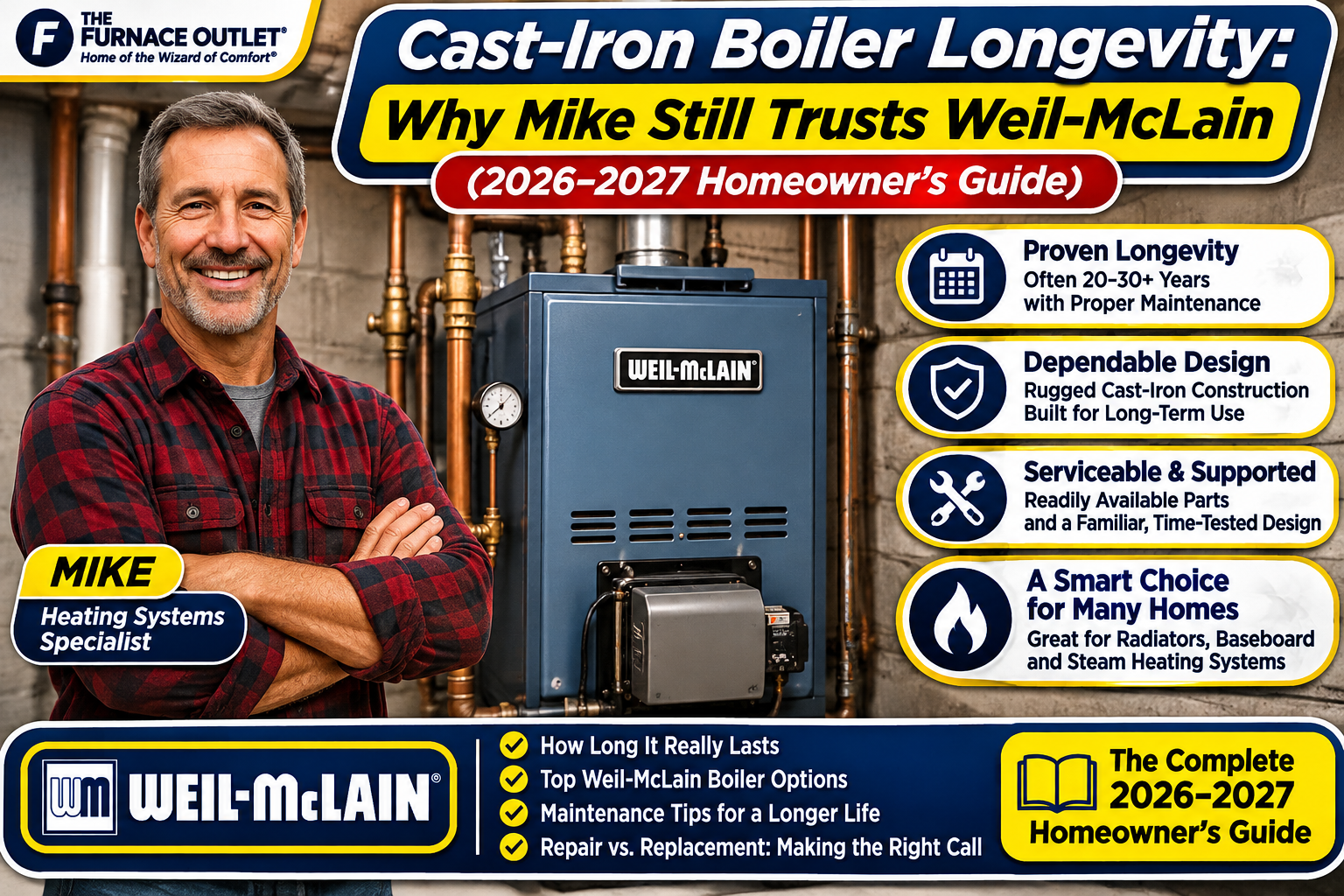
By Mike | Heating Systems Specialist | The Furnace Outlet | Updated November 2026
Walk into the basement of an older American home, particularly in the Northeast or Midwest, and you may find a cast-iron boiler that has been heating the property for decades. While homeowners regularly replace furnaces, air conditioners, and water heaters, some traditional boilers remain in service long after their original installation. That kind of durability is one reason experienced heating technicians continue to respect well-built cast-iron equipment.
Among the manufacturers associated with traditional boiler construction, Weil-McLain has earned a longstanding place in residential heating. Its cast-iron boilers have been installed in homes with hot-water radiators, baseboard heating, and steam distribution systems for generations. Although modern heating technology has introduced sophisticated condensing boilers, advanced controls, and alternative heat sources, there are still situations where a conventional cast-iron boiler makes excellent practical sense.
I don’t believe homeowners should purchase equipment simply because a brand has been around for a long time. What matters is how the boiler is constructed, how efficiently it operates, whether replacement parts are available, and how well it matches the heating system already installed in the house. Weil-McLain remains on my shortlist because its traditional boiler designs address many of these practical considerations.
Cast iron has been used in heating equipment for generations because it can withstand repeated exposure to high operating temperatures while providing substantial structural strength. In a traditional sectional boiler, individual cast-iron sections are assembled to form the heat exchanger through which water circulates or steam is generated. Heat from the burner passes through the boiler’s internal passages, transferring energy into the heating medium before exhaust gases leave through the venting system.
One advantage of this construction is its substantial thermal mass. Cast iron heats gradually and retains heat after the burner shuts off, which can provide steady operation in traditional hydronic systems. However, thermal mass shouldn’t automatically be confused with higher energy efficiency. A heavy boiler can retain useful heat while also experiencing standby losses, depending on insulation, controls, and operating conditions.
The material itself is durable, but it isn’t indestructible. Cast iron can crack when exposed to severe thermal stress, freezing, or inappropriate operating conditions, and corrosion can develop when the system is poorly maintained. A boiler’s longevity therefore depends on more than the thickness of its heat exchanger. Proper water chemistry, system design, combustion conditions, and regular maintenance are essential.
For planning purposes, a properly maintained residential cast-iron boiler may provide approximately 20–30 years of service, with some installations lasting considerably longer. This is a general industry planning range rather than a guaranteed lifespan or a manufacturer-published average for every Weil-McLain model. Actual longevity depends on whether the boiler serves a steam or hot-water system, the quality of installation, maintenance history, water conditions, and operating demands.
A hot-water boiler operating in a well-maintained closed-loop system may experience relatively little fresh-water introduction, reducing exposure to dissolved oxygen that can contribute to corrosion. Steam boilers often face different operating conditions, including periodic water addition and greater attention to water level and water quality. Consequently, it would be misleading to assume that every cast-iron steam boiler will last as long as a comparable hot-water model.
I’ve always encouraged homeowners to judge older boilers by their condition rather than their age alone. A 25-year-old unit with sound cast-iron sections, dependable safety controls, and acceptable combustion performance may still have useful service life. Conversely, a much younger boiler with recurring leaks, neglected maintenance, or serious installation problems may require replacement.
My confidence in Weil-McLain comes from the practical characteristics of its traditional boiler designs rather than the assumption that every model is superior to its competitors. The company continues to manufacture cast-iron boilers for residential hot-water and steam applications, allowing homeowners to choose equipment that works with established heating systems instead of automatically converting to an entirely different technology.
Serviceability is another important consideration. Conventional boilers often use recognizable heating-system components, including circulators, gas valves, burners, ignition controls, pressure controls, and safety devices. Although these components aren’t universally interchangeable, qualified heating contractors are generally familiar with their operation and maintenance requirements. That familiarity can make troubleshooting more straightforward than working with equipment requiring highly specialized proprietary electronics.
Weil-McLain also maintains technical documentation, replacement-parts information, and a professional distribution network. Its official residential boiler lineup includes traditional cast-iron equipment alongside newer high-efficiency technologies. For homeowners who prefer established heating equipment supported by manufacturer documentation, that combination is worth considering.
Weil-McLain offers several cast-iron boiler families designed for different heating applications. The CGa and CGi gas-fired boilers are intended for hot-water heating, while the EG family includes configurations suitable for traditional steam and hot-water applications. The company also offers oil-fired cast-iron equipment for properties where oil remains the primary heating fuel.
The CGa Series 4 is a conventional gas-fired cast-iron hot-water boiler with a published 84% AFUE rating. It uses cast-iron sections, stainless-steel burners, and a design emphasizing service access and dependable heating performance. The CGi Series 5 also carries a published 84% AFUE rating and incorporates features such as electronic ignition and built-in low-water protection. These are examples of current manufacturer-listed equipment, but specifications and availability should always be verified before purchasing.
For older homes with steam radiators, Weil-McLain’s EG boiler family is particularly relevant because steam systems require equipment specifically designed and rated for that application. A hot-water boiler shouldn’t be substituted for a steam boiler simply because both use cast-iron heat exchangers. The Weil-McLain steam boiler range provides information about equipment intended for steam heating.
Modern high-efficiency condensing boilers frequently use stainless-steel heat exchangers designed to handle operating conditions that differ substantially from those of conventional cast-iron boilers. Condensing technology captures additional heat from combustion gases by cooling them enough to recover latent heat from water vapor. Under appropriate conditions, this can produce significantly higher operating efficiency than a traditional noncondensing boiler.
Cast iron and stainless steel therefore shouldn’t be compared solely by asking which material is stronger. Each is used in equipment engineered for particular temperatures, combustion conditions, and heating-system requirements. Conventional cast-iron boilers are generally designed to avoid sustained flue-gas condensation within surfaces not intended for it, while condensing boilers are specifically engineered to manage acidic condensate.
A stainless-steel condensing boiler may provide substantial fuel savings when installed in a system capable of operating at lower return-water temperatures. A conventional cast-iron boiler may offer simpler operation and familiar maintenance requirements in a traditional high-temperature radiator system. Neither technology automatically guarantees a longer lifespan, and the better investment depends on the entire heating installation.
One of the most important factors influencing cast-iron boiler longevity is water quality. In a properly maintained closed-loop hot-water system, the same water circulates repeatedly, with relatively little fresh water entering under normal conditions. Excessive makeup water introduces additional dissolved oxygen and minerals, potentially increasing corrosion, deposits, and other operating problems.
Hard-water deposits can interfere with heat transfer, while untreated leaks may create ongoing corrosion risks. In steam systems, water quality and water level are especially important because the equipment regularly converts water into steam. Improper water treatment, excessive makeup water, and neglected maintenance can contribute to scale, unstable water levels, and premature deterioration.
Homeowners should avoid adding chemicals or changing system water without guidance from a qualified boiler professional. Treatment requirements depend on the equipment, piping materials, and manufacturer’s instructions. If a boiler repeatedly needs additional water, the underlying cause should be investigated rather than simply continuing to refill the system.
Even a durable cast-iron boiler can perform poorly when it is incorrectly sized. Oversized equipment may cycle frequently, increasing wear and reducing operating efficiency, while undersized equipment may struggle to maintain comfortable indoor temperatures during severe winter weather. Boiler sizing should therefore be based on the home’s heating requirements rather than automatically matching the input rating of the existing unit.
For hot-water systems, a professional heat-loss calculation helps determine the required heating capacity. The contractor should also examine the existing radiation, water temperatures, piping, and circulation arrangements. Steam systems require additional consideration because boiler capacity must be matched appropriately to the connected steam radiation, often using its equivalent direct radiation rating.
I’ve seen homeowners assume that a larger boiler will heat the house faster and provide better comfort. In reality, excessive capacity can create operating problems and unnecessary fuel consumption. Correct sizing is one of the most important decisions when replacing an older Weil-McLain system.
Traditional cast-iron boilers can provide dependable heating, but they generally don’t reach the peak efficiency levels available from properly applied modern condensing equipment. For example, selected Weil-McLain conventional gas-fired cast-iron models carry an 84% AFUE rating, while some modern condensing boilers achieve ratings in the mid-90% range.
AFUE, or Annual Fuel Utilization Efficiency, estimates how effectively a boiler converts fuel into useful heating over a standardized heating season. A higher rating generally indicates less fuel waste under the rating conditions, but actual household savings depend on climate, system operation, controls, and fuel prices.
The U.S. Department of Energy’s furnace and boiler guidance explains efficiency ratings and the importance of evaluating existing heating equipment. For homeowners with high annual heating bills, comparing the lifetime fuel costs of conventional and condensing boilers can be worthwhile. However, the additional installation expense of a condensing system should be included in the calculation.
Regular professional maintenance is essential because boilers combine combustion equipment, pressurized heating systems, electrical controls, and safety devices. A qualified technician should inspect the heat exchanger, burners, venting, operating controls, safety components, and system pressure or water-level arrangements according to the manufacturer’s maintenance schedule.
Hot-water systems also require attention to expansion tanks, circulators, air elimination, valves, and signs of leakage. Steam systems require appropriate inspection of low-water cutoffs, pressure controls, water-level indications, and condensate return arrangements. These components protect both heating performance and equipment safety.
Homeowners can monitor for visible leaks, unusual noises, repeated shutdowns, or changes in heating performance, but internal combustion adjustments and safety-device servicing should be left to trained professionals. Annual servicing is a reasonable baseline for many residential boilers, with additional inspections where the manufacturer or operating conditions require them.
Cast-iron boiler failures often involve problems that develop gradually rather than sudden defects in the casting itself. Persistent water leakage, corrosion, improper combustion, excessive thermal stress, and poor system maintenance can all contribute to premature deterioration. A boiler that repeatedly loses pressure or requires frequent makeup water deserves immediate investigation because the underlying condition may be damaging the system.
Poor venting or combustion can create safety hazards, including carbon monoxide exposure. Unusual soot accumulation, scorching, persistent burner problems, or exhaust odors should never be dismissed as normal signs of aging. Similarly, an unexplained increase in fuel consumption may indicate that the system is no longer operating efficiently.
A cracked or leaking cast-iron section is a serious issue requiring professional evaluation. Depending on the equipment’s age, condition, and repair requirements, replacing individual sections may be technically possible, but it isn’t always economically sensible. Homeowners should avoid operating equipment with suspected heat-exchanger damage until a qualified technician has determined that it is safe.
Weil-McLain provides model-specific limited warranties, and the coverage can differ substantially between residential hot-water boilers, steam boilers, and commercial equipment. Some residential cast-iron hot-water boilers have historically carried limited lifetime section coverage, while certain residential steam models have ten-year heat-exchanger warranties. Other models have different warranty periods, so a broad statement that all Weil-McLain cast-iron boilers include lifetime protection would be inaccurate.
Warranty coverage also doesn’t guarantee that a boiler will operate for the entire warranty period. A manufacturer’s limited warranty generally addresses qualifying defects under stated conditions rather than ordinary wear, maintenance problems, or every installation-related failure. Labor, transportation, and associated repair expenses may also be excluded.
Before purchasing or filing a claim, homeowners should review the official Weil-McLain warranty documentation for their exact model and manufacturing period. Keeping installation records and arranging regular professional maintenance can also help establish the equipment’s service history.
A 25-year-old cast-iron boiler isn’t automatically ready for replacement. If its heat exchanger is sound, its safety systems function correctly, and its heating performance remains dependable, a relatively minor repair may be reasonable. Components such as circulators, controls, and certain valves can sometimes be replaced without requiring a completely new boiler.
However, the decision becomes more complicated when the system develops repeated leaks, major heat-exchanger problems, severe corrosion, or expensive recurring failures. Older equipment may also consume more fuel than modern alternatives, particularly when operating controls are outdated or the boiler is substantially oversized.
I recommend obtaining a professional condition assessment and comparing the cost of necessary repairs with a complete replacement quotation. The decision should account for the boiler’s condition, annual fuel expenses, expected future repairs, and the homeowner’s plans for the property rather than relying on age alone.
For homeowners with existing radiator or baseboard systems, a new Weil-McLain cast-iron boiler can remain a practical choice when the heating requirements and operating conditions suit conventional boiler technology. Its familiar construction and established service arrangements may be attractive to owners who prioritize straightforward maintenance and compatibility with traditional heating systems.
However, a new cast-iron boiler shouldn’t be selected without evaluating modern alternatives. Condensing gas boilers may offer meaningful fuel savings in suitable hydronic applications, while air-to-water heat pumps and hybrid heating systems may deserve consideration depending on climate, electricity costs, and building characteristics.
A replacement project should begin with a heating-load calculation and a review of the complete distribution system. The contractor should then compare equipment efficiency, installed cost, venting requirements, operating temperatures, maintenance expectations, and local service availability. A conventional boiler may still be the best fit, but that conclusion should come from evaluating the property rather than simply repeating the previous installation.
Can a Weil-McLain cast-iron boiler last 30 years? Yes, some properly maintained cast-iron boilers can remain operational for 30 years or longer, although this isn’t guaranteed. Water quality, system design, maintenance, and operating conditions play major roles in determining actual service life. A professional inspection is more useful than age alone when evaluating an older boiler.
Are cast-iron boilers more reliable than condensing boilers? Traditional cast-iron boilers often have relatively straightforward designs, but that doesn’t prove they are universally more reliable. Condensing boilers offer higher efficiency under suitable conditions and can provide dependable performance when correctly installed and maintained. Reliability comparisons should consider the specific equipment and installation rather than material alone.
Can a cracked cast-iron boiler be repaired? A cracked or leaking boiler section requires professional assessment. Section replacement may be possible in some designs, but repair costs, equipment age, and safety considerations can make complete replacement more appropriate. Homeowners shouldn’t attempt temporary sealants or other improvised repairs on damaged pressure-containing components.
Does Weil-McLain offer a lifetime warranty? Certain residential cast-iron hot-water boilers have limited lifetime section warranties, but coverage varies by model and application. Steam boiler warranties can be substantially different, and labor or other repair expenses may not be included. Always review the warranty certificate for the exact equipment.
Is it worth replacing an old cast-iron boiler with a high-efficiency model? Replacement may be financially attractive when the existing boiler is inefficient, unreliable, or approaching a major repair. However, the potential fuel savings must be compared with the full installed cost and any necessary venting or system modifications. A contractor should evaluate whether the heating distribution system can take advantage of condensing operation.
There’s a reason I still respect traditional Weil-McLain cast-iron boilers. Their substantial construction, familiar operating principles, and suitability for established hydronic and steam heating systems have helped make them a lasting part of American home heating. But durability isn’t a reason to ignore maintenance, efficiency, or changing technology.
If you already own a Weil-McLain boiler that’s providing dependable heat, I wouldn’t recommend replacing it simply because it has reached a particular birthday. Have the equipment inspected, understand its condition, and compare the costs of continued operation with those of a properly selected replacement.
If you’re purchasing a new boiler, evaluate both conventional cast-iron and modern high-efficiency options before making your decision. The best heating system isn’t necessarily the newest technology or the heaviest equipment. It’s the system that fits your home, operates safely and efficiently, and can be maintained dependably for years to come.