Newsletter Subscribe
Enter your email address below and subscribe to our newsletter

HVAC made simple
By Tony Marino | Commercial HVAC Technician & Heating and Cooling Specialist | The Furnace Outlet | Updated November 2026
When you’re responsible for heating and cooling a commercial building, equipment reliability isn’t simply a matter of comfort. An air-conditioning failure can disrupt employees, drive customers away, damage temperature-sensitive inventory, and create unexpected operating expenses. That’s why selecting the right commercial HVAC system deserves considerably more attention than comparing equipment prices or choosing a familiar manufacturer.
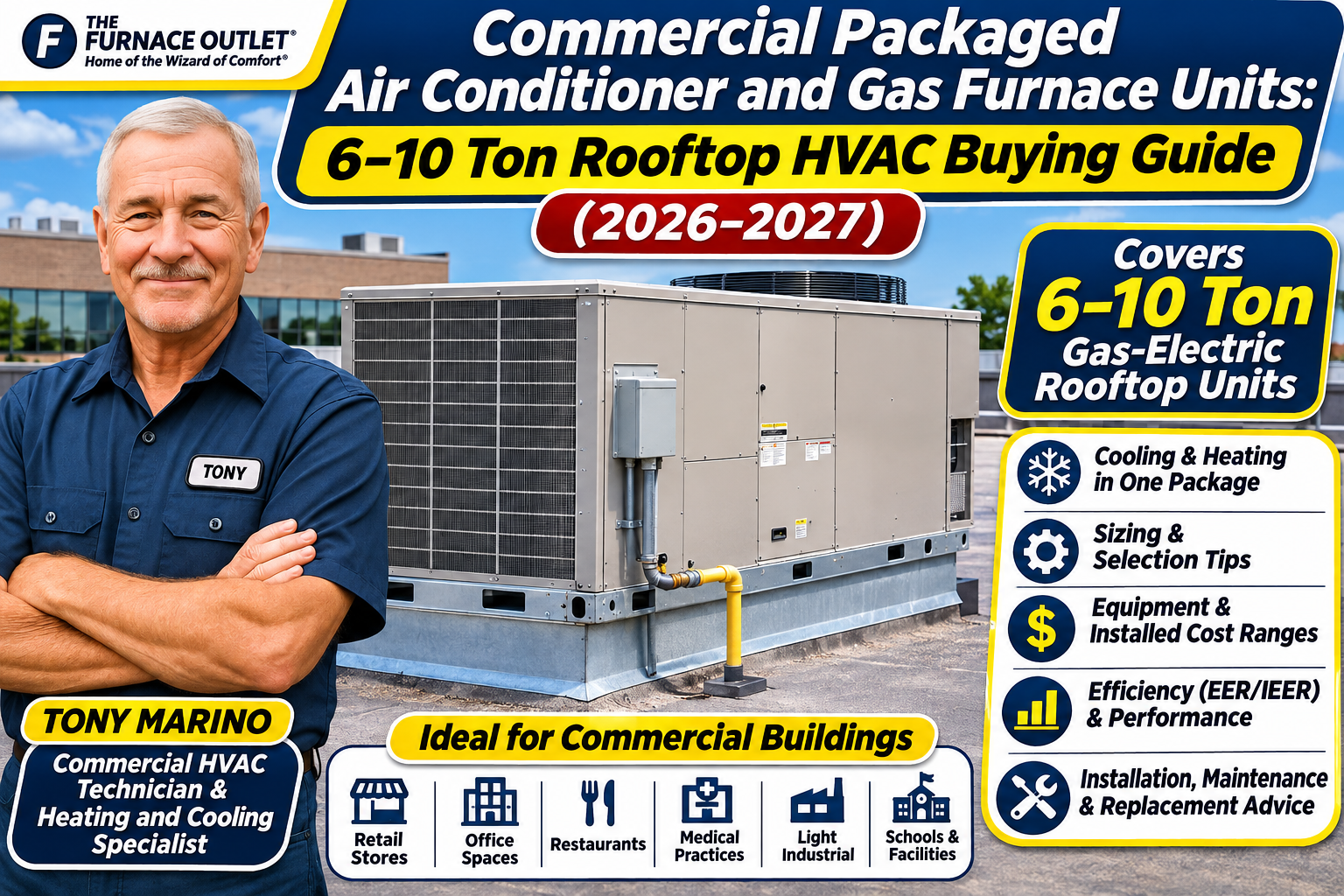
For many small and medium-sized commercial buildings, a 6–10-ton packaged gas-electric rooftop unit offers a practical combination of cooling capacity, gas heating, and relatively compact installation. These systems are widely used in retail stores, restaurants, professional offices, medical practices, workshops, and other commercial properties where centralized ducted heating and cooling are required.
After years of working around commercial heating and cooling equipment, I’ve learned that the best rooftop unit isn’t necessarily the most expensive model or the one with the highest advertised efficiency. The right choice depends on building load, ventilation requirements, heating demand, operating hours, ductwork, electrical service, and long-term maintenance costs. In this guide, I’ll explain how commercial packaged gas-electric systems work, what 6–10 tons of cooling actually means, and what building owners should consider before investing in new equipment.
A commercial packaged gas-electric unit combines an electric air-conditioning system and a gas-fired heating section inside a single outdoor cabinet. Unlike a conventional split system, which separates the indoor and outdoor components, a packaged unit contains the compressor, condenser, evaporator, supply-air blower, gas burners, heat exchanger, and associated controls in one assembly.
During summer, the refrigeration system removes heat from indoor air and transfers it outdoors. During winter, the gas furnace section burns natural gas or another approved fuel to warm the air distributed through the building’s ductwork. The two functions share the same air-distribution system but use different energy sources, allowing the building to benefit from electric cooling and gas heating.
Most commercial packaged systems are installed on rooftops, although some configurations allow ground-level installation. Rooftop placement preserves usable indoor space, reduces equipment visibility, and provides access for maintenance. However, it also introduces structural, lifting, weatherproofing, and service-access considerations that must be addressed during installation.
Commercial air-conditioning capacity is commonly expressed in tons, with one ton representing 12,000 BTUs per hour of nominal cooling capacity. A 6-ton system therefore represents approximately 72,000 BTUs per hour, while a 7.5-ton unit provides approximately 90,000 BTUs per hour. A 10-ton system represents approximately 120,000 BTUs per hour of nominal cooling capacity, although actual certified performance varies with equipment design and operating conditions.
These capacities are frequently used in light-commercial applications, but they shouldn’t be selected solely according to building square footage. A retail store with large windows, frequent door openings, and substantial lighting loads may require more cooling than an equally sized office with good insulation and limited occupancy. Restaurants can create even greater cooling and ventilation demands because of cooking equipment, exhaust systems, and internal heat gains.
I strongly recommend having a qualified mechanical contractor or engineer perform a commercial heating and cooling load calculation before selecting equipment. Proper sizing helps prevent excessive cycling, inadequate humidity control, high electricity consumption, and unnecessary wear on compressors and heating components.
Commercial packaged units in this capacity range are frequently found on smaller retail buildings, office suites, restaurants, professional practices, educational facilities, and light-industrial properties. They are particularly useful when a building requires both cooling and gas heating but doesn’t have sufficient interior mechanical space for separate equipment.
A 6-ton unit may suit a relatively modest commercial zone with moderate occupancy and manageable ventilation requirements. A 7.5-ton system can provide additional capacity for larger spaces or areas with higher internal heat loads, while a 10-ton unit may be appropriate for more demanding applications. However, these are general application examples rather than fixed building-size recommendations.
In some properties, installing two smaller rooftop units can be preferable to relying on one larger system. Multiple units may provide independent temperature control, accommodate different occupancy schedules, and offer partial cooling or heating availability if one unit requires service. The decision depends on building layout, operating requirements, installation costs, and the desired level of redundancy.
The heating section of a commercial gas-electric rooftop unit operates on principles similar to those of a residential gas furnace, although commercial equipment may have different capacities, controls, and safety arrangements. When the building thermostat or automation system calls for heat, the control sequence verifies required safety conditions before initiating ignition and opening the gas valve. The burners then generate heat, which transfers through the heat exchanger into the supply-air stream.
Combustion gases remain separated from the occupied-air distribution system and exit through the manufacturer’s approved venting arrangement. The supply blower circulates warmed air through the building’s ductwork, while safety controls monitor conditions such as flame presence, temperature limits, and abnormal combustion-related events.
Heating capacity must be evaluated separately from cooling tonnage because a 7.5-ton cooling unit may be available with multiple gas-heating input options. A building in a mild climate may require considerably less heating capacity than a similarly sized property in a northern state. Choosing the correct heating configuration helps reduce unnecessary fuel consumption and improves operating performance.
One of the most important differences between commercial rooftop units is how they regulate cooling capacity. A basic single-stage system generally operates at full cooling output whenever there is a demand, while two-stage equipment can provide a lower operating stage during lighter loads. More advanced systems may offer additional compressor stages or variable-capacity operation, depending on the manufacturer and product family.
Staged cooling can be particularly useful in commercial buildings where occupancy and internal heat gains change throughout the day. A retail store may experience relatively low cooling demand during early morning hours but much greater demand during afternoon shopping periods. Equipment that adjusts its cooling output can often maintain more consistent temperatures and reduce unnecessary full-capacity operation.
Variable-speed supply fans can provide additional benefits by adjusting airflow according to operating requirements. However, these features should be evaluated alongside maintenance complexity, control compatibility, and actual building usage. A sophisticated system delivers the greatest value when its capabilities match the property’s operating conditions.
Commercial packaged air conditioners are commonly evaluated using EER and IEER ratings rather than relying exclusively on the residential SEER2 measurements homeowners may recognize. EER measures cooling efficiency under specified operating conditions, while IEER, or Integrated Energy Efficiency Ratio, reflects performance across several operating points intended to represent varying cooling loads.
For commercial equipment, part-load efficiency can be especially important because rooftop systems frequently operate below their maximum cooling capacity. A unit with strong IEER performance may reduce electricity consumption during periods when full cooling output isn’t required, although actual savings depend on operating schedules, climate, ventilation demand, and control settings.
Federal commercial equipment efficiency requirements also depend on cooling capacity and heating configuration. The U.S. Energy Information Administration’s commercial equipment cost and efficiency analysis documents the efficiency framework for different categories of commercial rooftop air conditioners. Buyers should confirm current applicable standards and certified performance for the exact model rather than comparing ratings across unrelated equipment classes.
Several established manufacturers offer commercial packaged gas-electric systems suitable for this capacity range. Carrier, Trane, Lennox, York, Daikin, and Rheem are among the names commonly encountered when evaluating light-commercial rooftop equipment. Each manufacturer offers different product families, efficiency options, controls, heating configurations, and dealer-support arrangements.
Carrier’s WeatherMaster 48GE family, for example, includes gas-heating and electric-cooling rooftop units spanning 3–25 tons, with selected configurations offering staged cooling and advanced fan technology. The manufacturer’s WeatherMaster 48GE product information provides details about the current R-454B equipment platform.
Trane also offers commercial rooftop equipment through its Foundation and Precedent families, including gas-electric configurations suitable for light-commercial applications. Its official commercial rooftop unit catalog explains available equipment families and capacity ranges.
I wouldn’t automatically rank one manufacturer above every competitor without examining the specific model, installation requirements, and local service support. A dependable contractor with ready access to replacement parts can be more valuable than selecting a premium brand that has limited technical support in your area.
Commercial packaged equipment costs vary considerably according to capacity, manufacturer, efficiency, heating configuration, controls, and accessories. For preliminary U.S. budgeting, a 6-ton gas-electric rooftop system might involve approximately $9,000–$17,000 in equipment expense, while a 7.5-ton unit may fall around $11,000–$20,000. A 10-ton system can cost approximately $14,000–$25,000 or more, particularly when higher-efficiency equipment or advanced controls are selected.
These figures are illustrative planning allowances rather than verified national market averages or current manufacturer quotations. Commercial distributors frequently provide pricing through contractor accounts, and published equipment prices may exclude curb adapters, economizers, freight, controls, and installation accessories.
The complete installed cost is considerably more important than the equipment-only price. Depending on building conditions, a 6–10-ton commercial gas-electric replacement may require a working budget of approximately $18,000–$45,000 or more. Complex rooftop access, structural modifications, new ductwork, electrical upgrades, or building automation integration can push the total higher.
Before approving a project, I recommend obtaining a detailed written quotation that separates equipment, labor, lifting services, accessories, permits, and commissioning. This makes it easier to compare competing proposals and identify costs that might otherwise be overlooked.
Replacing a commercial rooftop unit involves more than disconnecting the old equipment and positioning a new cabinet. The contractor must evaluate roof access, structural loading, mounting arrangements, duct connections, gas piping, electrical service, drainage, and the safe removal of the existing system.
Crane or lifting services are often necessary because commercial rooftop units can weigh hundreds or thousands of pounds. The cost depends on building height, equipment weight, site access, crane capacity, lifting distance, and local labor conditions. A relatively straightforward lift may cost several hundred to a few thousand dollars, while complicated urban installations can be substantially more expensive.
The existing roof curb is another important consideration. If the replacement unit has different cabinet dimensions or duct openings, a properly engineered curb adapter may be required. I always recommend confirming equipment dimensions and curb compatibility before ordering the replacement, because a mismatch discovered on installation day can create delays and additional expenses.
Even a high-quality commercial rooftop unit can perform poorly when connected to inadequate ductwork. Supply and return ducts must be capable of handling the required airflow without excessive static pressure, leakage, or uneven distribution. Commercial buildings may also require specialized ventilation arrangements to meet occupancy and indoor air quality requirements.
Restricted airflow can increase operating stress, reduce cooling performance, and interfere with heating operation. Excessive airflow can create noise, poor humidity control, and unnecessary fan energy consumption. The contractor should verify that the selected unit’s fan performance is compatible with the actual duct-system resistance and required airflow.
When replacing an older unit, I recommend inspecting the existing ductwork rather than assuming it remains suitable. Changes in occupancy, renovations, additional partitions, or previous equipment modifications can alter the building’s heating and cooling requirements. Correcting airflow problems during replacement is often more economical than troubleshooting comfort complaints after the new equipment has been installed.
Many commercial rooftop units can be equipped with economizers that use suitable outdoor air to provide cooling when weather conditions allow. Instead of relying entirely on mechanical refrigeration, an economizer can introduce outdoor air through controlled dampers when temperature or enthalpy conditions make that approach beneficial.
This feature can reduce compressor operating hours in appropriate climates and building applications. However, economizers must be correctly installed, commissioned, and maintained to deliver meaningful savings. Stuck dampers, failed actuators, inaccurate sensors, or incorrect control settings can waste energy and create uncomfortable indoor conditions.
Fresh-air ventilation requirements must also be evaluated independently of economizer operation. Commercial buildings often need a specified amount of outdoor air based on occupancy and use. A qualified mechanical designer should confirm the applicable ventilation requirements and ensure that the rooftop unit can handle the resulting heating, cooling, and humidity loads.
The commercial HVAC industry is transitioning toward refrigerants with lower global warming potential, and newer rooftop equipment increasingly incorporates R-454B. This refrigerant has a substantially lower global warming potential than R-410A, which was widely used in earlier commercial cooling systems.
R-454B is classified as an A2L refrigerant, meaning it has lower toxicity and mild flammability under the applicable refrigerant safety classification. Equipment designed for R-454B incorporates appropriate safety provisions, and installation and servicing must follow the manufacturer’s requirements.
Carrier’s commercial packaged rooftop equipment information includes newer R-454B product families. When comparing equipment, ask the contractor to confirm the refrigerant, safety requirements, service procedures, and compatibility with the proposed installation.
An older R-410A rooftop unit shouldn’t simply be converted to R-454B by replacing its refrigerant. The refrigerant system and associated safety requirements must be appropriate for the equipment design.
Commercial packaged gas-electric systems typically require electrical service appropriate for their capacity and configuration. Depending on the model, equipment may be available for common commercial three-phase voltages such as 208/230V, 460V, or 575V. The exact electrical requirements must be verified using the manufacturer’s nameplate and installation documentation.
A replacement project may require electrical modifications if the new unit has different minimum circuit ampacity, overcurrent protection, or control requirements. Similarly, the gas piping and regulator arrangements must provide the correct fuel pressure and capacity for the selected heating section.
I recommend having both electrical and gas-service compatibility verified before equipment is ordered. Discovering that a building requires significant utility modifications after the rooftop unit arrives can delay installation and increase the final cost.
For long-term financial planning, commercial packaged rooftop units are often evaluated using a service-life range of approximately 15–20 years, although actual longevity varies substantially. Heavy operating schedules, extreme climates, corrosive environments, neglected maintenance, and poor installation can shorten equipment life.
Commercial systems frequently operate for longer daily periods than residential equipment, particularly in restaurants, retail facilities, and buildings with extended business hours. This increases the importance of routine maintenance and early identification of operating problems.
Regular filter replacement, coil cleaning, burner inspection, electrical testing, condensate maintenance, and control verification can help reduce unexpected failures. Commercial equipment should also be serviced according to manufacturer instructions and the building’s operating conditions rather than relying on a generic maintenance schedule.
Replacing a commercial rooftop unit can involve a substantial investment, so building owners understandably want to maximize the useful life of existing equipment. A relatively young system with a minor electrical or mechanical failure may be worth repairing, especially when replacement parts are readily available and the unit remains efficient.
However, repeated compressor failures, serious heat-exchanger damage, extensive corrosion, high repair costs, and persistent comfort complaints can make replacement more attractive. Older equipment may also consume considerably more electricity than modern high-efficiency alternatives, particularly when it lacks staged cooling or effective fan controls.
I recommend comparing the cost of repairs with the expected remaining equipment life and projected operating expenses. A major repair costing several thousand dollars may be difficult to justify when the unit is approaching the end of its useful life and additional failures are likely. A complete replacement analysis should also consider installation downtime, business disruption, and the value of improved reliability.
Commercial packaged HVAC equipment requires maintenance of both the refrigeration system and the gas-heating section. Cooling maintenance includes inspecting coils, compressors, fans, electrical connections, refrigerant-system performance, condensate drainage, and airflow. Heating maintenance includes evaluating burners, ignition components, flame sensing, heat exchangers, combustion performance, and safety controls.
Filters require particular attention because commercial buildings can experience substantial dust accumulation and extended operating hours. Dirty filters increase airflow resistance and can contribute to poor cooling, overheating, and unnecessary fan energy consumption.
I recommend establishing a preventive-maintenance agreement with a qualified commercial HVAC contractor. The service schedule should reflect equipment operating hours, occupancy, environmental conditions, and manufacturer recommendations. Critical facilities may require more frequent inspections or additional monitoring to reduce the risk of unexpected shutdowns.
Higher-efficiency commercial rooftop units can reduce electricity consumption, particularly in buildings with substantial annual cooling demand. However, the financial benefit depends on the difference in certified performance, local utility rates, operating schedules, and the price premium associated with the more efficient equipment.
For example, suppose an upgraded rooftop unit reduces annual electricity consumption by 5,000 kilowatt-hours. At an electricity rate of $0.16 per kilowatt-hour, the estimated annual electricity savings would be $800. If the efficiency upgrade increases the installed project cost by $4,000, the simple payback would be approximately five years before considering maintenance differences or other financial factors.
This is an illustrative calculation rather than a prediction for a particular building. A proper energy analysis should use actual operating hours, local weather data, electricity rates, and certified equipment performance. Gas-heating efficiency should also be evaluated separately from cooling efficiency.
How much space can a 10-ton commercial rooftop unit cool? A 10-ton system provides approximately 120,000 BTUs per hour of nominal cooling capacity, but the floor area it can serve depends on building insulation, occupancy, ventilation, windows, equipment loads, and climate. Commercial load calculations are necessary to determine whether that capacity is appropriate.
Does a commercial packaged unit include a gas furnace? A gas-electric packaged unit includes a gas-heating section and an electric cooling system within one outdoor cabinet. However, cooling-only packaged units, electric-heating configurations, and packaged heat pumps are also available, so buyers should verify the exact equipment category before purchasing.
Are 6–10-ton rooftop units available with three-phase power? Yes. Many commercial rooftop systems are designed for three-phase electrical service, with voltage options depending on the manufacturer and model. The building’s available electrical supply must be checked against the selected unit’s nameplate requirements.
Can a 7.5-ton rooftop unit replace an existing 10-ton system? It may be possible if a professional load calculation demonstrates that the smaller system can meet the building’s cooling and ventilation requirements. However, reducing capacity without evaluating the actual load can create serious comfort and performance problems.
Are commercial rooftop units expensive to maintain? Maintenance costs depend on equipment complexity, operating hours, accessibility, and the condition of the system. Regular preventive maintenance generally provides better financial protection than waiting for major failures, especially when equipment downtime can disrupt business operations.
When building owners ask me whether they should purchase a 6-ton, 7.5-ton, or 10-ton packaged gas-electric system, I recommend starting with the building’s actual heating, cooling, and ventilation requirements rather than the size of the existing equipment. A larger rooftop unit isn’t automatically better, and a premium model won’t deliver its advertised benefits if the ductwork, controls, or installation are unsuitable.
For 2026–2027, I would pay particular attention to certified cooling efficiency, staged operation, supply-fan technology, refrigerant requirements, heating capacity, and local service support. These factors can have a substantial influence on operating costs and equipment reliability over the next 15–20 years.
Most importantly, obtain detailed quotations from experienced commercial HVAC contractors and make sure each proposal includes the complete installation scope. A properly selected and professionally installed packaged gas-electric rooftop unit can provide dependable heating and cooling for years while helping control the long-term costs of operating your commercial property.
This article provides general educational information for U.S. commercial property owners and facility managers. Equipment capacities, efficiency ratings, costs, operating life, warranty terms, refrigerant requirements, and product availability vary by model and installation conditions. Pricing figures are illustrative planning estimates rather than verified contractor quotations. Commercial HVAC installations involve high-voltage electrical equipment, gas combustion systems, heavy rooftop machinery, refrigerants, and building-code requirements. Equipment selection, engineering, installation, commissioning, and servicing should be performed by appropriately qualified professionals.