Newsletter Subscribe
Enter your email address below and subscribe to our newsletter

HVAC made simple
By Tony Marino (Tony the Trusted Tech)
The Furnace Outlet | Updated October 2026
When winter temperatures drop and your heat pump seems to run from morning until night, it is natural to wonder whether something is wrong. Homeowners often expect heating equipment to operate in short cycles, similar to a traditional gas furnace. When the outdoor unit continues running for hours, concerns about electricity bills, compressor wear, and heating efficiency quickly follow. However, continuous heat pump operation during cold weather is not automatically a sign of equipment failure. In many situations, longer operating periods are exactly how an efficient heat pump is designed to maintain indoor comfort.
After decades of working with residential heating systems, I have learned that the most important question is not simply how long the heat pump runs. What matters is whether the equipment maintains the thermostat setting, delivers adequate heating, operates within its intended conditions, and avoids repeated protective shutdowns. A modern variable-speed heat pump may operate almost continuously at reduced capacity because steady operation can be more efficient and comfortable than frequent starts and stops. A conventional single-stage system behaves differently, but even those units may run for extended periods when outdoor temperatures fall.
Problems arise when the heat pump operates continuously without maintaining indoor temperature, consumes excessive electricity because of unnecessary auxiliary heating, or struggles against airflow restrictions, refrigerant-system faults, or inadequate heating capacity. In this guide, I will explain why heat pumps run longer during winter, how to distinguish normal operation from a developing problem, and what homeowners and HVAC technicians should investigate before replacing expensive components.
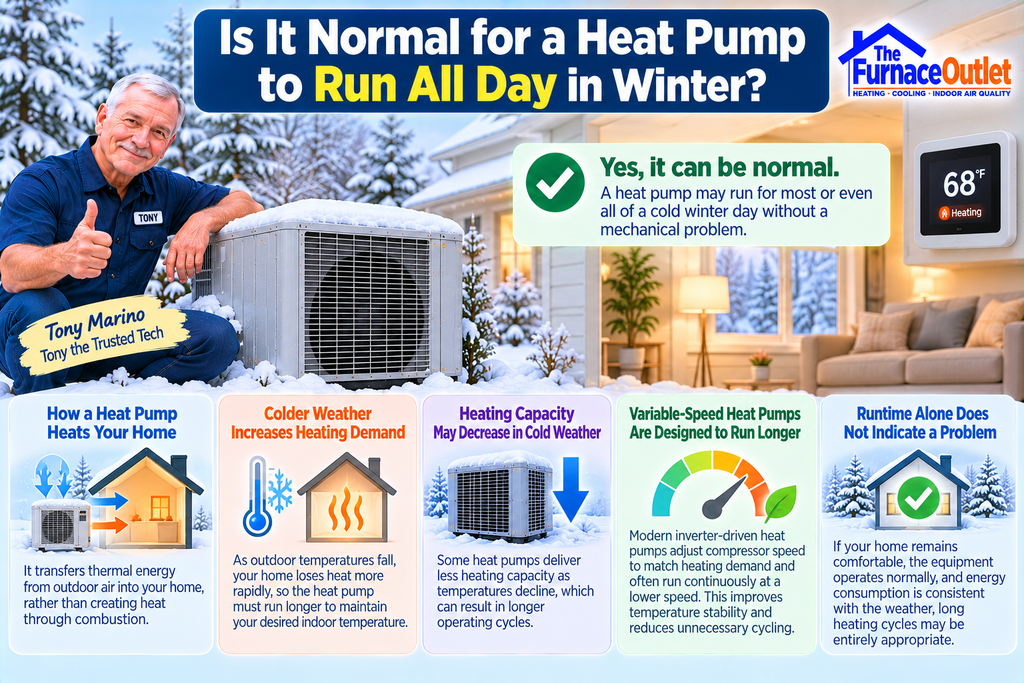
Yes, a heat pump can operate for most or even all of a cold winter day without necessarily having a mechanical problem. Unlike a conventional furnace that produces high-temperature heat through combustion, an air-source heat pump transfers thermal energy from outdoor air into the home. Its heating output and efficiency depend on outdoor conditions, equipment design, compressor operation, and the home’s heating demand.
As outdoor temperatures fall, the difference between indoor and outdoor temperatures increases, generally causing the building to lose heat more rapidly. At the same time, some heat pumps deliver less heating capacity as outdoor temperatures decline. The equipment must therefore operate longer to replace the heat escaping through walls, windows, ceilings, floors, and air leaks.
Modern inverter-driven heat pumps can adjust compressor speed to match heating demand. Rather than shutting down repeatedly, they may run continuously at a lower operating speed. This approach can improve temperature stability and reduce unnecessary cycling. Conventional single-stage heat pumps generally have less capacity modulation and may run nearly continuously during periods of high heating demand.
I do not judge winter heat pump performance by runtime alone. If the home remains comfortable, the equipment operates normally, and energy consumption is consistent with weather conditions, long heating cycles may be entirely appropriate.
Heat pumps rely on a refrigeration cycle that absorbs heat from outdoor air and releases it indoors. Even freezing air contains usable thermal energy, and properly designed cold-climate heat pumps can continue extracting that energy at temperatures well below 32°F.
However, colder weather creates two simultaneous challenges. The home’s heating demand usually increases, while the heat pump’s available heating capacity may decrease, depending on the model. The equipment may respond by increasing compressor speed, extending operating time, or activating supplemental heating when additional capacity is required.
The relationship between available heating capacity and building heat loss is especially important. At a particular outdoor temperature, the heat pump may deliver approximately the same amount of heat the building is losing. Near this operating balance point, long or continuous runtime can be expected. A heat pump operating continuously under these conditions is not necessarily inefficient. The relevant questions are whether it maintains indoor comfort and whether the equipment was appropriately selected for the home’s climate and heating requirements.
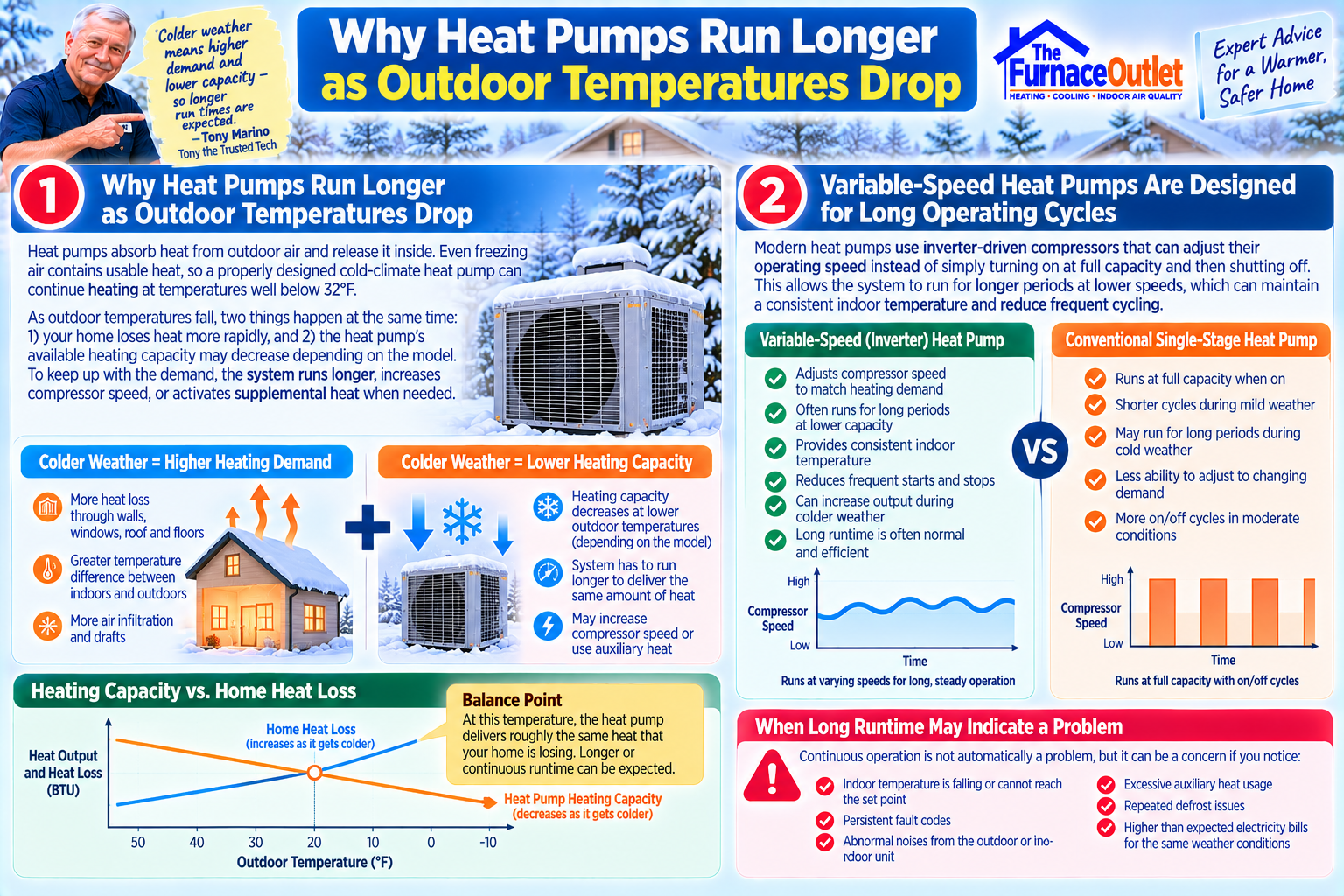
One of the biggest misunderstandings about modern heat pumps involves inverter-driven compressors. These systems can adjust their operating speed rather than running only at full output or remaining completely off. When heating demand is modest, a variable-speed heat pump may operate at reduced capacity for extended periods. This can maintain a consistent indoor temperature while avoiding frequent starts and stops. During colder weather, the compressor may increase its output and continue operating for much longer periods.
Homeowners accustomed to traditional furnaces may interpret this behavior as a problem because they expect the thermostat to shut the equipment off frequently. However, a long operating cycle can be normal when it matches the system’s intended control strategy. The warning sign is not continuous operation itself, but continuous operation accompanied by falling indoor temperatures, persistent fault codes, abnormal noises, or other evidence that the system is not delivering adequate heating.
During a severe cold spell, a home’s heating demand can rise substantially. Heat escapes through the building envelope, and uncontrolled outdoor air entering through gaps and openings adds to the heating load. A heat pump that cycles normally during mild weather may operate almost continuously when outdoor temperatures approach the conditions used for its design and sizing. The compressor may be working as intended, even though the operating pattern looks very different from autumn or early winter.
Some cold-climate heat pumps are specifically engineered to maintain strong heating capacity at low outdoor temperatures. Others experience more substantial capacity reductions and may depend on supplemental heating. The important consideration is whether the equipment’s documented low-temperature capacity is sufficient for the home’s actual heating requirements. Outdoor temperature alone cannot establish whether continuous operation is normal or abnormal.
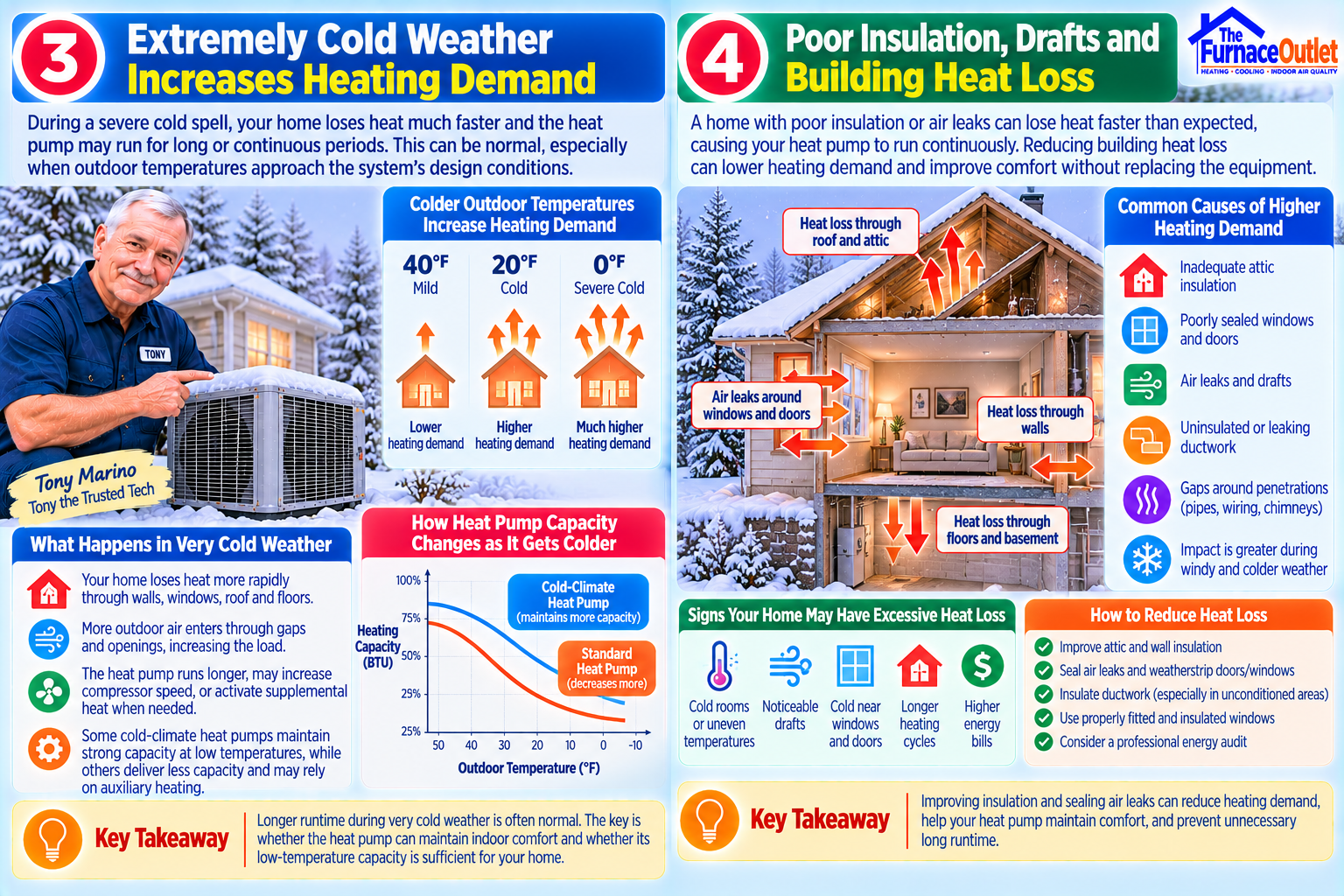
Sometimes the heat pump runs continuously because the home loses heat faster than expected. Inadequate attic insulation, poorly sealed windows, deteriorated weatherstripping, uninsulated ductwork, and air leakage can significantly increase winter heating demand. A house with substantial heat loss may require long heating cycles even when the heat pump is functioning correctly. Homeowners may notice cold rooms, drafts near doors and windows, or temperature differences between floors.
The problem becomes more noticeable during windy weather because air infiltration can increase heating demand. Heat loss through poorly insulated building surfaces also becomes more significant as outdoor temperatures decline.
I recommend considering the building as part of the heating system. Improving insulation, sealing appropriate air leaks, and correcting duct losses can reduce heating demand without replacing the heat pump. A qualified energy auditor or HVAC contractor can help identify building-envelope improvements and determine whether the installed equipment is properly matched to the home.
A heat pump must move sufficient indoor air across its heat exchanger to deliver heating effectively. A heavily clogged air filter, blocked return-air grille, restrictive ductwork, or malfunctioning blower can interfere with this process. When indoor airflow is inadequate, heat transfer may deteriorate, room temperatures may become uneven, and the system may struggle to satisfy the thermostat. Severe restrictions can also contribute to abnormal refrigeration conditions or protective shutdowns.
Homeowners may notice weak airflow from supply registers, unusual blower sounds, or rooms that remain cold despite extended equipment operation. An accessible filter should be inspected and maintained according to manufacturer instructions. Supply registers and return-air openings should remain unobstructed. However, a dirty filter should not automatically be blamed for every long-running heat pump. A technician should evaluate blower operation, airflow requirements, duct restrictions, and heating performance before drawing conclusions.
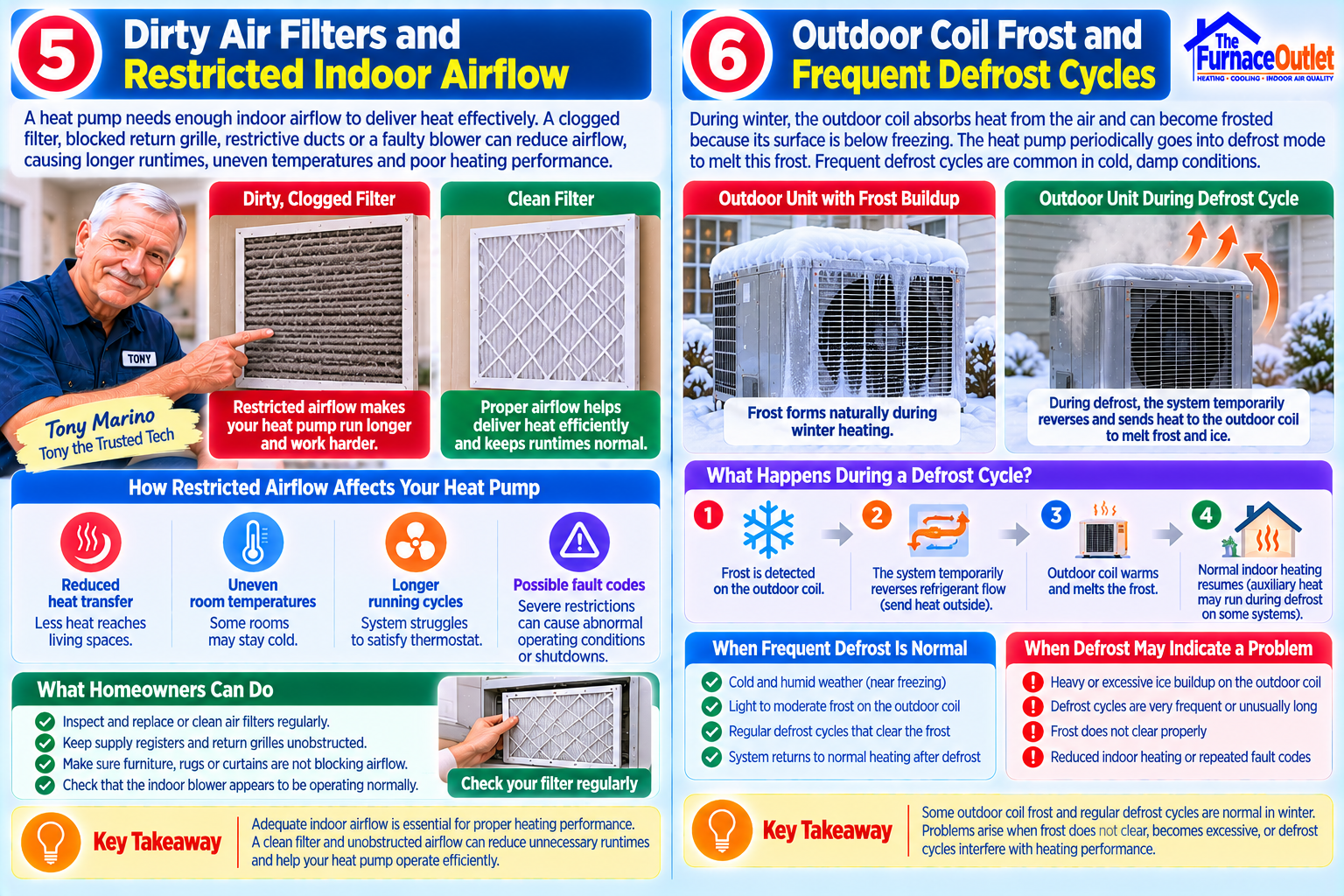
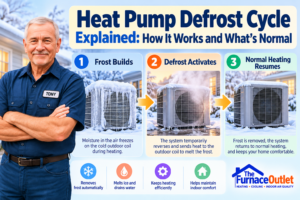
During winter heating, the outdoor coil absorbs thermal energy from surrounding air. Because its surface can operate below freezing, moisture may accumulate as frost. A properly functioning heat pump periodically removes excessive frost through automatic defrost operation. In many conventional systems, the refrigeration cycle temporarily reverses so heat can be directed toward the outdoor coil. During defrost, normal indoor heating may be reduced temporarily. Depending on equipment configuration, electric auxiliary heating may operate to maintain comfort.
Damp weather near freezing can encourage frost formation and make defrost events more noticeable. However, frequent defrost operation is not automatically evidence of a malfunction. Problems arise when frost does not clear properly, the outdoor coil becomes heavily encased in ice, or defrost cycles occur abnormally and interfere with heating performance. A technician should evaluate sensor readings, defrost controls, outdoor airflow, refrigerant conditions, and the manufacturer’s intended operating sequence before replacing components.
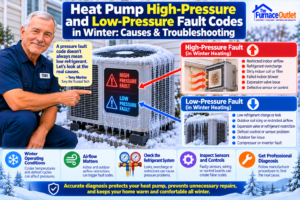
A heat pump relies on an appropriate refrigerant charge and properly functioning refrigeration components to absorb and transfer heat efficiently. A significant refrigerant leak, restriction, metering-device problem, or another refrigeration abnormality can reduce heating capacity. The heat pump may continue operating because the thermostat remains unsatisfied, even though the system is not delivering its expected output.
Possible symptoms include prolonged heating cycles, declining indoor comfort, unusual coil conditions, and protective fault codes. However, these symptoms can also result from airflow problems, incorrect controls, or insufficient equipment capacity. I would never recommend adding refrigerant simply because a heat pump runs continuously. Refrigerant charge must be evaluated using manufacturer-approved procedures and relevant operating measurements.
If a leak is confirmed, the cause should be investigated and corrected by qualified personnel following applicable refrigerant-handling requirements.
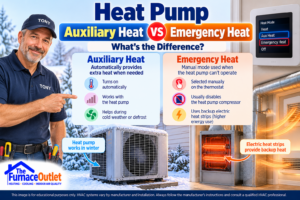
Many ducted heat pump systems include electric resistance heating elements that provide supplemental heating during demanding conditions. Other installations use a gas or oil furnace as part of a dual-fuel arrangement. Auxiliary heating may be required when the heat pump’s available capacity is insufficient to maintain the desired indoor temperature. If supplemental heat fails to operate when needed, the compressor may continue running while indoor temperature gradually falls. Potential causes include incorrect thermostat staging, outdoor temperature lockout settings, defective relays or sequencers, damaged heat strips, interrupted electrical supply, or safety-control problems.
A thermostat displaying “AUX” does not necessarily prove that backup heating equipment is energized. It may indicate only that supplemental heating has been requested. Not every heat pump includes auxiliary heating. Some ductless systems operate without resistance backup, and certain cold-climate installations are designed to cover most heating demand without it. Professional diagnosis must begin by identifying the installed equipment and confirming when backup heating should operate.
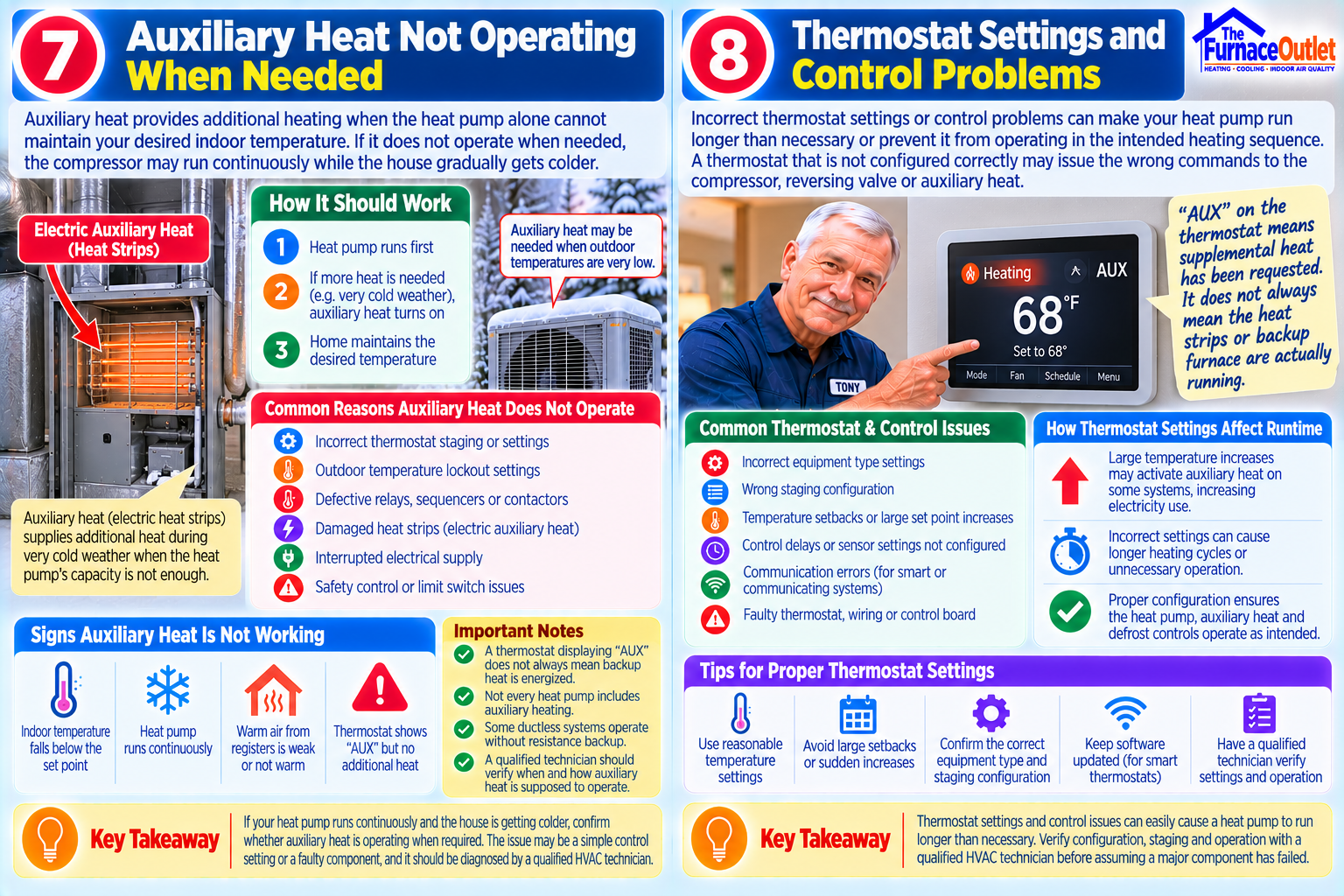
Incorrect thermostat settings can make a heat pump run longer than necessary or prevent it from operating according to its intended heating sequence. A thermostat configured for the wrong equipment type may issue incorrect compressor, reversing-valve, or auxiliary heating commands. Problems can also arise after thermostat replacement when staging settings, sensor configurations, or communication requirements are not correctly established.
Large thermostat temperature increases may activate auxiliary heating on some systems, potentially increasing electricity consumption. Other systems use more sophisticated controls that determine heating stages based on temperature differences, operating time, and equipment conditions. A thermostat displaying “Heating” does not guarantee that the equipment is delivering adequate heat. It may simply indicate that heating has been requested.
A qualified technician should verify thermostat configuration, operating commands, equipment response, and applicable control delays before concluding that a major component has failed.
An undersized heat pump may struggle to meet the building’s heating demand during very cold weather. Even when operating continuously at its available capacity, it may be unable to maintain the desired indoor temperature. This problem can result from inaccurate load calculations, equipment selected primarily for cooling performance, renovations that increased conditioned space, or insufficient consideration of local winter design conditions. However, continuous runtime alone does not prove undersizing. A correctly sized variable-speed heat pump may also operate for long periods during cold weather.
A professional assessment should compare the home’s calculated heating load with the equipment’s documented heating capacity at relevant outdoor temperatures. Replacement decisions should be based on proper load calculations and manufacturer performance data rather than simply selecting a larger unit. Oversizing can introduce its own comfort and efficiency problems.
The outdoor fan moves air across the outdoor coil during normal heating, allowing refrigerant to absorb heat from the environment. If the fan fails when airflow is required, heating capacity can decline and the system may develop abnormal operating conditions. Potential causes include a defective motor, damaged wiring, electronic control faults, ice interference, or mechanical obstructions.
Snowdrifts, leaves, and poorly maintained clearances can also restrict outdoor airflow. However, the outdoor fan commonly stops during certain defrost sequences. A stationary fan observed during defrost is not automatically evidence of failure. A technician should determine whether the equipment is in heating mode, performing defrost, or responding to a protective control before diagnosing a fan problem. Homeowners should never reach through the fan grille, rotate blades manually, or attempt to chip ice away from moving components.
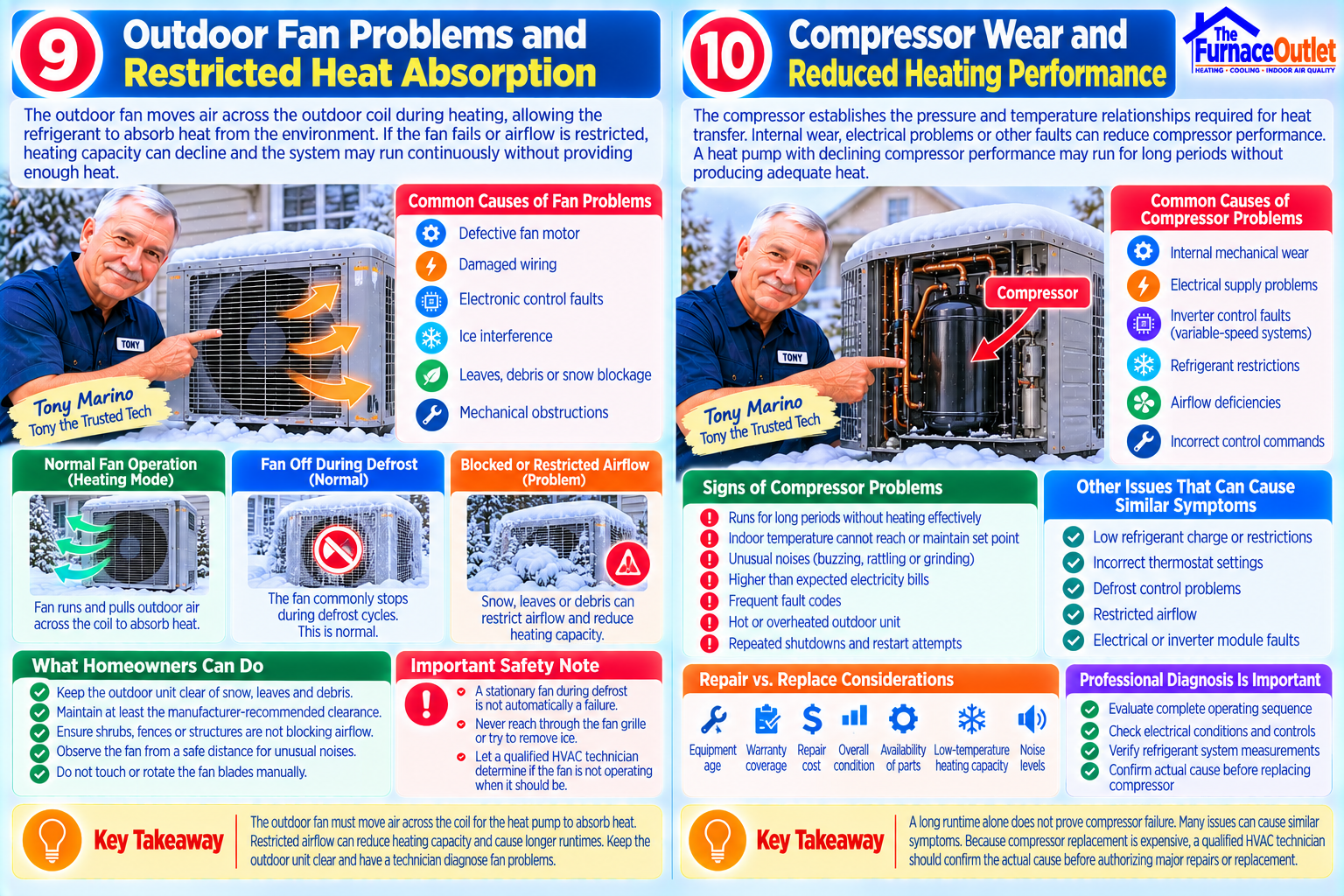
The compressor establishes the pressure and temperature relationships required for heat transfer. Internal mechanical deterioration, electrical problems, or abnormal operating conditions can reduce compressor performance or interfere with reliable operation. A heat pump with declining compressor performance may run for extended periods without producing adequate heat. However, a long operating cycle is not sufficient evidence of compressor failure.
Electrical supply problems, inverter-control faults, refrigerant restrictions, airflow deficiencies, and incorrect control commands can produce overlapping symptoms. A technician should evaluate the complete operating sequence, including compressor commands, electrical conditions, relevant refrigeration measurements, and manufacturer-specific diagnostic information. Compressor replacement can be expensive and generally involves sealed refrigeration-system work. Confirming the actual cause before authorizing replacement is essential.
A heat pump running longer will generally consume more total electricity if its average electrical demand remains unchanged. However, runtime alone does not determine energy consumption. A variable-speed heat pump operating continuously at low power may use less electricity than another system that cycles frequently at higher power. Total energy use depends on compressor speed, efficiency, outdoor temperature, heating demand, auxiliary heat operation, and other factors.
Electric resistance auxiliary heating can significantly affect winter electricity consumption because it generally delivers less heat per unit of electricity than an efficiently operating heat pump. A sudden increase in electricity use should therefore be evaluated alongside outdoor weather, thermostat settings, backup heating operation, and building heat loss. I recommend comparing energy consumption across similar weather conditions rather than judging performance solely by the number of hours the outdoor unit operates.
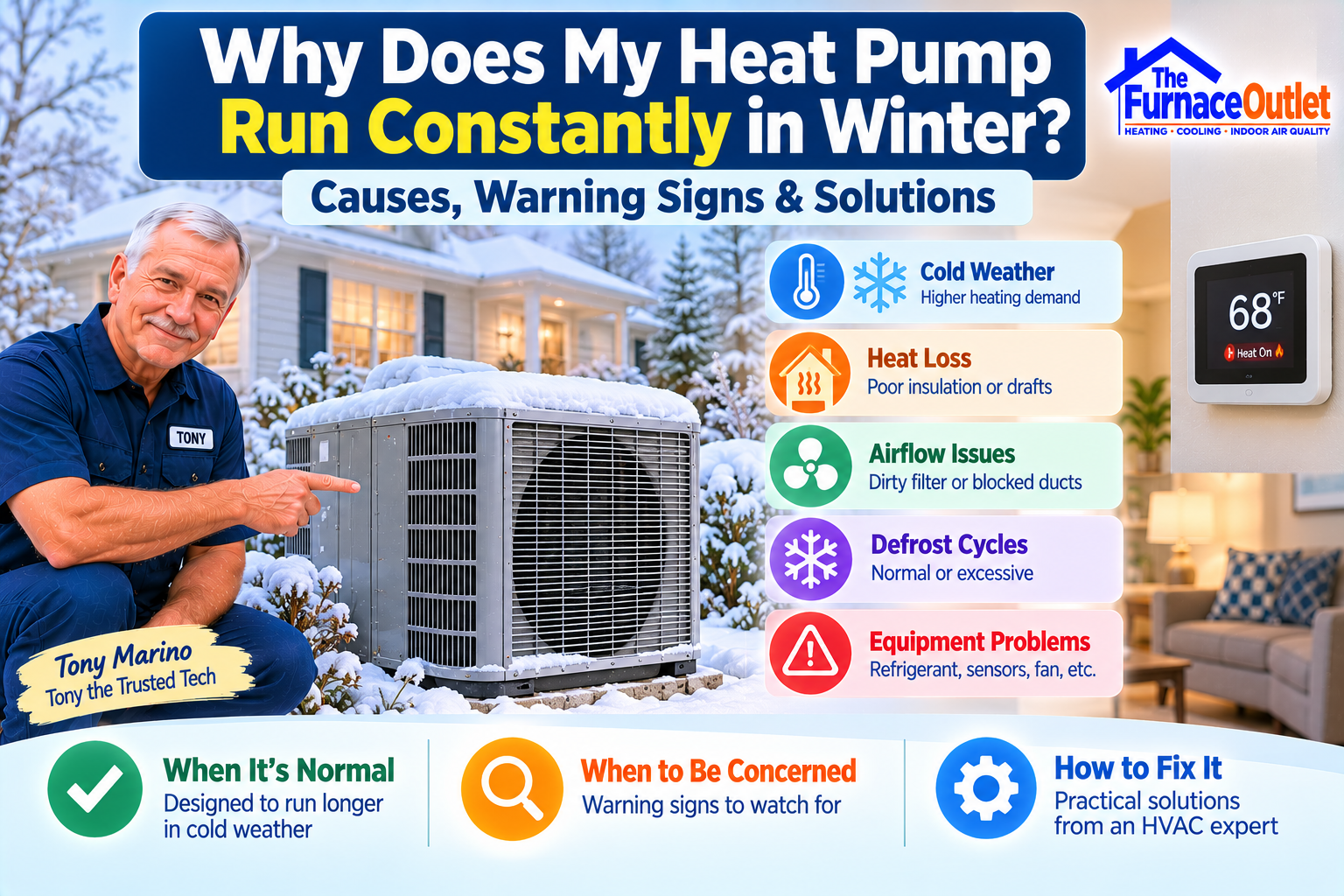
Continuous operation becomes more concerning when the indoor temperature cannot reach or maintain the thermostat setting. A system that runs for hours while the house grows colder may have insufficient heating capacity or an operating fault. Other warning signs include persistent fault codes, abnormal outdoor icing, repeated protective shutdowns, unusual compressor noises, weak indoor airflow, and auxiliary heating that appears to operate unexpectedly or excessively. A sudden change in operating behavior also deserves attention. If a heat pump previously maintained comfort under similar weather conditions but now struggles, the difference may indicate a developing problem.
Burning odors, smoke, sparking, or repeated breaker trips require prompt professional attention. These symptoms may indicate electrical hazards rather than ordinary heating-performance problems. I recommend evaluating these warning signs together rather than diagnosing a failed component based on runtime alone.
Begin by checking whether the thermostat’s measured indoor temperature is stable, rising, or falling during a sustained heating request. Confirm that the thermostat is set to the intended heating mode and review any displayed auxiliary heat indicators or fault messages. Inspect the accessible indoor air filter and maintain it according to manufacturer instructions. Keep supply registers and return-air grilles unobstructed.
Observe the outdoor unit from a safe distance for excessive snow accumulation, blocked airflow, unusual icing, or abnormal noises. Remember that temporary fan stoppage and visible vapor can occur during normal defrost. Record the outdoor weather conditions, how long the equipment appears to operate, and whether the home remains comfortable. This information can help a technician distinguish normal winter operation from an equipment fault. Do not remove electrical panels, manipulate refrigerant lines, bypass safety controls, or repeatedly reset protective devices. If severe mechanical noises, burning odors, smoke, or electrical faults occur, stop operating the affected equipment safely and arrange professional assistance.
A reliable diagnosis begins with identifying the exact heat pump model, compressor type, thermostat configuration, and installed backup heating equipment. The technician should establish whether the system is designed for variable-speed continuous operation or conventional cycling. Next, the technician should compare the thermostat setting with actual indoor conditions and determine whether the equipment is satisfying the heating demand. Outdoor temperature, building heat loss, and the manufacturer’s documented heating capacity are important considerations.
The investigation may include evaluating indoor airflow, outdoor fan operation, defrost performance, refrigerant-system conditions, compressor operation, and diagnostic fault history. Where auxiliary heating is installed, the technician should verify that supplemental stages operate according to the intended control sequence. If the equipment appears to function correctly but cannot maintain comfort, a heating-load assessment may be necessary. The completed diagnosis should explain whether the continuous runtime is normal, caused by inadequate equipment performance, or driven by excessive building heat loss.
Continuous operation by itself does not justify replacing a heat pump. Many systems are designed to operate for long periods, particularly during demanding winter conditions. If the problem involves a dirty filter, incorrect thermostat configuration, defective sensor, isolated electrical component, or airflow restriction, a relatively straightforward repair or adjustment may restore normal performance.
More expensive failures involving a compressor, inverter module, reversing valve, or extensive refrigerant-system damage require a broader assessment of equipment age, warranty coverage, repair cost, and overall condition. For older systems with repeated major failures, poor efficiency, unavailable parts, or inadequate cold-weather capacity, replacement may deserve consideration. When selecting new equipment, compare documented heating capacity at relevant outdoor temperatures, seasonal efficiency, sound ratings, backup heating requirements, and local service support. Proper sizing and installation are essential.
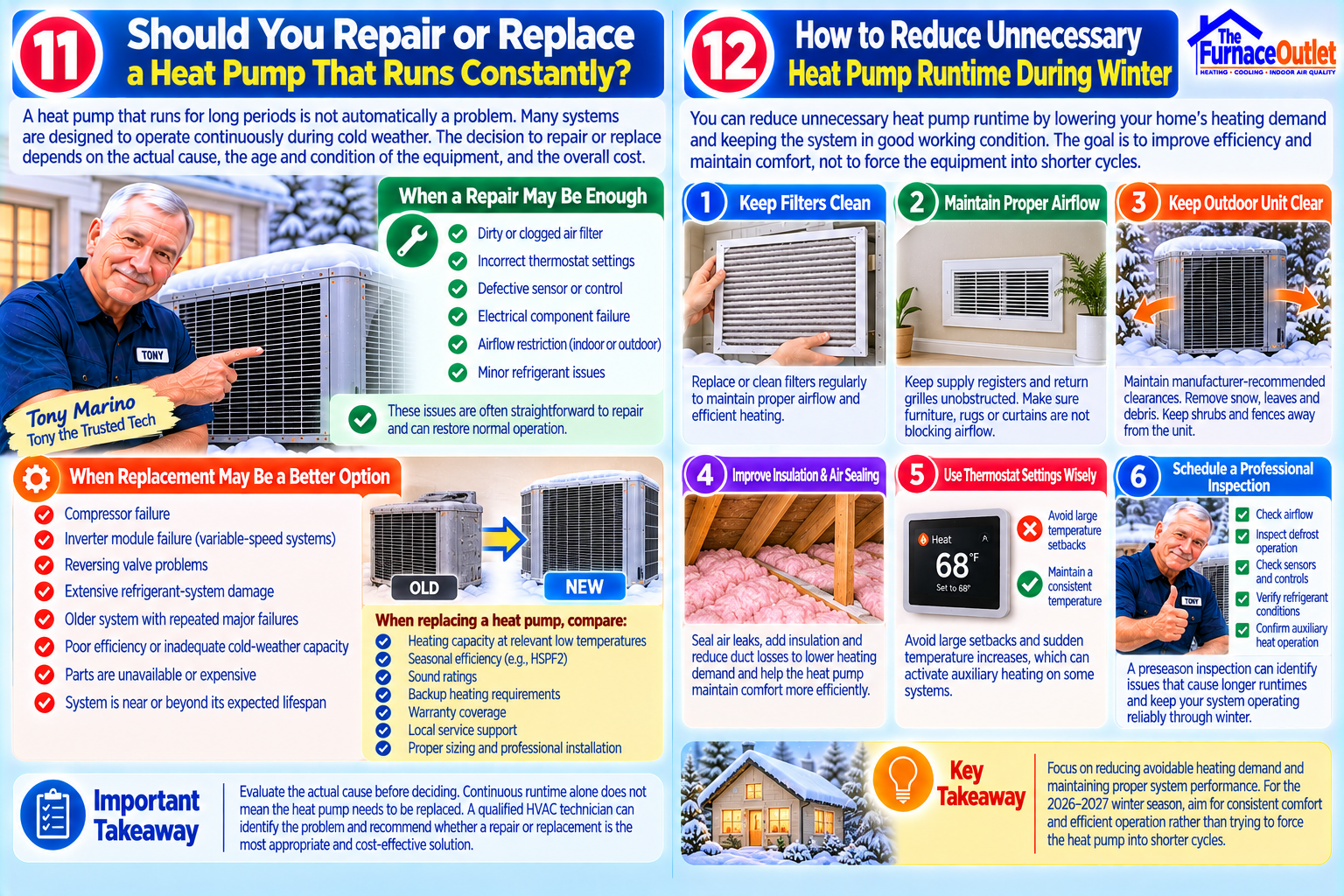
Reducing unnecessary runtime begins with addressing avoidable heating demand and maintaining proper equipment performance. Keep indoor filters clean, preserve airflow through supply and return openings, and maintain manufacturer-required clearances around the outdoor unit. Building-envelope improvements can also make a substantial difference. Appropriate air sealing, insulation upgrades, and correction of duct leakage can reduce heat loss and help the system maintain comfort more efficiently.
Thermostat settings should reflect the equipment’s intended operating strategy. Large temperature setbacks and sudden increases may not provide the expected savings on systems that activate electric auxiliary heating during recovery. A professional preseason inspection can identify airflow deficiencies, defrost problems, sensor issues, and other conditions that reduce heating performance. For the 2026–2027 winter season, focus on maintaining comfort and efficient operation rather than trying to force the heat pump into shorter cycles.
Not necessarily. Continuous operation may be normal during high heating demand, especially with variable-speed equipment. Concern increases when the system cannot maintain indoor temperature or develops other warning signs.
There is no universal temperature. Operating limits and heating capacity vary by manufacturer and model. Cold-climate heat pumps may operate at temperatures well below freezing.
No. Insufficient refrigerant is one possible cause of poor heating performance, but continuous runtime can also result from normal operation, building heat loss, airflow problems, or inadequate system capacity.
A properly functioning heat pump designed for extended operation should not be considered defective simply because it runs for long periods. Abnormal electrical, mechanical, or refrigeration conditions are more important concerns.
Possible causes include excessive building heat loss, inadequate equipment capacity, airflow restrictions, refrigerant-system problems, defrost faults, or unavailable auxiliary heating. Professional diagnosis should identify the actual cause.
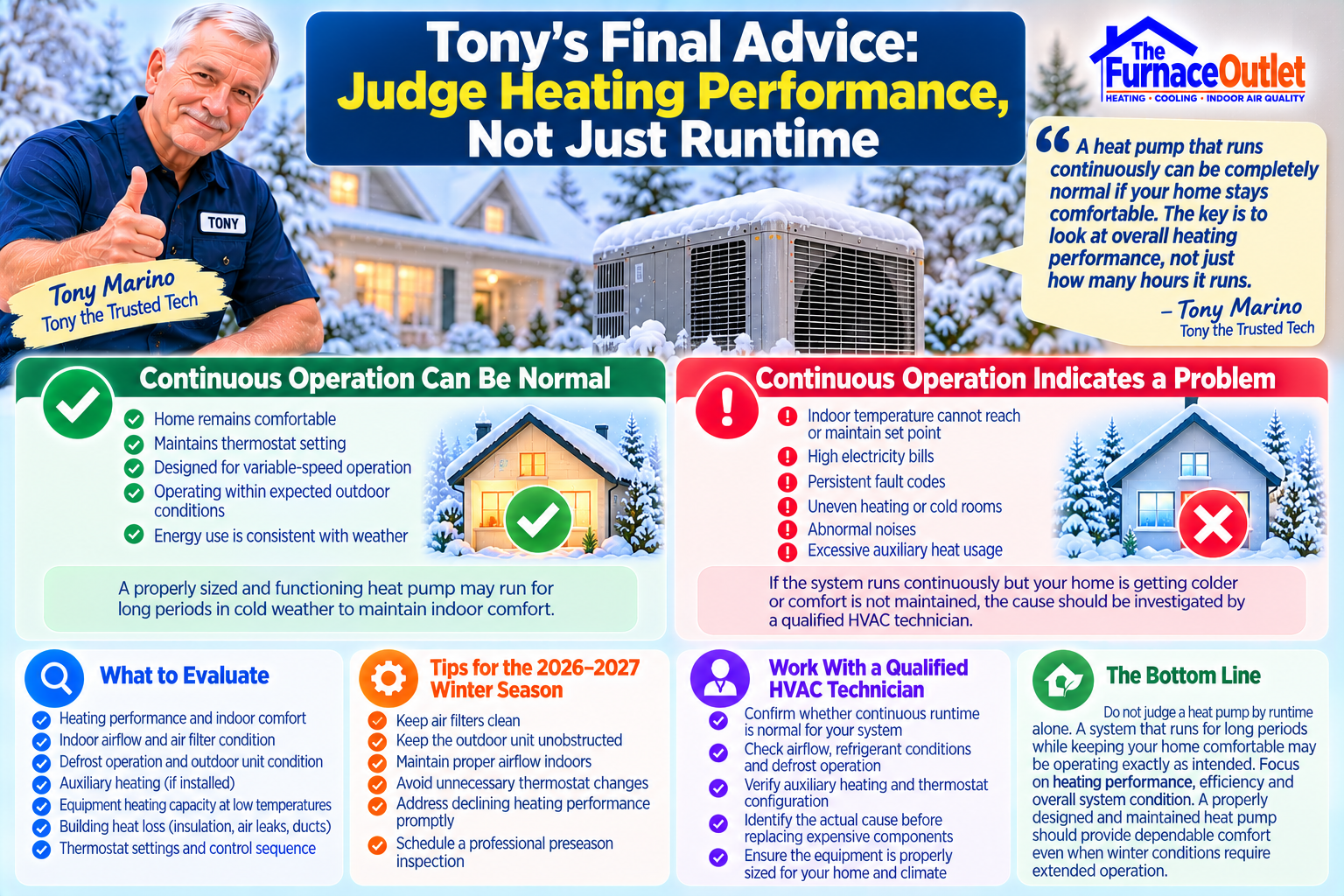
When a homeowner tells me their heat pump never seems to shut off during winter, I do not immediately assume the compressor is wearing out or the system is inefficient. I first want to know whether the house remains comfortable, whether the equipment is designed for variable-speed operation, and how outdoor conditions compare with the system’s documented heating capacity.
A heat pump that runs continuously while maintaining indoor temperature may be operating exactly as intended. A system that runs continuously while the indoor temperature falls requires a different investigation. Airflow restrictions, abnormal defrost operation, refrigerant problems, thermostat configuration, insufficient backup heating, and excessive building heat loss can all contribute to the same complaint. My recommendation is to evaluate heating performance, airflow, defrost operation, auxiliary heating, equipment capacity, and building heat loss before replacing expensive components. A qualified HVAC technician should distinguish normal winter runtime from a genuine performance problem and recommend repairs only after confirming the cause.
For the 2026–2027 winter season, maintain clean filters, keep the outdoor unit unobstructed, avoid unnecessary thermostat adjustments, and address declining heating performance promptly. A properly designed and maintained heat pump should provide dependable comfort even when winter conditions require long operating periods.
This article provides general educational information and does not replace professional HVAC diagnosis or service. Heat pumps contain high-voltage electrical components, pressurized refrigerants, moving fans, and manufacturer-specific safety controls. Homeowners should not remove service panels, manipulate refrigerant connections, bypass protective devices, or attempt electrical testing. Serious mechanical noises, electrical hazards, or repeated equipment shutdowns require qualified professional attention.
U.S. Department of Energy — Air-Source Heat Pumps: https://www.energystar.gov/products/air_source_heat_pumps
U.S. Department of Energy — Heat Pump Systems: https://www.energy.gov/heat-pumps
U.S. Department of Energy — Operating and Maintaining Your Heat Pump: https://www.epa.gov/burnwise/heat-pumps
ENERGY STAR — Air-Source Heat Pumps: https://www.energystar.gov/products/air_source_heat_pumps
ENERGY STAR — Heating and Cooling Maintenance Checklist: https://www.energystar.gov/saveathome/heating-cooling/maintenance-checklist
Northeast Energy Efficiency Partnerships — Cold Climate Air-Source Heat Pump List: https://ashp.neep.org/
These references provide general information about heat pump operation, efficiency, maintenance, and cold-climate performance. Equipment-specific operating limits, heating capacity, control strategies, and diagnostic procedures should always be confirmed using the applicable manufacturer’s documentation.