Newsletter Subscribe
Enter your email address below and subscribe to our newsletter

HVAC made simple
By Tony Marino (Tony the Trusted Tech) | The Furnace Outlet | Updated October 2026
If you have ever watched your outdoor heat pump on a cold winter morning and noticed the fan suddenly stop, steam rise from the cabinet, or water begin dripping underneath the unit, you may have wondered whether something was wrong. These changes can look alarming, especially when the heat pump has been running normally and suddenly begins making unfamiliar sounds. In many cases, however, you are witnessing a completely normal process known as the heat pump defrost cycle.
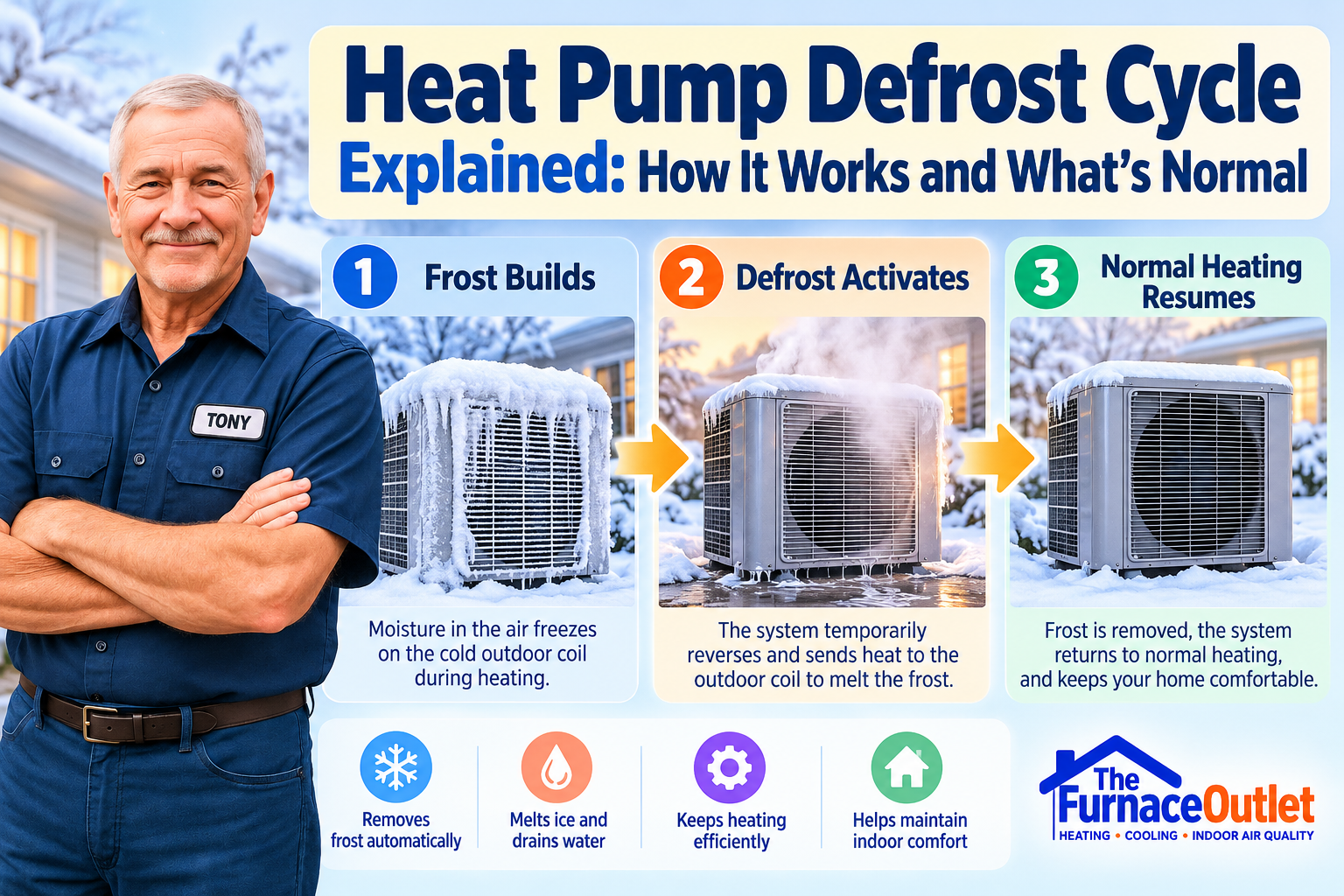
An air-source heat pump extracts heat from outdoor air and transfers it indoors to warm your home. During winter, the outdoor coil can become cold enough for moisture in the surrounding air to freeze on its surface. A thin layer of frost is expected under certain weather conditions, but excessive frost interferes with airflow and reduces the system’s ability to absorb heat. To prevent this buildup from becoming a serious performance problem, many heat pumps automatically enter a defrost cycle that warms the outdoor coil and melts accumulated frost.
After decades of working with heating and cooling equipment, I have found that homeowners often confuse normal defrost behavior with mechanical failure. A brief whooshing noise may be mistaken for a refrigerant leak, steam may be mistaken for smoke, and water beneath the outdoor unit may be interpreted as a plumbing problem. Understanding what the system is actually doing can prevent unnecessary worry and help homeowners recognize situations that genuinely require professional attention.
In this guide, I will explain how a heat pump defrost cycle works, why frost develops, what homeowners should expect during normal operation, how defrost controls make their decisions, and which warning signs suggest a malfunction. I will also explain how to distinguish ordinary winter behavior from sensor problems, reversing-valve faults, drainage restrictions, and other conditions that can affect reliable heating.
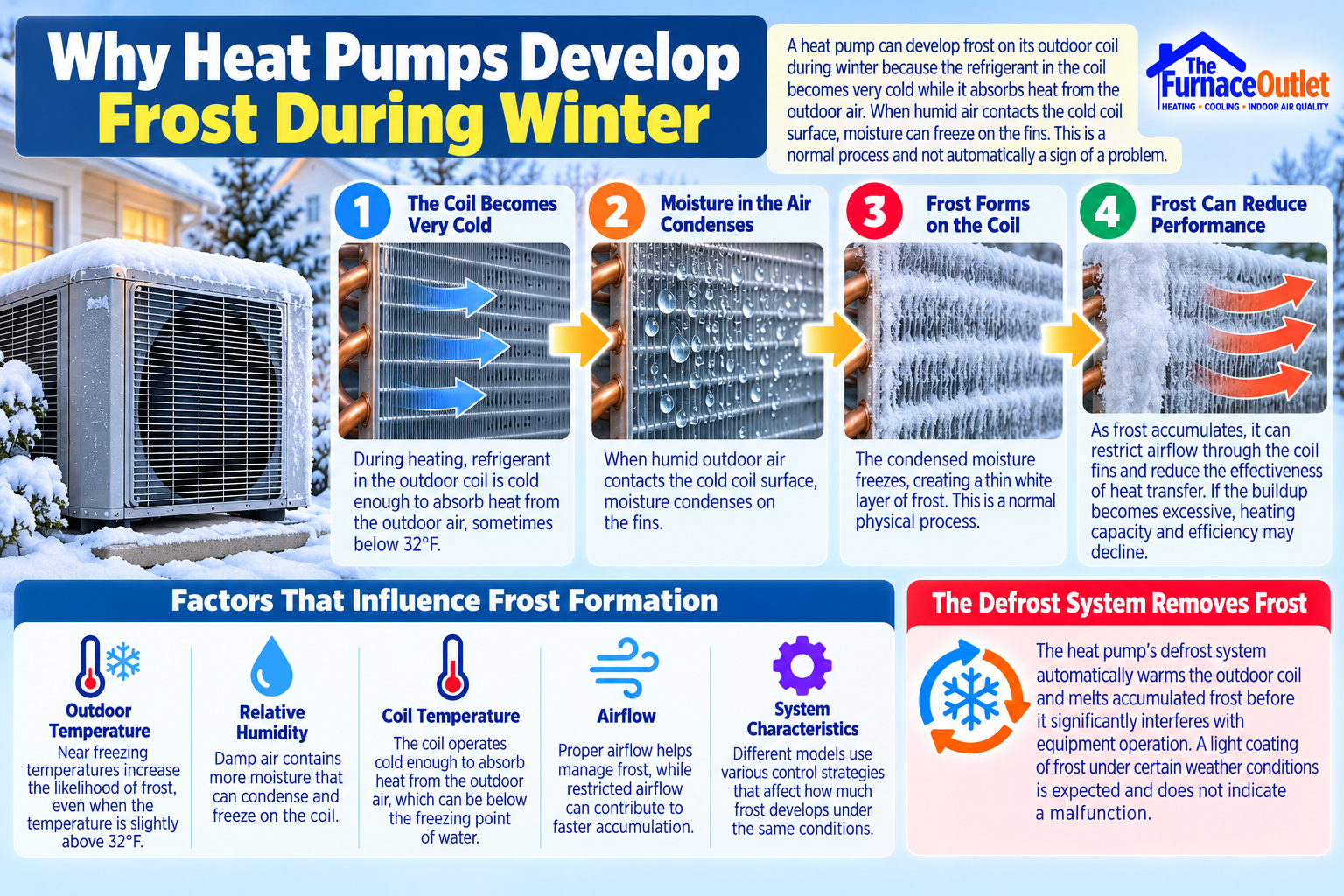
During normal heating operation, an air-source heat pump uses its outdoor coil to absorb thermal energy from the surrounding air. Refrigerant circulating through the coil operates at a temperature low enough to collect heat from that outdoor environment. Under suitable conditions, the coil surface may become colder than the freezing point of water, even when the outdoor air temperature is slightly above 32°F. When humid outdoor air contacts the cold coil, moisture can condense and freeze on its surface. The resulting frost may initially appear as a light white coating across the coil fins. This is a normal physical process and does not automatically indicate a refrigerant problem, defective component, or inadequate installation.
Frost formation depends on several factors, including outdoor temperature, relative humidity, coil temperature, airflow, and the heat pump’s operating characteristics. Damp weather near freezing can sometimes produce substantial frost because the air contains moisture that readily freezes on the cold coil. Extremely cold but relatively dry conditions may produce less visible frost.
As frost accumulates, it can restrict airflow through the coil fins and reduce the effectiveness of heat transfer. If the buildup becomes excessive, heating capacity and efficiency may decline. The defrost system exists to remove this frost before it significantly interferes with equipment operation.
Most conventional air-source heat pumps use a process called reverse-cycle defrost. During ordinary heating, the outdoor coil absorbs heat while the indoor coil releases heat into the home. During defrost, the refrigeration system temporarily changes its operating configuration so warm refrigerant can flow through the outdoor coil and melt accumulated frost.
The sequence generally begins when the equipment’s control system determines that defrost is necessary. Depending on the model, this decision may involve outdoor-coil temperature, ambient temperature, compressor operating time, pressure-related information, or other manufacturer-specific inputs.Once defrost begins, the reversing valve changes the refrigerant-flow arrangement. The outdoor coil temporarily operates as a condenser, receiving heat from the refrigeration system. The outdoor fan commonly stops during this period to reduce heat loss from the coil and help the accumulated frost melt more effectively. As the coil warms, frost turns into liquid water and drains through the outdoor cabinet. Homeowners may notice water dripping beneath the unit or vapor rising from the coil. The compressor commonly continues operating during reverse-cycle defrost, although the exact sequence varies between equipment designs.
When the controller determines that defrost is complete, the heat pump returns to normal heating operation. The reversing valve changes back to the appropriate heating configuration, the outdoor fan resumes operation as required, and the system continues delivering heat indoors.
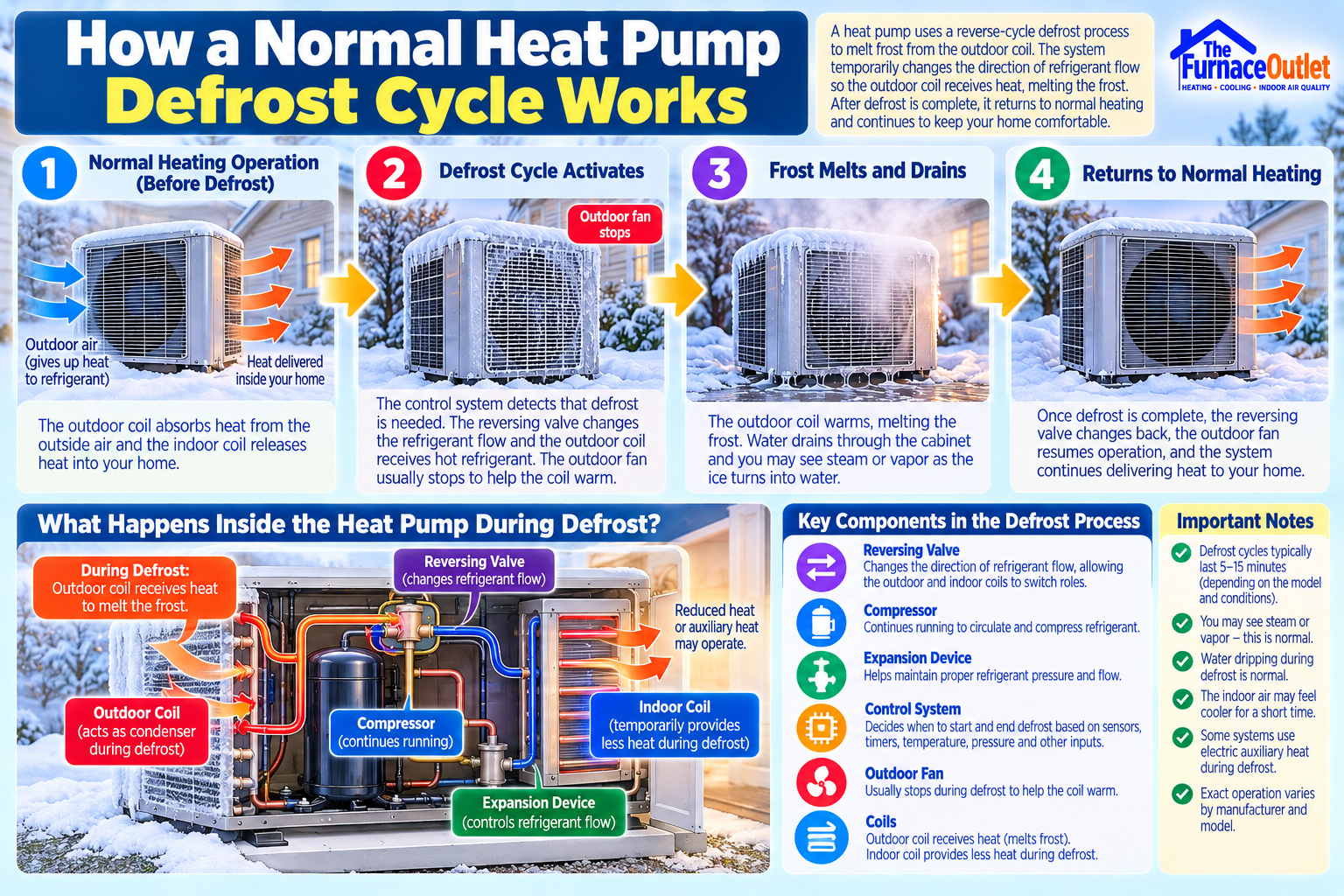
The reversing valve is one of the most important components involved in conventional reverse-cycle defrost. This valve changes the direction of refrigerant flow through the system, allowing the indoor and outdoor coils to exchange their heating and cooling functions. During normal winter heating, the outdoor coil absorbs heat from outside air, while the indoor coil releases that heat into the home. During defrost, the outdoor coil receives heat so accumulated frost can melt. This temporary change allows the equipment to clear ice without requiring homeowners to manually remove it.
The compressor supplies the energy needed to circulate and compress refrigerant during the process. Expansion devices and electronic controls also participate in maintaining the appropriate operating conditions. Modern inverter-driven systems may use more sophisticated compressor-speed and valve-control strategies than traditional single-stage equipment.
Because the refrigeration cycle temporarily redirects heat toward the outdoor coil, the indoor heat exchanger may provide less warmth during defrost. Some ducted heat pumps activate electric auxiliary heating to offset this temporary reduction. Other systems manage the interruption differently, depending on their design and installed heating equipment.
Not every heat pump uses an identical defrost method. Manufacturer-specific control sequences should always take priority over generic descriptions.
A normal defrost cycle often lasts only a few minutes, but there is no single duration that applies to every heat pump. Many conventional systems complete defrost within approximately 5–15 minutes, although actual timing depends on equipment design, weather conditions, frost accumulation, and the manufacturer’s control strategy.
Some systems terminate defrost when a temperature sensor indicates that the outdoor coil has warmed sufficiently. Others incorporate maximum-duration limits or additional operating conditions. Modern demand-defrost systems may adjust their behavior according to the amount of frost detected or inferred by their controls. A shorter cycle is not automatically better, and a longer cycle is not automatically evidence of failure. The important consideration is whether the equipment removes frost effectively and returns to normal heating within its intended operating limits.
If the outdoor coil remains heavily iced after repeated defrost attempts, or if the system appears unable to resume normal heating, professional investigation is appropriate. Homeowners should not attempt to alter defrost timers or override protective controls.
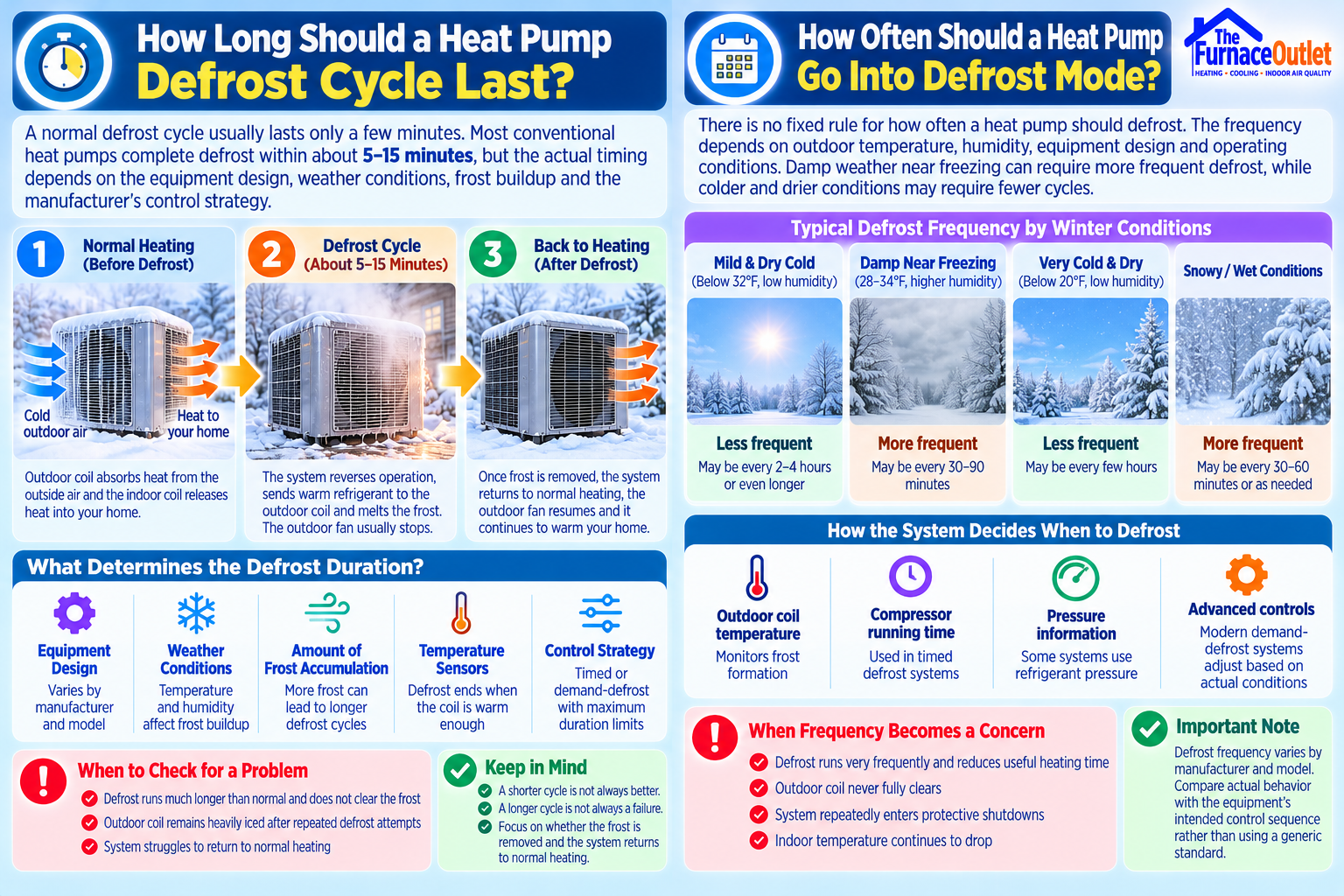
Defrost frequency varies considerably with outdoor temperature, humidity, equipment design, and operating conditions. A heat pump may require more frequent defrost during damp weather near freezing than during colder, drier conditions. Some older systems use timed defrost strategies that evaluate coil conditions after predetermined periods of compressor operation. Modern demand-defrost systems generally use additional information to determine when frost removal is actually necessary.
Consequently, there is no universal rule that every heat pump should defrost once per hour or at another fixed interval. A system that defrosts several times during particularly damp conditions may be operating normally, while another system may operate for extended periods without requiring defrost. The concern arises when defrost becomes so frequent that useful heating is substantially interrupted, when the outdoor coil never clears, or when the equipment repeatedly enters protective shutdowns. A technician should compare actual behavior with the manufacturer’s intended control sequence rather than applying a generic defrost-frequency standard.
A sudden whooshing, rushing, or hissing sound is one of the most recognizable signs of defrost operation. This noise commonly occurs when the reversing valve changes the refrigeration system’s operating configuration and refrigerant pressure relationships shift. The outdoor fan may stop while the compressor continues running, making other mechanical sounds more noticeable. Some equipment produces a brief change in compressor tone or a noticeable transition noise when entering or leaving defrost.
Homeowners may also hear dripping water or occasional light popping sounds as ice melts and metal components change temperature. These sounds can be normal when they occur briefly and the equipment subsequently resumes stable heating.
Persistent grinding, severe banging, repeated electrical chattering, or unusually loud metallic noises are different concerns. Such sounds may indicate fan obstruction, mechanical damage, electrical faults, or other problems requiring professional attention. I recommend judging defrost noises by their timing, duration, severity, and relationship to actual heating performance.
One of the most dramatic but often harmless winter heat pump observations is a cloud of white vapor rising from the outdoor cabinet. During defrost, the outdoor coil warms and accumulated frost melts. Moisture near the coil may evaporate, producing visible vapor that resembles steam. This vapor can appear suddenly and may be particularly noticeable on cold, humid days. It is often accompanied by dripping water and a temporary change in fan operation.
Visible water vapor during a successful defrost cycle is generally different from smoke caused by an electrical or mechanical failure. However, appearance alone should not be the only consideration. Burning odors, unusual electrical sounds, discoloration, or persistent smoke-like emissions warrant immediate caution.
If vapor appears briefly during defrost and disappears as the system returns to normal heating, it is usually consistent with expected operation. If you notice a burning smell, sparking, or signs of actual smoke, stop operating the affected equipment safely and seek qualified assistance.
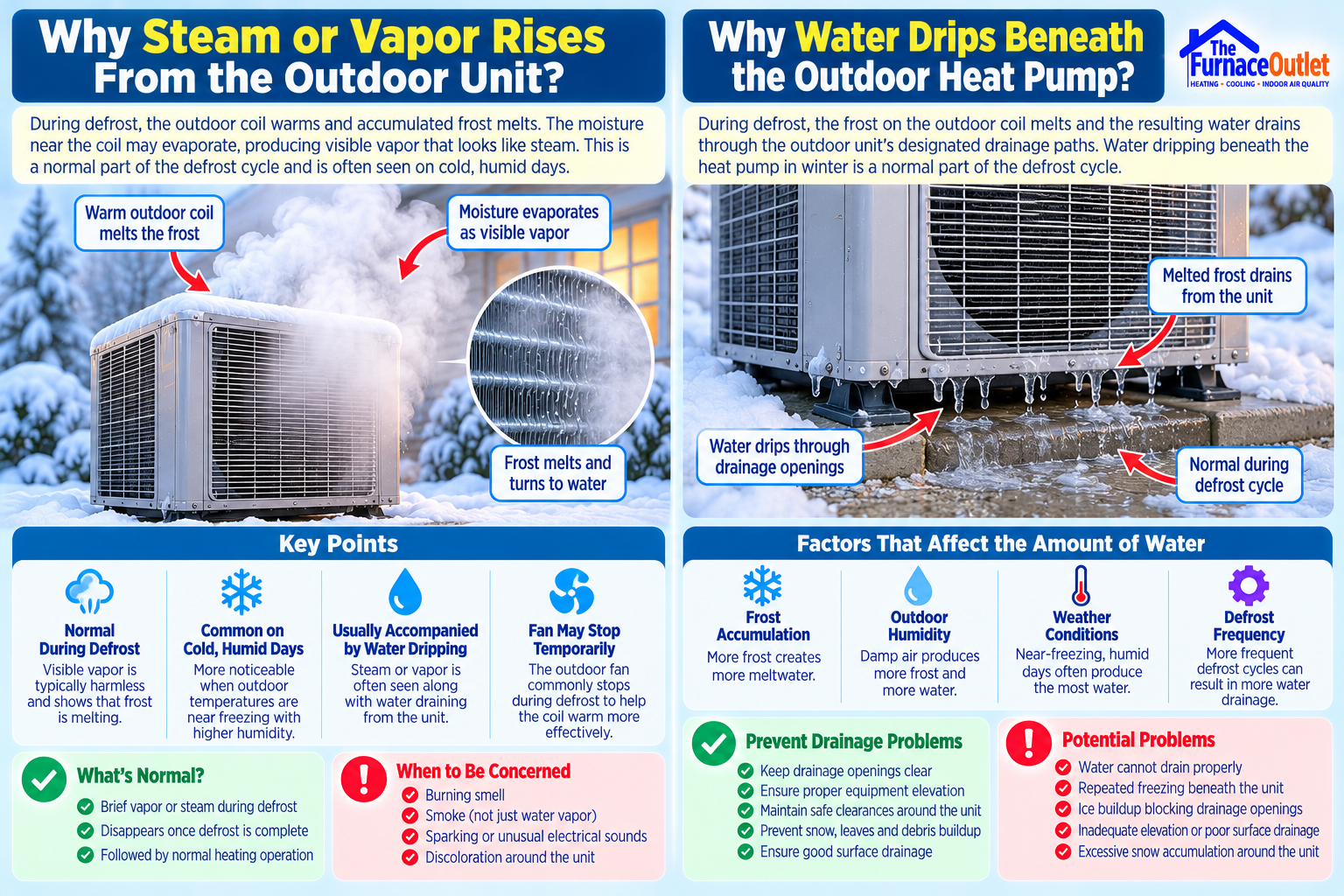
When defrost melts accumulated frost, the resulting water must leave the outdoor cabinet through its designed drainage paths. Consequently, water dripping beneath an outdoor heat pump during winter is often completely normal. The amount of water depends on frost accumulation, humidity, operating conditions, and defrost frequency. There is no universal quantity that defines normal drainage for every installation.
Problems arise when water cannot drain properly or repeatedly freezes in an unsuitable location. Blocked base-pan openings, inadequate equipment elevation, poor surface drainage, and excessive snow accumulation can allow ice to build beneath the cabinet. Over time, a growing ice mass may reach the outdoor coil, obstruct drainage openings, or interfere with fan components. Roof runoff and surrounding surface water can also contribute to ice accumulation independently of the heat pump’s defrost process.
A qualified technician should evaluate recurring drainage problems according to the equipment manufacturer’s installation requirements. Homeowners should never chip ice from internal components or use open flames or improvised heating devices to clear the cabinet.
During conventional reverse-cycle defrost, the refrigeration system temporarily redirects heat toward the outdoor coil. As a result, the indoor heat exchanger may deliver less warmth than during normal heating. Some homeowners notice that supply air feels cooler for a short period. This does not necessarily indicate a failed compressor or refrigerant leak. It may simply reflect the temporary operating change required to remove outdoor frost. Many ducted systems use electric auxiliary heat during defrost to help maintain indoor comfort. However, the presence and operation of backup heating depend on the installed equipment and control configuration.
Some ductless and advanced cold-climate systems use different strategies to manage indoor comfort during defrost. Their indoor fans may slow, pause, or operate according to manufacturer-specific logic. A brief reduction in supply-air warmth can be normal. A system that remains unable to heat after defrost ends requires further investigation.
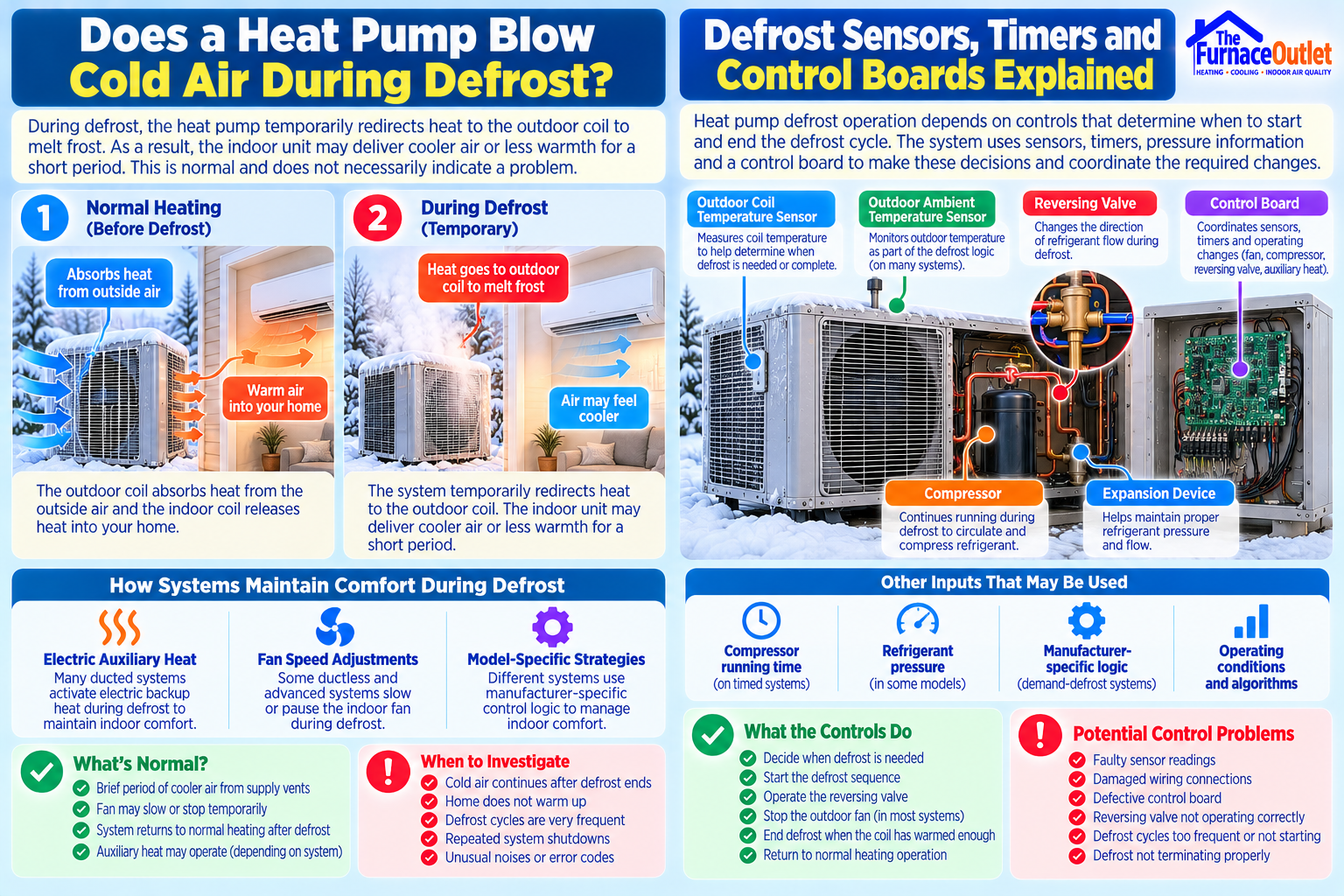
Heat pump defrost operation depends on controls that determine when frost removal should begin and when normal heating should resume. Conventional systems may use coil-temperature sensors and timing logic, while more advanced equipment can incorporate additional temperature measurements, pressure information, compressor operating data, and electronic control strategies. A temperature sensor may help the controller determine whether the outdoor coil is cold enough for frost formation or warm enough to terminate defrost. The exact logic differs between manufacturers.
Defrost control boards coordinate the required operating changes, including reversing-valve commands, outdoor fan operation, compressor behavior, and auxiliary heating where applicable. A defective sensor, damaged wiring connection, or control-board problem can interfere with these decisions. Depending on the failure, the system may skip necessary defrost cycles, enter defrost unnecessarily, or fail to terminate the sequence correctly.
However, heavy icing does not automatically prove that the defrost board is defective. Refrigerant-system abnormalities, airflow restrictions, fan problems, and drainage conditions can produce overlapping symptoms. Professional diagnosis should verify the complete control sequence before expensive components are replaced.
A light coating of frost across the outdoor coil is normal under suitable winter conditions. A properly functioning defrost system should remove excessive frost before it significantly interferes with airflow and heat transfer. Abnormal conditions may include thick ice that remains after attempted defrost cycles, ice spreading into fan areas, repeated protective shutdowns, or a noticeable decline in indoor heating performance.
The location of ice accumulation can provide useful clues. Frost distributed across the coil may involve different operating conditions from ice concentrated around drainage openings or beneath the cabinet. A heavily iced coil can result from ineffective defrost, restricted outdoor airflow, refrigeration problems, or multiple interacting causes. Similarly, ice accumulating below the unit may indicate a drainage or installation issue even when the refrigeration system is working correctly.
I recommend distinguishing coil icing from base-pan and ground icing before assuming that a single component has failed.
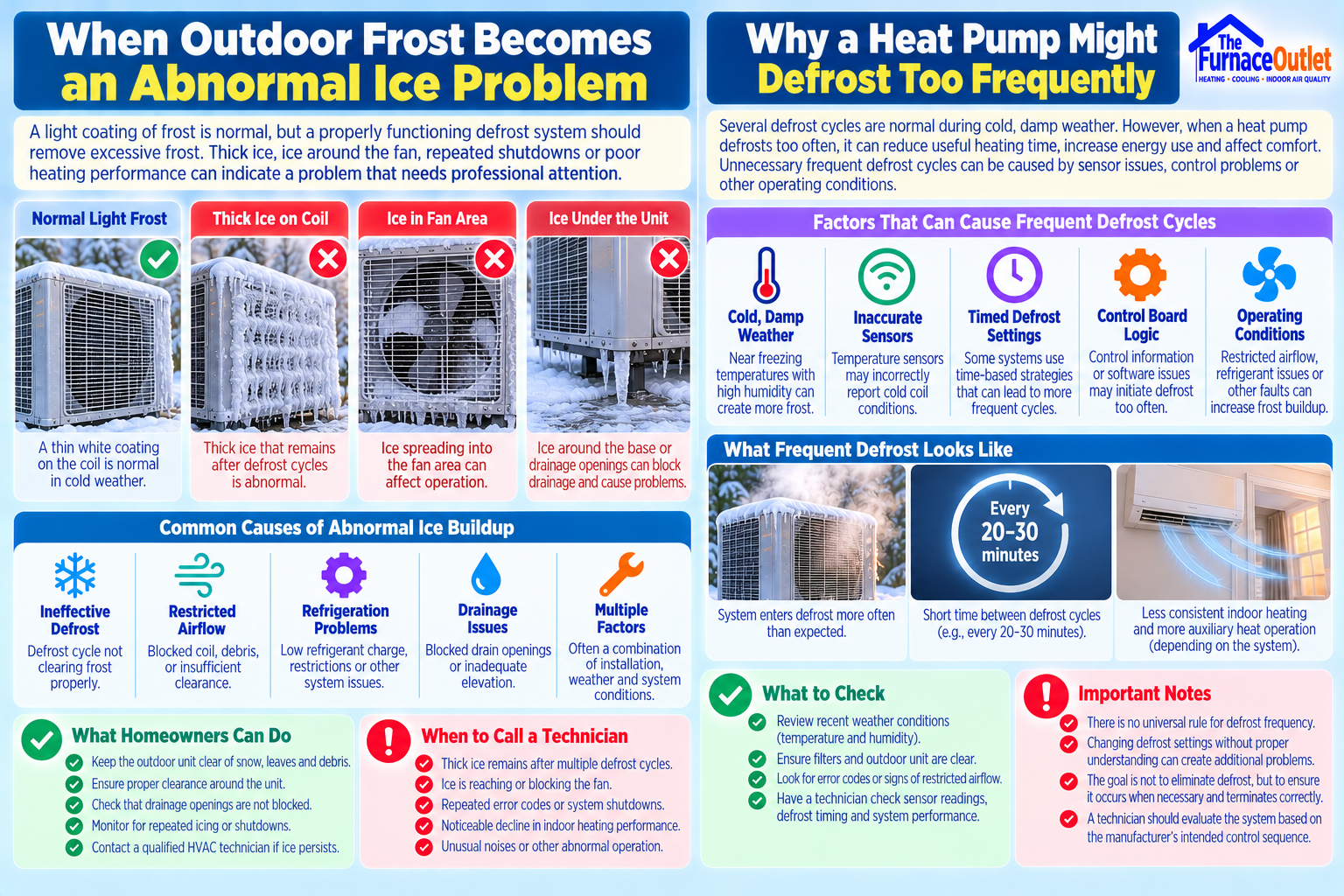
Excessive defrost operation can reduce useful heating time and increase energy consumption, particularly when electric auxiliary heat operates during the defrost sequence. Frequent defrost may be appropriate during certain cold, damp weather conditions. However, unnecessary defrost cycles can also result from inaccurate temperature sensors, incorrect control information, wiring problems, or manufacturer-specific control faults.
A sensor that incorrectly reports cold coil conditions may cause the controller to initiate defrost when frost removal is not needed. Other faults may prevent the system from accurately evaluating coil conditions. The technician should review outdoor weather, sensor readings, compressor operating history, defrost timing, and the manufacturer’s control specifications.
Changing defrost settings without understanding the equipment’s intended operation can create additional problems. The objective is not to eliminate defrost, but to ensure that it occurs when necessary and terminates correctly.
A heat pump that cannot clear excessive frost may have a problem involving sensors, control boards, reversing-valve operation, refrigerant conditions, or another component of the defrost sequence. If the controller never initiates defrost, the technician may investigate sensor information, control logic, wiring, and equipment configuration. If the system initiates defrost but the coil does not warm adequately, the investigation may shift toward reversing-valve response, compressor operation, refrigerant flow, and related controls.
A defective reversing-valve solenoid or internal valve problem can interfere with the intended refrigerant-flow change. However, replacing a reversing valve based solely on an iced coil is not justified. Low refrigerant charge, refrigerant restrictions, and other refrigeration abnormalities may also affect coil conditions and heating performance.
Professional troubleshooting should establish whether the problem involves failure to initiate defrost, failure to produce sufficient coil warming, failure to terminate defrost, or a drainage issue that allows ice to accumulate after successful frost removal.
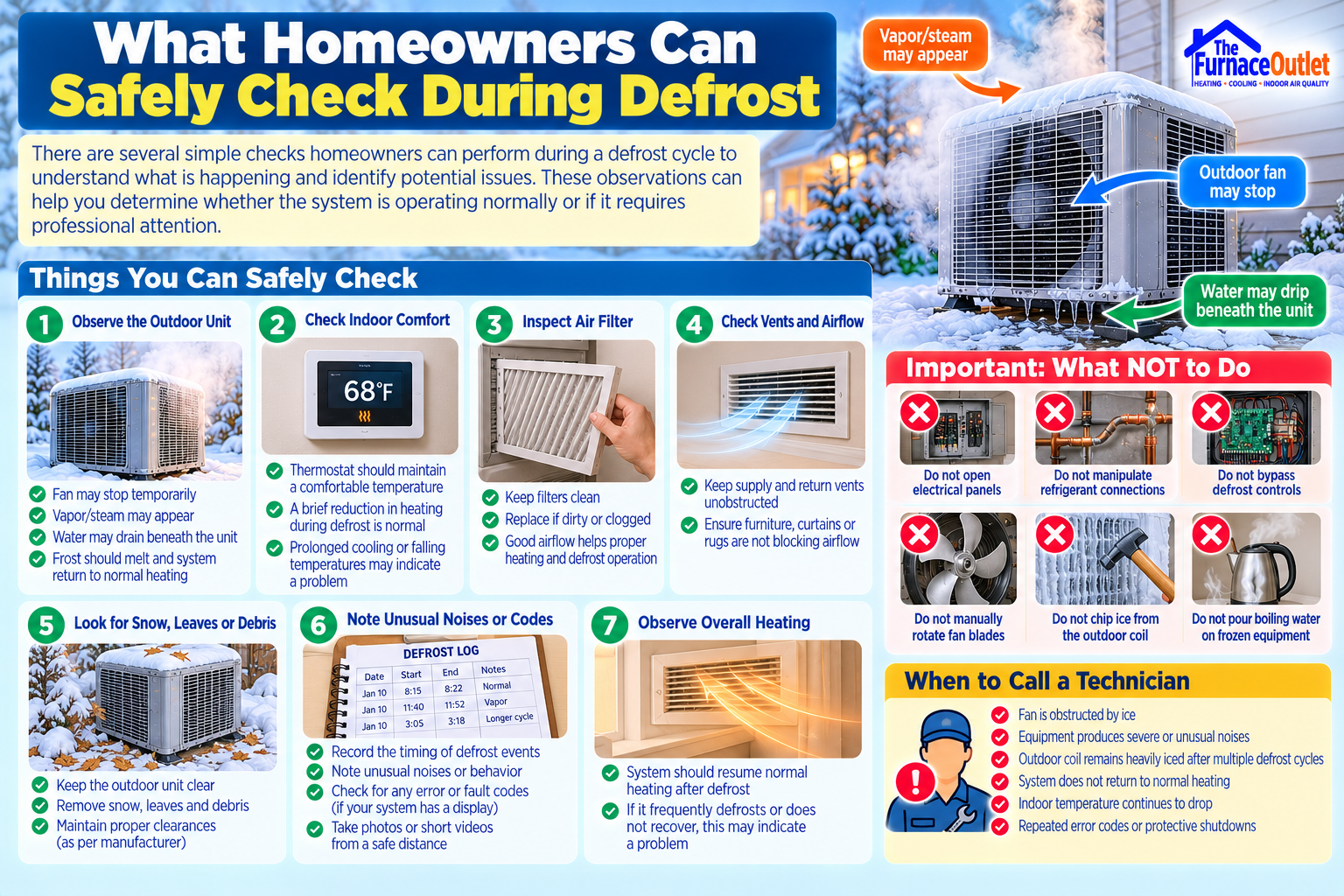
Begin by observing the outdoor unit from a safe distance. Note whether the fan temporarily stops, whether vapor appears, and whether water drains beneath the cabinet. If frost melts and the system subsequently returns to normal heating, these observations may be consistent with a successful defrost cycle. Check whether the thermostat continues maintaining a comfortable indoor temperature. A brief reduction in heating during defrost may be expected, but prolonged discomfort or falling indoor temperatures can indicate a performance problem. Inspect the accessible indoor air filter and keep supply registers and return-air grilles unobstructed. Observe whether excessive snow, leaves, or other debris are restricting airflow around the outdoor cabinet.
Record unusual noises, persistent ice accumulation, fault codes, and the approximate timing of defrost events. Photographs or short videos taken from a safe distance may help a technician understand an intermittent problem. Do not open electrical panels, manipulate refrigerant connections, bypass defrost controls, manually rotate fan blades, or chip ice from the outdoor coil. Pouring boiling water onto frozen equipment can damage components and create additional hazards.
If the fan is obstructed by ice, the equipment produces severe mechanical noises, or heating performance deteriorates substantially, stop operation safely according to manufacturer guidance and arrange qualified service.
A reliable diagnosis begins with identifying the exact equipment model and reviewing the manufacturer’s defrost-control sequence. The technician should establish whether the system uses timed defrost, demand defrost, or another control strategy. The next step is observing the outdoor coil, fan operation, heating performance, and any stored diagnostic information. Sensor readings should be evaluated against actual operating conditions and applicable manufacturer specifications.
Where appropriate, a technician may use an approved test procedure to verify that the equipment initiates defrost, changes refrigerant-flow configuration, warms the outdoor coil, and returns to normal heating correctly. Electrical testing may be required to evaluate control signals, reversing-valve solenoids, sensors, wiring connections, and control-board outputs. Refrigerant-system measurements may also be necessary when operating conditions suggest inadequate heat transfer or abnormal refrigeration behavior.
Drainage should be evaluated separately. A heat pump may complete defrost correctly while meltwater repeatedly freezes beneath the cabinet because of installation or environmental conditions. The completed diagnosis should identify the actual failed function rather than relying solely on the appearance of frost or ice.
Preventive maintenance begins with maintaining proper indoor and outdoor airflow. Keep filters clean according to manufacturer instructions, avoid blocking supply and return openings, and preserve required clearances around the outdoor unit. Snow accumulation and debris should not obstruct the outdoor coil or fan. Drainage pathways should remain functional, and the installation should provide appropriate clearance for defrost water to escape without repeatedly freezing against the cabinet.
In severe winter climates, manufacturer-approved elevated mounting arrangements or base-pan heating accessories may help manage recurring ice accumulation. These solutions are equipment-specific and should be evaluated by qualified contractors. A professional preseason inspection can include checking outdoor fan operation, sensor performance, defrost controls, electrical connections, drainage, and overall heating capacity.
For the 2026–2027 heating season, I recommend observing how the heat pump behaves during its first periods of freezing weather. Identifying abnormal ice accumulation early can prevent a manageable problem from becoming a midwinter heating failure.
Yes. Visible water vapor may appear when the outdoor coil warms and frost melts. Brief vapor during an otherwise normal defrost sequence is generally expected, but smoke accompanied by burning odors or electrical warning signs requires immediate attention.
On many conventional reverse-cycle defrost systems, the outdoor fan stops temporarily to help the coil warm. The exact behavior varies by manufacturer and model.
Yes. Heat pumps can perform defrost during freezing weather. The system uses heat generated through its refrigeration cycle to warm the outdoor coil and melt frost.
Defrost requires energy and temporarily interrupts normal heating. Auxiliary electric heating may also operate on some systems. Proper defrost control balances the energy required for frost removal against the performance losses caused by excessive icing.
No. Do not strike the coil, chip ice from fan components, or use boiling water or improvised heaters. Persistent ice accumulation should be evaluated by a qualified HVAC technician.
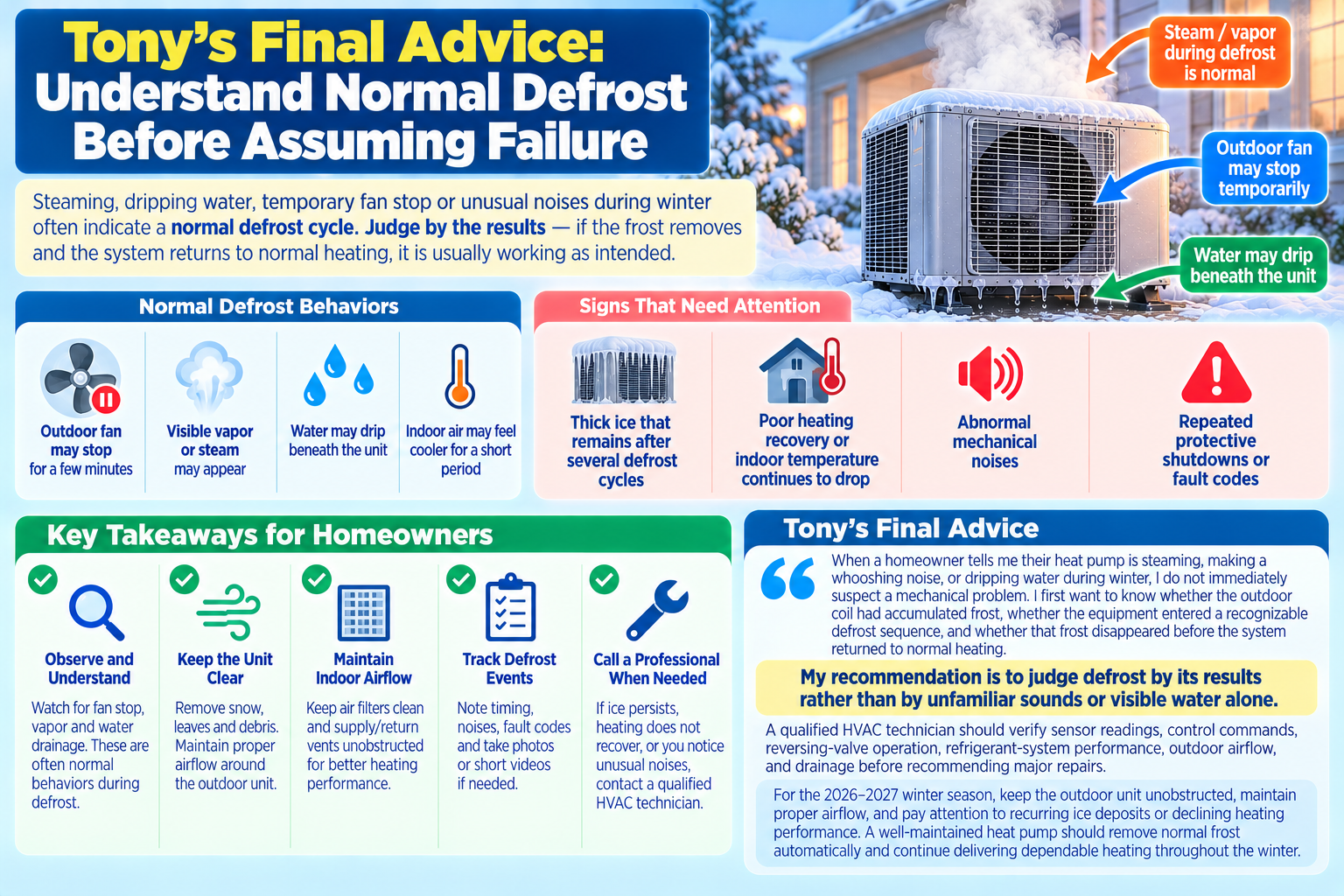
When a homeowner tells me their heat pump is steaming, making a whooshing noise, or dripping water during winter, I do not immediately suspect a mechanical problem. I first want to know whether the outdoor coil had accumulated frost, whether the equipment entered a recognizable defrost sequence, and whether that frost disappeared before the system returned to normal heating.
A properly functioning heat pump may temporarily stop its outdoor fan, redirect refrigerant flow, release visible water vapor, and drain meltwater beneath the cabinet. These behaviors are often part of normal winter operation. What concerns me is persistent ice accumulation, failed heating recovery, abnormal mechanical noises, repeated protective shutdowns, or defrost behavior that does not match the manufacturer’s intended sequence.
My recommendation is to judge defrost by its results rather than by unfamiliar sounds or visible water alone. A qualified HVAC technician should verify sensor readings, control commands, reversing-valve operation, refrigerant-system performance, outdoor airflow, and drainage before recommending major repairs.
For the 2026–2027 winter season, keep the outdoor unit unobstructed, maintain proper airflow, and pay attention to recurring ice deposits or declining heating performance. A well-maintained heat pump should remove normal frost automatically and continue delivering dependable heating throughout the winter.
This article provides general educational information and does not replace professional HVAC diagnosis or service. Heat pumps contain high-voltage electrical components, moving fans, pressurized refrigerants, and manufacturer-specific safety controls. Homeowners should not remove service panels, manipulate refrigerant connections, bypass protective devices, or attempt electrical testing. Persistent icing, serious mechanical noises, electrical hazards, or repeated equipment shutdowns require qualified professional attention.
U.S. Department of Energy — Air-Source Heat Pumps: https://www.energystar.gov/products/air_source_heat_pumps
U.S. Department of Energy — Heat Pump Systems: https://www.energy.gov/heat-pumps
U.S. Department of Energy — Operating and Maintaining Your Heat Pump: https://www.energy.gov/heat-pumps
ENERGY STAR — Air-Source Heat Pumps: https://www.energystar.gov/products/air_source_heat_pumps
Northeast Energy Efficiency Partnerships — Cold Climate Air-Source Heat Pump List: https://ashp.neep.org/
These resources provide background on heat pump operation, maintenance, and cold-climate performance. Defrost timing, sensor logic, operating temperatures, and diagnostic procedures should always be confirmed using the manufacturer’s documentation for the specific equipment.