Newsletter Subscribe
Enter your email address below and subscribe to our newsletter

HVAC made simple
By Tony Marino (Tony the Trusted Tech)
The Furnace Outlet | Updated October 2026
If you own a heat pump, you may have noticed two unfamiliar thermostat settings during winter: AUX Heat and Emergency Heat. Both relate to supplemental heating, but they serve different purposes, and misunderstanding the difference can lead to unnecessary electricity consumption, poor indoor comfort, or incorrect assumptions about equipment problems.
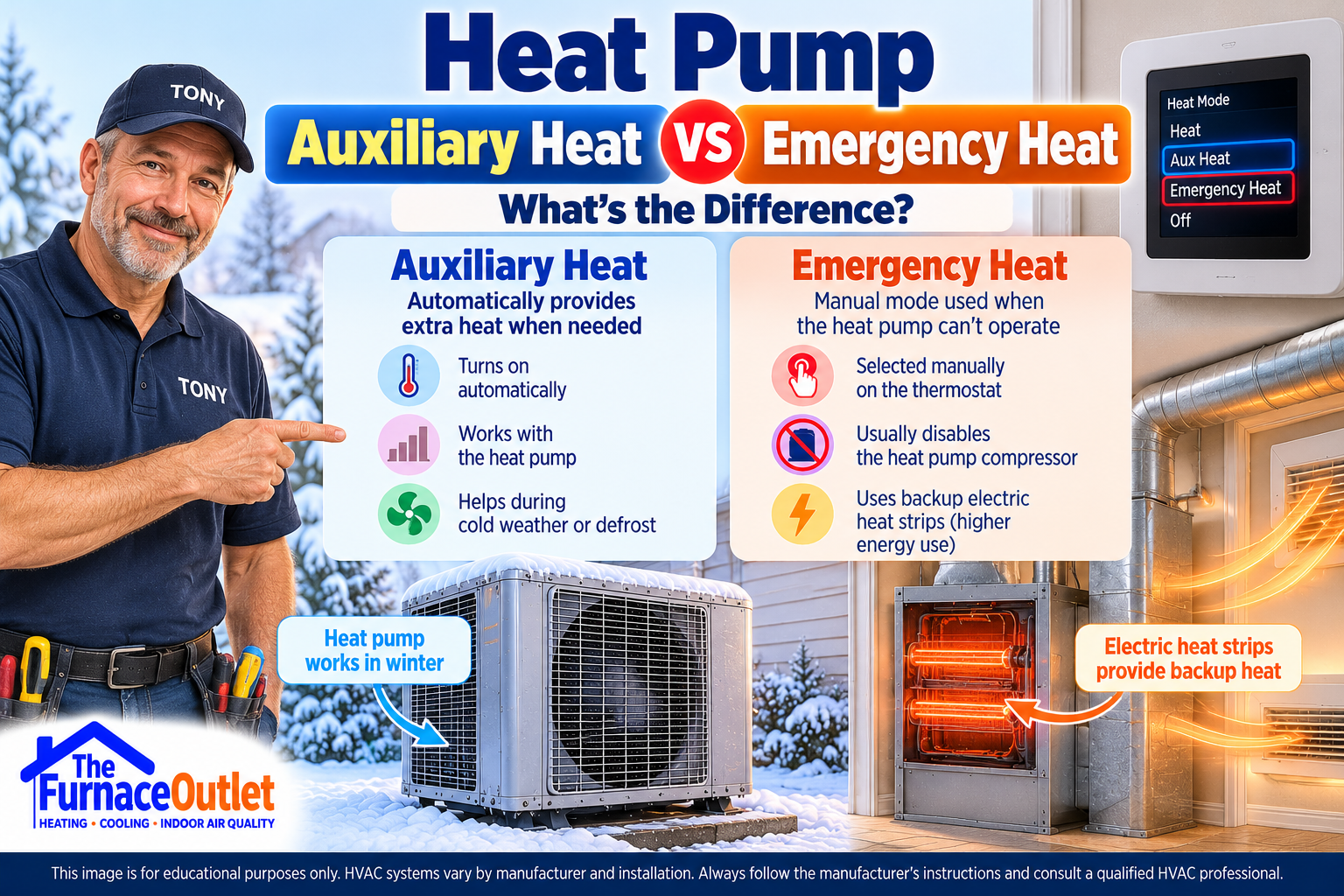
One of the most common questions homeowners ask me is whether auxiliary heat and emergency heat are actually the same thing. The answer is that they may use the same physical backup heating equipment, but the way the system activates and operates that equipment is different. Auxiliary heat is generally controlled automatically to support the heat pump when additional heating capacity is required. Emergency heat is typically a manually selected operating mode intended to provide heating when the primary heat pump cannot be used.
The distinction becomes especially important during freezing weather, when heating demand increases and some heat pumps require additional assistance. A thermostat displaying “AUX” does not necessarily mean something is wrong. Similarly, the presence of an emergency heat setting does not mean homeowners should select it whenever outdoor temperatures drop below freezing.
In this guide, I will explain how both heating modes work, when they activate, how they affect electricity bills, and which warning signs suggest a problem. I will also cover thermostat settings, electric heat strips, dual-fuel systems, defrost operation, and practical troubleshooting for the 2026–2027 heating season.
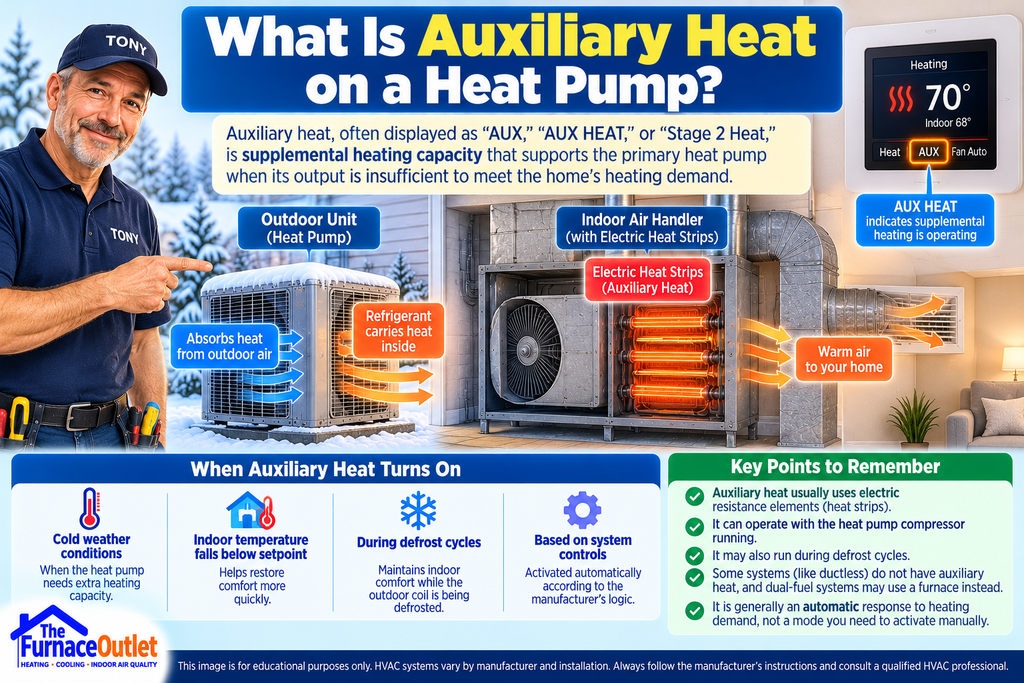
Auxiliary heat, often displayed as “AUX,” “AUX HEAT,” or “Stage 2 Heat,” is supplemental heating capacity that supports the primary heat pump when its output is insufficient to meet the home’s heating demand. In many conventional ducted systems, auxiliary heating comes from electric resistance elements installed inside the indoor air handler.
During normal operation, the heat pump transfers heat from outdoor air into the home. When outdoor conditions become demanding or the indoor temperature falls sufficiently below the thermostat setting, the control system may activate auxiliary heating to provide additional warmth. Depending on the equipment and control strategy, the heat pump compressor may continue operating while electric heat strips supplement its output.
Auxiliary heat can also operate during certain defrost cycles. When the refrigeration system temporarily redirects heat toward the outdoor coil to melt frost, supplemental electric heating may help prevent uncomfortable supply-air temperatures.
Not every heat pump includes electric resistance backup. Some ductless systems operate without it, while dual-fuel installations may use a gas or oil furnace as an alternative heating source. The exact meaning of “AUX” depends on the thermostat configuration and installed equipment.
The important point is that auxiliary heat is generally an automatic response to heating demand or a programmed operating condition, not a mode homeowners need to activate manually every time the weather becomes cold.
Emergency heat, sometimes labeled “EM HEAT,” “E-HEAT,” or “Emergency,” is a thermostat operating mode that typically disables normal heat pump compressor heating and uses an available backup heating source instead.
Importantly, selecting emergency heat is not automatically safe after an electrical fault. If the indoor air handler, backup heater, or associated electrical circuits are damaged or tripping breakers, operating emergency heat could involve the same faulty equipment. A qualified professional should verify the system arrangement before backup heating is used following a serious electrical failure.
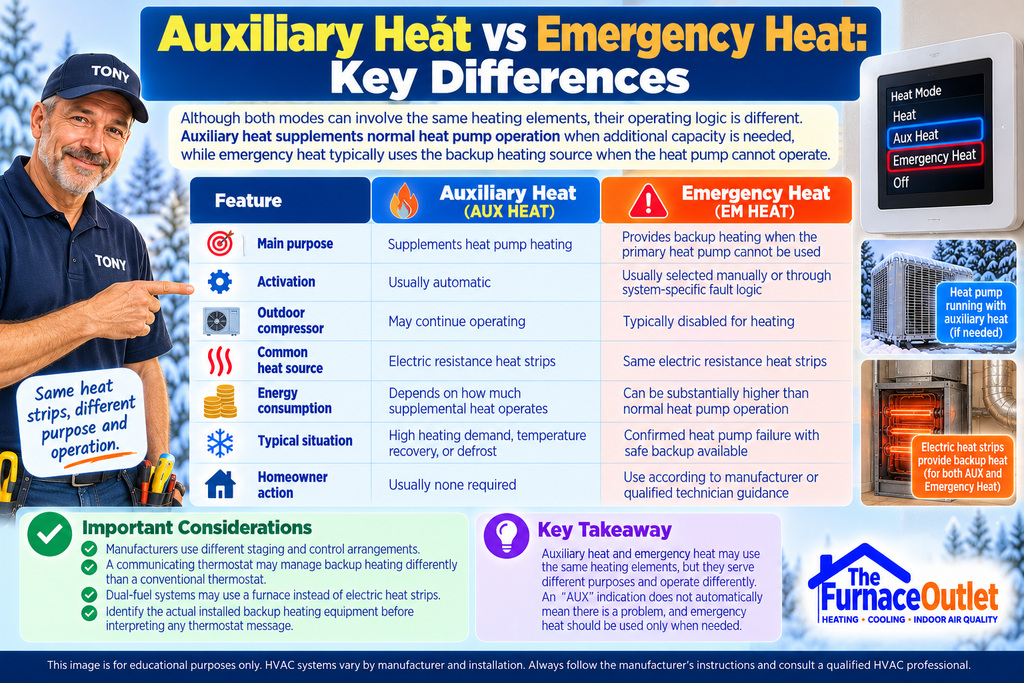
Although both modes can involve the same heating elements, their operating logic is different. Auxiliary heat supplements normal heat pump operation when the control system determines that additional capacity is needed. Emergency heat typically substitutes the backup heating source for the primary heat pump.
| Feature | Auxiliary Heat | Emergency Heat |
|---|---|---|
| Main purpose | Supplements heat pump heating | Provides backup heating when the primary heat pump cannot be used |
| Activation | Usually automatic | Usually selected manually or through system-specific fault logic |
| Outdoor compressor | May continue operating | Typically disabled for heating |
| Common heat source | Electric resistance heat strips | Same electric resistance heat strips |
| Energy consumption | Depends on how much supplemental heat operates | Can be substantially higher than normal heat pump operation |
| Typical situation | High heating demand, temperature recovery, or defrost | Confirmed heat pump failure with safe backup available |
| Homeowner action | Usually none required | Use according to manufacturer or qualified technician guidance |
These differences apply to common residential systems, but manufacturers use different staging and control arrangements. A communicating thermostat may manage backup heating differently from a conventional thermostat, and dual-fuel systems require additional consideration.
I recommend identifying the actual installed backup heating equipment before interpreting any thermostat message. Two homes displaying the same “AUX” indicator may have completely different heating systems.
Electric resistance heat strips are heating elements commonly installed inside ducted heat pump air handlers. When energized, electrical resistance converts electricity into heat, and the indoor blower distributes that heat through the ductwork.
These elements can provide dependable heating without requiring the outdoor compressor to extract heat from cold air. However, their energy performance differs substantially from that of a functioning heat pump. Electric resistance heating generally provides approximately one unit of heat for each unit of electricity consumed at the point of use. A heat pump can often deliver multiple units of heat for each unit of electricity because it transfers existing thermal energy rather than producing all the heat through resistance.
Heat strip assemblies may contain multiple stages and require dedicated electrical circuits. Their operation depends on contactors, relays, sequencers, control boards, safety limits, and properly sized electrical protection. A thermostat requesting auxiliary heating does not prove that the elements are actually energized. A failed relay, damaged element, interrupted electrical supply, or active safety control may prevent heat production despite an “AUX” display. Electrical testing and heat strip repairs should be performed by qualified professionals.
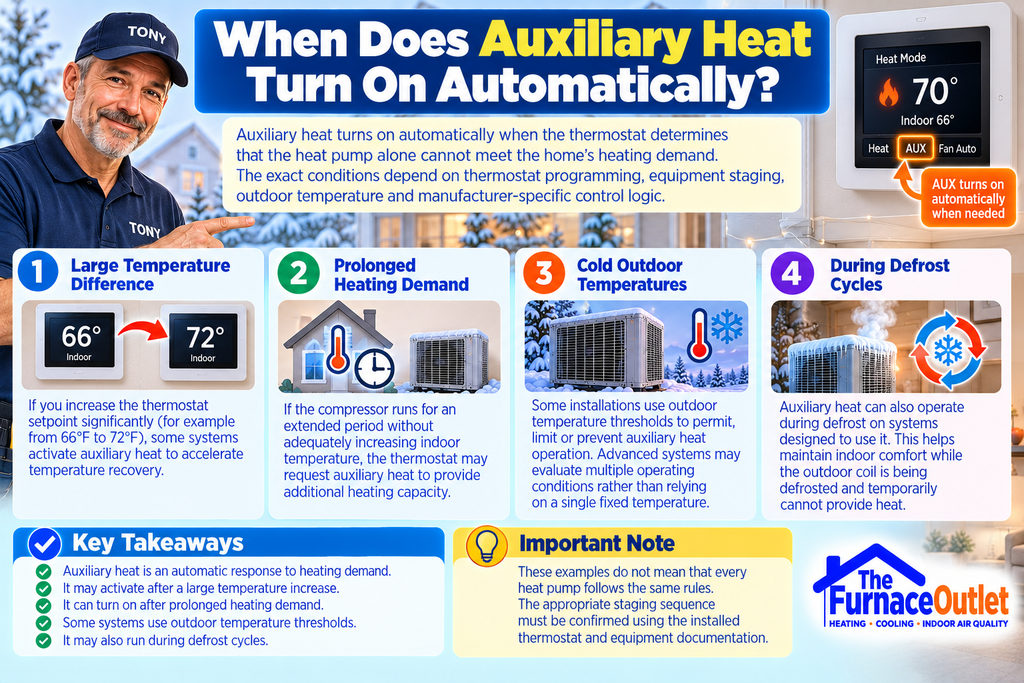
Auxiliary heating may activate when the thermostat determines that the heat pump alone cannot satisfy the heating demand within the intended operating conditions. The decision depends on thermostat programming, equipment staging, outdoor temperature information, and manufacturer-specific control logic.
These examples do not mean that every heat pump follows the same rules. The appropriate staging sequence must be confirmed using the installed thermostat and equipment documentation.
As outdoor temperatures fall, a home’s heating demand generally increases because more heat escapes through the building envelope. At the same time, the available heating capacity of some air-source heat pumps decreases. When the building’s heating demand exceeds the heat pump’s available output, supplemental heating may be necessary to maintain the desired indoor temperature.
This relationship is sometimes discussed using the system’s thermal balance point, where available heat pump capacity approximately matches the building’s heating load. Below that point, supplemental heating may be required unless the equipment can increase its output sufficiently. However, not every heat pump needs backup heating at the same outdoor temperature. Cold-climate heat pumps may maintain substantial capacity at temperatures well below 32°F, while other systems require supplemental output earlier.
A properly sized cold-climate system may operate through much of the winter without regularly energizing electric heat strips. The correct question is not whether auxiliary heat activates below a particular universal temperature, but whether the installed system is delivering the heating capacity expected under the actual conditions.
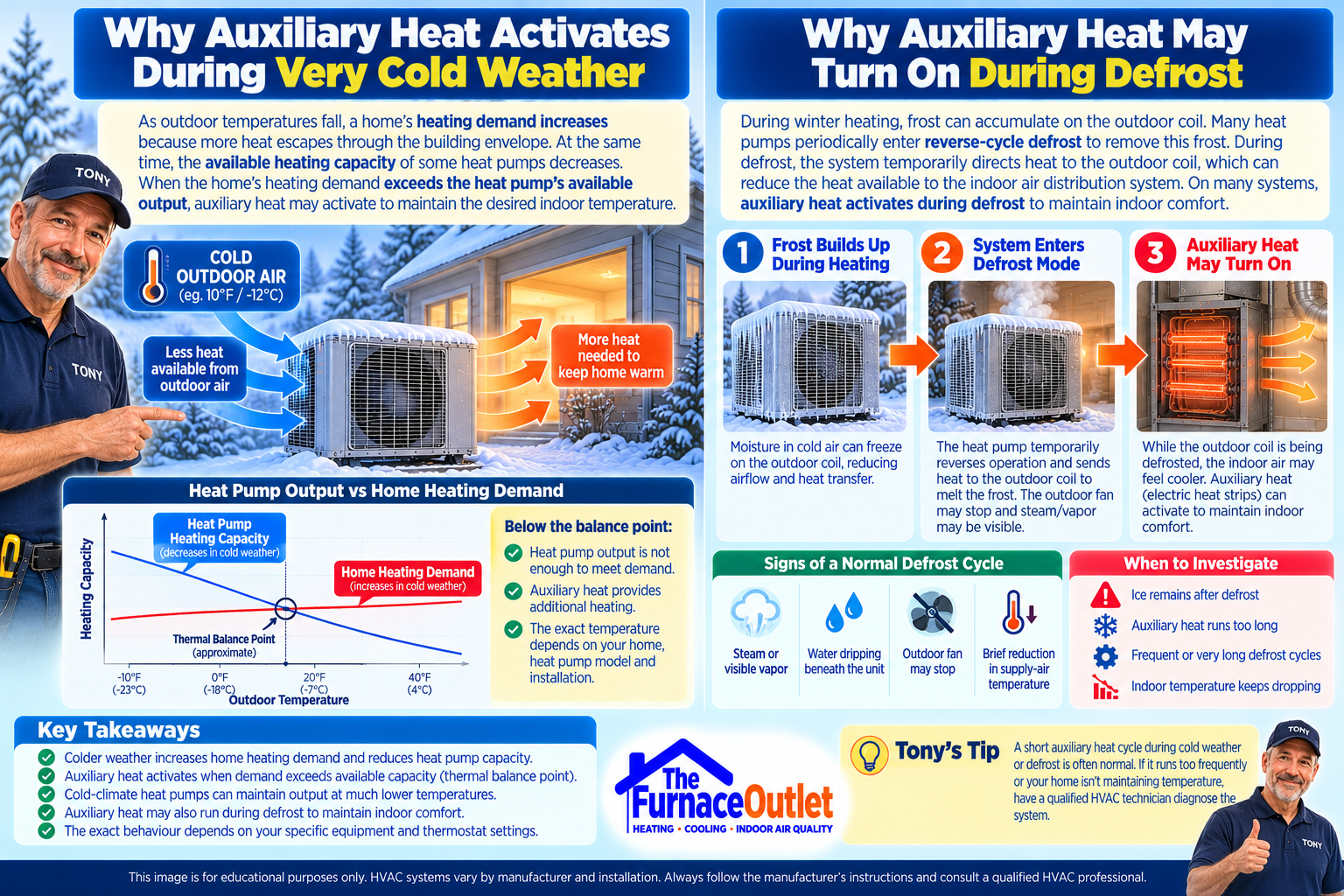
During winter heating, frost can accumulate on the outdoor coil. Many conventional heat pumps periodically enter reverse-cycle defrost to remove that frost and restore efficient heat transfer. During defrost, the refrigeration system temporarily directs heat toward the outdoor coil. This can reduce the heat available to the indoor air distribution system. On many ducted installations, electric auxiliary heating activates during defrost to maintain indoor comfort and offset the temporary change in refrigerant operation.
Homeowners may notice a brief change in supply-air temperature, a whooshing sound from the outdoor unit, water dripping beneath the cabinet, or visible vapor rising as frost melts. A short auxiliary heating event associated with a successful defrost cycle may be completely normal. However, auxiliary heating that remains energized unnecessarily after defrost or operates continuously because the outdoor coil never clears may warrant investigation. Defrost sensors, control logic, refrigerant conditions, outdoor airflow, and drainage problems can all influence winter performance.
Electric resistance auxiliary heating can increase electricity consumption substantially compared with heat pump-only operation, particularly when large heating elements operate for extended periods. Consider a simplified example. A 10-kW electric heat strip assembly operating at full output for one hour consumes approximately 10 kilowatt-hours of electricity. At an illustrative electricity rate of $0.18 per kWh, that hour would cost approximately $1.80 in electricity for the heat strips alone, excluding other equipment consumption and utility charges.
If the same heating assembly operated at full output for four hours, it would consume approximately 40 kWh, costing $7.20 at that example rate. Actual costs depend on heater capacity, staging, operating time, local electricity rates, and the amount of heating supplied by the compressor. A heat pump’s comparative efficiency also changes with outdoor conditions, so a universal savings percentage would be misleading. The important lesson is that brief auxiliary heating events are not necessarily expensive, but unnecessary or prolonged electric resistance operation can significantly increase winter bills.
Emergency heat is not inherently a different type of electric heater. In many systems, it uses the same resistance elements available for auxiliary heating. The difference is that emergency heat typically operates without the heat pump compressor contributing its normal heating output. Consequently, the backup elements may need to supply a larger share of the home’s heating demand. When the compressor is operating efficiently, combining heat pump output with limited auxiliary heating will generally use less electricity than relying entirely on resistance heating for the same heating requirement.
However, actual costs depend on outdoor conditions, equipment efficiency, heating demand, and whether the backup source is electric resistance or another fuel. For a dual-fuel system using a gas furnace, the cost comparison also depends on electricity and fuel prices, furnace efficiency, and the installed control strategy. I would never recommend emergency heat as a routine method for reducing electricity consumption on a conventional all-electric heat pump. Its purpose is backup operation, not automatic energy savings.
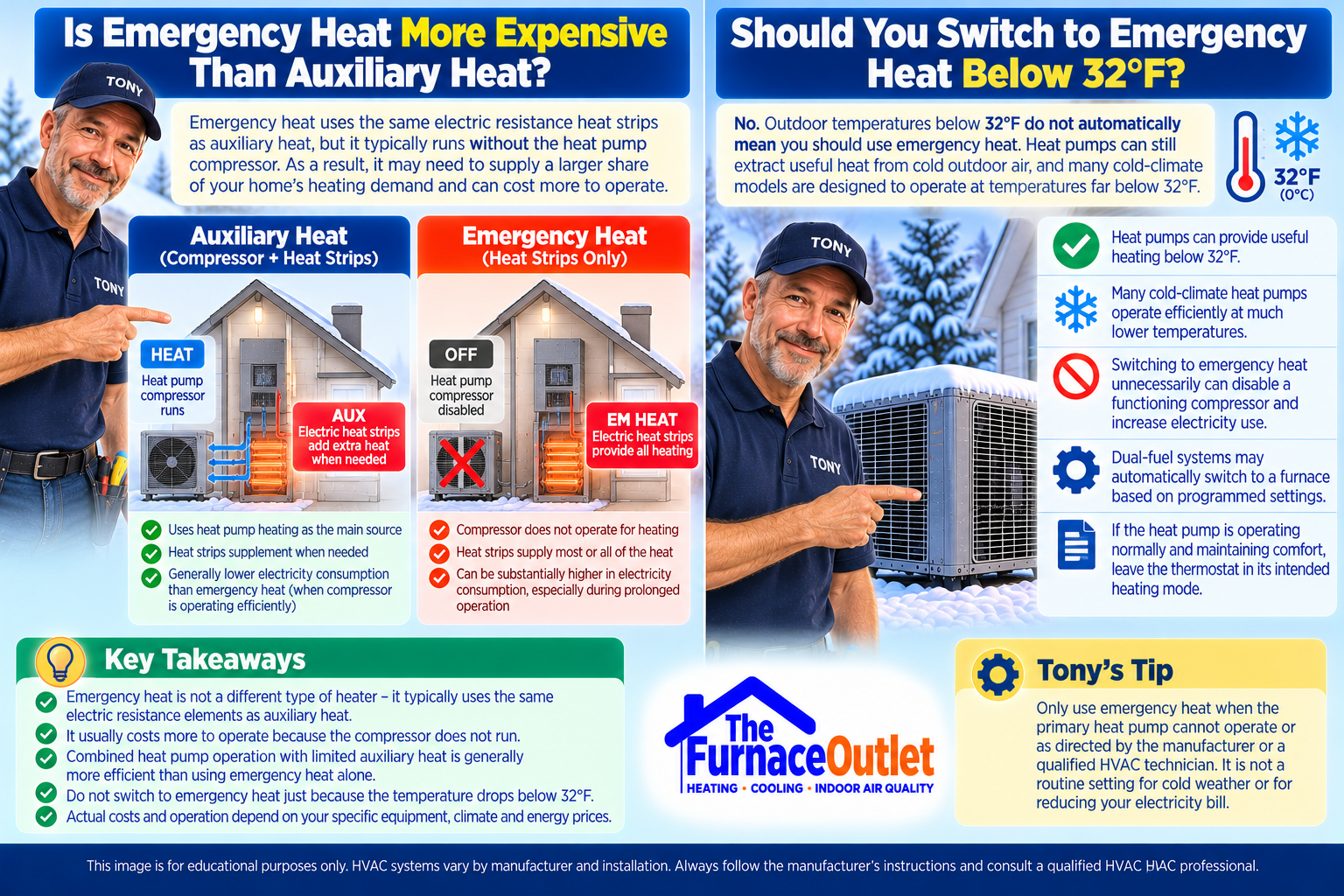
No. The outdoor temperature reaching 32°F does not automatically mean that emergency heat should be selected. Air-source heat pumps can extract useful thermal energy from outdoor air below freezing. Many cold-climate models are specifically engineered for operation at temperatures far below 32°F. Selecting emergency heat unnecessarily may disable a functioning compressor and increase dependence on electric resistance heating. The appropriate operating strategy depends on the equipment’s documented low-temperature capacity, heating load, backup heating arrangement, and manufacturer controls.
Some dual-fuel installations automatically switch between a heat pump and furnace according to programmed economic or performance thresholds. Those systems should follow their approved control strategy. If the heat pump is operating normally and maintaining indoor comfort, homeowners should generally leave the thermostat in its intended heating mode rather than manually selecting emergency heat because of cold weather alone.
Occasional auxiliary heating is normal on many systems, but frequent or prolonged activation deserves closer attention when it is unexpected. One possible explanation is high heating demand during severe weather. Another is repeated large thermostat adjustments that cause the control system to request rapid temperature recovery. Restricted indoor airflow, a dirty filter, excessive building heat loss, or inadequate system capacity may also increase supplemental heating demand.
Equipment problems can contribute as well. A compressor that is not operating correctly, abnormal outdoor icing, refrigerant-system faults, or control problems may prevent the heat pump from supplying its expected output. An incorrectly configured thermostat may request auxiliary heat unnecessarily. Some systems also have outdoor temperature sensors or lockout settings that influence staging decisions. A technician should verify whether auxiliary heat is actually energized, why it was requested, and whether the heat pump is performing within manufacturer specifications. The “AUX” indicator alone is not sufficient to diagnose a failure.
If auxiliary heating fails when the system requires supplemental output, the heat pump may continue operating while indoor temperature gradually falls. Possible causes include damaged electric heat strips, defective contactors or sequencers, failed relays, interrupted electrical circuits, thermostat staging problems, or protective safety controls. In some installations, auxiliary heating has separate electrical breakers from the outdoor heat pump and indoor blower. Consequently, the compressor may continue running while the backup heating circuit is unavailable.
Homeowners may notice that the thermostat displays “AUX” but supply air does not become warmer, or that the home struggles to recover during particularly cold conditions. However, the diagnosis must begin by confirming whether auxiliary heating should be operating under those conditions and whether the system actually includes the expected backup equipment. Electrical components and heat strip circuits can carry hazardous voltages. Testing should be performed by qualified HVAC technicians or licensed electricians.
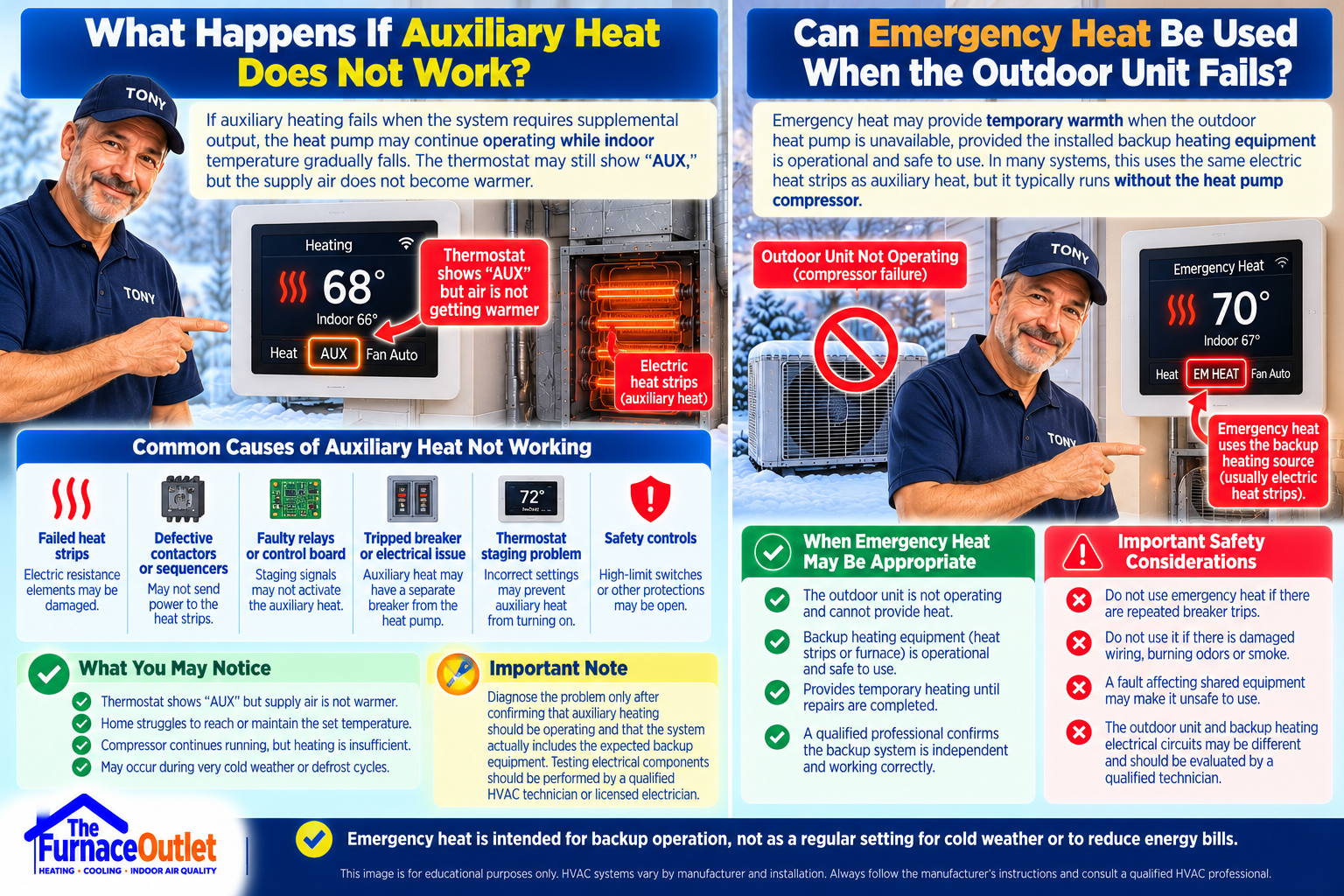
Emergency heat may provide temporary warmth when the outdoor heat pump is unavailable, provided the installed backup heating equipment is operational and safe to use. For example, a conventional ducted system with separate electric resistance backup may be able to heat the home without running the outdoor compressor. However, the availability of emergency heat does not guarantee that it is safe after every equipment failure.
If the problem involves repeated breaker trips, damaged wiring, burning odors, smoke, or an electrical fault affecting shared equipment, switching to emergency heat may expose the same hazardous components to power. A failed outdoor compressor circuit and a failed indoor heat strip circuit are different situations, and the electrical arrangement must be understood before selecting backup operation. If a qualified professional confirms that the backup heating system is safe and independent of the failed equipment, emergency heat may be an appropriate temporary solution while repairs are arranged.
Dual-fuel heating systems combine an electric heat pump with a separate combustion-based heating source, commonly a gas furnace. In these installations, the furnace may provide backup or alternate heating when outdoor conditions, energy prices, or equipment controls favor furnace operation. Unlike a conventional electric heat strip arrangement, a dual-fuel system often operates the heat pump and furnace as alternative heating sources rather than combining both simultaneously. The exact sequence depends on equipment compatibility and approved control design.
Some systems use an outdoor temperature threshold to switch heating sources. Others employ communicating controls that evaluate performance or operating conditions. The thermostat may use labels such as auxiliary, backup, alternate, or emergency heat, but their meaning can differ from that of a conventional all-electric heat pump. Homeowners should consult the installed system’s documentation rather than assuming every “AUX” or “EM HEAT” indication refers to electric resistance heating.
Thermostat configuration plays a significant role in determining when supplemental heating operates. Incorrect equipment-type settings, staging parameters, reversing-valve configuration, outdoor temperature lockouts, or communication settings can interfere with normal heating control. Problems sometimes appear after replacing an older thermostat with a smart thermostat that has not been correctly configured for the installed heat pump and backup heating system.
Large overnight temperature setbacks can also increase auxiliary heating demand during morning recovery on certain installations. Whether setbacks save energy depends on equipment type, climate, control strategy, and the heating source used during recovery. For many conventional heat pumps with electric resistance backup, moderate and consistent thermostat settings can help avoid unnecessary auxiliary heat activation. However, advanced communicating systems may include optimized setback and recovery strategies. Homeowners should follow manufacturer guidance rather than applying one universal thermostat rule.
The first useful observation is whether the home maintains the selected indoor temperature during demanding conditions. If the thermostat displays “AUX” briefly during a cold morning or defrost event and the home remains comfortable, that may be expected behavior. If auxiliary heat appears to run continuously while indoor temperature falls, or if electricity consumption increases dramatically without an obvious weather-related explanation, further investigation may be justified.
A technician can verify the thermostat’s staging request, electrical operation of the backup heating elements, blower airflow, safety controls, and actual heating output. It is also important to confirm that the compressor is operating correctly. Excessive auxiliary heating may be a symptom of inadequate primary heat pump performance rather than a defect in the backup heater. No single thermostat message or supply-air temperature reading proves that the entire heating system is operating correctly.
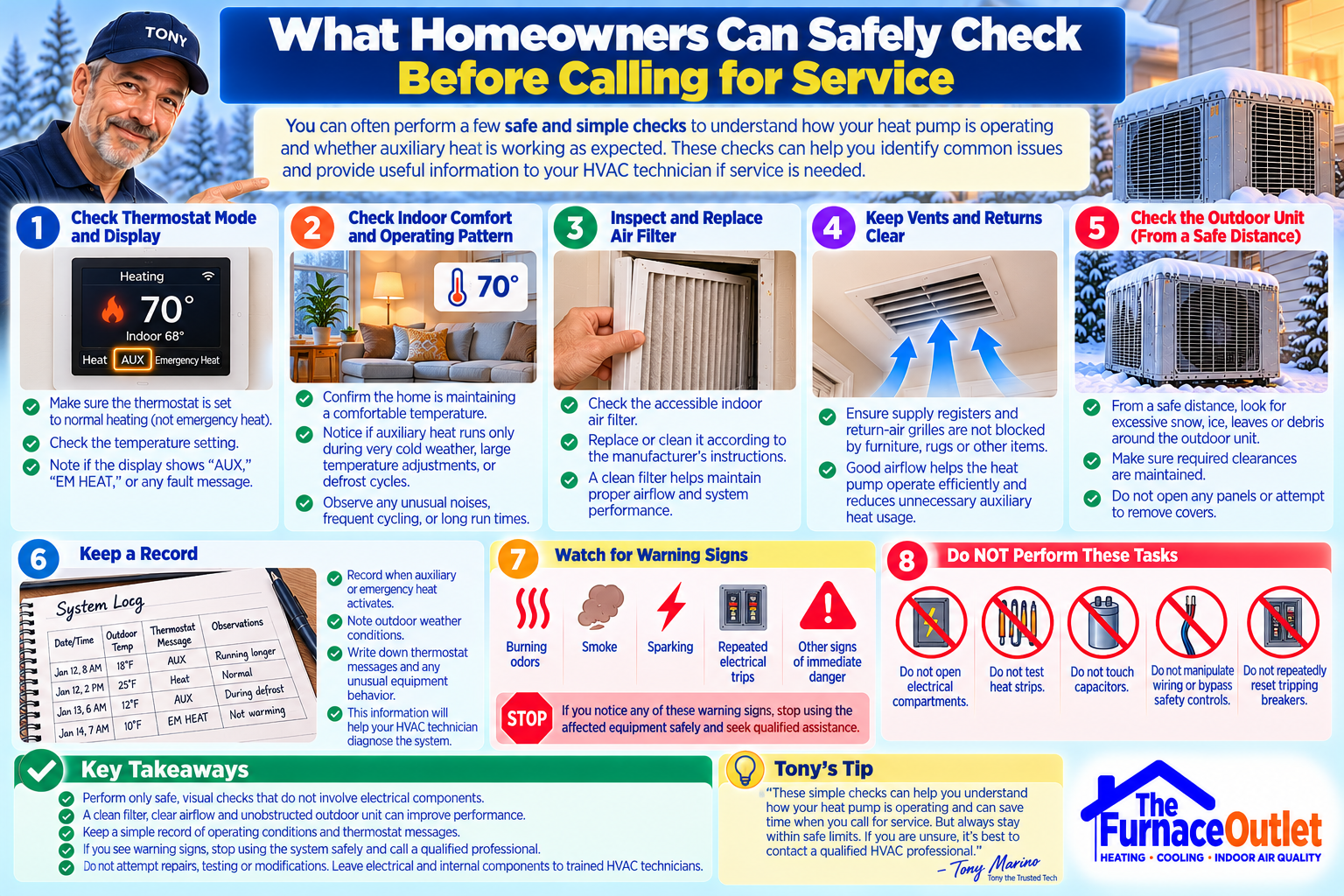
Start by checking whether the thermostat is set to normal heating rather than emergency heat. Confirm the selected temperature and note whether the display shows “AUX,” “EM HEAT,” or a fault message. Observe whether the home is maintaining a comfortable temperature and whether auxiliary heating appears only during particularly cold weather, large temperature adjustments, or defrost events.
Inspect the accessible indoor air filter and maintain it according to manufacturer instructions. Keep supply registers and return-air grilles unobstructed. From a safe distance, check the outdoor unit for excessive snow accumulation, debris, or persistent ice that could interfere with normal operation. Record when backup heating activates, outdoor weather conditions, thermostat messages, and any unusual equipment behavior. Do not open electrical compartments, test heat strips, touch capacitors, manipulate wiring, or bypass safety controls. Do not repeatedly reset tripping breakers.
If the system produces burning odors, smoke, sparking, repeated electrical trips, or other signs of immediate danger, stop using the affected equipment safely and seek qualified assistance.
Professional diagnosis begins with identifying the installed heat pump, thermostat, air handler, backup heating equipment, and control arrangement. The technician should determine whether the system uses electric resistance heat strips, a dual-fuel furnace, or another supplemental heating configuration. Next, the technician verifies the thermostat’s heating requests and the actual equipment response. This includes determining when auxiliary heat should activate and whether emergency heat operation is available under the approved control sequence.
Electrical measurements and manufacturer-specific procedures may be used to evaluate heat strip circuits, relays, sequencers, contactors, safety limits, and associated controls. The technician should also assess primary heat pump performance. A compressor, defrost, airflow, or refrigerant-system problem may cause excessive backup heating demand even when the auxiliary heating components are functioning correctly. The completed diagnosis should identify whether the issue involves incorrect staging, failed backup equipment, inadequate primary heating capacity, or excessive building heat loss.
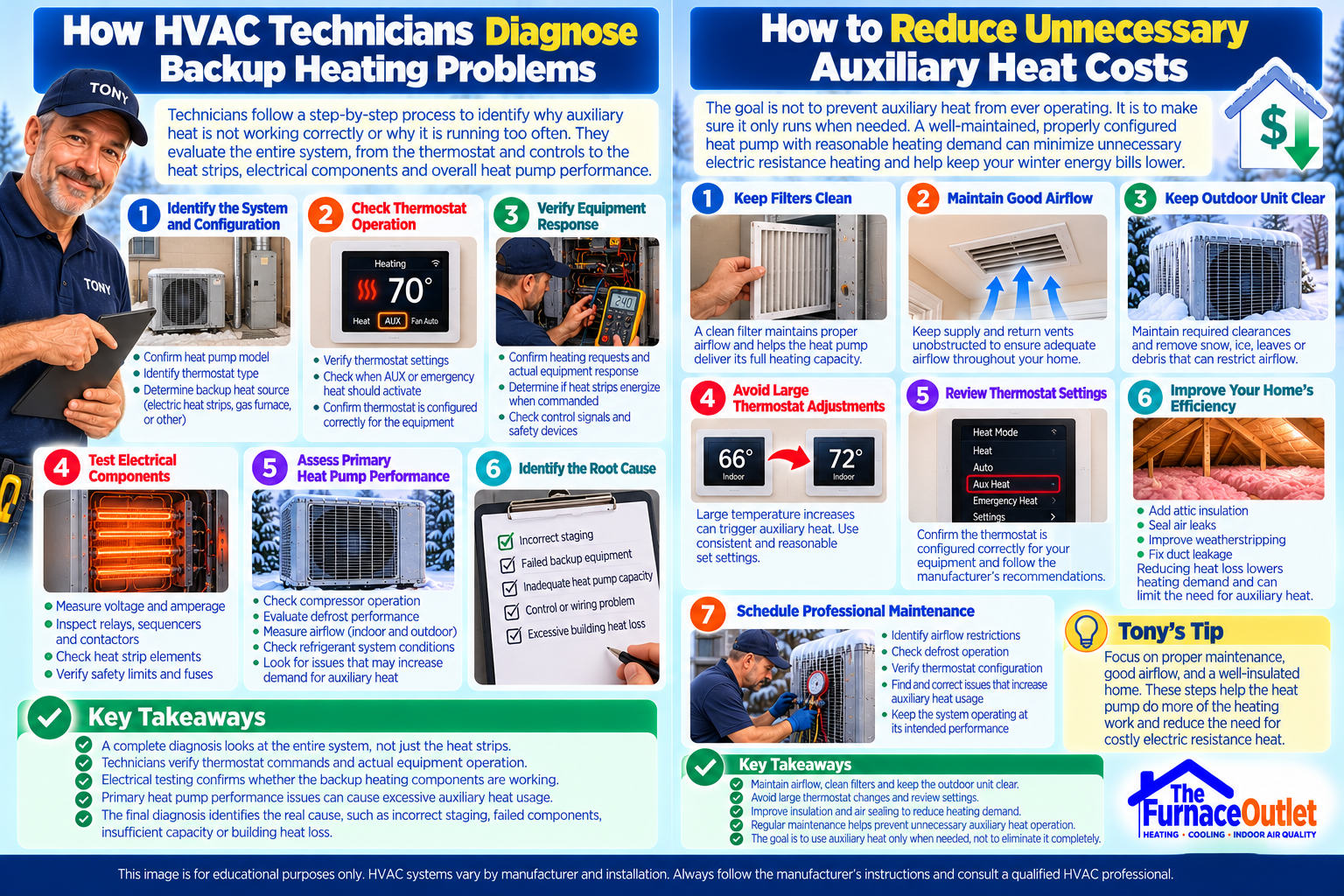
Reducing unnecessary auxiliary heating begins with ensuring that the primary heat pump operates efficiently and that the home’s heating demand is reasonable. Keep indoor filters clean, maintain unobstructed supply and return airflow, and preserve required outdoor equipment clearances. Avoid large thermostat adjustments when the installed control system is known to activate electric resistance heat during recovery. Review programmable thermostat settings and manufacturer recommendations.
Building-envelope improvements can also reduce heating demand. Appropriate attic insulation, air sealing, weatherstripping, and correction of duct leakage may help the heat pump maintain comfort without frequent supplemental heating. A professional maintenance visit can identify airflow restrictions, defrost problems, thermostat configuration errors, and other conditions that unnecessarily increase backup heating operation. The goal is not to prevent auxiliary heating from ever operating. It is to ensure that supplemental heat activates only when appropriate and that the primary system delivers its intended performance.
Not exactly. Both may use the same backup heating elements, but auxiliary heat generally supplements normal heat pump operation automatically, while emergency heat typically operates the backup source without normal compressor heating.
No. Auxiliary heating may be normal during high heating demand, certain thermostat recovery periods, or defrost. Unexpected prolonged operation deserves investigation.
It may be appropriate when the installed backup heating equipment is confirmed safe and intended for that operating mode. Do not use it to work around unresolved electrical faults.
Not necessarily. Heating performance depends on backup heater capacity, system configuration, and control strategy. Emergency heat is not intended as a routine faster-heating setting.
Electric resistance heating generally uses more electricity than an efficiently operating heat pump to provide the same amount of heat. Extended heat strip operation can therefore increase consumption.
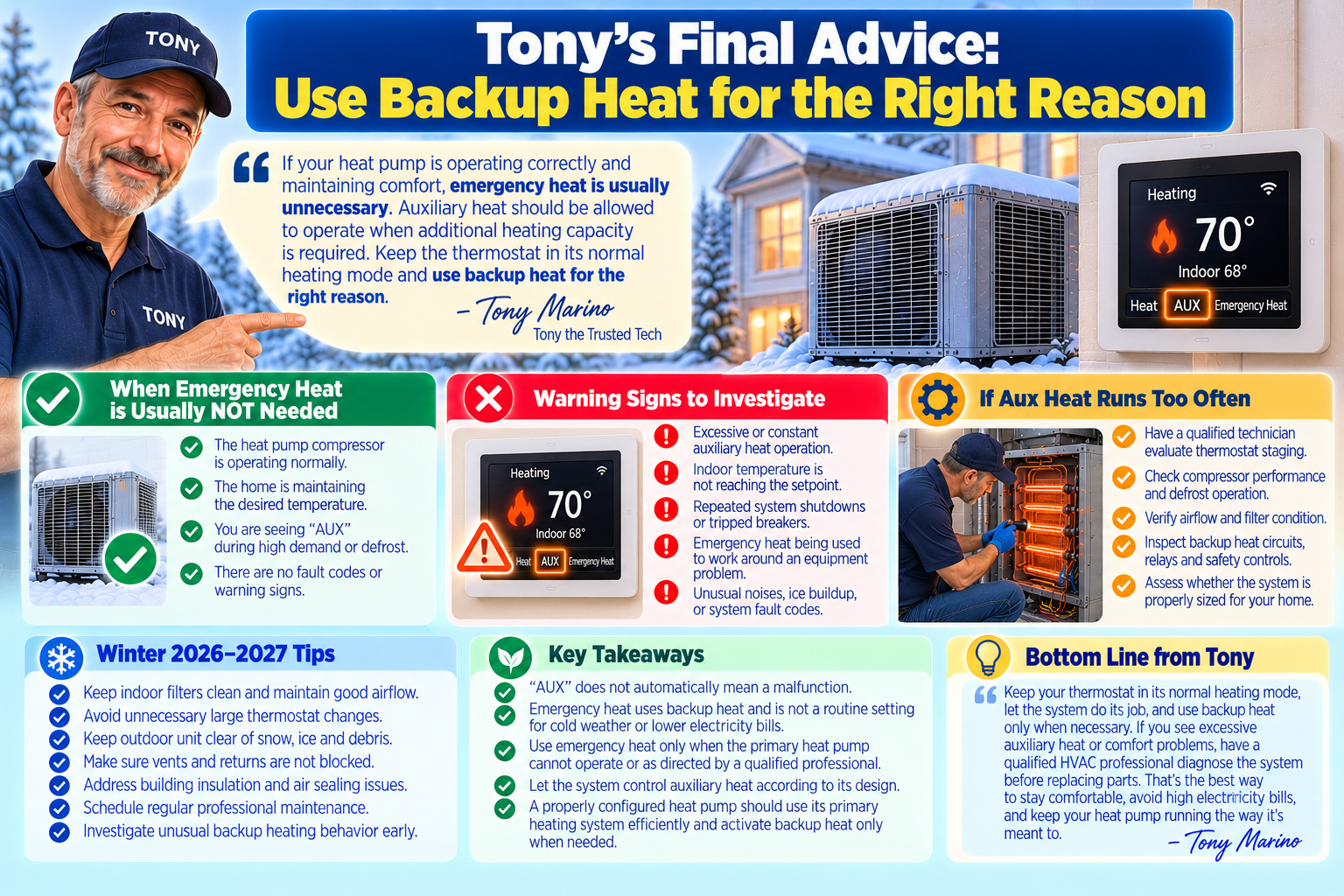
When a homeowner asks whether they should switch from auxiliary heat to emergency heat during winter, my first question is whether the primary heat pump is operating correctly. If the compressor is functioning normally and the system is maintaining comfort, emergency heat is usually unnecessary. Auxiliary heat should be allowed to operate according to the equipment’s intended control strategy when additional heating capacity is required.
I also want homeowners to understand that an “AUX” indicator does not automatically signal a malfunction. It may simply mean the thermostat has requested supplemental heating during a demanding operating condition. What concerns me is excessive backup heating, declining indoor comfort, repeated protective shutdowns, or emergency heat being used to work around an unresolved equipment problem.
My recommendation is to keep the thermostat in its normal heating mode unless the manufacturer or a qualified professional advises otherwise. If auxiliary heat operates excessively, have the technician evaluate thermostat staging, compressor performance, defrost operation, airflow, backup heating circuits, and the home’s actual heating demand before replacing components.
For the 2026–2027 winter season, maintain proper airflow, avoid unnecessary thermostat changes, and investigate unusual backup heating behavior promptly. A properly configured heat pump should use its primary heating system efficiently and activate supplemental heat only when its operating strategy calls for it.
This article provides general educational information and is not a substitute for professional HVAC or electrical diagnosis. Heat pumps and auxiliary heating equipment contain potentially hazardous electrical components, high-temperature heating elements, moving parts, and manufacturer-specific safety controls. Homeowners should not remove electrical panels, test energized circuits, replace breakers, bypass controls, or attempt internal heat strip repairs. Backup heating should not be used to circumvent unresolved electrical or equipment safety faults.
U.S. Department of Energy — Air-Source Heat Pumps
https://www.energystar.gov/products/air_source_heat_pumps
U.S. Department of Energy — Heat Pump Systems
https://www.energy.gov/heat-pumps
U.S. Department of Energy — Operating and Maintaining Your Heat Pump
https://www.epa.gov/burnwise/heat-pumps
ENERGY STAR — Air-Source Heat Pumps
https://www.energystar.gov/products/air_source_heat_pumps
Northeast Energy Efficiency Partnerships — Cold Climate Air-Source Heat Pump List
https://ashp.neep.org/
These references provide general information about heat pump operation, energy performance, maintenance, and cold-climate equipment. Thermostat staging, emergency heating availability, electrical requirements, and backup heating operation should always be confirmed against the installed manufacturer’s documentation.