Newsletter Subscribe
Enter your email address below and subscribe to our newsletter

HVAC made simple
By Jake Lawson | HVAC Specialist | The Furnace Outlet
Most homeowners associate air pollution with busy highways, industrial emissions, wildfire smoke, and other outdoor environmental problems. However, the air inside a home can also contain a complex mixture of particles, gases, allergens, and biological contaminants. These pollutants may originate from everyday household activities, building materials, heating equipment, cleaning products, and even outdoor air entering through windows or ventilation systems.
According to the U.S. Environmental Protection Agency (EPA), Americans spend approximately 90% of their time indoors, and concentrations of certain pollutants can be several times higher indoors than outdoors. This makes indoor air quality an important consideration for homeowners seeking a comfortable, safe, and well-maintained living environment. Although not every household pollutant creates an immediate health hazard, prolonged exposure to certain contaminants can contribute to respiratory irritation, allergic reactions, and other health concerns.
One challenge is that poor indoor air quality is not always obvious. Some pollutants produce noticeable odors, while others are invisible and odorless. A home may appear spotless and maintain comfortable temperatures while still experiencing inadequate ventilation, excessive humidity, elevated airborne particles, or combustion-related hazards.
As an HVAC specialist with more than 10 years of experience, I recommend approaching indoor air quality problems by identifying their sources before investing in additional equipment. Air purifiers, HVAC filters, and ventilation improvements can be useful, but their effectiveness depends on understanding which pollutants are present and how they enter or accumulate inside the home.
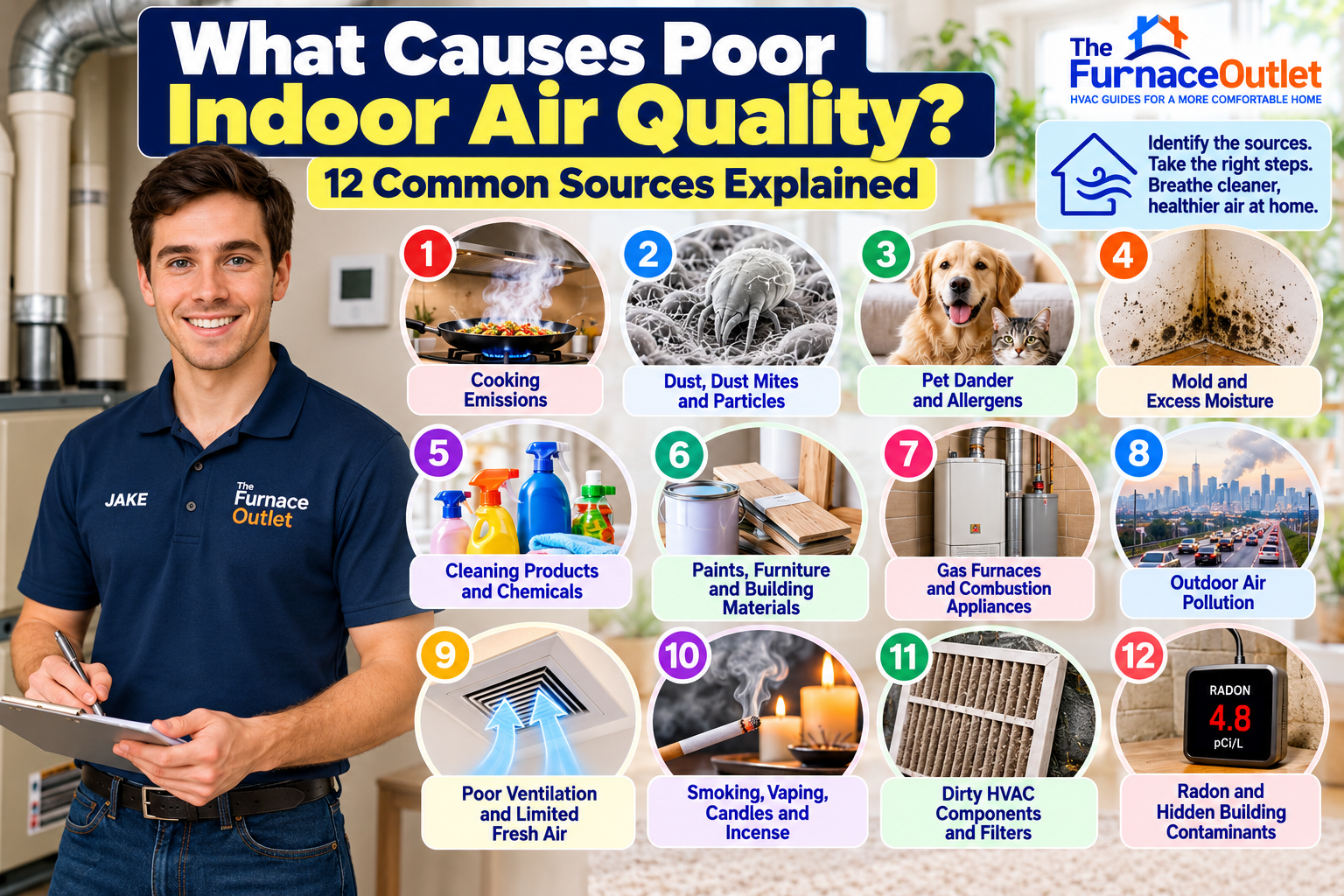
In this guide, I explain 12 common causes of poor indoor air quality, the conditions that make them problematic, and practical measures homeowners can take to reduce exposure.
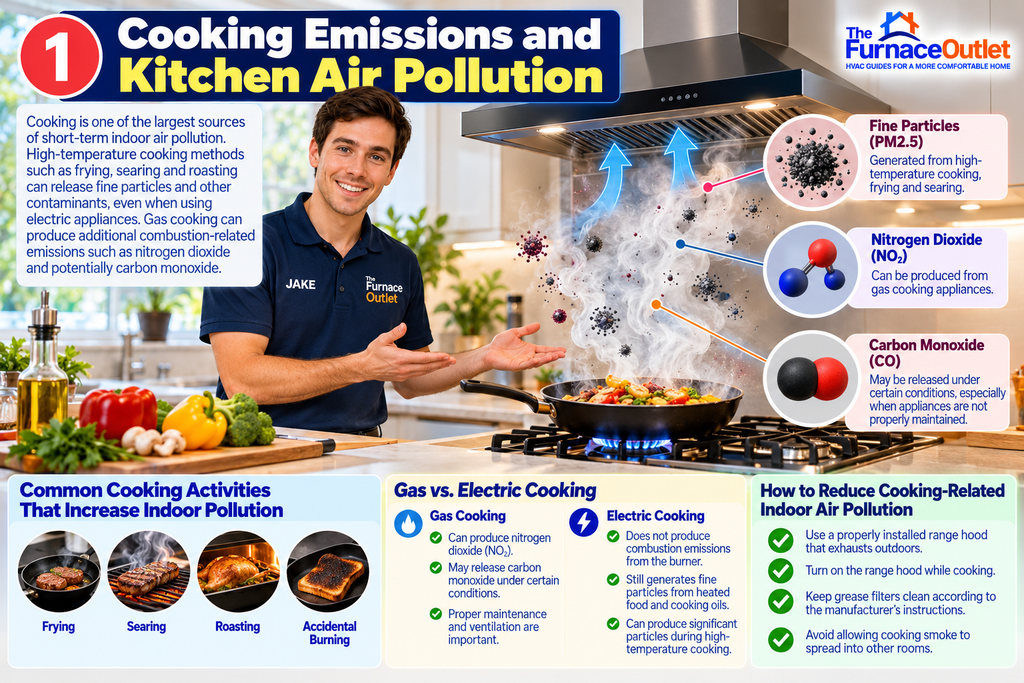
Cooking is one of the most common sources of short-term indoor particle pollution. Frying, searing, roasting, and cooking at high temperatures can generate fine particulate matter, including PM2.5, which consists of particles measuring 2.5 micrometers or smaller. These particles may remain airborne after cooking has finished and can spread into nearby rooms.
Gas cooking appliances can introduce additional pollutants associated with fuel combustion, including nitrogen dioxide and, under certain conditions, carbon monoxide. Electric cooking avoids combustion emissions from the burner itself, but it can still generate substantial airborne particles through heated food, cooking oils, and accidental burning.
The severity of cooking-related pollution depends on cooking methods, ventilation effectiveness, appliance condition, and how frequently meals are prepared. A kitchen with inadequate exhaust ventilation may allow cooking emissions to accumulate throughout the home, particularly in open-plan living spaces.
I recommend using a properly installed range hood that exhausts outdoors whenever possible. Homeowners should operate the hood during cooking, maintain grease filters according to manufacturer instructions, and avoid allowing visible cooking smoke to spread into occupied rooms. Recirculating range hoods may help capture some grease and odors, but they do not provide the same removal of indoor pollutants as effective outdoor exhaust.
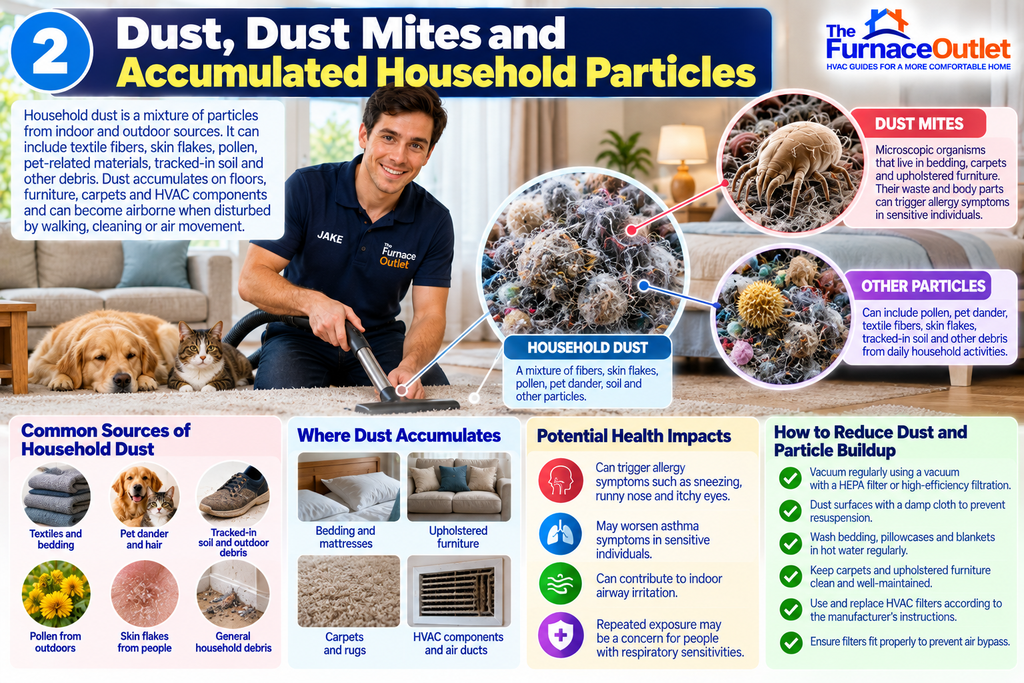
Household dust is a mixture of particles originating from indoor and outdoor sources. It may contain textile fibers, skin flakes, tracked-in soil, pollen, pet-related materials, and other debris. Dust accumulates on floors, furniture, carpets, and HVAC components before being disturbed by walking, cleaning, or air movement.
Dust mites are microscopic organisms that commonly inhabit bedding, upholstered furniture, and other suitable environments. Their allergenic materials can contribute to symptoms among sensitive individuals, particularly when exposure occurs repeatedly in bedrooms or other frequently occupied spaces.
Poor filtration, infrequent cleaning, and heavily contaminated carpets can increase the amount of settled material available for resuspension. However, visible dust alone does not provide a complete assessment of indoor air quality, because some important airborne pollutants cannot be seen.
Regular vacuuming with suitable filtration, damp dusting, laundering bedding, and maintaining HVAC filters can help reduce particle accumulation. I also recommend checking whether central HVAC filters fit properly, because air bypassing the filter can reduce its effectiveness and allow additional debris to circulate through the system.
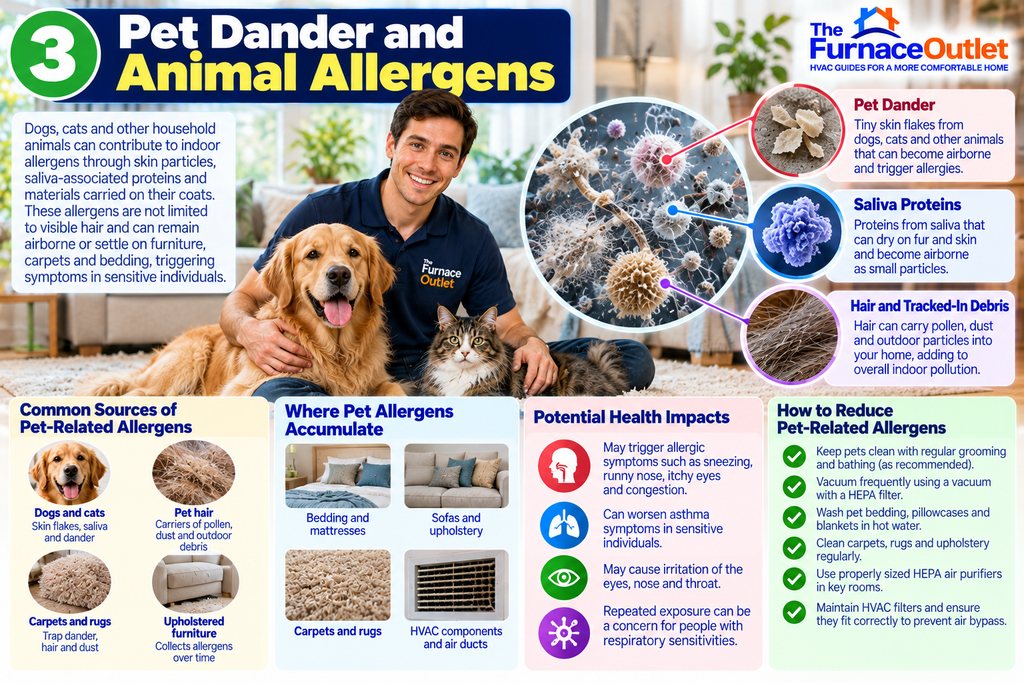
Dogs, cats, and other household animals can contribute to indoor allergens through skin particles, saliva-associated proteins, and materials carried on their coats. Pet allergens are not limited to visible hair, and some particles may remain airborne or settle into furniture, carpeting, and bedding.
Pet movement can also resuspend ordinary household dust, especially in homes with carpeting or upholstered furniture. The amount of exposure depends on the animal, household cleaning practices, ventilation, and the sensitivities of individual occupants.
A common misunderstanding is that an air purifier can completely eliminate pet allergens. While appropriately sized HEPA filtration can reduce certain airborne particles, it cannot remove all allergenic material embedded in mattresses, carpets, and furniture.
I recommend combining regular cleaning, suitable grooming, properly maintained HVAC filtration, and targeted portable air cleaning where needed. Families experiencing persistent allergy symptoms should also seek appropriate medical guidance, since environmental management may need to be tailored to the individual.
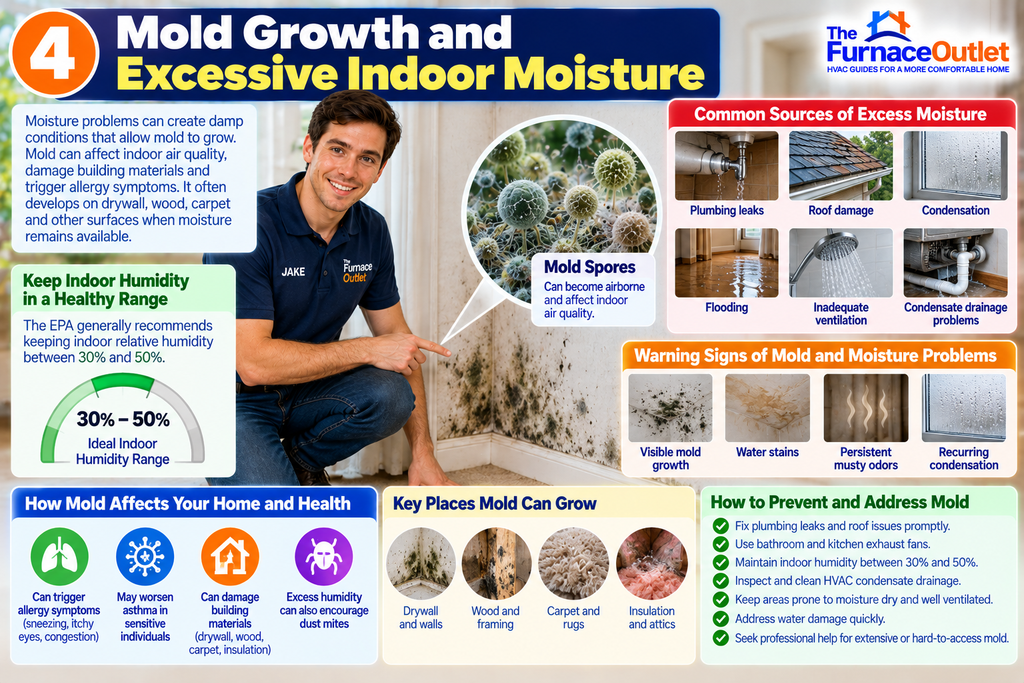
Moisture problems are among the most important building-related causes of poor indoor air quality. Plumbing leaks, roof damage, condensation, flooding, and inadequate ventilation can create damp conditions that support mold growth on susceptible materials.
Mold may develop on drywall, wood, carpeting, insulation, and other surfaces when moisture remains available. Visible growth, persistent musty odors, water stains, and recurring condensation are warning signs that deserve investigation.
Excessive humidity can also encourage dust mites and contribute to deterioration of building materials. The EPA generally recommends keeping indoor relative humidity around 30%–50%, although practical targets depend on climate, temperature, and the risk of condensation.
I recommend addressing the source of moisture before focusing on air cleaning. A HEPA purifier may capture some airborne spores, but it cannot remove mold growing inside walls or correct a leaking pipe. Homeowners should repair leaks promptly, maintain bathroom ventilation, inspect condensate drainage, and obtain qualified assistance when contamination is extensive or difficult to access.
Many cleaning products contain chemicals that can enter indoor air during use. Depending on their formulation, products such as disinfectants, degreasers, solvents, furniture polish, and air fresheners may release volatile organic compounds or other substances.
The health implications vary considerably because VOCs are a broad category of chemicals with different properties and exposure risks. Some products may cause noticeable irritation or odors, while others can release compounds that are not readily detected by smell.
Using large quantities of cleaning chemicals in enclosed rooms can increase exposure, particularly when ventilation is inadequate. Mixing incompatible products can also create dangerous reactions. For example, mixing bleach with ammonia-containing or acidic cleaners can release hazardous gases.
I recommend following product labels carefully, avoiding unnecessary chemical mixtures, selecting suitable lower-emission alternatives, and providing ventilation during activities that generate substantial vapors. Cleaning products should be stored securely and used only for their intended purposes rather than applied excessively in the belief that stronger chemical odors indicate better cleanliness.

Indoor furnishings and construction materials can release chemical emissions over time. Paints, adhesives, sealants, flooring products, composite wood, and certain manufactured furnishings may contribute VOCs or specific chemicals such as formaldehyde to indoor environments.
Emission rates vary according to product composition, age, temperature, humidity, and ventilation conditions. New furniture or recently renovated rooms may produce noticeable odors, but odor intensity does not reliably indicate whether a particular exposure is safe or hazardous.
Pressed-wood products can be a source of formaldehyde depending on their manufacturing characteristics and applicable emissions standards. Choosing products that meet recognized emissions requirements can help reduce avoidable indoor exposure.
When renovating, I recommend selecting appropriate low-emission materials, following manufacturer instructions, and planning adequate ventilation during and after installation. Homeowners should also avoid assuming that a standard HVAC particle filter will remove chemical gases. Source reduction and suitable ventilation are generally more relevant for many gaseous pollutants.
Fuel-burning heating equipment requires particular attention because improper combustion or venting can introduce hazardous pollutants into occupied spaces. Gas furnaces, boilers, fireplaces, wood stoves, and fuel-burning water heaters must be installed, operated, and maintained according to applicable safety requirements.
Carbon monoxide is especially dangerous because it is colorless and odorless. Faulty equipment, obstructed venting, inappropriate installation, and other combustion problems can create life-threatening conditions. Wood-burning appliances can also contribute particulate pollution when smoke enters the home.
Homeowners should not rely on odors or visible smoke to identify every combustion hazard. A conventional air purifier cannot replace safe appliance operation, correct venting, or working carbon monoxide alarms.
I recommend professional servicing of fuel-burning heating equipment according to manufacturer guidance, keeping vents unobstructed, and installing listed carbon monoxide alarms in appropriate locations. If a carbon monoxide alarm activates or exposure is suspected, occupants should leave the building immediately and contact emergency services from a safe location.
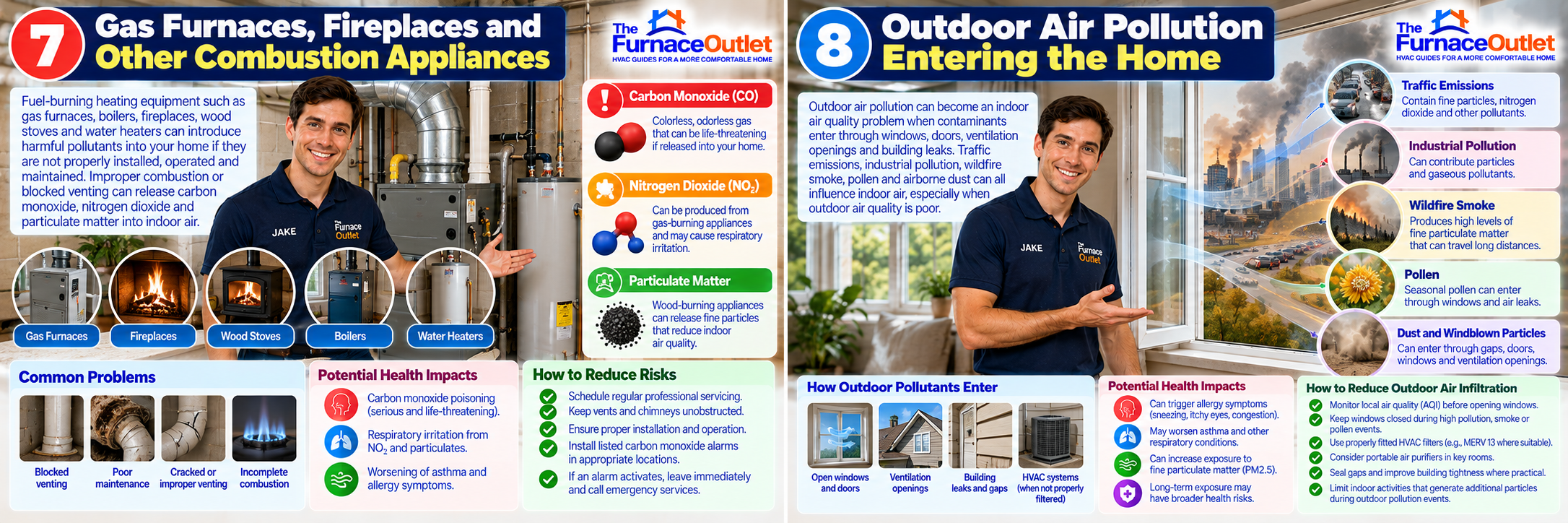
Outdoor pollution can become an indoor air quality problem when contaminants enter through windows, doors, ventilation openings, and building leakage pathways. Traffic emissions, industrial pollution, wildfire smoke, pollen, and airborne dust can all influence indoor conditions.
The extent of outdoor pollution entering a home depends on building tightness, ventilation design, filtration, weather conditions, and occupant behavior. Opening windows can improve ventilation when outdoor air is suitable, but it may increase indoor particle concentrations during severe pollution events.
Homes near busy roads or other pollution sources may experience additional exposure, although actual concentrations depend on local conditions and building characteristics. Seasonal pollen and smoke events can also produce substantial changes in indoor air quality.
I recommend checking reliable outdoor air-quality information before increasing natural ventilation during pollution episodes. Compatible HVAC filtration, properly sized portable air cleaners, and reduced indoor particle-generating activities may help lower exposure when outdoor air is temporarily unsuitable.
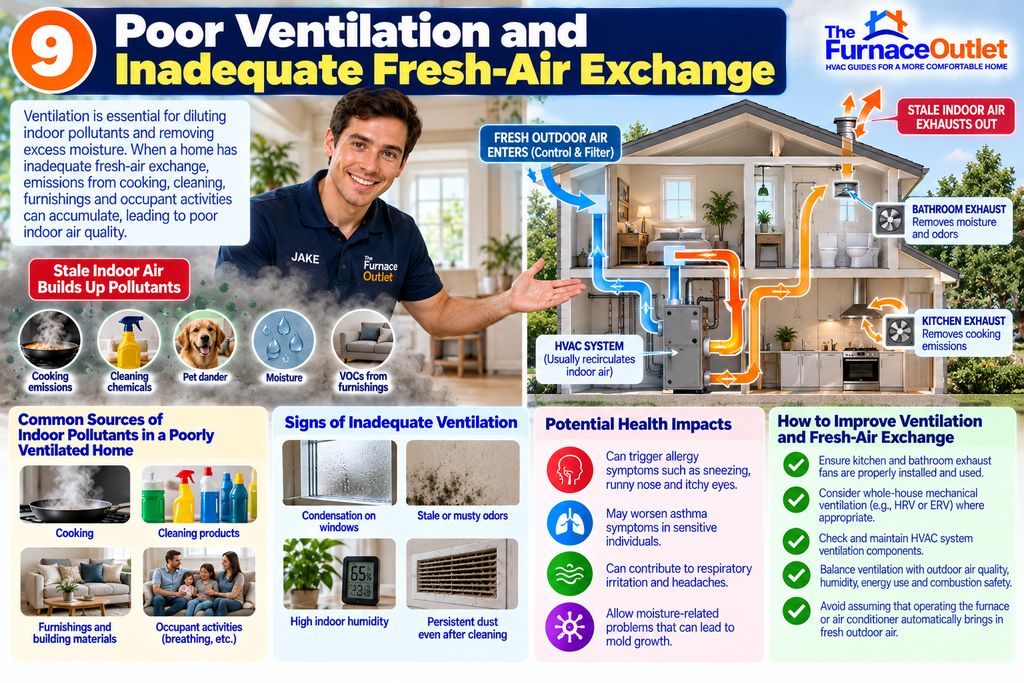
Ventilation is essential for diluting many pollutants generated indoors and removing excess moisture. When a home has inadequate outdoor air exchange, emissions from cooking, cleaning, furnishings, and occupant activities may accumulate.
Modern energy-efficient construction can reduce uncontrolled air leakage, which helps conserve heating and cooling energy. However, tighter construction also increases the importance of intentional ventilation that is properly designed and maintained.
A common misconception is that operating a central furnace or air conditioner automatically supplies fresh outdoor air. Many residential systems primarily recirculate indoor air unless they include dedicated outdoor-air ventilation equipment.
I recommend evaluating kitchen and bathroom exhaust systems first, followed by the home’s broader ventilation arrangement. Depending on the building, solutions may include improved exhaust ventilation or a properly designed whole-house mechanical ventilation system. Ventilation should be balanced against outdoor air quality, humidity, energy use, and combustion safety rather than increased indiscriminately.
Indoor smoking is a major avoidable source of airborne contaminants. Tobacco smoke contains fine particles and numerous chemicals, and secondhand smoke exposure is associated with serious health risks. Smoke residues can also remain on surfaces and furnishings after visible smoke has disappeared.
Vaping can introduce aerosols and chemicals into indoor air, although the composition differs from tobacco smoke. Candles and incense can also produce particles and combustion byproducts, with emissions influenced by product composition, burning conditions, and ventilation.
Frequent use of these products in enclosed rooms may increase indoor pollutant concentrations. Fragranced products should not be assumed to improve air quality simply because they create a pleasant smell.
My recommendation is to keep smoking and vaping outside the home and minimize unnecessary indoor combustion sources. When candles or incense are used, homeowners should consider their contribution to airborne particles and recognize that filtration cannot eliminate every associated chemical exposure.
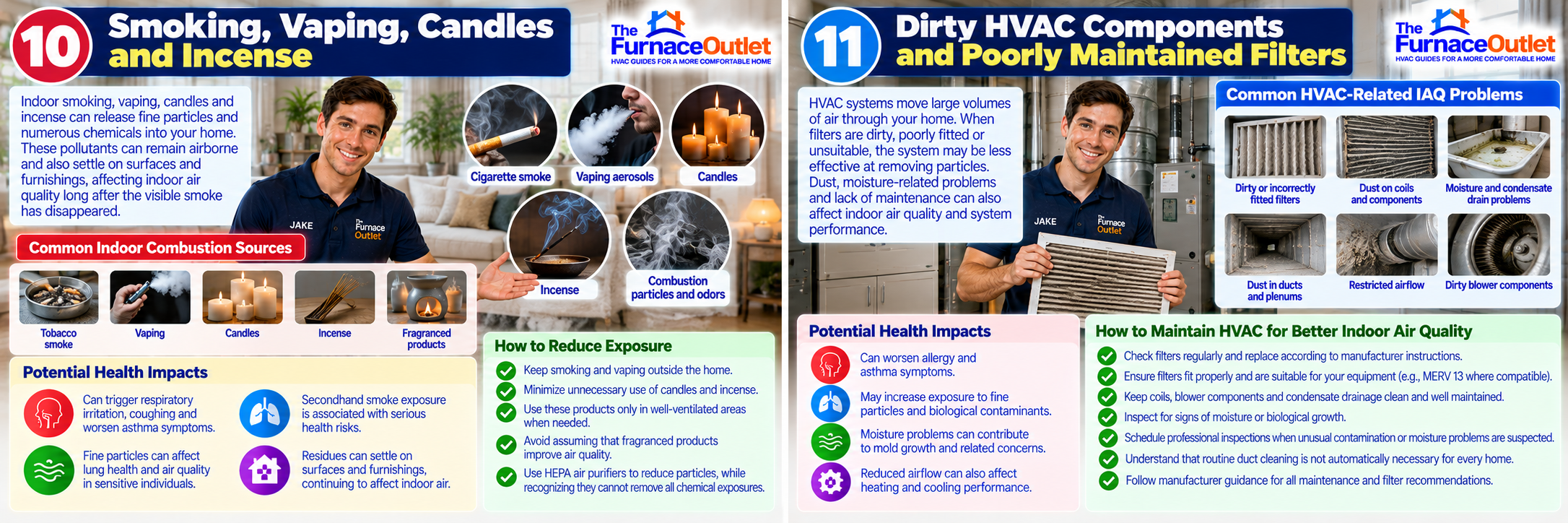
HVAC systems can influence indoor air quality because they move substantial volumes of air through occupied spaces. When filters are poorly fitted, excessively dirty, or unsuitable for the equipment, the system may provide less effective particle removal.
Dust can accumulate on accessible equipment surfaces, while moisture-related problems around cooling coils and condensate systems can create additional concerns. Restricted airflow may also affect heating and cooling performance, making filter maintenance important for both equipment operation and air quality.
However, homeowners should distinguish ordinary dust accumulation from significant contamination. Routine duct cleaning is not automatically necessary for every home, and the EPA does not recommend indiscriminate duct cleaning as a universal indoor air quality solution.
I recommend checking filters regularly, following equipment-specific replacement instructions, maintaining condensate drainage, and scheduling professional inspections when unusual contamination or moisture problems are suspected. Higher-efficiency filters, including MERV 13 where compatible, can provide additional particle capture, but airflow requirements must be respected.
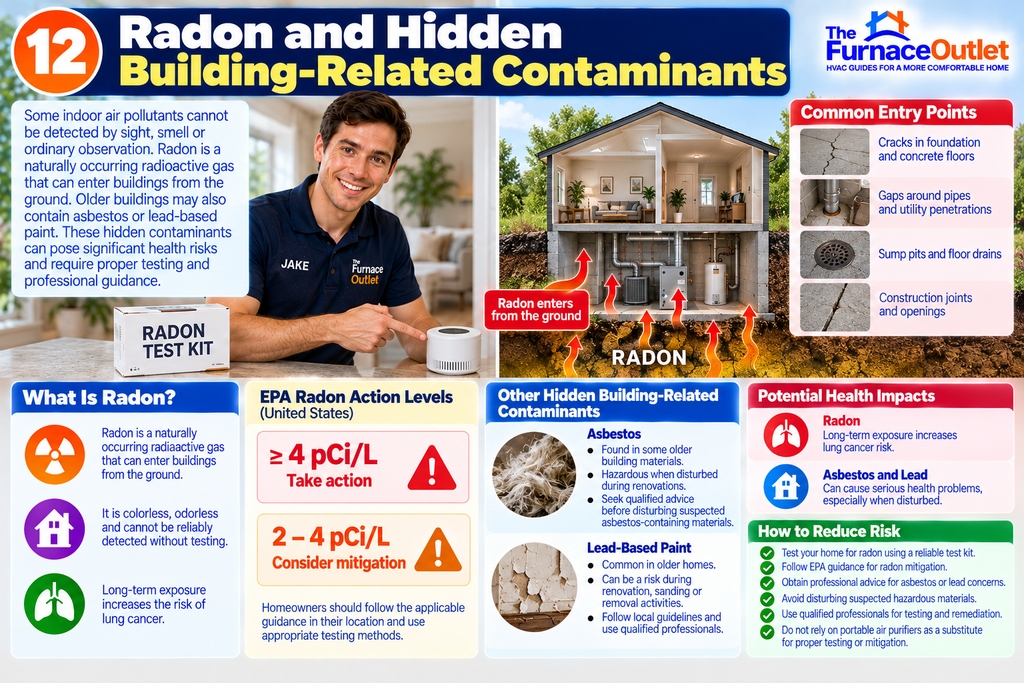
Some of the most important indoor pollutants cannot be detected through ordinary observation. Radon is a naturally occurring radioactive gas that can enter buildings from the ground. Long-term radon exposure increases lung cancer risk, and the gas cannot be reliably identified through smell or visible symptoms.
Radon concentrations vary among buildings, which means nearby homes may have different test results. Testing is the appropriate way to determine whether a particular property requires mitigation.
In the United States, the EPA recommends taking action at radon concentrations of 4 picocuries per liter or higher and considering mitigation between 2 and 4 picocuries per liter. Homeowners should follow the applicable guidance in their location and use appropriate testing methods.
Older buildings may also contain asbestos-containing materials or lead-based paint. These hazards are especially important during renovations that could disturb contaminated materials. I recommend obtaining qualified advice before disturbing suspected hazardous building materials and avoiding the assumption that portable air purifiers can substitute for proper testing or remediation.
Identifying an indoor air quality problem requires more than purchasing a monitor and checking a single numerical reading. The first step is to examine household activities, building conditions, and the timing of symptoms or noticeable changes. Cooking-related particle concentrations may rise during meal preparation, while moisture problems may become more apparent after showering or during humid weather.
Consumer monitors can help identify trends in PM2.5, carbon dioxide, humidity, and certain estimated chemical measurements. However, their accuracy and capabilities vary, and no single consumer device measures every relevant pollutant. Carbon dioxide trends may provide information about ventilation patterns, but they do not establish whether a home is free from hazardous contaminants.
I recommend documenting recurring concerns and investigating likely sources systematically. Specialized hazards require appropriate testing, including dedicated radon measurements and listed carbon monoxide alarms. Persistent moisture damage, combustion concerns, or unusual contamination may justify evaluation by qualified professionals.
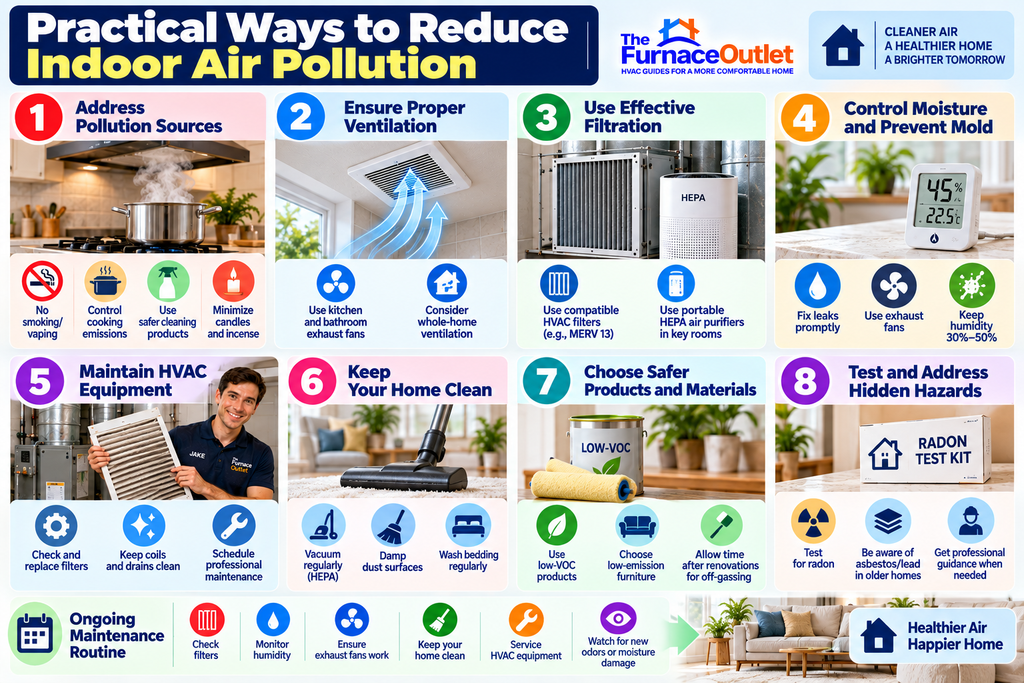
Improving indoor air quality is most effective when homeowners address pollution sources before relying on air-cleaning equipment. Removing avoidable indoor smoke, controlling cooking emissions, repairing moisture problems, and selecting suitable household products can reduce the amount of pollution that must subsequently be diluted or filtered.
The next priority is appropriate ventilation. Kitchen and bathroom exhaust systems should function correctly, and whole-house ventilation should be evaluated where necessary. Outdoor conditions should be considered because bringing in more air is not always beneficial when pollution levels outside are elevated.
Filtration provides an additional layer of protection against many airborne particles. Compatible HVAC filters and appropriately sized portable HEPA air cleaners can reduce particle concentrations, particularly when equipment operates for sufficient periods. Their effectiveness depends on airflow, maintenance, placement, and the amount of pollution being generated.
I recommend combining these improvements with a sustainable maintenance routine. Regular cleaning, humidity monitoring, filter inspection, equipment servicing, and attention to new odors or moisture damage can help prevent manageable problems from becoming persistent indoor air quality concerns.
There is no single source that dominates every household. Cooking emissions, indoor smoke, inadequate ventilation, household dust, cleaning products, and moisture problems are all common contributors. The most important source depends on household activities, building characteristics, and outdoor conditions.
Exposure to certain indoor pollutants can contribute to respiratory irritation, allergic symptoms, and other health effects. Some hazards, including carbon monoxide and radon, have particularly serious implications. Symptoms alone cannot reliably identify a pollutant, so persistent health concerns deserve appropriate medical evaluation alongside investigation of the indoor environment.
No. Suitable air purifiers can reduce many airborne particles, but their effectiveness against gases varies substantially. Conventional particle filtration cannot correct combustion defects, eliminate radon, repair leaks, or remove all contaminants embedded in building materials and furnishings.
Yes. Visible cleanliness does not guarantee adequate ventilation or the absence of invisible pollutants. A spotless home may still have elevated cooking emissions, excessive humidity, radon, or combustion-related problems. Indoor air quality should therefore be evaluated according to actual sources and conditions rather than appearance alone.
Warning signs may include poorly fitting filters, recurring moisture around equipment, unusual odors, or visible contamination requiring investigation. However, these observations do not establish that the HVAC system is the primary pollution source. A qualified technician can assess airflow, filtration, condensate drainage, and equipment condition when concerns persist.
Not necessarily. Opening windows can dilute indoor pollutants when outdoor air is suitable, but it can also introduce smoke, traffic particles, pollen, and other contaminants. The appropriate decision depends on outdoor conditions and the indoor pollution sources being addressed.
A digital hygrometer can provide ongoing information about indoor moisture conditions. Homeowners should pay particular attention during humid summers, cold winters, and periods when condensation or dampness is noticeable. Maintaining suitable humidity helps reduce moisture-related problems, although it does not replace fixing leaks or providing appropriate ventilation.
Testing is the only reliable way to determine whether radon concentrations are elevated. Homeowners should consult applicable local guidance and use recognized testing methods. If elevated levels are found, qualified mitigation may be necessary rather than relying on ordinary filtration equipment.
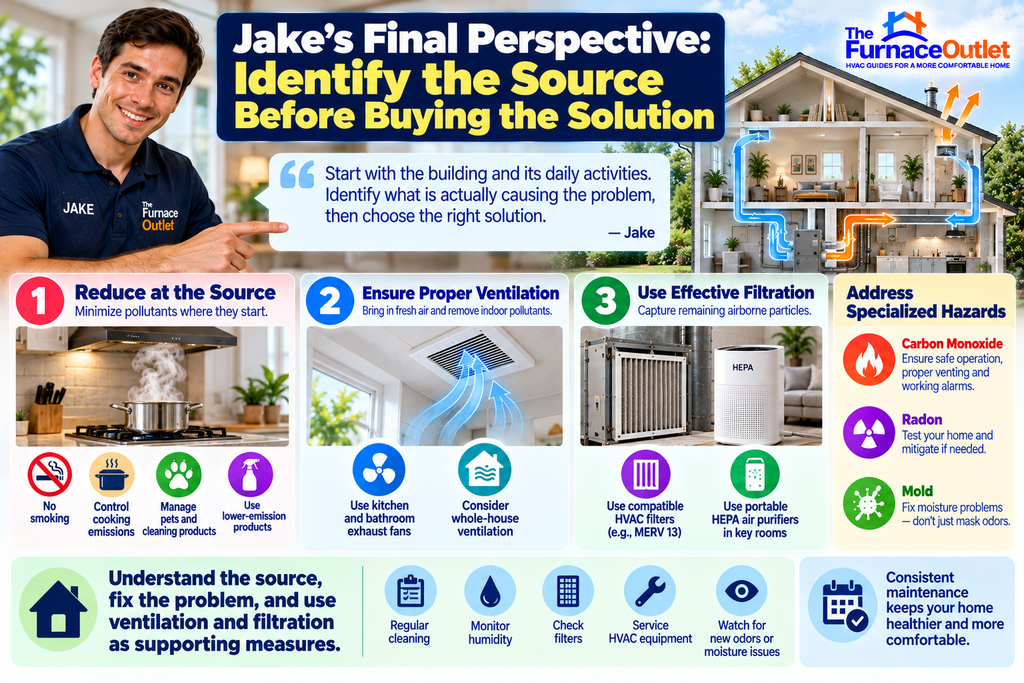
When homeowners ask me why the air inside their homes feels stale, dusty, or uncomfortable, I recommend beginning with the building and its daily activities rather than assuming the HVAC system is entirely responsible. Cooking, moisture, pets, household chemicals, combustion equipment, and outdoor pollution can all influence indoor conditions, and the most effective solution depends on which sources are actually present.
My preferred strategy follows three principles: reduce pollutants at their source, provide suitable ventilation, and use effective filtration for remaining airborne particles. I also emphasize the importance of addressing specialized hazards correctly. Carbon monoxide requires proper combustion safety measures and alarms, radon requires testing and potentially mitigation, and mold problems require moisture correction rather than simply masking odors.
The best way to improve indoor air quality is to understand what is polluting the home, correct the underlying problem, and use ventilation and filtration as supporting measures. With consistent maintenance and informed decisions, homeowners can reduce avoidable indoor pollution while protecting comfort and HVAC performance throughout 2026 and beyond.
This article provides general educational information about residential indoor air quality and HVAC-related conditions. It is not a substitute for professional environmental testing, medical evaluation, combustion-safety inspection, or building-code guidance. Pollutant exposure and appropriate corrective measures vary according to building characteristics, equipment, climate, and individual circumstances.
If a carbon monoxide alarm activates or carbon monoxide exposure is suspected, evacuate immediately and contact emergency services from a safe location. Suspected asbestos, lead, significant mold contamination, or other specialized hazards should be evaluated and addressed using appropriate qualified professionals.
The Furnace Outlet publishes independent HVAC educational content. References to public agencies and technical organizations do not imply endorsement or affiliation.
© 2026 The Furnace Outlet | https://thefurnaceoutlet.com
U.S. Environmental Protection Agency — Introduction to Indoor Air Quality. A foundational resource explaining common indoor pollutants, exposure considerations, and approaches to improving indoor environments. https://www.epa.gov/indoor-air-quality-iaq/introduction-indoor-air-quality
U.S. Environmental Protection Agency — Improving Indoor Air Quality. Guidance on source control, ventilation, and air cleaning as complementary pollution-reduction strategies. https://www.epa.gov/indoor-air-quality-iaq/improving-indoor-air-quality
U.S. Environmental Protection Agency — Guide to Air Cleaners in the Home. Explains air-cleaner technologies, filtration performance, and limitations of residential air-cleaning products. https://www.epa.gov/indoor-air-quality-iaq/guide-air-cleaners-home
World Health Organization — WHO Global Air Quality Guidelines. Evidence-based recommendations concerning particulate matter and major gaseous air pollutants. https://www.who.int/publications/i/item/9789240034228
U.S. Environmental Protection Agency — A Brief Guide to Mold, Moisture and Your Home. Practical information about moisture prevention, mold identification, and remediation considerations. https://www.epa.gov/mold/brief-guide-mold-moisture-and-your-home