Newsletter Subscribe
Enter your email address below and subscribe to our newsletter

HVAC made simple
By Jake Lawson | HVAC Specialist | The Furnace Outlet
When homeowners think about creating a comfortable living environment, they usually focus on temperature, heating costs, air conditioning performance, and insulation. However, another essential aspect of home comfort often receives much less attention: the quality of the air circulating throughout the building. Indoor air can contain airborne particles, gases, allergens, moisture, and biological contaminants that influence respiratory health, everyday comfort, and the condition of the home itself.
According to the U.S. Environmental Protection Agency (EPA), Americans spend approximately 90% of their time indoors, and concentrations of some pollutants can be several times higher indoors than outdoors. This does not mean that every home has unhealthy air, but it demonstrates why indoor environments deserve careful attention. Cooking, cleaning, household products, heating equipment, outdoor pollution, pets, and building materials can all contribute to the substances present in the air we breathe.
Indoor air quality has also become an increasingly important consideration in modern energy-efficient homes. Improved insulation and air sealing can reduce heating and cooling losses, but they also make intentional ventilation more important. A tightly constructed home without adequate ventilation may retain pollutants generated by everyday household activities, particularly when cooking, cleaning, or using fuel-burning appliances.
As an HVAC specialist with more than 10 years of experience, I believe homeowners should approach indoor air quality as a complete building-management issue rather than a problem that can be solved simply by purchasing an expensive air purifier. Effective improvements generally require identifying pollution sources, maintaining appropriate ventilation, controlling indoor moisture, and using filtration equipment suited to the home’s actual requirements.
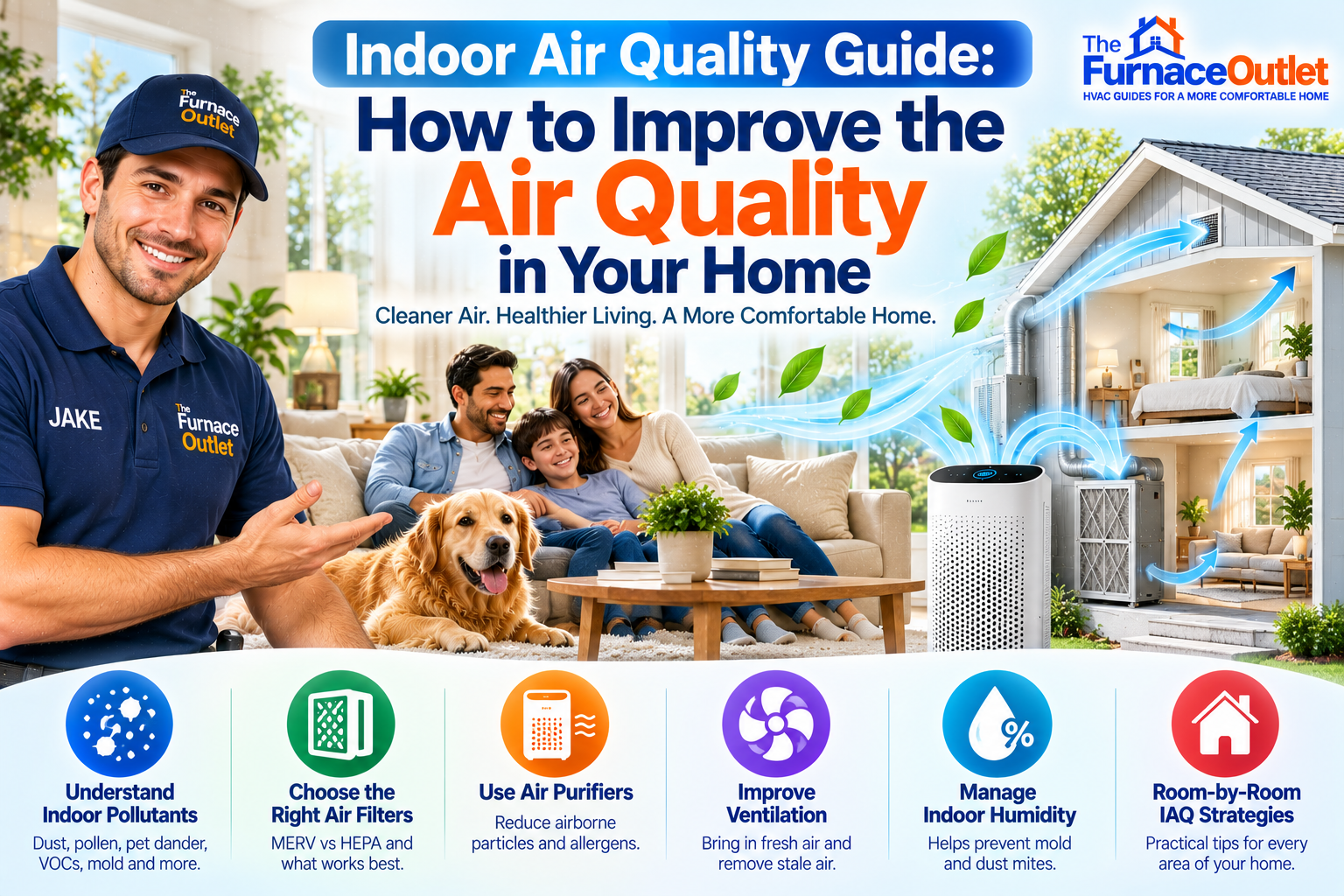
This Indoor Air Quality Guide 2026 explains how homeowners can recognize common indoor pollutants, improve HVAC filtration, select appropriate air-cleaning equipment, manage humidity, reduce household emissions, and develop a practical long-term strategy for healthier indoor environments.

Indoor air quality, commonly abbreviated as IAQ, refers to the characteristics of air within buildings that may affect occupants’ health, comfort, and well-being. It includes the concentration of airborne pollutants, the availability of ventilation, moisture conditions, temperature, and the performance of systems that move or treat indoor air.
A home with comfortable temperatures does not necessarily have excellent indoor air quality. Heating and cooling equipment may maintain the desired thermostat setting while airborne particles, cooking emissions, or chemical contaminants remain present. Similarly, a room may smell fresh because of fragrances while the underlying pollution sources have not been addressed.
Indoor air quality is also dynamic rather than constant. Pollutant concentrations may increase during cooking, cleaning, vacuuming, renovation work, or periods of heavy outdoor pollution. Ventilation rates, weather conditions, occupant activities, and HVAC operation can all change indoor conditions throughout the day.
The EPA identifies three foundational approaches to improving indoor air quality: source control, ventilation, and air cleaning or filtration. These strategies work best when used together, with source control generally taking priority because preventing pollution is often more effective than attempting to remove it after it enters the air.
Residential indoor air contains a mixture of substances originating from both indoor and outdoor environments. Some pollutants are produced directly by household activities, while others enter through doors, windows, ventilation openings, or gaps in the building envelope. Understanding the major categories helps homeowners select effective solutions instead of relying on products marketed as universal air-cleaning devices.
Particulate matter consists of tiny solid particles and liquid droplets suspended in the air. PM10 generally refers to particles with aerodynamic diameters of 10 micrometers or smaller, while PM2.5 refers to finer particles measuring 2.5 micrometers or smaller. These particles can originate from cooking, candles, fireplaces, smoking, outdoor traffic pollution, dust, and other combustion or mechanical processes.
Fine particulate matter deserves particular attention because smaller particles can penetrate deeply into the respiratory system. Exposure to particle pollution has been associated with respiratory and cardiovascular health effects, although individual risks depend on exposure concentration, duration, and personal susceptibility.
The World Health Organization’s global air quality guidelines provide health-based recommendations for particulate matter and several important gaseous pollutants. For homeowners, the practical lesson is to reduce avoidable particle sources, control outdoor air entry when pollution is severe, and use appropriate filtration when needed.

Volatile organic compounds, or VOCs, are chemicals that can be released into indoor air from paints, solvents, adhesives, cleaning products, air fresheners, furnishings, and certain building materials. Different VOCs have different properties and health implications, so the term should not be treated as describing one substance with a single risk level.
Formaldehyde is one specific indoor air pollutant associated with some pressed-wood products, adhesives, and other materials. Emissions can vary depending on the product, its age, temperature, humidity, and ventilation conditions.
Homeowners can reduce exposure by selecting lower-emission materials, following product-use instructions, storing chemicals appropriately, and ventilating during activities that generate emissions. A standard particle filter is not designed to remove most gaseous pollutants, which is why source reduction remains particularly important.
Indoor environments can contain pollen, pet dander, dust-mite allergens, mold spores, and other biological particles. Their presence and significance depend on household activities, moisture conditions, outdoor exposure, cleaning practices, and individual sensitivities.
Allergens may accumulate in carpets, upholstered furniture, bedding, and other surfaces before becoming airborne again through movement or cleaning. Moisture problems can also encourage mold growth on susceptible materials, creating additional concerns beyond ordinary household dust.
Regular cleaning, moisture control, appropriate filtration, and attention to known allergen sources can help reduce exposure. However, air filtration alone cannot remove contaminants embedded in carpets, mattresses, or damp building materials.

Fuel-burning appliances can generate gases and particles during combustion. Gas stoves, furnaces, boilers, fireplaces, and other combustion equipment may contribute to indoor pollution if emissions are released into occupied spaces or ventilation is inadequate.
Carbon monoxide is especially dangerous because it is colorless and odorless and can cause life-threatening poisoning. Nitrogen dioxide is another combustion-related pollutant that may affect respiratory health, particularly when indoor sources are not properly managed.
Proper appliance installation, safe venting, professional maintenance, effective kitchen exhaust, and working carbon monoxide alarms are essential precautions. Homeowners should never assume that a conventional air purifier can substitute for combustion safety measures.
Radon is a naturally occurring radioactive gas that can enter buildings from the surrounding ground. Its presence cannot be determined through smell or ordinary household observation, and long-term exposure increases lung cancer risk.
Unlike many particle pollutants, radon requires specific testing and, when elevated, appropriate mitigation measures. Standard portable air purifiers are not a substitute for radon testing or a properly designed radon reduction system.
Older buildings may also contain asbestos-containing materials or lead-based paint, depending on their age and construction history. These materials require appropriate assessment and safe handling, especially before renovations that could disturb them.
A successful indoor air quality plan should address the causes of pollution before focusing on expensive equipment. In my experience, homeowners often purchase filtration devices without first investigating obvious problems such as inadequate kitchen ventilation, moisture damage, indoor smoking, or improperly maintained heating equipment.
The most effective approach combines reducing pollution at its source, providing suitable outdoor air exchange, and filtering contaminants that remain in circulation. Each strategy addresses a different part of the problem, and no single method can reliably control every indoor pollutant.

Source control involves eliminating a pollutant source or reducing the amount it releases into indoor air. Examples include keeping smoking and vaping out of the home, reducing unnecessary candle burning, selecting lower-emission cleaning products, correcting plumbing leaks, and ensuring combustion appliances operate safely.
Cooking deserves particular attention because frying, searing, and other high-temperature cooking activities can generate substantial airborne particles. Using a properly installed range hood that exhausts outdoors can help capture pollutants near the source before they spread throughout the house.
Source control is particularly valuable for pollutants that ordinary particle filters cannot effectively remove. Chemical vapors, carbon monoxide, and radon require different interventions, making it important to identify the actual hazard before selecting equipment.

Ventilation introduces outdoor air and removes or dilutes pollutants generated indoors. Natural ventilation may occur through open windows and doors, while mechanical ventilation uses fans and ductwork to provide more controlled air exchange.
However, opening windows is not always the best solution. During wildfire smoke events, heavy traffic pollution, or other periods of poor outdoor air quality, uncontrolled outdoor air entry may increase indoor particle concentrations. Ventilation decisions should therefore consider outdoor conditions as well as indoor pollution sources.
Bathrooms and kitchens benefit from effective exhaust systems that discharge air outdoors. Whole-house mechanical ventilation can provide more consistent air exchange, particularly in tightly sealed buildings where uncontrolled infiltration is limited.

Filtration can reduce airborne particle concentrations by passing air through suitable filter media. HVAC filters may treat air circulating through a central heating and cooling system, while portable air cleaners typically serve individual rooms or defined areas.
Filtration effectiveness depends on filter performance, airflow, equipment runtime, placement, and the amount of pollution being generated. Even a highly efficient filter cannot provide adequate cleaning if too little air passes through it.
I recommend treating filtration as a supplement to source control and ventilation. A properly sized air cleaner may provide meaningful benefits for airborne particles, but it cannot repair a plumbing leak, correct unsafe combustion, or eliminate every gaseous contaminant.
Heating, ventilation, and air conditioning systems influence how air moves throughout a home. Central forced-air equipment circulates indoor air through return ducts, filtration components, heating or cooling equipment, and supply registers. This circulation can support particle filtration when the system uses an appropriate filter and operates for sufficient periods.
However, many residential HVAC systems primarily recirculate indoor air rather than continuously introducing outdoor air. A homeowner should not assume that running a furnace or air conditioner automatically provides adequate fresh-air ventilation.
HVAC performance also affects indoor moisture. Cooling coils remove moisture when operating under suitable conditions, while heating changes relative humidity as air temperature rises. Incorrect equipment sizing, restricted airflow, condensate problems, and inadequate ventilation can contribute to uncomfortable or unhealthy conditions.
A well-maintained HVAC system supports an indoor air quality strategy, but the system must be evaluated as part of the complete building rather than treated as an independent solution to every pollutant problem.

The Minimum Efficiency Reporting Value, or MERV, is a standardized rating used to describe how effectively certain air filters capture particles within specified size ranges. Higher MERV ratings generally indicate better particle capture performance, although the filter’s actual effect on indoor air also depends on airflow and installation.
Many basic residential filters are designed primarily to protect HVAC equipment from larger debris. Higher-efficiency filters can capture more fine particles, but they may also introduce additional resistance to airflow depending on their construction, size, and condition.
For many compatible residential HVAC systems, MERV 13 filtration is a useful target, provided the equipment can accommodate the filter without excessive pressure drop or reduced airflow. Homeowners should not automatically install the highest-rated filter available without checking manufacturer guidance or obtaining professional advice.
A filter that restricts airflow can create heating and cooling performance problems, even when its particle capture rating is excellent. Filter depth, surface area, cabinet design, and proper sealing are therefore as important as the advertised MERV number.
Air can bypass a filter when the filter does not fit properly or when gaps exist around the filter rack. In such cases, some circulating air may avoid the filter media altogether, reducing the expected cleaning benefit.
Dirty filters can also restrict airflow and increase operating demands. Replacement intervals depend on the filter type, household dust levels, pets, operating hours, and manufacturer instructions rather than a universal schedule.
I recommend checking accessible HVAC filters monthly during heavy heating or cooling use and replacing them as needed. Homeowners should also verify that replacement filters match the required dimensions and airflow specifications.

High-efficiency particulate air, or HEPA, filtration is widely used in portable air-cleaning equipment. Genuine HEPA filters are designed to capture a very high proportion of particles under specified test conditions, making them useful for reducing many airborne particles when combined with adequate airflow.
A portable HEPA air purifier can be particularly helpful in bedrooms, living rooms, and other frequently occupied spaces. It may also provide additional particle removal during periods when outdoor air quality is poor and opening windows is undesirable.
However, purchasing a HEPA purifier does not guarantee excellent indoor air quality. A small device operating in a large room may deliver insufficient clean airflow, while a unit operated only occasionally may provide less benefit than expected.
The most important selection factors include clean air delivery rate, room size, noise level, energy consumption, replacement filter costs, and the manufacturer’s performance information. I recommend prioritizing verified particle-cleaning performance over decorative features, fragrance systems, or unsupported claims about removing every indoor contaminant.

Clean Air Delivery Rate, commonly abbreviated CADR, indicates how much filtered air an air cleaner delivers for a specified pollutant category. A higher CADR generally means the device can remove airborne particles more quickly from a given room, assuming appropriate operating conditions.
Air changes per hour, or ACH, describes the volume of air moved or exchanged relative to the room volume. When discussing portable air cleaners, the term often refers to equivalent clean-air changes rather than actual outdoor ventilation.
For example, consider a bedroom measuring 12 feet by 15 feet with an 8-foot ceiling. Its volume is approximately 1,440 cubic feet. To provide an illustrative five equivalent clean-air changes per hour through a portable cleaner alone, the required particle CADR would be approximately 120 cubic feet per minute.
This calculation is useful for equipment selection, but five equivalent clean-air changes per hour should not be interpreted as a universal residential health requirement. The appropriate cleaning rate depends on the pollutant, source strength, occupancy, ventilation, and intended outcome.
Whole-house air-cleaning systems are commonly installed within compatible central HVAC ductwork. They can treat air circulated throughout the system’s connected spaces, potentially providing broader coverage than a single portable unit.
Their effectiveness depends on the HVAC blower operation, filtration media, duct configuration, airflow capacity, and installation quality. If the central fan operates infrequently, the air cleaner may provide limited treatment during periods when heating or cooling is not required.
Portable air purifiers offer greater flexibility because they can operate independently in selected rooms. This can be especially useful for bedrooms, home offices, or households that want additional particle removal without modifying their central HVAC system.
I recommend choosing based on the home’s layout, existing equipment, noise preferences, maintenance requirements, and the specific pollution problem. A well-sized portable cleaner may be more useful than a poorly configured whole-house system, while properly designed central filtration can provide valuable coverage across multiple rooms.

Some air-cleaning products use ozone generation, ionization, or other electronic processes to claim that they neutralize pollutants. These technologies should not be treated as equivalent to conventional mechanical filtration.
Ozone is a respiratory irritant, and devices that intentionally produce ozone can introduce an additional indoor pollutant. Certain electronic air-cleaning technologies may also produce byproducts under particular operating conditions.
The EPA advises against using ozone generators in occupied indoor spaces. I recommend selecting established mechanical filtration technologies and carefully reviewing independent performance information before considering products that rely on chemical reactions or electronic air treatment.
A purifier should not create new indoor air quality concerns while attempting to address existing ones. Humidity influences indoor comfort, airborne particle behavior, biological growth, and the condition of building materials. Air that is excessively dry may contribute to discomfort, while persistent high humidity can encourage dust mites, condensation, and mold growth in susceptible locations.
The EPA generally recommends maintaining indoor relative humidity around 30%–50%, while recognizing that actual conditions vary by climate and building characteristics. In winter, some homes may require lower humidity to prevent condensation on cold windows and exterior surfaces. During humid summers, air conditioning or dehumidification may be necessary to control excessive moisture.
A digital hygrometer provides a practical starting point for monitoring humidity. I recommend measuring conditions in frequently occupied rooms and checking for window condensation, musty odors, damp materials, or recurring moisture problems.
Humidifiers and dehumidifiers should be selected according to the actual conditions rather than used automatically. Humidifiers require careful cleaning and appropriate water management, while dehumidifiers need regular drainage and maintenance. Neither device can correct a concealed plumbing leak or defective building envelope.
Mold can develop when suitable materials remain damp for sufficient periods. Common moisture sources include roof leaks, plumbing failures, condensation, inadequate bathroom ventilation, flooding, and poorly managed indoor humidity.
Visible mold, recurring dampness, water stains, or persistent musty odors should prompt investigation. Surface cleaning alone may provide temporary improvement, but mold is likely to return if the underlying moisture problem remains unresolved.
Air purifiers equipped with particle filters may capture some airborne mold spores, but they cannot remove mold growing inside walls, under flooring, or on other damp materials. Effective remediation requires correcting the moisture source and addressing contaminated materials appropriately.
I recommend fixing leaks promptly, using bathroom exhaust fans during and after showers, maintaining condensate drainage, and investigating repeated condensation. Extensive contamination, contaminated HVAC systems, or moisture problems involving hazardous materials may require professional assessment and remediation.

Cooking can be one of the largest short-term sources of indoor particle pollution. High-temperature frying, searing, roasting, and accidental food burning can release fine particles and other contaminants, even when the cooking appliance is electric.
Gas cooking introduces additional combustion-related emissions, including nitrogen dioxide and potentially carbon monoxide under certain conditions. The amount released into the home depends on appliance condition, cooking methods, ventilation, and other factors.
A range hood that exhausts outdoors is generally preferable to a recirculating hood for removing cooking pollutants. Its effectiveness depends on airflow, capture design, installation height, and whether occupants actually use it while cooking.
I recommend operating suitable kitchen exhaust ventilation whenever cooking generates substantial heat, moisture, or airborne emissions. Homeowners should also clean grease filters according to manufacturer instructions and avoid allowing cooking smoke to spread throughout the house.
Bedrooms deserve particular attention because occupants spend extended periods in these spaces, often with doors and windows closed. Bedding, upholstered furniture, carpets, pets, and outdoor pollen can contribute to particle and allergen exposure.
Regular laundering, appropriate vacuuming, moisture control, and suitable ventilation can help maintain cleaner bedroom conditions. Homes with significant outdoor pollution may benefit from limiting unfiltered outdoor air entry during poor-air-quality periods and using a properly sized portable air cleaner.
A quiet HEPA air purifier may be useful when additional airborne particle removal is needed. However, homeowners should evaluate its clean air delivery rate at a noise level they can comfortably tolerate during sleep, rather than relying solely on the manufacturer’s maximum-performance setting.
I recommend keeping bedroom air-cleaning arrangements simple and sustainable. Consistent filtration, clean bedding, controlled moisture, and attention to known pollutant sources are generally more valuable than complicated equipment that occupants rarely operate.

Dogs, cats, and other pets can contribute to indoor allergens through skin particles, saliva-associated proteins, and materials carried on their coats. Pet activity can also resuspend settled dust from flooring, furniture, and bedding.
Regular cleaning, appropriate grooming, and maintenance of HVAC filters can help reduce airborne and settled contaminants. Portable HEPA filtration may provide additional particle removal, particularly in rooms where pets spend considerable time.
However, pet allergens are not limited to visible hair. Some allergenic particles are small enough to remain airborne, while others accumulate on surfaces and fabrics. A purifier cannot remove all allergens from furniture or prevent new allergens from being introduced.
I recommend considering the complete household environment, including ventilation, cleaning practices, filter maintenance, and individual sensitivities. Families experiencing persistent allergy symptoms should seek appropriate medical guidance rather than assuming that a particular filtration device will resolve every problem.
Outdoor air pollution can significantly influence indoor air quality, especially when smoke or fine particles enter through open windows, doors, ventilation systems, and building leakage pathways. During severe pollution events, normal recommendations to increase outdoor ventilation may need to be adjusted.
Homeowners should monitor reliable local air-quality information and reduce unnecessary outdoor air entry when conditions are hazardous. Properly sized portable air cleaners, compatible higher-efficiency HVAC filtration, and attention to building leakage can help reduce indoor particle exposure.
Some ventilation systems include outdoor-air intakes that may require appropriate filtration or operating adjustments during smoke events. These changes should follow equipment instructions and professional guidance, especially where ventilation is needed for combustion safety or other essential purposes.
I recommend establishing a cleaner indoor room during extended smoke events when practical. This involves reducing indoor particle-generating activities, operating suitable filtration, and avoiding unnecessary opening of exterior doors and windows. Filtration reduces exposure but does not guarantee complete protection from every smoke-related gas or particle.
Whole-house mechanical ventilation can provide more predictable outdoor air exchange than relying entirely on incidental leakage and window opening. Such systems may be particularly valuable in tightly sealed homes where ventilation requirements cannot be met consistently through natural air movement.
Exhaust-only, supply-only, and balanced ventilation systems operate differently. Balanced systems can use dedicated supply and exhaust pathways, while heat-recovery ventilators and energy-recovery ventilators transfer some energy between outgoing and incoming air streams.
Heat-recovery ventilators primarily exchange sensible heat, while many energy-recovery ventilators also transfer some moisture. Their performance depends on equipment design, climate, installation quality, airflow balancing, and maintenance.
I recommend having a qualified professional evaluate ventilation needs before installing new equipment. Excessive ventilation can increase energy costs or introduce outdoor pollution, while inadequate ventilation may allow indoor contaminants to accumulate. The objective is appropriate, controlled ventilation rather than simply maximizing airflow.

Houseplants can improve the appearance of living spaces and provide enjoyment, but their ability to remove indoor pollutants under ordinary residential conditions is frequently overstated. Some laboratory experiments have demonstrated pollutant uptake by plants under controlled conditions. However, these findings do not establish that a practical number of houseplants can provide meaningful whole-room air cleaning in occupied homes.
Plants also require watering, and excessively damp soil can create moisture or microbial concerns. Homeowners should therefore avoid treating decorative plants as substitutes for ventilation, filtration, or source control. I recommend enjoying houseplants for their aesthetic value while relying on established indoor air quality measures for pollution management.
Air duct cleaning is often marketed as an essential indoor air quality service, but routine cleaning of every residential duct system is not automatically necessary. The potential benefit depends on the condition of the ductwork and whether meaningful contamination is present.
Duct inspection may be appropriate when there is substantial visible debris, suspected microbial contamination, evidence of pest infestation, or unusual contamination following construction or other events. Even then, the underlying cause should be corrected rather than simply removing visible material. Poorly performed duct cleaning can disturb contaminants or damage duct components. Homeowners should be cautious about exaggerated claims that duct cleaning will cure allergies, eliminate all household dust, or dramatically reduce energy bills.
I recommend evaluating filter fit, duct leakage, equipment cleanliness, and moisture problems before paying for extensive duct cleaning. Where cleaning is justified, contractors should use suitable procedures and avoid damaging internal insulation or other components.

Consumer indoor air quality monitors can provide useful information about certain pollutants and environmental conditions. Depending on the device, measurements may include PM2.5, carbon dioxide, temperature, relative humidity, and estimates of volatile organic compounds.
However, low-cost sensors have limitations involving calibration, accuracy, interference, and the pollutants they can actually detect. A device displaying a numerical air-quality score should not be assumed to measure every important contaminant in the home. Carbon dioxide measurements can help homeowners understand occupancy-related ventilation patterns under appropriate conditions, but CO2 alone does not establish overall indoor air safety. Likewise, a consumer VOC reading may not identify individual chemicals or determine whether a specific exposure is hazardous.
I recommend using monitors to observe trends and investigate activities that cause repeatable changes. Homeowners should use dedicated, appropriate testing methods for hazards such as radon and rely on listed carbon monoxide alarms rather than general-purpose air-quality sensors for emergency CO detection.
Radon exposure deserves attention because it cannot be detected through ordinary household observation. Homes can have elevated radon concentrations regardless of appearance, cleanliness, or the presence of air purifiers. Testing is the only reliable way to determine whether a particular home has elevated radon. Short-term and long-term test methods are available, and results should be interpreted according to applicable national or local guidance.
In the United States, the EPA recommends taking corrective action when radon concentrations are at or above 4 picocuries per liter and considering mitigation for levels between 2 and 4 picocuries per liter. These values are radon-specific action guidance, not general indoor air quality ratings. Where mitigation is needed, properly designed systems can reduce radon entry from the ground. I recommend using qualified testing and mitigation professionals when appropriate and verifying results after corrective work.

The most effective household strategy begins with identifying the largest and most controllable pollution sources. Homeowners should first investigate combustion safety, visible moisture damage, indoor smoking, major cooking emissions, and other conditions that may require direct intervention. The next step is to evaluate ventilation and filtration. Kitchen and bathroom exhaust systems should operate appropriately, HVAC filters should fit correctly, and portable air cleaners should be sized for the spaces they serve. Outdoor air conditions should also be considered before increasing natural ventilation.
Finally, homeowners should establish a maintenance routine. This includes inspecting filters, checking humidity, cleaning accessible surfaces, reviewing air-cleaner performance, maintaining heating and cooling equipment, and arranging specialized testing where necessary. I recommend documenting major changes and observing whether they address the original concern. Indoor air quality improvements should be based on the problem being solved rather than the number of devices installed.
The most effective approach combines source control, appropriate ventilation, and filtration. Begin by reducing avoidable pollutants such as indoor smoke, excessive cooking emissions, and chemical product vapors. Then evaluate ventilation and use suitable particle filtration where needed. This approach is generally more effective than relying exclusively on a portable air purifier.
There is no single number that establishes whether all aspects of indoor air are healthy. Different pollutants require different measurement methods and health-based guidance, while humidity, ventilation, and building conditions must also be considered. A low PM2.5 reading does not rule out elevated radon, carbon monoxide, or other contaminants.
MERV 13 and HEPA describe different filtration performance categories and applications. HEPA filters provide very high particle capture efficiency under defined testing conditions, while MERV 13 filters can be suitable for many compatible central HVAC systems. The better choice depends on airflow requirements, installation compatibility, and the amount of air passing through the filter.
Appropriately designed particle filtration can reduce airborne particles that contain microorganisms, including some virus-containing respiratory aerosols. However, effectiveness depends on airflow, filter performance, placement, and operating time. Air cleaners do not guarantee prevention of infection and should supplement appropriate ventilation and other relevant precautions.
Some air purifiers use activated carbon or other gas-phase media that may reduce certain odors under suitable conditions. Performance depends on the amount and type of media, the chemicals involved, and how frequently the filter is replaced. A standard HEPA particle filter alone is not designed to remove most odor-causing gases.
Replacement frequency depends on filter design, operating hours, dust levels, pets, and manufacturer guidance. Some disposable filters require relatively frequent replacement, while deeper media filters may last longer. I recommend inspecting accessible filters monthly during heavy use and replacing them when necessary rather than following one interval for every household.
Opening windows can improve ventilation when outdoor air is suitable, but it may introduce pollution during wildfire smoke events, heavy traffic emissions, or other poor-air-quality conditions. Homeowners should consider outdoor air quality, weather, and indoor pollutant sources before relying on open windows as their primary ventilation strategy.
Persistent high humidity can encourage mold growth, dust mites, and moisture damage in susceptible environments. The EPA commonly recommends indoor relative humidity around 30%–50%, adjusted for building and climate conditions. Correcting leaks, maintaining ventilation, and using appropriate dehumidification can help manage excessive moisture.
Price does not reliably establish cleaning performance. A moderately priced device with suitable CADR, effective filtration, acceptable noise, and affordable replacement filters may outperform a more expensive model with insufficient airflow or poorly supported marketing claims. I recommend comparing verified specifications and total ownership costs.
Certain indoor exposures can contribute to headaches, irritation, dizziness, or fatigue, but these symptoms have many possible causes and cannot establish a specific indoor air problem by themselves. Carbon monoxide exposure is a particularly serious concern when compatible symptoms occur near combustion equipment. Suspected CO exposure requires immediate evacuation, emergency contact, and medical evaluation.
Professional evaluation may be appropriate when there are persistent unexplained odors, recurring moisture problems, suspected combustion defects, significant contamination, or concerns about specific pollutants that require specialized measurement. Testing should be selected according to a defined question rather than purchasing a broad, poorly explained package of measurements.
Indoor air quality deserves attention throughout the year, although the dominant problems may change seasonally. Winter can increase combustion use and reduce window ventilation, while summer may introduce humidity, mold, and outdoor pollution concerns. A year-round plan should account for seasonal changes rather than focusing on only one period.
When homeowners ask me how to improve the air quality in their homes, I explain that the most effective solution rarely begins with buying the most expensive purifier or installing the highest-rated HVAC filter. Good indoor air quality starts with understanding where pollutants originate, how air moves through the building, and which conditions allow contaminants or moisture to accumulate. A home may require better kitchen ventilation, more effective filtration, improved moisture management, or professional attention to combustion equipment, depending on the actual problem.
My preferred approach combines practical source control, appropriate outdoor air exchange, properly selected HVAC filtration, and consistent equipment maintenance. I also encourage homeowners to pay attention to the limitations of consumer air-quality monitors and air-cleaning technologies. A particle filter cannot correct a radon problem, a fragrance cannot eliminate combustion pollutants, and a dehumidifier cannot permanently solve an active plumbing leak.
The best indoor air quality strategy is not the one with the most equipment, but the one that addresses the home’s actual pollution sources while maintaining effective ventilation, filtration, moisture control, and safe HVAC operation. By managing these elements together, homeowners can create more comfortable indoor environments and reduce avoidable exposure to common household pollutants throughout 2026 and beyond.

1. U.S. Environmental Protection Agency — Improving Indoor Air Quality. Explains source control, ventilation, and air filtration, including why controlling pollutant sources is often the most effective first intervention.
2. EPA — Guide to Air Cleaners in the Home. Authoritative guidance on portable air purifiers, HVAC filters, CADR, particle removal, and limitations of air-cleaning technologies.
3. EPA — Factsheet: What Is Indoor Air Quality?. A July 2025 EPA publication covering indoor pollutant sources, health concerns, building systems, and recommended IAQ improvements.
4. World Health Organization — WHO Global Air Quality Guidelines. A comprehensive, evidence-based scientific publication addressing PM2.5, PM10, nitrogen dioxide, ozone, sulfur dioxide, and carbon monoxide. Published in 2021 and still valuable foundational study material in 2026.
5. CDC/NIOSH — Improving Air Cleanliness. Guidance on ventilation-system maintenance, filter installation, and HEPA air-cleaning technologies, particularly for airborne respiratory hazards.
6. EPA — Improving Your Indoor Environment. Practical homeowner recommendations covering indoor moisture, exhaust ventilation, air filtration, combustion appliances, and cleaning.
7. EPA — Low-Cost Air Pollution Monitors and Indoor Air Quality. Explains what consumer sensors measure, how to interpret readings, and the limitations of inexpensive indoor monitoring equipment.
8. EPA — Ozone Generators That Are Sold as Air Cleaners. Reviews scientific evidence concerning ozone-producing devices, their effectiveness, and potential health hazards
This article is intended for general educational purposes and does not constitute medical advice, environmental testing certification, building-code guidance, or professional HVAC diagnosis. Indoor air quality conditions vary according to building design, climate, ventilation, pollutant sources, and individual health considerations. Homeowners should follow manufacturer instructions, applicable regulations, and recommendations from appropriately qualified professionals.
If a carbon monoxide alarm activates or carbon monoxide exposure is suspected, leave the building immediately and contact emergency services from a safe location. Do not re-enter until authorized by emergency responders. Suspected asbestos, lead, extensive mold contamination, radon, and other specialized hazards may require qualified assessment and appropriate remediation.
The Furnace Outlet provides independent HVAC educational content. References to public agencies, standards organizations, and external research do not imply endorsement, sponsorship, or affiliation.
© 2026 The Furnace Outlet | https://thefurnaceoutlet.com