Newsletter Subscribe
Enter your email address below and subscribe to our newsletter

HVAC made simple
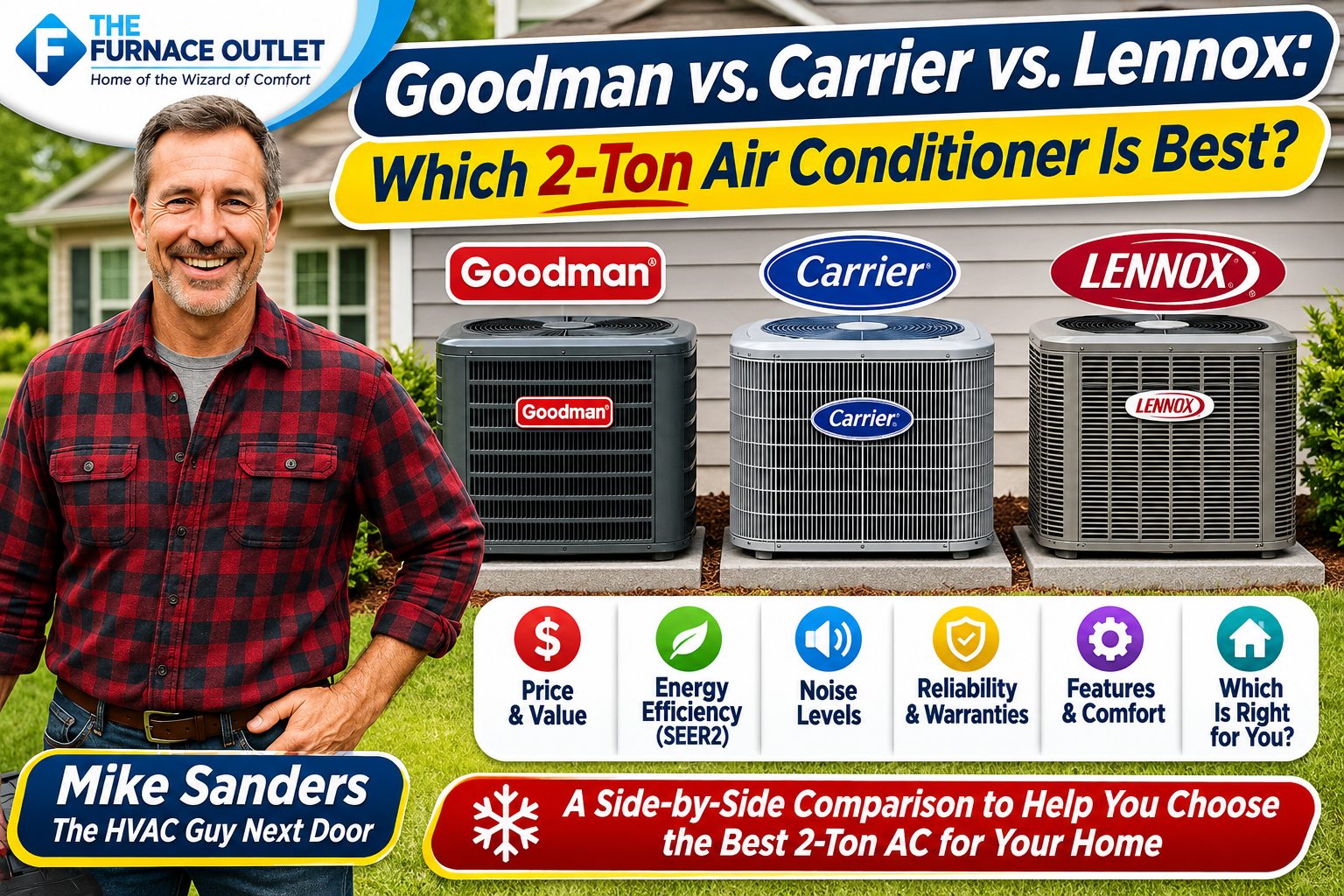
By Mike Sanders — Mike the HVAC Guy Next Door | The Furnace Outlet
If you’re shopping for a 2-ton central air conditioner, chances are you’ve come across three familiar names: Goodman, Carrier, and Lennox. All three manufacturers offer residential cooling systems, but they approach equipment design, efficiency, comfort features, and pricing somewhat differently. The challenge isn’t simply finding the most recognizable brand. It’s finding an air conditioner that fits your home, your budget, and your expectations for long-term comfort.
I’ve always believed buying an air conditioner should feel more like making an informed home improvement decision and less like trying to decode a complicated engineering manual. You want reliable cooling, reasonable electricity bills, manageable noise levels, and equipment that won’t become a maintenance headache. Whether you’re replacing an aging system or installing central cooling for the first time, understanding what each manufacturer offers can make the decision much easier.
In this guide, we’ll compare Goodman, Carrier, and Lennox 2-ton air conditioners based on cooling performance, energy efficiency, comfort, reliability, installation costs, warranties, and long-term value. We’ll also look at the importance of proper sizing and installation, because even an excellent air conditioner can disappoint when it isn’t matched correctly to the house.
Before comparing brands, it’s helpful to understand what you’re buying. A 2-ton air conditioner has a nominal cooling capacity of approximately 24,000 BTU per hour. Despite the name, it doesn’t weigh two tons. The term comes from the historical relationship between cooling capacity and the amount of heat absorbed when ice melts.
A 2-ton system is often considered for smaller or moderately sized homes, but there isn’t a universal square-footage range that guarantees the correct fit. A well-insulated home in a mild climate may require substantially less cooling than an older house with large windows, poor insulation, and intense afternoon sun. Ceiling height, air leakage, humidity, and ductwork conditions also influence the cooling load.
That’s why I recommend a professional ACCA Manual J load calculation before choosing equipment. Installing a larger air conditioner than necessary can cause short cycling and inadequate humidity removal, while an undersized system may struggle during peak summer temperatures. The right capacity matters more than the brand name printed on the outdoor cabinet.
Goodman has built its reputation around offering residential heating and cooling equipment at relatively accessible prices. For homeowners replacing an older central air conditioner, Goodman is often worth considering because its product lineup includes straightforward systems alongside higher-efficiency options. The brand focuses on delivering essential cooling performance without requiring every buyer to pay for premium features.
Depending on the model, Goodman air conditioners may offer single-stage or variable-speed operation, different efficiency ratings, and compatibility with selected indoor components and controls. Its newer product generations also reflect the industry’s transition toward lower-global-warming-potential refrigerants. However, specifications vary by model, and older equipment should not be assumed to use the same refrigerant or control platform as newer products.
What makes Goodman appealing is its value proposition. A properly installed Goodman system can provide dependable cooling without the higher initial investment associated with some premium configurations. However, homeowners should compare the exact model, certified efficiency, warranty terms, and local installer support rather than assuming that every Goodman air conditioner offers identical performance.
Carrier is one of the established names in residential air conditioning, with equipment spanning entry-level, midrange, and premium configurations. Its product families are designed for homeowners with different priorities, whether that means affordable replacement cooling, quieter operation, improved humidity control, or advanced system communication.
Depending on the product generation and configuration, Carrier offers single-stage, two-stage, and variable-speed cooling technology. Higher-end systems can adjust their output to match changing cooling demand, potentially improving temperature consistency and reducing abrupt operating cycles. These features can be particularly valuable in homes where comfort and humidity management are major concerns.
I would consider Carrier a strong option for homeowners who want a broad range of comfort features and are willing to compare equipment at several price levels. The important thing is not to assume that a premium brand automatically means premium performance in every model. A basic Carrier unit and a sophisticated variable-speed Carrier system can deliver very different ownership experiences.
Lennox is especially well known for its emphasis on high-efficiency residential cooling equipment. The company offers conventional air conditioners as well as advanced variable-capacity systems designed to provide precise temperature control and efficient part-load operation. For homeowners who prioritize comfort technology and potential long-term energy savings, Lennox deserves consideration.
Selected Lennox systems use variable-capacity compressors that can adjust cooling output rather than simply switching between full operation and shutdown. This can help maintain steadier indoor temperatures and improve humidity management when the equipment is properly sized and configured. Premium models may also offer quieter operation and sophisticated thermostat integration.
However, advanced equipment usually comes with additional considerations. Initial purchase costs may be higher, certain components and controls may be model-specific, and service quality depends on the local contractor. I recommend evaluating Lennox’s premium features against your actual needs rather than assuming the highest-efficiency model will always provide the best financial return.
The three brands overlap considerably, so it’s more useful to compare their product families than to declare one manufacturer superior in every category. Goodman generally appeals to value-focused buyers, Carrier provides a broad range of comfort technologies, and Lennox offers options spanning affordable equipment through premium high-efficiency systems.
| Feature | Goodman | Carrier | Lennox |
|---|---|---|---|
| Main appeal | Practical value | Balanced comfort and technology | Efficiency and premium comfort |
| Entry-level options | Yes | Comfort series | Merit series |
| Midrange options | Yes | Performance series | Elite series |
| Premium options | Variable-speed models | Infinity systems | Signature Collection |
| Advanced cooling | Selected variable-speed models | Two-stage and variable-speed | Two-stage and variable-capacity |
| Initial cost positioning | Often value-oriented | Broad price range | Broad range, premium options |
| Best suited for | Budget-conscious buyers | Comfort-focused households | Efficiency-focused buyers |
These are general brand-positioning comparisons, not measured performance rankings. For example, Goodman lists R-32 systems including the GLXS4B and variable-speed GXV models, while Carrier offers Comfort, Performance, and Infinity families. Lennox organizes its products into Merit, Elite, and Dave Lennox Signature collections. Not every model in these families is necessarily offered in a 2-ton configuration. goodmanmfg.com+2
Energy efficiency is one of the biggest considerations when purchasing a central air conditioner because the system may operate for thousands of hours over its lifetime. The most useful comparison metric for modern U.S. central air conditioners is SEER2, which measures seasonal cooling output relative to electricity consumption under standardized test conditions.
A higher SEER2 rating generally indicates lower cooling electricity consumption when comparing equivalent systems under similar conditions. However, a manufacturer’s advertised maximum rating may apply to a particular matched equipment combination rather than every available capacity. A 2-ton condenser paired with one indoor coil or air handler may achieve a different certified rating from the same outdoor unit paired with another indoor component.
For a practical example, consider replacing a 13 SEER2 system with a 17 SEER2 system. Under a simplified assumption of equivalent annual cooling demand, the higher-efficiency system could use approximately 24% less cooling electricity. Actual savings depend on climate, installation quality, equipment matching, thermostat settings, and operating conditions. The U.S. Department of Energy’s central air-conditioner purchasing guidance provides additional information about efficiency comparisons. Department of Energy
Noise matters more than many homeowners realize, especially when the outdoor condenser sits near a bedroom window, patio, or neighboring property. Air conditioner sound levels depend on compressor design, fan speed, cabinet construction, installation location, and operating conditions.
Single-stage air conditioners typically operate at a fixed compressor output whenever cooling is requested. Two-stage and variable-speed systems can operate at reduced capacity during lighter cooling conditions, which may lower operating noise. Premium equipment may also incorporate compressor insulation, optimized fan blades, and vibration-control components.
Carrier’s premium Infinity lineup, for example, advertises sound levels as low as 55 dBA for selected configurations. That figure shouldn’t be interpreted as the sound rating of every Carrier model or every 2-ton installation. I recommend comparing the published sound specifications for the exact Goodman, Carrier, and Lennox models being quoted rather than relying on brand-wide claims. Carrier Residential
Homeowners naturally want to know which brand will last the longest, but there’s no reliable way to promise that one manufacturer will outperform the others in every home. Air conditioner reliability depends on component quality, installation practices, operating conditions, maintenance, and the availability of competent service technicians.
One of the biggest influences on long-term performance is installation quality. Incorrect refrigerant charging, poor airflow, improperly matched indoor and outdoor components, and inadequate electrical connections can create problems even with expensive equipment. Conversely, a properly installed midrange system may provide years of dependable operation.
My recommendation is to evaluate the contractor as carefully as the equipment. Ask whether the installer performs load calculations, verifies duct airflow, follows manufacturer commissioning procedures, and provides written documentation. Also check which brands local contractors regularly service and whether replacement components are readily available.
Warranty coverage can influence long-term ownership costs, particularly when major components require replacement. However, warranty terms differ by model, installation date, registration status, ownership, and location. It’s important to distinguish between parts coverage, compressor coverage, unit-replacement provisions, and labor coverage.
Goodman offers enhanced limited warranties on eligible registered equipment, including extended parts coverage and additional compressor or unit-replacement provisions on selected models. Carrier also offers extended parts coverage on qualifying registered systems, while Lennox provides model-dependent warranty arrangements. None of these benefits should be assumed without reviewing the actual warranty certificate.
Goodman’s official warranty guidance explains how registration and equipment eligibility affect coverage. Before signing an installation contract, ask the contractor to identify who will register the equipment, whether labor is covered, and what happens if a major component fails after several years. Goodman
Another important consideration when comparing central air conditioners is the refrigerant used by the equipment. Newer residential systems increasingly use lower-global-warming-potential refrigerants as manufacturers transition away from R-410A for newly produced equipment.
Goodman has introduced R-32 air-conditioning models, while Carrier uses R-454B, marketed as Puron Advance, in newer residential equipment. Lennox also offers R-454B systems, including its Merit ML17KC2 two-stage product family. Both R-32 and R-454B are classified as A2L refrigerants, meaning they have lower flammability than many conventional flammable refrigerants but require equipment and installation practices designed for their properties. apps.goodmanmfg.com+2
Homeowners don’t need to become refrigerant experts before buying an air conditioner, but they should confirm that the complete indoor and outdoor equipment combination is approved for the specified refrigerant. Refrigerants aren’t interchangeable, and technicians must follow the applicable safety and servicing requirements.
Installed air conditioner prices can vary substantially even when the systems have identical nominal cooling capacities. Equipment efficiency, compressor technology, indoor coil compatibility, electrical work, duct modifications, regional labor rates, and contractor overhead all influence the final quotation.
For preliminary U.S. budgeting, a basic 2-ton central air-conditioning replacement might cost approximately $4,000–$7,000 installed, while more advanced configurations could range from $6,000–$11,000 or higher. Premium variable-speed installations involving new controls, indoor equipment, or substantial modifications can exceed these amounts. These are broad planning allowances rather than verified live quotations for particular Goodman, Carrier, or Lennox models.
Instead of comparing only the final price, request itemized proposals identifying the outdoor condenser, indoor coil or air handler, thermostat, refrigerant piping requirements, electrical work, labor, permits, and warranty coverage. A slightly more expensive proposal may represent better value if it includes essential installation work that another contractor has excluded.
A 2-ton air conditioner must be matched to the home’s cooling load and the existing distribution system. If the ductwork cannot deliver the required airflow, even a premium condenser may struggle to maintain comfort. Poor refrigerant line installation, inadequate condensate drainage, and incorrect thermostat configuration can also undermine system performance.
Professional installers should evaluate the building’s cooling requirements, select compatible equipment, and verify that the system operates within the manufacturer’s specifications. The certified efficiency of the complete matched system is more meaningful than the advertised rating of the outdoor condenser alone.
This is why I wouldn’t automatically choose a premium Lennox over a properly installed Goodman, or a Carrier simply because the name is familiar. The best purchase combines suitable equipment, competent installation, reasonable operating costs, and dependable service support.
If your main priority is controlling the upfront purchase cost, Goodman deserves serious consideration. Its conventional cooling models can provide the essential performance many homeowners need without requiring premium technology. For households replacing an aging system on a limited budget, a correctly sized Goodman installation may be a sensible investment.
If you’re looking for a balance between efficiency, quieter operation, and comfort features, Carrier’s Performance lineup is worth investigating. Lennox’s Elite models and selected Goodman higher-efficiency systems should also be included in the comparison. The best midrange option depends on the actual equipment specifications and contractor quotations.
For homeowners prioritizing advanced temperature control and premium efficiency, Carrier Infinity and Lennox Signature systems are strong candidates, alongside Goodman’s variable-speed offerings. However, the additional investment should be evaluated against expected electricity savings, climate, noise preferences, and how long you plan to remain in the home.
Is Goodman as reliable as Carrier or Lennox? Goodman can provide dependable cooling when the equipment is properly installed and maintained, but reliability cannot be determined from brand name alone. Carrier and Lennox also offer equipment across several price and performance categories, so a fair comparison requires specific model numbers. Installation quality, local service support, and maintenance history are important factors regardless of manufacturer.
Is a 2-ton air conditioner enough for a 1,500-square-foot house? It may be sufficient, oversized, or undersized depending on the home’s insulation, climate, windows, air leakage, and internal heat gains. Square footage alone doesn’t provide enough information to determine cooling capacity accurately. A professional Manual J calculation is the appropriate starting point before selecting a 24,000 BTU/h system.
Which brand has the lowest electricity bills? The brand itself doesn’t determine electricity consumption. The certified SEER2 rating of the matched system, cooling load, climate, thermostat settings, and installation quality are more useful indicators. A high-efficiency Goodman may consume less electricity than an entry-level Carrier or Lennox, while the reverse may be true when comparing different equipment combinations.
Is a premium 2-ton air conditioner worth the extra money? Premium equipment can be worthwhile when quieter operation, improved humidity management, and higher efficiency are important. However, the additional purchase cost may not be recovered through electricity savings alone, particularly in homes with limited cooling demand. Compare the installed price difference with estimated operating savings and the comfort features you’ll actually use.
If I were helping a neighbor choose between Goodman, Carrier, and Lennox, I wouldn’t start by declaring one brand the winner. I’d begin by asking about the home’s cooling needs, the available budget, electricity costs, and whether quieter operation or advanced humidity control matters. Goodman is a sensible starting point for value-focused buyers, Carrier offers attractive midrange and premium comfort options, and Lennox deserves attention for efficiency-focused installations.
For many homeowners, my preferred approach would be to obtain three comparable quotations for properly sized 2-ton systems, including at least one value-oriented model and one higher-efficiency alternative. Compare certified SEER2 ratings, total installed costs, warranty coverage, and contractor qualifications before deciding. The best air conditioner isn’t necessarily the one with the highest price or most impressive brochure; it’s the one that delivers dependable comfort at a cost that makes sense for your home.
Educational disclaimer: This article provides general consumer information about residential central air conditioners in the United States. Product specifications, refrigerants, availability, efficiency ratings, warranties, and installed costs vary by model, location, and installation conditions. Obtain a professional cooling-load calculation and verify equipment compatibility and certified performance before purchasing.