Newsletter Subscribe
Enter your email address below and subscribe to our newsletter

HVAC made simple
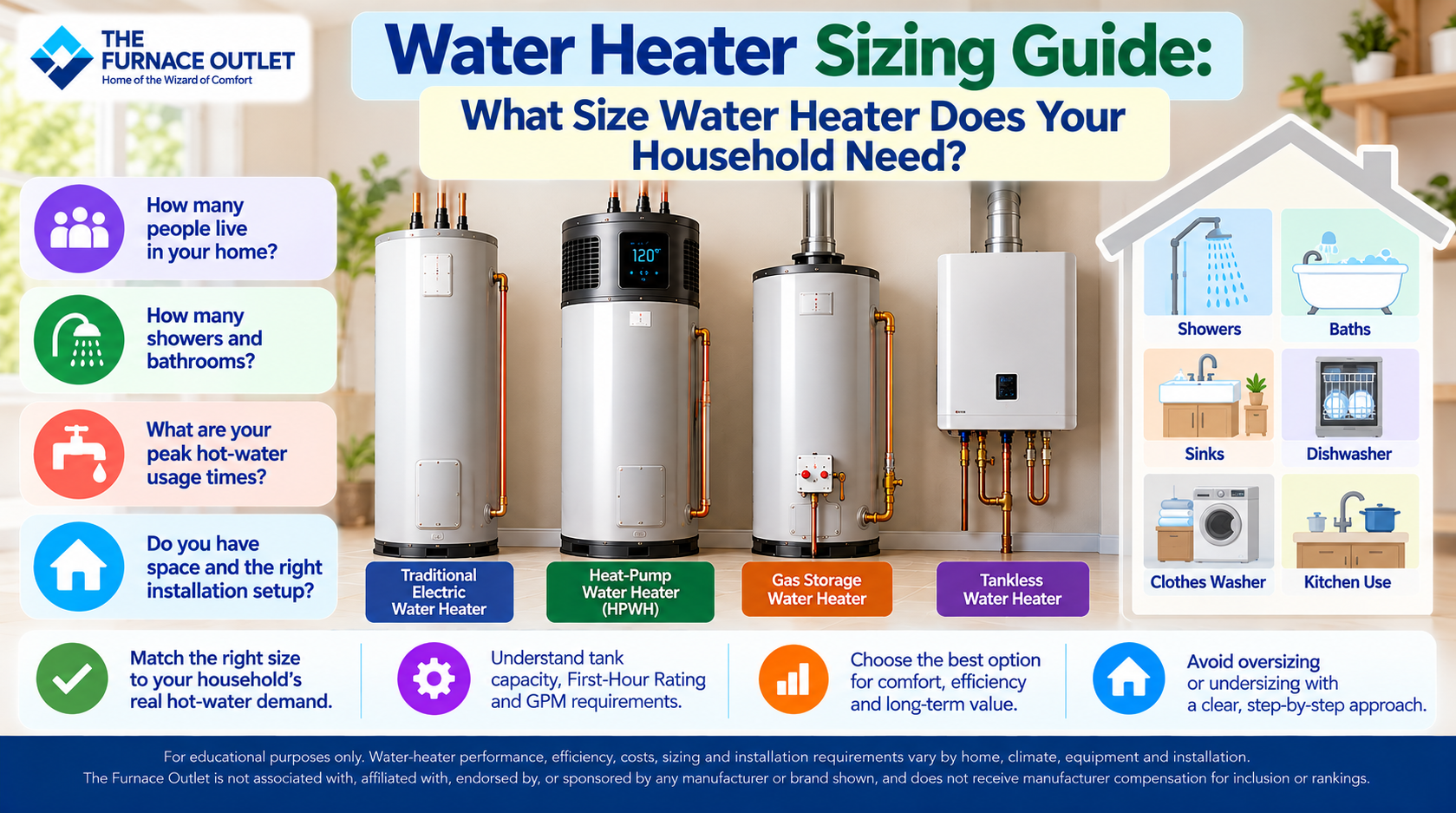
Choosing the right water-heater size is not as simple as counting the number of people in your household and matching that number to a tank-size chart. Household size provides a useful starting point, but two families with the same number of people can have dramatically different hot-water requirements. A family of four taking several showers between 6:30 and 8:00 in the morning creates a very different load from a family of four whose showers, laundry, dishwashing, and other hot-water use are distributed throughout the day.
I’m Savvy Mavi, Savvy the Sustainability Expert, and I prefer to size water heaters around how a household actually uses hot water rather than relying on a generic gallons-per-person formula. With a storage water heater, I want to understand both tank capacity and First-Hour Rating (FHR). With a tankless system, I am much more interested in simultaneous gallons per minute (GPM) and temperature rise. Heat-pump water heaters introduce another important consideration because a somewhat larger storage tank can sometimes improve overall efficiency by reducing reliance on electric-resistance backup during periods of heavy demand.
The objective is therefore not to buy the largest water heater that fits in the utility room. Good sizing means selecting enough capacity and recovery performance to satisfy the household’s realistic peak demand without paying for unnecessary equipment or creating avoidable energy consumption.
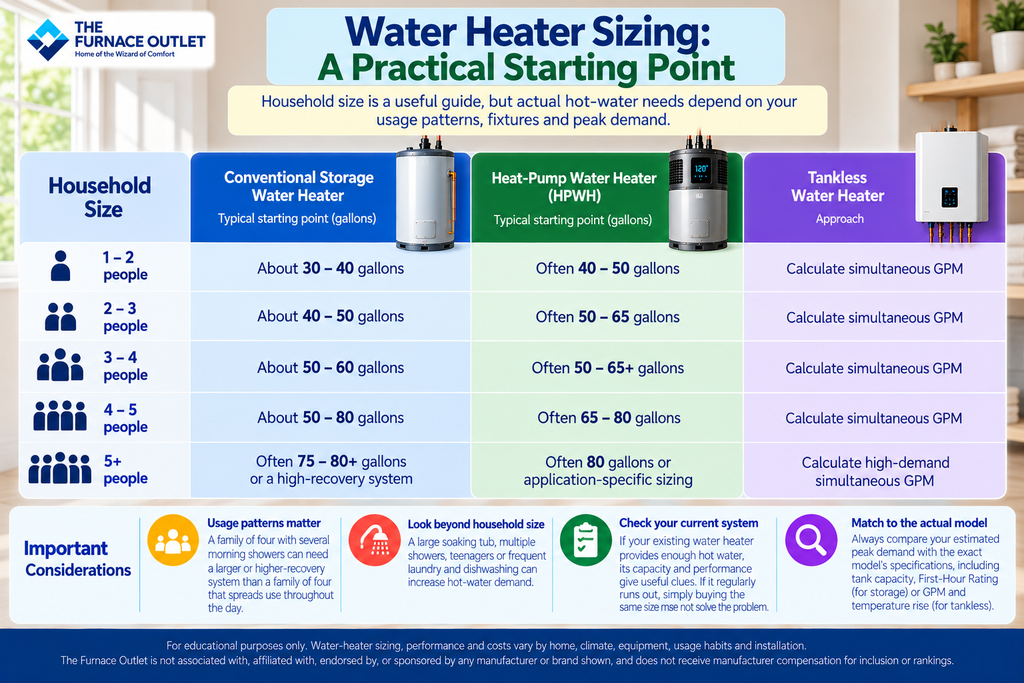
Household size remains useful because more occupants generally mean greater hot-water consumption. However, I would treat the following ranges as preliminary planning estimates rather than final sizing recommendations. Before purchasing equipment, I would compare the household’s peak demand with the specifications of the exact water heater being considered.
| Household Size | Conventional Storage Starting Point | HPWH Starting Point | Tankless Approach |
|---|---|---|---|
| 1–2 people | About 30–40 gallons | Often 40–50 gallons | Calculate simultaneous GPM |
| 2–3 people | About 40–50 gallons | Often 50–65 gallons | Calculate simultaneous GPM |
| 3–4 people | About 50–60 gallons | Often 50–65+ gallons | Calculate simultaneous GPM |
| 4–5 people | About 50–80 gallons | Often 65–80 gallons | Calculate simultaneous GPM |
| 5+ people | Often 75–80+ gallons or a high-recovery system | Often 80 gallons or application-specific sizing | Calculate high-demand simultaneous GPM |
These ranges illustrate why there is no single correct answer to a question such as, “What size water heater does a family of four need?” A 50-gallon storage heater may perform perfectly well in one four-person household while another family of four may benefit from greater storage or a higher First-Hour Rating. A household with a large soaking tub, multiple showers, teenagers, or concentrated morning demand can require substantially different performance from a household with more modest and evenly distributed hot-water use.
The same caution applies when replacing an existing heater. If the current system consistently provides enough hot water, its capacity and performance offer useful information about the home’s demand. If it regularly runs out of hot water, simply buying another heater with the same nominal tank capacity could reproduce the same problem.
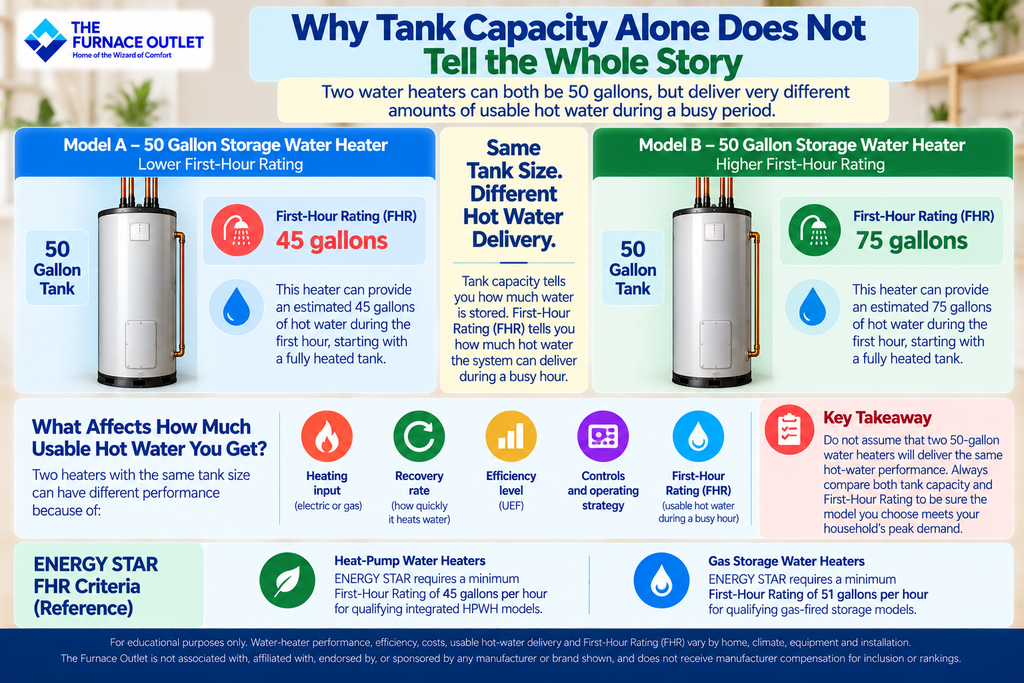
Tank capacity is the easiest water-heater specification to understand. A 50-gallon storage heater has approximately 50 gallons of nominal storage, so homeowners naturally focus on that number. The problem is that stored gallons do not tell us everything about how much usable hot water the system can deliver during a busy period.
Two heaters with similar nominal storage capacities can have different heating inputs, recovery characteristics, efficiency levels, controls, and First-Hour Ratings. One may therefore satisfy a concentrated morning demand considerably better than another even though both are marketed as 50-gallon water heaters.
For this reason, I consider tank capacity and First-Hour Rating together. Current ENERGY STAR criteria define FHR as an estimate of the maximum volume of hot water a storage water heater can supply during an hour beginning with the heater fully heated. ENERGY STAR’s current qualifying criteria require at least 45 gallons per hour of FHR for integrated heat-pump water heaters and at least 51 gallons per hour for qualifying gas-fired storage models. These figures are certification requirements rather than universal household-sizing recommendations, but they illustrate why FHR deserves attention alongside nominal tank size.
A homeowner comparing two 50-gallon models should therefore not assume that their hot-water delivery will be identical. I would check the FHR of each model and determine whether it comfortably covers the household’s realistic peak-hour requirement.

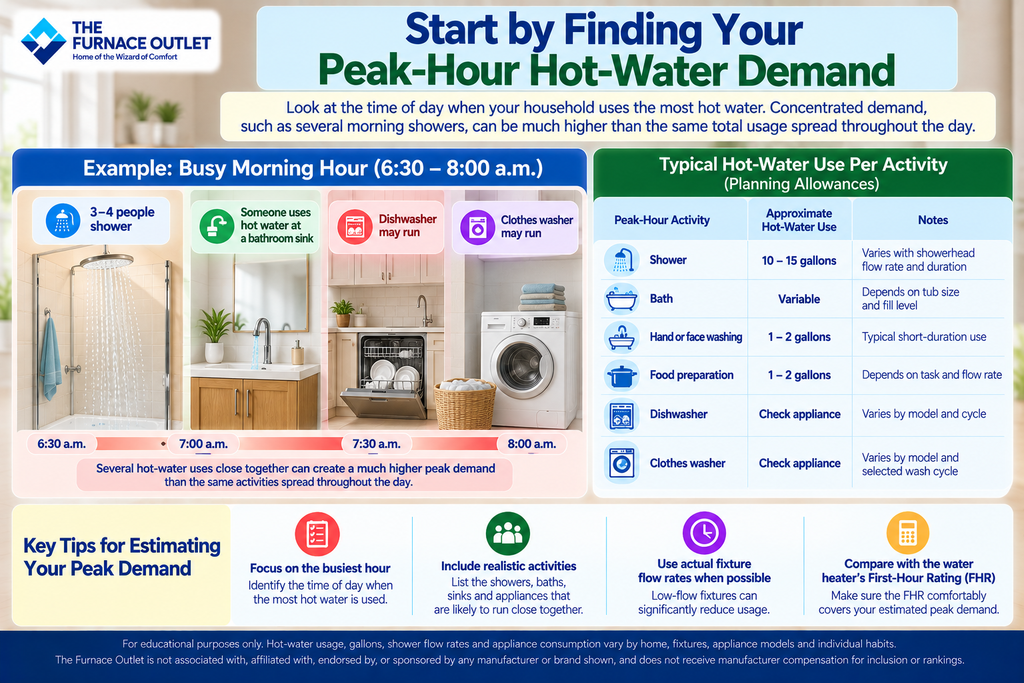
The most useful sizing exercise for a storage water heater is identifying the household’s busiest hour of hot-water use. Total daily consumption matters for energy costs, but concentrated demand is particularly important when determining whether the heater can maintain comfort during the busiest part of the day.
Consider a household where three or four people shower between 6:30 and 8:00 a.m. while someone also uses hot water at a bathroom or kitchen sink. That household could experience a significant demand peak even if relatively little hot water is used during the remainder of the day. Another household could use a similar amount of hot water overall but spread the consumption across morning, afternoon, and evening, placing much less pressure on the heater at any one time.
I would therefore write down the hot-water activities that realistically occur during the busiest hour. The goal is not to assume that every faucet and appliance in the house will operate simultaneously. Instead, the calculation should reflect how the household genuinely behaves.
| Peak-Hour Activity | Approximate Planning Allowance |
|---|---|
| Shower | Roughly 10–15 gallons of hot water |
| Bath | Highly variable depending on tub size and fill level |
| Hand or face washing | Roughly 1–2 gallons |
| Food preparation | Roughly 1–2 gallons |
| Dishwasher | Check the specific appliance |
| Clothes washer | Check machine and selected wash cycle |
These are only rough planning allowances rather than standardized equipment ratings. Modern low-flow showerheads, efficient washing machines, dishwasher cycles, mixing valves, and personal habits can change actual hot-water consumption considerably. Whenever practical, I would use the flow ratings of the home’s actual fixtures and the water-consumption information supplied with its appliances.
Once I have a realistic estimate for the busiest hour, I can compare that number with the FHR of candidate storage water heaters. This provides a much stronger basis for equipment selection than household size alone.
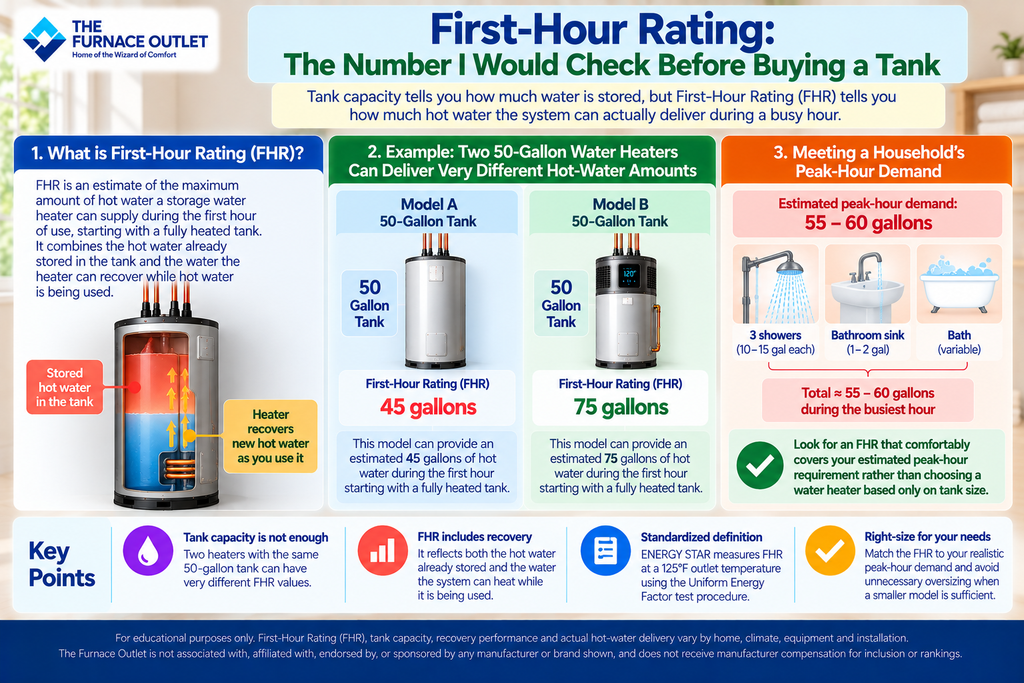
Suppose a household estimates that it may require approximately 55 to 60 gallons of hot water during its busiest hour. Knowing that a proposed water heater has a 50-gallon tank still does not tell me enough. I want to see how much hot water the complete system can deliver during that hour, which is where FHR becomes particularly useful.
A heater starts the hour with already-heated water in its tank, but it also begins heating replacement water as hot water is drawn. FHR therefore represents a combination of stored hot water and recovery performance rather than simply repeating the tank’s nominal capacity.
ENERGY STAR’s current definition measures FHR at a 125°F outlet temperature under the applicable Uniform Energy Factor test procedure. That standardized methodology makes FHR useful when comparing models, provided the homeowner remembers that laboratory ratings and actual household performance are not necessarily identical.
If the calculated household peak is around 60 gallons, I would look for an FHR that comfortably accommodates that requirement rather than selecting the first appliance labeled “50 gallon.” At the same time, I would avoid unnecessary oversizing when a smaller heater clearly provides sufficient first-hour performance.
Conventional electric resistance water heaters are relatively straightforward, but I would still follow the same peak-demand approach. If the existing electric tank has reliably served the household and usage patterns have not changed, its capacity and performance provide a useful baseline. If the household has grown or the existing system regularly runs short of hot water, I would recalculate rather than automatically duplicating the old heater.
For example, a couple moving into a home with an existing 50-gallon electric heater may find that the system provides substantially more capacity than they routinely need. Conversely, a household that has grown from two occupants to five may discover that the same tank no longer handles several morning showers comfortably.
I would compare nominal storage, FHR, UEF, physical dimensions, electrical requirements, warranty, and installed price among the models that meet the calculated demand. This avoids treating all conventional electric tanks of the same nominal size as interchangeable products.
Gas storage heaters use the same basic principle of storing heated water, which means FHR remains important. Their burner input and recovery characteristics, however, can differ considerably from those of electric resistance heaters.
Current ENERGY STAR criteria for qualifying residential gas-fired storage heaters include both efficiency requirements and a minimum FHR of 51 gallons per hour. That threshold should not be interpreted to mean every household needs 51 gallons during its peak hour. It simply demonstrates that hot-water delivery is important enough to be evaluated separately from tank capacity and efficiency.
When sizing a gas storage heater, I would therefore compare the exact model’s nominal capacity, FHR, recovery characteristics, UEF, fuel requirements, venting configuration, physical dimensions, and installation requirements. A relatively compact high-recovery heater may perform differently from a larger but lower-recovery system, so tank size should not be used as the sole comparison.
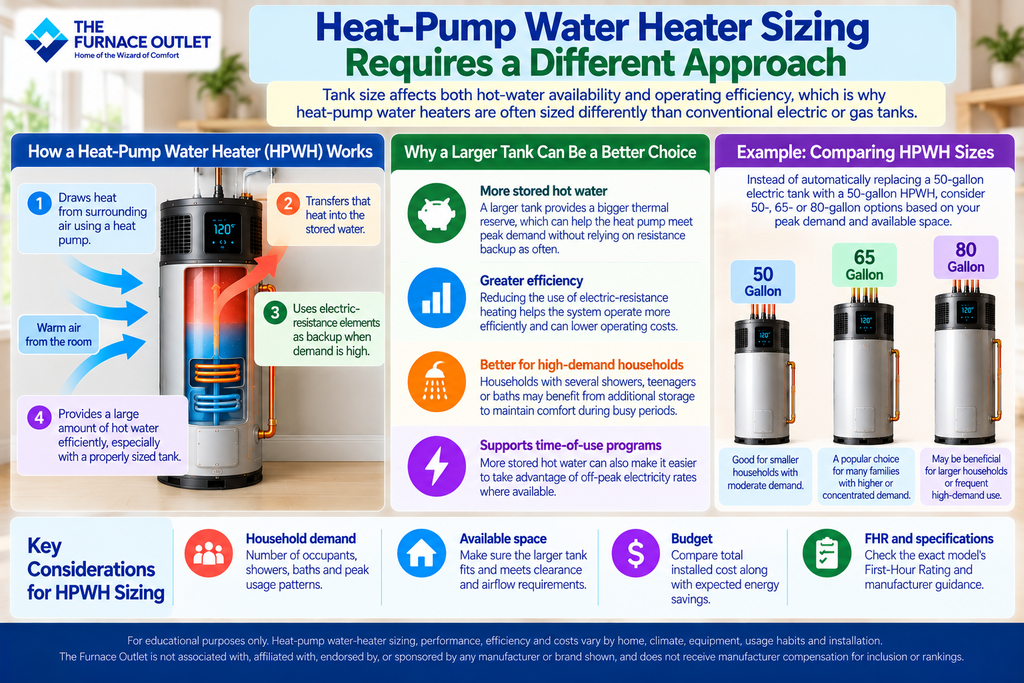
Heat-pump water heaters make the sizing discussion especially interesting because tank size can influence both hot-water availability and operating efficiency.
An HPWH primarily uses a heat pump to transfer heat from the surrounding air into stored water. Many integrated systems also include electric-resistance elements that can assist when hot-water demand exceeds what the heat pump can recover quickly enough. That backup capacity protects household comfort, but resistance heating is less efficient than heat-pump operation.
ENERGY STAR’s technical guidance consequently recommends following local plumbing-code FHR requirements and manufacturer sizing recommendations while considering a larger tank than might traditionally be selected for an electric resistance or fossil-fuel storage heater. The reason is that additional stored hot water can reduce the need for auxiliary resistance heating during periods of high demand.
This is an important distinction. If I were replacing a 50-gallon electric resistance heater, I would not automatically order a 50-gallon HPWH simply because the old tank had that capacity. Depending on the household’s peak demand, available space, budget, and the exact equipment, I might compare 50-, 65-, and 80-gallon HPWH options.
At first glance, deliberately selecting a larger storage tank can sound inconsistent with energy efficiency. With heat-pump technology, however, additional stored hot water can function as a thermal reserve.
Imagine a household with several showers concentrated in the morning. A smaller HPWH could potentially satisfy that demand by activating its resistance elements more frequently. A larger tank may allow the heat pump to heat and store more water before the peak occurs, helping the system meet demand while relying more heavily on the efficient heat-pump cycle.
ENERGY STAR specifically notes that upsizing an HPWH can minimize inefficient resistance heating. Its guidance also identifies households with high hot-water draw periods, including households with teenagers or occupants who prefer baths, as situations where additional storage may be useful. Greater storage can also increase the potential to shift water heating toward off-peak periods when a household participates in time-of-use electricity programs.
This does not mean that everyone should buy an 80-gallon HPWH. Physical space, purchase cost, household demand, FHR, local electricity rates, and installation requirements still matter. The lesson is simply that HPWH sizing deserves its own calculation rather than a gallon-for-gallon replacement assumption.
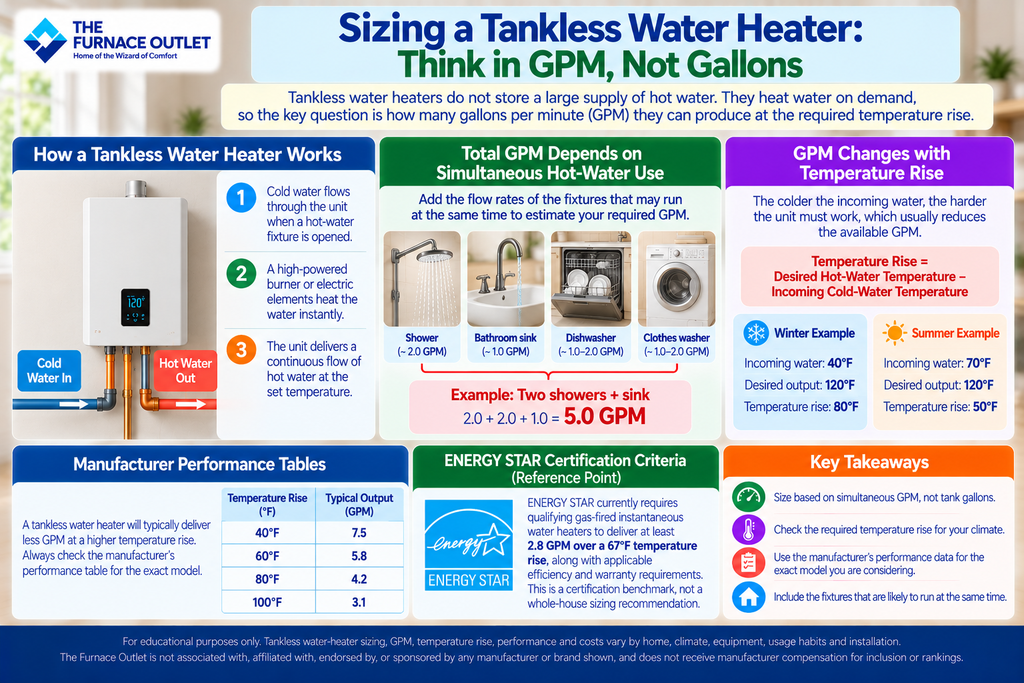
Tankless sizing is fundamentally different because there is no large reservoir of stored hot water. Instead of asking how many gallons the appliance stores, I want to know how much hot water it can produce each minute at the required temperature rise.
ENERGY STAR explains that tankless models are rated according to hot-water output in gallons per minute. As more fixtures are likely to operate simultaneously, the required GPM increases. A household where a shower, dishwasher, and clothes washer could realistically run together therefore needs more instantaneous heating capacity than a home where only one hot-water fixture normally operates at a time.
Current ENERGY STAR certification criteria also illustrate the relationship between GPM and temperature rise. Qualifying gas-fired instantaneous water heaters must achieve at least 2.8 GPM over a 67°F temperature rise, along with the applicable efficiency and warranty requirements. That is a certification benchmark rather than a recommendation for whole-house sizing, but it demonstrates why a GPM rating needs a temperature-rise condition attached to it.
For a real home, I would list the fixtures that could reasonably operate simultaneously, identify their actual flow rates, and add the hot-water flows together. Only then would I start comparing tankless equipment.
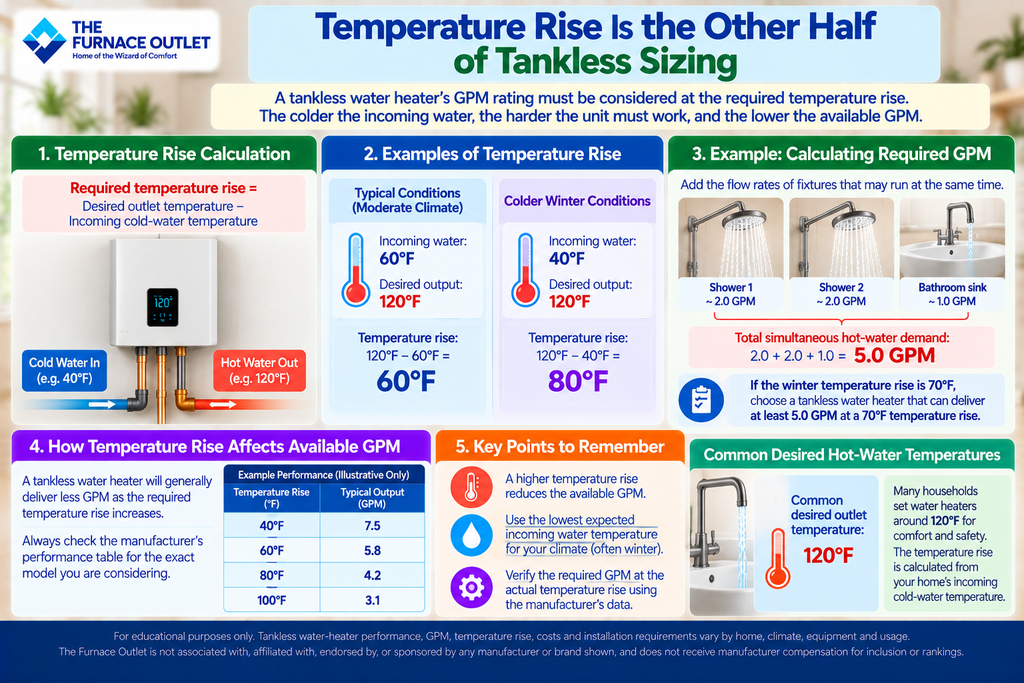
A tankless heater’s advertised GPM number means very little unless I know the temperature rise at which that output can be maintained. The colder the incoming water, the harder the heater must work to reach the desired outlet temperature.
The calculation itself is straightforward: Required temperature rise = desired outlet temperature − incoming cold-water temperature.
If the incoming water is 60°F and the desired outlet temperature is 120°F, the heater needs to produce a 60°F temperature rise. If winter incoming water falls to 40°F, the same 120°F outlet target requires an 80°F rise. A tankless heater will generally be capable of delivering less flow at the more demanding temperature rise.
Suppose two showers operate simultaneously at approximately 2.0 GPM each while another hot-water faucet uses approximately 1.0 GPM. The household’s simultaneous requirement would be about 5 GPM. If the winter temperature rise is 70°F, I would look at the manufacturer’s performance data and verify that the exact heater can deliver at least that flow at approximately that rise.
This is much more reliable than choosing a tankless heater because its marketing material displays a large maximum GPM figure. Maximum advertised output may be achieved under conditions very different from those the heater will experience in the home.
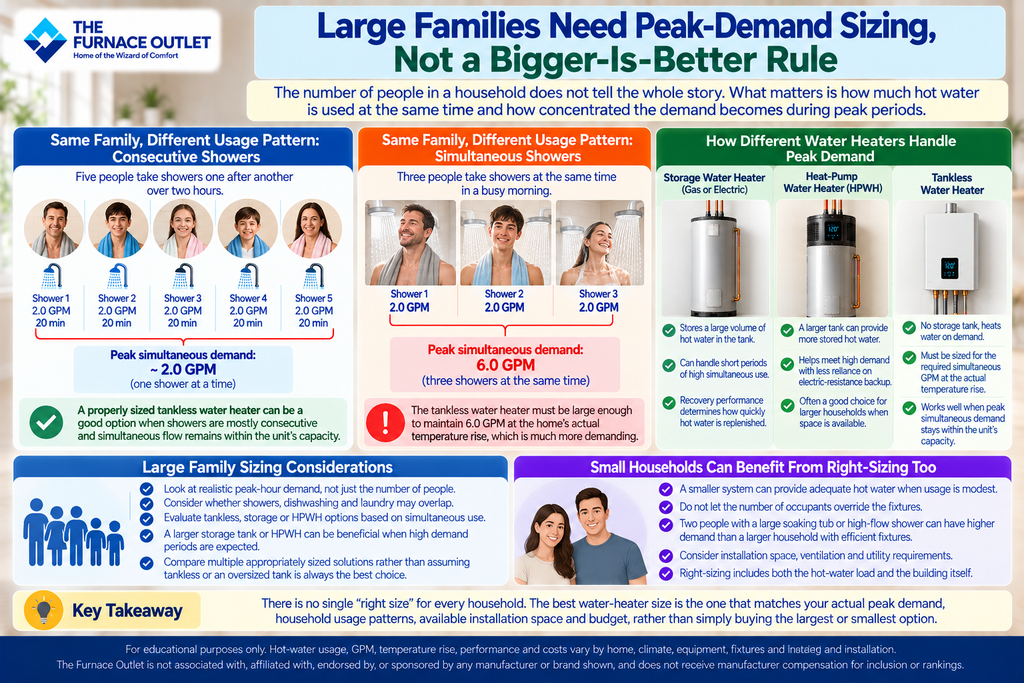
Large households are particularly vulnerable to simplistic sizing advice because the number of occupants alone does not reveal whether demand is consecutive or simultaneous.
Imagine five people taking showers one after another over two hours. A correctly sized tankless heater could be attractive because there is no stored reservoir to exhaust, provided the simultaneous flow remains within the appliance’s capacity. Now imagine three of those showers operating simultaneously. The tankless system suddenly needs enough heating capacity to maintain all three flows at the home’s actual temperature rise.
A storage heater approaches the problem differently. A large tank provides a substantial reserve that can absorb concentrated demand, while recovery performance determines how quickly the supply is replenished. A large HPWH may be particularly attractive where sufficient installation space is available because additional storage can help the heat pump meet heavy draw periods without excessive reliance on resistance backup. ENERGY STAR’s current HPWH guidance explicitly supports considering a larger tank when high hot-water draw periods are expected.
For a large family, I would therefore compare multiple appropriately sized solutions rather than automatically assuming tankless or an oversized storage tank is superior.
A one- or two-person household can make the opposite mistake by buying far more capacity than it realistically needs. If hot-water consumption is modest and rarely concentrated, a smaller storage system may provide perfectly adequate comfort.
However, the number of occupants should still not override the fixtures. Two people with a large soaking tub and high-flow shower can create greater peak demand than a larger household using efficient fixtures and spreading showers throughout the day.
A smaller home can also create installation constraints. An HPWH may require more consideration of airflow and service clearances than a conventional electric tank, while tankless equipment can save valuable floor space but may require gas, venting, electrical, or plumbing modifications. Right-sizing therefore includes both the hot-water load and the building itself.
After determining the water-heating capacity I need, I still have to verify that the equipment can actually be installed correctly.
A larger storage heater may be taller or wider than the existing appliance. Doorway dimensions, ceiling height, plumbing connections, drain-pan requirements, service access, venting, and code clearances can all influence whether a proposed replacement is practical.
HPWHs require particular attention because they draw heat from surrounding air. ENERGY STAR’s technical guidance discusses manufacturer requirements for adequate surrounding air volume and explains that confined installations may require strategies such as transfer grilles, louvered doors, or manufacturer-approved ducting. It also emphasizes following the exact equipment instructions and applicable codes rather than assuming every HPWH has identical installation requirements.
Tankless systems solve the tank-footprint problem but introduce their own infrastructure considerations. A gas tankless unit may require suitable gas supply, combustion-air and venting arrangements, condensate management for condensing equipment, and electrical power. Whole-house electric tankless systems can require substantial electrical capacity. The “right size” is therefore a heater that meets the load and works with the home’s infrastructure.
Before choosing equipment, I would first document the number of occupants, bathrooms, showers, major hot-water appliances, and any high-demand fixtures such as large tubs. I would then identify the busiest period of the day and estimate how much hot water is realistically consumed during that period rather than relying exclusively on daily consumption.
For a conventional storage system, I would compare tank capacity with the exact model’s FHR. For a heat-pump water heater, I would additionally consider whether a larger tank could reduce resistance-backup operation while still fitting the available installation space. For tankless equipment, I would calculate realistic simultaneous GPM and determine the temperature rise using the home’s coldest expected incoming-water temperature.
Once those requirements are established, I would compare efficiency, physical dimensions, electrical or fuel requirements, installation complexity, warranty, maintenance, local service availability, and total installed cost. This method requires a little more work than selecting a tank from a household-size chart, but it gives the homeowner a much stronger chance of achieving both reliable hot water and sensible energy use.
A family of four might begin by comparing storage heaters in roughly the 50- to 65-gallon range, while some households may benefit from larger storage depending on their peak demand. With an HPWH, 65 gallons or more can be worth considering when several high-demand uses occur close together because additional storage may reduce reliance on resistance backup. The final decision should be based on peak-hour demand, FHR, available installation space, and the performance of the exact model rather than household size alone.
A 50-gallon heater can be sufficient for many four-person households, but nominal tank capacity does not answer the question by itself. If the system has adequate FHR and the household spreads hot-water use reasonably well, 50 gallons may work comfortably. A household with several morning showers, a large tub, or overlapping laundry and bathing demand could require greater first-hour performance or additional storage.
The choice should reflect peak hot-water demand, FHR, available space, installation conditions, and budget. ENERGY STAR’s HPWH guidance specifically recommends considering upsizing because additional storage can reduce the frequency with which less-efficient resistance backup is needed during heavy demand. A household with several occupants and concentrated morning use may therefore have a stronger reason to consider 65 or 80 gallons than a one- or two-person household with modest demand.
First-Hour Rating estimates how much hot water a fully heated storage water heater can supply during the first hour of use under the standardized test procedure. It is valuable because it reflects both stored hot water and the system’s ability to recover during that period. Two tanks with similar nominal capacities can therefore have different FHR values and different peak-demand capabilities.
Begin by adding the flow rates of the hot-water fixtures that are realistically likely to operate at the same time. Then calculate the temperature rise between the cold incoming water and the desired outlet temperature. The selected tankless heater should be capable of supplying the required simultaneous GPM at that temperature rise, based on the manufacturer’s published performance data rather than only its maximum advertised GPM. ENERGY STAR likewise advises homeowners to consider simultaneous fixture operation when estimating the capacity needed from a whole-home tankless heater.
A larger water heater is not automatically better because unnecessary capacity can increase purchase cost, consume more installation space, and provide little practical benefit when demand is modest. Heat-pump water heaters deserve a more nuanced approach because intentional upsizing can sometimes improve operating efficiency by allowing more hot water to be stored using the heat pump before a peak-demand period. Even then, the decision should be based on actual household demand and manufacturer guidance rather than simply buying the largest available tank.
The existing heater is a useful starting point, particularly if it has consistently provided satisfactory performance, but it should not automatically determine the replacement. Changes in household size, bathing habits, fixtures, appliances, efficiency goals, or water-heating technology can all justify recalculating the requirement. Moving from conventional resistance heating to a heat-pump water heater is an especially good reason to reconsider tank capacity rather than assuming a gallon-for-gallon replacement.
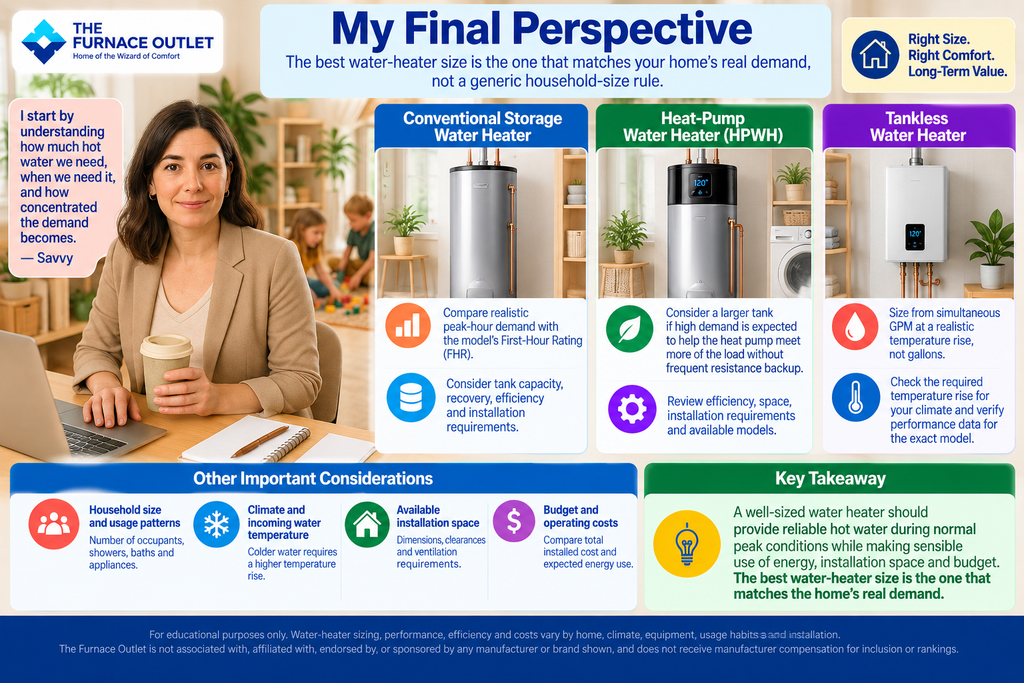
When I size a water heater, I do not begin with a rigid rule saying that a certain number of people always requires a particular number of gallons. I begin by understanding how much hot water the household needs, when it needs it, and how concentrated that demand becomes. Household size is useful context, but peak demand is what turns that information into an equipment requirement.
For a conventional storage heater, I would compare realistic peak-hour demand with the exact model’s First-Hour Rating, while also considering tank capacity, recovery, efficiency, and installation requirements. For a heat-pump water heater, I would deliberately investigate whether additional storage could allow the heat pump to handle more of the load without frequently engaging resistance backup. For a tankless heater, I would move away from tank-size thinking entirely and size from simultaneous GPM at a realistic temperature rise.
The goal is not to find the smallest heater that barely satisfies the household, nor is it to buy excess capacity simply for reassurance. A well-sized system should provide reliable hot water during normal peak conditions while making sensible use of energy, installation space, and household budget. The best water-heater size is the one that matches the home’s real demand rather than a generic household-size rule.
For readers who want to verify the technical concepts or go deeper into water-heater sizing, I recommend using independent government and industry resources alongside the specifications supplied by the manufacturer of the exact equipment being considered.
The Furnace Outlet is an independent informational and educational resource. It is not associated with, affiliated with, endorsed by, or sponsored by any water-heater manufacturer or brand discussed in this article, and it does not receive manufacturer compensation for inclusion or rankings.
Water-heater sizing, tank capacity, First-Hour Rating, recovery performance, GPM, temperature rise, efficiency, installation requirements, costs, and real-world hot-water availability vary according to household usage, climate, incoming-water temperature, plumbing fixtures, equipment design, operating settings, and installation conditions. Household-size ranges and fixture-use examples in this guide are intended only as preliminary planning guidance and should not replace the sizing instructions for the exact equipment, applicable plumbing or building codes, or professional evaluation. Before purchasing or installing a water heater, verify current manufacturer specifications and consult an appropriately qualified or licensed plumbing, electrical, HVAC, or other professional where required