Newsletter Subscribe
Enter your email address below and subscribe to our newsletter

HVAC made simple

Installing a gas tankless water heater in 2026 typically costs more upfront than replacing a conventional storage water heater, but the final price depends heavily on what has to change around the appliance. The heater itself is only one part of the project. Gas piping, venting, combustion air, condensate drainage, electrical service, plumbing modifications, permits and removal of the old water heater can all affect the final bill.
For a typical U.S. residential project, I would use about $2,000 to $4,000 as a practical planning range for many professionally installed whole-home gas tankless systems, while recognizing that straightforward replacements can come in lower and complicated conversions can exceed $5,000. Current 2026 cost surveys support a fairly broad market range: This Old House estimates natural-gas tankless systems at roughly $1,650–$3,500 installed, while HomeGuide places tankless installations more broadly at about $1,400–$5,600. Angi’s 2026 data puts typical tankless projects at approximately $1,406–$3,902. This Old House
The number I would pay the most attention to, however, is not the national average. I would want an itemized installed quote for my particular house, because converting an older storage water heater to a 199,000-BTU/h condensing tankless system can be a completely different project from replacing one modern tankless heater with another.
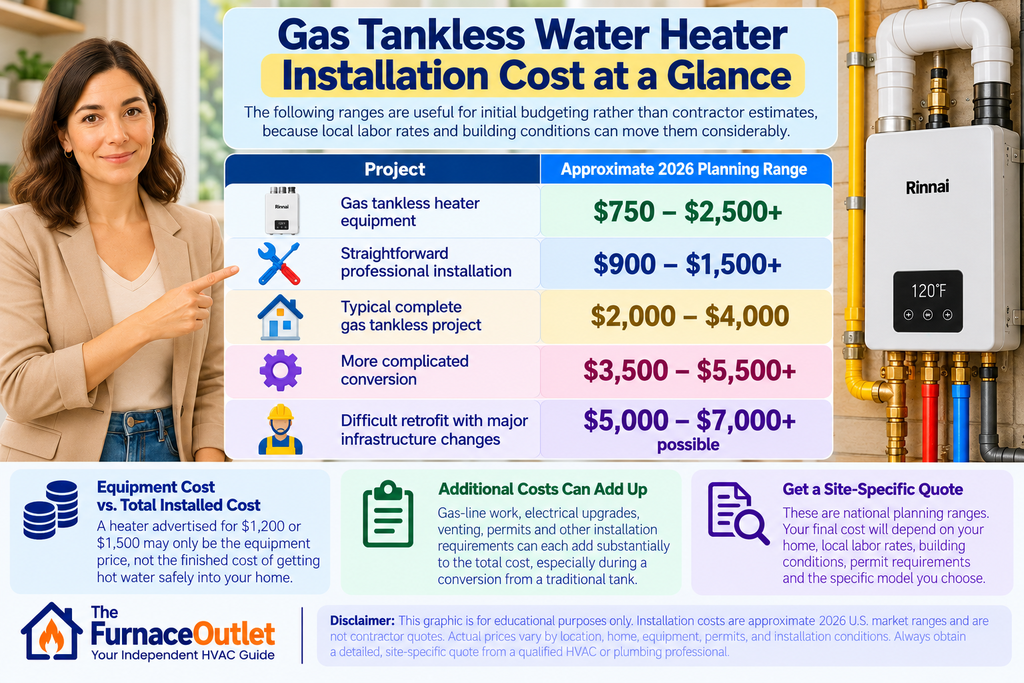
The following ranges are useful for initial budgeting rather than contractor estimates, because local labor rates and building conditions can move them considerably.
| Project | Approximate 2026 Planning Range |
|---|---|
| Gas tankless heater equipment | $750–$2,500+ |
| Straightforward professional installation | $900–$1,500+ |
| Typical complete gas tankless project | $2,000–$4,000 |
| More complicated conversion | $3,500–$5,500+ |
| Difficult retrofit with major infrastructure changes | $5,000–$7,000+ possible |
This Old House’s 2026 research places natural-gas tankless equipment at approximately $750–$2,000 and installation at $900–$1,500, producing a total range of $1,650–$3,500. Its broader tankless cost analysis also notes that gas-line work, electrical upgrades and venting can each add substantially to a conversion.
That is why I would be cautious about advertisements offering a tankless heater for $1,200 or $1,500. That may be the equipment price, not the finished cost of getting hot water safely into the house.
Whole-home gas tankless heaters vary substantially in price according to capacity, efficiency, features and brand. A smaller or relatively basic non-condensing unit may cost considerably less than a premium condensing model with integrated recirculation, Wi-Fi controls and a burner approaching 200,000 BTU/h.
This Old House currently estimates natural-gas tankless equipment at approximately $750–$2,000, while HomeGuide gives a broader $600–$2,600 equipment range across tankless systems.
Premium equipment can move beyond those ranges, particularly when additional accessories are required. I would therefore compare the exact model numbers rather than assuming that two quotes describing an “11-GPM tankless heater” include equivalent equipment.
Capacity also matters. A heater capable of serving several simultaneous fixtures in a cold climate generally requires substantially more heating capacity than a unit serving a smaller household in a warm climate. Paying for the wrong size is not a bargain, regardless of the purchase price.

Professional installation can represent a substantial part of the project. Angi’s current installation guidance places professional tankless installation labor at approximately $600–$1,850, while noting that the overall project can become much more expensive when infrastructure modifications are required.
The installer may need to remove the old heater, mount the new appliance, modify water lines, connect the gas supply, install intake and exhaust venting, provide condensate drainage, make electrical connections, install service valves, test gas pressure, check for leaks, commission the burner and confirm proper operation.
A quote that includes all of those tasks should not be compared directly with a lower quote covering only mounting and basic plumbing connections.
Gas supply is one of the first things I would investigate when converting from a storage water heater to tankless. An older tank-type gas water heater might have a burner input around 30,000–50,000 BTU/h, while a large whole-home tankless heater can approach 200,000 BTU/h.
That dramatic increase in instantaneous demand can expose limitations in the existing gas piping, regulator or meter. The installer therefore needs to evaluate not just the pipe entering the water heater but the gas system as a whole.
This Old House estimates potential gas-line installation work at approximately $500–$1,000 in its current tankless cost breakdown, although a difficult or long piping run can obviously differ.
I would not assume that an existing 1/2-inch or 3/4-inch line is adequate simply because it physically connects to the heater. Gas-pipe sizing depends on BTU load, fuel type, pipe length, pressure, allowable pressure drop, material, fittings and other connected appliances.
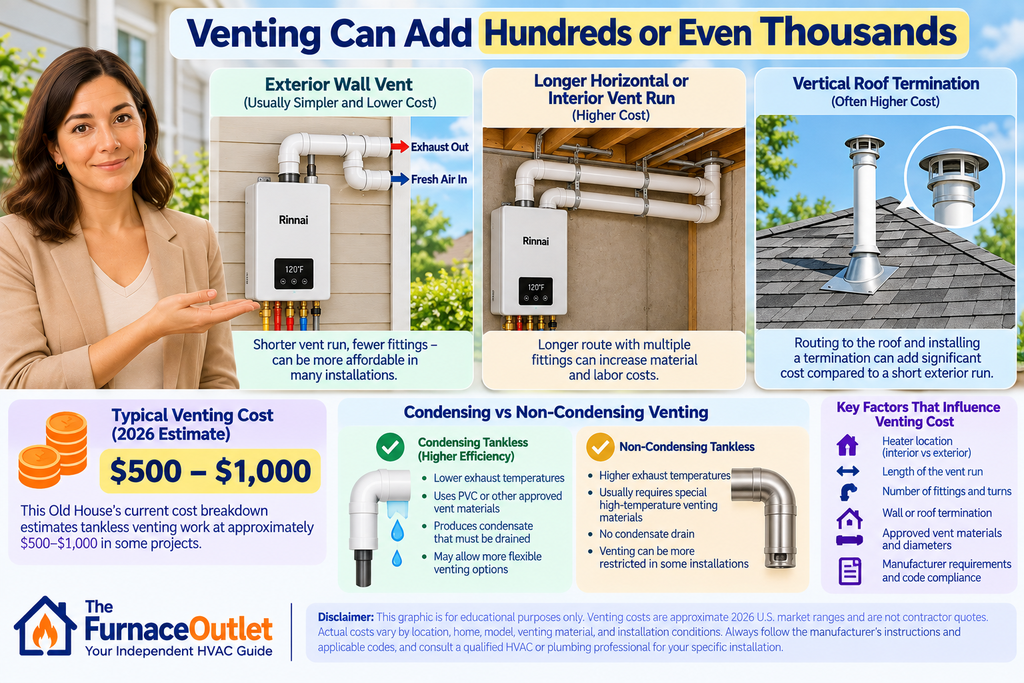
Gas tankless heaters need a safe combustion-exhaust system. ENERGY STAR explains that whole-home gas tankless heaters discharge combustion gases through a dedicated sealed vent system. Condensing equipment recovers additional exhaust heat, resulting in condensation and different venting requirements.
Venting cost depends heavily on where the heater is installed. A condensing direct-vent heater mounted near an exterior wall may have a relatively straightforward intake and exhaust arrangement. A heater in the center of a large house could require a much longer route with multiple fittings or a vertical roof termination.
This Old House’s current cost breakdown estimates tankless venting work at approximately $500–$1,000 in some projects.
I would treat that as a planning estimate rather than a fixed allowance. The exact heater determines approved vent materials, diameters, equivalent-length limits and termination requirements.
Many premium gas tankless heaters sold today are condensing models. These appliances recover additional heat from combustion gases, improving efficiency but producing liquid condensate.
ENERGY STAR notes that certified gas condensing tankless heaters use a secondary heat exchanger to recover additional combustion heat and require a condensate drain.
If there is an appropriate drain close to the heater, this may add relatively little complexity. If the heater is installed where gravity drainage is impractical, the project may require a condensate pump or a different drainage route. Depending on the installation and applicable requirements, condensate neutralization may also be needed or recommended.
This is why I would choose the mounting location only after evaluating water, gas, electricity, venting and condensate drainage together.
A gas tankless water heater burns gas, but that does not mean it operates without electricity. Modern units use electrical power for controls, ignition, combustion fans, sensors, displays and sometimes recirculation pumps.
The electrical requirement is much smaller than that of a whole-home electric tankless heater, but a suitable receptacle or circuit still has to be available according to the manufacturer’s requirements and applicable electrical codes.
This Old House estimates that electrical modifications associated with some tankless installations can run approximately $300–$800. A house with a suitable nearby circuit may require very little work. Moving the heater to a new location or correcting older electrical infrastructure can increase the price.
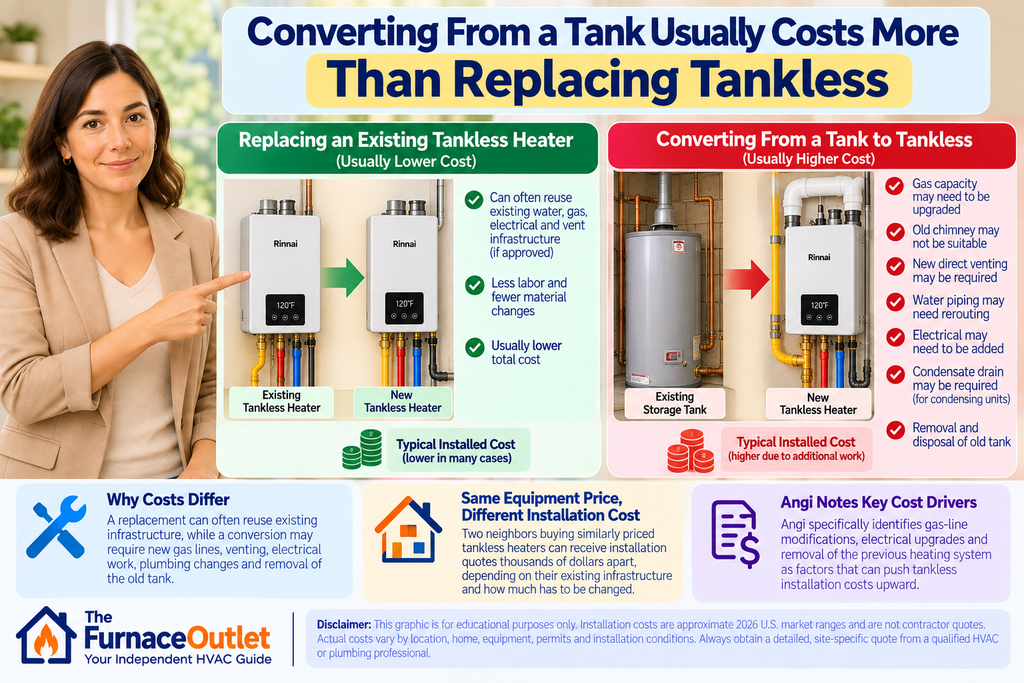
One of the biggest distinctions I would make when discussing installation price is replacement versus conversion. Replacing an existing tankless heater with another compatible unit can sometimes reuse portions of the existing water, gas, electrical and vent infrastructure, provided everything is approved for the new appliance. That can keep labor and material costs relatively controlled.
Converting a conventional storage water heater to tankless can be considerably more involved. Gas capacity may need upgrading, the old atmospheric chimney may not be suitable, new direct venting may be necessary, water piping can require rerouting, electricity may need to be added and a condensing heater may need a new drain.
Angi specifically identifies gas-line modifications, electrical upgrades and removal of the previous heating system as factors that can push tankless installation costs upward. Angi
This explains why two neighbors buying similarly priced tankless heaters could receive installation quotes thousands of dollars apart.
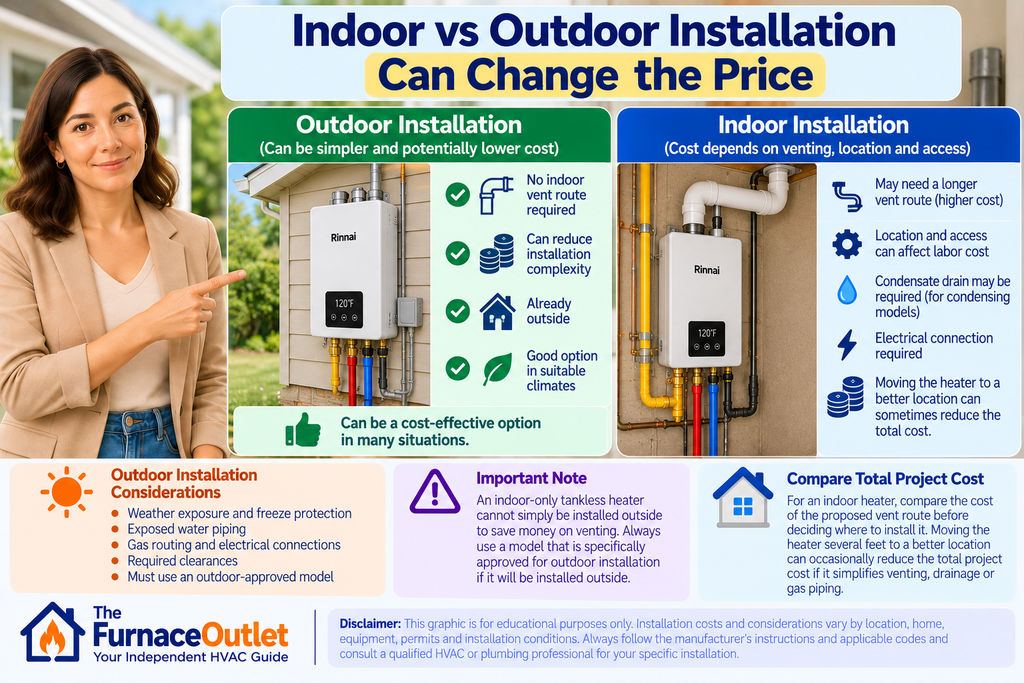
An outdoor-approved tankless water heater can sometimes simplify a project because the appliance is already outside and may eliminate a conventional indoor exhaust route. That can make outdoor installation financially attractive in appropriate climates.
However, outdoor installation introduces other considerations, including weather exposure, freeze protection, exposed water piping, gas routing, electrical connections and required clearances. An indoor-only heater cannot simply be installed outside to save money on venting.
For an indoor heater, I would compare the cost of the proposed vent route before deciding exactly where the appliance should go. Moving the heater several feet to a better location can occasionally reduce total project cost if it substantially simplifies venting, drainage or gas piping.
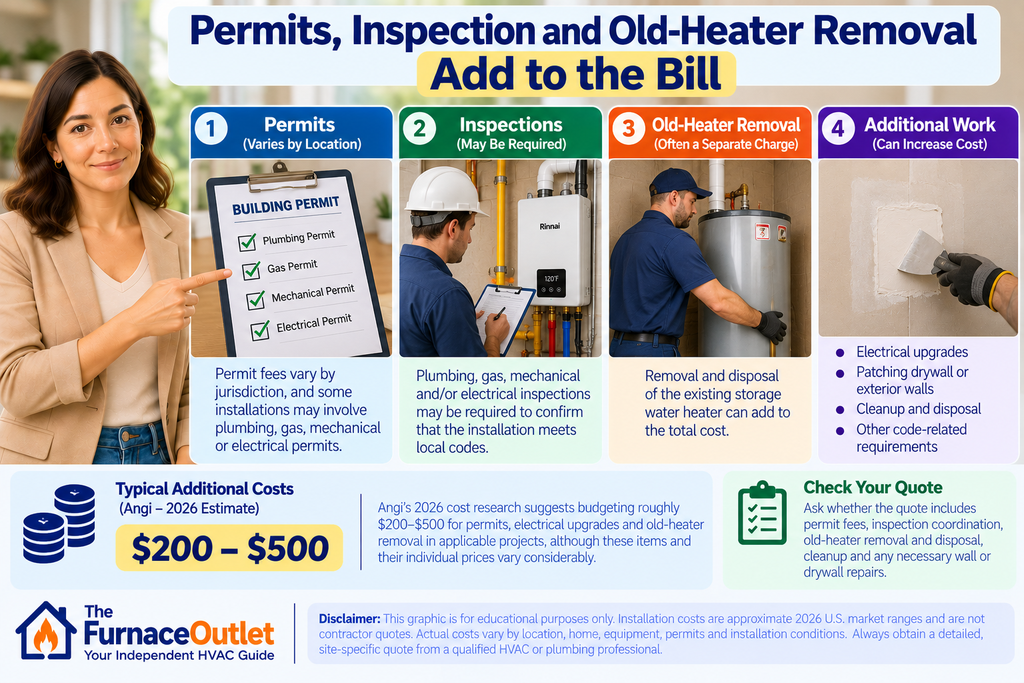
The smaller charges can become significant when added together. Permit fees vary by jurisdiction, and some installations may involve plumbing, gas, mechanical or electrical inspections.
Removal and disposal of the old storage heater can also be included separately. Angi’s 2026 cost research suggests budgeting roughly $200–$500 for permits, electrical upgrades and old-heater removal in applicable projects, although these items and their individual prices vary considerably.
I would ask whether the contractor’s quote includes permit fees, inspection coordination, removal of the existing heater, disposal, cleanup and any drywall or exterior-wall repairs resulting from the work.
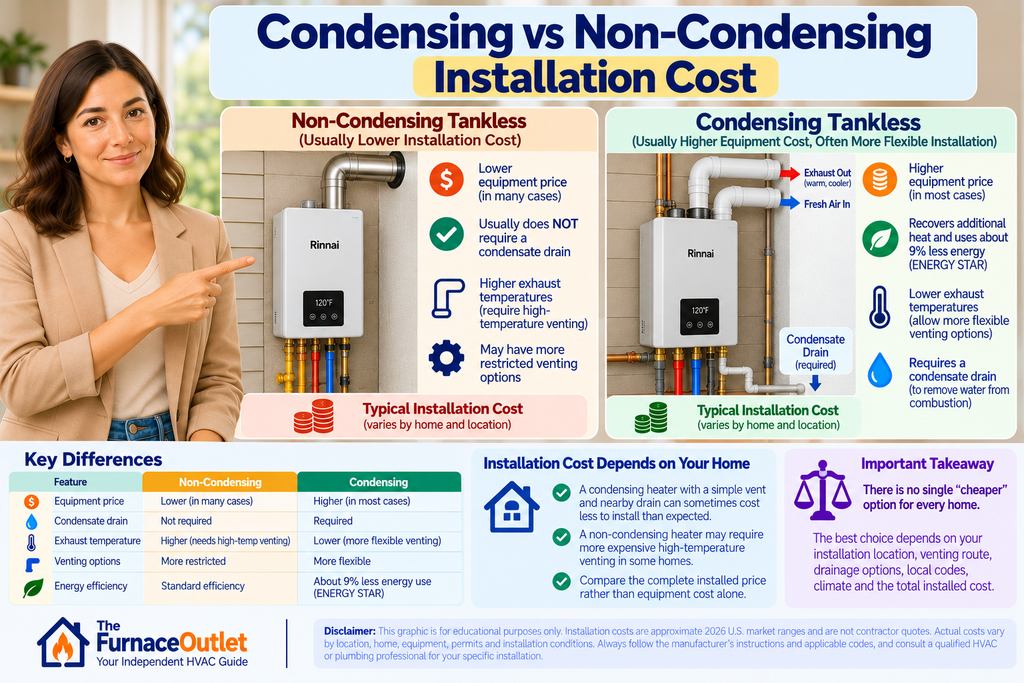
A non-condensing heater can have a lower equipment price and normally does not require a combustion-condensate drain. That can make it attractive in some replacements.
Condensing equipment generally costs more upfront, but its lower exhaust temperatures can permit more flexible manufacturer-approved venting systems. ENERGY STAR notes that certified condensing gas tankless heaters recover additional combustion heat and use about 9% less energy than conventional gas tankless water heaters.
The installation-cost comparison therefore depends on the house. A higher-priced condensing heater with a simple vent and nearby drain could cost less to install than expected, while a cheaper non-condensing unit requiring an expensive high-temperature vent route could lose much of its initial price advantage.
I would compare the complete installed price rather than equipment cost alone.
Not necessarily by a proportional amount. Moving from one whole-home model to another may change the equipment price more than the labor cost if both use similar plumbing and venting arrangements.
The bigger issue is infrastructure. A high-capacity heater can demand more gas at maximum firing, which may trigger gas-piping or meter upgrades that a smaller appliance would not require.
Correct sizing therefore matters financially as well as technically. I would calculate simultaneous hot-water demand and winter temperature rise before selecting the heater rather than automatically purchasing the largest available model. Oversizing equipment unnecessarily can increase purchase price and potentially complicate gas infrastructure without providing a meaningful household benefit.
For a straightforward whole-home installation where much of the necessary infrastructure is already suitable, I would initially budget around $2,000–$3,000. For a conventional tank-to-tankless conversion involving new venting and moderate gas or plumbing modifications, I would be more comfortable budgeting $3,000–$4,500.
If the project requires a long new gas line, meter upgrade, difficult vent routing, electrical work, condensate pumping, extensive plumbing changes or relocation of the appliance, I would prepare for $4,500–$6,000 or more. Current market data shows why a wide range is necessary: published 2026 estimates span roughly $1,400 to $5,600 for tankless installations, and Angi notes that extensive retrofit work can push some projects toward $7,000.
Those numbers are planning ranges, not quotes. Local labor rates alone can create substantial differences.

I would request an itemized proposal showing the exact manufacturer and model number, equipment price, installation labor, water-line modifications, isolation/service valves, gas piping, gas-meter or regulator work if needed, combustion-air and exhaust venting, condensate drainage, electrical work, permits, old-heater removal and commissioning.
I would also ask the contractor to confirm that the gas system was evaluated for the heater’s maximum input while considering other appliances operating simultaneously. For venting, I would want confirmation that the proposed material, diameter, equivalent length and termination arrangement comply with the exact manufacturer’s instructions.
Finally, I would obtain at least three comparable quotes when practical. Angi likewise recommends obtaining multiple itemized estimates from qualified installers because infrastructure and permit requirements can substantially affect the final price.
For planning purposes, I would expect many whole-home projects to fall around $2,000–$4,000, although current published estimates range more broadly. This Old House lists natural-gas tankless installations at approximately $1,650–$3,500, while HomeGuide’s broader tankless range reaches $1,400–$5,600.
The heater may require considerably more than two water connections and a gas connection. Gas piping, meter capacity, venting, combustion air, condensate drainage, electrical power, permits and plumbing changes can all be part of the installation.
A conversion is usually more expensive than a compatible tankless-to-tankless replacement because existing infrastructure may need substantial modification. I would commonly plan around $3,000–$4,500, with difficult conversions potentially exceeding $5,000.
Possibly, but it should be evaluated rather than assumed adequate. A large whole-home tankless heater can approach 200,000 BTU/h, creating substantially greater instantaneous gas demand than many conventional storage water heaters.
It can be because condensate drainage is required, but lower exhaust temperatures can also provide more flexible manufacturer-approved venting options. The total installed cost determines which design is actually cheaper for a particular house.
I would not recommend a gas tankless installation as a typical DIY project. It involves fuel-gas connections, combustion, venting, carbon-monoxide safety, water plumbing and electrical work. This Old House describes tankless installation as an advanced project that will generally require professional involvement, particularly for gas equipment.
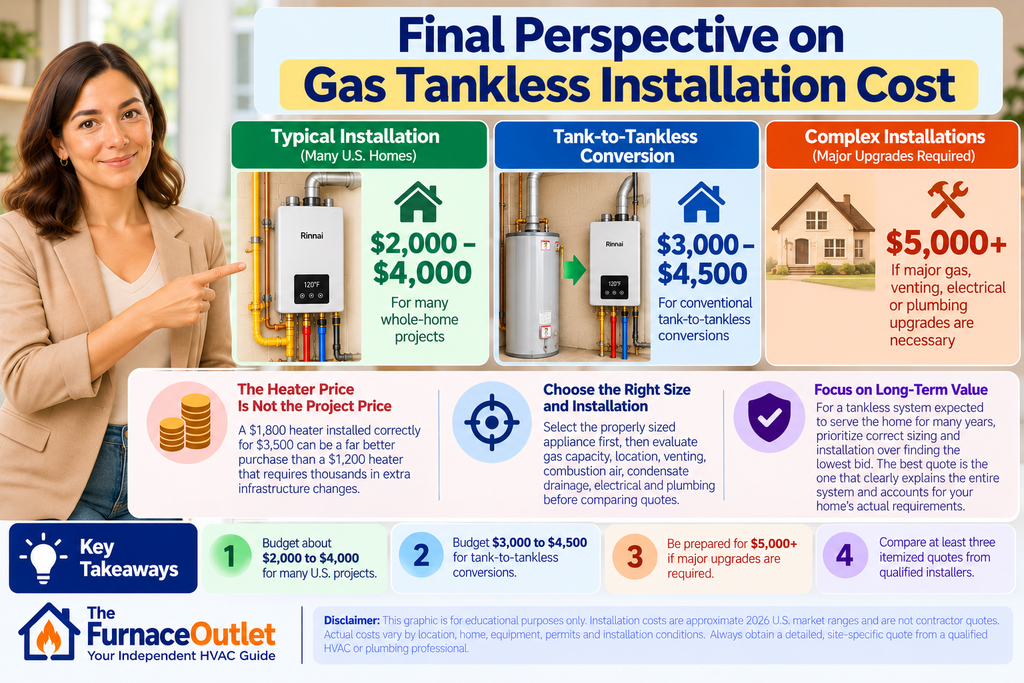
If someone asked me, “How much should I budget to install a gas tankless water heater in 2026?”, my practical starting answer would be about $2,000 to $4,000 for many U.S. whole-home projects. I would increase that budget toward $3,000–$4,500 for a conventional tank-to-tankless conversion and be prepared for $5,000 or more if major gas, venting, electrical or plumbing upgrades are necessary. Those ranges fit reasonably within current 2026 market estimates while acknowledging how dramatically individual homes can differ.
The most important lesson is that the price of the heater is not the price of the project. I would select the properly sized appliance first, then evaluate gas capacity, installation location, venting, combustion air, condensate drainage, electrical requirements and plumbing before comparing contractor proposals. An $1,800 heater installed correctly for $3,500 can be a far better purchase than a $1,200 heater that unexpectedly requires thousands of dollars in infrastructure changes.
For a tankless system expected to serve the home for many years, I would prioritize correct sizing and installation over finding the lowest bid. The best quote is the one that clearly explains the entire system, accounts for the building’s actual requirements and leaves as few expensive surprises as possible.
Current 2026 pricing benchmarks can be found in This Old House’s Tankless Water Heater Installation Cost Guide, Angi’s 2026 Tankless Water Heater Cost Guide and HomeGuide’s 2026 Water Heater Installation Cost Guide. For technical background on condensing gas tankless operation, venting and condensate, see ENERGY STAR’s Whole-Home Gas Tankless Water Heater Guide. This Old House also provides a useful overview of professional tankless installation.
The Furnace Outlet provides this information for general educational and budgeting purposes. Installation prices are approximate U.S. market ranges and are not contractor quotes. Actual equipment, labor, permits, gas-system upgrades, venting, electrical work and plumbing costs vary substantially by location, home, manufacturer and installation conditions. Gas tankless water heaters involve combustible fuel and combustion exhaust, so installation should follow the exact manufacturer’s instructions, applicable codes and permit requirements and should be performed by appropriately qualified professionals where required.
The Furnace Outlet is an independent informational resource and is not associated with, endorsed by or affiliated with any manufacturer, contractor or organization mentioned. Product specifications, code requirements and prices can change, so current information should always be verified before purchase or installation.