Newsletter Subscribe
Enter your email address below and subscribe to our newsletter

HVAC made simple
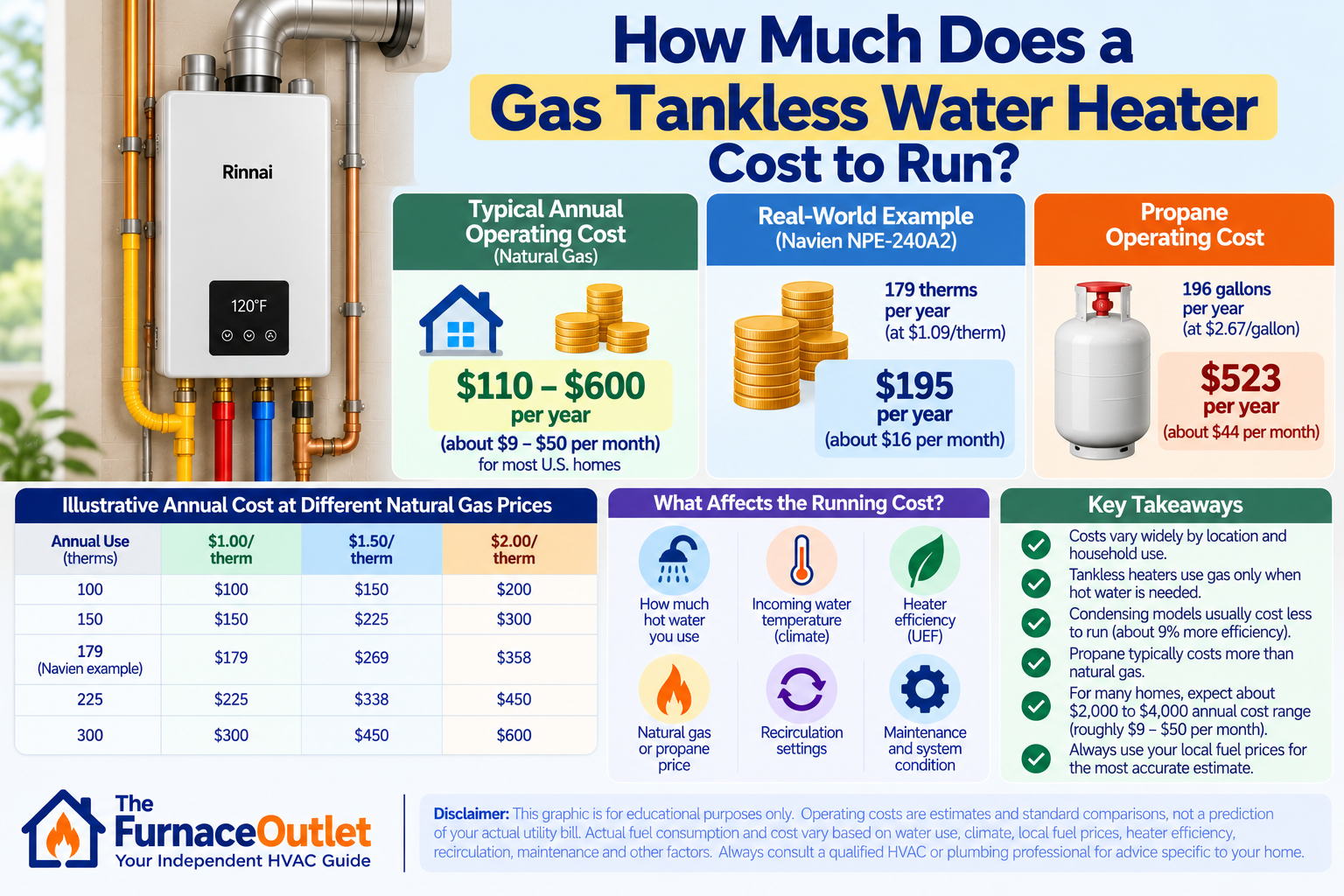
A gas tankless water heater can be relatively inexpensive to operate because it burns fuel only when hot water is being demanded rather than repeatedly reheating a stored tank throughout the day. However, there is no single monthly operating-cost number that applies to every home. Household hot-water use, incoming-water temperature, thermostat setting, natural-gas or propane price, heater efficiency and recirculation settings can all materially change the bill.
For a useful real-world benchmark, Navien currently publishes DOE-test-based annual energy consumption of 179 therms of natural gas per year for its high-efficiency NPE-240A2 condensing tankless heater. Navien’s published EnergyGuide-style example uses $1.09 per therm and calculates an annual natural-gas operating cost of $195, equivalent to about $16 per month. The same model operating on propane is listed at 196 gallons annually and $472 per year using Navien’s assumed $2.41-per-gallon propane price.
Those figures are excellent for comparing technologies, but I would not assume that my own bill will be $16 per month. Current energy prices vary enormously by location and can change over time. The U.S. Energy Information Administration’s residential natural-gas data, for example, show substantial variation across states and seasons during 2026. U.S. Energy Information Administration
The better approach is to understand how much energy the household uses and multiply that consumption by the actual local fuel price.
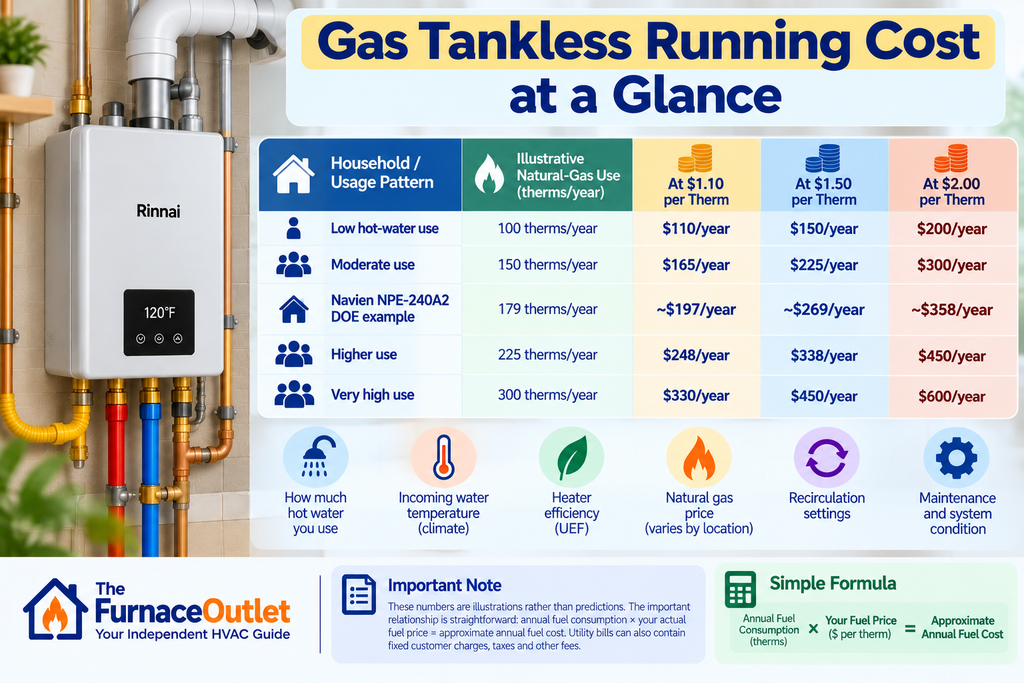
For budgeting, I would think about tankless operating cost in terms of annual fuel consumption rather than a universal monthly figure. A useful illustrative range for natural gas looks like this:
| Household / Usage Pattern | Illustrative Natural-Gas Use | At $1.10/Therm | At $1.50/Therm | At $2.00/Therm |
|---|---|---|---|---|
| Low hot-water use | 100 therms/year | $110/year | $150/year | $200/year |
| Moderate use | 150 therms/year | $165/year | $225/year | $300/year |
| Navien NPE-240A2 DOE example | 179 therms/year | ~$197/year | ~$269/year | ~$358/year |
| Higher use | 225 therms/year | $248/year | $338/year | $450/year |
| Very high use | 300 therms/year | $330/year | $450/year | $600/year |
These numbers are illustrations rather than predictions. The important relationship is straightforward: annual fuel consumption × your actual fuel price = approximate annual fuel cost. Utility bills can also contain fixed customer charges, taxes and other fees that should not necessarily be attributed entirely to the water heater.
Navien’s NPE-240A2 provides a particularly useful reference because the manufacturer publishes both annual energy consumption and estimated operating cost. The heater has a 0.95 UEF and a maximum input of 199,900 BTU/h, yet its DOE-based residential annual consumption is listed at 179 therms of natural gas.
Using Navien’s stated $1.09-per-therm assumption produces an estimated annual cost of $195, or roughly $16.25 per month. The fact that the heater can fire at almost 200,000 BTU/h does not mean it continuously consumes 200,000 BTU every hour. A modern tankless heater modulates its burner according to hot-water demand and shuts down when hot water is no longer required. This distinction is essential when estimating operating cost. Maximum BTU input describes the heater’s peak capability, not its continuous energy consumption.
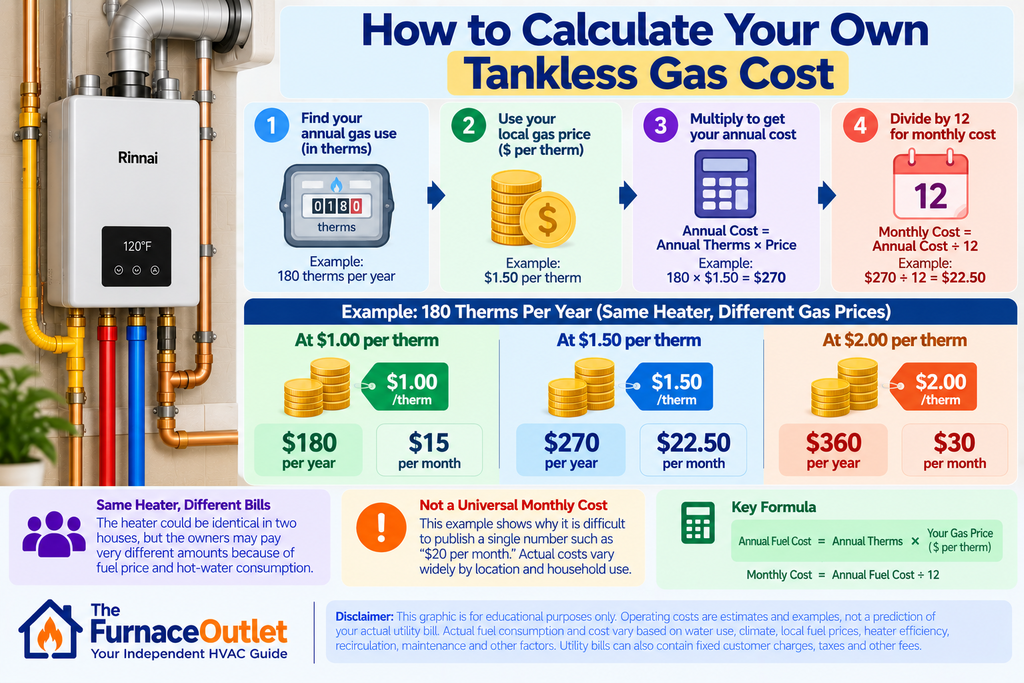
If you know approximately how many therms the water heater uses annually, the calculation is simple. Suppose a household consumes 180 therms per year and pays $1.50 per therm. The annual fuel cost would be approximately 180 × $1.50 = $270, or about $22.50 per month averaged across the year. At $2.00 per therm, the same 180 therms would cost $360 annually, or $30 per month. At $1.00 per therm, the cost would fall to $180 annually, or $15 per month.
This demonstrates why I would hesitate to publish a statement such as “a tankless heater costs $20 per month to operate.” The heater could be identical in two houses while the owners pay substantially different amounts because of fuel price and hot-water consumption.
A family taking several long showers each day will naturally use more gas than a two-person household taking short showers. Baths, dishwashing, laundry, large soaking tubs and simultaneous fixture use all contribute to hot-water consumption. Tankless technology does not make hot water free. Its advantage is that the heater avoids maintaining a large tank of hot water when nobody needs it.
ENERGY STAR explains that whole-home gas tankless heaters save energy by heating water on demand and eliminating storage-tank standby losses. ENERGY STAR estimates that a certified gas tankless water heater can save a family of four about $95 per year compared with a standard gas storage water heater, based on its standardized assumptions. ENERGY STAR
Actual savings can be higher or lower depending on the household.
Where you live can have a surprisingly large effect on tankless operating cost because the heater must raise incoming water to the desired outlet temperature. Imagine that you want 120°F water. If incoming water is 70°F, the heater needs a 50°F temperature rise. If winter groundwater arrives at 40°F, it requires an 80°F rise. Producing that additional temperature rise requires more energy for the same quantity of water.
This is one reason a family in a cold northern climate can use more gas for domestic hot water than a similar family in a warm southern climate, even if their shower habits are almost identical. Temperature rise also affects the maximum flow the heater can provide. Navien’s NPE-240A2, for example, is rated at approximately 11.2 GPM at a 35°F rise but around 4.9 GPM at an 80°F rise.
I would therefore consider climate and winter inlet-water temperature when evaluating both capacity and operating cost.
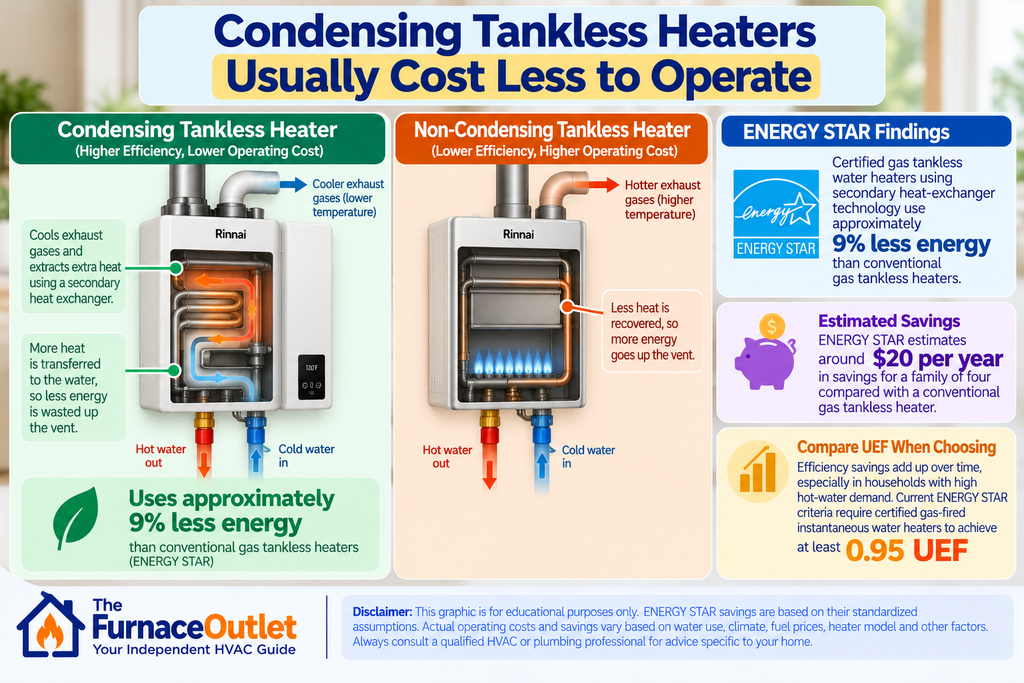
A condensing tankless heater extracts additional energy from the combustion exhaust through a secondary heat exchanger. Instead of allowing as much heat to leave through the vent, it transfers more of that energy into the water. ENERGY STAR states that its certified gas tankless water heaters using secondary heat-exchanger technology use approximately 9% less energy than conventional gas tankless water heaters. ENERGY STAR also estimates savings of around $20 annually for a family of four compared with a conventional gas tankless heater under its assumptions.
That may not sound dramatic in a single year, but water heaters are long-lived appliances. Efficiency savings accumulate over time, particularly in households with high hot-water demand. I would therefore compare UEF when choosing between appropriately sized models. Current ENERGY STAR criteria require certified gas-fired instantaneous water heaters to achieve at least 0.95 UEF.
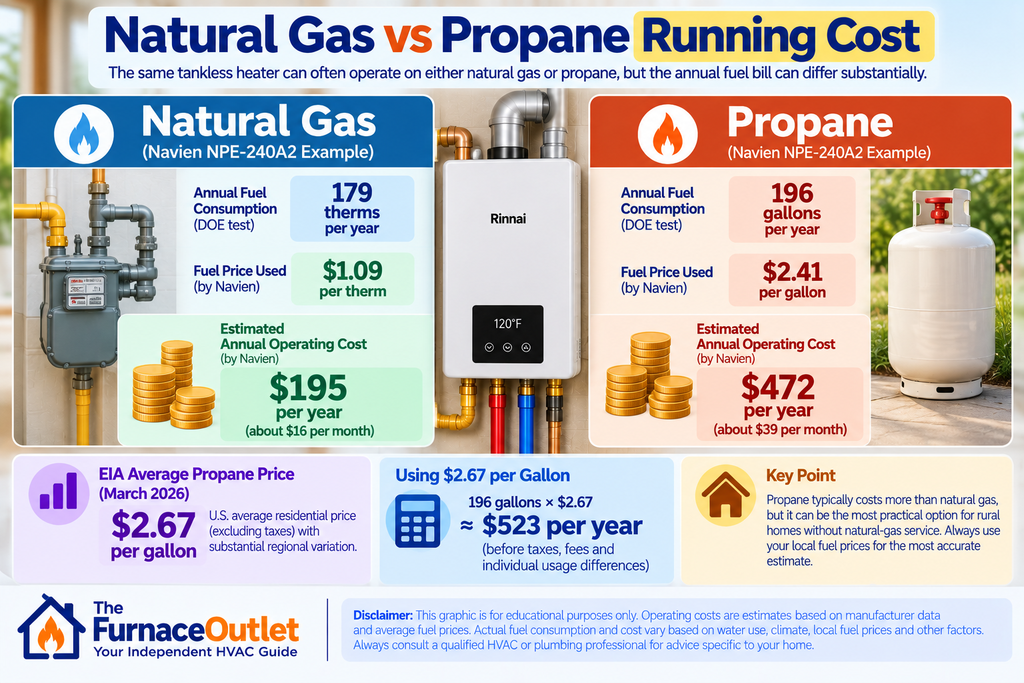
The same tankless heater can sometimes operate on either natural gas or propane, but the annual fuel bill can differ substantially. Navien’s NPE-240A2 again provides a useful apples-to-apples comparison. The manufacturer lists annual DOE-test consumption of 179 therms for natural gas and 196 gallons for propane. Using Navien’s stated fuel-price assumptions, that becomes $195 per year for natural gas versus $472 for propane.
Current market prices should always be substituted for those manufacturer assumptions. EIA reported the U.S. average residential propane price at approximately $2.67 per gallon at the end of March 2026, excluding taxes, with substantial regional variation. U.S. Energy Information Administration
At $2.67 per gallon, 196 gallons would cost approximately $523 per year, before considering applicable taxes, fees or differences in actual consumption. That does not mean propane is a poor choice. For a rural home without natural-gas service, propane may be the most practical way to obtain high-capacity gas tankless water heating. It simply makes local fuel price particularly important.
The 199,000-BTU figure often worries homeowners because it sounds enormous compared with a conventional storage water heater. However, it represents approximately the heater’s maximum hourly burner input at full fire, not normal continuous consumption. If a 199,000-BTU/h heater somehow operated at full input continuously for one hour, it would consume roughly 1.99 therms because one therm equals 100,000 BTU. But normal domestic operation is intermittent and modulating.
A shower may require only part of the heater’s maximum output, while multiple simultaneous fixtures can cause the burner to increase its firing rate. When all hot-water fixtures close, the burner stops. I would therefore never estimate the annual bill by multiplying 199,000 BTU by 24 hours and 365 days. That would bear little resemblance to normal residential use.
Hot-water recirculation can improve comfort by reducing the time spent waiting for hot water at distant fixtures. However, continuously circulating hot water through household piping can increase heat loss and therefore increase energy consumption.
Modern tankless systems can reduce this penalty through timers, demand controls, learning functions and intelligently scheduled recirculation. The best strategy is usually to circulate hot water when it is likely to be needed rather than keeping the loop continuously hot around the clock. If operating cost is important to me, I would therefore examine the recirculation strategy, not merely whether the heater has a recirculation pump. Pipe insulation also matters because reducing distribution heat loss means less energy is needed to maintain useful hot-water temperatures.
Higher outlet temperatures generally require more energy because the heater has to create a greater temperature rise. If incoming water is 50°F, heating it to 120°F requires a 70°F rise, while heating it to 130°F requires an 80°F rise. I would not raise the water temperature unnecessarily simply because the tankless heater is capable of doing so. Temperature should be selected with household needs, manufacturer guidance and scald safety in mind.
The relationship is particularly important in winter, when incoming water is already colder.
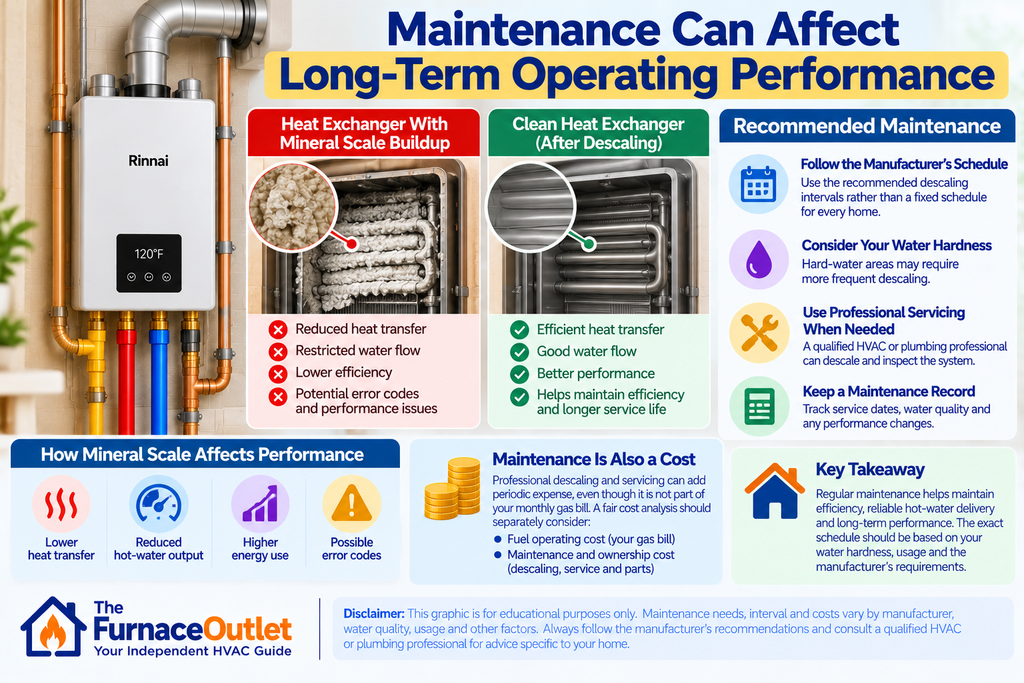
Mineral scale can accumulate inside the heat exchanger, particularly in hard-water areas. Over time, excessive scale can interfere with heat transfer, water flow and appliance performance. I would follow the manufacturer’s maintenance recommendations rather than assuming every tankless heater needs exactly the same descaling schedule. Water hardness, usage and manufacturer requirements should determine the maintenance strategy.
Maintenance itself is also part of the true ownership cost. Professional servicing or descaling can add periodic expense even though it is not part of the monthly gas bill. A fair tankless cost analysis should distinguish fuel operating cost from maintenance and ownership cost.
This is where tankless technology has an inherent advantage. A conventional storage heater maintains a reservoir of hot water, meaning heat continuously escapes through the tank and surrounding piping and has to be replaced. Tankless equipment largely avoids that storage loss because it heats water when demand occurs.
ENERGY STAR estimates that a certified gas tankless heater can save a family of four approximately $95 annually compared with a standard gas storage water heater. Navien’s published NPE-240A2 comparison provides another illustration. Under the manufacturer’s assumptions, its condensing tankless model uses 179 therms annually, compared with 228 therms for another tankless example and 293 therms for a 50-gallon tank model.
I would treat those figures as comparative examples rather than promises of household savings, but they demonstrate why standby losses matter.
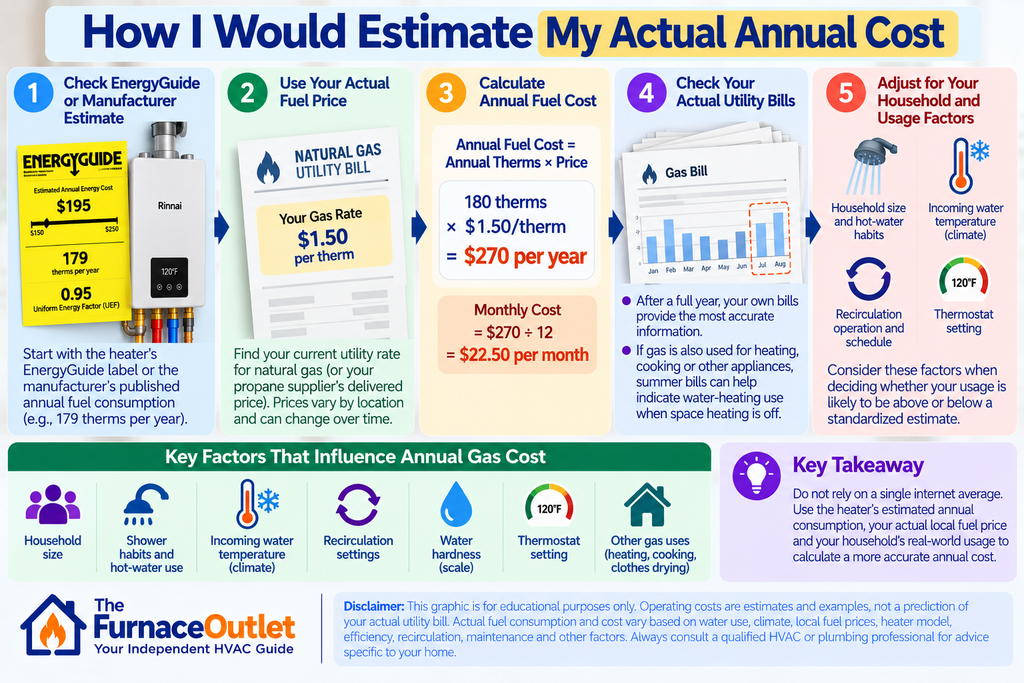
Rather than relying on an internet average, I would start with the heater’s EnergyGuide information or manufacturer-published annual consumption estimate. I would then obtain my utility’s actual natural-gas rate or propane supplier’s delivered price and calculate annual fuel cost from those numbers.
After the heater has operated for a full year, the best information comes from the home’s own energy bills. If gas is also used for heating, cooking or other appliances, isolating water-heating consumption is more difficult, but summer gas consumption can sometimes provide a useful indication when space heating is not operating. I would also consider household size, shower habits, winter groundwater temperature, recirculation operation and thermostat setting when deciding whether my usage is likely to be above or below a standardized estimate.
There is no universal monthly figure, but Navien’s DOE-based NPE-240A2 example works out to approximately $16.25 per month using its $195 annual natural-gas estimate and stated $1.09-per-therm assumption. Your actual bill could be substantially different because fuel rates and household usage vary.
Navien estimates 196 gallons per year for the propane version of its NPE-240A2. At the EIA’s late-March 2026 U.S. average residential propane price of roughly $2.67 per gallon, that amount of propane would cost approximately $523 annually, although regional propane prices vary considerably.
Generally, an efficient tankless heater should use less energy because it avoids storage-tank standby losses. ENERGY STAR estimates savings of approximately $95 annually for a family of four when comparing a certified gas tankless heater with a standard gas storage heater under its assumptions.
Not necessarily. A larger heater has a higher maximum firing capacity, but modern units modulate according to demand. Household hot-water consumption and required temperature rise have a major influence on actual annual fuel use.
It can. ENERGY STAR says certified condensing gas tankless heaters using secondary heat-exchanger technology use approximately 9% less energy than conventional gas tankless heaters. Whether the dollar savings justify the purchase price depends on fuel prices, usage and how long you own the heater.
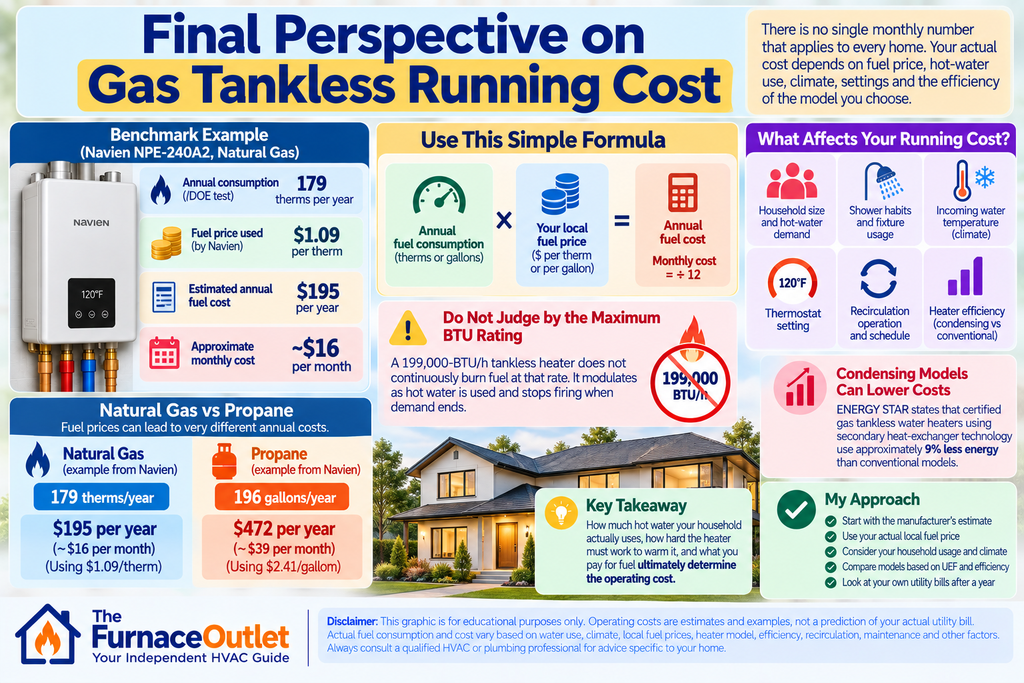
If someone asked me, “How much will a gas tankless water heater add to my gas bill?”, I would resist giving one universal number. As a useful benchmark, a premium condensing model such as the Navien NPE-240A2 carries a manufacturer-published DOE-test estimate of 179 therms per year and $195 annual natural-gas cost using a $1.09-per-therm assumption. That works out to roughly $16 per month, but it should be treated as a standardized comparison rather than a promise about a particular home.
The calculation I trust most is annual fuel consumption multiplied by the homeowner’s actual local fuel price. I would then adjust my expectations for household hot-water demand, winter inlet-water temperature, thermostat setting, recirculation and heater efficiency. Natural gas will frequently produce a lower fuel bill than delivered propane where utility gas is already available, while a high-efficiency condensing model can reduce consumption compared with conventional tankless technology.
Most importantly, I would not judge running cost from the heater’s maximum BTU rating. A 199,000-BTU/h tankless heater does not continuously burn fuel at that rate. It modulates as hot water is used and stops firing when demand ends. How much hot water the household actually consumes, how hard the heater must work to warm it and what the homeowner pays for fuel ultimately determine the operating cost.
For standardized tankless efficiency and savings information, see ENERGY STAR — How Whole-Home Gas Tankless Water Heaters Work and ENERGY STAR — Gas Tankless Benefits & Savings. Manufacturer-specific DOE-test consumption and operating-cost figures are available from Navien — NPE-240A2 Specifications. For current fuel-price context, see U.S. EIA — Residential Natural Gas Prices and U.S. EIA — Residential Propane Prices.
The Furnace Outlet provides this information for general educational and budgeting purposes. Operating-cost examples are estimates and standardized comparisons rather than predictions of an individual household’s utility bill. Actual fuel consumption and cost vary according to water use, climate, incoming-water temperature, heater efficiency, fuel prices, recirculation, maintenance and other conditions. Manufacturer specifications, EnergyGuide information and current local utility rates should be verified when estimating costs for a particular home.
The Furnace Outlet is an independent informational resource and is not associated with, endorsed by or affiliated with ENERGY STAR, Navien, the U.S. Energy Information Administration or any manufacturer or organization mentioned. Product names and trademarks remain the property of their respective owners.